
Service notebook of Harold Gordon Cornell - 1917 - Part 21
5..... The use of "GO continue firing in your own time" is not clearly
understood. This signal means "go on on your own" I will come back
and help you a little later. "C i G.O. am returning to my landing
ground go on firing" is thus a contradiction in terms and ma y may
be very annoying to the battery commander who is the best judge as to
whether he will continue "blind" or not. "G.O." should only be used
after fire for effect has been opened: it is obviously used during
ranging.
6...... Many pilots do not realise the difference between "G. F. fire f
for effect (fleeting opportunity)" and "L.L. all available batteries to
open fire" I the former case (if a zone call) the decision lies with
the group commander as to how many batteries shall be employed the
target may only be worth one battery small but evenescent in the latter
case all batteries must open fire without further orders.
L.L. is in fact a S.O.S. call.
(Note G.E. Gun fire ... L.L. all.)
7........... Many pilots do not realise the difference quite gather
their right action if a hostile battery is seen active while they are
engaged in a destructive shoot on another target. A modern shoot keeps
the pilot so fully engaged that he cannot do zone calls while actually
engaged in a shoot. His right course of action is as follows:-
Suppose his own battery to be still in process of ranging and
the new hostile battery to be particularly obnoxious he should send
"M.Q. wait" to his own battery and send a zone call for the new target.
If on the other hand his own battery has proceeded to fire for effect
he can send them "G.O. go on your own I will keep an wye on you"
and proceed to deal with the new target either by calling up another
battery or with the zone call.
8..... Regularity of timing is of great importance - if a battery
never knows whether the next "G" is coming after 2 minutes interval
or 5 they live on tenterhooks. The gunner has to remain lanyard
in hand for minutes at a time and in the end the battery is blamed if it
does not fire within 10 seconds of the "G".
Further some rounds are cooked in barrell and some are not
leading to irregular shooting. A constant interval between "G's." is of
great importance This means forethought on the part of a pilot on days
of strong wind. A slowish but regular shoot is therefore often better
than a quick jerky one speed can gradually be increased with
increasing experience.
ARTILLERY COOPERATION NOTES No.3.
HINTS TO SQUADRON COMMANDERS ESPECIALLY TO THOSE ABOUT TO GO OVERSEAS
1. On a fighting front avoid wireless work with divisional artillery
you always have more than you can do with heavy artillery. If
divisional artillery must have aeroplane observation they must fire to a
a settled programme and the result of the various shoots must be marked
on maps and dropped at divisional headquarters. If this is done in the
morning and repeated in the afternoon a good general registration can be
effected for every battery in the division in one day by no other method
is this possible.
2. . Avoid shooting with heavy guns 6" 9.2" and 12". These are slow shooting
long range weapons with large 50% zones They require special methods
owing to their longe range and waste a lot of time The baloons mey
be able to take them on . . . .
3... At the very outset stop all irregular methods such as "fire one min
after G" all these infringe some of the 4 cardinal rules stated above a
and lead to regrettable incidents. Experienced pilots may be allowed
some latitude in this respect but you will find these are the very people
who are satisfied with the rules laid down. It is the new pilots
who try new "stunts" and fail.
4..... Always have the wireless diaries of each shoot sent up to you daily
as soon as possible after the days shooting is over.
(The counter battery commander will be interested in them en-route)
If you go through them yourself however pressed in work you may be
you will find out all sorts of curious things, will be able to stop
irregular methods creeping in, and will be able to keep an eye on the
regular timing of shoots. Make your operators comment upon the sending
of your pilots. Your effeciency will increase by leaps and bounds if
you do this.
5 ......"Failures" There is no time for these - if prevention fails the
next best thing is a rapid cure. We still get pilots overseas who
call up a battery for an hour at a time and cannot see ground signals.
During this time they are jambing everybody in the neighbourhood
and wasting valuable moments. Their right course is to go to the
central wireless station and see if their wireless is O.K.
They should then say "No answer from P" (or whatever the batty call is)
(N.A.P. is a convenient abbreviation) and the C.W.S. can then report to
the counter battery commander and get things put right.
If as is most likely "P" has got the ground signals out and the pilot
is looking in the wrong place the C.W.S. can send up the co-ordinates
of "P" on lamp or panel and the pilot can try again.
5. if he still fails to see the ground signals he should try shooting blind
i.e. without seeing the battery fire but watching the target for the burst
This is not recommended in the ordinary way but is better than a failure.
It must only be tried if other guns are not shooting close to target.
If this fails (which is not very likely unless the bursts are poor)
the pilot should come home. The whole round of attempts should not take
more than ¾ hour and the pilot will know he has tried everything to
redeem a failure....Track every failure with relentless energy
it is only by making yourself a nuisance to all concerned that you will
avoid a recurrence of the event. This is about the only return you nq
have to render from which you yourself directly benefit.
6....... An absurd amount of failure s with new pilots occur from failure
to see ground signals map reading and "general "casualness" is largely th
the cause but the laying out of these signals requires your constant
attention... Your wireless officer and other officers when visiting batteries
should always see the ground signals put out. They must be kept
clean. I know of a perfectly good ground signal position being spoilt
by chalk from a new dugout being thrown up near it.. O another occasion
the washing of a bettery was misread as H by 2 successive pilots.
Photos of your batteries with ground signals out if you are allowed to ta
take these are very helpful. On snow dark green ground signals are better
than red.
7....... In constant liaison with the gunners lies your salvation.
Visit them yourself at all times and send your officers regularly
especially after failures. Get new battery commanders to stay with you
for a day or two before you shoot with them and reverse the process
with your new pilots and make your s quadron headq uarters
at all times a home of rest and sanatorium for sick gunners.
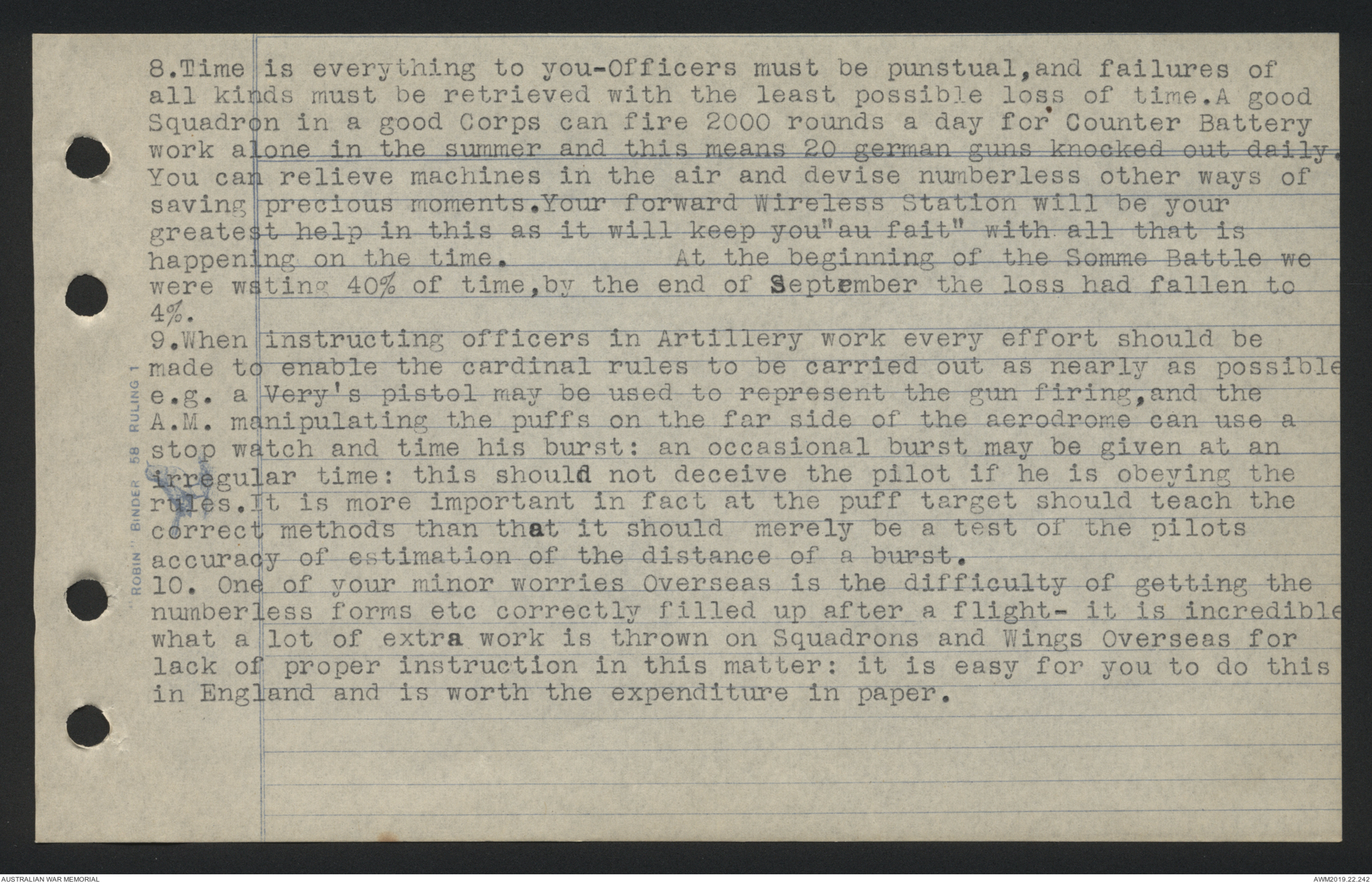
8. Time is everything to you - Officers must be punstual, and failures of
all kinds must be retrieved with the least possible loss of time. A good
Squadron in a good Corps can fire 2000 rounds a day for Counter Battery
work alone in the summer and this means 20 german guns knocked out daily.
You can relieve machines in the air and devise numberless other ways of
saving precious moments.Your forward Wireless Station will be your
greatest help in this as it will keep you "au fait" with all that is
happening on the time. At the beginning of the Somme Battle we
were wsting 40% of time, by the end of September the loss had fallen to
4%.
9.When instructing officers in Artillery work every effort should be
made to enable the cardinal rules to be carried out as nearly as possible
e.g. a Very's pistol may be used to represent the gun firing, and the
A.M. manipulating the puffs on the far side of the aerodrome can use a
stop watch and time his burst: an occasional burst may be given at an
irregular time: this should not deceive the pilot if he is obeying the
rules. It is more important in fact at the puff target should teach the
correct methods than that it should merely be a test of the pilots
accuracy of estimation of the distance of a burst.
10. One of your minor worries Overseas is the difficulty of getting the
numberless forms etc correctly filled up after flight - it is incredible
what a lot of extra work is thrown on Squadrons and Wings Overseas for
lack of proper instruction in this matter: it is easy for you to do this
in England and is worth the expenditure in paper.
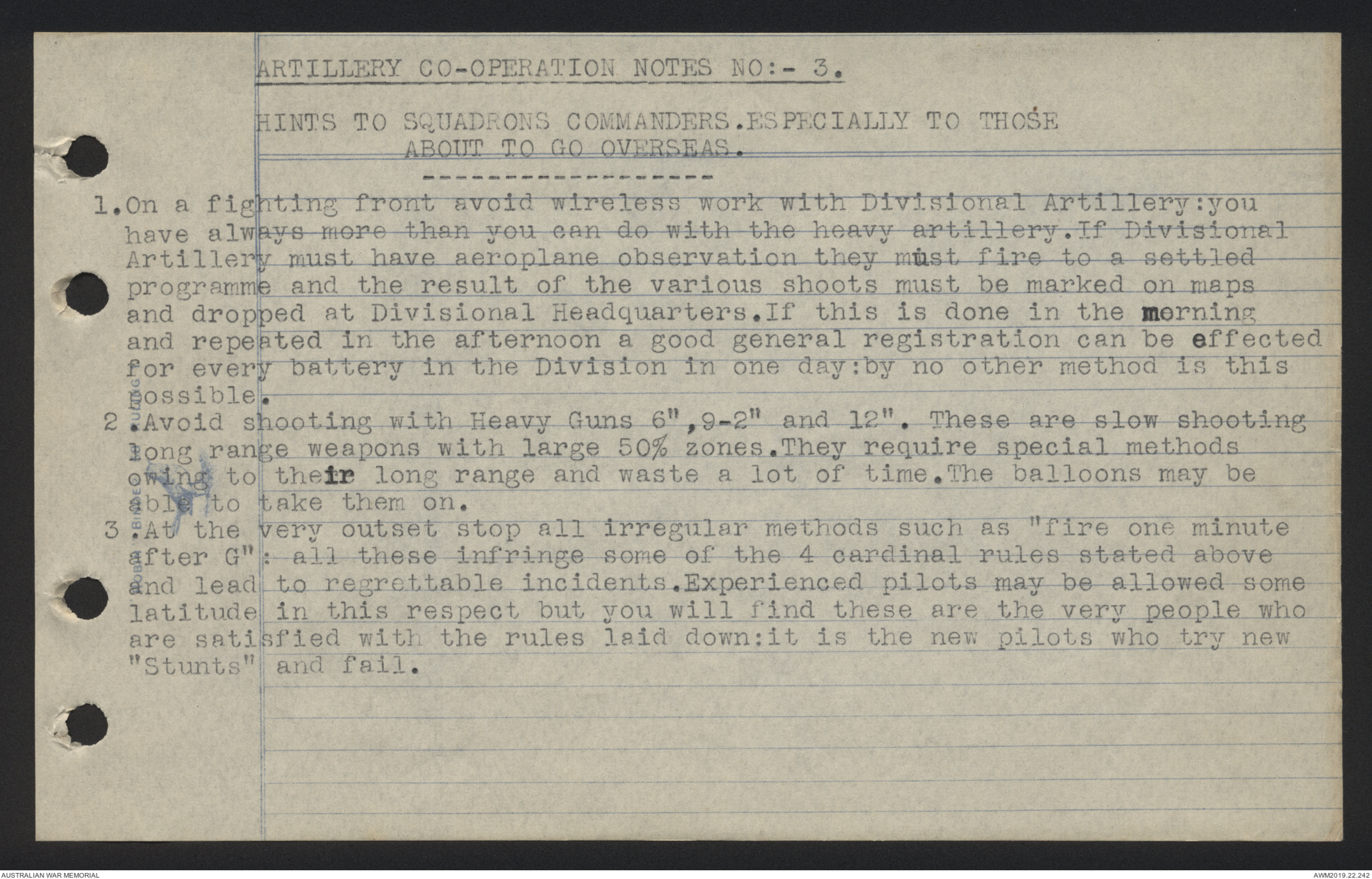
ARTILLERY CO-OPERATION NOTES NO:- 3.
HINTS TO SQUADRONS COMMANDERS. ESPECIALLY TO THOSE
ABOUT TO GO OVERSEAS.
1. On a fighting front avoid wireless work with Divisional Artillery: you
have always more than you can do with the heavy artillery.If Divisional
Artillery must have aeroplane observation they must fire to a settled
programme and the result of the various shoots must be marked on maps
and dropped at Divisional Headquarters. If this is done in the morning
and repeated in the afternoon a good general registration can be effected
for every battery in the Division in one day: by no other method is this
possible.
2. Avoid shooting with heavy guns 6", 9-2" and 12". These are slow shooting
long range weapons with large 50% zones. They require special methods
owing to their long range and waste a lot of time. The balloons may
be able to take them on.
3. At the very outset stop all irregular methods such as "fire one minute
after G": all these infringe some of the 4 cardinal rules stated above
and lead to regrettable incidents. Experienced pilots may be allowed some
latitude in this respect but you will find these are the very people who
are satisfied with the rules laid down: it is the new pilots who try new
"Stunts" and fail.
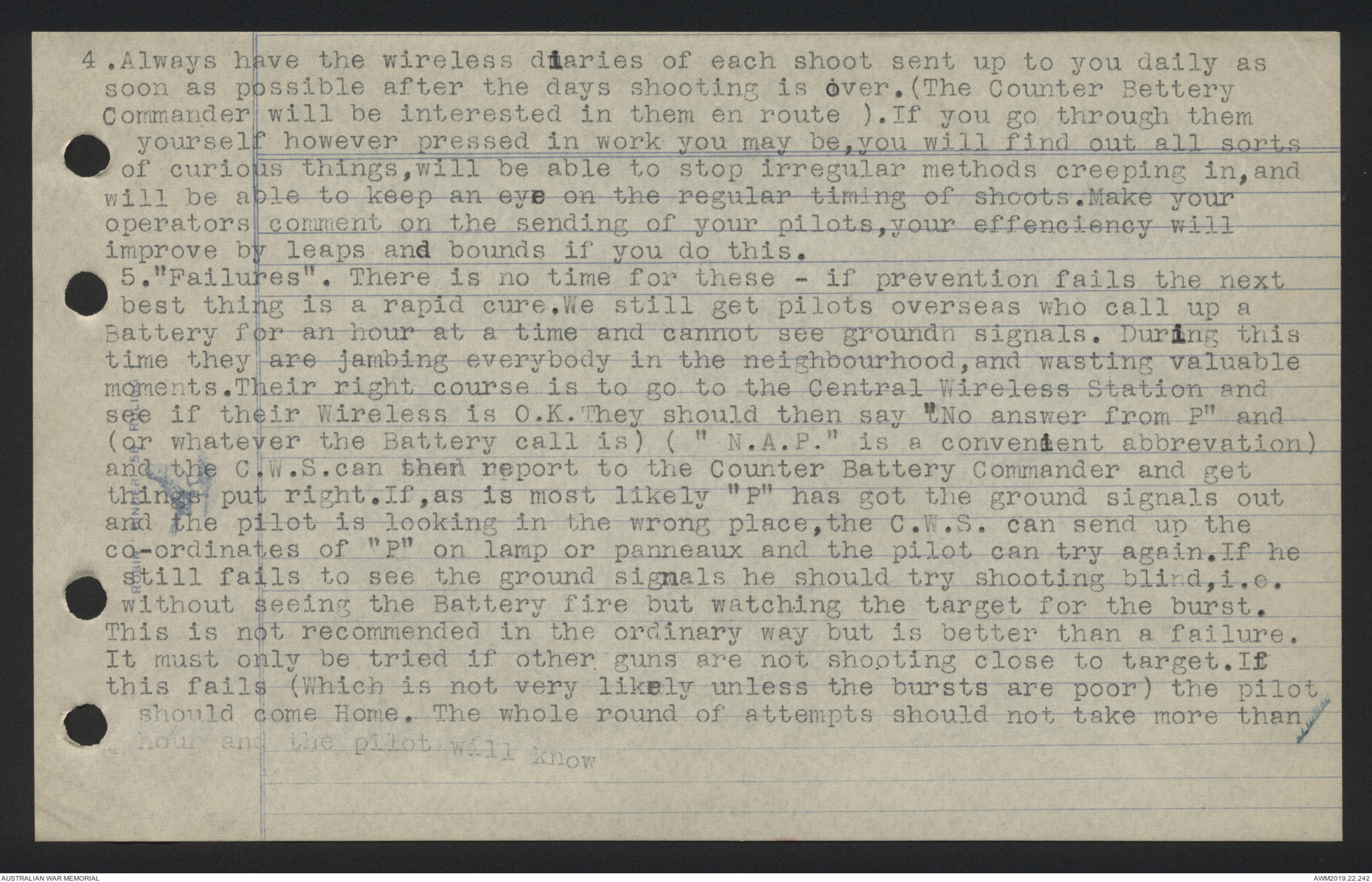
4. Always have the wireless diaries of each shoot sent up to you daily as
soon as possible after the days shooting is over. (The Counter Bettery
Commander will be interested in them en route ). If you go through them
yourself however pressed in work you may be, you will find out all sorts
of curious things, will be able to stop irregular methods creeping in, and
will be able to keep an eye on the regular timing of shoots. Make your
operators comment on the sending of your pilots, your effenciency will
increase by leaps and bounds if you do this.
5. "Failures". There is no time for these - if prevention fails the next
best thing is a rapid cure. We still get pilots overseas who call up a
Battery for an hour at a time and cannot see ground signals. During this
time they are jambing everybody in the neighbourhood, and wasting valuable
moments. Their right course is to go to the Central Wireless Station and
see if their Wireless is O.K.They should then say "No answer from P" and
(or whatever the Battery call is) ("N.A.P." is a convenient abbreviation)
and the C.W.S. can then report to the Counter Battery Commander and get
things put right. If, as is most likely "P" has got the ground signals out
and the pilot is looking in the wrong place, the C.W.S. can send up the
co-ordinates of "P" on lamp or panneaux and the pilot can try again. If he
still fails to see the ground signals he should try shooting blind, i.e.
without seeing the Battery fire but watching the target for the burst.
This is not recommended in the ordinary way but is better than a failure.
It must only be tried if other guns are not shooting close to target. If
this fails (Which is not very likely unless the bursts are poor) the pilot
should come Home. The whole round of attempts should not take more than /
hour and the pilot will know
/ than
¾ hour and the pilot will know he has tried everything to redeem a
failure.
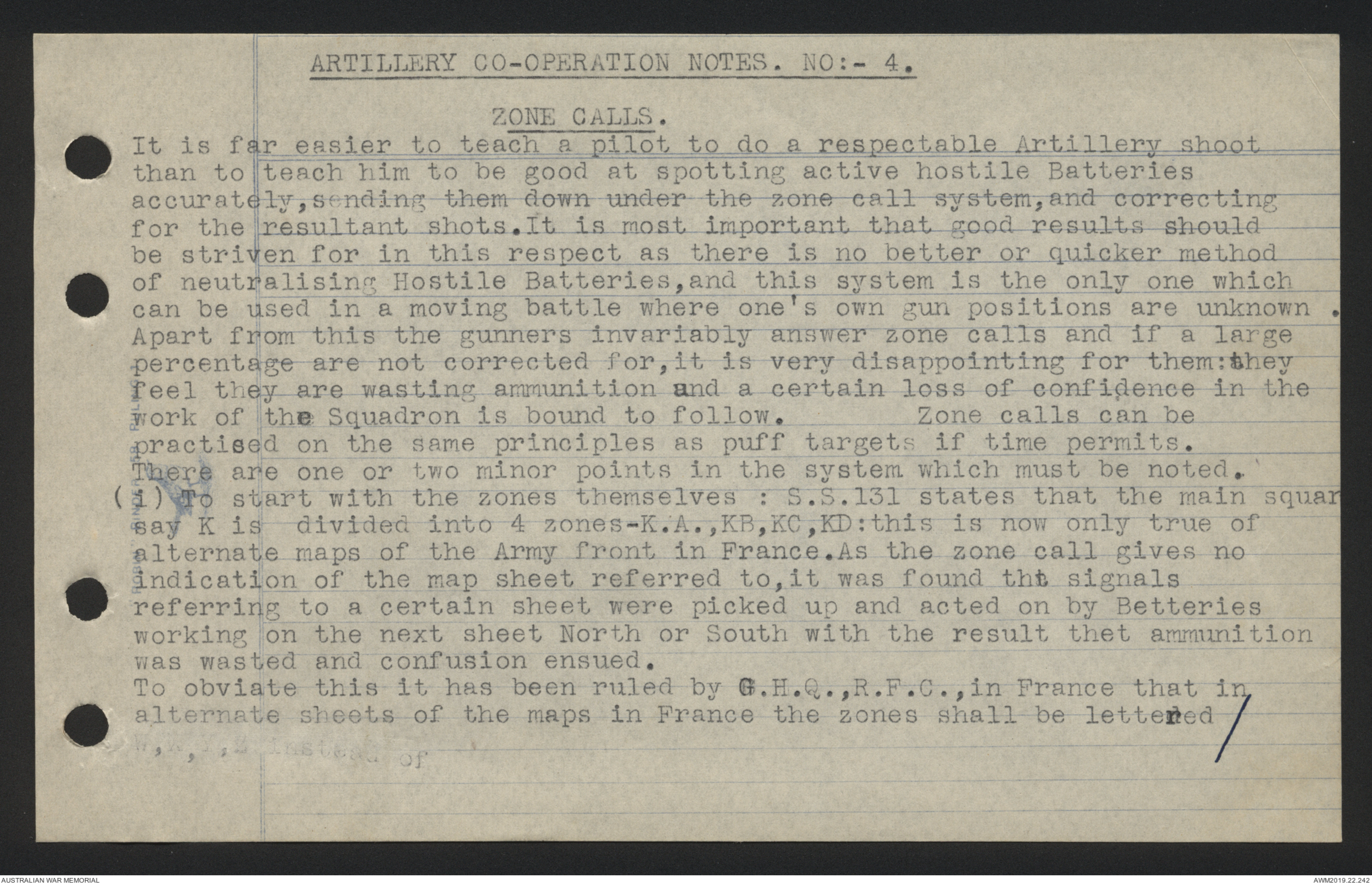
ARTILLERY CO-OPERATION NOTES NO:- 4.
ZONE CALLS.
It is far easier to teach a pilot to do a respectable Artillery shoot
than to teach him to be good at spotting active hostile Batteries
accurately, sending them down under the zone call system, and correcting
for the resultant shots. It is most important that good results should
be striven for in this respect as there is no better or quicker method
of neutralising Hostile Batteries, and this system is the only one which
can be used in a moving battle where one's own gun positions are unknown.
Apart from this the gunners invariably answer zone calls and if a large
percentage are not corrected for, it is very disappointing for them: they
feel they are wasting ammunition and a certain loss of confidence in the
work of the Squadron is bound to follow. Zone calls can be
practised on the same principles as puff targets if time permits.
There are one or two minor points in the system which must be noted.
(i) To start with zones themselves: S.S.131 states that the main square
say K is divided into 4 zones - K.A., KB, KC, KD: this is now only true of
alternate maps of the Army front in France. As the zone call gives no
indication of the map sheet referred to, it was found tht signals
referring to a certain sheet were picked up and acted on by Betteries
working on the next sheet North or South with the result thet ammunition
was wasted and confusion ensued.
To obviate this it has been ruled by G.H.Q., R.F.C., in France that in
alternate sheets of the maps in France the zones shall be lettered/
W,X,Y,Z instead of
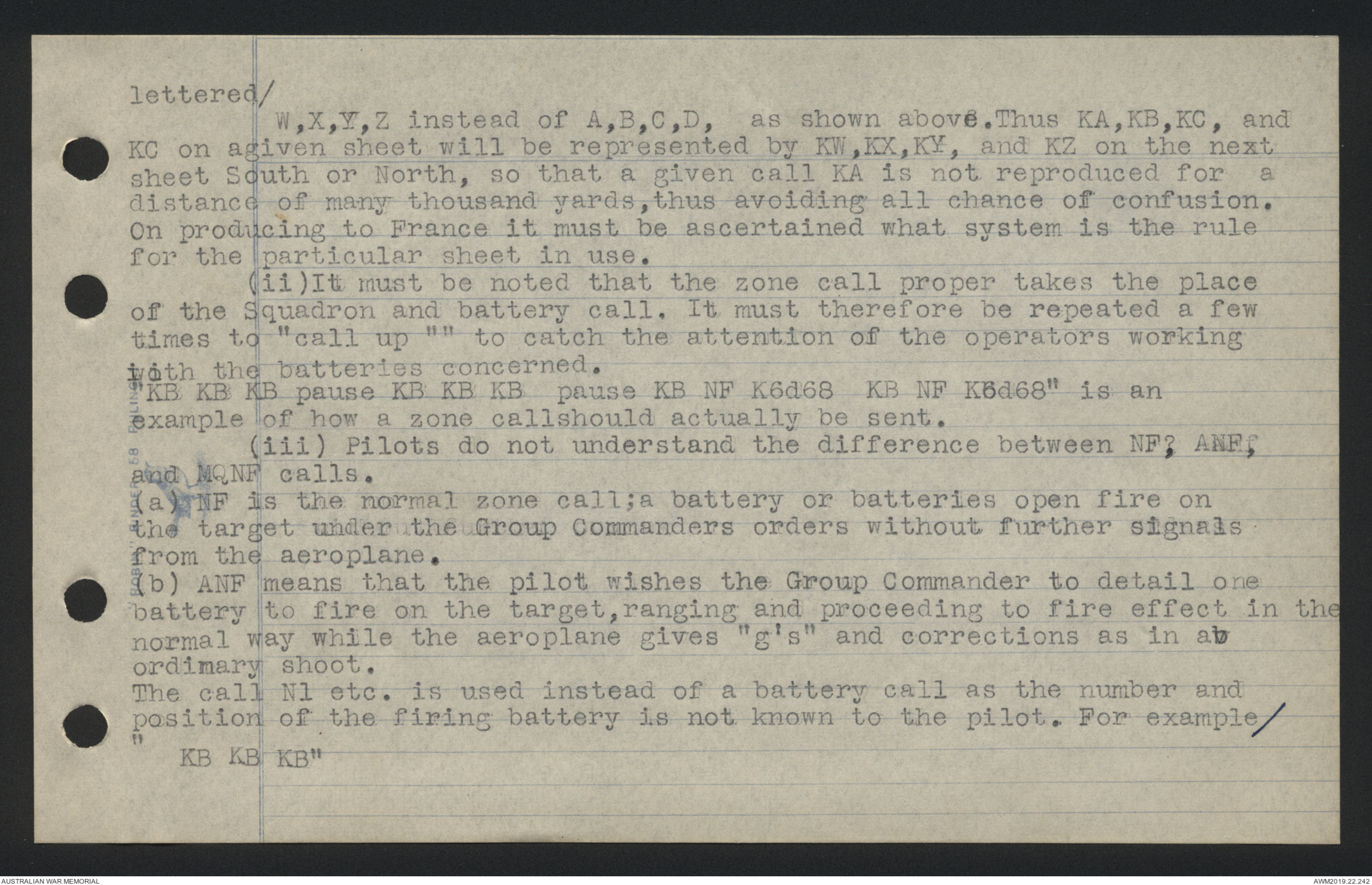
lettered/
W,X,Y,Z instead of A,B,C,D, as shown above. Thus KA,KB,KC, and
KC on agiven sheet will be represented by KW,KX,KY, and KZ on the next
sheet South or North, so that a given call KA is nor reproduced for a
distance of many thousand yards, thus avoiding all chance of confusion.
On producing to France it must be ascertained what system is the rule
for the particular sheet in use.
(ii) It must be noted that zone call proper takes the place
of the Squadron and battery call. It must therefore be repeated a few
times to "call up"" to catch the attention of the operators working
with the batteries concerned.
"KB KB KB pause KB KB KB pause KB NF K6d68 KB NF K6d68" is an
example of how a zone call should actually be sent.
(iii) Pilots do not understand the difference between NF, ANF,
and MQNF calls.
(a) NF is the normal zone call; a battery or batteries open fire on
the target under the Group Commanders orders without further signals
from the aeroplane.
(b) ANF means that the pilot wishes the Group Commander to detail one
battery to fire on the target, ranging and proceeding to fire effect in the
normal way while the aeroplane gives "g's" and corrections as in ab
ordinary shoot.
The call N1 etc, is used instead of a battery call as the number and
position of the firing battery is not known to the pilot. For example/
"KB KB KB"
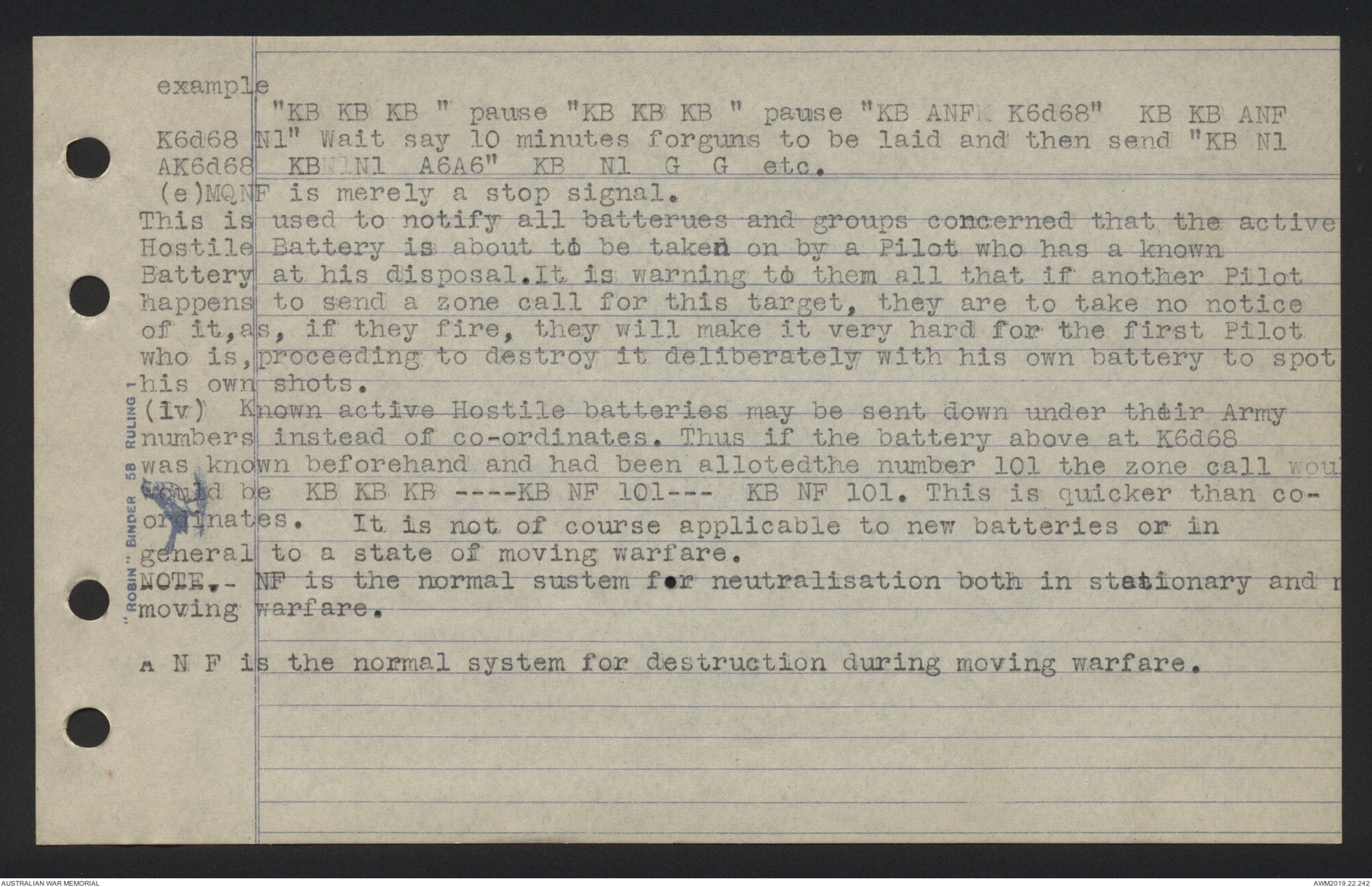
example
"KB KB KB" pause "KB KB KB" pause "KB ANF K6d68" KB KB ANF
K6d68 N1" Wait say 10 minutes forguns to be laid and then send "KB N1
AK6d68 KN N1 A6A6" KB N1 G G etc,
(e) MQNF is merely a stop signal.
This is used to notify all batterues and groups concerned that the active
Hostile Battery is about to be taken on by a Pilot who has a known
Battery at his disposal. It is warning to them all that if another Pilot
happens to send a zone call for this target, they are to take no notice
of it, as, if they fire, they will make it very hard for the first Pilot
who is, proceeding to destroy it deliberately with his own battery to spot
- his own shots.
(iv) Known active Hostile batteries may be sent down under their Army
numbers instead of co-ordinates. Thus if the battery above at K6d68
was known beforehand and had been alloted the number 101 the zone call
would be KB KB KB - - - -KB NF 101- - - KB NF 101. This is quicker than coordinates.
It is not of course applicable to new batteries or in
general to a state of moving warfare.
NOTE.- NF is the normal sustem for neutralisation both in stationary and
moving warfare.
A N F is the normal system for the destruction during moving warfare.
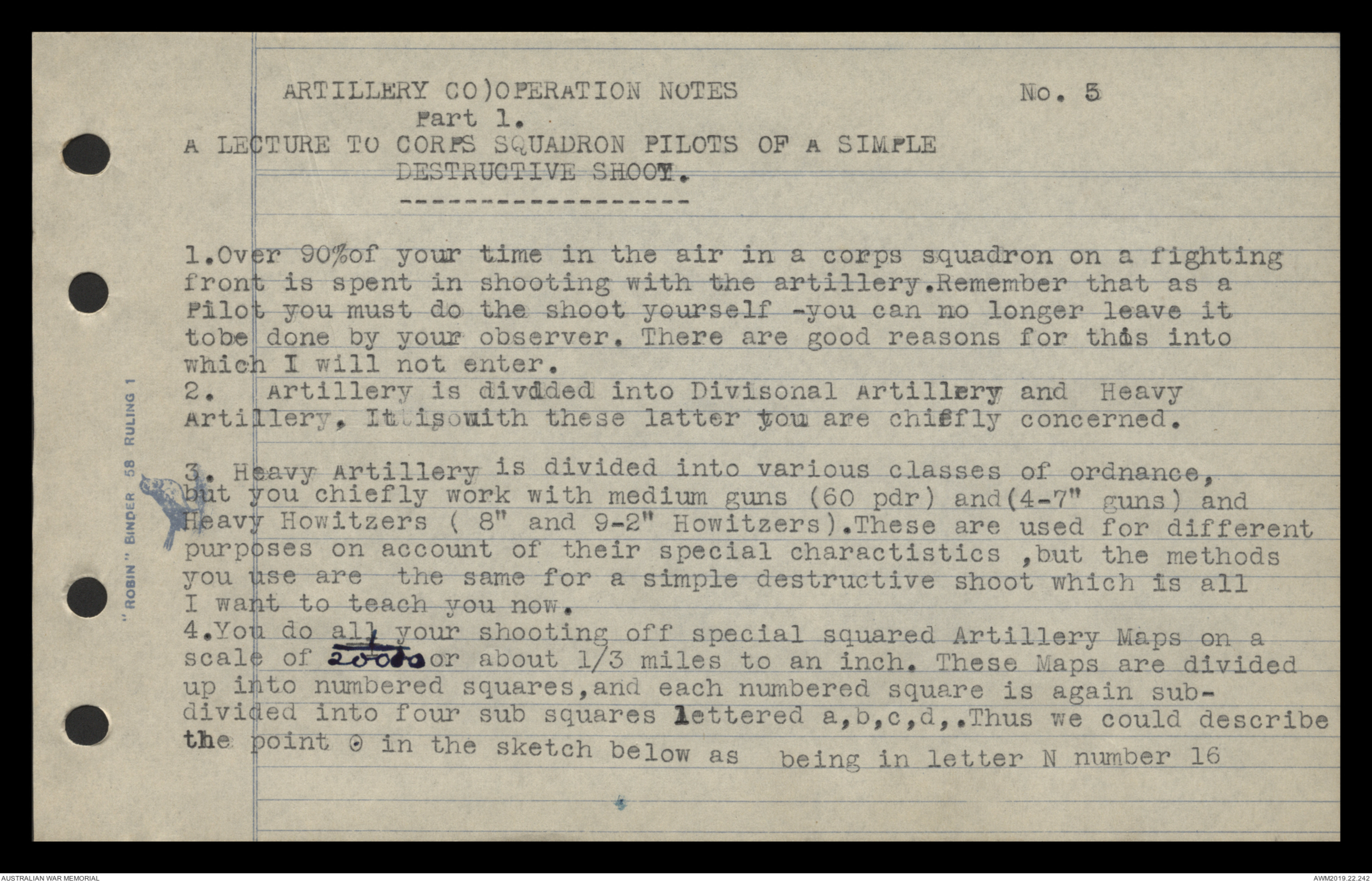
ARTILLERY CO)OPERATION NOTES No. 5
Part 1.
A LECTURE TO CORPS SQUADRON PILOTS OF A SIMPLE
DESTRUCTIVE SHOT.
1. Over 90%of your time in the air in a corps squadron on a fighting
front is spent in shooting with the artillery. Remember that as a
Pilot you must do the shoot yourself - you can no longer leave it
to be done by your observer. There are good reasons for this into
which I will not enter.
2. Artillery is divided into Divisional Artillery and Heavy
Artillery. It is with these latter you are chiefly concerned.
3. Heavy Artillery is divided into various classes of ordnance,
but you chiefly work with medium guns (60 pdr) and (4-7" guns) and
Heavy Howitzers (8" and 9-2" Howitzers). These are used for different
purposes on account of their special characteristics, but the methods
you use are the same for a simple destructive shoot which is all
I want to teach you.
4. You do all your shooting off special squared Artillery Maps on a
scale of1/ 20000 or about 1/3 miles to an inch. These Maps are divided
up into numbered squares, and each numbered square is again sub-divided
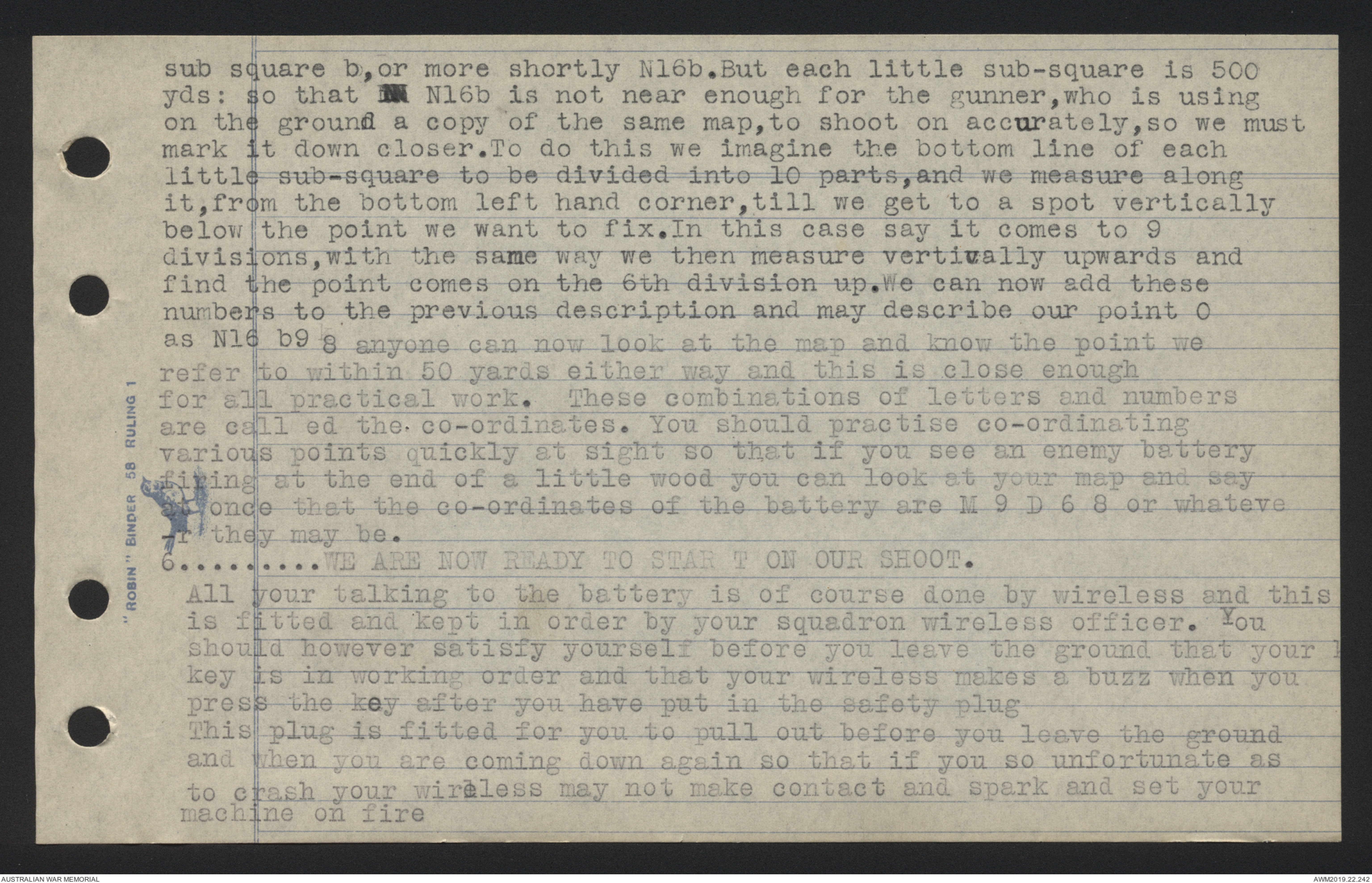
into four sub squares lettered a,b,c,d,. Thus we could describe
the point (.) in the sketch below as being in letter N number 16
sub square b, or more shortly N16b, But each little sub-square is 500
yds: so that NN N16b is not near enough for the gunner, who is using
on the ground copy of the same map, to shoot on accurately, so we must
mark it down closer. To do this we imagine the bottom line of each
little sub-square to be divided into 10 parts, and we measure along
it, from the bottom left hand corner, till we get to a spot vertically
below the point we want to fix. In this case say it comes to 9
divisions, with the same way we then measure vertically upwards and
find the point comes on the 6th division up.We can now add these
numbers to the previous description and may describe our point O
as N16 b98 anyone can now look at the map and know the point we
refer to within 50 yards either way and this is close enough
for all practical work. These combinations of letters and numbers
are call ed the co-ordinates. You should practise co-ordinating
various points quickly at sight so that if you see an enemy battery
firing at the end of a little wood you can look at your map and say
at once that the co-ordinates of the battery are M 9 D 6 8 or whatever
they may be.
6 ......... WE ARE NOW READY TO STAR T ON OUR SHOOT.
All your talking to the battery is of course done by wireless and this
is fitted and kept in order by your squadron wireless officer. You
should however satisfy yourself before you leave the ground that your
key is in working order and that your wireless makes a buzz when you
press the key after you have put in the safety plug
This plug is fitted for you to pull out before you leave the ground
and when you are coming down again so that if you so unfortunate as
to crash your wireless may not make contact and spark and set your
machine on fire
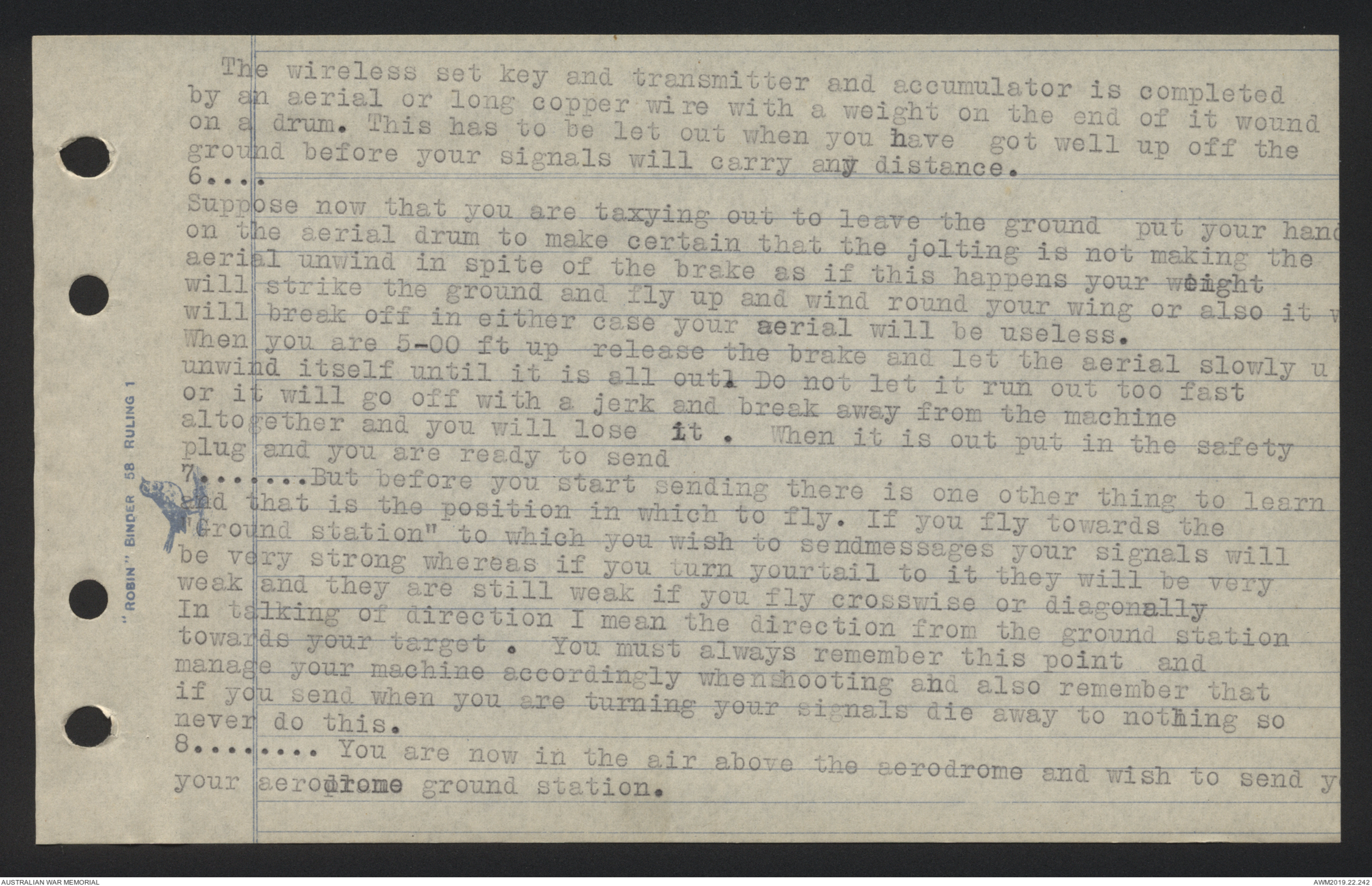
The wireless set key and transmitter and accumulator is completed
by an aerial or long copper wire with a weight on the end of it wound
on a drum. This has to be let out when you have got well up off the
ground before your signals will carry any distance.
6 ....
Suppose now that you are taxying out to leave the ground put your hand
on the aerial drum to make certain that the jolting is not making the
aerial unwind in spite of the brake as if this happens your weight
will strike the ground and fly up and wind round your wing or also it
will break off in either case your aerial will be useless.
When you are 5-00 ft up release the brake and let the aerial slowly u
unwind itself until it is all out. Do not let it run out too fast
or it will go off with a jerk and break away from the machine
altogether and you will lose it. When it is out put in the safety
plug and you are ready to send
7 ....... But before you start sending there is one other thing to learn
and that is the position in which to fly. If you fly towards the
"Ground station" to which you wish to send messages your signals will
be very strong whereas if you turn your tail to it they will be very
weak and they are still weak if you fly crosswise or diagonally
In talking of direction I mean the direction from the ground station
towards your target. You must always remember this point and
manage your machine accordingly when shooting and also remember that
if you send when you are turning your signals die away to nothing so
never do this.
8 ........ You are now in th air above the aerodrome and wish to send y
your aerodrome ground station.
 Jen
Jen This transcription item is now locked to you for editing. To release the lock either Save your changes or Cancel.
This lock will be automatically released after 60 minutes of inactivity.