
Service notebook of Harold Gordon Cornell - 1917 - Part 20
(2)
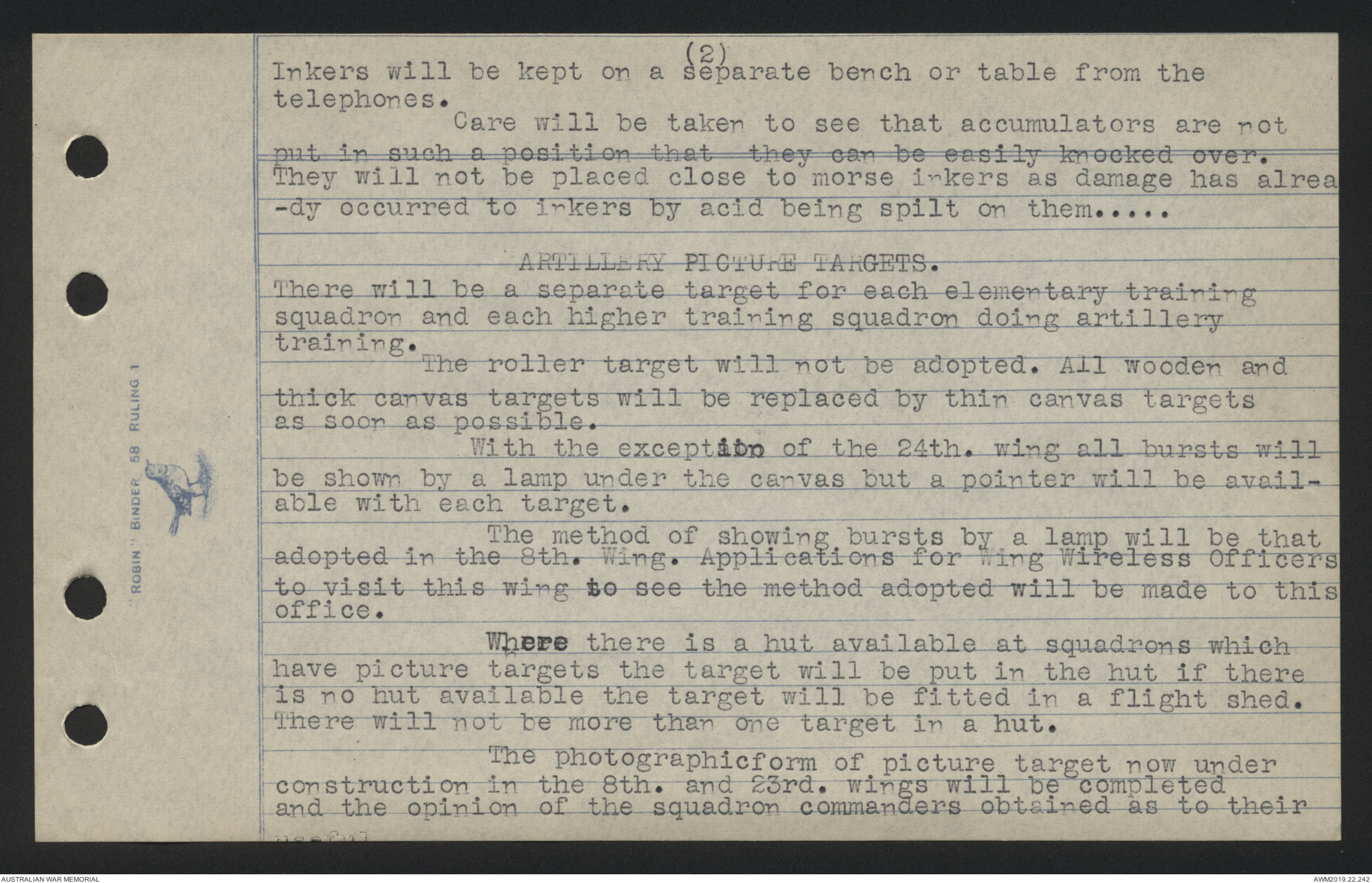
Inkers will be kept on a separate bench for table from the
telephones.
Care will be taken to see the accumulators are not
put in such a position that they can be easily knocked over.
They will not be placed close to morse inkers as damage has already
occurred to inkers by acid be spilt on them. . . . .
ARTILLERY PICTURE TARGETS.
There will be a separate target for each elementary training
squadron and each higher training squadron doing artillery
training.
The roller target will not be adopted. All wooden and
thick canvas targets will be replaced by thin canvas targets
as soon as possible.
With the exception of the 24th. wing all bursts will
be shown by a lamp under the canvas but a pointer will be available
with each target.
The method of showing bursts by a lamp will be that
adopted in the 8th. Wing. Applications for Wing Wireless Officers
to visit this wing to see the method adopted will be made to this
office.
Where there is a hut available at squadrons which
have picture targets the target will be put in the hut if there
is no hut available the target will be fitted in a flight shed.
There will not be more than one target in a hut.
The photogarphic form of picture target now under
construction in the 8th. and 23rd. wings will be completed
and the option of the squadron commanders as to their
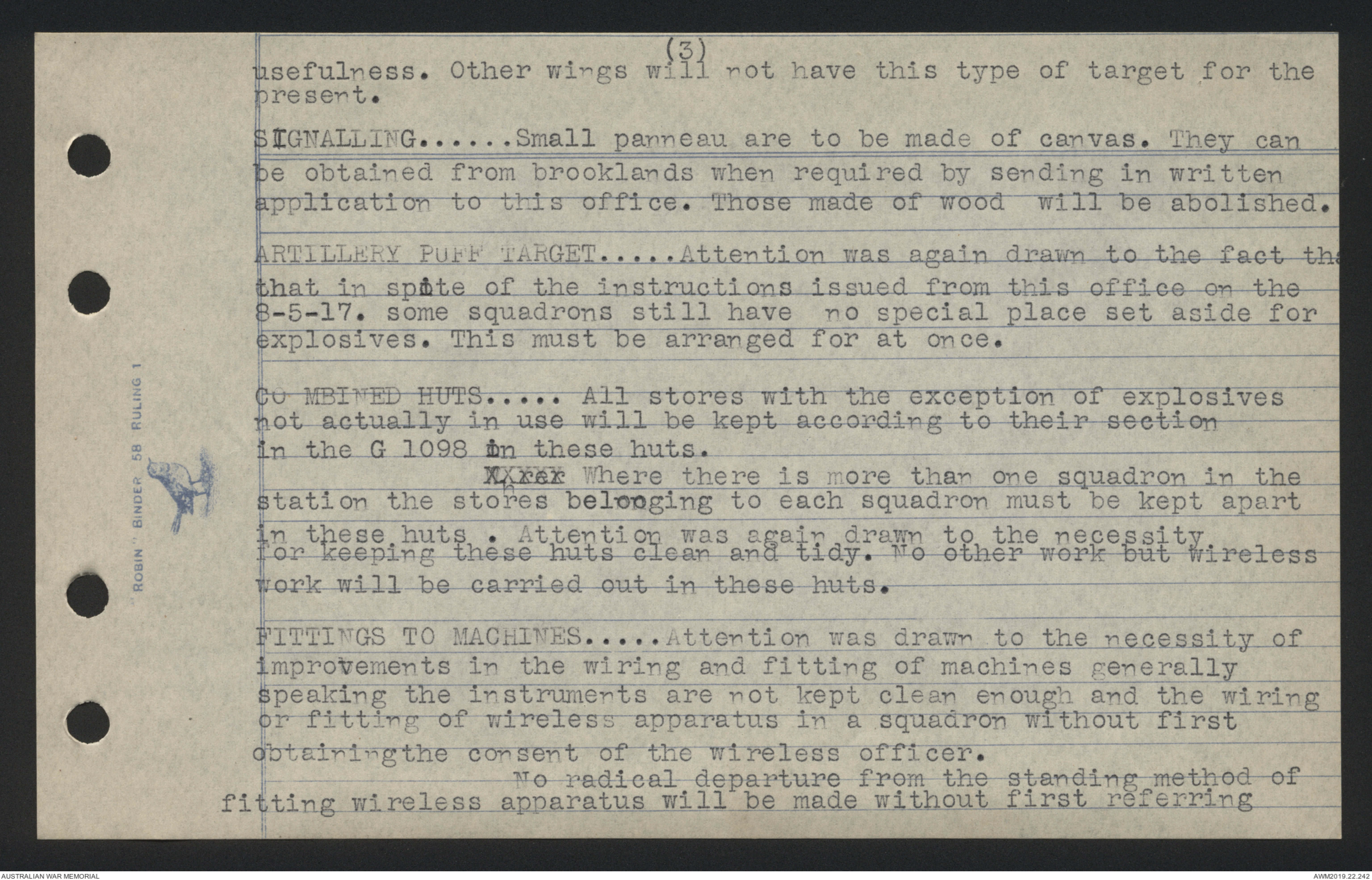
(3)
usefulness. Other wings will not have this type of target for the
present.
SIGNALLING. . . . . . Small panneau are to be made of canvas. They can
be obtained from brooklands when required by sending in written
application to this office. Those made of wood will be abolished.
ARTILLERY PUFF TARGET. . . . . Attention was again drawn to the fact tha
that in spite of the instructions issued from this office on the
8-5-17. some squadrons still have no special place set aside for
explosives. This must be arranged for at once.
COMBINED HUTS. . . . . All stores with the exception of explosives
not actually in use will be kept according to their section
in the G 1098 in these huts.whrer Where there is more than one squadron in the
station the stores belonging to each squadron must be kept apart
in these huts. Attention was again drawn to the necessity
for keeping these huts clean and tidy. No other work but wireless
work will be carried out in these huts.
FITTINGS TO MACHINES. . . . . Attention was drawn to the necessity of
improvements in the wiring and fitting of machines generally
speaking the instruments are not kept clean enough and the wiring
or fitting of wireless apparatus in a squadron without first
obtaining the consent of the wireless officer.
No radical departure from the standing method of
fitting wireless apparatus will be made without first referring
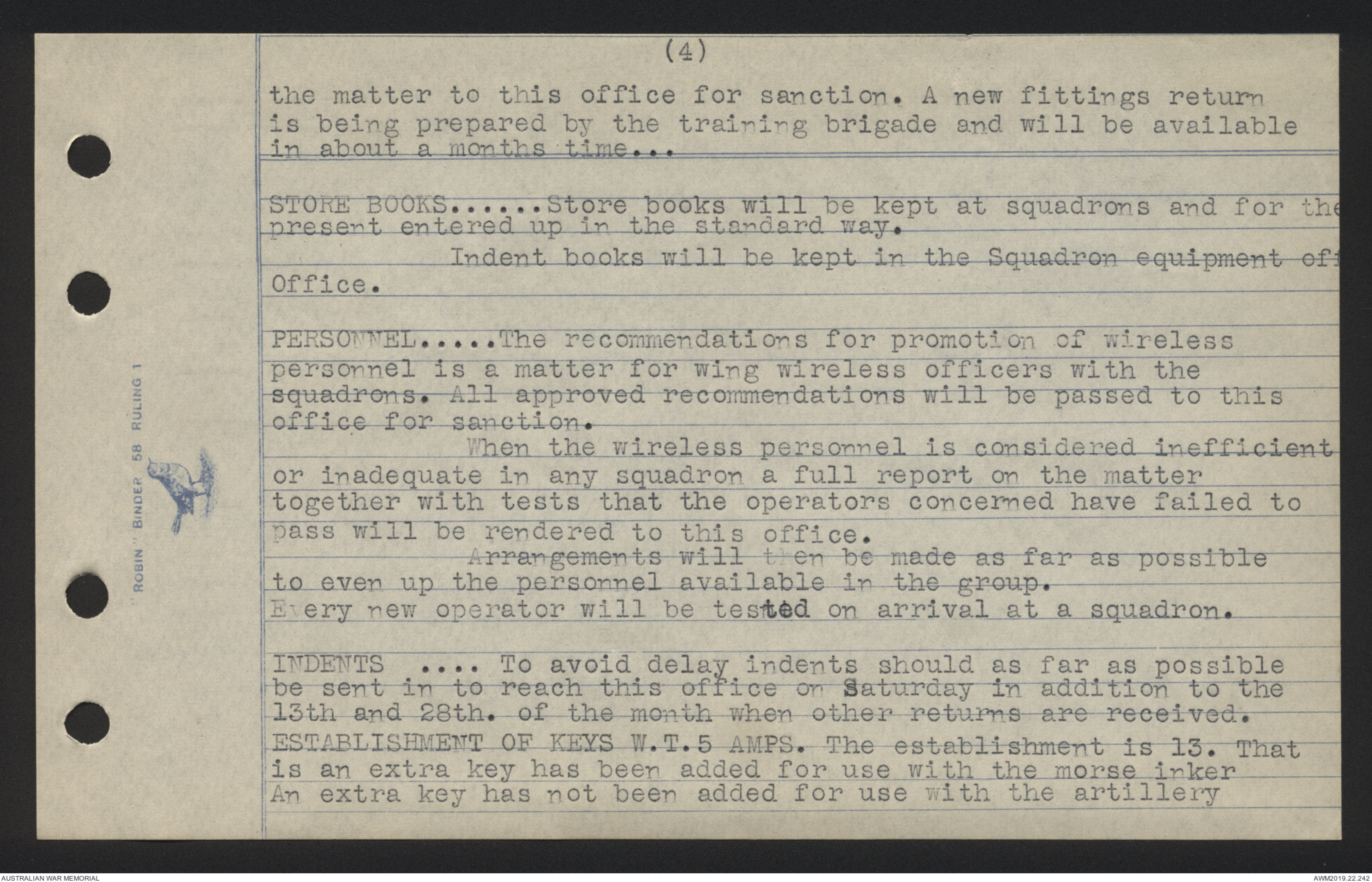
(4)
the matter to this office for sanction. A new fittings return
is being prepare by the training brigade and will be available
in about a months time. . .
STORE BOOKS. . . . . . Store books will be kept at squadrons and for the
present entered up in the standard way.
Indent books will be kept in the Squadron equipment of
Office.
PERSONNEL. . . . .The recommendations for promotion of wireless
personnel is a matter for wing wireless officers with the
squadrons. All approved recommendations will be passed to this
office for sanction.
When the wireless personnel is considered inefficient
or inadequate in any squadron a full report on the matter
together with tests that the operators concerned have failed to
pass will be rendered to this office.
Arrangements will then be made as far as possible
to even up the personnel available in the group.
Every new operator will be tested on arrival at a squadron.
INDENTS . . . . To avoid delay indents should as far as possible
be sent in to reach this office on Saturday in addition to the
13th and 28th. of the month when other returns are received.
ESTABLISHMENT OF KEYS W.T.5 AMPS. The establishment is 13. That
is an extra key has been added for use with the morse inker
An extra key has not been added for use with the artillery
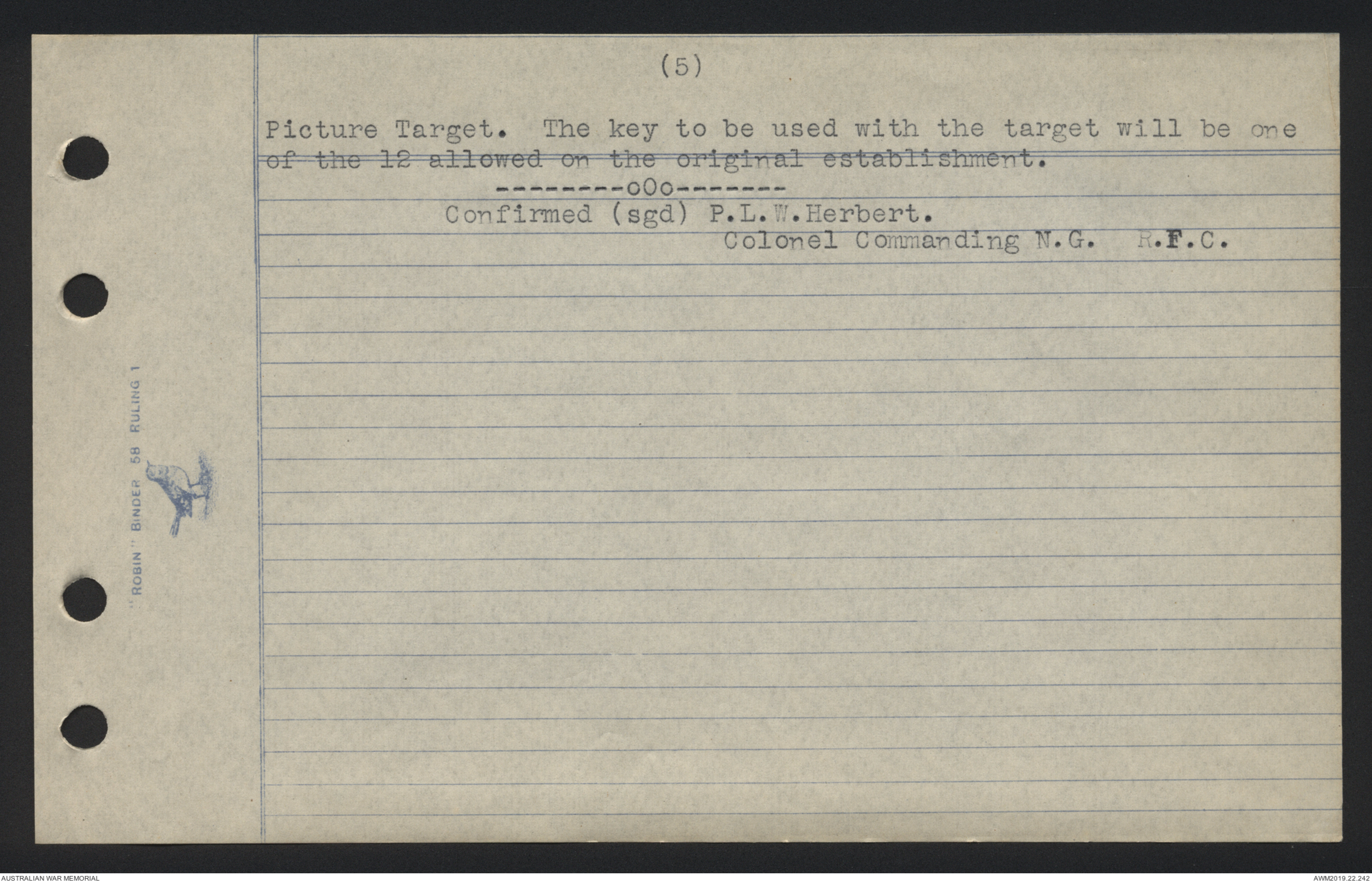
(5)
Picture Target. The key to used with the target will be one
of the 12 allowed on the original establishment.
--------oOo--------
Confirmed (sgd) P.L.W. Herbert.
Colonel Commanding N.G. R.F.C.
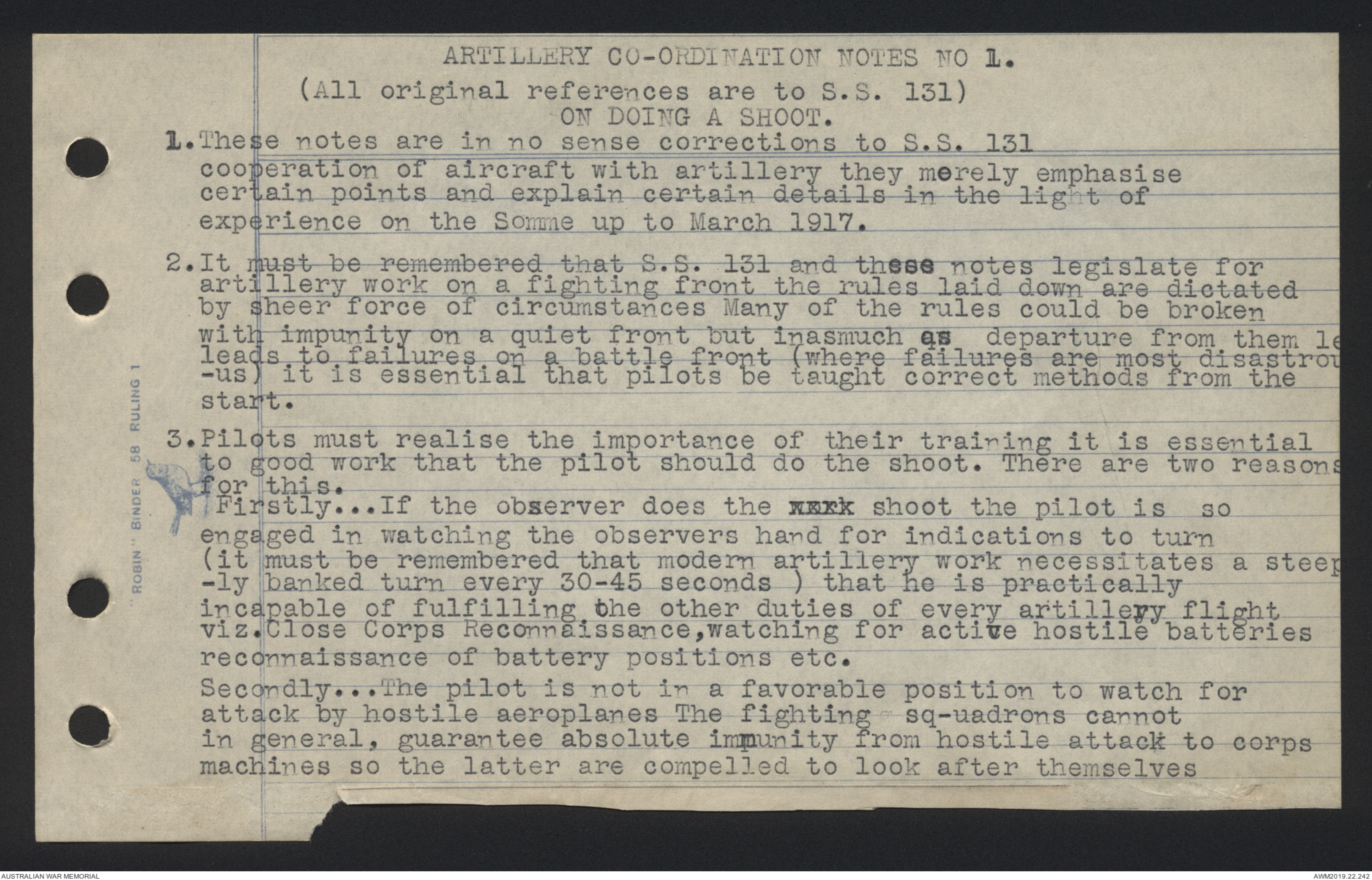
ARTILLERY CO-ORDINATION NOTES NO 1.
(All original references are to S.S.131)
ON DOING A SHOOT.
1. These notes are in no sense corrections to S.S.131
cooperation of aircraft with artillery they merely emphasise
certain points and explain certain details in the light of
experience on the Somme up to March 1917.
2. It must be remember that S.S.131 and these notes legislate for
artillery work on a fighting front the rules laid down are dictated
by sheer force of circumstances Many of the rules could be broken
with impunity on a quiet front but in as much as departure from them le
leads to failures on a battle front (where failures are most disastrous)
it is essential that pilots be taught correct methods from the
start.
3. Pilots must realise the importance of their training it is essential
to good work that the pilot should do the shoot. There are two reasons
for this.
Firstly. . . If the observer does the work shoot the pilot is so
engaged in watching the observers hand for indications to turn
(it must be remember that modern artillery work necessitates a steeply
banked turn every 30-45 seconds) that he is practically
incapable of fulfilling the other duties of every artillery flight
viz. Close Corps Reconnaissance, watching for active hostile batteries
reconnaissance of battery positions etc.
Secondly. . . The pilot is not in a favourable position to watch for
attack by hostile aeroplanes The fighting sq-uadron cannot
in general, guarantee absolute immunity from hostile attack to corps
machines so the latter are compelled to look after themselves
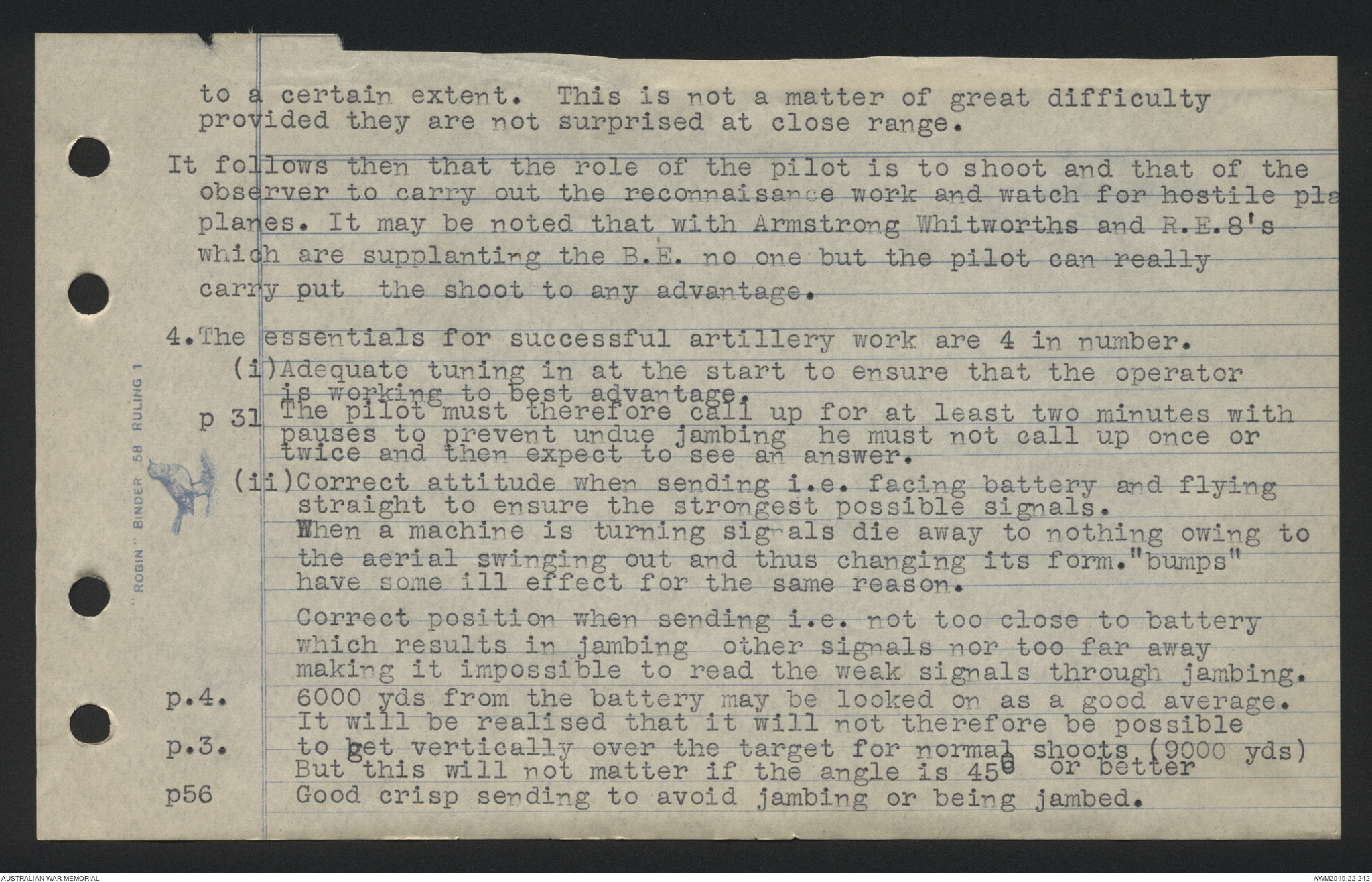
to a certain extent. This is not a matter of great difficulty
provided they are not surprised at close range.
It follows then that the role of the pilot is to shoot and that of the
observer to carry out the reconnaissance work and watch for hostile pla
planes. It may be noted that with Armstrong Whitworths and R.E.8's
which are supplanting the B.E. no one but the pilot can really
carry out the shoot to any advantage.
4. The essentials for successful artillery work are 4 in number.
(i) Adequate tuning in at the start to ensure that the operator
is working to best advantage.
[*p 31*] The pilot must therefore call up for at least two minutes with
pauses to prevent undue jambing he must not call up once or
twice and then expect to see an answer.
(ii) Correct attitude when sending i.e. facing battery and flying
straight to ensure the strongest possible signals.
When a machine is turning signals die away to nothing owing to
the aerial swinging out and thus changing its form. "bumps"
have some ill effect for the same reason.
Correct position when sending i.e not too close to battery
which results in jambing other signals nor too far away
making it impossible to read the weak signals through jambing.
[*p.4.*] 6000 yds from the battery may be looked on as a good average.
It will be realised that it will not therefore be possible
[*p.3.*] to get vertically over the target for normal shoots (9000 yds)
but this will not matter if the angle is 45° or better
[*p.56*] Good crisp sending to avoid jambing or being jambed.
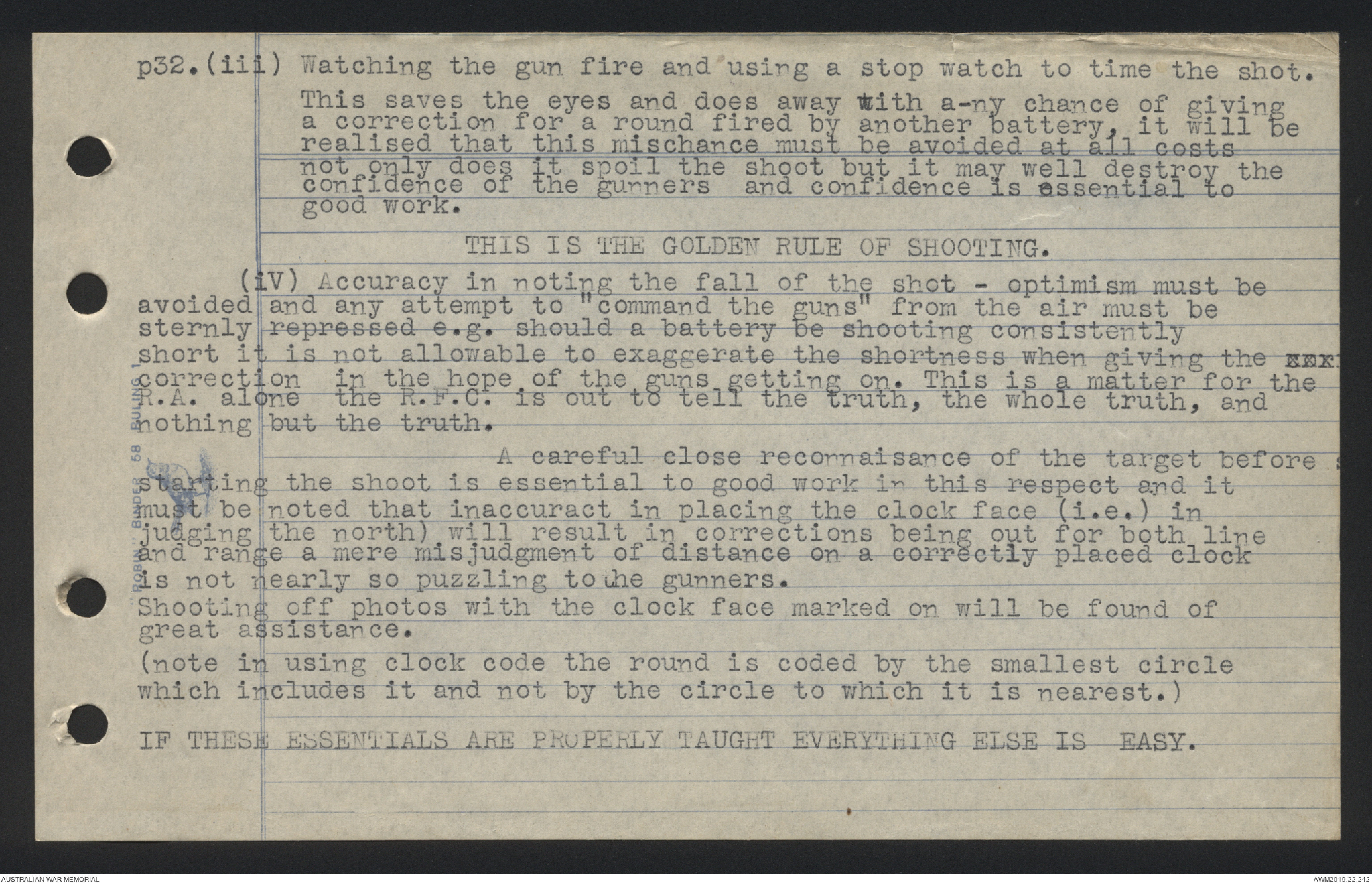
p32. (iii) Watching the gun fire and using a stop watch to time the shot.
This saves the eyes and does away a-ny chance of giving
a correction for a round fired by another battery, it will be
realised that this mischance must be avoided at all costs
not only does it spoil the shoot but it may well destroy the
confidence of the gunners and confidence is essential to
good work.
THIS IS THE GOLDEN RULE OF SHOOTING.
(iv) Accuracy in noting the fall of the shot - optimism must be
avoided and any attempt to "command the guns" from the air must be
sternly repressed e.g. should a battery be shooting consistently
short it is not allowable to exaggerate the shortness when giving the cor
correction in the hope of the guns getting on. This is a matter for the
R.A. alone the R.F.C. is out to tell the truth, The whole truth, and
nothing but the truth.
A careful close reconnaisance of the target before
starting the shoot is essential to good work in this respect and it
must be noted that inaccuract in placing the clock face (i.e.) in
judging the north) will result in corrections being out for both line
and range a mere misjudgment of distance on a correctly placed clock
is not nearly so puzzling to the gunners.
Shooting off photos with the clock face marked on will be found of
great assistance.
(note in using clock code the round is coded by the smallest circle
which includes it and not by the circle to which it is nearest.)
IF THESE ESSENTIALS ARE PROPERLY TAUGHT EVERYTHING ELSE IS EASY.
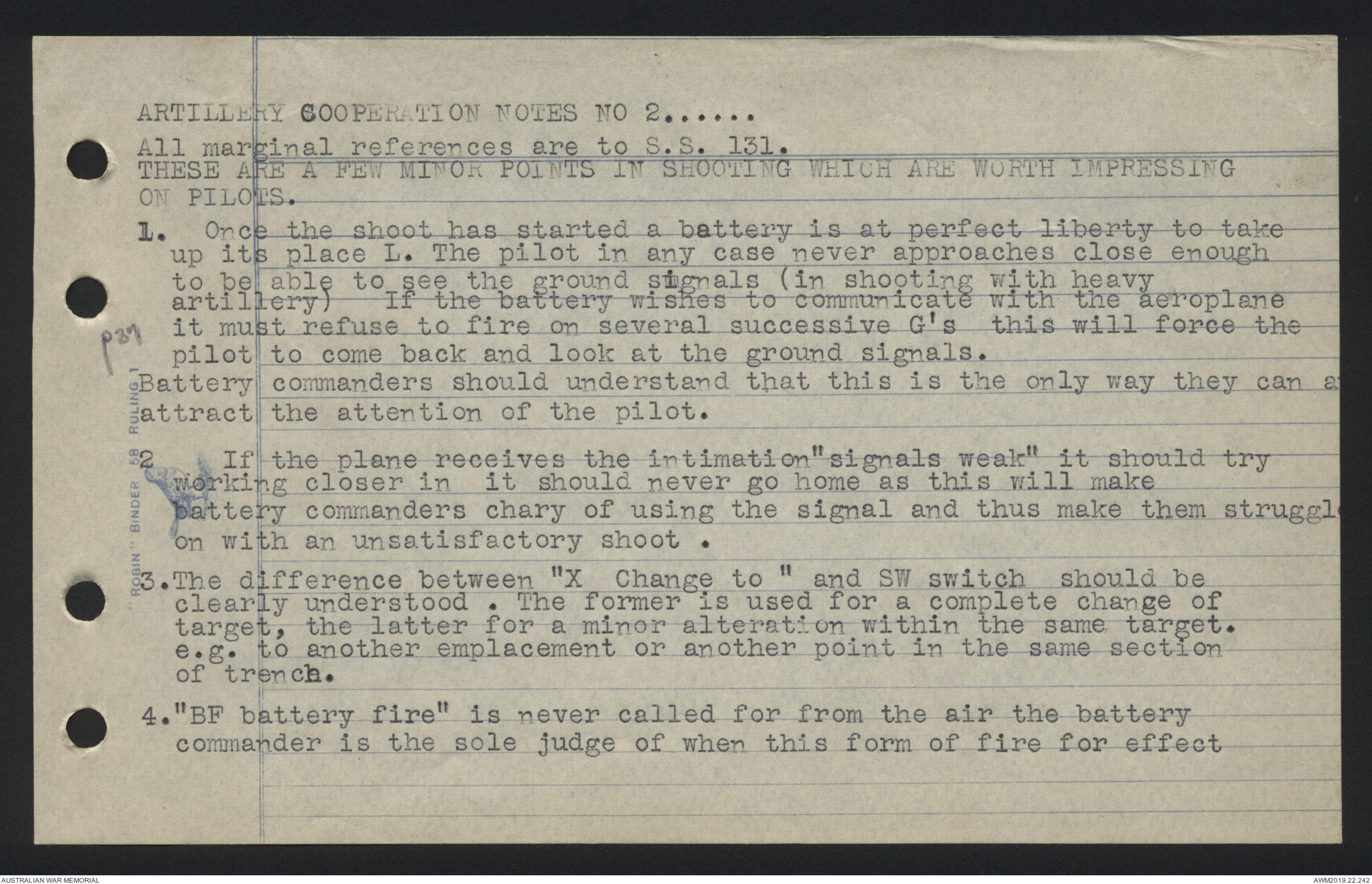
ARTILLERY COOPERATION NOTES NO 2. . . . .
All marginal references are to S.S.131.
THESE ARE A FEW MINOR POINTS IN SHOOTING WHICH ARE WORTH IMPRESSING
ON PILOTS.
1. Once the shoot has started a battery is at perfect liberty to take
up its place L. The pilot in any case never approaches close enough
to be able to see the ground signals (in shooting with heavy
artillery) If the battery wishes to communicate with the aeroplane
it must refuse to fire on several successive G's this will force the
pilot to come back and look at the ground signals.
Battery commanders should understand that this is the only way they can
attract the attention of the pilot
2. If the plane receives the intimatation "signals weak" it should try
working closer in it should never go home as this will make
battery commanders chary of using the signal and thus make them struggl
on with an unsatisfactory shoot.
3. The difference between "X Change to" and SW switch should be
clearly understood. The former is used for a complete change of
target, the latter for a minor alteration within the same target.
e.g. to another emplacement or another point in the same section
of trench.
4. "BF battery fire" is never called for from the air the battery
commander is the sole judge of when this form of fire for effect
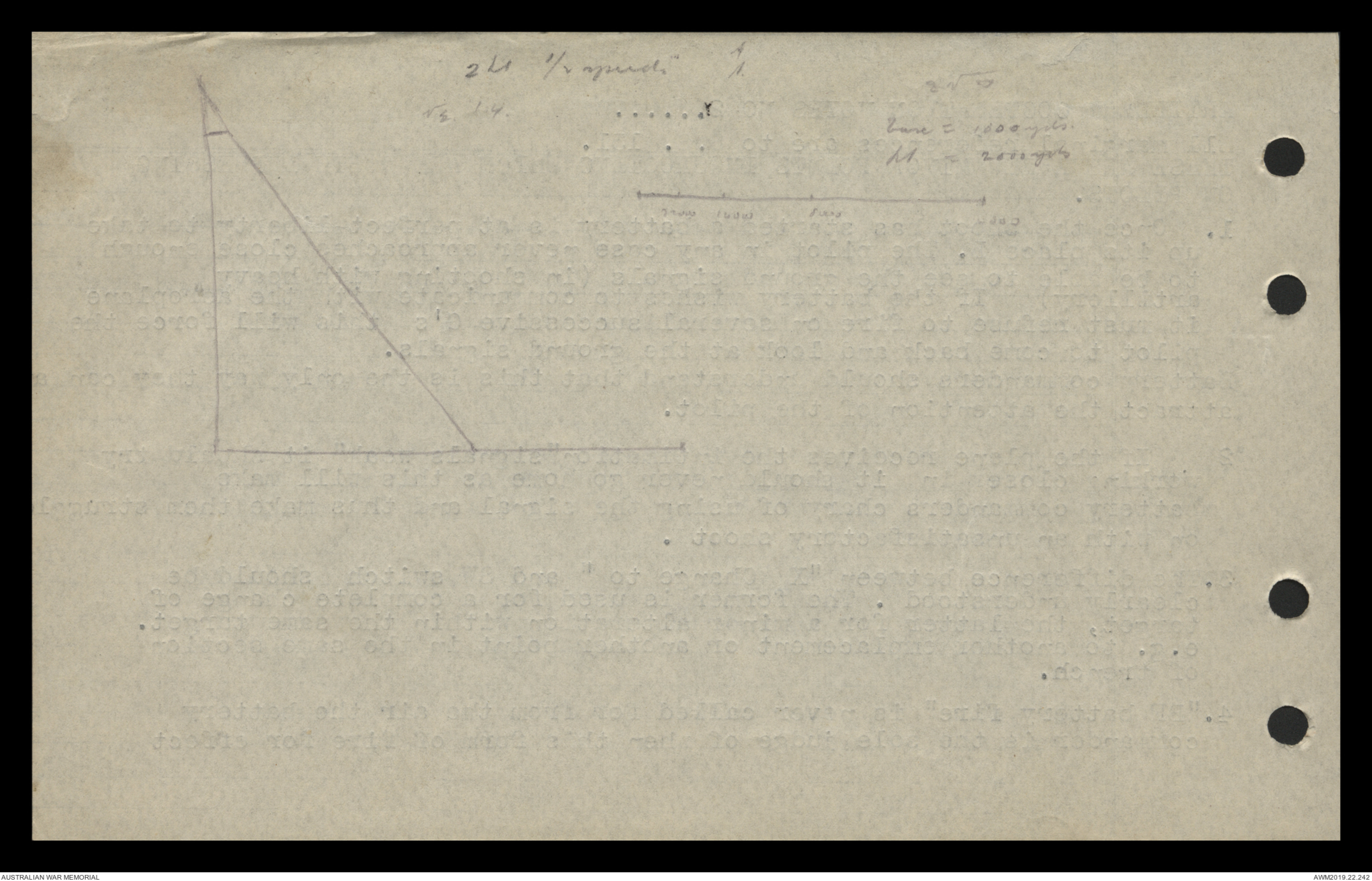
Hand drawn diagram - see original document
ARTILLERY COOPERATION NOTES NO 2. All marginal references to S.S.131.
THERE ARE A FEW MINOR POINTS IN SHOOTING WHICH ARE WORTH IMPRESSION
ON PILOTS. . . . . . . .L
1. Once the shoot has started a bettery is at perfect liberty to take
up its L: the pilot in any case never approaches close enough to be
able to see the ground signals (in shooting with heavy artillery)
If the battery wishes to communicate with the aeroplane it must refuse
to fire on several successive "G"s this will force the pilot to come
back and look at the ground signals. Battery commanders should
understand that this is the only way they can attract the attention of
the pilot.
2. . . . . If the plane receives the intimation "singnals weak" it should try
working closer in it should never go home as this will make Battery Commanders
chary of using the signal and thus makes them struggle on with an
unsatisfactory shoot.
3. . . . . . . The difference between "X change to" and "S.W. switch" should be
clearly understood. The former is used for a complete change of target
the latter for a minor alteration within the same target e.g. to another
emplacement or another point in the same section of trench.
4. . . . . . ."BF battery fire" is never called for from the air The battery
Commander is the sole judge of when this form of fire for effece should b
opened. The only exception should be when time is short and a quick shoot
with comparatively cheap ammuntion (e.g. 60 pdrs) is desirable when "Will
"Will U BF" may be sent.
Th
5. . . . . .
 Sam scott
This transcription item is now locked to you for editing. To release the lock either Save your changes or Cancel.
This lock will be automatically released after 60 minutes of inactivity.