
Service notebook of Harold Gordon Cornell - 1917 - Part 18
(3)
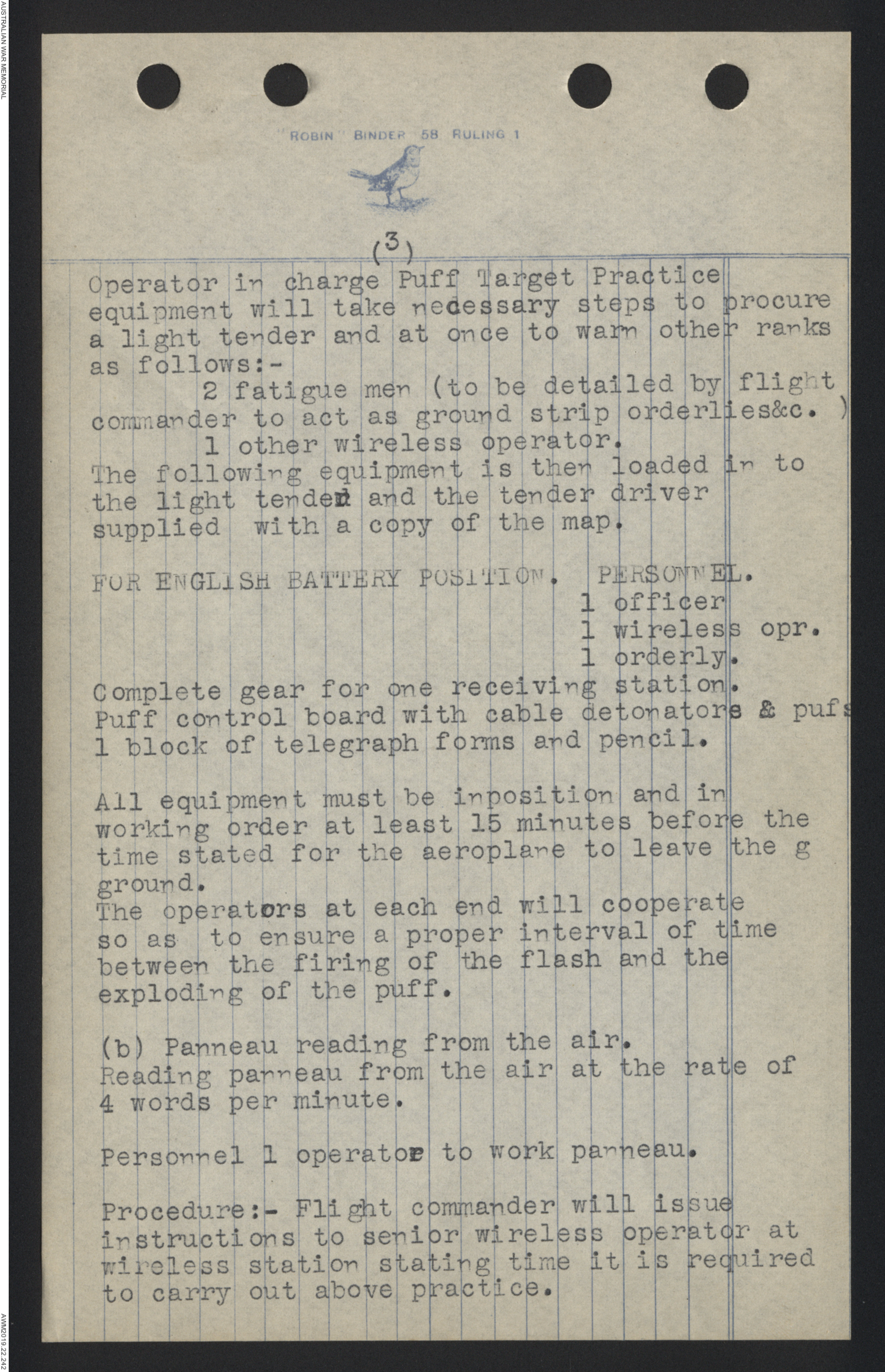
Operator in charge Puff Target Practice
equipment will take necessary steps to procure
a light tender and at once to warn other ranks
as follows:–
2 fatigue men (to be detailed by flight
commander to act as ground strip orderlies&c.)
1 other wireless operator.
The following equipment is then loaded in to
the light tender and the tender driver
supplied with a copy of the map.
FOR ENGLISH BATTERY POSITION. PERSONNEL.
1 officer
1 wireless opr.
1 orderly.
Complete gear for one receiving station.
Puff control board with cable detonators & pufs
1 block of telegraph forms and pencil.
All equipment must be in position and in
working order at least 15 minutes before the
time stated for the aeroplane to leave the g
ground.
The operators at each end will cooperate
so as to ensure a proper interval of time
between the firing of the flash and the
exploding of the puff.
(b) Panneau reading from the air.
Reading panneau from the air at the rate of
4 words per minute.
Personnel 1 operator to work panneau.
Procedure:– Flight commander will issue
instructions to senior wireless operator at
wireless station stating time it is required
to carry out above practice.
(4)
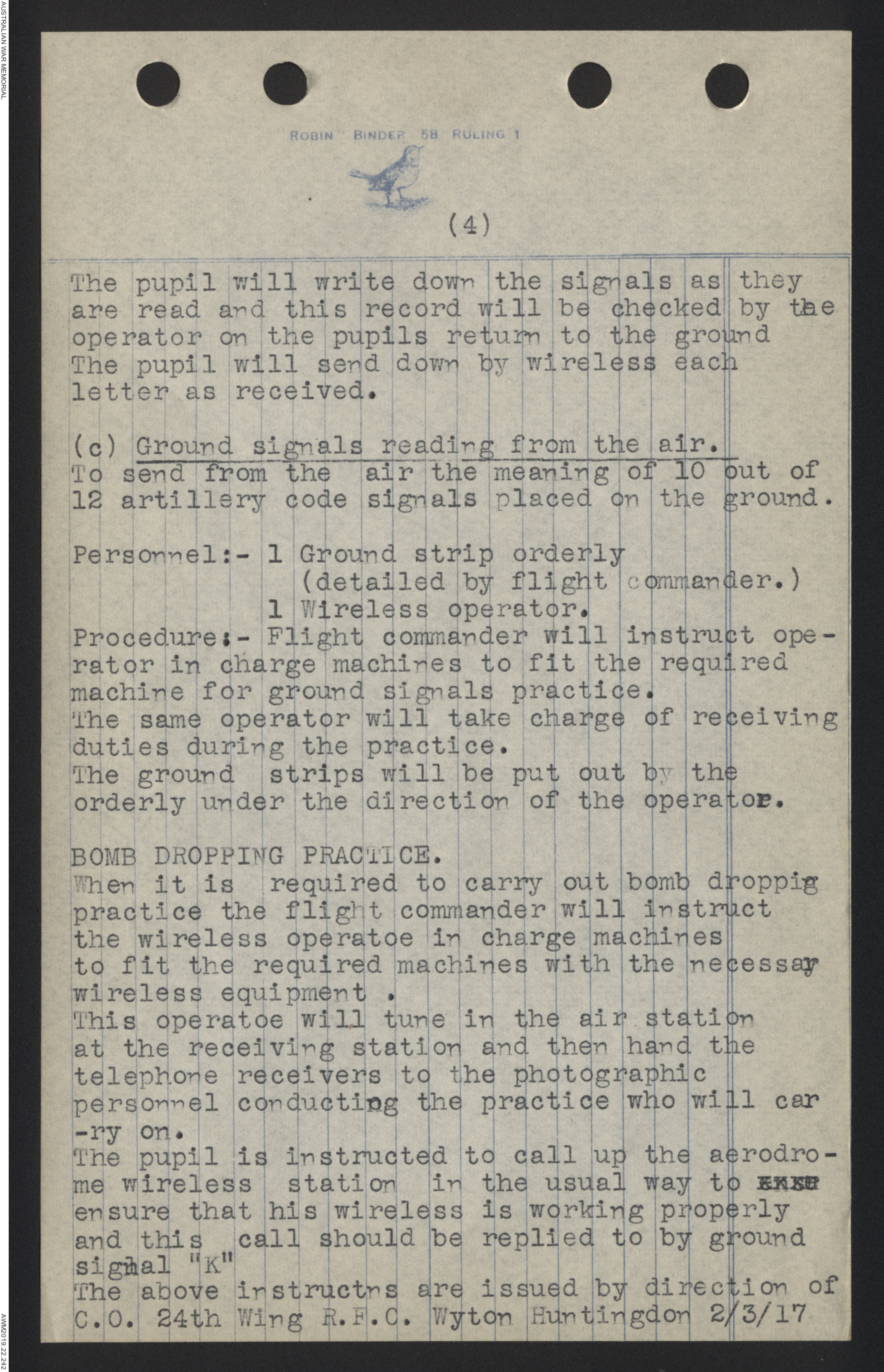
The pupil will write down the signals as they
are read and this record will be checked by the
operator on the pupils return to the ground
The pupil will send down by wireless each
letter as received.
(c) Ground signals reading from the air.
To send from the air the meaning of 10 out of
12 artillery code signals placed on the ground.
Personnel:– 1 Ground strip orderly
(detailed by flight commander.)
1 Wireless operator.
Procedure:– Flight commander will instruct operator
in charge machines to fit the required
machine for ground signals practice.
The same operator will take charge of receiving
duties during the practice.
The ground strips will be put out by the
orderly under the direction of the operator.
BOMB DROPPING PRACTICE.
When it is required to carry out bomb droppig
practice the flight commander will instruct
the wireless operatoe in charge machines
to fit the required machines with the necessary
wireless equipment.
This operator will tune in the air station
at the receiving station and then hand the
telephone receivers to the photographic
personnel conducting the practice who will carry
on.
The pupil is instructed to call up the aerodrome
wireless station in the usual way to ensu
ensure that his wireless is working properly
and this call should be replied to by ground
signal “K”
The above instructns are issued by direction of
C.O. 24th Wing R.F.C. Wyton Huntingdon 2/3/17
(5)
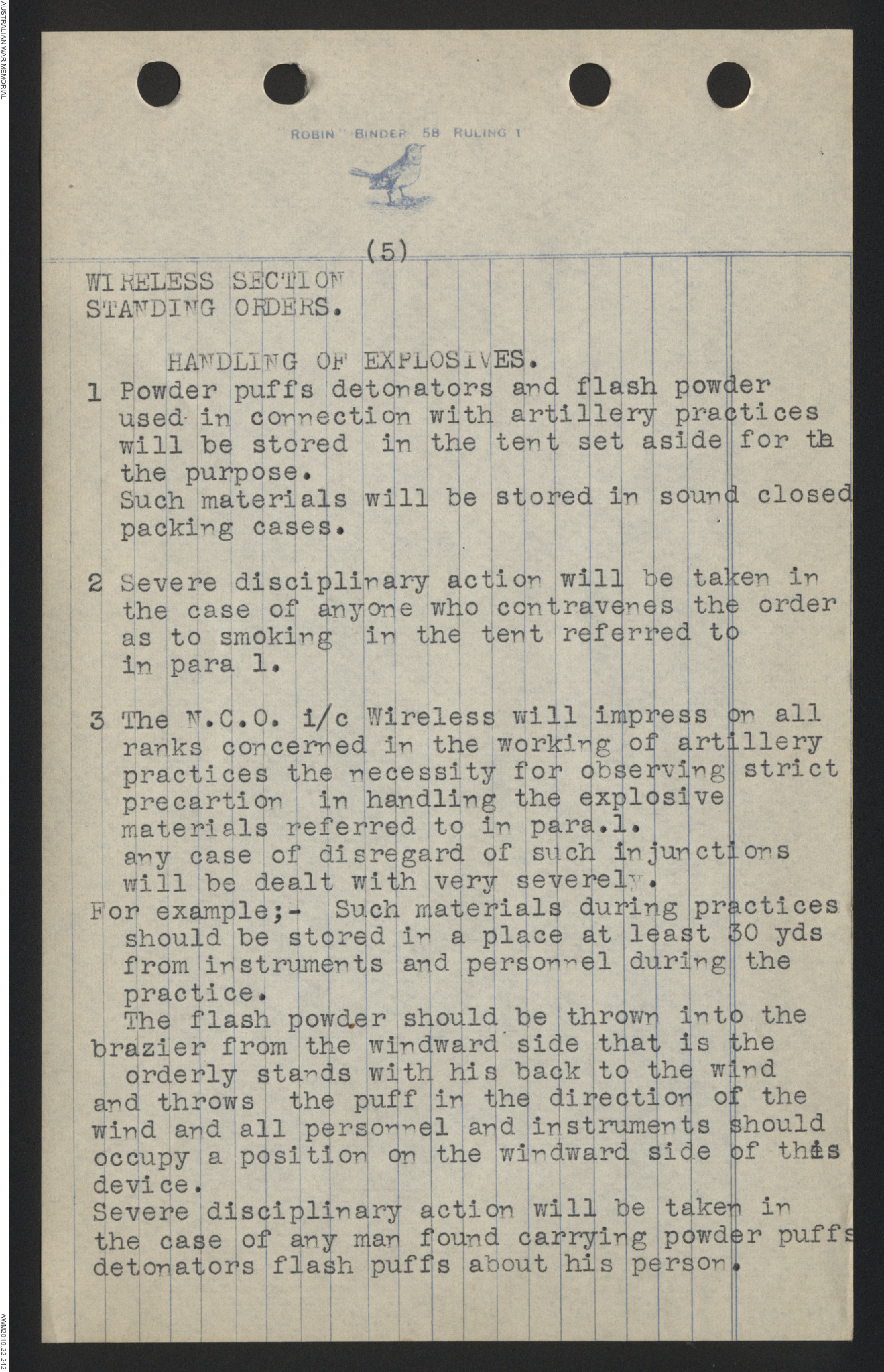
WIRELESS SECTION
STANDING ORDERS.
HANDLING OF EXPLOSIVES.
1 Powder puffs detonators and flash powder
used in connection with artillery practices
will be stored in the tent set aside for th
the purpose.
Such materials will be stored in sound closed
packing cases.
2 Severe disciplinary action will be taken in
the case of anyone who contravenes the order
as to smoking in the tent referred to
in para 1.
3 The N.C.O. i/c Wireless will impress on all
ranks concerned in the working of artillery
practices the necessity for observing strict
precartion in handling the explosive
materials referred to in para.1.
any case of disregard of such injunctions
will be dealt with very severely.
For example;– Such materials during practices
should be stored in a place at least 30 yds
from instruments and personnel during the
practice.
The flash powder should be thrown into the
brazier from the windward side that is the
orderly stands with his back to the wind
and throws the puff in the direction of the
wind and all personnel and instruments should
occupy a position on the windward side of this
device.
Severe disciplinary action will be taken in
the case of any man found carrying powder puffs
detonators flash puffs about his person.
(6)
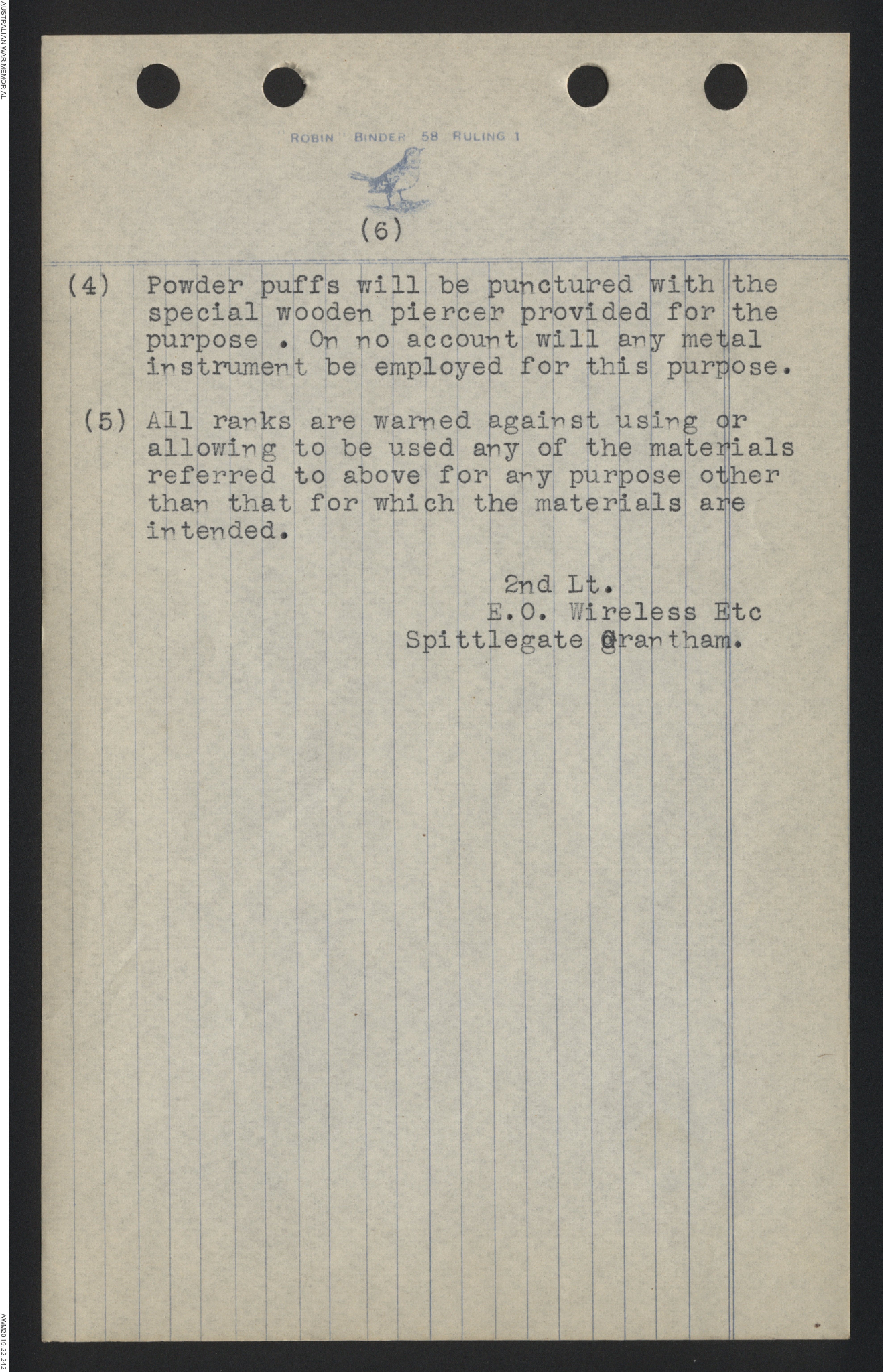
(4) Powder puffs will be punctured with the
special wooden piercer provided for the
purpose. On no account will any metal
instrument be employed for this purpose.
(5) All ranks are warned against using or
allowing to be used any of the materials
referred to above for any purpose other
than that for which the materials are
intended.
2nd Lt.
E.O. Wireless Etc
Spittlegate Grantham.
(7)
Wireless training of officers.
Instructions for conduct of picture target
practice.
The practice will consist of:–
ARTILLERY OBSERVATION
MAP READING.
EQUIPNENT EQUIPMENT:–
1 Picture target scale 1 inch to 100 yds laid
out horizontally. 6667X
2 squared service maps 1 describing
20,000
the area on the picture.
1 movable minature 4 gun battery fitted with
electric lights and a key for the battery
commander to fire the guns.
1 set of ground strips in minature.
1 observers seat fixed at a convenient height
overlooking the picture target.
1 key safety plug and aerial winch for observer.
1 B.C. post (seat and desk).
1 set telephone receivers for wireless operatorg
1 pointer with white bead to show “bursts”
1 pointed with flash light to show “gun flashes.”
ARTILLERY OBSERVATION AND MAP READING.
PERSONNEL:–
(a) Artillery observation
1 instructor
1 observer
1 battery commander
1 strip orderly
1 battery wireless operator.
The duties of strip orderly and wireless operator
can be combined in the duty of battery
commander.
In addition wireless operatorsw with telephone
receivers for the squadron and central wireless
stations may be added.
(8)
(b) Map reading
1 instructor
1 observer.
CONDUCT OF AN ARTILLERY PRACTICE.
The practices are to be carried out on identically
the same lines as a shoot would be on
active service. For example; in a prearranged
shoot against a hostile battery position
The observer and the battery commander first
discuss the shoot but once the observer has
taken his seat the instructor allows no more
discussion except by the regular method viz:–
The observer by wireless and the battery
commander by means of ground strips.
On directions from the instructor to commence
the practice the observer calls up his
squadron to test his wireless the n having
verified his target he proceeds to call up his
battery when the battery wireless operator
“tunes in”.
The observer having sent the signal “G”
the B.C. fires whereupon the instructor
indicates the burst with the pointer with the
white bead and the observer sends down
the corrections accordingly.
Whilst the shoot is actually in progress all
the instructor has to do is to indicate
the position of “bursts” but at the end of
the shoot he summarises any mistakes made and
discusses the shoot in general on such points
as for instance SENDING? LAYING OUT OF STRIPS
SCALE OF DISTANCES ON THE GROUND. TIMES OF
FLIGHT. DIFFERENCE TYPES OF GUNS HOWITZERS ETC
The pointer fitted with a flash light is for
the instructor to indicate the position of
active hostile batteries only and whether the
(9)
observer adopts the zone call method or calls
up a particular battery the pro same procedure
is adopted.
MAP READING.
Experience has proved that however
well an artillery observer or contact patrol
observer has learnt his work too much attention
cannot be paid to map reading.
With definite landmarks such as cross roads woods
and buildings there is little difficulty but
in open country and country cut up and intersected
with trenches the greatest care and
attention is demanded of the observer.
To instil care and attention into an observer
much can be done on the picture target.
The instructor indicates points by means of th
pointer with a flash light and the observer
sends down the co-ordinates by wireless.
Wireless section
24th Wing
(10)
Station instructions.
issued by officer i/c Wireless
24th Wing R.F.C.
March 27th 1917.
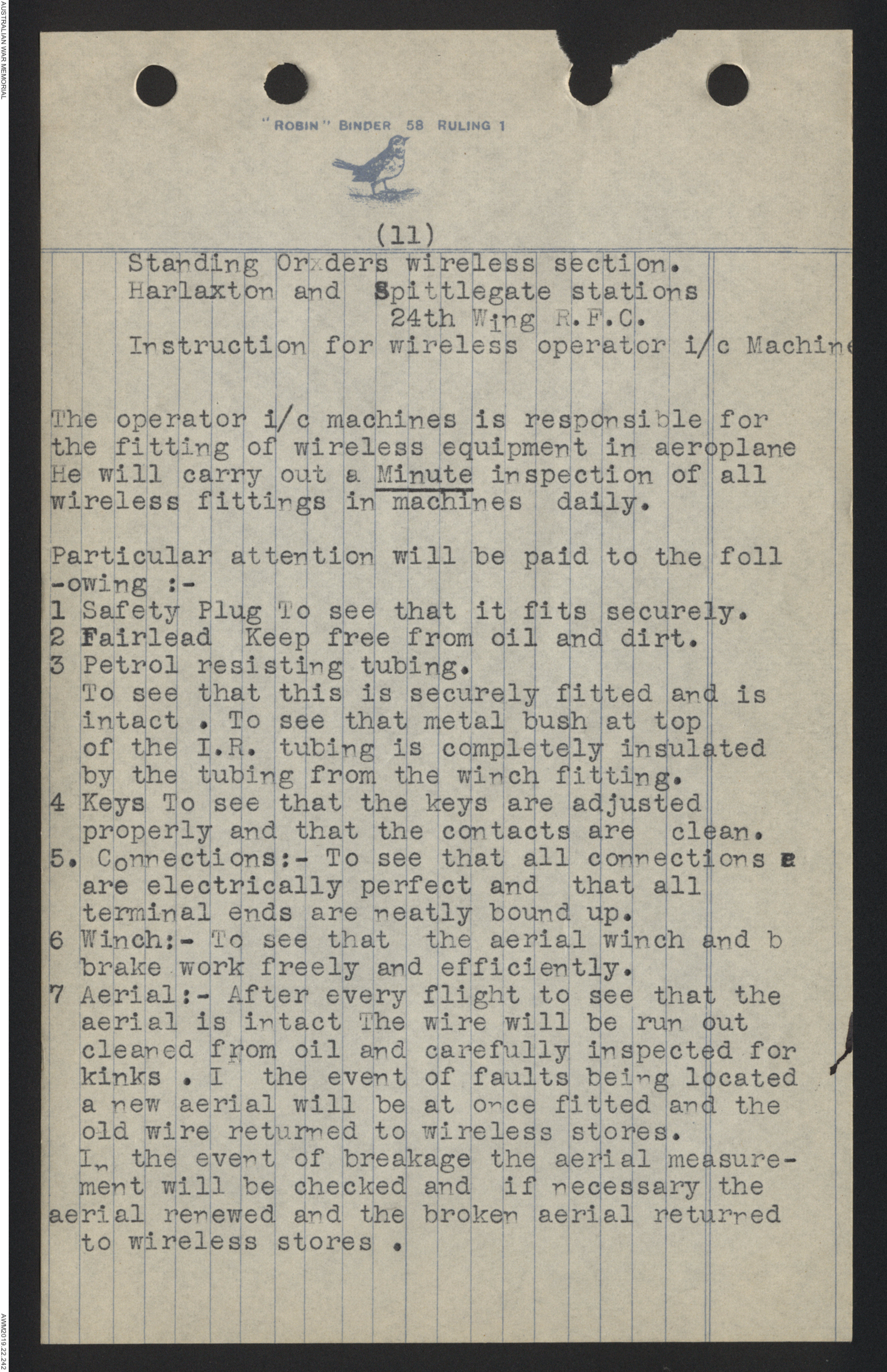
(11)
Standing Orxders wireless section.
Harlaxton and Spittlegate stations
24th Wing R.F.C.
Instruction for wireless operator i/c Machine
The operator i/c machines is responsible for
the fitting of wireless equipment in aeroplane
He will carry out a Minute inspection of all
wireless fittings in machines daily.
Particular attention will be paid to the following:–
1 Safety Plug To see that it fits securely.
2 Fairlead Keep free from oil and dirt.
3 Petrol resisting tubing.
To see that this is securely fitted and is
intact. To see that metal bush at top
of the I.R. tubing is completely insulated
by the tubing from the winch fitting.
4 Keys To see that the keys are adjusted
properly and that the contacts are clean.
5. Connections:- To see that all connections a
are electrically perfect and that all
terminal ends are neatly bound up.
6 Winch:- To see that the aerial winch and b
brake work freely and efficiently.
7 Aerial:- After every flight to see that the
aerial is intact The wire will be run out
cleaned from oil and carefully inspected for
kinks. I the event of faults being located
a new aerial will be at once fitted and the
old wire returned to wireless stores.
In the event of breakage the aerial measurement
will be checked and if necessary the
aerial renewed and the broken aerial returned
to wireless stores.
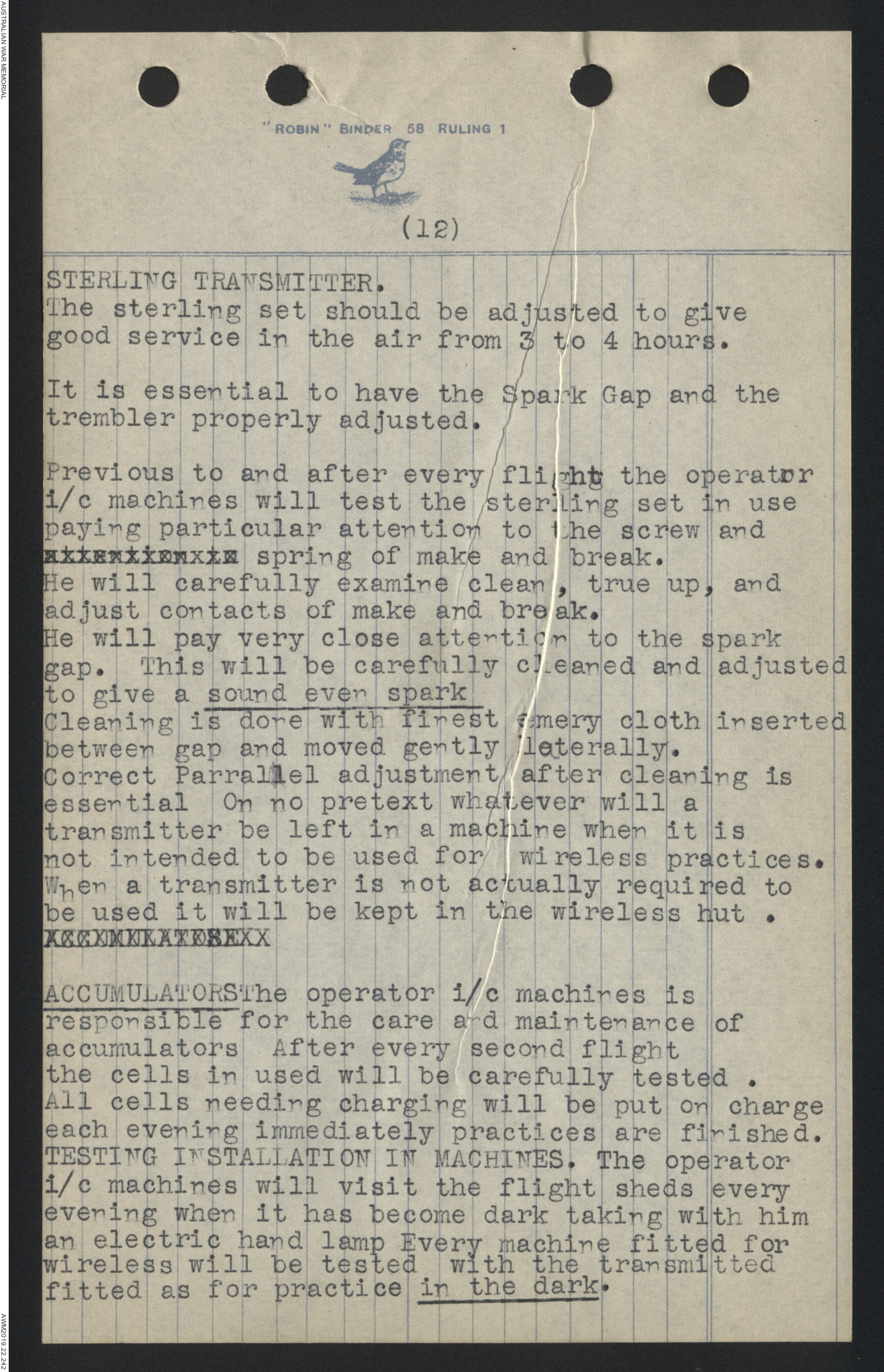
(12)
STERLING TRANSMITTER.
The sterling set should be adjusted to give
good service in the air from 3 to 4 hours.
It is essential to have the Spark Gap and the
trembler properly adjusted.
Previous to and after every flight the operator
i/c machines will test the sterling set in use
paying particular attention to the screw and
attention to spring of make and break.
He will carefully examine clean, true up, and
adjust contacts of make and break.
He will pay very close attention to the spark
gap. This will be carefully cleaned and adjusted
to give a sound even spark
Cleaning is done with finest emery cloth inserted
between gap and moved gently laterally.
Correct Parallel adjustment after cleaning is
essential On no pretext whatever will a
transmitter be left in a machine when it is
not intended to be used for wireless practices.
When a transmitter is not actually required to
be used it will be kept in the wireless hut .
ACCUMULATOSE
ACCUMULATORS The operator i/c machines is
responsible for the care and maintenance of
accumulators After every second flight
the cells in used will be carefully tested.
All cells needing charging will be put on charge
each evening immediately practices are finished.
TESTING INSTALLATION IN MACHINES. The operator
i/c machines will visit the flight sheds every
evening when it has become dark taking with him
an electric hand lamp Every machine fitted for
wireless will be tested with the transmitted
fitted as for practice in the dark.
 Deb Parkinson
This transcription item is now locked to you for editing. To release the lock either Save your changes or Cancel.
This lock will be automatically released after 60 minutes of inactivity.