
Service notebook of Harold Gordon Cornell - 1917 - Part 17
7.
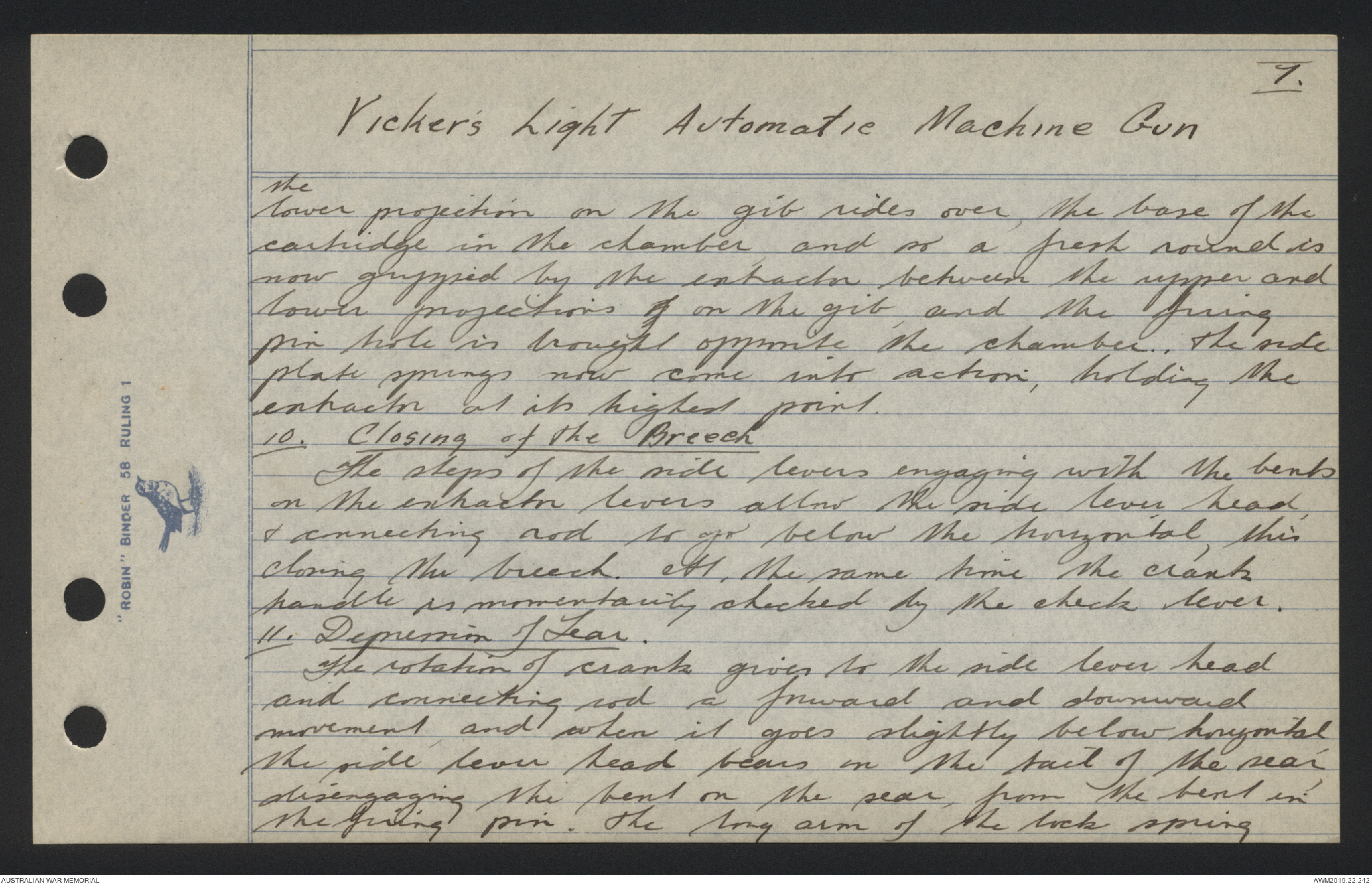
Vicker's Light Automatic Machine Gun
the lower projection on the gib rides over the base of the
cartridge in the chamber and so a fresh round is
now gripped by the extractor between the upper and
lower projections of on the gib, and the firing
pin hole is brought opposite the chamber. The side
plate springs now come into action, holding the
extractor at its highest point.
10. Closing of the Breech
The steps of the side levers engaging with the bents
on the extractor levers allow the side lever head,
& connecting rod to go below the horizontal, this
closing the breech. At the same time the crank
handle is momentarily checked by the check lever.
11. Depression of Sear.
The rotation of crank gives to the side lever head
and connecting rod a forward and downward
movement, and when it goes slightly below horizontal
the side lever head bears on the tail of the sear
disengaging the bent on the sear, from the bent in
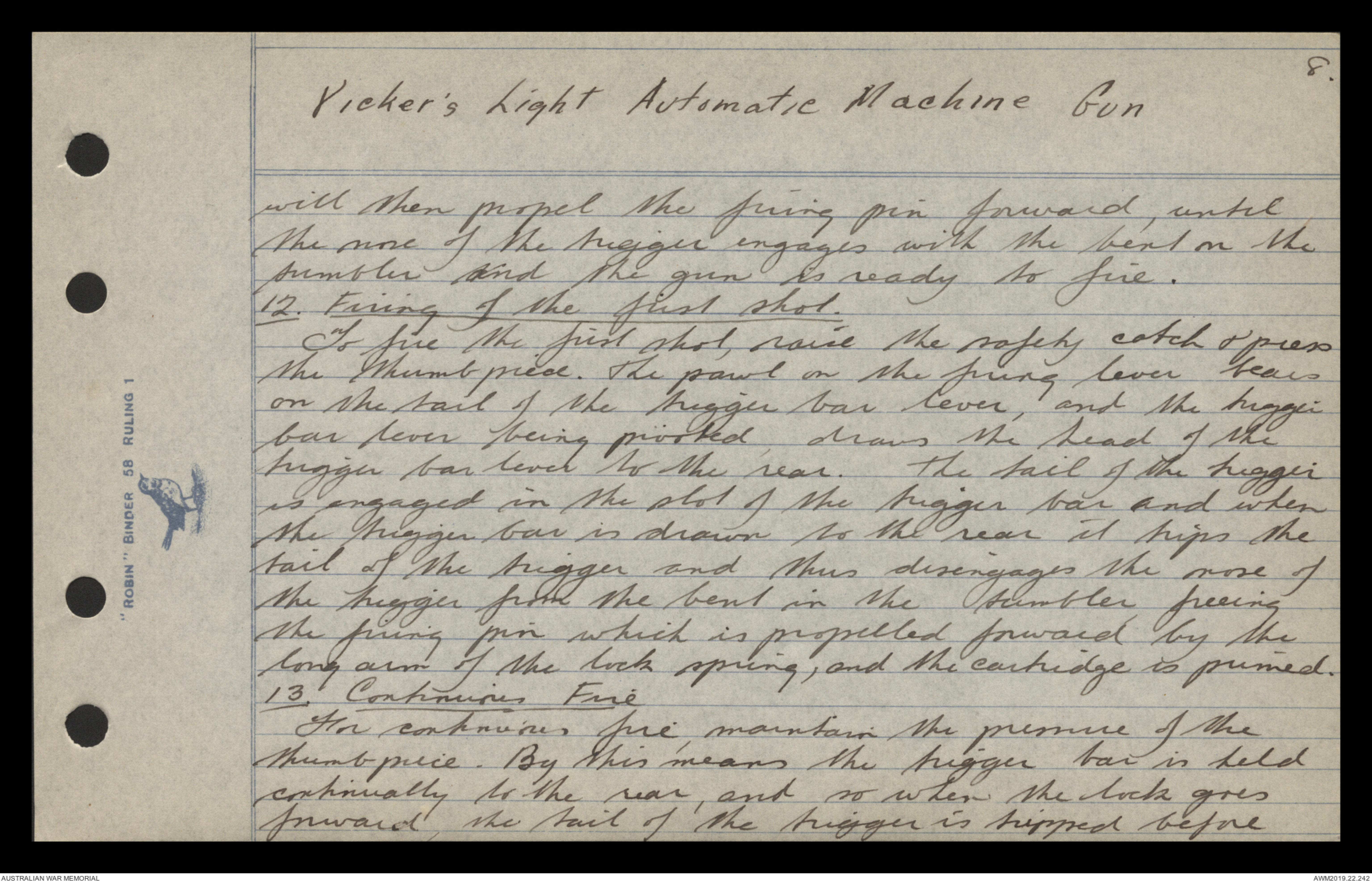
the firing pin. The long arm of the lock spring
8.
Vicker's Light Automatic Machine Gun
will then propel the firing pin forward, until
the nose of the trigger engages with the bent on the
tumbler and the gun is ready to fire.
12. Firing of the first shot.
To fire the first shot, raise the safety catch & press
the thumb piece. The pawl on the firing lever bears
on the tail of the trigger bar lever, and the trigger
bar lever being pivoted, draws the head of the
trigger bar lever to the rear. The tail of the trigger
is engaged in the slot of the trigger bar and when
the trigger bar is drawn to the rear it trips the
tail of the trigger and this disengages the nose of
the trigger from the bent in the tumbler freeing
the firing pin which is propelled forward by the
long arm of the lock spring, and the cartridge is primed.
13. Continuous Fire
For continuous fire, maintain the pressure of the
thumbpiece. By this means the trigger bar is held
continually to the rear, and so when the lock goes
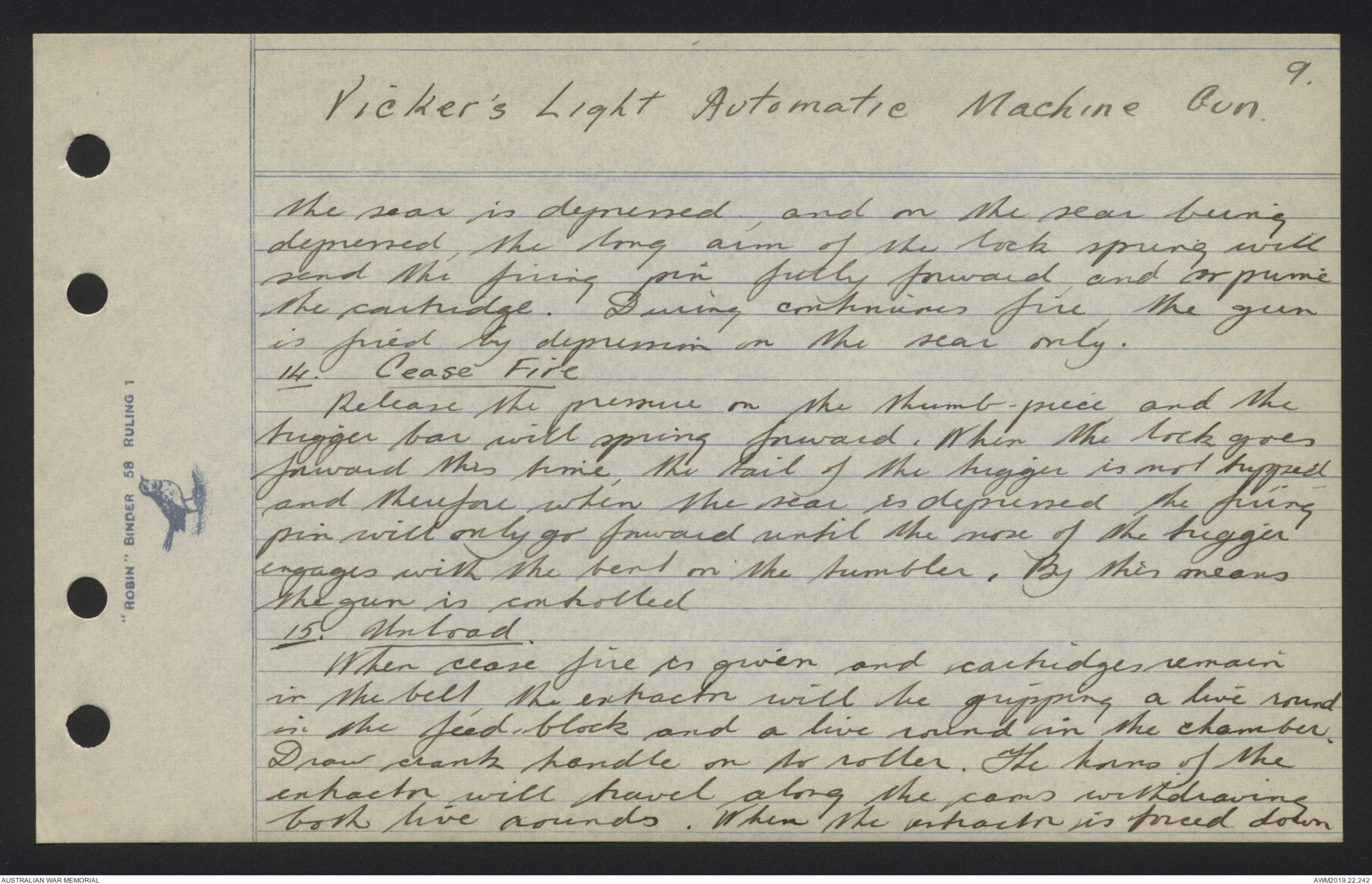
forward, the tail of the trigger is tripped before
9.
Vicker's Light Automatic Machine Gun
the sear is depressed, and on the sear being
depressed, the long arm of the lock spring will
send the firing pin fully forward, and so prime
the cartridge. During continuous fire, the gun
is fired by depression in the sear only.
14. Cease Fire
Release the pressure on the thumb-piece and the
trigger bar will spring forward. When the lock goes
forward this time, the tail of the trigger is not tripped
and therefore when the sear is depressed the firing
pin will only go forward until the nose of the trigger
engages with the bent on the tumbler. By this means
the gun is controlled
15. Unload
When cease fire is given and cartridge remain
in the belt, the extractor will be gripping a live round
in the feed-block and a live round in the chamber.
Draw crank handle on the roller. The horns of the
extractor will travel along the cams withdrawing
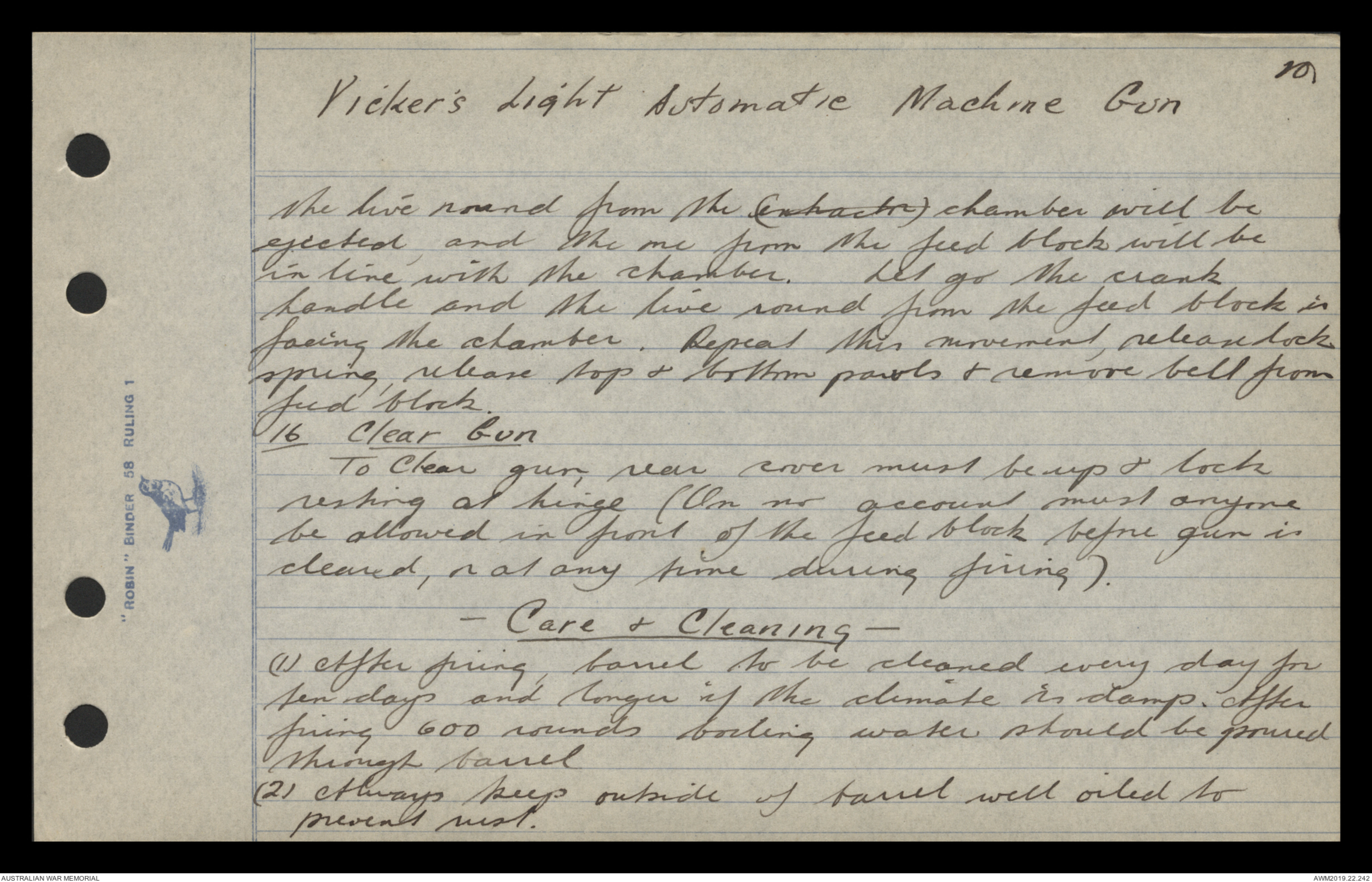
both live rounds. When the extractor is forced down
10
Vicker's Light Automatic Machine Gun
the live round from the (cxtractor) chamber will be
ejected and the one from the feed block will be
in line with the chamber. Let go the crank
handle and the live round from the feed block is
facing the chamber. Repeat this movement, release lock
spring, release top and bottom pawls & remove belt from
feed block.
16 Clear Gun
To clear gun, sear cover level must be up & lock
resting at hinge (On no account must anyone
be allowed in front of the feed block before gun is
cleared, or at any time during firing).
Care & Cleaning
(1) After firing, barrel to be cleaned every day for
ten days and longer if the climate is damp. After
firing 600 rounds boiling water should be poured
through barrel.
(2) Always keep outside if barrel well oiled to
prevent rust.
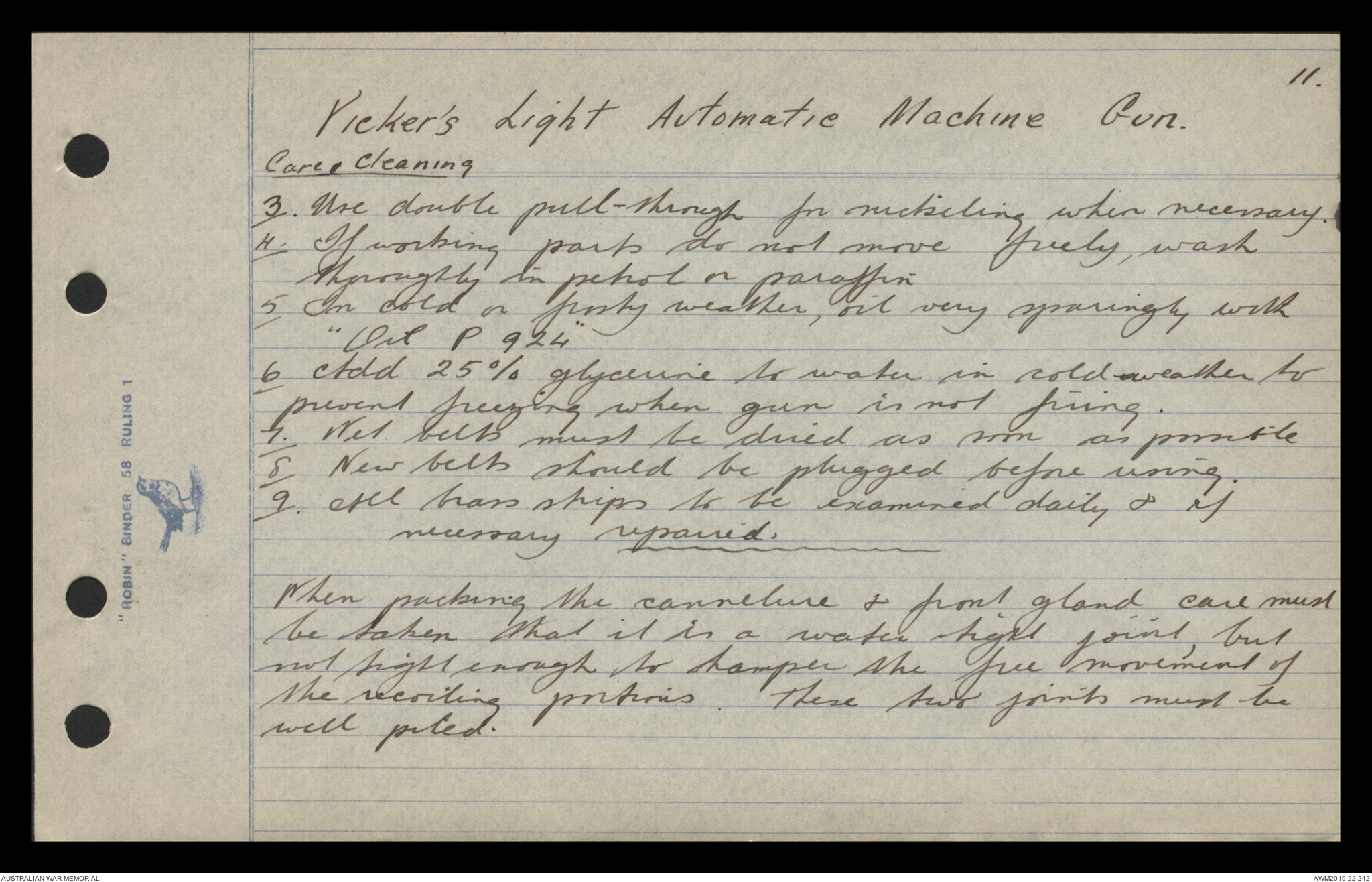
11.
Vicker's Light Automatic Machine Gun
Care & Cleaning
3. Use double pull-through for nickeling when necessary.
4. If working parts do not move freely, wash
thoroughly in petrol or paraffin
5. In cold or frosty weather, oil very sparingly with
"Oil P924"
6. Add 25% glycerine to water in cold weather to
prevent freezing when gun is not firing.
7. Wet belts must be dried as soon as possible.
8. New belts should be plugged before using.
9. All brass strips to be examined daily & if
necessary repaired.
When packing the cannelure & front gland care must
be taken that it is a water tight joint, but
not tight enough to hamper the free movement of
the recoiling portions. These two joints must be
well piled.
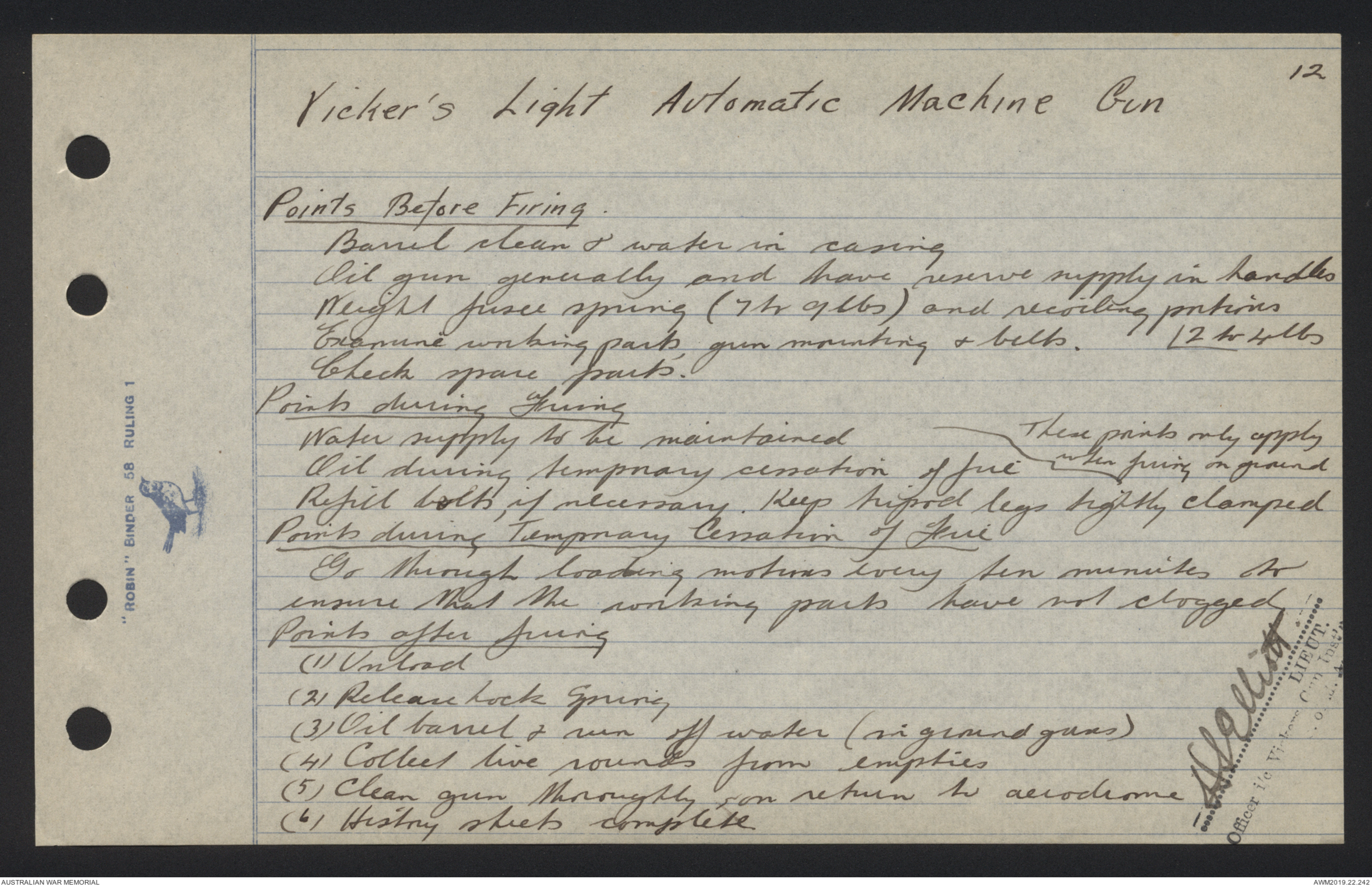
12
Vicker's Light Automatic Machine Gun
Points Before Firing.
Barrel clean & water in casing.
Oil gun generally and have reserve supply in handles
Weight fusee spring (7 to 9 lbs) and recoiling portions (2 to 4 lbs)
Examine working parts, gun mounting & belts.
Check spare parts.
Points during Firing
Water supply to be maintained. )These points only apply
Oil during temporary cessation if fire. ) when firing on ground
Refill bolts, if necessary. Keep tripod legs tightly clamped.
Points during Temporary Cessation of Fire
Go through loading motions every ten minutes to
ensure that the working parts have not clogged.
Points after firing
(1) Unload,
(2) Release Lock Spring
(3) Oil barrel & run off water (in ground guns)
(4) Collect live round from empties
(5) Clean guns thoroughly on return to aerodrome
(6) History sheets complete.
[*HSElliott*]
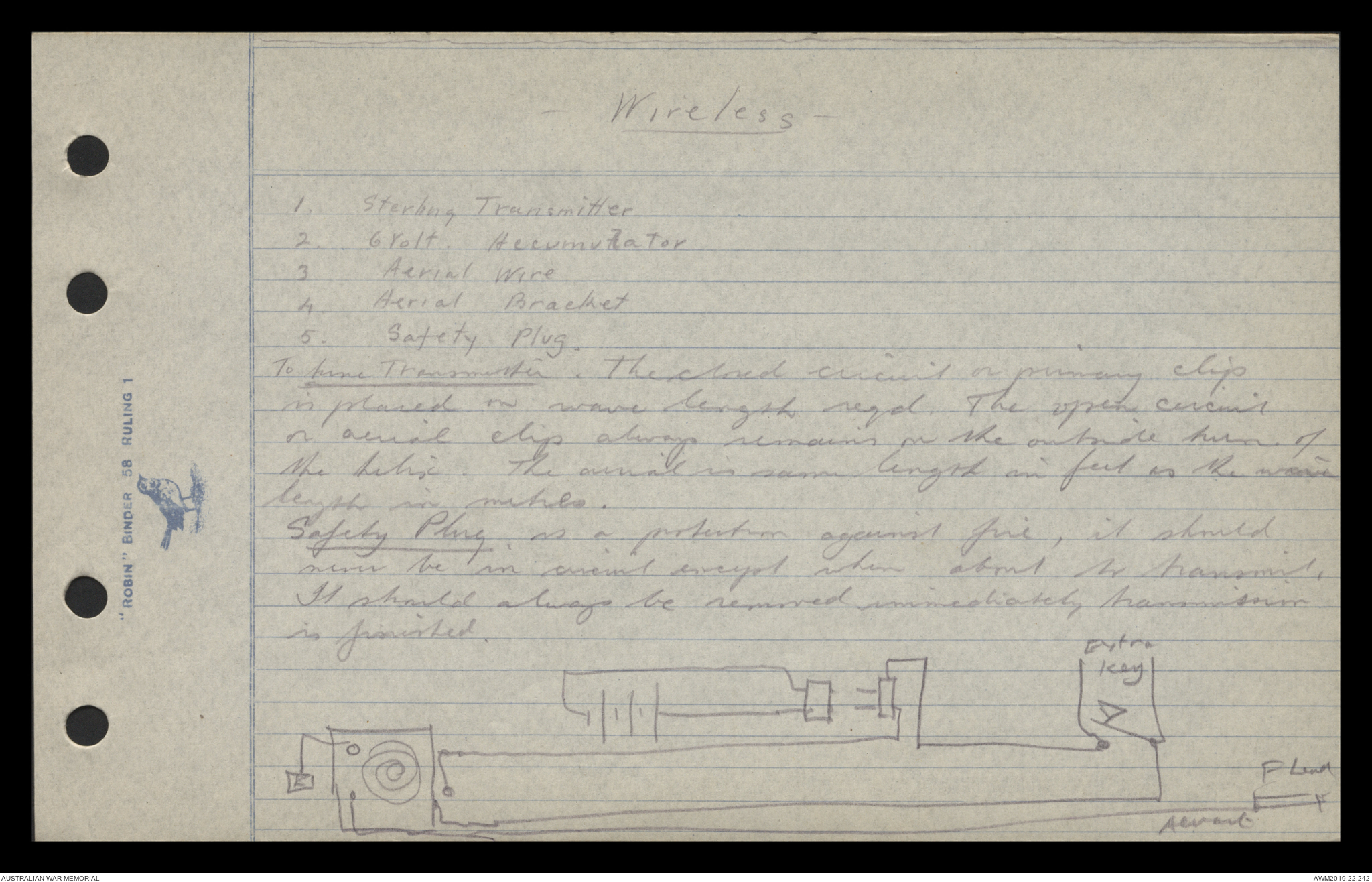
Wireless
1. Sterling Transmitter
2. 6 Volt Accumulator
3. Aerial Wire
4. Aerial Bracket
5. Safety Plug
To tune Transmitter. The closed circuit or primary clip
is placed on wave length reqd. The open circuit
or aerial clip always remains on the outside turn of
the helix. The aerial is same length in feet as the wave
length in metres.
Safety Plug is a protection against fire, it should
never be in circuit except when about to transmit.
It should always be removed immediately transmission
is finished.
Diagram - see original document
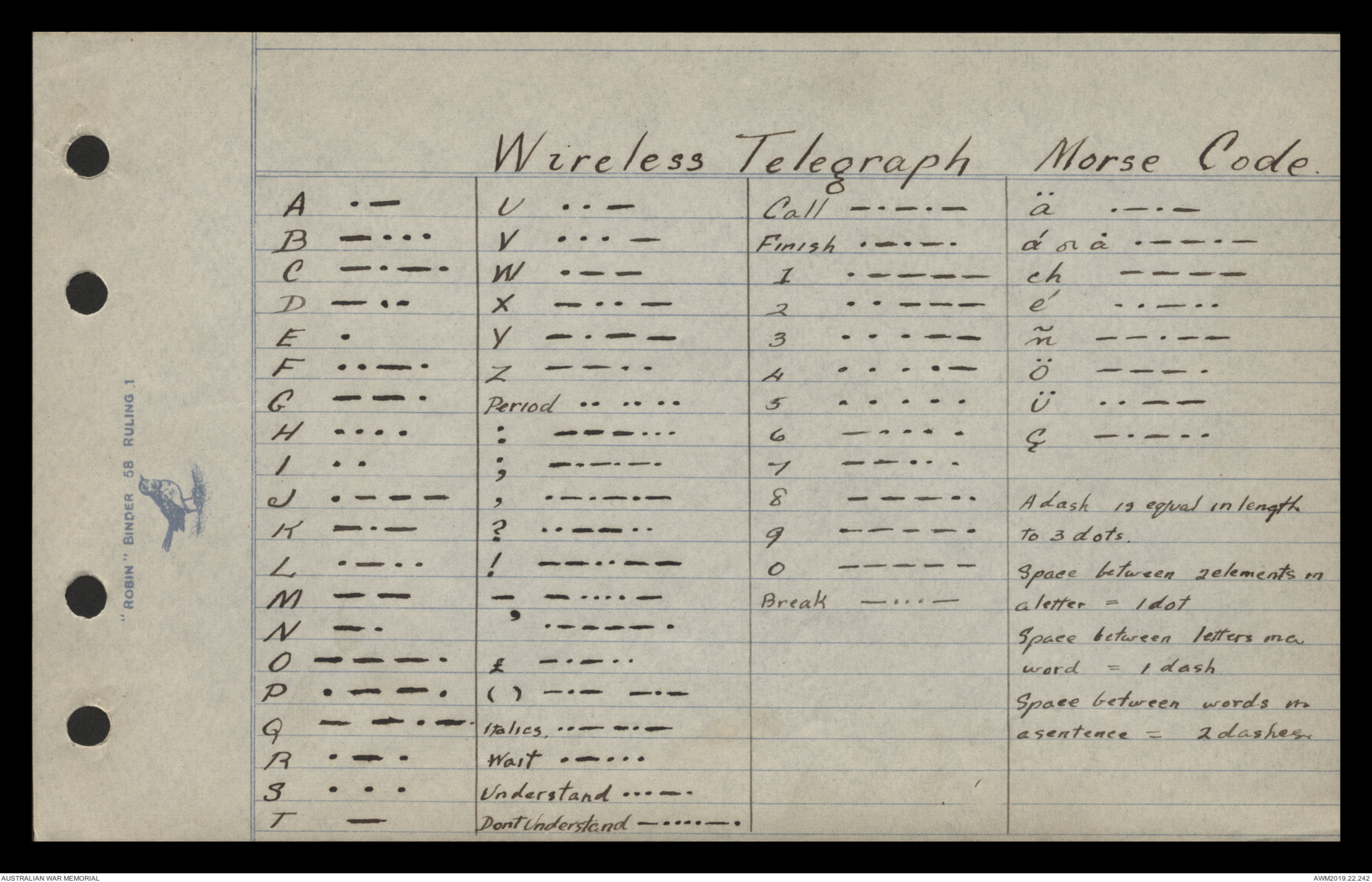
Wireless Telegraph Morse Code
| A .- | U ..- | Call - . - . - | ä .-.- |
| B -... | V...- | Finish . - . - . | á or å .--.- |
| C -.-. | W.- - | 1 .- - - - | ch ---- |
| D -.- | X-..- | 2 ..--- | é ..-.. |
| E . | Y -.-- | 3 ...-- | ῆ --.-- |
| F..-. | Z --.. | 4 .....- | ö ---. |
| G --. | Period .. .. .. | 5 ..... | ü ..-- |
| H .... | : ---... | 6 -.... | ç -.-.. |
| I .. | ; -.-.-. | 7 --... | |
| J .--- | , .-.-.- | 8 ---.. | A dash is equal in length |
| K -.- | ? ..--.. | 9 ----. | to 3 dots. |
| L .-.. | ! --..-- | 0 ----- | Space between 2 elements in |
| M -- | - -....- | Break -...- | a letter = 1 dot |
| N -. | ' .----. | Space between letters in a | |
| O ---. | £ -.-.. | word = 1 dash | |
| P .--. | ( ) -.- -.- | Space between words in | |
| Q --.- | Italics ..-.- | a sentence = 2 dashes | |
| R .-. | Wait .-... | ||
| S ... | Understand ...-. | ||
| T - | Don't understand -....-. |
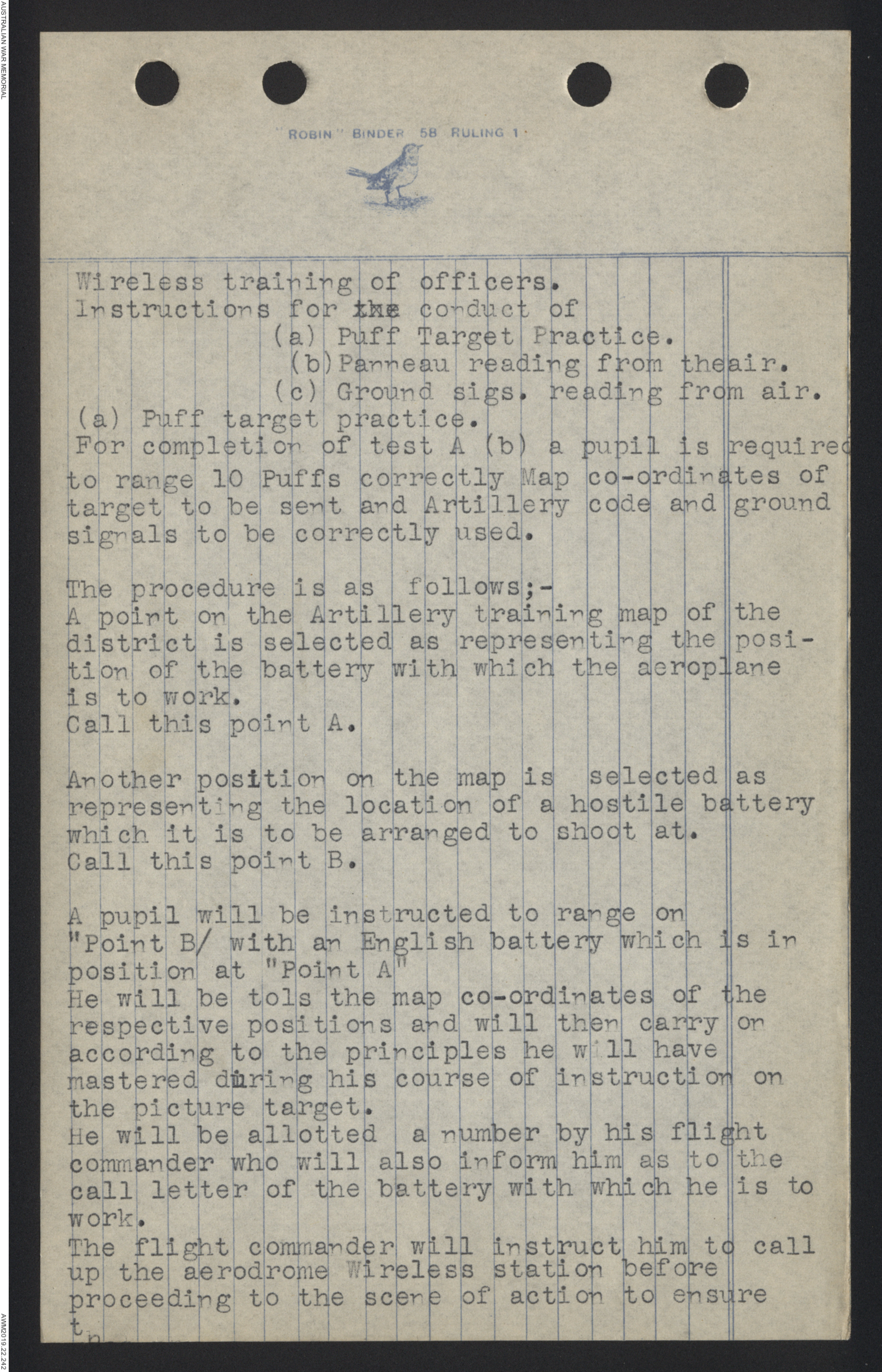
Wireless training of officers.
Instructions for the conduct of
(a) Puff Target Practice.
(b) Panneau reading from the air.
(c) Ground sigs. reading from air.
(a) Puff target practice.
For completion of test A (b) a pupil is required
to range 10 Puffs correctly Map co-ordinates of
target to be sent and Artillery code and ground
signals to be correctly used.
The procedure is as follows; -
A point on the Artillery training map of the
district is selected as representing the position
of the battery with which the aeroplane
is to work.
Call this point A.
Another position on the map is selected as
representing the location of a hostile battery
which it is to be arranged to shoot at.
Call this point B.
A pupil will be instructed to range on
"Point B/ with an English battery which is in
position at "Point A"
He will be tols the map co-ordinates of the
respective positions and will then carry on
according to the principles he will have
mastered during his course of instruction on
the picture target.
He will be allotted a number by his flight
commander who will also inform him as to the
call letter of the battery with which he is to
work.
The flight commander will instruct him to call
up the aerodrome Wireless station before
proceeding to the scene of action to ensure
t
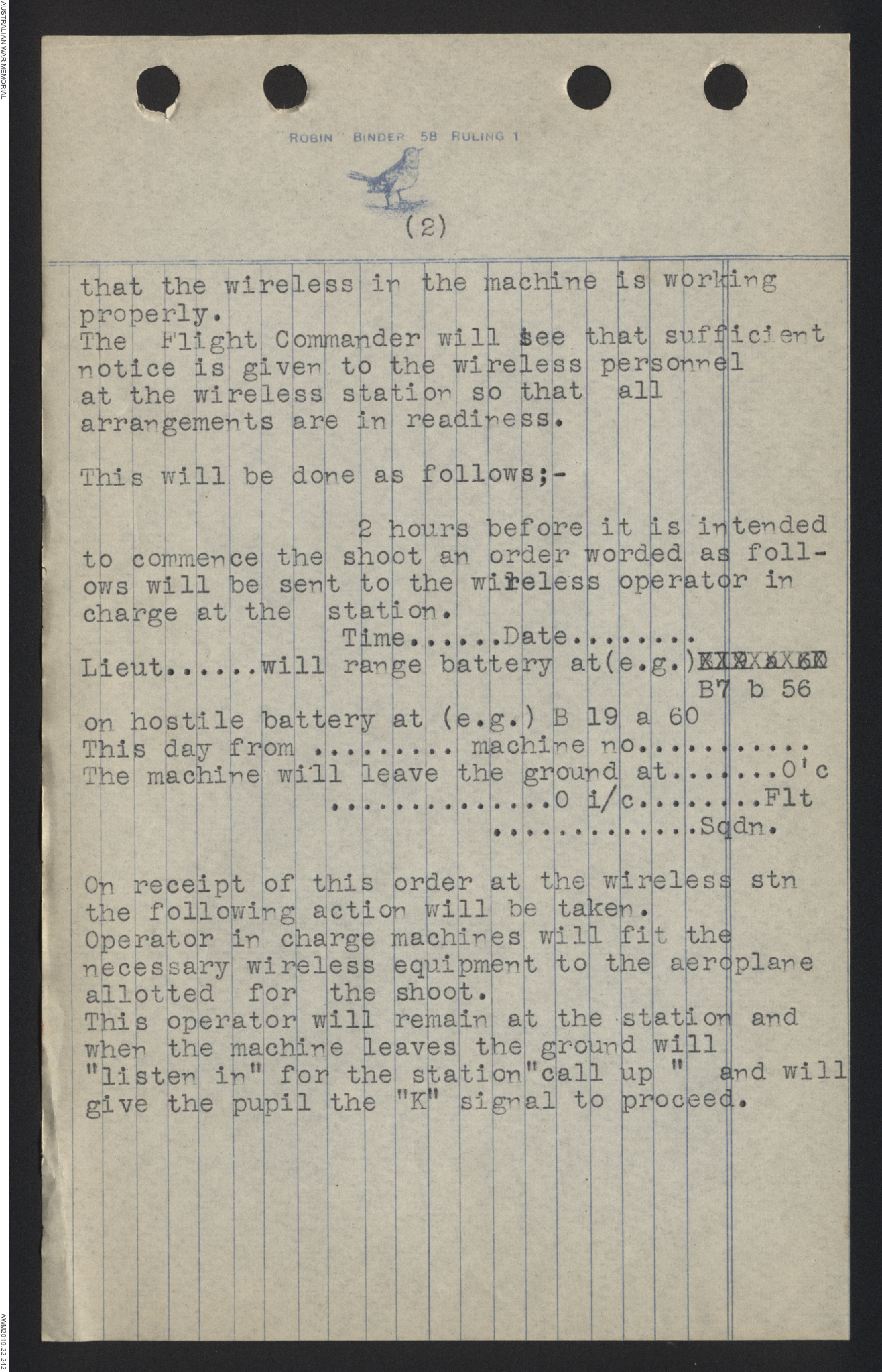
(2)
that the wireless in the machine is working
properly.
The Flight Commander will see that sufficient
notice is given to the wireless personnel
at the wireless station so that all
arrangements are in readiness.
This will be done as follows; -
2 hours before it is intended
to commence the shoot an order worded as follows
will be sent to the wireless operator in
charge at the station.
Time ....... Date..........
Lieut........ will range battery at (e.g.) B 9 A 60 B7 B 56
on hostile battery at (e.g.) B 19 a 60
This day from ......... machine no.........
The machine will leave the ground at .......... O'c
.......... O i/c ..........Flt
..............Sqdn.
On receipt of this order at the wireless stn
the following action will be taken.
Operator in charge machines will fit the
necessary wireless equipment to the aeroplane
allotted for the shoot.
This operator will remain at the station and
when the machine leaves the ground will
"listen in" for the station "call up" and will
give the pupil the "K" signal to proceed.
 Sam scott
This transcription item is now locked to you for editing. To release the lock either Save your changes or Cancel.
This lock will be automatically released after 60 minutes of inactivity.