
Service notebook of Harold Gordon Cornell - 1917 - Part 15
Rigging - FE 2b
of top booms is 3½"; skin equals an angle of 3¾°
(this is for trial flight). Bolt fin on top of tail-plane
and adjust Bottom & top tail bracing wires making
tail plane horizontal & fin vertical. Fin is set central
Materials used Tail booms Hollow spruce, all struts
solid spruce, Fin & Rudder steel tail plane
spruce, with 4 steel compression tubes.
1
Directions for Wire Splicing with English "Tuck"
Splice
1. Bind wires with thread for 2" at distance of 6" from end, &
shape loops & secure
2. Separate strands & bind ends
3. Find "heart" wire & put through the centre of cable &
secure loose end.
4. Hold cable with loose ends pointing away and downwards
and take lowest strand on right & pass it under strand
on right of "heart" wire
5. Work from right to left.
6. Enter No 2 wire where No 1 comes out, and pass under one
strand and pull out
7. Repeat with Nos 3 & 4, entering them where previous wire
comes out
8. Enter No 5 where No 4 comes out & pass under two strands
coming out where No 1 entered
9. Enter No 6 in the same place as No 5 i.e. where No 4 comes
out but pass under one strand only
10. First round completed one wire will come out at each space
it is not necessary now to place wire No 5 under two strand
as in the first round.
2.
Directions for Wire Splicing
11. repeat for 3 rounds over one strand & under one, and
always bury "heart" wire
12. Always pull wires tight & beat into shape after finishing
each round
13. After completing 3 rounds take Nos 1, 3, & 5 wires and
pass them over one strand and under two
14. Cut off ends & bind with thread (the binding should not be
more than 1" long)
1
Sail - making
How to repair bullet or shrapnel hole in a plane
First cut out all bad parts in the shape of a square,
cut each corner ¼" diagonally, turning in edges ¼".
Cut a patch ¼" bigger all round turning in edges ¼"
sewing patch with the over & under stitch. Clean round
patch with acetone. Cut a second patch an inch
bigger all round with frayed edges: stick second
patch in tops of first with top. To finish apply two
coats of dope and one of varnish
To mend a slit or tear Draw tear together
with over & under stitch. Clean round stitching with
acetone. Stick a patch an inch wide over stitching.
A second patch 2" wide with frayed edges. To finish
apply two coats of dope & one of varnish.
Uses of Dope. Waterproofing, strengthening, adhesive
purposes, tautness, & renders the plane airtight.
To a new plane. apply at least 5 coats of dope
& two of varnish.
Before covering a plane See that all turnbuckles are safely
locked
2.
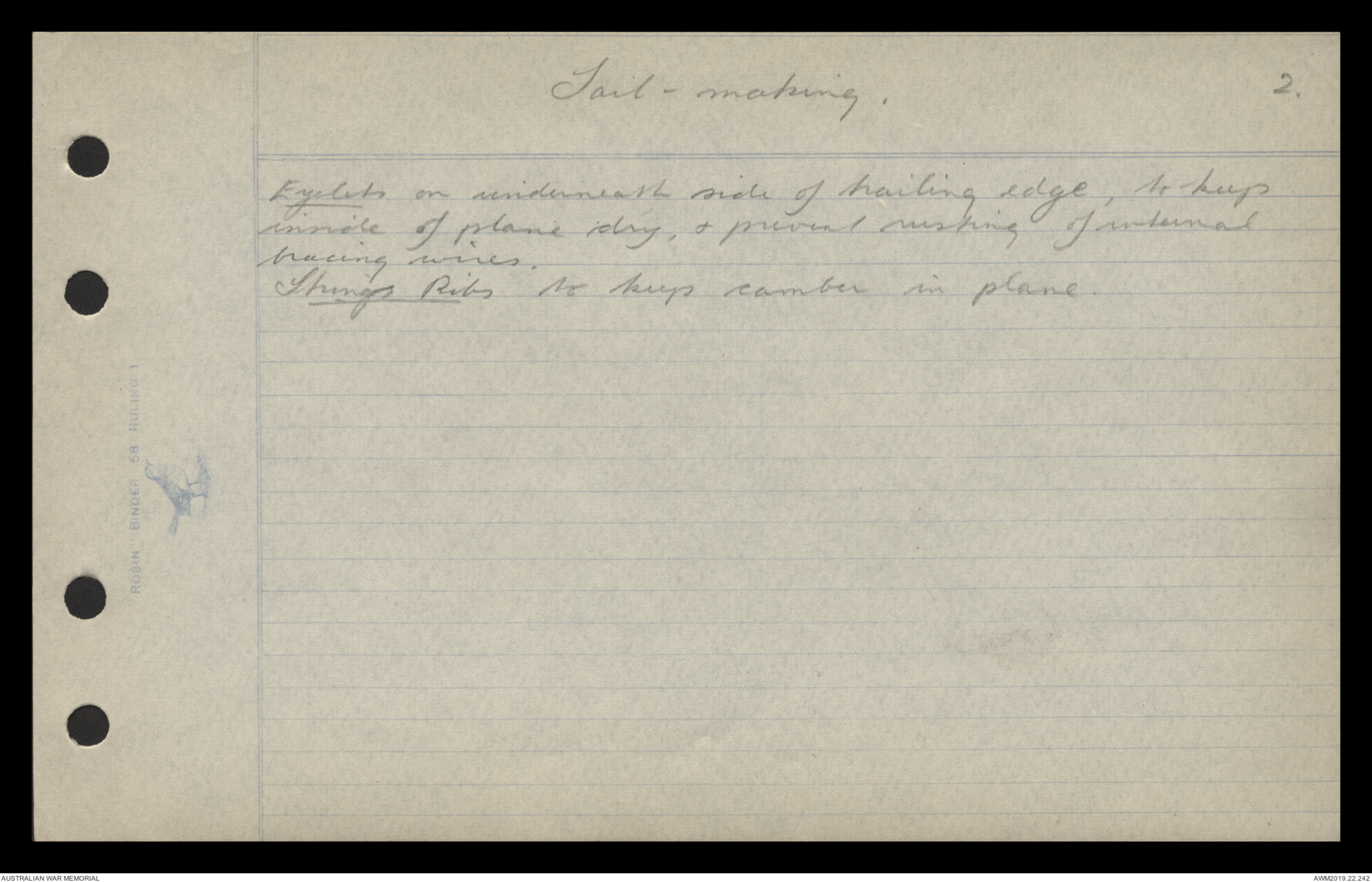
Sail - making.
Eyelets on underneath side of trailing edge to keep
inside of plane dry, & prevent rusting of internal
bracing wires.
Strings Ribs to keep camber in plane.
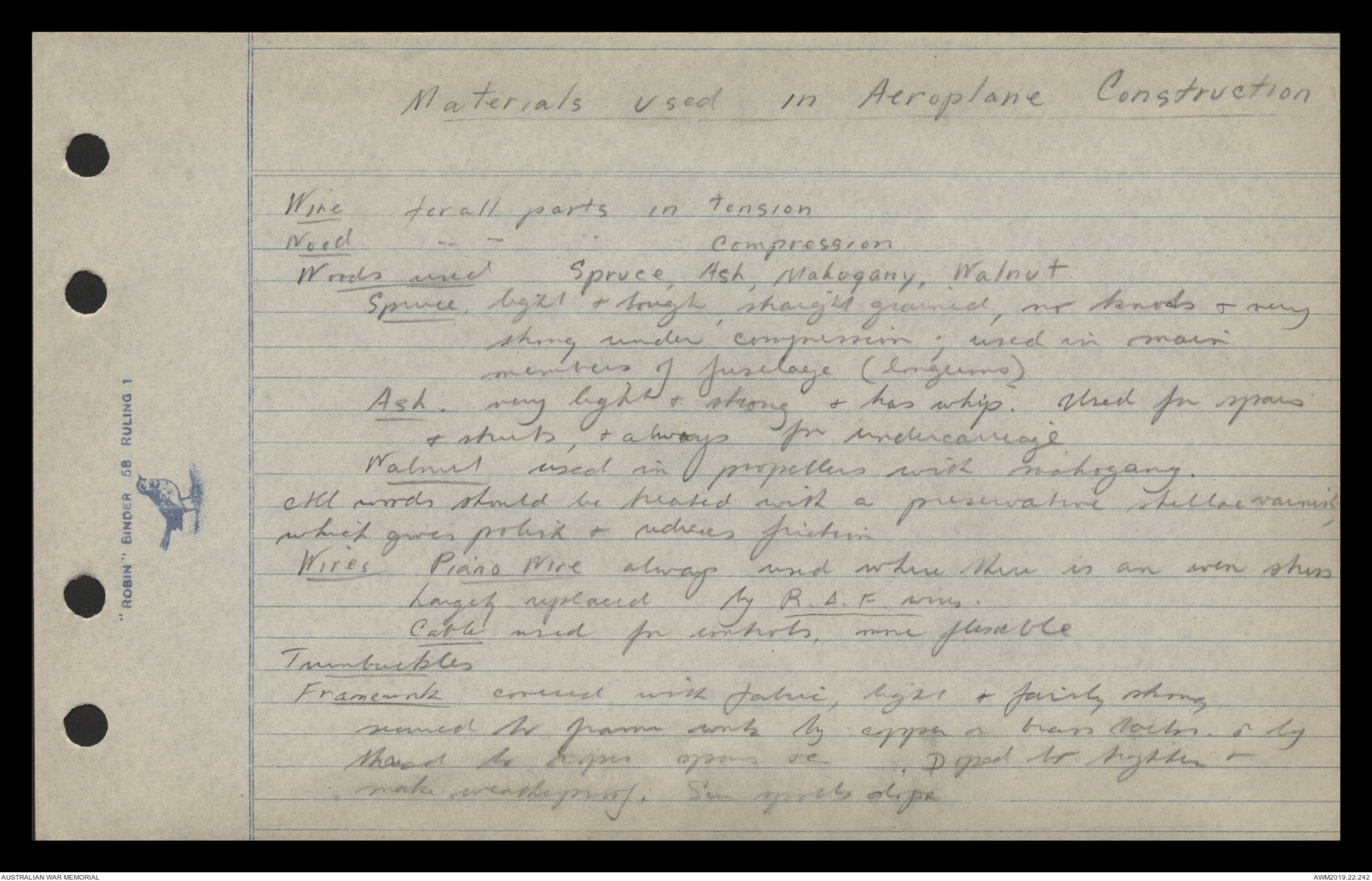
Materials used in Aeroplane Construction
Wire for all parts in tension
Wood " " " " compression
Woods used Spruce, Ash, Mahogany, Walnut
Spruce, Light & tough, straight grained, no knots & very
strong under compression; used in main
members of fuselage (longerons)
Ash. very light & strong & has whip. Used for spars
& struts, & always for undercarriage
Walnut used in propellers with mahogany.
All woods should be treated with a preservative shellac varnish
which gives polish & reduces friction
Wires Piano Wire always used where there is an even stress
largely replaced by R.A.F. wires.
Cable used for controls, more flexible
Turnbuckles
Framework covered with fabric, light & fairly strong
secured to frame work by copper or brass locks or by
thread to ropes spars &c. Doped to tighten &
make weatherproof. Sun spoils dope
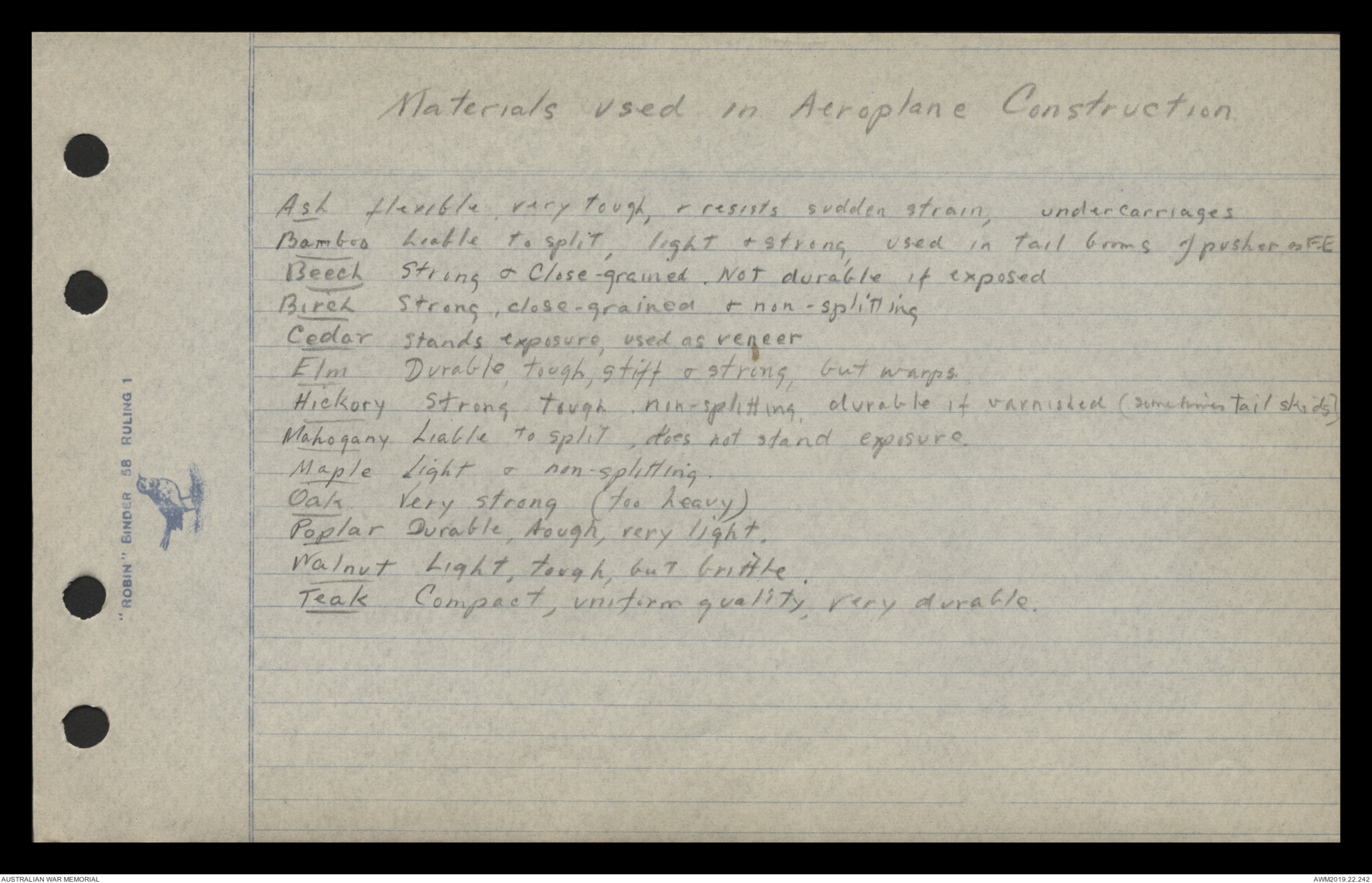
Materials used in Aeroplane Construction.
Ash flexible, very tough, & resists sudden strain, undercarriages
Bamboo Liable to split, light & strong, used in tail booms of pusher as F.E.
Beech Strong & Close-grained. Not durable if exposed
Birch Strong, close-grained & non-splitting
Cedar Stands exposure, used as veneer
Elm Durable, tough, stiff & strong, but warps
Hickory Strong tough, non-splitting, durable if varnished (sometimes tail skids)
Mahogany Liable to split, does not stand exposure.
Maple Light & non-splitting.
Oak Very strong (too heavy)
Poplar Durable, tough, very light
Walnut Light, tough but brittle.
Teak Compact, uniform quality, very durable.
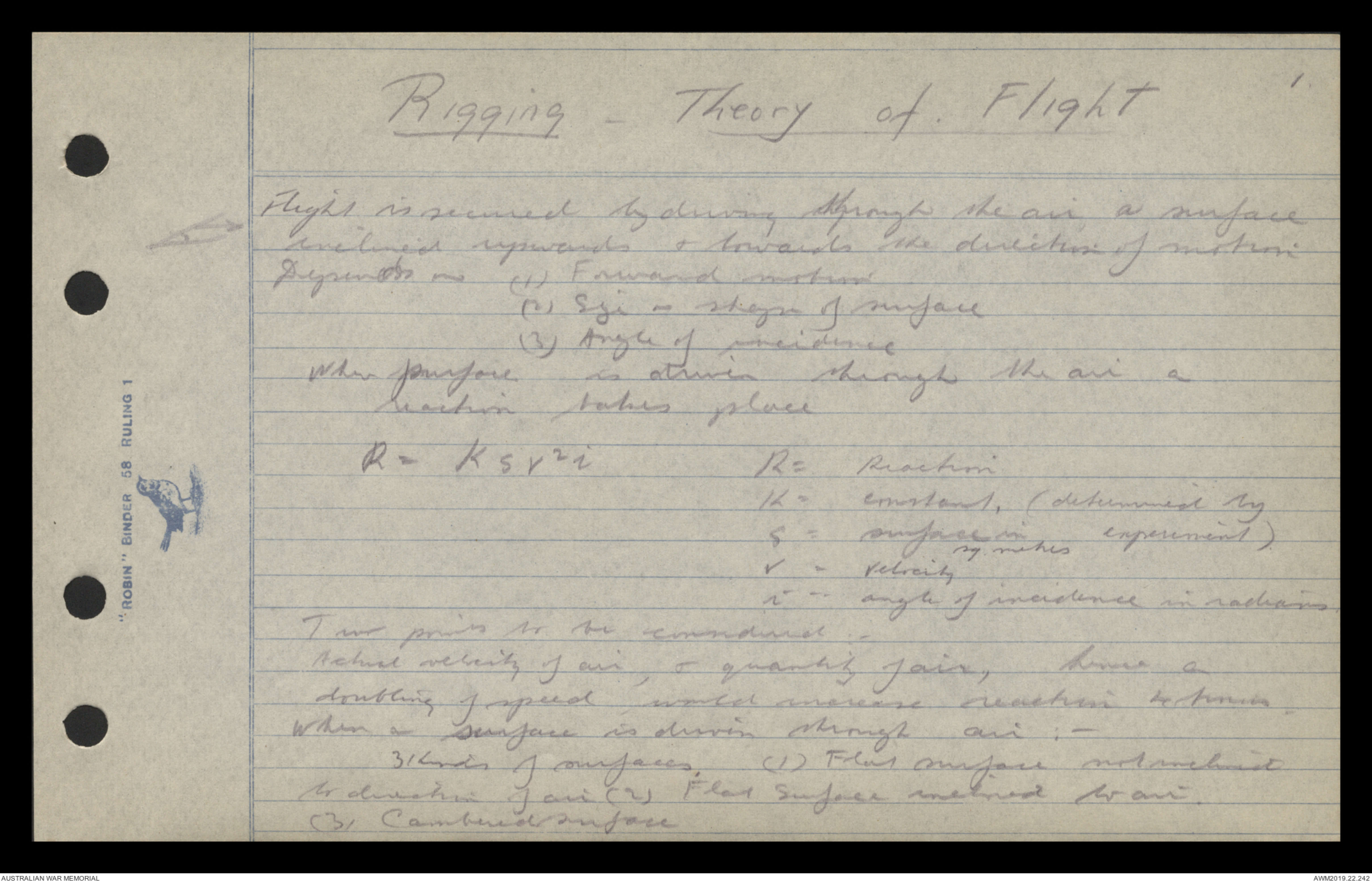
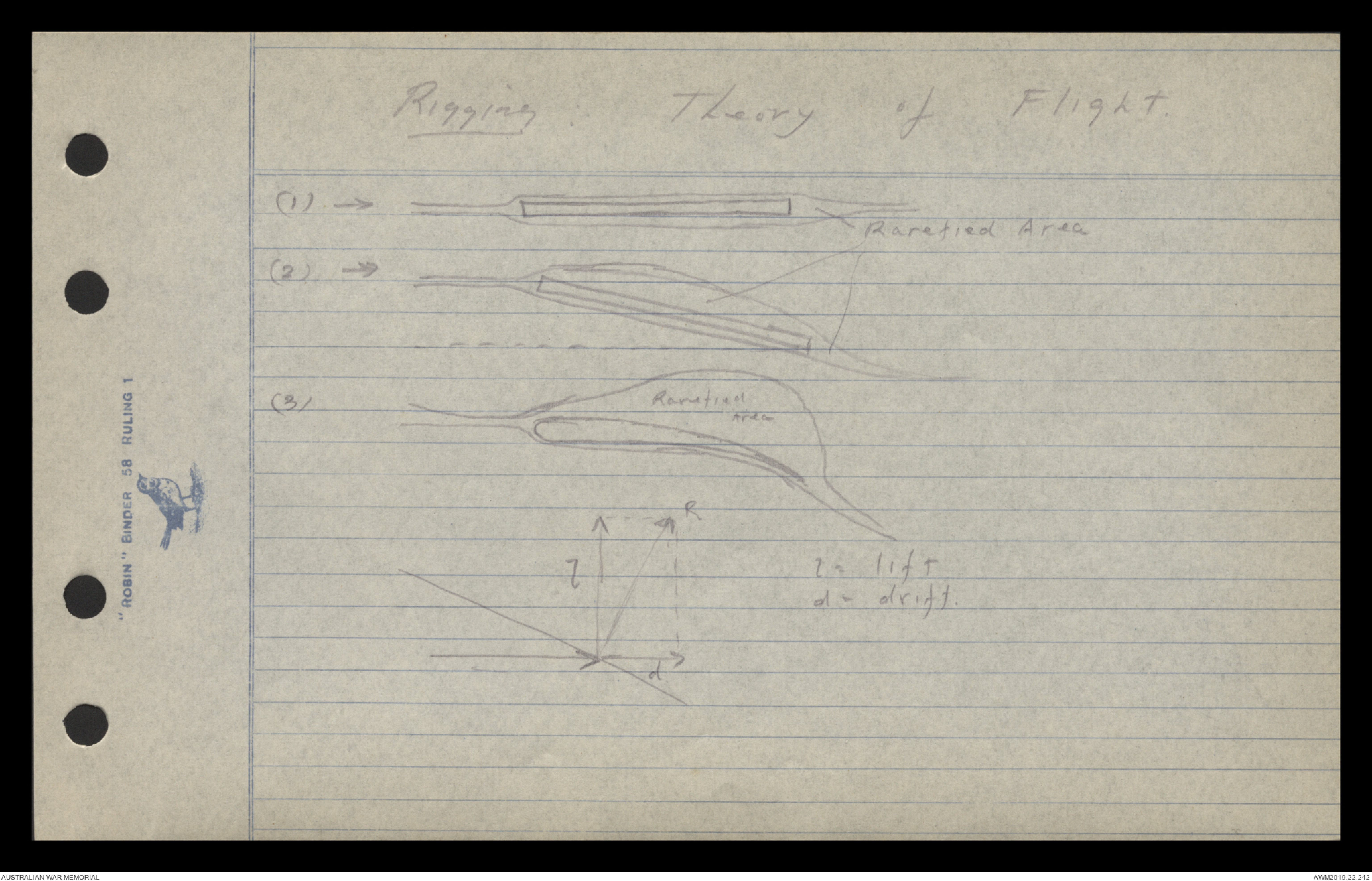
Rigging - Theory of Flight
Flight is secured by driving through the air a surface
[*diagram-see original document*]
inclined upwards and towards the direction of motion
Depends on (1) Forward motion
(2) Size - shape of surface
(3) Angle of incidence
When purfore is driven through the air a
reaction takes place
R = k s v2 i R = Reaction
K = constant (determined by experiment)
S = surface in
sq metres
V = velocity
i = angle if incidence in radians
Two points to be considered:-
Actual velocity of air, & quality of air, hence a
doubling of speed would increase reaction 4 times
When a surface is driven through air:-
3 kinds of surfaces, (1) Flat surface not inclined
to direction of air (2) Flat Surface inclined to air.
(3) Combined surface
Rigging : Theory of Flight
Diagrams - see original document
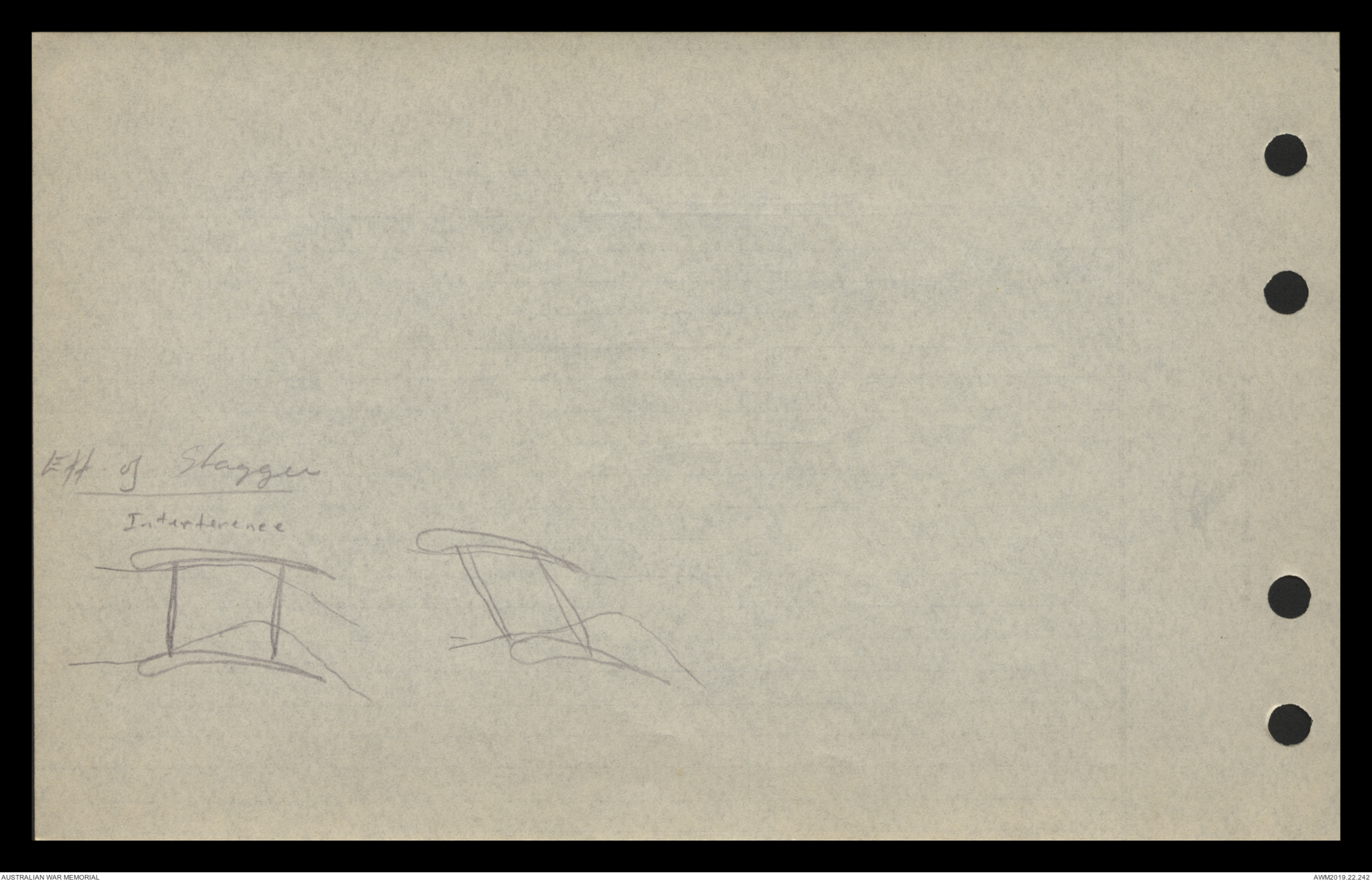
Eff of Stagger
Interference
Diagrams - see original document
 Jasmine Hatharasinghe
This transcription item is now locked to you for editing. To release the lock either Save your changes or Cancel.
This lock will be automatically released after 60 minutes of inactivity.