
Service notebook of Harold Gordon Cornell - 1917 - Part 2
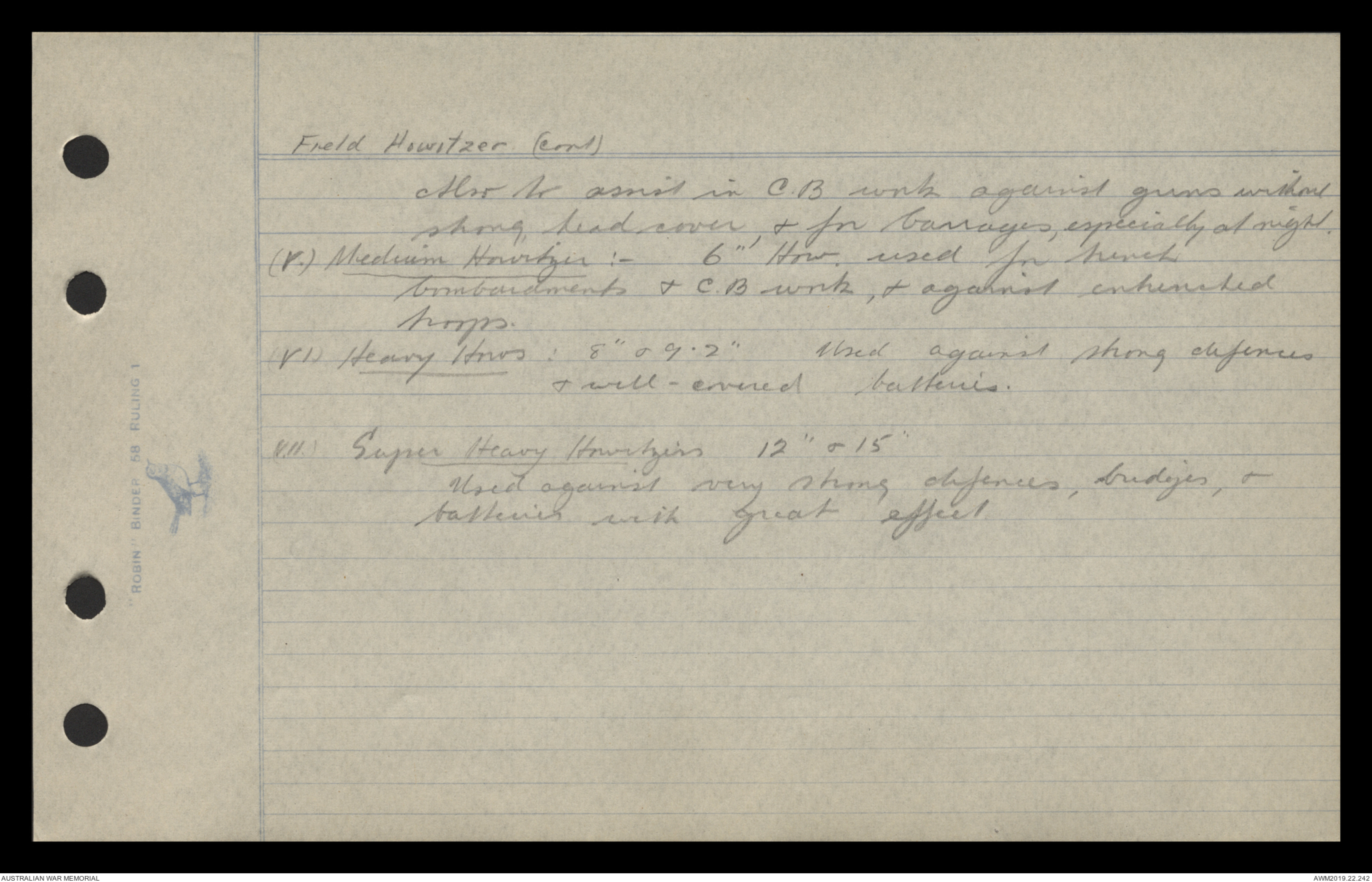
Field Howitzer (cont)
Also to assist in C.B work against guns without
strong, head cover, & for barrages, especially at night
(V.) Medium Howitzer :- 6" How used for trench
bombardments & C.B work, & against entrenched
troops.
(VI) Heavy Hows : 8" & 9.2" Used against strong defences
and well-covered batteries.
(VII) Super Heavy Howitzers 12" & 15"
Used against very strong defences, bridges, &
batteries with great effect.
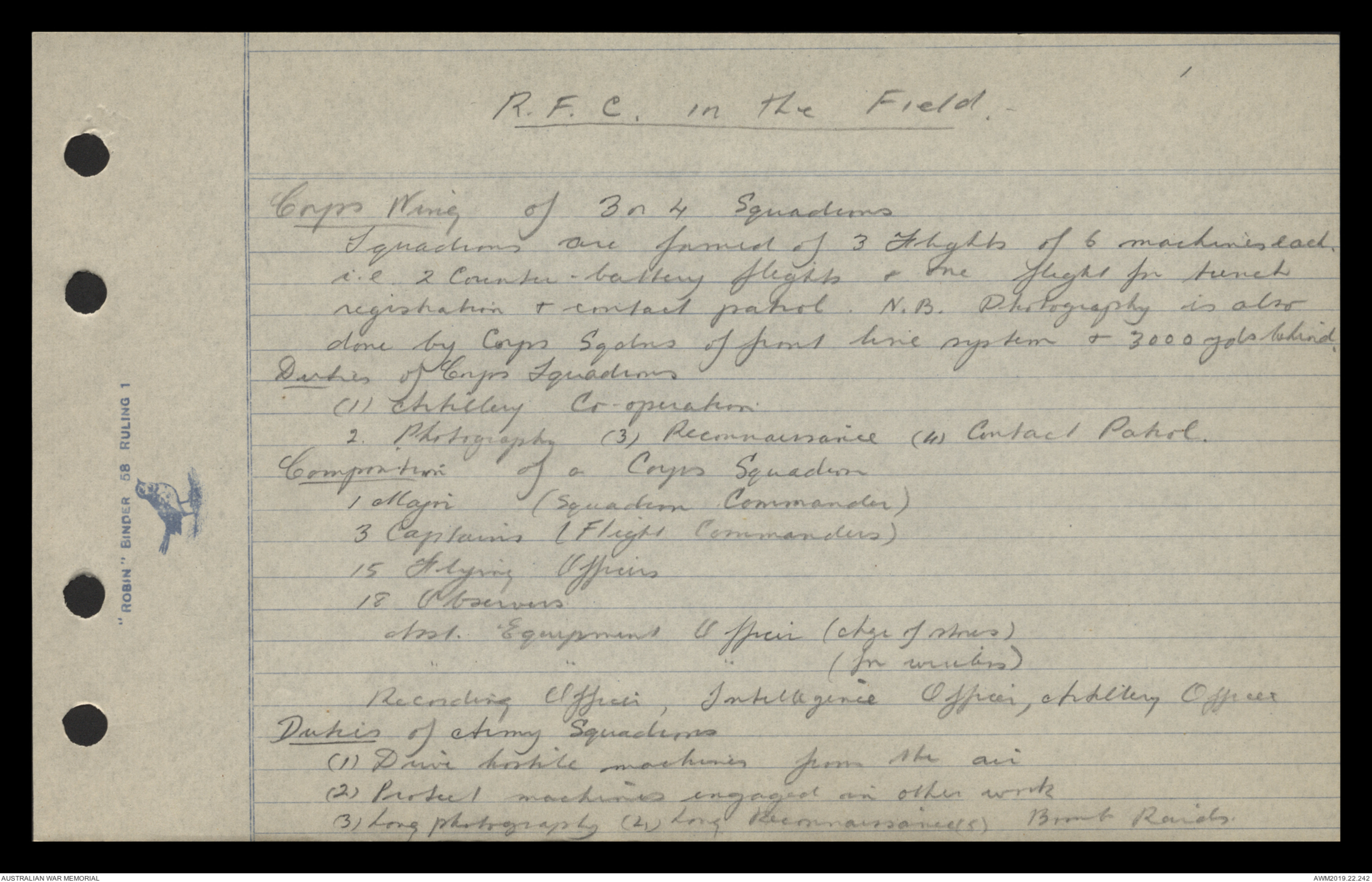
R.F.C. in the Field.
Corps Wing of 3 or 4 Squadrons
Squadrons are formed of 3 Flights of 6 machines each.
i.e. 2 counter-battery flights & one flight for trench
registration & contact patrol. N.B. Photography is also
done by Corps Sqdns of front line system & 3000 yds behind.
Duties of Corps Squadrons
(1) Artillery Co-operation
2. Photography (3) Reconnaissance (4) Contact Patrol.
Composition of a Corps Squadron
1 Major (Squadron Commander)
3 Captains (Flight Commanders)
15 Flying Officers
18 Observers
Asst. Equipment Officer (chge of stores)
" " " ( for wireless)
Recording Officer, Intelligence Officer, Artillery Officer
Duties of Army Squadrons
(1) Drive hostile machines from the air
(2) Protect machines engaged in other work
(3) Long photography (4) Long Reconnaissance (5) Bomb Raids.
R.F.C. in the Field
Aircraft depots (2 in France at present)
Responsible for New Machines, Equipment Officers, Pilots
Aircraft parks (1 to each Brigade)
Responsible for parts, engines, & spares being distributed
to Squadrons.
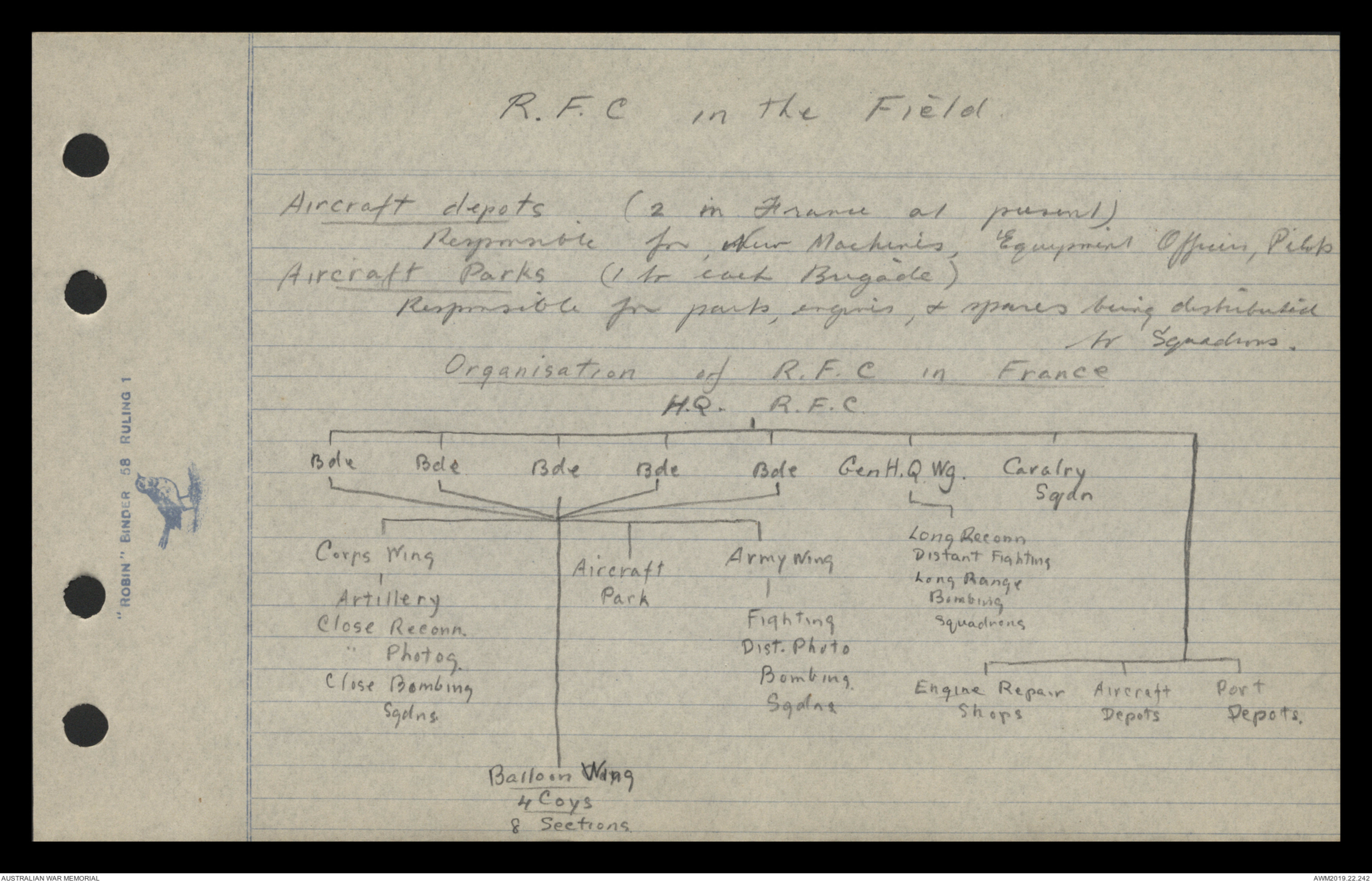
Organisation of R.F.C in France
H.Q R.F.C.
Hand drawn Diagram - see original document
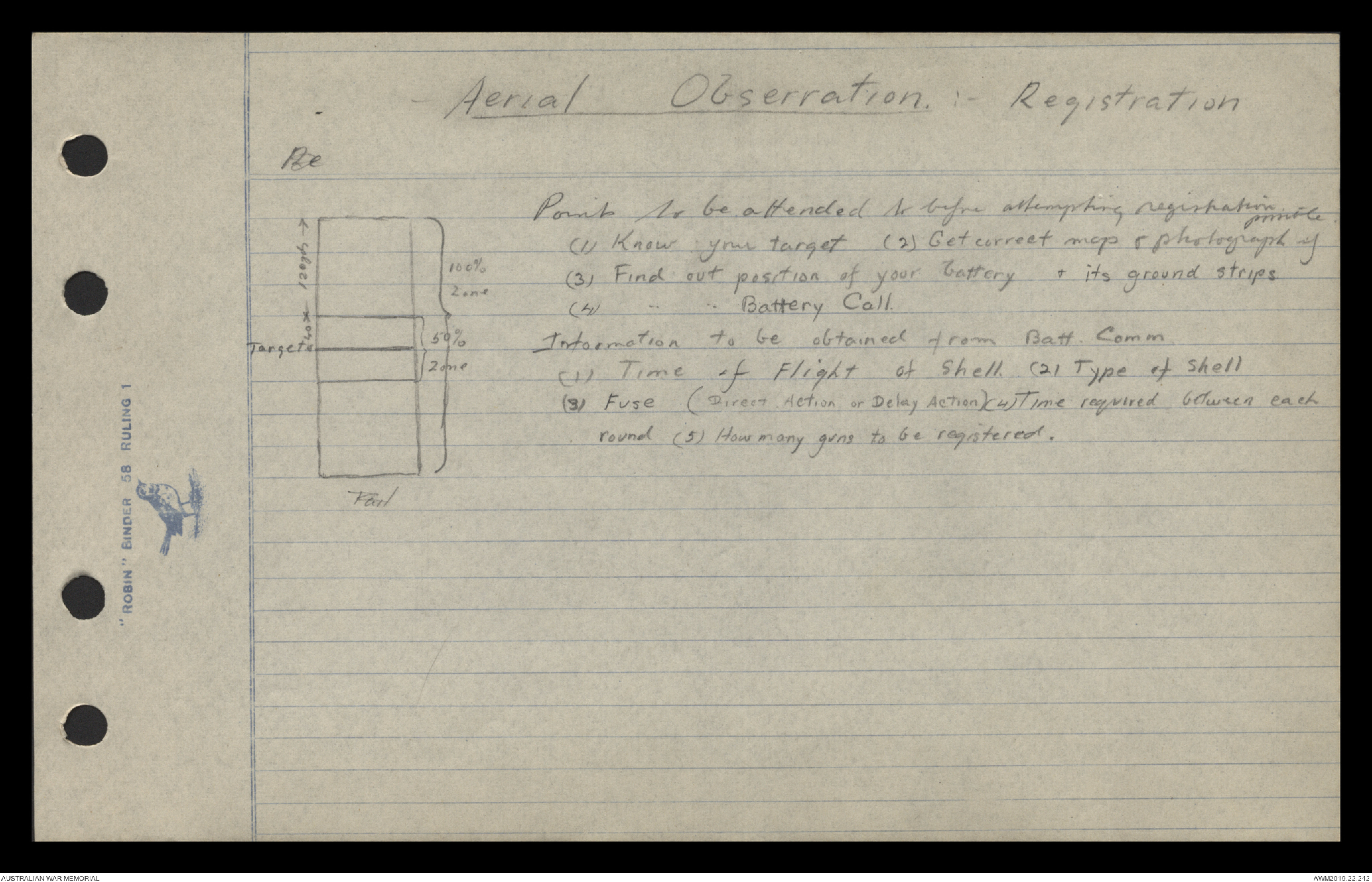
Aerial Observation. :- Registration
Hand drawn Diagram - see original document
Points to be attended to before attempting registration.
(1) Know your target (2) Get current map & photograph if possible.
(3) Find out position of your battery & its ground strips
(4) " " Battery Call.
Information to be obtained from Batt. Comm.
(1) Time of Flight of Shell. (2) Type of shell
(3) Fuse (Direct Action or Delay Action) (4) Time required between each
round (5) How many guns to be registered.
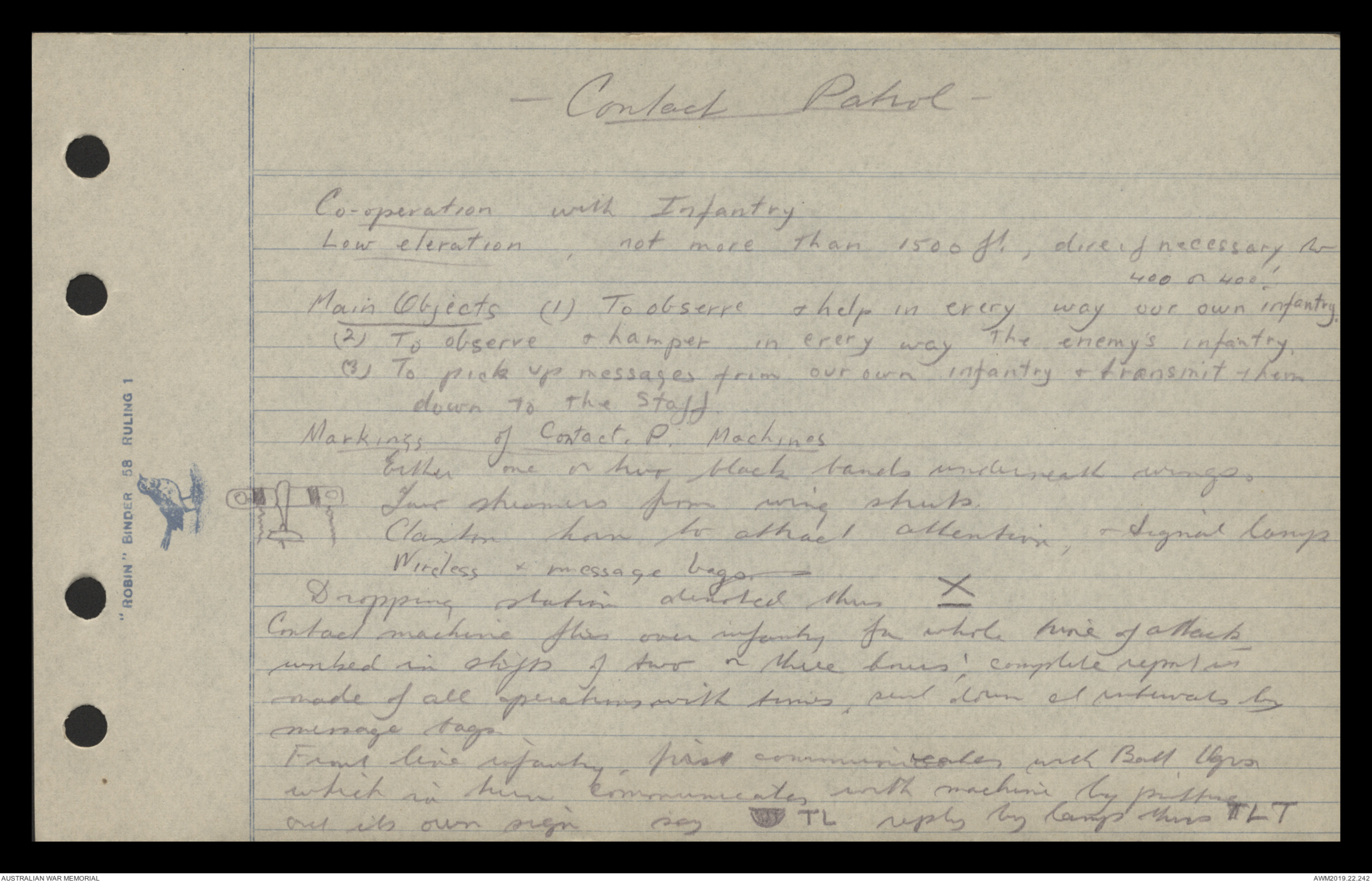
- Contact Patrol -
Co-operation with Infantry
Low elevation not more than 1500ft, dive if necessary to
400 or 400!
Main Objects (1) To observe & help in every way our own infantry.
(2) To observe & hamper in every way the enemy's infantry.
(3) To pick up messages from our own infantry & transmit them
down to the staff
Markings of Contact. P. Machines
Hand drawn diagram - see original document
Either one or two bands underneath wings.
Two streamers from wing struts
Claxton horn to attract attention, & Signal lamps
Wireless & message bags.
Dropping station denoted thus X
Contact machine flies over infantry for whole time of attack
worked in shifts of two or three hours; complete report is
made of all operations with times, sent down at intervals by
message bags.
Front line infantry, first communicates with Batt Hqrs
which in turn communicates with machine by putting
out its own sign say hand drawn symbol - see original document TL reply by lamp thus TLT
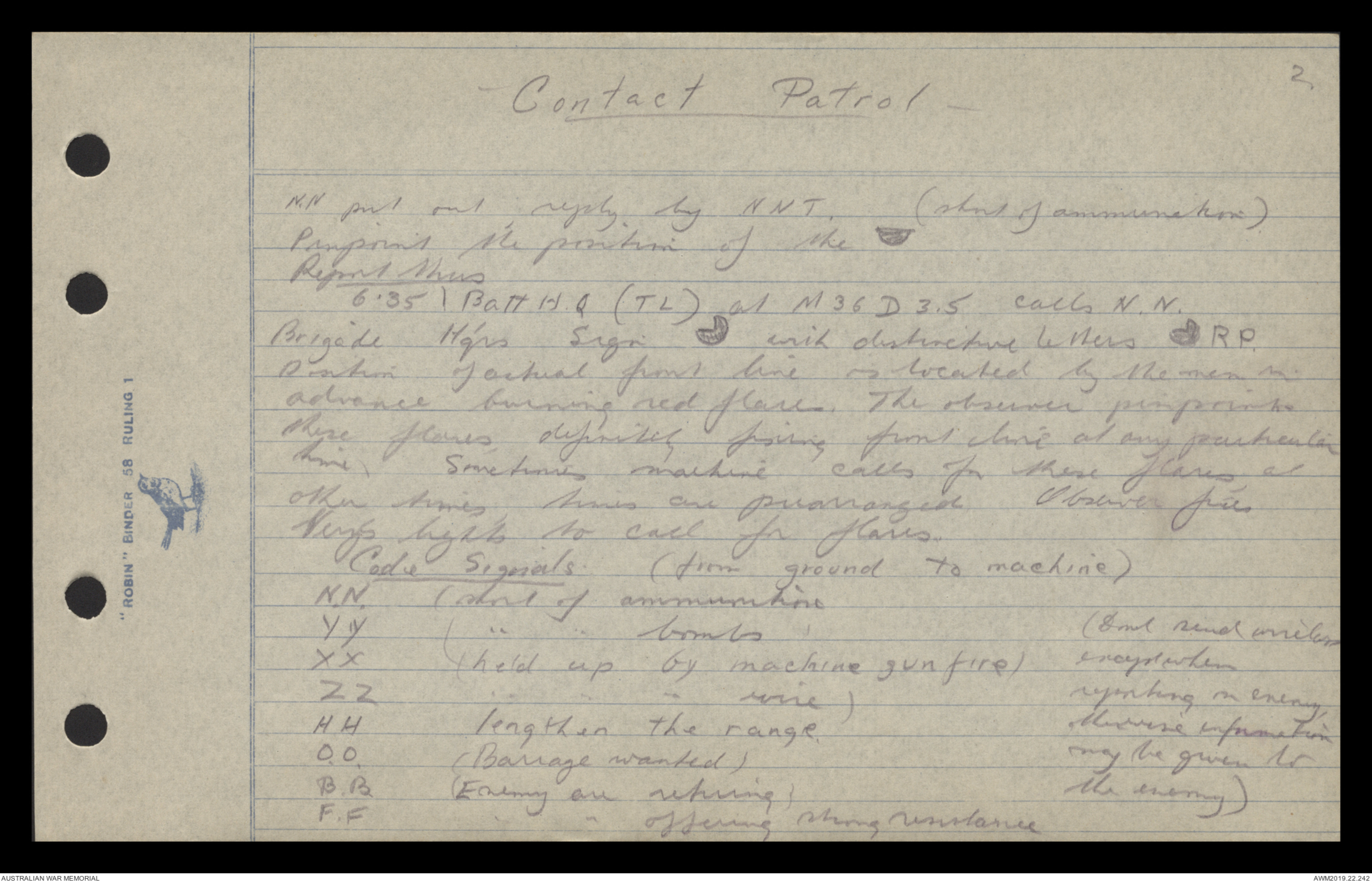
- Contact Patrol - 2.
N.N put our reply by NNT (start of communication)
Pinpoint the position of the hand drawn symbol - see original document
Report thus
6.35 / Batt H.Q (TL) at M 36 D 3.5 calls N.N.
Brigade Hq'rs Sign hand drawn symbol - see original document with distinctive letters hand drawn symbol - see original document RP.
Position of actual front line is located by the men in
advance burning red flares. The observer pinpoints
these flares, definitely fixing front line at any particular
time. Sometimes machine calls for these flares, at
other times times are prearranged Observe fires
Verys lights to call for flares.
Code Signals: (from ground to machine)
N.N. (short of communication
YY ( " " bombs
XX (held up by machine gun fire)
ZZ ( " " " wire)
HH lengthen the range
O.O. (Barrage wanted)
B.B. (Enemy are returning)
F.F. " " offering strong resistance
[*(Dont send wireless
except when
reporting on enemy,
otherwise information
may be given to
the enemy)*]
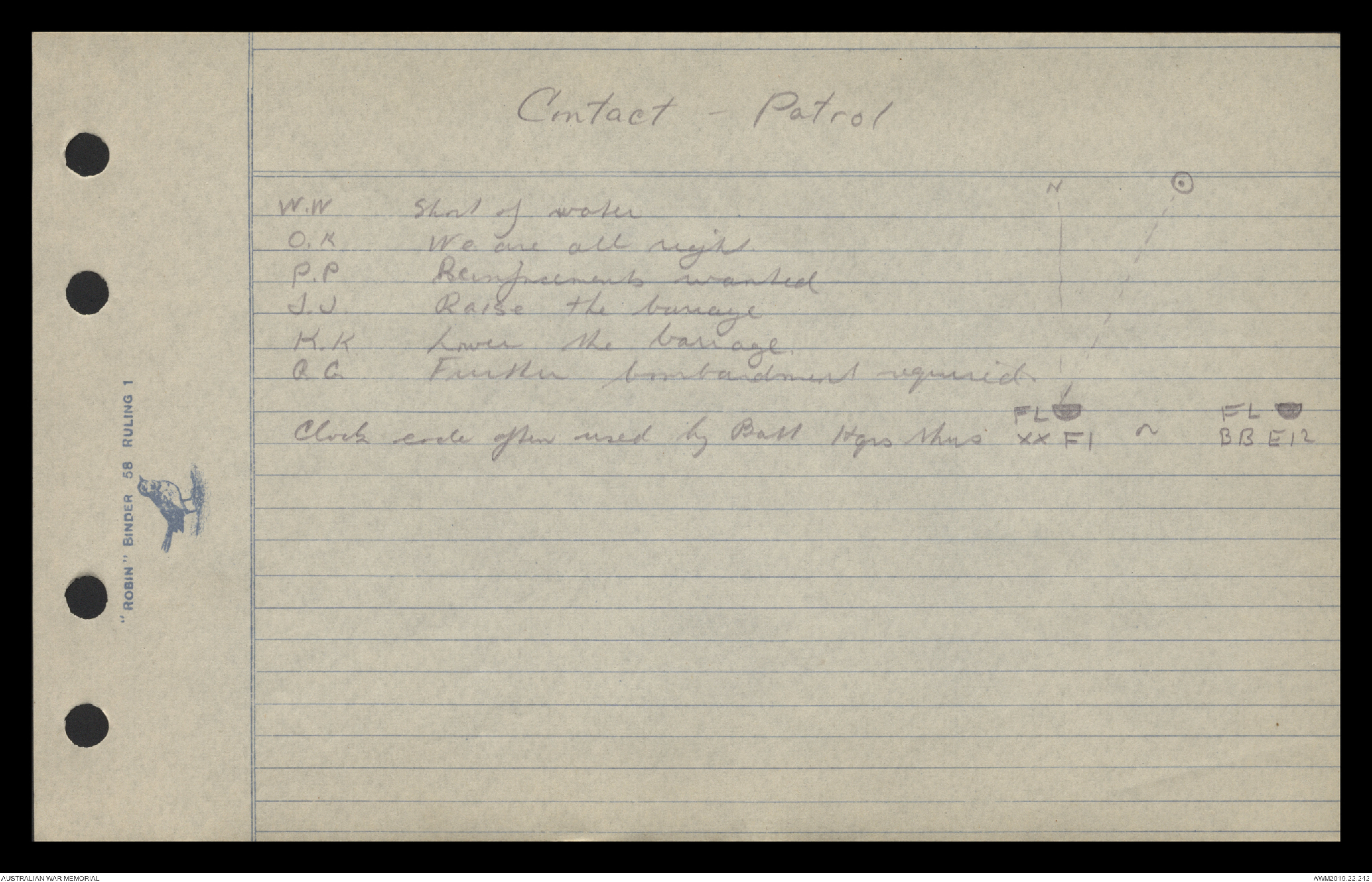
Contact - Patrol
W.W Short of water
O.K We are all right.
P.P Reinforcements wanted
J.J Raise the barrage
K.K Lower the barrage
G.G Further bombardment required.
Clock circle often used by Batt Hqrs thus
Hand drawn diagram - see original document
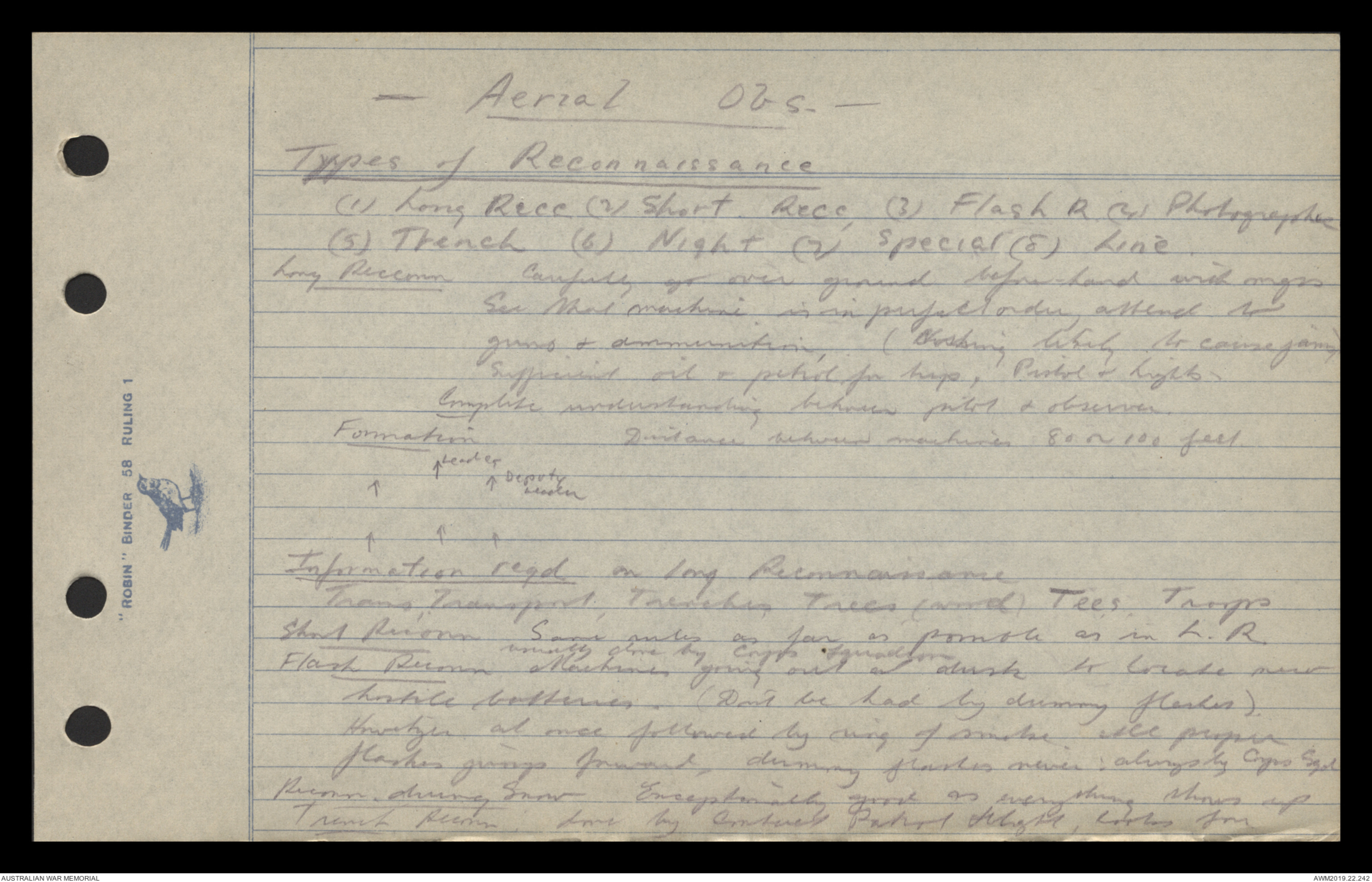
- Aerial Obs. -
Types of Reconnaissance
(1) Long Recc (2) Short Recc, (3) Flash R. (4) Photographic
(5) Trench (6) Night (7) Special (8) Line.
Long Reconn Carefully go over ground before-hand with signs
See that machine is in perfect order, attend to
guns & ammunition, (stashing likely to cause jaming)
Sufficient oil & petrol for trip, Pistol & Lights.
Complete understanding between pilot & observer.
Formation Distance between machines 80 or 100 feet
Hand drawn diagram - see original document
Information reqd on long Recconnaissance
Trains, Transport, Trenches, Trees (wood) Tees, Troops
Short Reconn Same rules as far as possible as in L.R.
usually done by Corps Squadron
Flash Reconn Machines going out at dusk to locate new
hostile batteries. (Don't be had by dummy flashes).
Howitzer at once followed by ring of smoke. All proper
flashes jump forward, dummy flashes never: always by Corps Sqd
Reconn. during Snow Exceptionally good as everything shows up
Trench Reconn done by Contact Patrol Flight, looks for
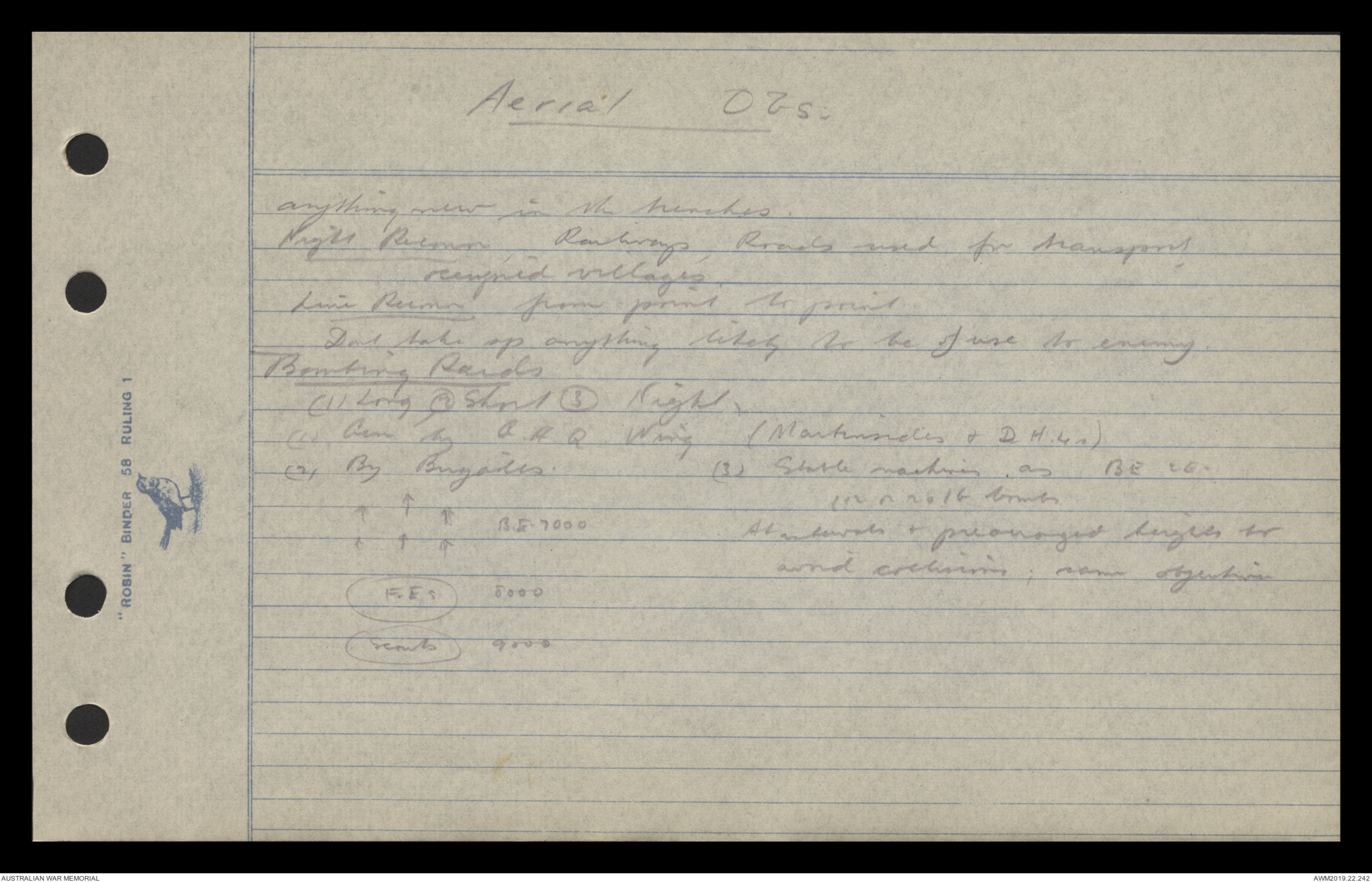
Aerial Obs.
anything new in the trenches.
Night Reconn Railways, Roads used for transport,
occupied villages.
Line Reconn from point to point.
Dont take up anything likely to be of use to enemy.
Bombing Raids
(1) Long (2) Short (3) Night,
(1) Gen by G.H.Q. Wing (Martinsides & D.H.4s)
(2) By Brigades. (3) Stable machines as BE 2E
(12 or 20 lb bombs
At intervals & prearranged heights to
avoid collisions; same objective
Hand drawn diagram - see original document
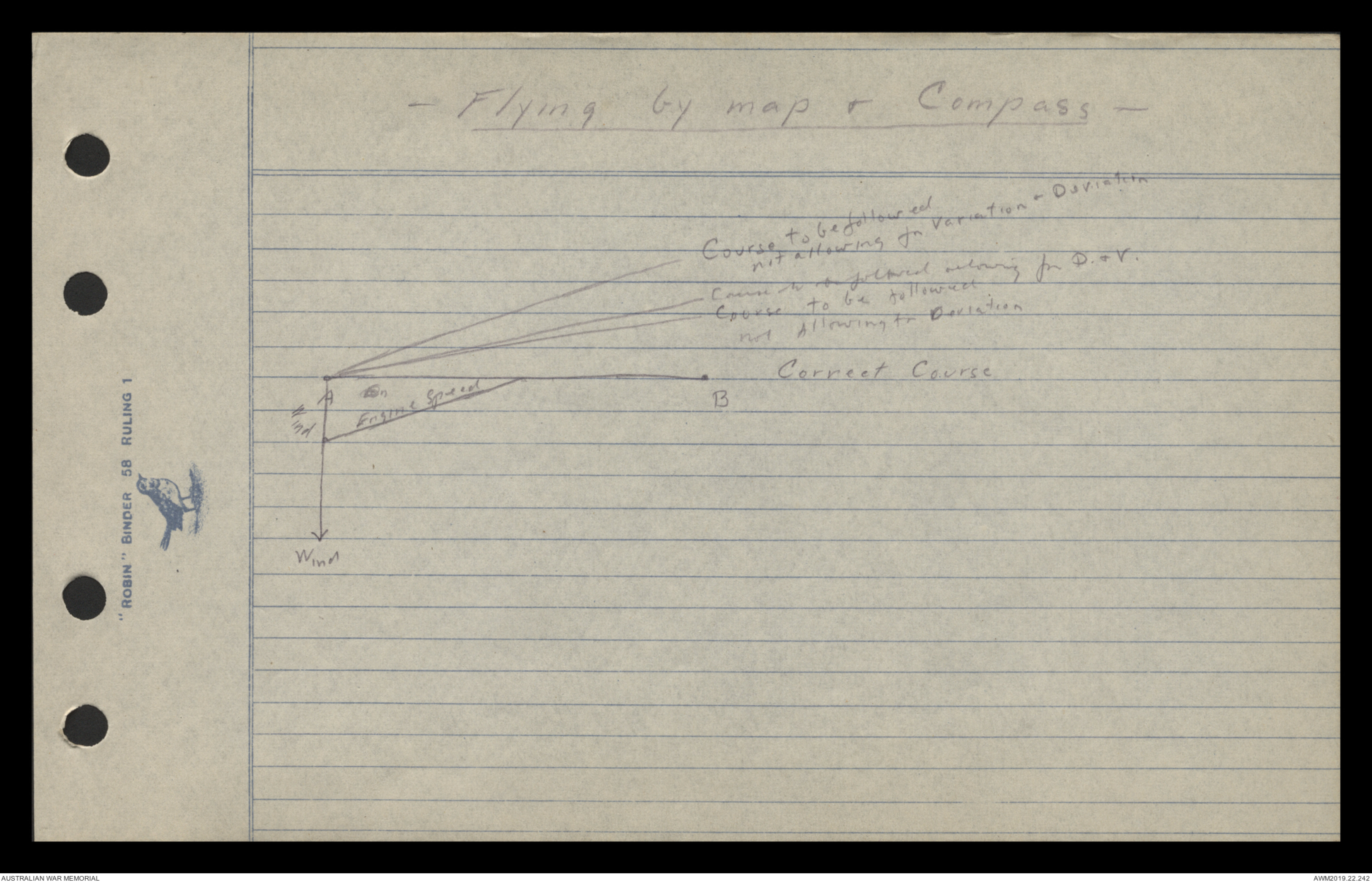
- Flying by map & Compass -
Hand drawn diagram - see original document
 Jen
Jen This transcription item is now locked to you for editing. To release the lock either Save your changes or Cancel.
This lock will be automatically released after 60 minutes of inactivity.