
Service notebook of Harold Gordon Cornell - 1917 - Part 1
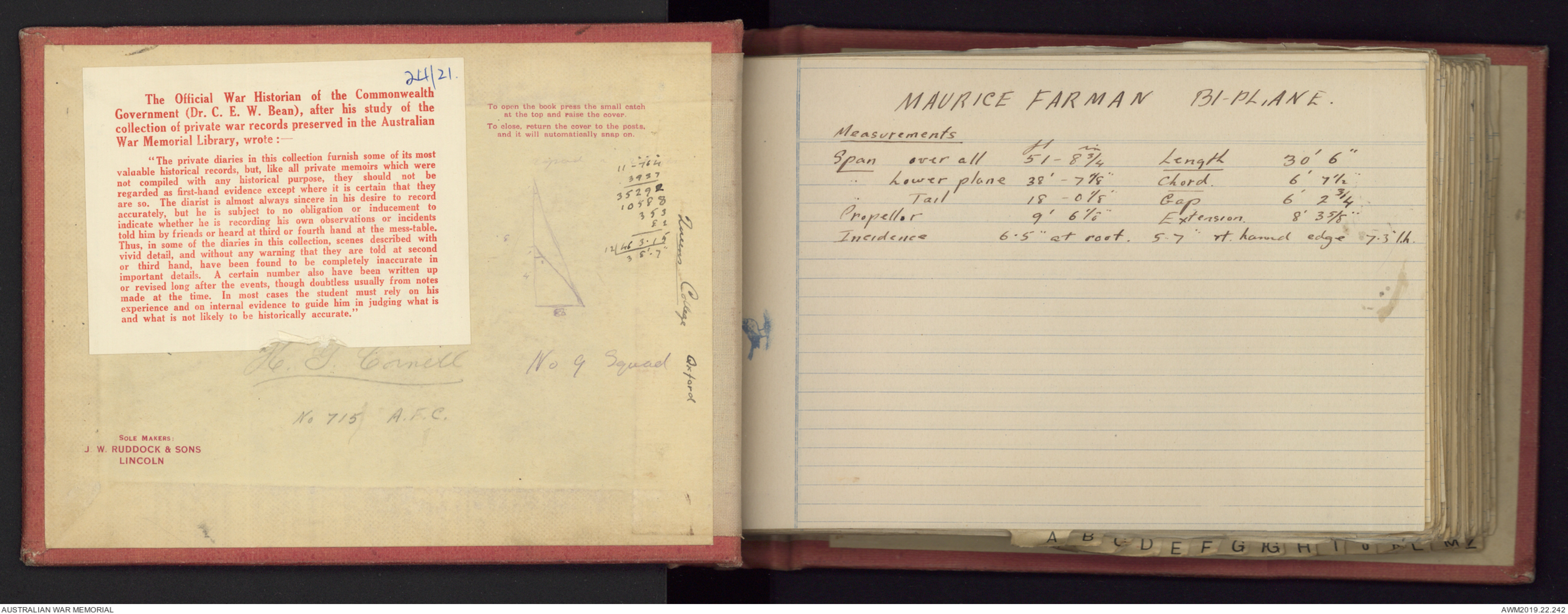
Inside front cover of diary - see original
Hand drawn diagram - see original document
11-764
3937
35292
10588
353
52
12|463.15
3.5'-7"
[*Queens College Oxford*]
H. G. Cornell No 9 Squad
No 715 A.F.C.
MAURICE FARMAN BI-PL,ANE.
Measurements
ft in
Span over all 51 - 8 ¾ Length 30' 6"
" Lower plane 38' - 7 1⁄8" Chord. 6' 7 ½"
" Tail 18 - 0 1⁄8" Gap 6' 2 ¾"
Propellor 9' 6 1⁄8" Extension 8' 3 5⁄8"
Incidence 6.5" at root. 5.7" rt. hand edge 7.3" l.h.
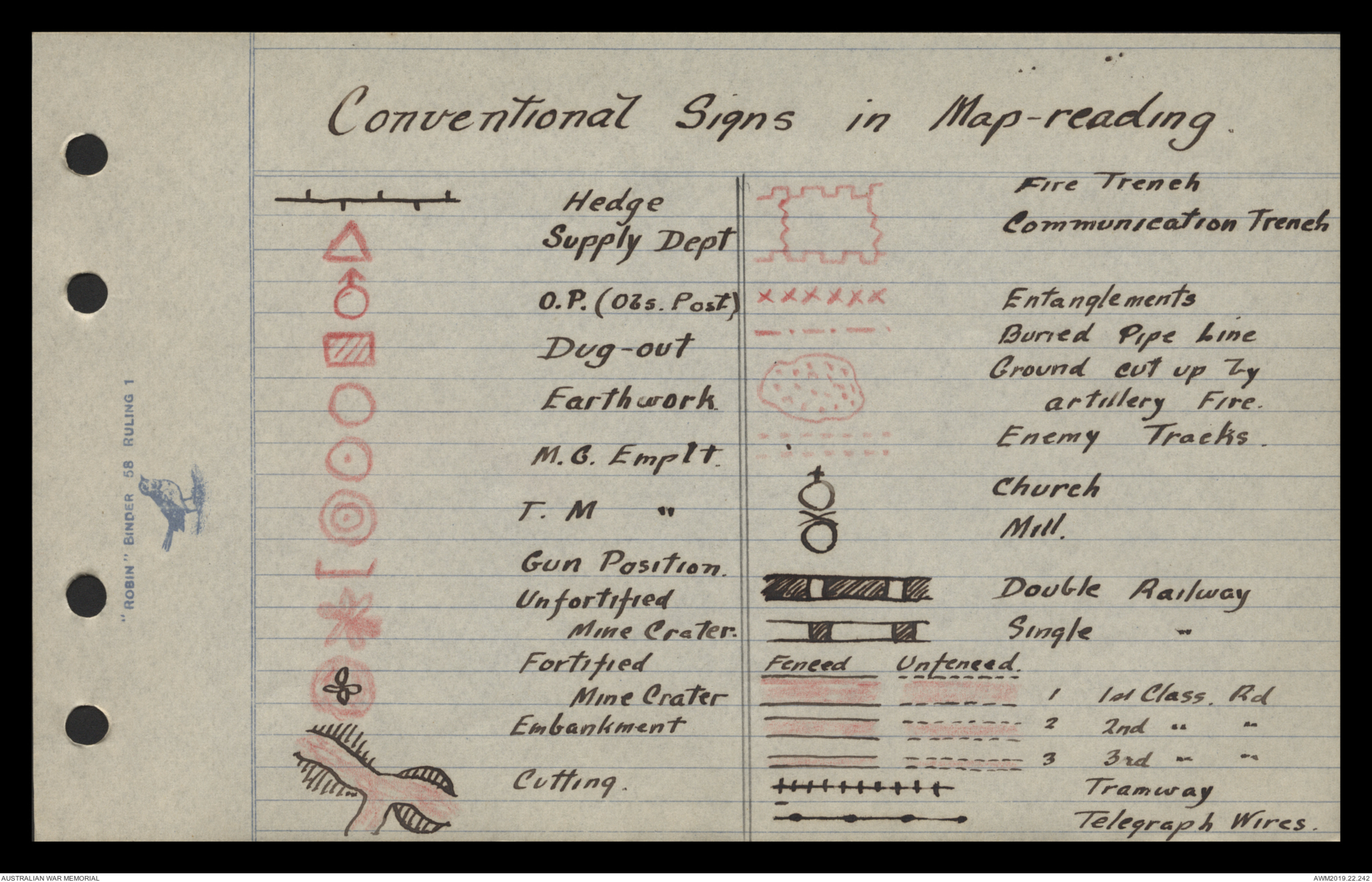
Conventional Signs in Map-reading.
Diagrams- see original document
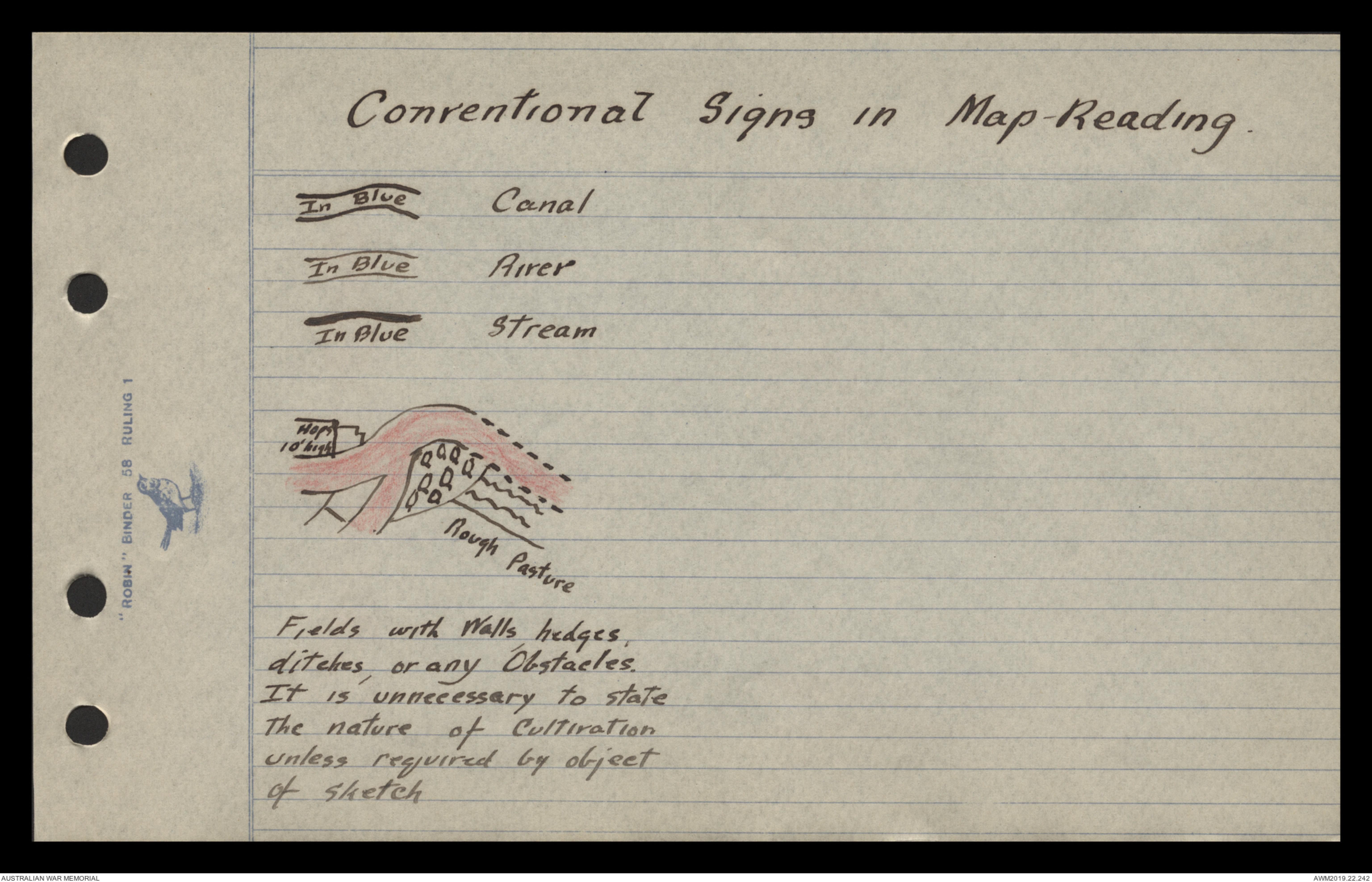
Conventional Signs in Map-Reading.
Diagrams - see original document
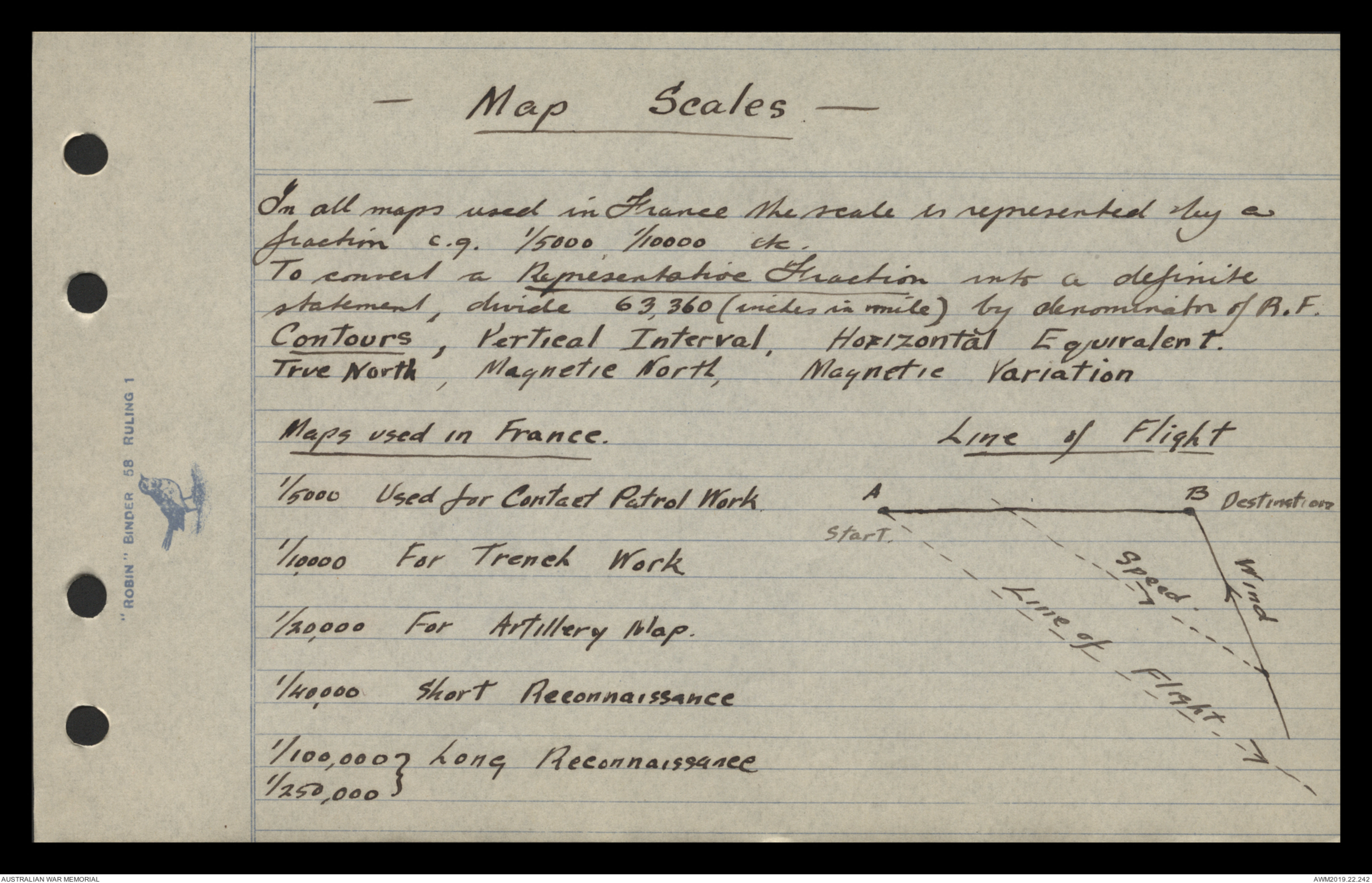
Map Scales
In all maps used in France the scale is represented by a
fraction e.g. 1/5000, 1/10000 etc.
To convert a Representative Fraction into a definite
statement, divide 63,360 (inches in mile) by denominator of R.F.
Contours, Vertical Interval, Horizontal Equivalent.
True North, Magnetic North, Magnetic Variation
Maps used in France.
1/5000 Used for Contact Patrol Work.
1/10,000 For Trench Work
1/20,000 For Artillery Map.
1/40,000 Short Reconnaissance
1/100,000} Long Reconnaissance
1/250,000}
Line of Flight
Diagram - see original document
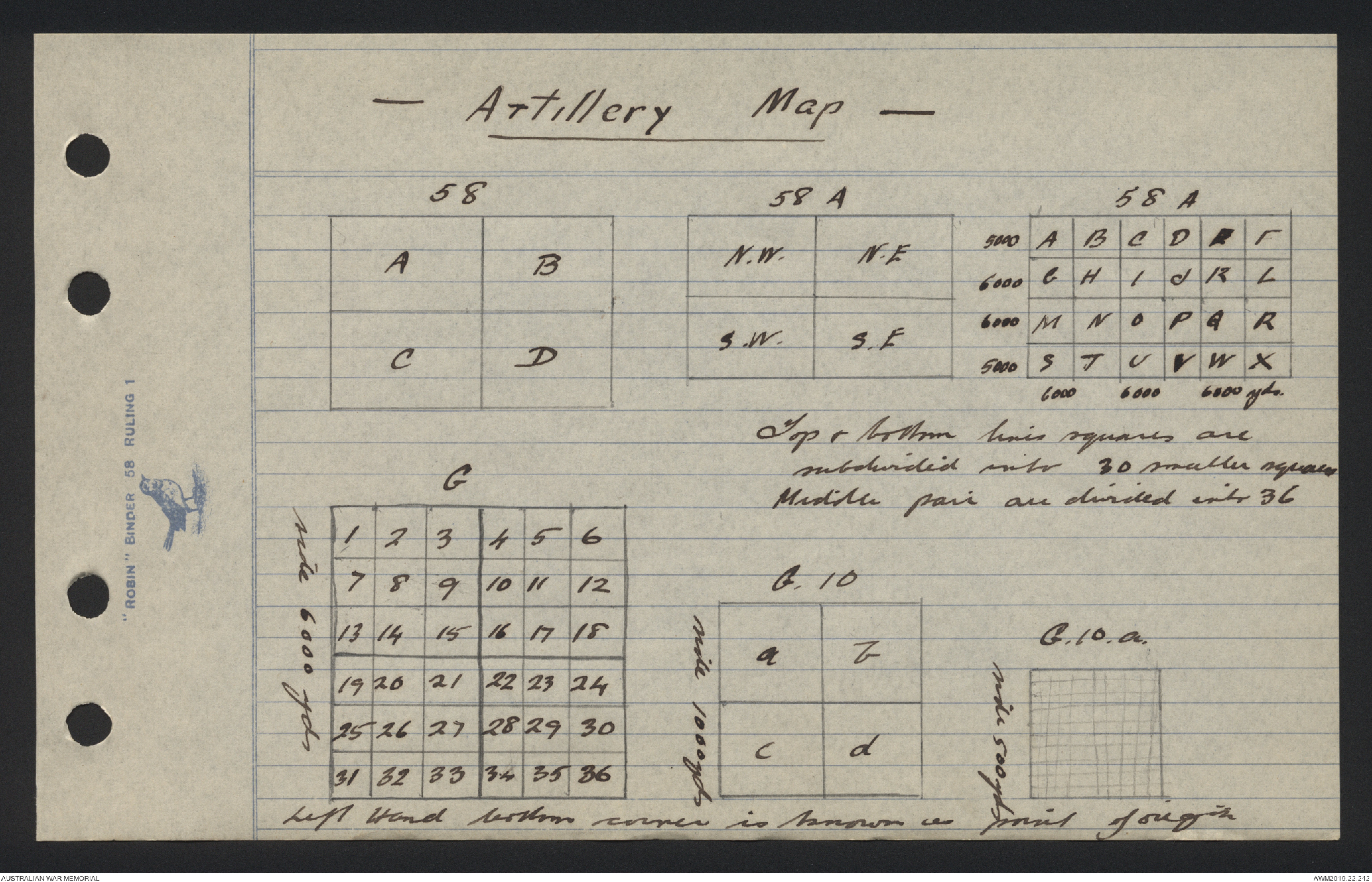
Artillery Map
Diagram - see original document
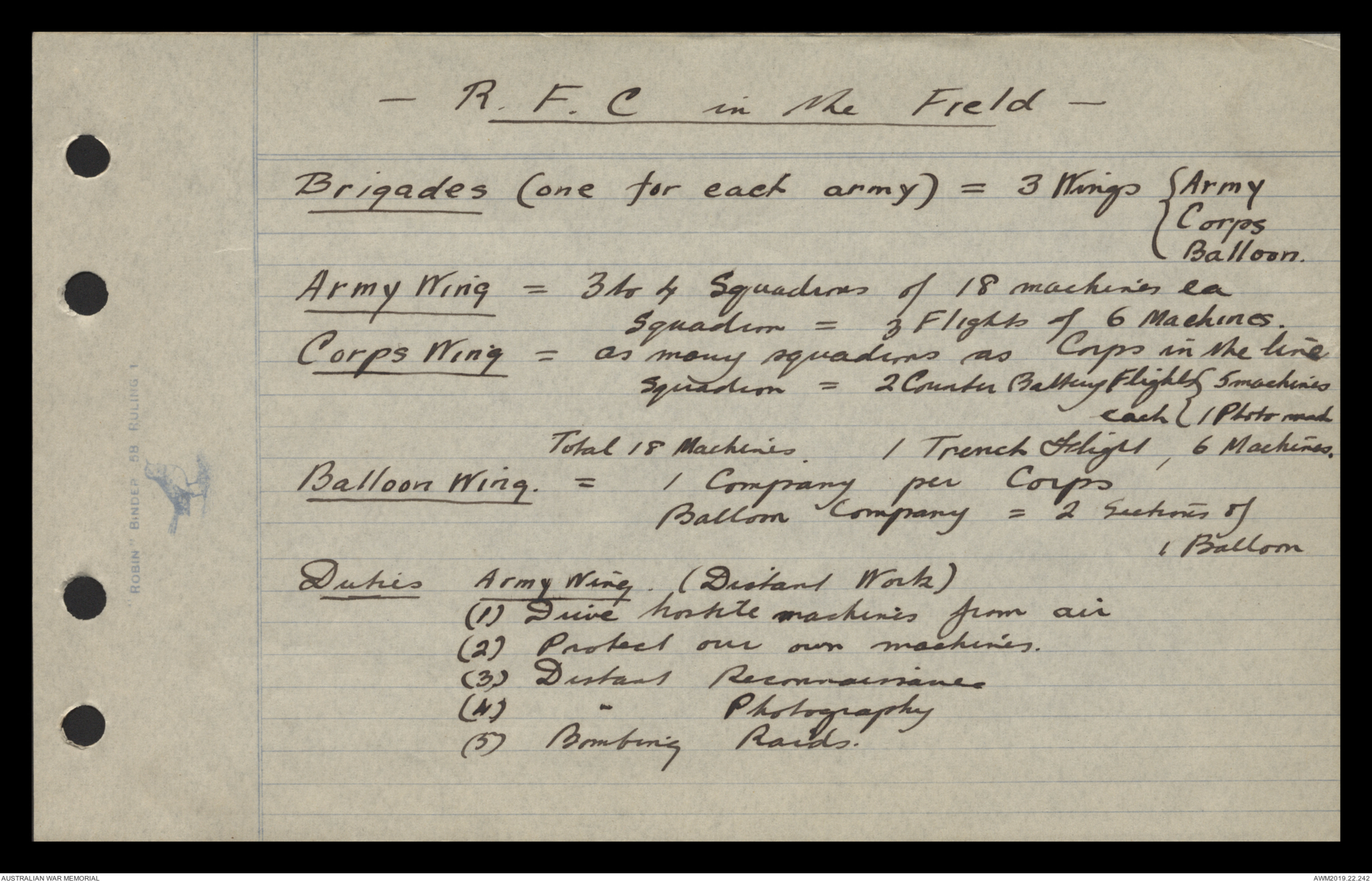
R.F.C in the Field
Brigades (one for each army) = 3 Wings {Army
{Corps
{Balloon.
Army Wing = 3 to 4 Squadrons of 18 machines ea
Squadron = 3 Flights of 6 Machines.
Corps Wing = as many squadrons as Corps in the line
Squadron = 2 Counter Battery Flights {5 machines
each {1 Photo mach
Total 18 machines. 1 Trench Flight, 6 Machines.
Balloon Wing. = 1 Company per Corps
Balloon Company = 2 Sections of
1 Balloon
Duties Army Wing. (Distant Work)
(1) Drive hostile machines from air
(2) Protect our own machines.
(3) Distant Reconnaissance
(4) " Photography
(5) Bombing Raids.
2
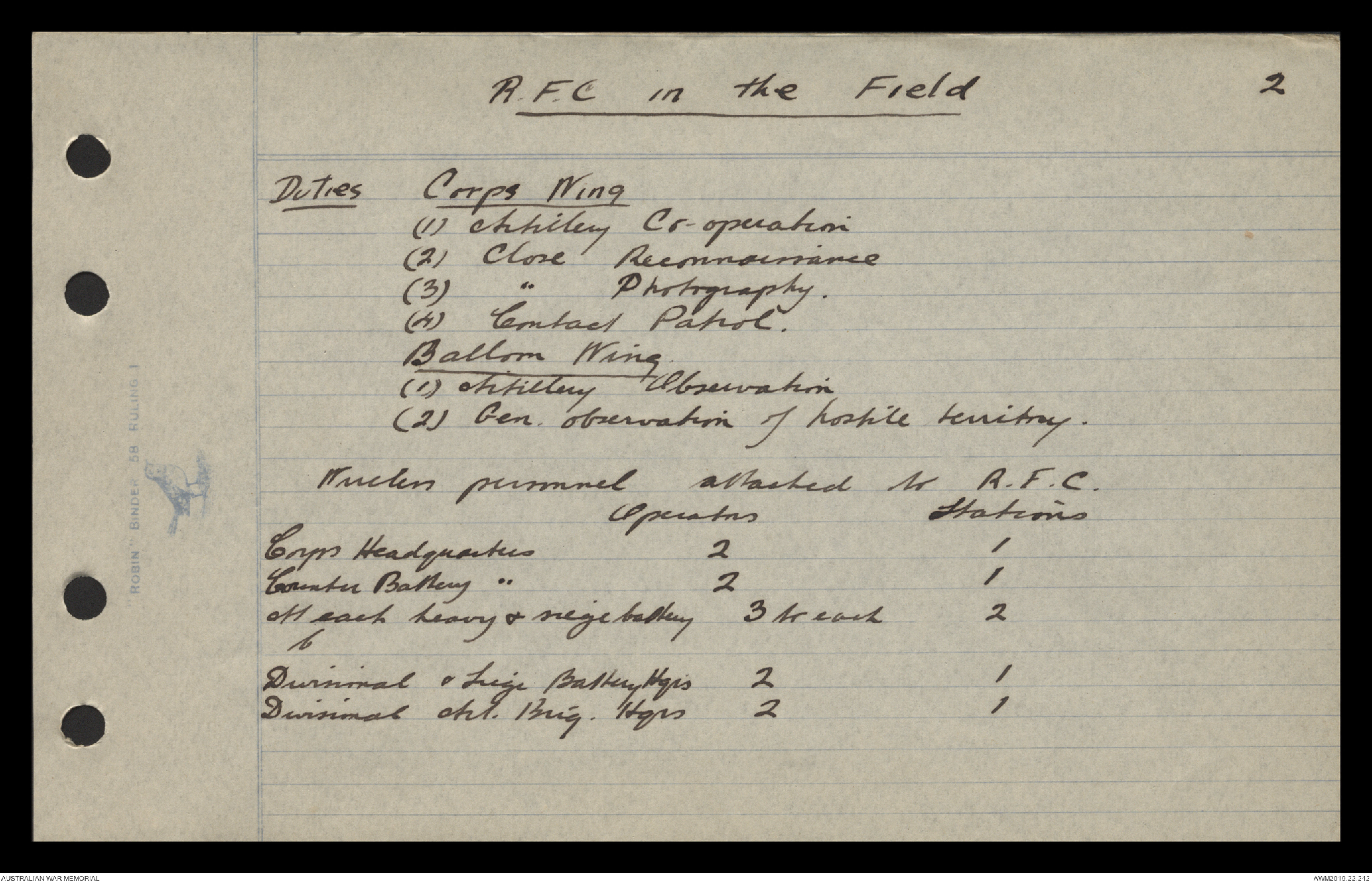
R.F.C in the Field
Duties Corps Wing
(1) Artillery Co-operation
(2) Close Reconnaissance
(3) " Photography.
(4) Contact Patrol.
Balloon Wing.
(1) Artillery Observation
(2) Gen. observation of hostile territory.
Wireless personnel attached to R.F.C.
Operators Stations
Corps Headquarters 2 1
Counter Battery " 2 1
Att each heavy & siege battery 3 to each 2
C
Divisional & Siege Battery Hqrs 2 1
Divisional Art. Brig. Hqrs 2 1
1
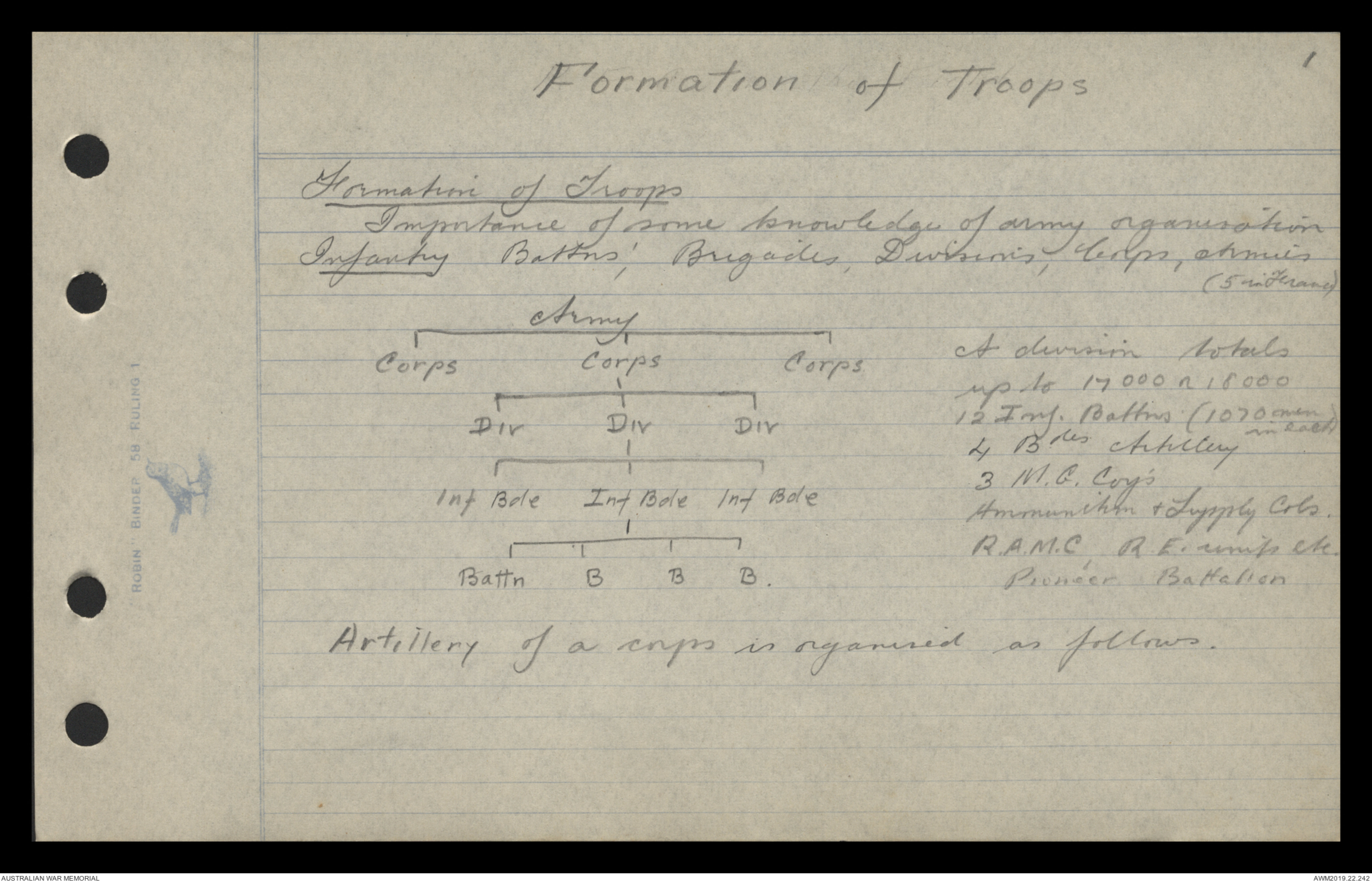
Formation of Troops
Formation of Troops
Importance of some knowledge of army organisation
Infantry Battns', Brigades, Divisions, Corps, Armies (5 in France)
Diagram - see original document
A division totals
up to 17000 or 18000
12 Inf. Battns (1070 men in each)
4 Bdes Artillery
3 M.G. Coy's
Ammunition & Supply Cols.
R.A.M.C, R.E. units etc.
Pioneer Battalion
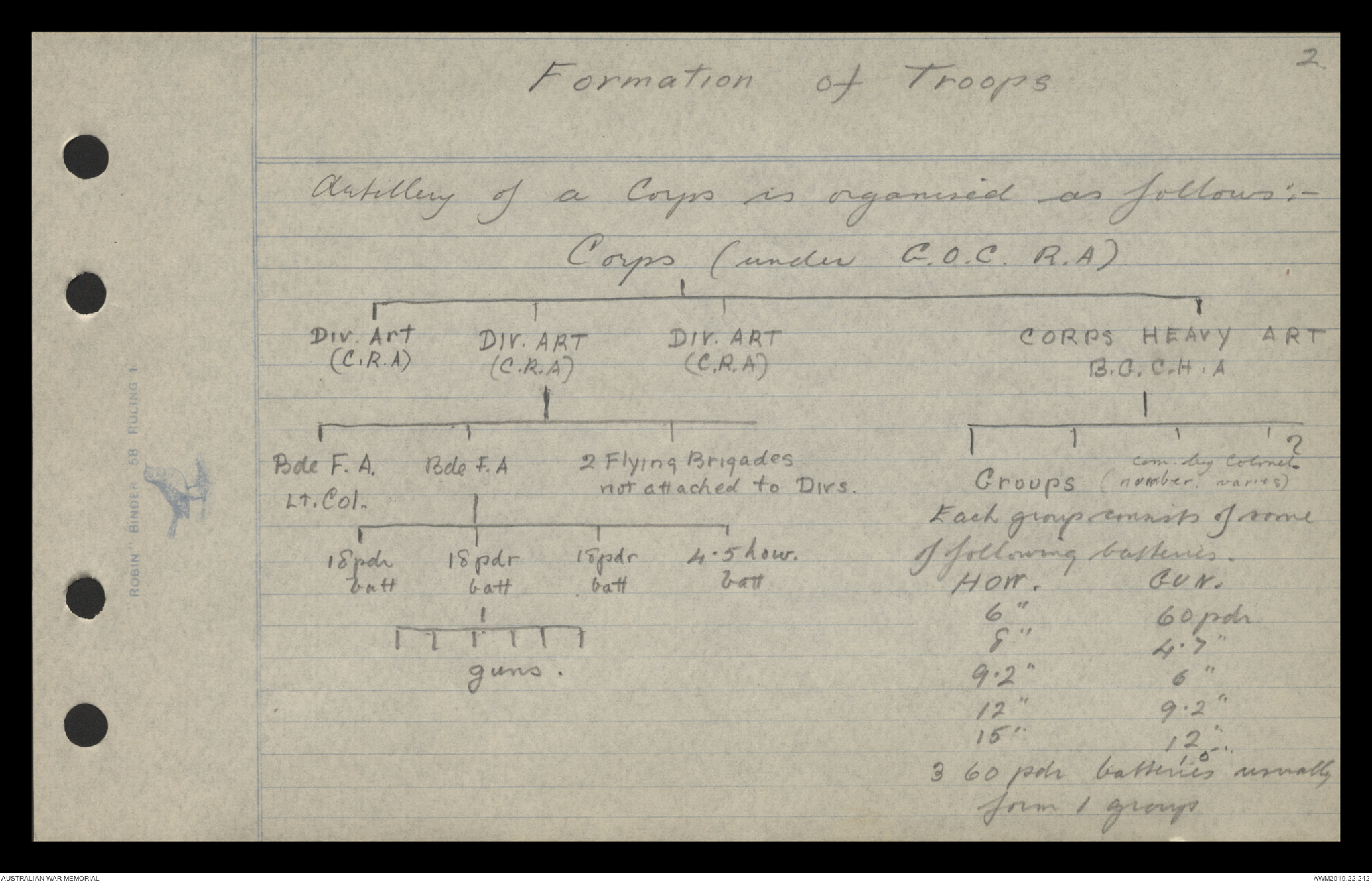
Artillery of a corps is organised as follows.
2.
Formation of Troops
Artillery of a Corps is organised as follows:-
Diagram - see original document
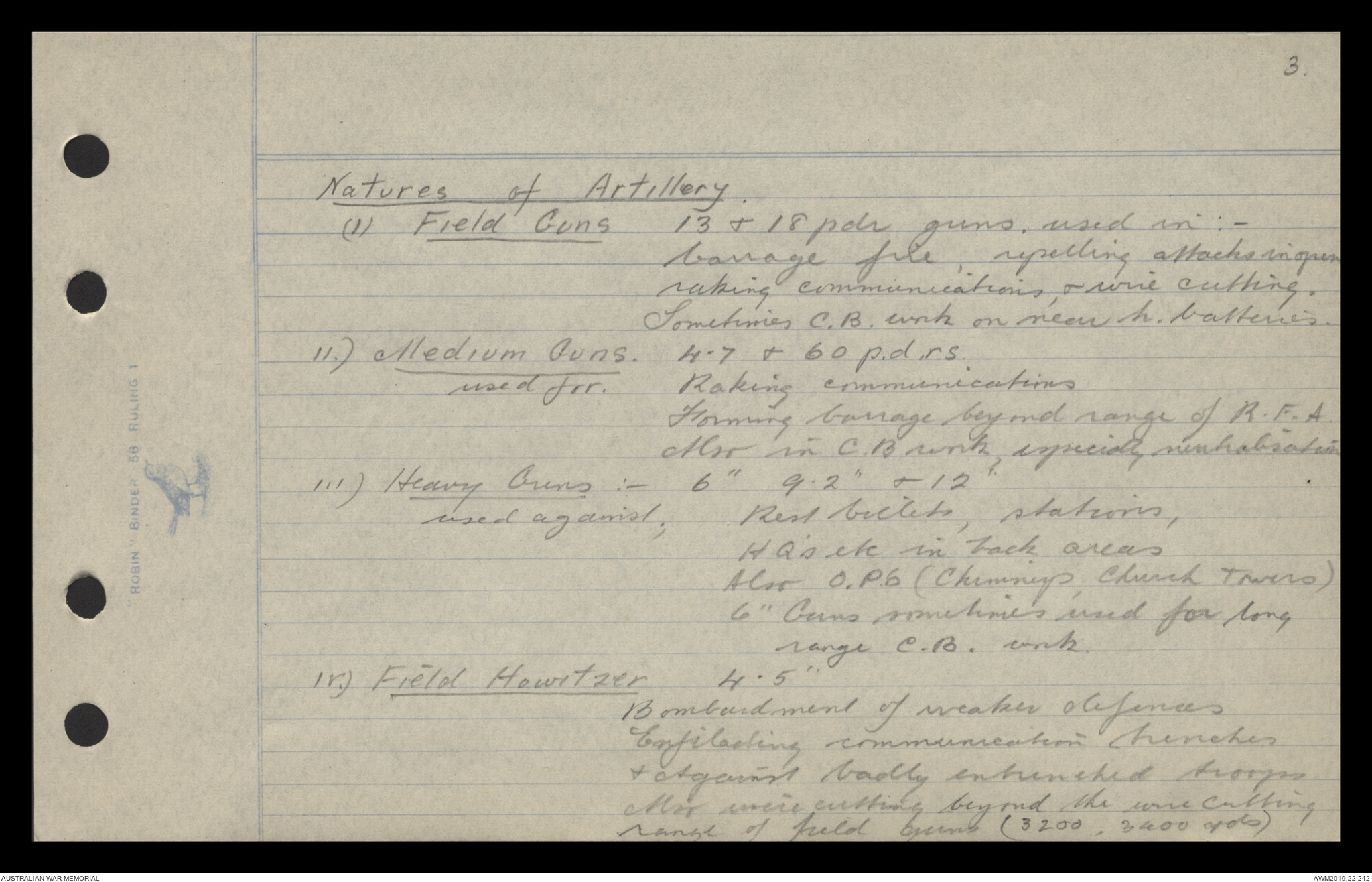
3.
Natures of Artillery.
(I) Field Guns 13 & 18 pdr guns. used in:-
barrage fire, repelling attacks in open
raking communications, & wire cutting.
Sometimes C.B. work on near L. batteries.
II.) Medium Guns. 4.7 & 60 p.d.r.s
used for. Raking communications
Forming barrage beyond range of R.F.A.
Also in C.B work, especially neutralisation
III) Heavy Guns :- 6" 9.2" & 12"
used against; Rest billets, stations,
H.Q's etc in back areas
Also O.P's (Chimneys, Church Towers)
6" Guns sometimes used for long
range C.B. work.
IV.) Field Howitzer 4.5"
Bombardment of weaker defences
Enfilading communication trenches
& Against badly entrenched troops
Also wire cutting beyond the wire cutting
range of Field Guns (3200 - 3400 yds)
 Transcriber 6897
This transcription item is now locked to you for editing. To release the lock either Save your changes or Cancel.
This lock will be automatically released after 60 minutes of inactivity.