
Notebook of James Stuart Leslie Ross - Part 1
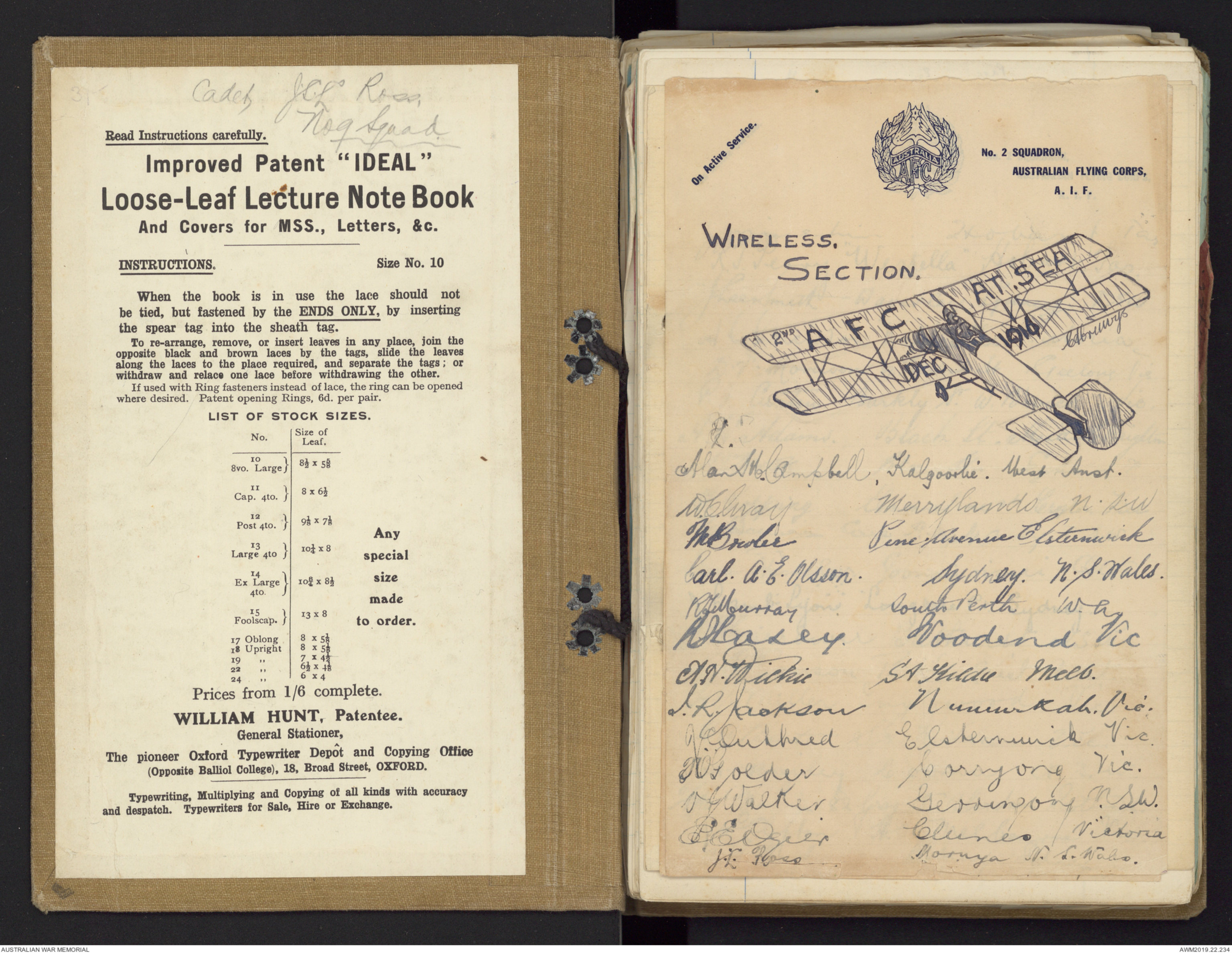
Cadet JSL Ross
No 9 Squad.
inside cover of notebook ~ see original
WIRELESS.
SECTION.
sketch - see original document
Alan M. Campbell Kalgoorlie. West Aust.
W.C. Gray Merrylands N.S.W.
M Bowler Pine Avenue Elsternwick
Carl. A.E. Olsson Sydney N.S.Wales.
R T Murray South Perth W.A.
RJ Casey. Woodend Vic
A.H.Wilkie St Kilda Melb.
I.R. Jackson Numurkah. Vic.
J.C. Outhred Elsternwick Vic
F O Golder Corryong Vic.
V J Walker Gerringong N.S.W.
E E Ogier Clunes Victoria
J.L. Ross Moruya N.S.Wales.
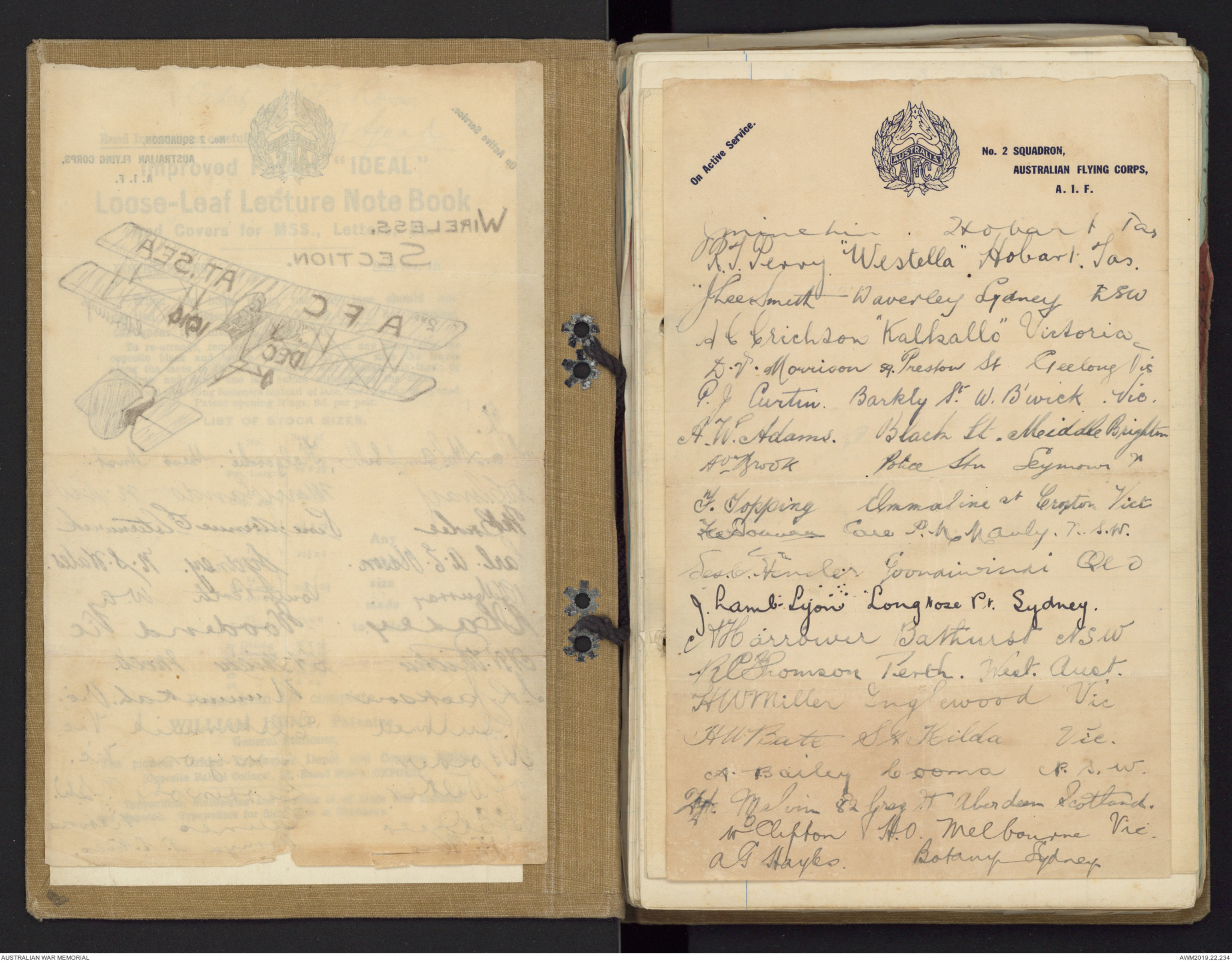
J Minchin Hobart Tas
R.T. Perry "Westella". Hobart. Tas.
J Lee Smith Waverley Sydney NSW
A C Crichton "Kalkallo" Victoria
D.V. Morrison 59. Preston St Geelong Vic
P.J Curtin Barkly St W. B'wick. Vic.
A.W. Adams. Black St. Middle Brighton
A O Brook Police Stn Seymour V
F. Topping Emmaline St Croxton Vict
FW Donnan Care P.M. Manly. N.S.W.
Lesle C Hensler Goondiwindi QLD
J. Lamb Lyon Longnose Pt. Sydney.
A Harrower Bathurst NSW
R C Thomson Perth. West. Aust.
H W Miller Inglewood Vic
H U Bate St Kilda Vic.
A. Bailey Cooma N.S.W.
F Melvin 82 Gray St Aberdeen Scotland
W Clifton H.O. Melbourne Vic.
A G Hayles Botany Sydney
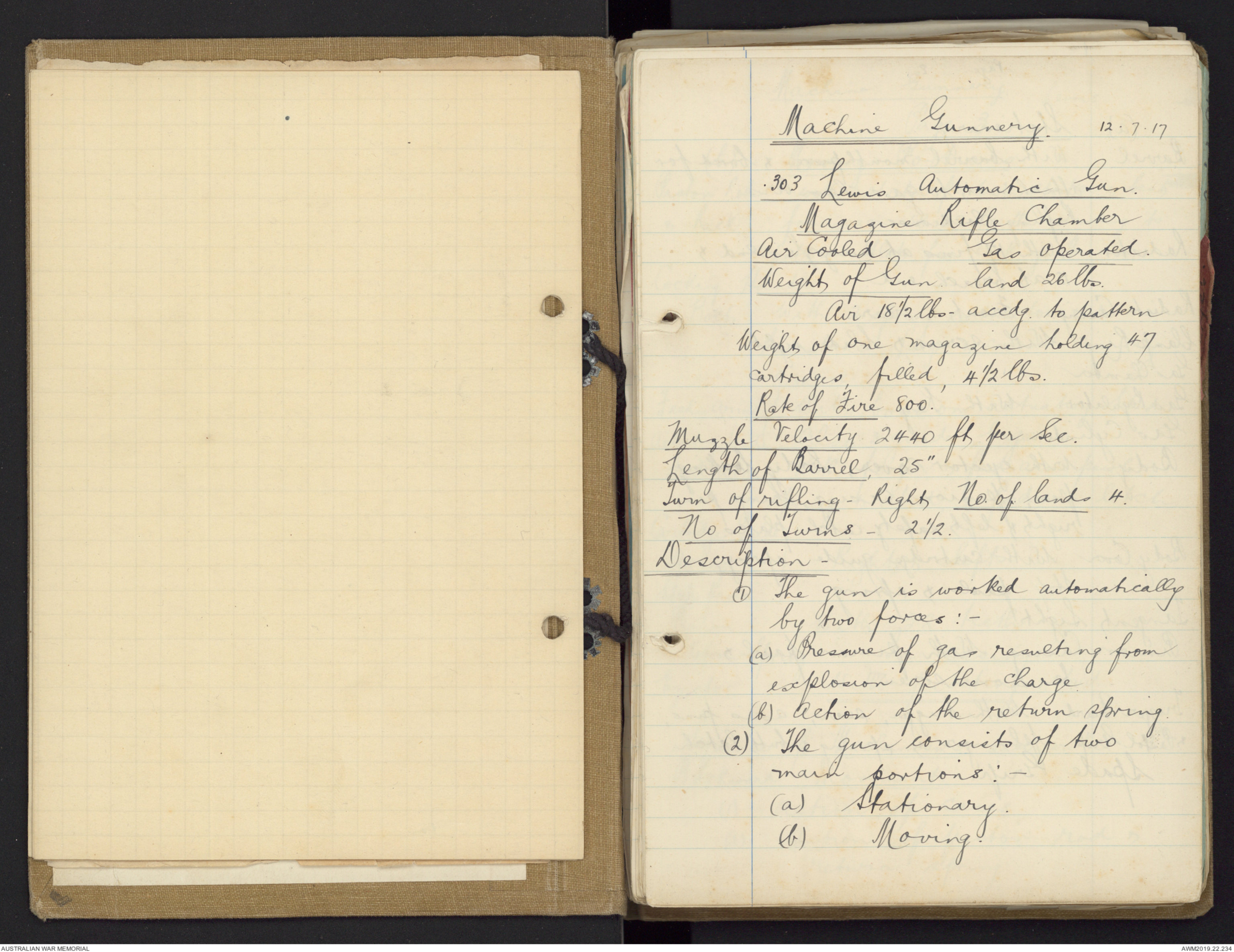
Machine Gunnery 12.7.17
.303 Lewis Automatic Gun.
Magazine Rifle Chamber
Air Cooled Gas operated.
Weight of Gun land 26lbs
Air 18½ lbs. accdg. to pattern
Weight of one magazine holding 47
cartridges, filled, 4½ lbs.
Rate of Fire 800.
Muzzle Velocity 2440 ft per Sec.
Length of Barrel, 25"
Turn of rifling - Right No. of lands 4.
No of Turns - 2½
Description -
1 The gun is worked automatically
by two forces:-
(a) Pressure of gas resulting from
explosion of the charge.
(b) Action of the return spring.
(2) The gun consists of two
main portions:-
(a) Stationary.
(b) Moving.
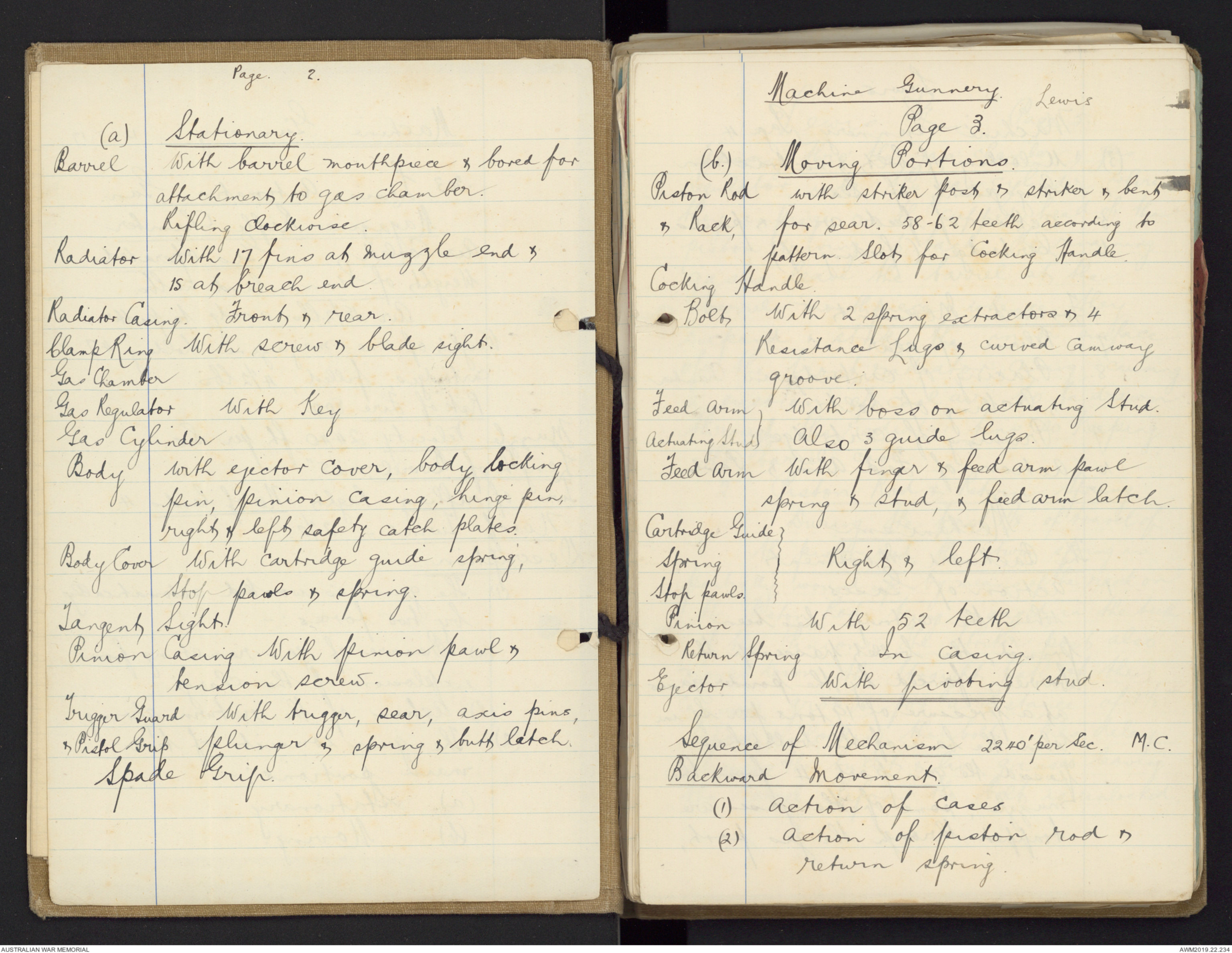
Page. 2.
(a) Stationary.
Barrel With barrel mouthpiece & bored for
attachments to gas chamber.
Rifling clockwise.
Radiator With 17 fins at muzzle end &
15 at breach end.
Radiator Casing. Front & rear.
Clamp Ring With screw & blade sight.
Gas Chamber
Gas Regulator With Key
Gas Cylinder
Body with ejector cover, body locking
pin, pinion casing, hinge pin,
right & left safety catch plates.
Body Cover With cartridge guide spring,
Stop pawls & spring.
Tangent Sight
Pinion Casing With pinion pawl &
tension screw.
Trigger Guard With trigger, sear, axis pins,
& Pistol Grip plunger & spring & butt latch.
Spade Grip.
Machine Gunnery
Lewis
Page 3.
(b.) Moving Portions.
Piston Rod & Rack,
with striker post & striker & bent
for sear. 58-62 teeth according to
pattern. Slots for Cocking Handle.
Cocking Handle Bolts
With 2 spring extractors & 4
Resistance Lugs & curved Camway
groove.
Feed Arm}
Actuating Stud} With boss on actuating Stud.
Also 3 guide lugs.
Feed Arm With finger & feed arm pawl
spring & stud, & feed arm latch.
Cartidge Guide }
Spring } Right & left
Stop pawls }
Pinion With 52 teeth
Return Spring In casing.
Ejector With pivoting stud.
Sequence of Mechanism 2240' per Sec. M.C.
Backward Movement.
(1) Action of cases
(2) Action of piston rod &
return spring.
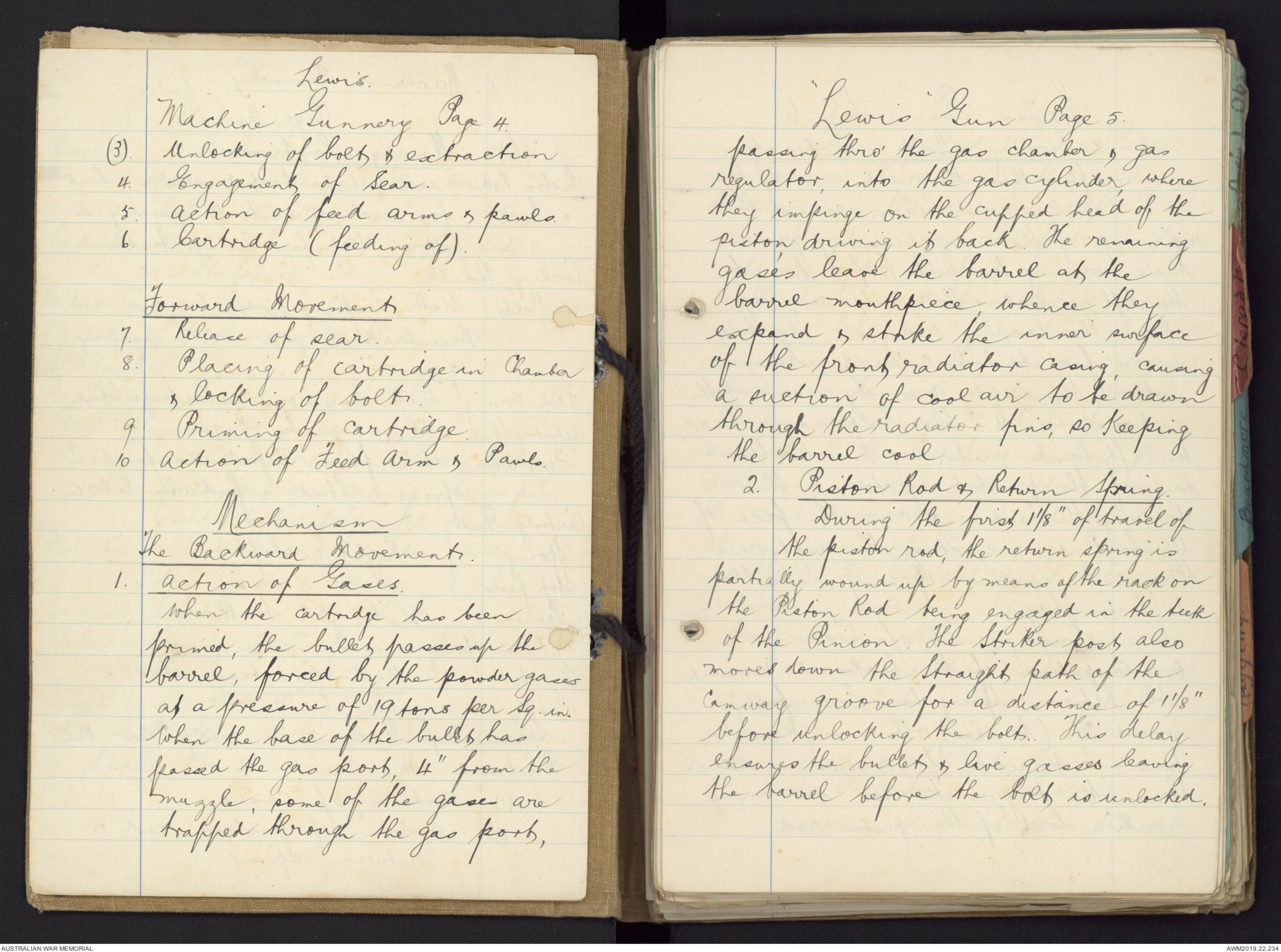
Lewis.
Machine Gunnery Page 4.
(3). Unlocking of bolts & extraction
4. Engagement of Sear.
5. Action of feed arms & pawls.
6. Cartridge (feeding of).
Forward Movement
7. Release of sear.
8. Placing of cartridge in Chamber
& locking of bolts.
9. Priming of cartridge.
10 Action of Feed Arm & Pawls.
Mechanism
The Backward Movement.
1. Action of Gases.
When the cartridge has been
primed, the bullet passes up the
barrel, forced by the powder gases
at a pressure of 19 tons per Sq. in.
When the base of the bullet has
passed the gas port, 4" from the
muzzle, some of the gases are
trapped through the gas port,
"Lewis" Gun Page 5.
passing thro' the gas chamber & gas
regulator, into the gas cylinder, where
they impinge on the cupped head of the
piston, driving it back. The remaining
gases leave the barrel at the
barrel mouthpiece, whence they
expand & strike the inner surface
of the front radiator casing, causing
a suction of cool air to be drawn
through the radiator fins, so keeping
the barrel cool.
2. Piston Rod & Return Spring.
During the first 1⅛" of travel of
the piston rod, the return spring is
partially wound up by means of the rack on
the Piston Rod being engaged in the teeth
of the Pinion. The Striker posts also
moves down the Straight path of the
Camway groove for a distance of 1⅛"
before unlocking the bolt. This delay
ensures the bullet & live gasses leaving
the barrel before the bolt is unlocked.
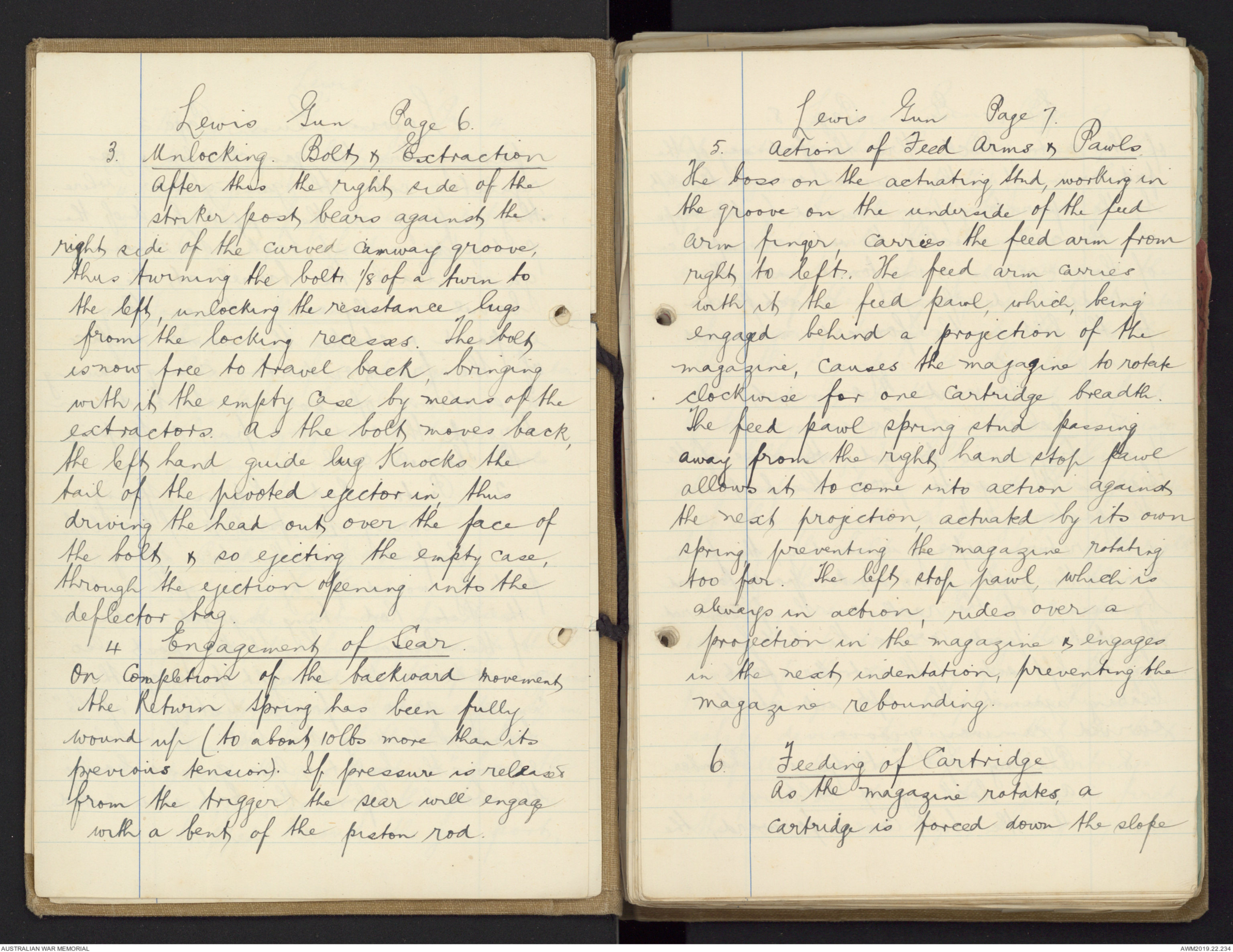
Lewis Gun Page 6.
3. Unlocking. Bolts & Extraction
After this the right side of the
striker post bears against the
right side of the curved camway groove,
thus turning the bolt ⅛ of a turn to
the left, unlocking the resistance lugs
from the locking recesses. The bolt
is now free to travel back, bringing
with it the empty case by means of the
extractors. As the bolt moves back,
the left hand guide lug Knocks the
tail of the pivoted ejector in, thus
driving the head out over the face of
the bolt, & so ejecting the empty case,
through the ejection opening into the
deflector bag.
4 Engagement of Sear.
On Completion of the backward movement
the Return Spring has been fully
wound up (to about 10lbs more than its
previous tension). If pressure is released
from the trigger the sear will engage
with a bent of the piston rod.
Lewis Gun Page 7.
5. Action of the Feed Arms & Pawls
The boss on the actuating Stud, working in
the groove on the underside of the feed
arm finger, carries the feed arm from
right to left. The feed arm carries
with it the feed pawl, which, being
engaged behind a projection of the
magazine, causes the magazine to rotate
clockwise for one cartridge breadth.
The feed pawl spring stud passing
away from the right hand stop pawl
allows it to come into action against
the next projection, actuated by its own
spring, preventing the magazine rotating
too far. The left stop pawl, which is
always in action, rides over a
projection in the magazine & engages
in the next indentation, preventing the
magazine rebounding.
6. Feeding of Cartridge
As the magazine rotates, a
cartridge is forced down the slope
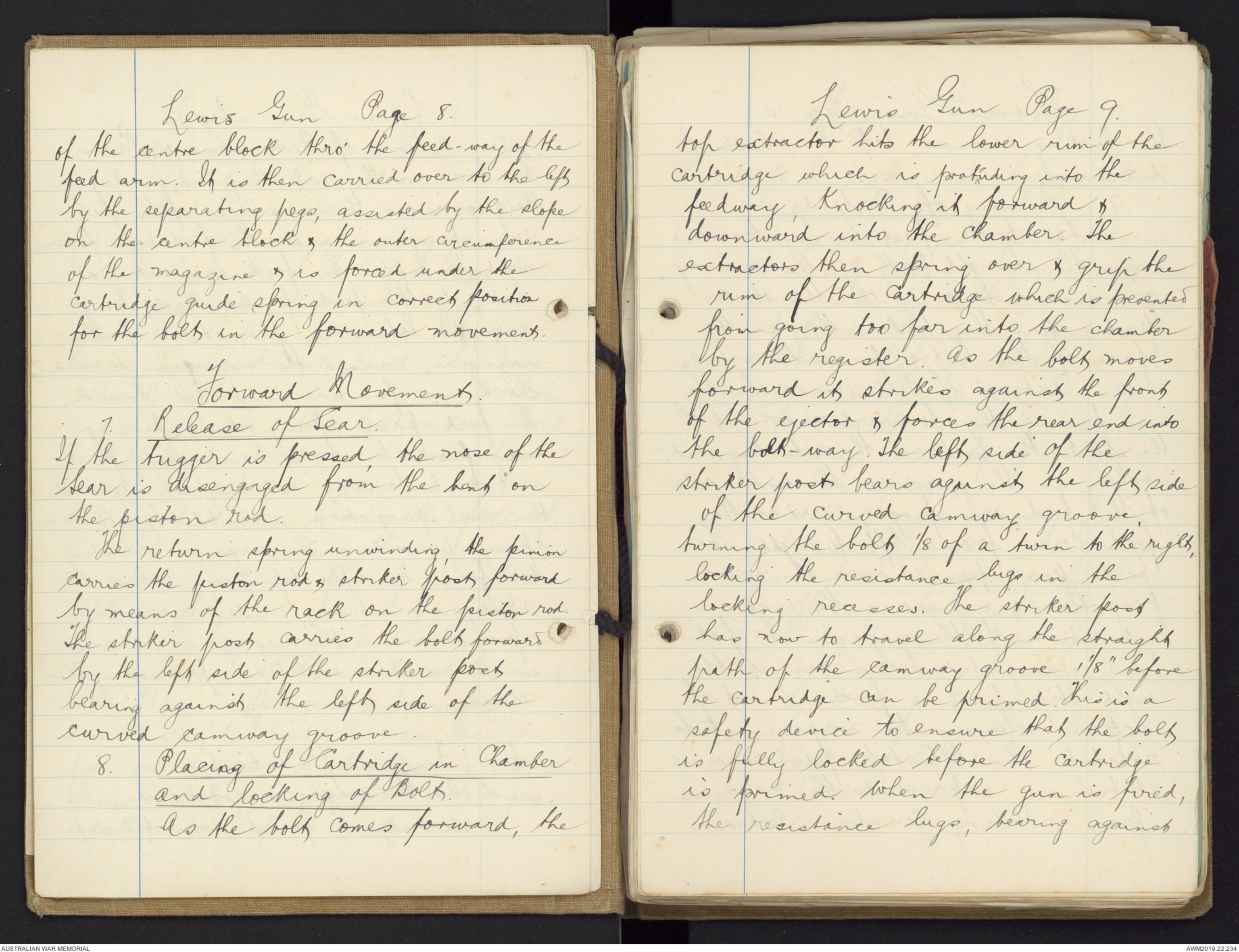
Lewis Gun Page 8.
of the centre block thro' the feed-way of the
feed arm. It is then carried over to the left
by the separating pegs, assisted by the slope
on the centre block & the outer circumference
of the magazine & is forced under the
cartridge guide spring in correct position
for the bolt in the forward movement.
Forward Movement.
7. Release of Sear.
If the trigger is pressed, the nose of the
Sear is disengaged from the bent on
the piston rod.
The return spring unwinding, the pinion
carries the piston rod & striker post forward
by means of the rack on the piston rod.
The striker post carries the bolt forward
by the left side of the striker post
bearing against the left side of the
curved camway groove.
8. Placing of Cartridge in Chamber
and locking of Bolt.
As the bolt comes forward, the
Lewis Gun Page 9.
top extractor hits the lower rim of the
cartridge which is protruding into the
feedway, Knocking it forward &
downward into the chamber. The
extractors then spring over & grip the
rim of the cartridge which is prevented
from going too far into the chamber
by the register. As the bolt moves
forward it strikes against the front
of the ejector & forces the rear end into
the bolt-way. The left side of the
striker post bears against the left side
of the curved Camway groove,
turning the bolt ⅛ of a turn to the right,
locking the resistance lugs in the
locking recesses. The striker post
has now to travel along the straight
path of the camway groove 1⅛" before
the cartridge can be primed. This is a
safety device to ensure that the bolt
is fully locked before the cartridge
is primed. When the gun is fired,
the resistance lugs, bearing against
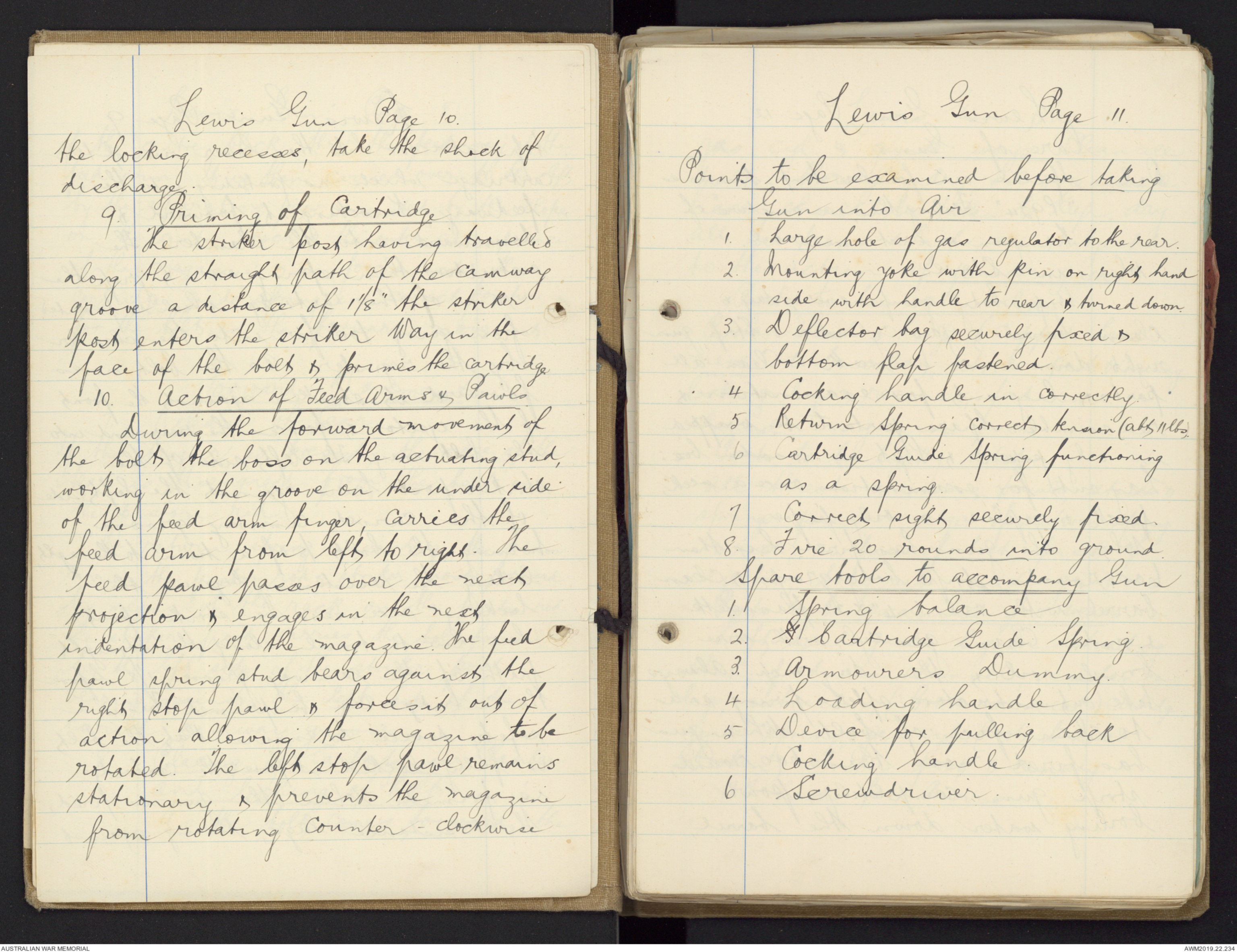
Lewis Gun Page 10.
the locking recesses, take the shock of
discharge.
9. Priming of Cartridge
The striker post having travelled
along the straight path of the camway
groove a distance of 1⅛" the striker
post enters the striker Way in the
face of the bolt & primes the cartridge.
10. Action of Feed Arms & Pawls.
During the forward movement of
the bolt the boss on the actuating stud,
working in the groove on the under side
of the feed arm finger, carries the
feed arm from left to right. The
feed pawl passes over the next
projection & engages in the next
indentation of the magazine. The feed
pawl spring stud bears against the
right stop pawl & forces it out of
action allowing the magazine to be
rotated. The left stop pawl remains
stationary & prevents the magazine
from rotating counter-clockwise
Lewis Gun Page 11.
Points to be examined before taking
Gun into Air
1. Large hole of gas regulator to the rear.
2. Mounting yoke with pin on right hand
side with handle to rear & turned down.
3. Deflector bag securely fixed &
bottom flap fastened.
4 Cocking handle in correctly
5 Return Spring correct tension (abt 11lbs)
6 Cartridge Guide Spring functioning
as a spring.
7 Correct sight securely fixed.
8. Fire 20 rounds into ground
Spare tools to accompany Gun
1. Spring balance
2. G Cartridge Guide Spring.
3. Armourers Dummy.
4 Loading handle
5 Device for pulling back
Cocking handle.
6 Screwdriver.
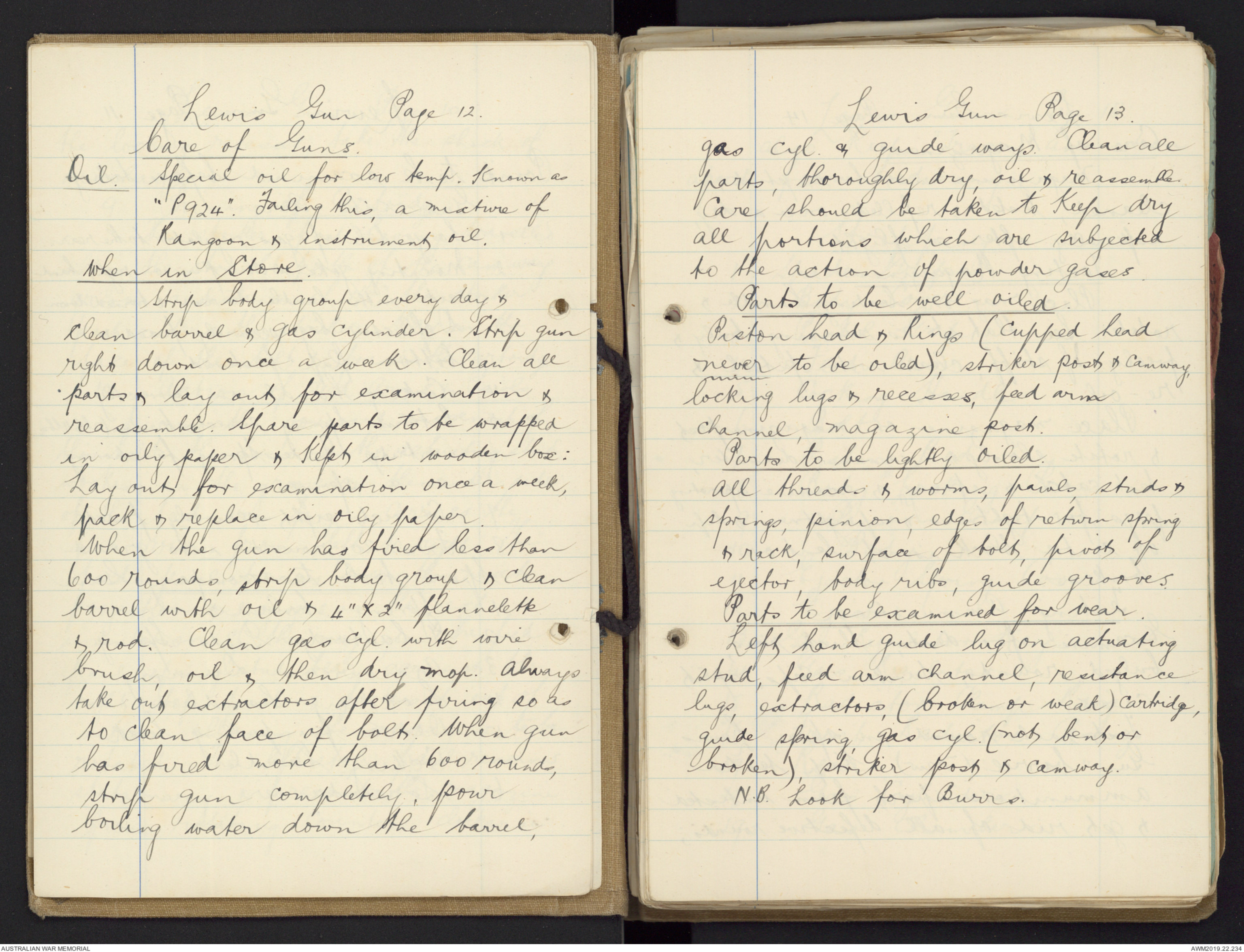
Lewis Gun Page 12.
Care of Guns.
Oil. Special oil for low temp. Known as
"P924". Failing this, a mixture of
Rangoon & instrument oil.
When in Store.
Strip body group every day &
clean barrel & gas cylinder. Strip gun
right down once a week. Clean all
parts & lay out for examination &
reassemble. Spare parts to be wrapped
in oily paper & Kept in wooden box:
Lay out for examination once a week,
pack & replace in oily paper.
When the gun has fired less than
600 rounds, strip body group & clean
barrel with oil & 4" x 2" flannelette
& rod. Clean gas cyl. with wire
brush, oil & then dry mop. Always
take out extractors after firing so as
to clean face of bolt. When gun
has fired more than 600 rounds,
strip gun completely, pour
boiling water down the barrel,
Lewis Gun Page 13.
gas cyl. & guide ways. Clean all
parts, thoroughly dry, oil & reassemble.
Care should be taken to keep dry
all portions which are subjected
to the action of powder gases.
Parts to be well oiled.
Piston head & Rings (cupped head
never to be oiled), striker post & camway,
locking lugs & recesses, feed arm
channel, magazine post.
Parts to be lightly oiled.
All threads & worms, pawls, studs &
springs, pinion, edges of return spring
& rack, surface of bolt, pivot of
ejector, body ribs, guide grooves.
Parts to be examined for wear.
Left hand guide lug on actuating
stud, feed arm channel, resistance
lugs, extractors, (broken or weak) cartridge,
guide spring, gas cyl. (not bent or
broken), striker post & camway.
N.B. Look for Burrs.
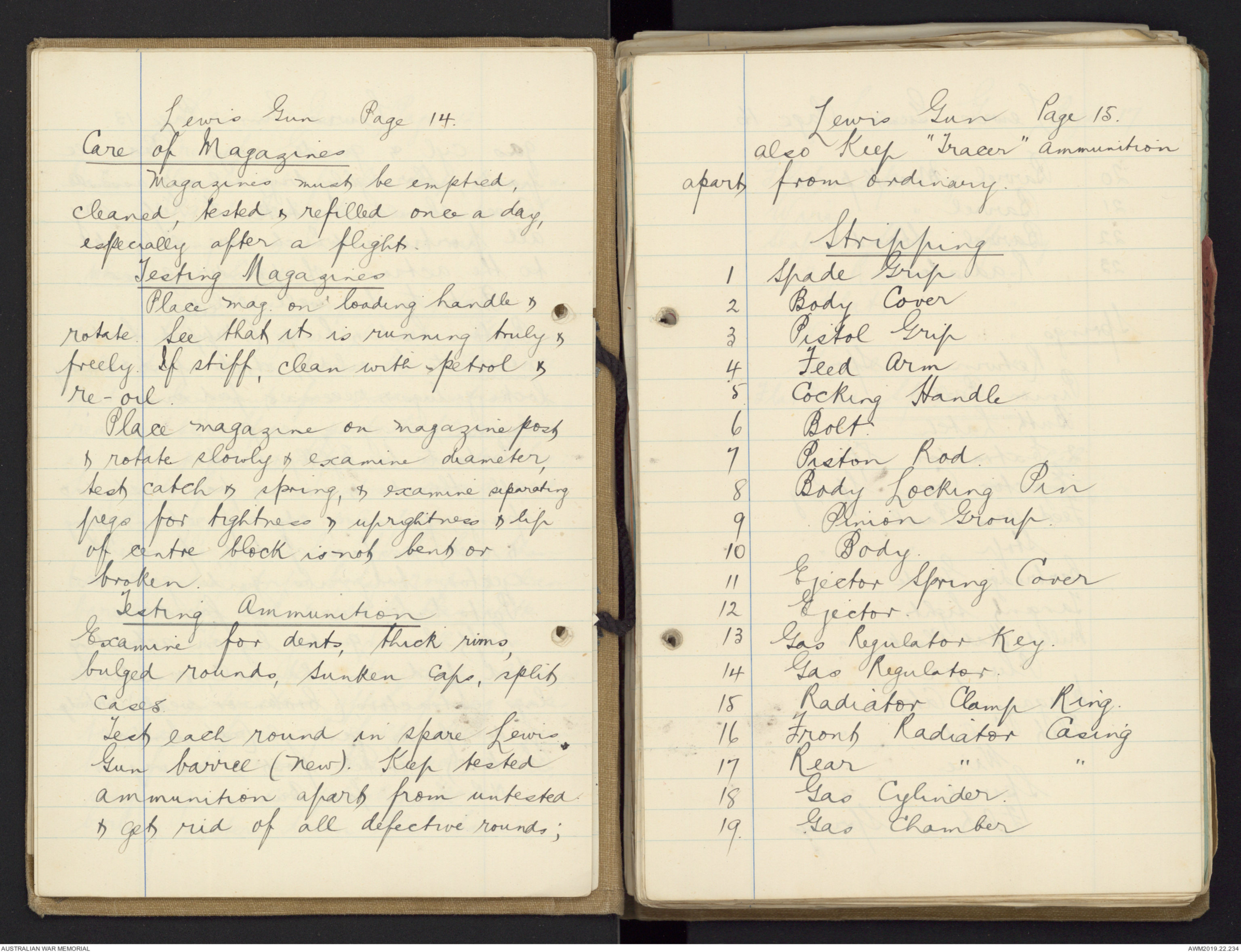
Lewis Gun Page 14.
Care of Magazines
Magazines must be emptied,
cleaned, tested & refilled once a day,
especially after a flight.
Testing Magazines
Place mag. on loading handle &
rotate. See that it is running truly &
freely. If stiff, clean with petrol &
re-oil.
Place magazine on magazine post
& rotate slowly & examine diameter,
test catch & spring, & examine separating
pegs for tightness & uprightness & lip
of centre block is not bent or
broken.
Testing ammunition
Examine for dents, thick rims,
bulged rounds, sunken caps, split
cases.
Test each round in spare Lewis
Gun barrel (New). Keep tested
ammunition apart from untested
& get rid of all defective rounds;
Lewis Gun Page 15.
also Keep "Tracer" ammunition
apart from ordinary.
Stripping
1 Spade Grip
2 Body Cover
3 Pistol Grip
4 Feed Arm
5 Cocking Handle
6 Bolt.
7 Piston Rod.
8 Body Locking Pin
9 Pinion Group
10 Body.
11 Ejector Spring Cover
12 Ejector.
13 gas Regulator Key.
14 Gas Regulator.
15 Radiator Clamp Ring.
16 Front Radiator Casing
17 Rear " "
18 Gas Cylinder.
19. Gas Chamber
 Jen
Jen This transcription item is now locked to you for editing. To release the lock either Save your changes or Cancel.
This lock will be automatically released after 60 minutes of inactivity.