
Notebook of Thomas Joseph Lynch, 1944-1945 - Part 4

(53)
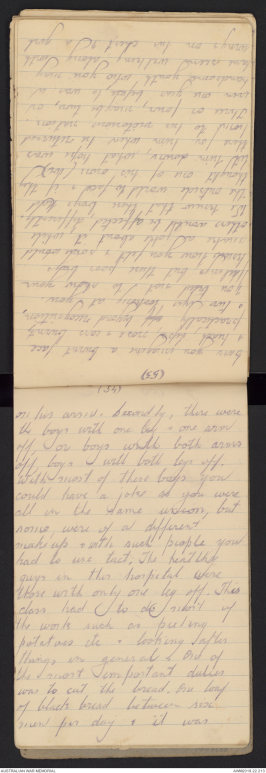
Can you imagine a burnt face
& head, lip, nose & ears burnt,
practically off beyond recognition,
& two eyes looking at you.
you tried not to show your
feelings but these poor boys
know how you felt & some would
make a joke about it while
others would be affected differently.
We knew that those boys had
the outside world to face & if they
thought one of his own (we)
let him down, what hope was
there for him when he returned
home to his victorious nation.
Three or four, maybe two, or even
one year before, he was a
handsome youth who you may
have seen walking along with
wings on his chest & a girl
(54)
on his arm. Secondly, there were
the boys with one leg & one arm
off, or boys with both arms
off, boys with both legs off.
With most of these boys you
could have a joke as you were
all in the same union, but
some were of a different
make up & with such people you
had to use tact. The healthy
guys in the hospital were
those with only one leg off. This
class had to do most of
the work such as peeling
potatoes etc & looking after
things in general & one of
the most important duties
was to cut the bread. One loaf
of black bread between six
men per day & it was
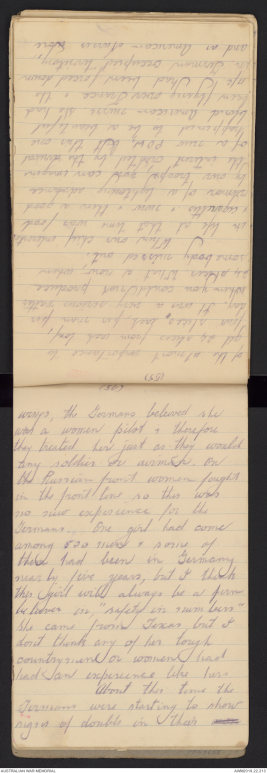
(55)
of the utmost importance to
get 24 slices from each loaf,
four slices, each per man per
day. It was a very serious matter
when you could not produce
24 slices. What a row, when
somebody missed out.
When our chief interest
in life at that time was food
& cigarettes & war & then a good
rumour of a lightening advance
by our troops, you can imagine
the interest created by the arrival
of a new POW, but this one
happened to be a beautiful
blond American nurse. She had
been flying over France & the
a/c had been forced down
in German occupied territory,
and as American Nurses wore
(56)
wings, the Germans believed she
was a woman pilot & therefore
they treated her just as they would
any soldier or airman. On
the Russian front women fought
in the front line so this was
no new experience for the
Germans. One girl had come
among 500 men & some of
them had been in Germany
nearly five years, but I think
this girl will always be a firm
believer in "safety in numbers"
She came from Texas but I
dont think any of her tough
countrymen or women had
had an experience like her.
About this time the
Germans were starting to show
signs of trouble in their xxx
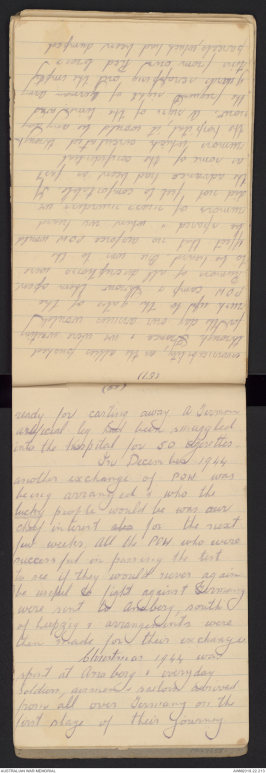
(57)
invincibility, as the allies pushed
through France & we were waiting
for the day our Armies would
rush up to the gates of the
PO.W. camp & throw them open.
Rumours of all descriptions were
to be heard. One was to the
effect that no airforce POW would
be spared & when we heard
rumours of mass murders we
did not feel to comfortable. If
the advance had been as fast
as some of the confidential
rumours which circulated through
the hospital, it would be any day
now. A sign of the times was
the frequent sight of German Army
guards scrapping out the empty
tins from our Red Cross
parcels, which had been dumped
(58)
ready for carting away. A German
artificial leg had been smuggled
into the hospital for 50 cigarettes.
In December 1944
another exchange of POW was
being arranged & who the
lucky people would be was our
chief interest also for the next
few weeks. All the POW who were
successful in passing the test
to see if they would never again
be useful to fight against Germany
were sent to Anaberg, south
of Leipzig & arrangements were
then made for their exchange.
Christmas 1944 was
spent at Anaberg & every day
soldiers, airmen & sailors arrived
from all over Germany on the
last stage of their journey
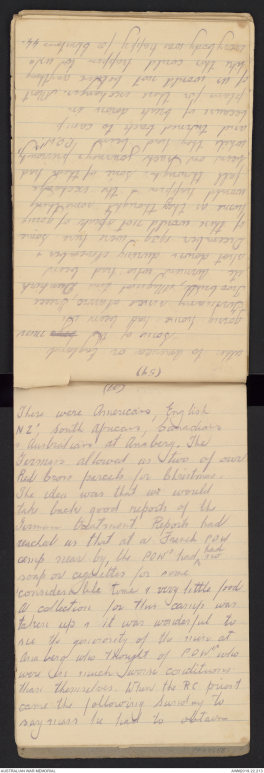
(59)
either to America or England
Some of the boys men
going home had been in
Germany since Navaro, Greece
Tobruk, Maginot Line, Dunkirk
etc. Airmen who had been
shot down during November &
December 1939 were here. Some
of these would not speak of going
home as they thought something
would happen & the exchange
fall through. Some of them had
been on such journeys previously
while they had been P.O.W.'s
and turned back to camp
because of break down in
plans for these exchanges. Most
of us would not believe anything
like this could happen to us &
everybody was happy for Christmas 44.
(60)
There were Americans, English
N.Z; South Africans, Canadians
& Australians at Anaberg. The
Germans allowed us two of our
Red Cross parcels for Christmas.
The idea was that we would
take back good reports of the
German treatment. Reports had
reached us that at a French POW
camp near by, the POWs had ^had no
soap or cigarettes for some
considerable time & very little food.
A collection for their camp was
taken up & it was wonderful to
see the generosity of the men at
Anaberg who thought of POWs who
were in much worse conditions
than themselves. When the RC priest
came the following Sunday to
say mass he had to obtain
(61)
help to transport the gifts to
his camp.
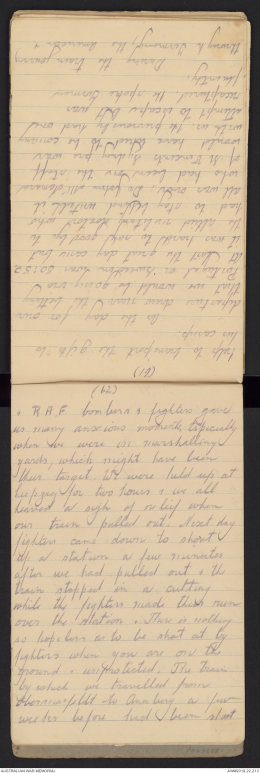
As the day for our
departure drew near the betting
that we would be going via
Portugal or Sweden was 50:52.
At last the great day came but
it was hard to say good bye to
the allied military doctor who
had to stay behind untill it
all was over. Dr John McNamara
who had been on the staff
of St Vincents Sydney pre war
would have liked to be coming
with us. He previously had one
attempt to escape but was
recaptured. He spoke German
fluently.
During the train journey
through Germany, the American &
(62)
& R.A.F. bombers & fighters gave
us many anxious moments especially
when we were in marshalling
yards, which might have been
their target. We were held up at
Leipzig for two hours & we all
heaved a sigh of relief when
our train pulled out. Next day
fighters came down to shoot
up a station a few minutes
after we had pulled out & the
train stopped in a cutting
while the fighters made their run
over the station. There is nothing
so hopeless as to be shot at by
fighters when you are on the
ground & unprotected. The train
by which we travelled from
Obernfeldt to Anaberg a few
weeks before had been shot
(63)
up & several passengers killed,
while running to the trees along
side the line for cover. The fighters
must have been short of fuel
as they only made one run &
did not return.
The journey down
through Southern Germany & across
the dirty Danube was uninteresting
for the greater part of the trip
but immediately we crossed
the border of Germany & Switzerland
there was a considerable
change in everybody. We were
at last free men again. The
American & British Red Cross
Societies were at Zurich to
welcome us & here we received
gifts which were only the beginning
of the good things which were
(64)
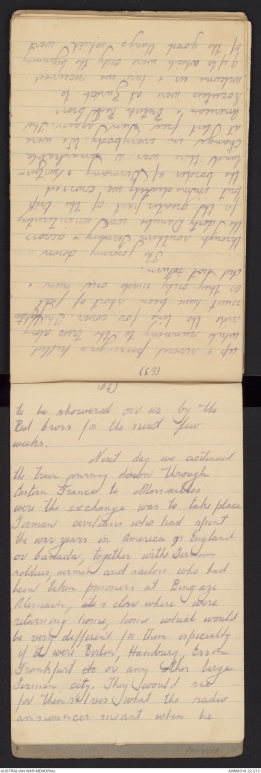
to be showered on us by the
Red Cross for the next few
weeks.
Next day we continued
the train journey down through
Eastern France to Marseilles
were the exchange was to take place.
German civilians who had spent
the war years in America or England
or Canada, together with German
soldiers, airmen and sailors who had
been taken prisoner at Benghazi
Alexandria, if & else where were
returning home, home which would
be very different for them especially
if it were Berlin, Hamburg, Essen,
Frankfurt etc or any other large
German city. They would see
for themselves what the radio
announcer meant when he
(65)
said "1500 of our bombers were
out over Germany last night"
We passed trains
going north to Germany & in
these carriages were people in
the same condition as many of us.
It all seemed rather useless to me.
Every thing was working
smoothly on our arrival at
Marseilles. Germans leaving ships
like the Orangvil Castle & Gripsholm
& we were going aboard. The
former was bound for England &
the later for America. Every body
was taking addresses and promising
faithfully to write. We gradually
became sorted out & just to sit
down & a steward to come along
& say " is there anything I can
get you sir, made you forget a lot
(66)
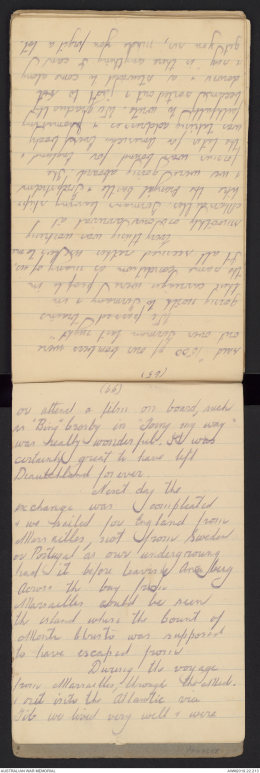
or attend a film on board, such
as "Bing" Crosby in "Going my way "
was really wonderful. It was
certainly great to have left
Deutchland for ever.
Next day the
exchange was completed
& we sailed for England from
Marseilles, not from Sweden
or Portugal as our underground
had it before leaving Anaberg.
Across the bay from
Marseilles could be seen
the island where the Count of
Monte Christo was supposed
to have escaped from.
During the voyage
from Marseilles, through the Med.
& out into the Atlantic via
Gib we lived very well & were
(67)
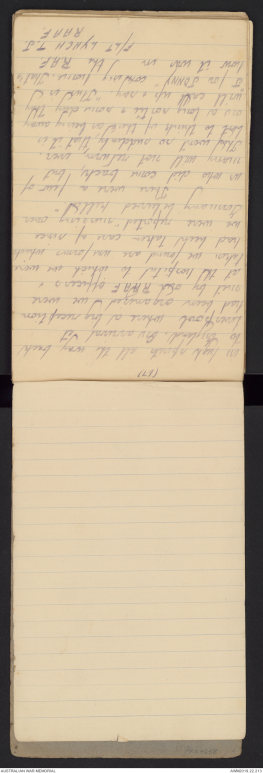
in high spirits all the way back
to England. On arrival at
Liverpool where a big reception
had been organised we were
met by our R.A.A.F. Officers &
at the hospital to which we were
taken we found our uniforms which
had been taken care of since
we were reported "missing over
Germany believed killed."
There were a few of
us who did come back but
many will not return, ever.
They went so suddenly it is
best to think of them as being away
on a long sortie & some day they
will call up and say "This is
J for JONNY" coming home. That's
how it was in the R.A.F.
F/L Lynch T.J.
R.A.A.F.
 D Coates
This transcription item is now locked to you for editing. To release the lock either Save your changes or Cancel.
This lock will be automatically released after 60 minutes of inactivity.