
Notebook of Thomas Joseph Lynch, 1944-1945 - Part 3
(33)
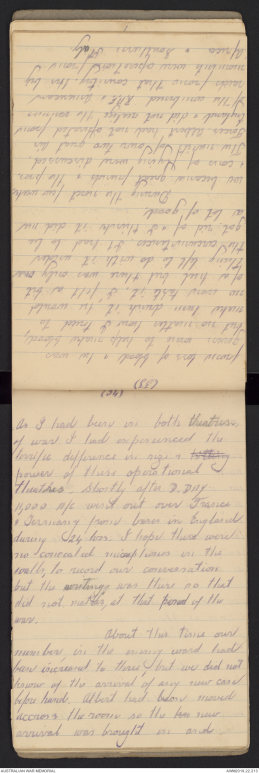
from loss of blood & he was
given water to help make blood,
but no matter how I tried to
make him drink it, he would
not even taste it. I felt a bit
of a heel but there was only one
thing to do with it under
the circumstances. It had to be
got rid of and I think it did me
a lot of good.
During the next few weeks
we became great friends & the pros
and cons of flying were discussed.
The merits of our two great Air
Forces. Albert had not operated from
England & did not realise the [[volume?]]
of the combined R.A.F. & American
raids from that country. The big
mosquitos were operated from
Africa and Southern Italy.
(34)
As I had been in both theatres
of war I had experienced the
terrific difference in size and battery
power of these operational
theatres. Shortly after D.DAY
11,000 A/C went out over France
& Germany from bases in England
during 24 hrs. I hope there were
no concealed microphones in the
walls to record our conversation
but the writing was there so that
did not matter, at that period of the
war.
About this time our
number in the enemy ward had
been increased to three, but we did not
know of the arrival of any new case
before hand. Albert had been moved
across the room so the he new
arrival was brought in and
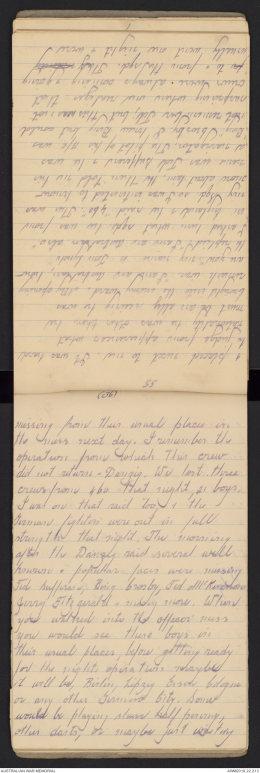
35
& placed next to me. It was hard
to judge from appearances what
nationality he was other than he
must be an ally seeing he was
brought into the enemy ward. My opening
remark was "I am an Australian, how
are you, my name is Tom Lynch".
He replied "I am an Australian also"
I asked him what sqd he was from
in England and he said "460". This was
my sqd so I was interested to know
more about him. He then told me his
name was Ted [[Jefferson]] and he was
a navigator. The pilot of his a/c was
"Boy" Crosby. I knew Boy but could
not remember Ted, but this was not
surprising when one realises that
crews were always coming and going
fr to & from the sqd. They xxxxxx
usually went one night & were
(36)
missing from their usual place in
the mess next day. I remember the
operation from which this crew
did not return - Danzig. We lost three
crews from 460 that night, 21 boys.
I was on that raid too & the
German fighters were out in full
strength that night. The morning
after the Danzig raid several well
known & popular faces were missing.
Ted [[?Suffield?]], Brig Crosby, Ted [[?McKinnon]]
Jerry Fitzgerald & many more. When
you walked into the officers' mess
you would see these boys in
their usual places, before getting ready
for the nights operation. Maybe
it will be Berlin, Leipzig, Essen, Cologne
or any other German City. Some
would be playing shove half penny,
others darts, or maybe just waiting
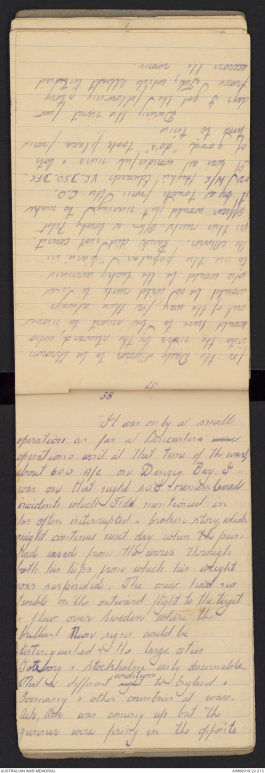
37
for the Daily Mission to be thrown
into the mess by the steward, who
would have to be smart to move
out of the way, for there always
would be a wild rush to see
who would be the lucky airman
to [[ace?]] the popular "Jane" in
the Mission. Rank did not count
as this [[?]] often a lowly Pilot
Officer would just manage to make
it by a touch from the C.O.
[[?]] W/C. Hughie Edwards
VC DSO DFC.
It was a wonderful mess & lots
of good "do's" took place from
time to time.
During the next few
days I got the following story
from Ted, while Albert listened
across the room.
38
It was only a small
operation as far as Lancaster xxxx
operations went at that time of the war
about 600 A/C on Danzig Bay. I
was on that night so I remembered
incidents which Ted mentioned in
his often interrupted & broken story which
might continue next day when the pain
had eased from the wires through
both his hips from which his weight
was suspended. The crew had no
trouble on the outward flight to the target
& flew over Sweden where the
brilliant [[?low sunset]] could be
distinguished & the large cities
Goteborg & Stockholm easily discernible.
What a different sight conditions to England &
Germany & other countries at war.
Ack Ack was coming up but the
gunners were firing in the opposite
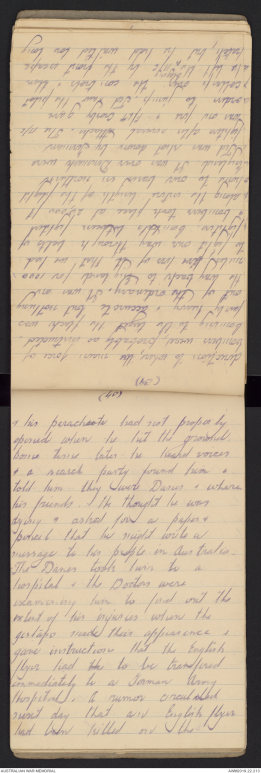
(39)
direction to where
the main force of
bombers were, probably
as instructed.
Coming to the target the flack
was fairly heavy &
accurate but nothing
out of the ordinary. It was on
the way back to England for 1000
miles, five hrs of it that we had
to fight our way through belts
of fighters. Combat between fighters
& bombers took place at 20,000 ft
& along the entire length of the flight
home to our bases in northern
England. It was over Denmark were
Ted was shot down by German
fighters after several attacks. The a/c
was on fire & F/LT Crosby gave
orders to jump. Ted saw the pilot
collapse over the controls & then
he left the Flying
a/c y the front escape
hatch, but
he had waited too long
(40)
& his parachute had not properly
opened when he hit the ground.
Some time later he heard voices
& and a search party found him &
told him they were Danes & where
his friends. He thought he was
dying & asked for a paper &
pencil that he might write a
message to his people in Australia.
The Danes took him to a
hospital & the Doctors were
examining him to find out the
extent of his injuries when the
gestapo make their appearance &
gave instructions that the English
flyer had th to be transported
immediately to a German Army
Hospital. A rumour circulated
next day that an English flyer
had been killed on the
(42)
operating table by the Gestapo. To
contradict the fake rumour, the
Germans had Ted photographed
& the photo inserted in the daily
papers. Ted had a cutting when
he arrived at the Frankfurt
Hospital. During the four months
he was in the German Hospital
in Denmark he xxxxx had no
medical treatment for his wounds
etc & he was always guarded by
at least one guard day and night.
He was put on a wooden
stretcher - sent down to Frankfurt
by train - his journey must have
been a terrible nightmare in
the condition he was in. In
the three cases my own, Albert's, &
Teds no medical papers were sent
with us & no information was
(42)
known of previous treatment.
Language again was the difficulty
when the doctors at Frankfurt were
examining Ted after arrival. In
all three cases, the medical staff
at Frankfurt did everything for us
but in Ted's case it was to
no avail for he later died after
months of terrible agony. His
injuries consisted of two broken
hips, a large hole at the base of
the spine, an open wound in the
[[blades]] & his left foot was withered
& no feeling in it except after
massaging for several minutes.
The medical officers made plans
for his treatment & workmen
inserted four iron poles from each
corner of the bed & two bars
length ways along the top, on which
(43)
were two small pullies. He was
taken to the operating theatre
& after about two hours came
back with wire through both
his hips. The ends of those
wires were taken through
both pullies & two weights
were suspended at each end
of the wires. The idea of this
was to suspend him by the hips
& thereby no weight was taken
on the wounded back. The wires
were also intended to set his
broken hips in place again. When
he wanted to move his bowels he
would pull his body up with
the aid of two straps attached
above his head & the weights would
[[thereby?]] drop & the
was in Ted never the
(44)
& curse in this chamber of horrors.
Ted tried to make love to the
nurse while he was still under
the influence of the anaesthetic. She
said you can never be sure of
men under any conditions.
For the next two or
three months the allies ward
caused a lot of interest & the
guinea pigs had lots of interesting
visitors. Ted was the one which
who caused most interest to the ^people
passing by, owing to the unusual
position in which he was placed.
Some times he would joke about it,
when he was not suffering too much.
We often discussed what
we would do after we returned to
our homes in Australia-America.
Albert was going into a business
(45)
with his wife. He would tell me what
a great girl she was & he would
lay back and think of her and home.
Ted was keen to fly again,
Mosquitoes for preference. This was
the ^best A/C of the war years as far
as he was concerned.
About this time we
had some allied visitors. We got
very little information from the outside
world & we would not know that there
was a war on, if it had not been
for the sound of the American A/c
going over by day, and the RAF by
night. The only good thing was
being on the underground ward was
that you were not disturbed at night
during air raids by our Lancasters
& we felt more or less safe from
the "[[Chicago ?]]" as the Americans
(46)
were called & the "Terror Flyers" as
the R.A.F. was known. Our visitors
came from a POW camp near
Frankfurt. There was another American
boy in the hospital who we did not
know of previously. He had had his eyes
covered & now that he was O.K.
was to be sent to a POW camp.
A few days later another
American arrived for skin grafting
treatment. He had been burned
about the face rather badly & the
German doctors were trying to do
something about his eye lids which
had been burnt. xxx The flying goggles
generally protect your eyes when you
are burned about the face, but this
pilot had pulled his off. He had
been a member of the famous
American Eagle Sqd which had
(47)
operated in
England during the Battle
of Britain. Before
the Americans came
into the war, he had married an
English girl & that
was his chief worry
to get back
to England to see her.
She would
see a different face to
the one she knew.
The workers in the
hospital were
chiefly Russian girls &
their
duties included washing out the
wards each morning & often beautiful
fruit from the [[Rhine?]] found its
way into our ward in a bucket
or some other such method. Most
of these girls were from Stalingrad.
The xxxx state of the
allied ward at that time was that,
Ted was not improving & if anything
worse, still in his bed of torture.
(48)
Alberts leg was still badly
infected & he did not have much
hope that he would leave the
hospital alive. I was the only one
of the three improving. So much
so that one morning a pair of
crutches were brought in & I was
told that they were for me & the
orderly told me to try & use them.
They seemed to be too small
for me but I had a try. I put my
left foot on the floor for the first
time for many months. Only a few
weeks before that I had been lifted
out of bed by a [[frail?]] nurse &
placed on a weighing machine
which had been brought into
the ward. My all up weight
including night shirt, was 75 lbs.
The orderly assisted me to put the
crutches under my
armpits & to stand
(49)
next & here came the great [[thrill?]]
to walk again. It more or less
supported me for a few steps
away from the bed & back again
& I was very proud of the
performance.
I was looking forward to more
practice next morning, on the
sticks. I was able to go across the
room and sit on Albert's bed & when
I had regained my power I would
[[trot?]] across to poor old Ted. They
were both as thrilled as I was
& I was able to give them a
few hints about the care of
the crutches which might come in
handy to them when they were
as active as myself. I found
a brisk walk once or twice
around the small ward was quite
enough for me at that stage.
(50)
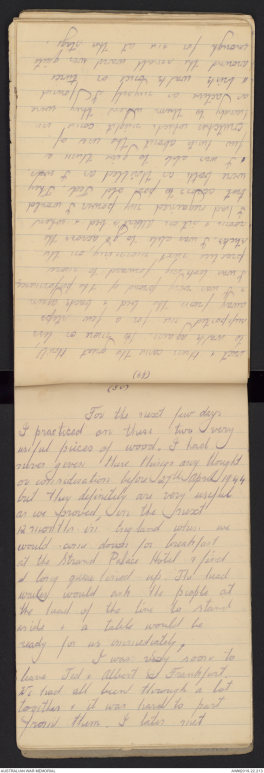
For the next few days
I practiced on these two very
useful pieces of wood. I had
never given
these things any thought
or consideration before 27th April 1944
but they definitely are very useful
as we proved, in the next
12 months in England where we
would come down for breakfast
at the Strand Palace Hotel & find
a long queue lined up. The head
waiter would ask the people at
the head of the line to stand
aside & a table would be
ready for us inevitably.
I was very soon to
leave Ted & Albert in Frankfurt.
We had all been through a lot
together & it was hard to part
from them. I later met
(51)
Albert at [[?]] but Ted was
never to leave Frankfurt. He died
a few months later. The doctor
& staff at the Frankfurt Luftwaffe
Hospital did everything possible
for us & it could have easily been
three instead of one.
To [[Obermassfeld?]] [[?]]
Hospital was [[?]] all Allied
POW who were not able to go
to organised camps, such as
[[?]] from were a big [[mass?]]
[[escape?]] took place in April 1944
Fifty officers were shot
after being recaptured. There we
had our own doctors who were
POW & had been captured in
the North African campaign at
Tobruk [[D]] etc. [[?]] to be
[[seen?]] some of the worst cases
(52)
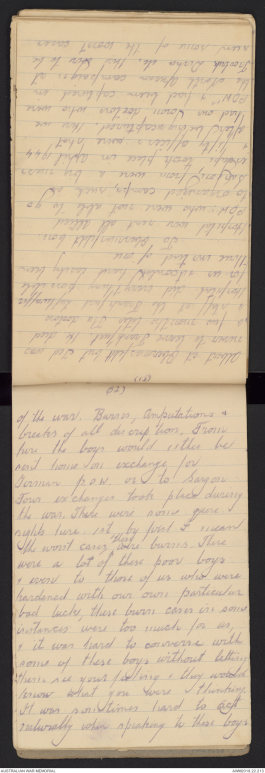
of the war. Burns, Amputations &
burns of all descriptions. From
here the boys would either be
sent home on exchange for
German P.O.W. or to [[Bayer?]]
Four exchanges took place during
the war. There were some [[queer?]]
sights [[?]] by first I [[?]]
the worst cases ^those were burns.
There
were a lot of these poor boys
& [[?]] to those of us who were
hardened with our own particular
bad luck, these burn cases in some
instances were too much for us,
and it was hard to converse with
some of these boys without letting
them seeing you [[failing?]] &
they would
know what you were thinking.
It was sometimes hard to act
normally when speaking
to these boys
 Sam scott
This transcription item is now locked to you for editing. To release the lock either Save your changes or Cancel.
This lock will be automatically released after 60 minutes of inactivity.