
Unit diaries relating to service of Geoffrey W. Fennell - Wallet 2 - Part 11
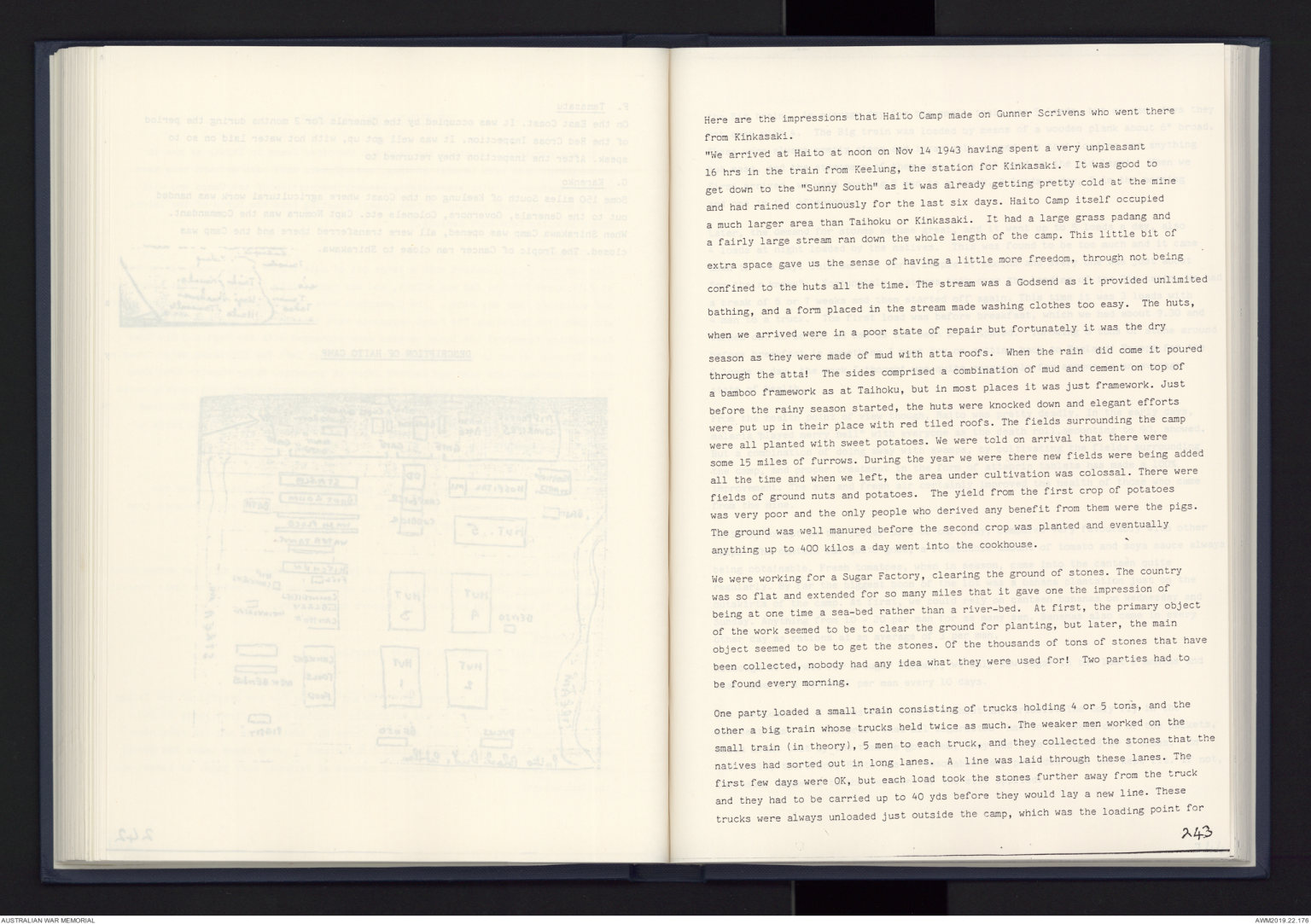
Here are the impressions that Haito Camp made on Gunner Scrivens who went there
from Kinkasaki.
"We arrived at Haito at noon on Nov 14 1943 having spent a very unpleasant
16 hrs in the train from Keelung, the station for Kinkasaki. It was good to
get down to the "Sunny South" as it was already getting pretty cold at the mine
and had rained continuously for the last six days. Haito Camp itself occupied
a much larger area than Taihoku or Kinkasaki. It had a large grass padang and
a fairly large stream ran down the whole length of the camp. This little bit of
extra space gave us the sense of having a little more freedom, through not being
confined to the huts all the time. The stream was a Godsend as it provided unlimited
bathing, and a form placed in the stream made washing clothes too easy. The huts,
when we arrived were in a poor state of repair but fortunately it was the dry
season as they were made of mud with atta roofs. When the rain did come it poured
through the atta! The sides comprised a combination of mud and cement on top of
a bamboo framework as at Taihoku, but in most places it was just framework. Just
before the rainy season started, the huts were knocked down and elegant efforts
were put up in their place with red tiled roofs. The fields surrounding the camp
were all planted with sweet potatoes. We were told on arrival that there were
some 15 miles of furrows. During the year we were there new fields were being added
all the time and when we left, the area under cultivation was colossal. There were
fields of ground nuts and potatoes. The yield from the first crop of potatoes
was very poor and the only people who derived any benefit from them were the pigs.
The ground was well manured before the second crop was planted and eventually
anything up to 400 kilos a day went into the cookhouse.
We were working for a Sugar Factory, clearing the ground of stones. The country
was so flat and extended for so many miles that it gave one the impression of
being at one time a sea-bed rather than a river-bed. At first, the primary object
of the work seemed to be to clear the ground for planting, but later, the main
object seemed to be to get the stones. Of the thousands of tons of stones that have
been collected, nobody had any idea what they were used for! Two parties had to
be found every morning.
One party loaded a small train consisting of trucks holding 4 or 5 tons, and the
other a big train whose trucks held twice as much. The weaker men worked on the
small train (in theory), 5 men to each truck, and they collected the stones that the
natives had sorted out in long lanes. A line was laid through these lanes. The
first few days were OK, but each load took the stones further away from the truck
and they had to be carried up to 40 yds before they would lay a new line. These
trucks were always unloaded just outside the camp, which was the loading point for
243
the Big train. An average day for the small train was 5 loads, but on many days they
got away with 4. The Big train was loaded by means of a wooden plank about 6" broad.
These were always pretty steep and invariably warped, so that loading was anything
but easy, and the steepness of them made it a bit hard on the old legs! When we
first arrived, we were working 5 men to a truck, 3 loads a day, 2 in the morning
and one in the afternoon.
Later, the demand for stones became great, and it went up to 5 loads a day, also
4 loads at night loaded by the natives. This was found to be too much and it came
down to 4 a day. This went on for a couple of months and every one was just about
"on their knees". Fortunately, natives took over the loading of the Big train. We had
a break of 6 or 7 weeks and then started off again. This time it was 3 loads with
4 men to a truck. The first load was before breakfast, which we had about 9.30 and
turned out to be not as bad as had been anticipated. Throwing 8 tons of stone around
before breakfast is something I must try on getting back to England! Except for the
5 loads a day, the work I thought was quite reasonable for anyone in an average
state of health.
From the health point of view though, Haito was pretty deadly. In the early days,
malaria "played merry hell" with everyone as the death roll, mounting to 90, showed.
But a combination of doing away with swamps, by cultivating the fields surrounding
the camp, and proper treatment in the form of attabrin tablets has made a 100%
improvement. The sun and fresh air certainly improved the health of those who came
from the mine.
Rations, except in the latter part of our stay, compared very favourably with other
camps. The canteen was quite good, a reasonable amount of tomato and soya sauce always
being obtainable. Fresh tomatoes, when in season, came into the canteen quite
regularly. By far the biggest boon of the lot was a banana plantation just on the
outskirts of the camp. At first, we could rely on canteen bananas on Wednesday and
Sunday. Anything from 10 - 20 per man for as many sen. Bananas also came in every
other day as rations at an average of 3 per man.
Although we worked for a Sugar Company, we only saw sugar in the last 2 months and
that came as a tea bowl per man every 10 days.
The American Red X stores were issued without any trouble. The only fly in the
ointment was the order that all cigarettes had to be taken out of the packets,
which meant that by the time we got them, they had been handled 5 or 6 times. On
the whole, therefore, Haito was a reasonable camp provided that one kept fit. If not,
the usual comments to the treatment of the sick applied.
244
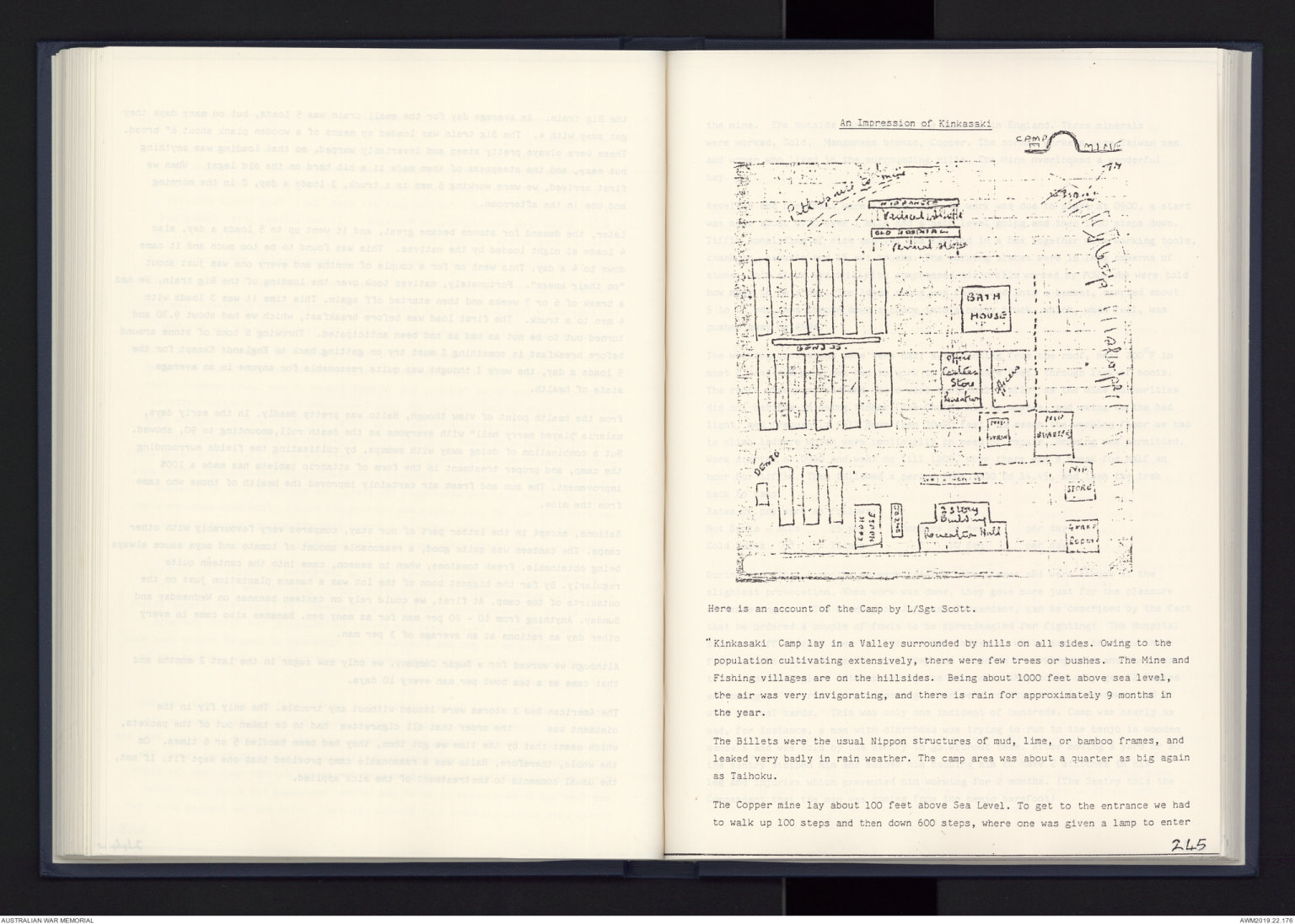
An Impression of Kinkasaki
Diagram - see original document.
Here is an account of the Camp by L/Sgt Scott.
"Kinkasaki Camp lay in a Valley surrounded by hills on all sides. Owing to the
population cultivating extensively, there were few trees or bushes. The Mine and
Fishing villages are on the hillsides. Being about 1000 feet above sea level,
the air was very invigorating, and there is rain for approximately 9 months in
the year.
The Billets were the usual Nippon structures of mud, lime, or bamboo frames, and
leaked very badly in rain weather. The camp area was about a quarter as big again
as Taihoku.
The Copper mine lay about 100 feet above Sea Level. To get to the entrance we had
to walk up 100 steps and then down 600 steps, where one was given a lamp to enter
245
the mine. The outside workings are the same as in England. Three minerals
were worked, Gold, Manganese bronze, Copper. The normal workers were Taiwan men
and women who lived in the surrounding hills. The Mine overlooked a wonderful
bay.
Reveille and breakfast were at 0600 hrs. As work was due to start at 0900, a start
was made about 0730 over 1 mile and a half level going and then 1000 steps down.
Tiffin consisting of rice and veg was carried in a box together with working tools,
chankuls, baskets and 15 cwt trucks. The working places were in long caverns of
stone. This stone was drilled by compressed air drills worked by POWs who were told
how many to do a day. The loose stone was chankuled into a basket, carried about
5 to 15 yds, and thrown down a chute into a bogey truck, which, when full, was
pushed away by POWs.
The working conditions were very bad; acid running from the roof, heat 200°F in
most places and many men had to work in their bare feet, through lack of boots.
The roofs were very bad and there were continual "falls" as the mine authorities
did not believe in using timber. The Chutes had no covers, and owing to the bad
light, men frequently fell down from 30-90 feet. To reach the working floor we had
to climb ladders which were continually in need of repair. Smoking was permitted.
Work started at 0900 and went on till 1200, when there was a break for half an
hour for tiffin. Then followed a period from 1230 to 14.45, and then the trek
back to Camp.
Rates of pay were as follows:
Hot Spots - NCOs 25 sen Gunners 20 sen per day
Cold Spots - " 15 sen " 10 sen per day
During the first 4 months we were treated like slaves and were struck at the
slightest provocation. When work was done, they gave more just for the pleasure
of hammering us. The Buncho, or Japanese Commandant, can be described by the fact
that he ordered a couple of fowls to be spreadeagled for fighting! The Hospital
Nippon staff orderly used to illtreat the patients, while asking them how they
felt. On one occasion in the mine they put 4 men in a working hole and they were
told to do 16 Bogies. After sweeping the hole out, they could only get 12 Bogies
and owing to the resulting hammering 1 man went to Hospital, 1 bed-down, and 2
with medical cards. This was only one incident of hundreds. Camp was nearly as
bad, for instance, a man with diarrhoea was trying to run to the benjo in wooden
sandals and was told by the sentry to go without them. After moving a yard or so
the sentry stopped him and bashed him causing him to have 2 stitches in his
leg and injuries which prevented him working for 2 months. (The Sentry told the
Commandant that the man was coming from the bengo barefoot).
246
The food, on the other hand, for those working in the mine, was plentiful as
regards rice, in fact the men had more than they could eat. There were of course
the usual deficiencies of vitamins due to lack of fats and meat. The Cookhouse
put up an excellent job of work.
The party from the Regiment arrived at the mine in August 1943. From May 1944
onwards, conditions changed for the better. Lt Wakyama left and his place was
taken by Capt Nomura, who came from Shirakawa Camp. He was rated by everyone as
a "Nippon Gentleman". "The Goons" wished to be treated as brothers and the
Nippon Guards became very friendly. The Hospital patients and sick were treated
very well. The amount of rice decreased but on the other hand pasties were
frequently served for the evening meal. Sports were organised, but the men were
in no fit state for them. However, from 4.30 in the afternoon till 7.30 next morning
our time was our own".
NEW CONDITIONS AT SHIRAKAWA
October had certainly been packed with excitements. By the 26th all the newcomers
had arrived and on the 30th the Camp was reorganised. All Lt Colonels and Majors
moved into the Generals' block, 3 to a room, and became No 1 Squad. The remaining
officers moved into the old Colonels' hut and were organised into 3 new Squads.
The BORs were graded into "fit" men and "light workers", and formed Squads 5 and 6
and occupied the old 9 and 10 Squad Hut, and the old enlisted men's hut. The
centre floor of the 9 and 10 Squad hut was removed, and partitions taken down,
with the result that they now consisted of a raised sleeping platform, and the old
7 & 8 Squad hut was treated the same way, as new arrivals were expected, as it was
rumoured that the Camp was to be brought up to 700. It was evidently to be made
into a Convalescent Camp coupled with light Farm work for the fit men.
Before dealing with the Hospital arrangements, mention should be made of the Air
Raid Questionnaire. The Commandant sent for Col Jephson and asked for his co-operation
as regards Air Raid Precautions. As a result, he and the Squad Leaders
put forward several suggestions such as (1) Marking the camp clearing as a PoW
Camp (2) Having the windows out during raids to avoid glass splinters (3) Unrestricted
use of the benjo (4) All to lie down on beds as at present (5) Fire
watchers to be appointed for each hut etc.
When the Commandant read this he said it was not what he wanted at all. Two officers
per Squad were asked to send in written answers to the following questionnaire
(1) Were the planes Allied? (2) What targets were they attacking (3) How many
planes and were they from Aircraft Carriers or China (4) Were we afraid and if so
of what (5) How did the behaviour of the Guards impress us.
247
The Interpreter returned at the end of the month having accompanied the Generals
to Japan. He told an American friend that he had found that a marriage had been
arranged for him but that his honeymoon had been somewhat disturbed by bombing!
He prophesied that "as the bones of contention" had been removed, our treatment
would improve, PX Stores were unlimited, and the Commandant and the Guards were
horrified at the state of health of the new arrivals.
The Hospital
Col Glattly of the US Medical Corps, late Chief Surgeon Luzon Force, was the only
remaining Doctor out of 18! As it was obvious that he could not cope by himself,
a voluntary organisation was introduced. Lt Cooper of the Regiment was appointed
"Matron" or "Registrar", and General Chief Staff Officer to Col Glattly. Lt Knights
became an assistant Dresser together with Capt Hinton of the Lanarkshire Yeomanry,
who had previously done good work at Kinkasaki. Col Hennessey also helped with
Outpatients in the Huts. A permanent squad of officers was formed to provide Food
servers, dish washers, mosquito net fixers, and most important of all medical
orderlies to wash the patients, clean the rooms and make themselves useful generally.
The roster was changed weekly.
The Generals Hut, North end, was known as the Hospital Annexe and divided into
sections of 5 rooms each containing 3 patients for purposes of medical and sanitary
attention. Sgt Elliott, L/Sgt Scott and L/Bdr Wersby were in a bunk together, with
L/Bdr Daff just up the passage. All four were suffering from stomach troubles,
having had dysentery at various times and were all skin and bone. They were
all however very cheerful and very thankful to get away from the mine to better
surroundings. Q Horner was attached to the Hospital as PT instructor and O/C Sunbathing,
and could be seen every morning and afternoon looking the picture of
health himself, surrounded by patients lying on blankets and doing mild arm, leg
and breathing exercises. Owing to their emaciated condition nothing very serious
could be attempted.
The month closed with the removal of all bamboo home-made chairs, wash-stands,
camp equipment, less camp beds. The reason for this was unknown except that the
order had presumably come from HQ at Taihoku, who hated to see any attempt to
make ourselves comfortable. However the loss of a bamboo chair is really not
much to worry about compared to the hardships being endured by those in other
camps.
November started quietly, the main point of issue being to decide how Canteen
Stores were to be dealt with. The majority of the men would not be in a position
to earn any pay for some time and, as a result, a scheme was drafted whereby the
officers were to contribute sufficient money from their credits to allow every
man to receive goods to the value of 11 Yen. This sum was based on a monthly
issue of 2 Syrup, 2 Sauce, 4 Fish Flakes, 2 Salt, Sugar, 1/10 lb of tea and
cigarettes as issued to the troops in red packets, costing 4 sen a packet of 10.
These plans were disturbed by a bolt from the blue, launched, as usual at the weekend!
On Sunday Nov 5th, Col Jephson was summoned to "the Hill" and told that 600 POWs were
arriving in about 2 days time! They would be accommodated in 7, 8, 9 and 10 Squad
huts with the balance in half 5 Squad. 7 & 8 Squad Hut was to be converted immediately,
to accommodate BORs. Incidentally, Nov 5th was Col Jephson's birthdy so
he received a pleasant (?) surprise from the Nips!
The chief difficulties would be the supply of water, and the cooking of extra meals.
The Nips did not know who the new arrivals were - they might be Chinese mandarins
with masses of luggage, or else shipwrecked sailors and soldiers with nothing!
Regarding the water, it was decided to ask for permission for them to go out to the
well and have a good wash once a day. Storage facilities in camp would not allow
this extra water to be drawn. Regarding food, 10 extra men were warned for cookhouse
duties; meals would be served in 2 shifts.
The new arrivals were to be divided in 5 Squads, A to E, and a Field Officer was
put in charge of each squad to act as "bear leader". It was understood that 400
would be moving on in about 3 days time. Sunday was classed as being an ordinary
working day, and the necessary alterations were made. On Sunday night, however,
there was an "Air Alert". On Monday morning, Col Jephson was told that the date of
arrival was postponed. Our conjectures were that (1) The party was coming from
overseas, probably from Thailand (2) Their convoy had been attacked or had found the
Port of Takao in the process of being attacked (3) They would now disembark at
Keelung (4) We might find some of our Regiment who had been left behind in Singapore
among the party. Nothing further transpired until 2 days later. On Wednesday, Nov 8th
we were told that only 200 would be coming, mostly Americans with a few officers
and a padre. The Interpreter and the BB went off on Tuesday night to meet them.
Squads A - C were abolished and evicted officers returned to their rooms.
Since the arrival of certain officers from Thailand in the previous party, every
effort had been made to get old friend located. As a result, we discovered that
Major Nelson and Capt Howard, BMRA and Staff Capt RA, 9 Ind Div, had Staff jobs in a
Base Camp in Burma and were both well. Lt McKenzie was in Thailand working as a
Medical Orderly in a Hospital. No news could be got of Capt Godman, Lts Reid and
Vincent, but Major McEwen had been with the parties on Railway construction.
Unfortunately it was impossible to locate any NCOs and men about whom we were
naturally very worried, owing to the news we had received about the epidemics of plague
and Cholera. Sgt Beardmore was located and was said to be well.
249
The party arrived at midday on Nov 8th covered in grime and heavily bearded!
Apart from that, they appeared in much better fettle than those from Kinkasaki
and Haito. They were Americans from the Philippines, and Col Glattly the MO
was delighted to find 5 MOs and the whole of his Divisional Medical Staff from
Manila. The remainder were a mixture of 18 Div and Southern Area Singapore,
Argylls, Leicesters, E Surreys, 135 Fd Regt, 122 Fd Regt, 125 A/T, Cambs, Norfolks,
Suffolks, Heavy AA. There were 4 officers, a Padre, a Gordon, an Argyll and a
Cambs. They had been 5 months on the way! Rail, Thailand to Singapore. Boat to
Borneo and Manila, 5 weeks in Manila and had been torpedoed 3 times in trying to
leave Manila! We learnt quite enough to make us realise that the "Wild Eagles"
had gone completely out of business and the Nip Mercantile Marine was getting
a real pasting whenever it showed its nose out!
On Nov 10th, Heoki told Col Pugh that Roosevelt had been re-elected. Red 'ot news
and a decided blow to Nippon. The Nipponese officers in Manila had let some of
them listen in to the Wireless, whilst in Manila, to a speech by Churchill about
the Siegfried Line, a 3 day truce asked for by Keittel and Churchill's remarks
re the Far East. Nov 11th proved a cold day and it was impossible to hold any
2 Minutes' Silence for all as it was not a holiday. It was also the 1000th Day
of Captivity.
More news about Thailand
From a Bdr in 122 Regt we heard that in June 1942, as already recorded in the
Registers, Sgt Archer and about 12 other ranks went to Thailand with 135 Fd
Regt. They first went to Chungkai and worked on the first section of the Railway.
The work consisted of making embankments and cuttings, and the hours of work were
from 8.30 - 12 and 2-6, though later on, they sometimes went out for 3 days at a
time. Sgt Archer was in charge of a Battalion Cook House. They stayed in a camp
for about 2 months and then moved on. On the first stage from Chungkai to Taisan
they lived in attap and bamboo huts, but later they had 160 lb tents. The food was
good at the start, but got worse later and consisted of rice and peanuts. Nip
Sappers were in charge of the. Nip Civilian engineers looked after the Tamils
brought from the Rubber estates. The Tamils were paid $1 a day, but had 50 cents
deducted to be remitted to their families in Malaya. About October 1942 more
parties arrived from Singapore. In one party were about 60 men of the Regt.
The Working parties were now divided into 6 groups (4 Thai, 2 Burma)
No 1. British Party Base Nonproduc. Rail starts. (Base Nonproduc)
No 2. Chungkai to Tarsau. Argylls, Manchesters, Gordons, Loyals, Cambs, Suffolks,
Norfolks, RASC, RAOC, Malay Vols, 122, 137, 125, 155, 135, 148 RCOS for Wireless
Communications. Dutch.
No 3. Burma. Australians, Indians, a few Yanks off the "Houston".
No 4. Arawel to Tarsau about 60 men. 5 Fd, 3 AA, 6 AA, HKS 80 AT. Dutch.
250
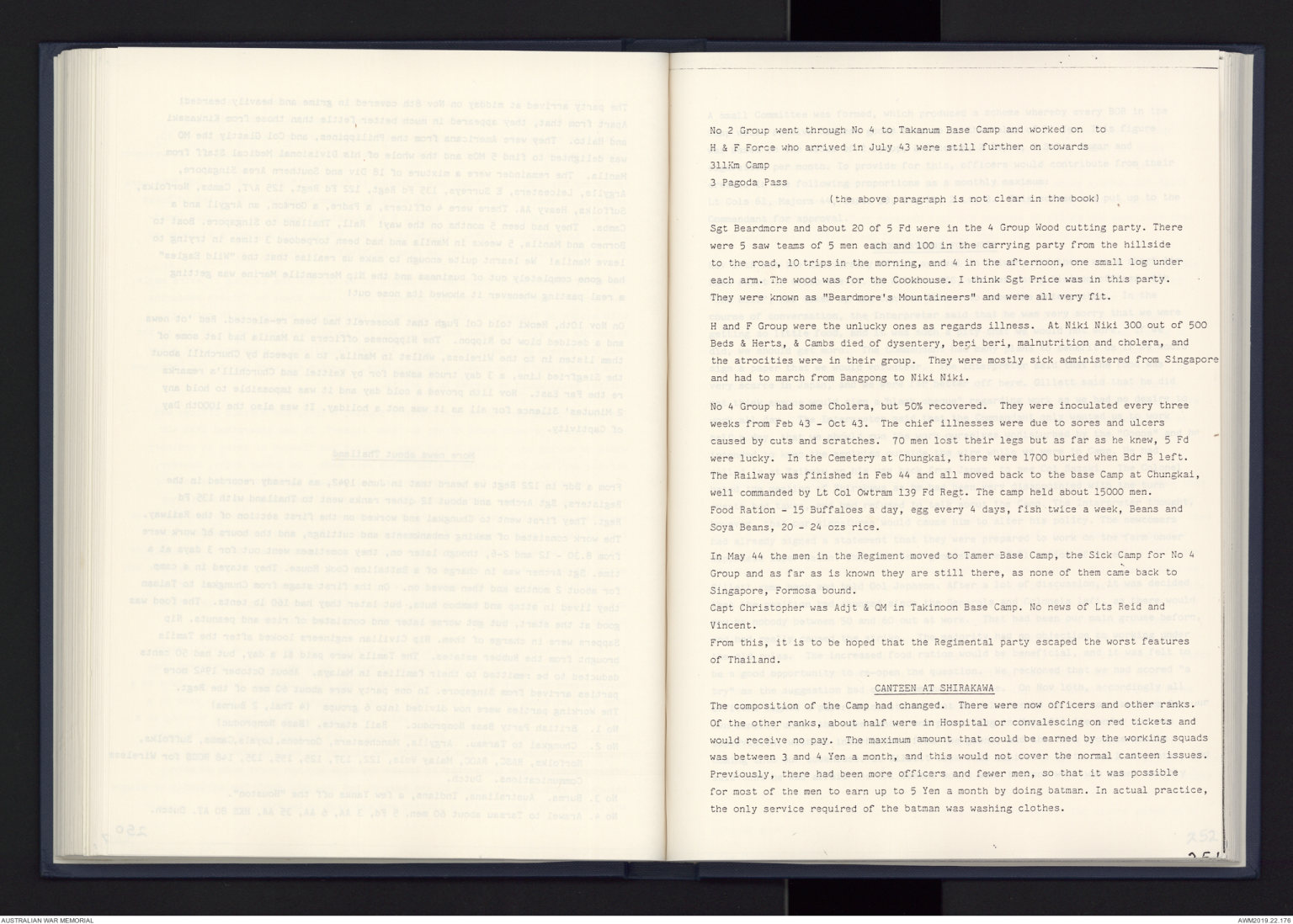
No 2 Group went through No 4 to Takanum Base Camp and worked on to
H & F Force who arrived in July 43 were still further on towards
311Km Camp
3 Pagoda Pass
(the above paragraph is not clear in the book)
Sgt Beardmore and about 20 of 5 Fd were in the 4 Group Wood cutting party. There
were 5 saw teams of 5 men each and 100 in the carrying party from the hillside
to the road, 10 trips in the morning, and 4 in the afternoon, one small log under
each arm. The wood was for the Cookhouse. I think Sgt Price was in this party.
They were known as "Beardmore's Mountaineers" and were all very fit.
H and F Group were the unlucky ones as regards illness. At Niki Niki 300 out of 500
Beds & Herts, & Cambs died of dysentery, beri beri, malnutrition and cholera, and
the atrocities were in their group. They were mostly sick administered from Singapore
and had to march from Bangpong to Niki Niki.
No 4 Group had some Cholera, but 50% recovered. They were inoculated every three
weeks from Feb 43 - Oct 43. The chief illnesses were due to sores and ulcers
caused by cuts and scratches. 70 men lost their legs but as far as he knew, 5 Fd
were lucky. In the Cemetery at Chungkai, there were 1700 buried when Bdr B left.
The Railway was finished in Feb 44 and all moved back to the base Camp at Chungkai,
well commanded by Lt Col Owtram 139 Fd Regt. The camp held about 15000 men.
Food Ration - 15 Buffaloes a day, egg every 4 days, fish twice a week, Beans and
Soya Beans, 20 - 24 ozs rice.
In May 44 the men in the Regiment moved to Tamer Base Camp, the Sick Camp for No 4
Group and as far as is known they are still there, as none of them came back to
Singapore, Formosa bound.
Capt Christopher was Adjt & QM in Takinoon Base Camp. No news of Lts Reid and
Vincent.
From this, it is to be hoped that the Regimental party escaped the worst features
of Thailand.
CANTEEN AT SHIRAKAWA
The composition of the Camp had changed. There were now officers and other ranks.
Of the other ranks, about half were in Hospital or convalescing on red tickets and
would receive no pay. The maximum amount that could be earned by the working squads
was between 3 and 4 Yen a month, and this would not cover the normal canteen issues.
Previously, there had been more officers and fewer men, so that it was possible
for most of the men to earn up to 5 Yen a month by doing batman. In actual practice,
the only service required of the batman was washing clothes.
251
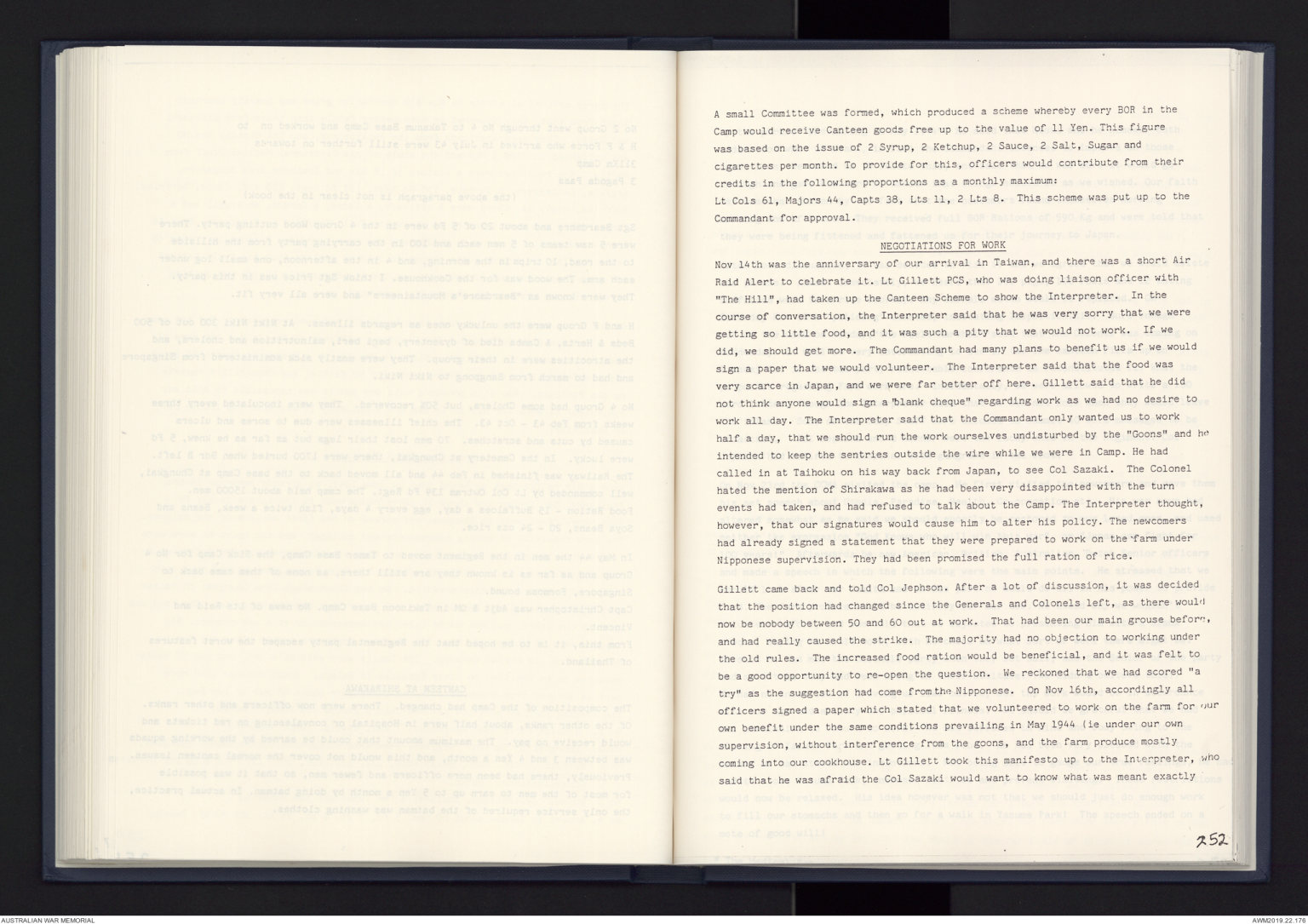
A small Committee was formed, which produced a scheme whereby every BOR in the
Camp would receive Canteen goods free up to the value of 11 Yen. This figure
was based on the issue of 2 Syrup, 2 Ketchup, 2 Sauce, 2 Salt, Sugar and
cigarettes per month. To provide for this, officers would contribute from their
credits in the following proportions as a monthly maximum:
Lt Cols 61, Majors 44, Capts 38, Lts 11, 2 Lts 8. This scheme was put up to the
Commandant for approval.
NEGOTIATIONS FOR WORK
Nov 14th was the anniversary of our arrival in Taiwan, and there was a short Air
Raid Alert to celebrate it. Lt Gillett PCS, who was doing liaison officer with
"The Hill", had taken up the Canteen Scheme to show the Interpreter. In the
course of conversation, the Interpreter said that he was very sorry that we were
getting so little food, and it was such a pity that we would not work. If we
did, we should get more. The Commandant had many plans to benefit us if we would
sign a paper that we would volunteer. The Interpreter said that the food was
very scarce in Japan, and we were far better off here. Gillett said that he did
not think anyone would sign a "blank cheque" regarding work as we had no desire to
work all day. The Interpreter said that the Commandant only wanted us to work
half a day, that we should run the work ourselves undisturbed by the "Goons" and he
intended to keep the sentries outside the wire while we were in Camp. He had
called in at Taihoku on his way back from Japan, to see Col Sazaki. The Colonel
hated the mention of Shirakawa as he had been very disappointed with the turn
events had taken, and had refused to talk about the Camp. The Interpreter thought,
however, that our signatures would cause him to alter his policy. The newcomers
had already signed a statement that they were prepared to work on the farm under
Nipponese supervision. They had been promised the full ration of rice.
Gillett came back and told Col Jephson. After a lot of discussion, it was decided
that the position had changed since the Generals and Colonels left, as there would
now be nobody between 50 and 60 out at work. That had been our main grouse before,
and had really caused the strike. The majority had no objection to working under
the old rules. The increased food ration would be beneficial, and it was felt to
be a good opportunity to re-open the question. We reckoned that we had scored "a
try" as the suggestion had come from the Nipponese. On Nov 16th, accordingly all
officers signed a paper which stated that we volunteered to work on the farm for our
own benefit under the same conditions prevailing in May 1944 (ie under our own
supervision, without interference from the goons, and the farm produce mostly
coming into our cookhouse. Lt Gillett took this manifesto up to the Interpreter, who
said that he was afraid the Col Sazaki would want to know what was mean exactly
252
 Sam scott
This transcription item is now locked to you for editing. To release the lock either Save your changes or Cancel.
This lock will be automatically released after 60 minutes of inactivity.