
Unit diaries relating to service of Geoffrey W. Fennell - Wallet 2 - Part 7
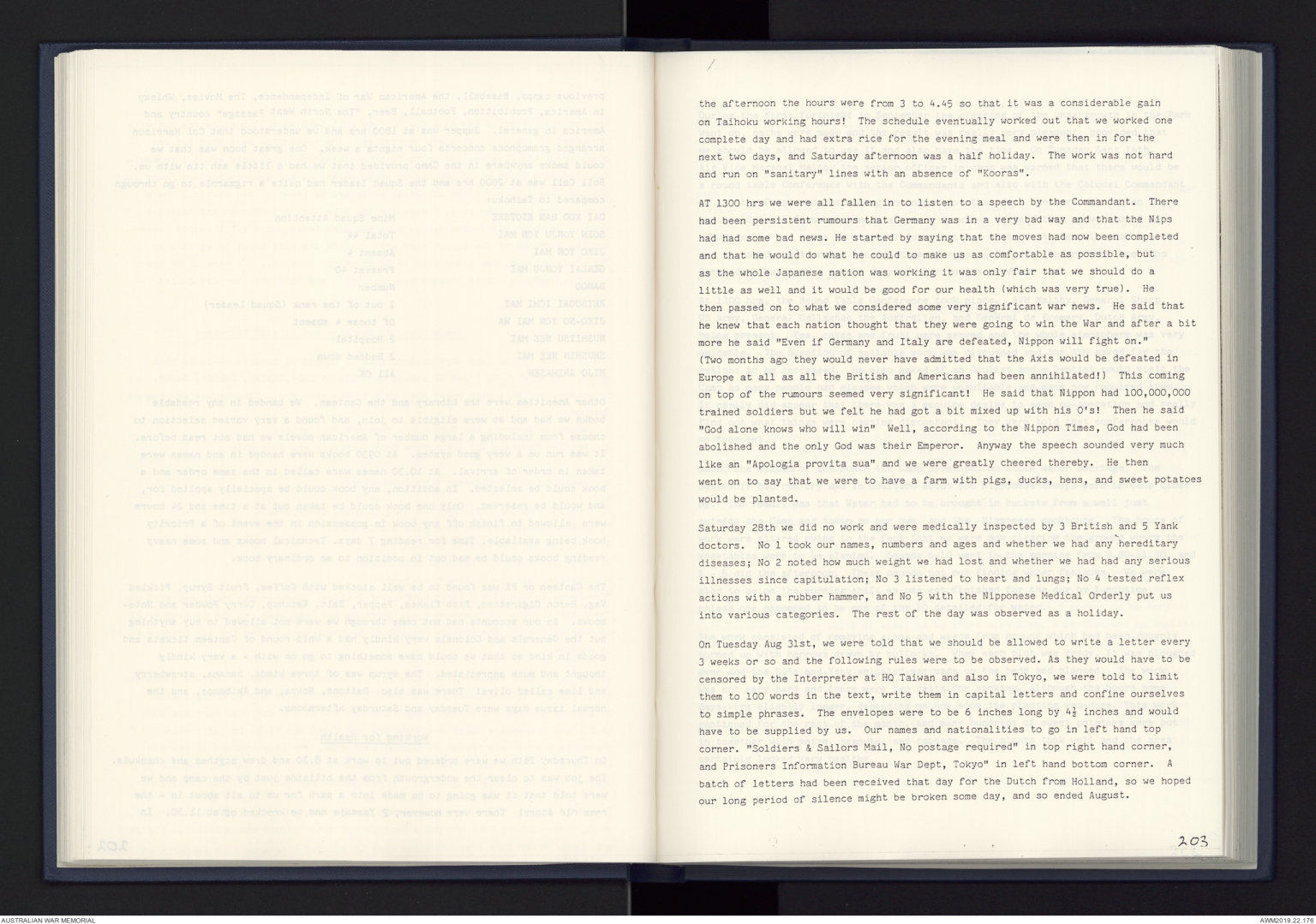
the afternoon the hours were from 3 to 4.45 so that it was a considerable gain
on Taihoku working hours! The schedule eventually worked out that we worked one
complete day and extra rice for the evening meal and were then in for the
next two days, and Saturday afternoon was a half holiday. The work was not hard
and run on "sanitary" lines with an absence of "Kooras".
AT 1300 hrs we were all fallen in to listen to a speech by the Commandant. There
had been persistent rumours that Germany was in a very bad way and that the Nips
had had some bad news. He started by saying that the moves had now been completed
and that he would do what he could to make us as comfortable as possible, but
as the whole Japanese nation was working it was only fair that we should do a
little as well and it would be good for our health (which was very true). He
then passed on to what we considered some very significant war news. He said that
he knew that each nation thought they were going to win the War and after a bit
more he said "Even if Germany and Italy are defeated, Nippon will fight on."
(Two months ago they would never have admitted that the Axis would be defeated in
Europe at all as all the British and Americans had been annihilated!) This coming
on top of the rumours seemed very significant! He said that Nippon had 100,000,000
trained soldiers but we felt he had got a bit mixed up with his 0's! Then he said
"God alone knows who will win" Well, according to the Nippon Times, God had been
abolished and the only God was their Emperor. Anyway the speech sounded very much
like an " Apologia provita sua" and we were greatly cheered thereby. He then
went on to say that we were to have a farm with pigs, ducks, hens, and sweet potatoes
would be planted.
Saturday 28th we did no work and were medically inspected by 3 British and 5 Yank
doctors. No 1 took our names, numbers and ages and whether we had any hereditary
diseases; No 2 noted how much weight we had lost and whether we had had any serious
illnesses since capitulation; No 3 listened to heart and lungs; No 4 tested reflex
actions with rubber hammer, and No 5 with the Nipponese Medical Orderly put us
into various categories. The rest of the day was observed as a holiday.
On Tuesday Aug 31st, we were told that we should be allowed to write a letter every
3 weeks or so and the following rules were to be observed. As they would have to be
censored by the Interpreter at HQ Taiwan and also Tokyo, we were told to limit
them to 100 words in the text, write them in capital letters and confine ourselves
to simple phrases. The envelopes were to be 6 inches long by 4½ inches and would
have to be supplied by us. Our names and nationalities to go in the left hand top
corner. "Soldiers & Sailors Mail, No postage required" in top right hand corner,
and Prisoners Information Bureau War Dept, Tokyo" in left hand bottom corner. A
batch of letters had been received that day for the Dutch from Holland, so we hoped
our long period of silence might be broken some day, and so ended August.
203
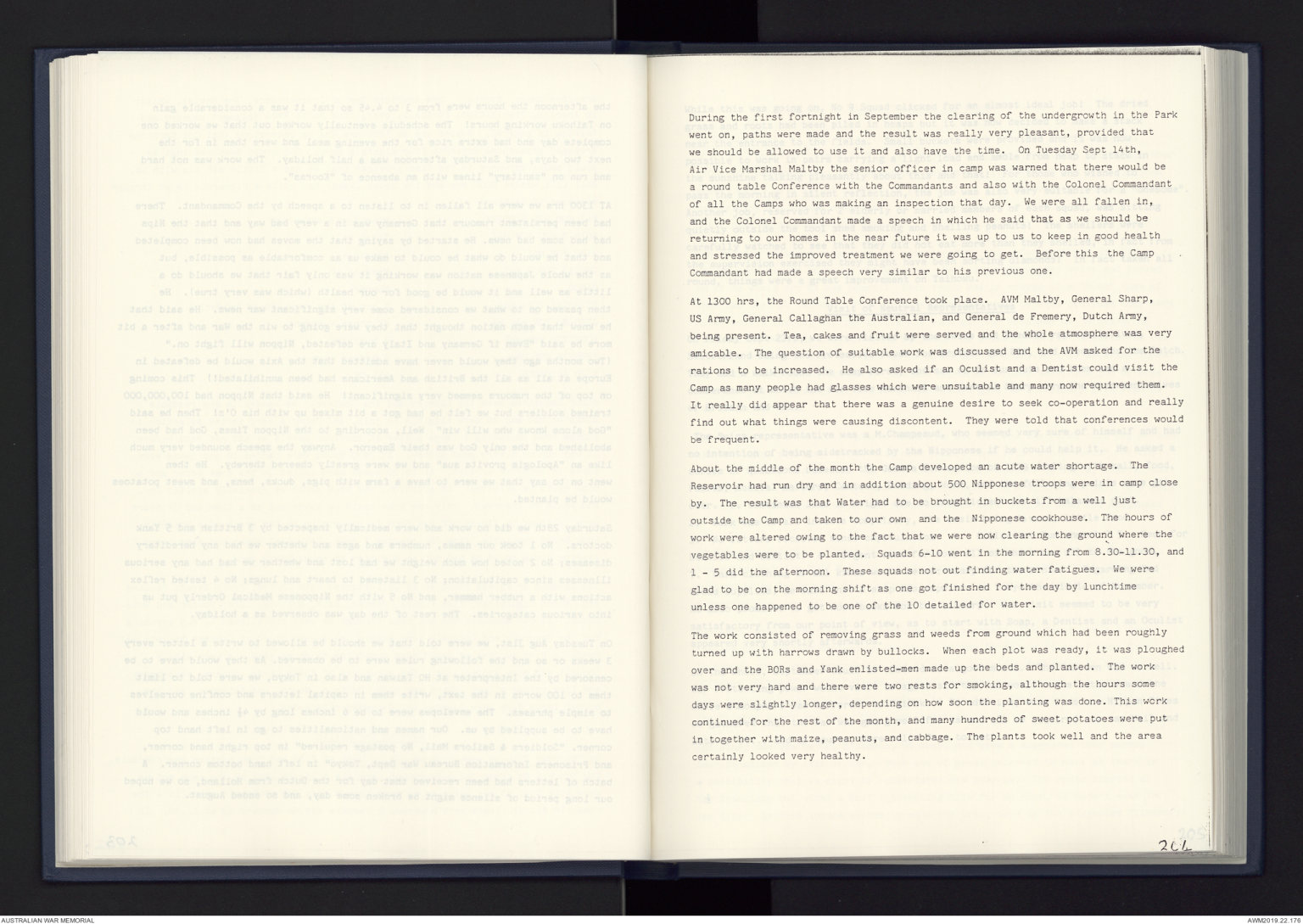
During the first fortnight in September the clearing of the undergrowth in the Park
went on, paths were made and the result was really very pleasant, provided that
we should be allowed to use it and also have the time. On Tuesday Sept 14th,
Air Vice Marshal Maltby the senior officer in camp was warned that there would be
a round table Conference with the Commandants and also with the Colonel Commandant
of all the Camps who was making an inspection that day. We were all fallen in,
and the Colonel Commandant made a speech in which he said that as we should be
returning to our homes in the near future it was up to us to keep in good health
and stressed that improved treatment we were going to get. Before this the Camp
Commandant had made a speech very similar to his previous one.
At 1300 hrs, the Round Table Conference took place. AVM Maltby, General Sharp,
US Army, General Callaghan the Australian, and General de Fremery, Dutch Army,
being present. Tea, cakes and fruit were served and the whole atmosphere was very
amicable. The question of suitable work was discussed and the AVM asked for the
rations to be increased. He also asked if an Oculist and a Dentist could visit the
Camp as many people had glasses which were unsuitable and many now required them.
It really did appear that there was a genuine desire to seek
co-operation and really
find out what things were causing discontent. They were told that conferences would
be frequent.
About the middle of the month the Camp developed an acute water shortage. The
Reservoir had run dry and in addition about 500 Nipponese troops were in camp close
by. The result was that Water had to be brought in buckets from a well just
outside the Camp and taken to our own and the Nipponese cookhouse. The hours of
work were altered owing to the fact that we were now clearing the ground where the
vegetables were to be planted. Squads 6-10 went in the morning from 8.30-11.30, and
1 - 5 did the afternoon. These squads not out finding water fatigues. We were
glad to be on morning shift as one got finished for the day by lunchtime
unless one happened to be one of the 10 detailed for water.
The work consisted of removing grass and weeds from ground which had been roughly
turned up with harrows drawn by bullocks. When each plot was ready, it was ploughed
over and the BORs and Yank enlisted-men md up the beds and planted. The work
was not very hard and there were two rests for smoking, although the hours some
days were slightly longer, depending on how soon the planting was done. This work
continued for the rest of the month, and many hundreds of sweet potatoes were put
in together with maize, peanuts, and cabbage. The plants took well and the area
certainly looked very healthy.
204
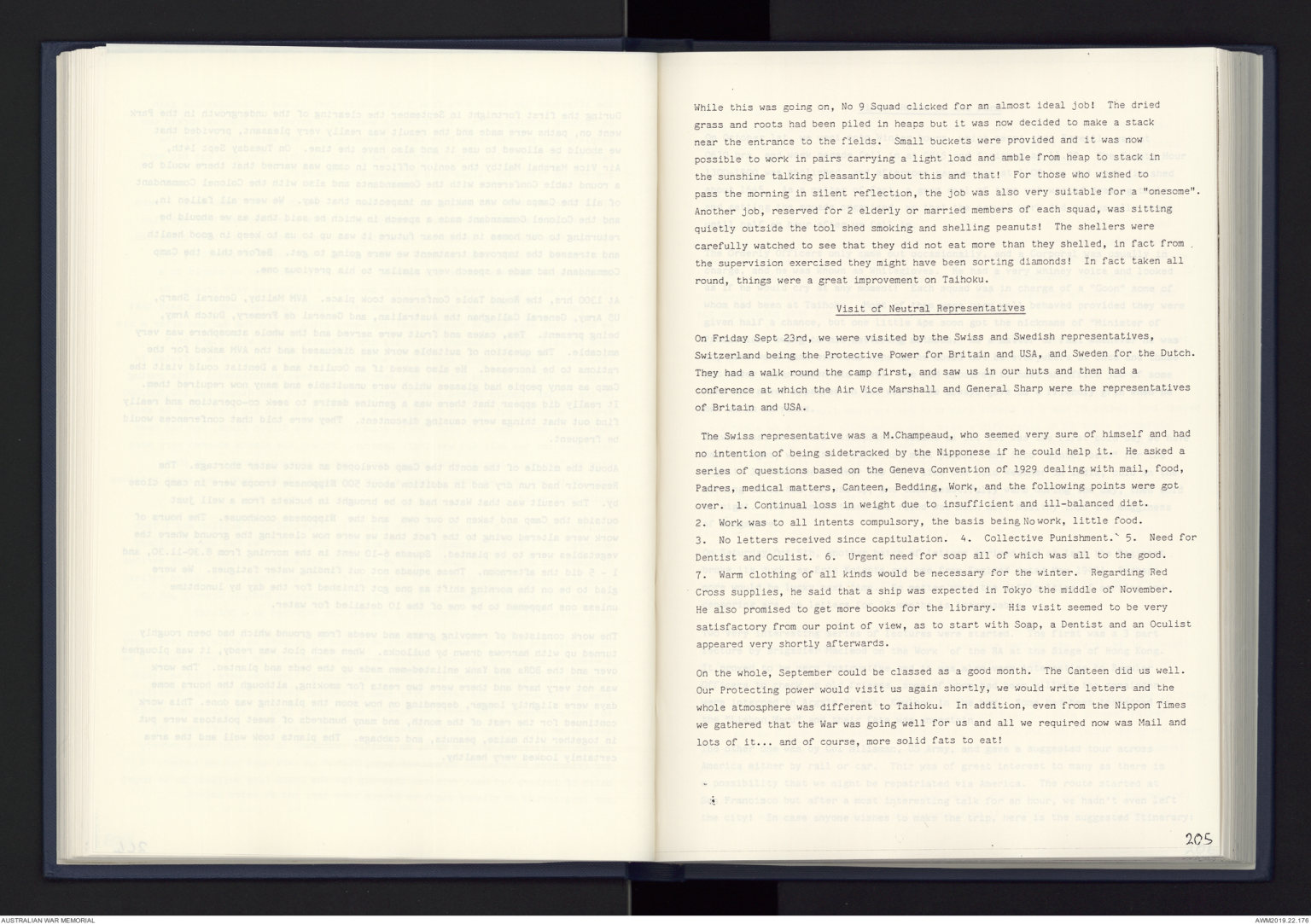
While this was going on, No 9 Squad clicked for an almost ideal job! The dried
grass and roots had been piled in heaps but it was now decided to make a stack
near the entrance to the fields. Small buckets were provided and it was now
possible to work in pairs carrying a light load and amble from heap to stack in
the sunshine talking pleasantly about this and that! For those who wished to
pass the morning in silent reflection, the job was also very suitable for a "onesome".
Another job, reserved for 2 elderly or married members of each squad, was sitting
quietly outside the tool shed smoking and shelling peanuts! The shellers were
carefully watched to see they did not eat more than they shelled, in fact from
the supervision exercised they might have been sorting diamonds! In fact taken all
round, things were a great improvement on Taihoku.
Visit of Neutral Representatives
On Friday Sept 23rd, we were visited by the Swiss and Swedish representatives,
Switzerland being the Protective Power for Britain and USA, and Sweden for the Dutch.
They had a walk round the camp first, and saw us in our huts and then had a
conference at which the Air Vice Marshal and General Sharp were the representatives
of Britain and USA.
The Swiss representative was a M.Champeaud, who seemed very sure of himself and had
no intention of being sidetracked by the Nipponese if he could help it. He asked a
series of questions based on the Geneva Convention of 1929 dealing with mail, food,
Padres, medical matters, Canteen, Bedding, Work, and the following points were got
over. 1. Continual loss in weight due in sufficient and ill-balanced diet.
2. Work was to all intents compulsory, the basis being No work, little food.
3. No letters received since capitulation. 4. Collective Punishment. 5. Need for
Dentist and Oculist. 6. Urgent need for soap all of which was all to the good.
7. Warm clothing of all kinds would be necessary for the winter. Regarding Red
Cross supplies, he said that a ship was expected in Tokyo in the middle of November.
He also promised to get more books for the library. His visit seemed to be very
satisfactory from our point of view, as to start with Soap, a Dentist and an Oculist
appeared very shortly afterwards.
On the whole, September could be classed as a good month. The Canteen did us well.
Our Protecting power would visit us again shortly, we would write letters and the
whole atmosphere was different to Taihoku. In addition, even from the Nippon Times
we gather that the War was going well for us and all we required now was Mail and
lots of it... and of course, more solid fats to eat!
205
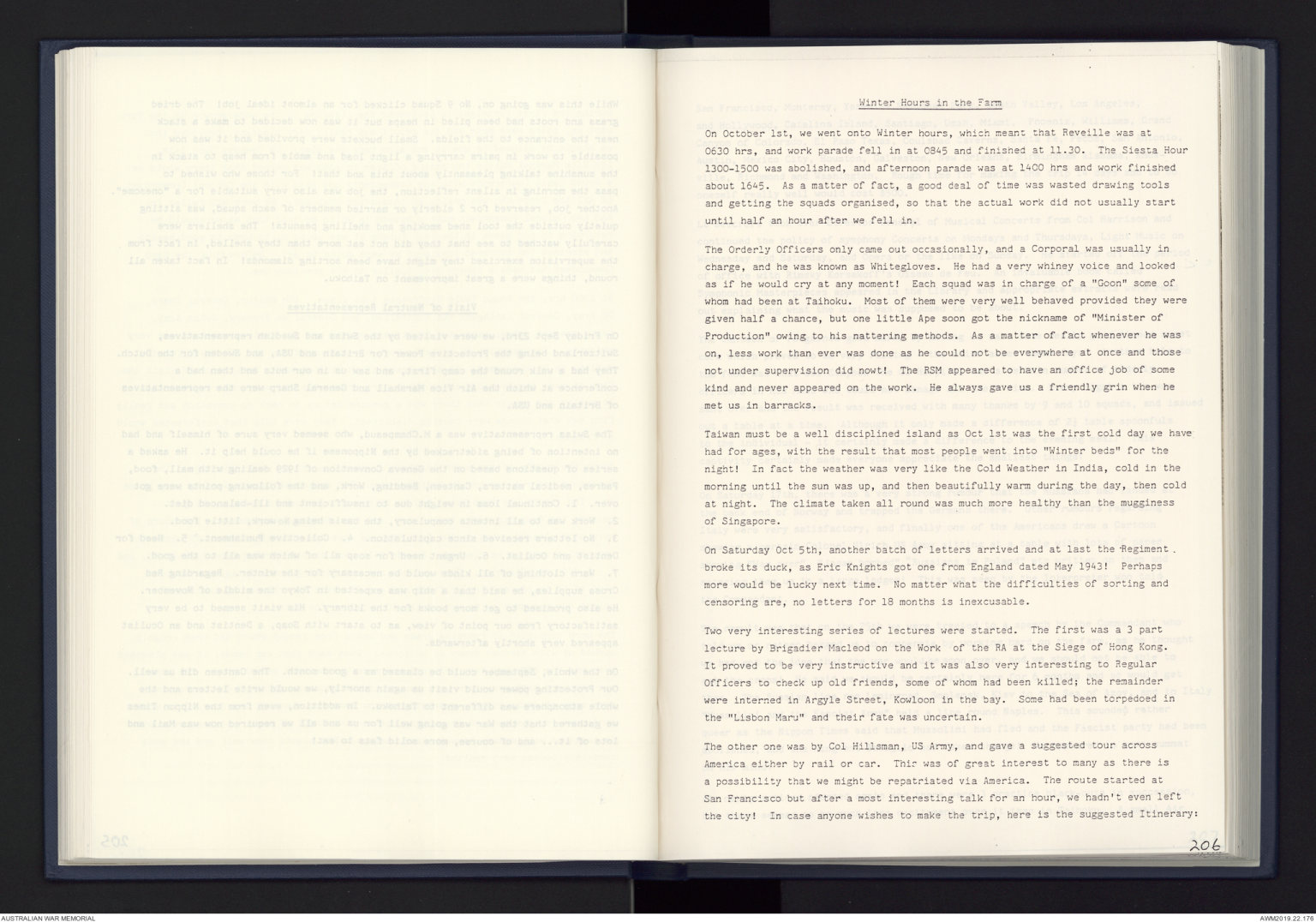
Winter Hours in the Farm
On October 1st, we went onto Winter hours, which meant that Reveille was at
0630 hrs, and work parade fell in at 0845 and finished at 11.30. The Siesta Hour
1300-1500 was abolished, and afternoon parade was at 1400 hrs and work finished
abou 1645. As a matter of fact, a good deal of time was wasted drawing tools
and getting the squads organised, so that the actual work did not usually start
until half an hour after we fell in.
The Orderly Officers only came out occasionally, and a Corporal was usually in
charge, and he was known as Whitegloves. He had a very whiney voice and looked
as if he would cry at any moment! Each squad was in charge of a "Goon" some of
whom had been at Taikohu. Most of them were very well behaved provided they were
given half a chance, but one little Ape soon got the nickname of "Minister of
Production" owing to his nattering methods. As a matter of fact whenever he was
on, less work than ever was done as he could not be everywhere at once and those
not under supervision did nowt! The RSM appeared to have an office job of some
kind and never appeared on the work. He always gave us a friendly grin when he
met us in barracks.
Taiwan must be well disciplined island as Oct 1st was the first cold day we have
had for ages, with the result that most people went into "Winter beds" for the
night! In fact the weather was very like the Cold Weather in India, cold in the
morning until the sun was up, and the beautifully warm during the day, then cold
at night. The climate taken all round was much more healthy than the mugginess
of Singapore.
On Saturday Oct 5th, another batch of letters arrived and at last the Regiment
broke its duck, as Eric Knights got one from England dated May 1943! Perhaps
more would be lucky next time. No matter what the difficulties of sorting and
censoring are, no letters for 18 months is inexcusable.
Two very interesting series of lectures were started. The first was a 3 part
lecture by Brigadier Macleod on the Work of the RA at the Siege of Hong Kong.
It proved to be very instructive and it was also very interesting to Regular
Officers to check up old friends, some of whom had been killed; the remainder
were interned in Argyle Street, Kowloon in the bay. Some had been torpedoed in
the "Lisbon Maru" and their fate was uncertain.
The other one was by Col Hillsman, US Army, and gave a suggested tour across
America either by rail or car. This was of great interest to many as there is
a possibility that we might be repatriated via America. The route started at
San Francisco but after a most interesting talk for an hour, we hadn't even left
the city! In case anyone wishes to make the trip, here is the suggested Itinerary:
206
San Francisco, Monterey, Yosemite National Park, Death Valley, Los Angeles,
and Hollywood, Catalina Island, Santiago, Umah, Miami, Phoenix, Williams, Grand
Canyon of Colorado, El Paso Texas, Coulsbad Caverns, Santa Fe, Pecos, San Antonio,
Austin, Mexico City, Houston, Galveston, New Orleans, Birmingham Alabama, Knoxville,
Richmond and Washington. Rough time for making the trip 14 days and to do
oneself really well would cost $500.
Lt Beecroft took over Director General of Musical Concerts from Col Harrison and
continued the policy of symphony Concerts on Mondays and Thursdays, Light Music on
Wednesday and Saturday, and Opera or the like on Sunday. He started off the period
of office with Rimsky Korsakoff's Oiseau de Feu. An invaluable book called
Symphonic Masterpieces appeared in the Library and appropriate extracts were read
out explaining what the music was supposed to be about.
The Canteen or PX gained good marks by having on sale some really good tinned sweet
corn which proved to be very filling - the chief asset these days! Another help to
the food was that Col Simpson the OC Hospital had a certain number of elderly
officers in his Mess who could not manage all their rice. Every night a tin was
sent over and the result was received with many thanks by 9 and 10 squads, and issued
out a table at a time. Although it only made a difference of 2½ table spoonfuls
to the individual - it certainly made a difference to the evening meal! This
captivity certainly made everyone appreciate the smallest things!
On Saturday 17th, there was a very strong rumour that the Russians had landed at
the back end of Norway and trapped the Germans there. Other rumours regarding
Italy were very satisfactory, and finally one of the Americans drew a Cartoon
showing a certain Colonel Ulrich US Army sitting at a table with lots of paper
showing "War over", "Japan bombed", "Russians in Poland" etc written on them and
entering them up in a large ledger! This was seen by the Interpreter who told
the Commandant.
The result was that on the 25th we were treated to a speech by the Commandant who
told us or rather begged us to cooperate by working hard on the farm, as he thought
we had got the idea that the war would be soon over, and we should not be able to
eat the crops! He said we should be certainly here for 6 months and so would get
them. The Russian line ran Leningrad, Smolensk, Kiev to the Sea of Azov, and in Italy
"Mussolini and the Fascist Army" held a line round Naples. This sounded rather
queer as the Nippon Times said that Mussolini had fled and the Fascist party had been
abolished, and the King and Badoglio had taken charge! He appeared to have summat
on his mind!
Air raid practices started again and there were 3 practice black-outs in succession,
but there seemed to be much less excitement over it than in Taihoku. A small Air
207
Raid shelter was built for the sentry at the gate leading to the tool shed, but
it was generally agreed that it would not keep anything out in the event of any
bombs falling.
The following week there was a change in working squads. 9 & 10 "the young
squads" were separated, 9 going out in the mornings with 2 British generals,
5 Hong Kong 7 The Dutchmen, and 8 the American and British Lt Cols. It produced
new fields for conversation as all the squads were working quite close to each
other on weeding.
On Thursday Oct 28th there was a whole holiday on account of it being the National
Day of Taiwan. A very pleasant day was spent by all and as an extra treat there
was an issue of cucumber and sauce for the evening meal. There was also a strong
rumour circulated by the American, Sgt Provo, that another batch of letters had
arrived and that certainly set a lot of hearts beating! Incidentally this NCO had
been two years in Japan training to be a Buddhist and so spoke the language
fluently.
Nov 3rd was a whole holiday in honour of the founding of the Meyi Restoration.
On the same day we were asked to write a 50 word treatise on the following subjects:
1. Why is Britain fighting Japan (2) What territory does Britain seek to acquire as
a result of the War. They asked for frank opinions and got them!
On November 4th we had a sad blow as Lt Marsden was suddenly told to pack up and
get ready to leave. He eventually left at two in the afternoon and we all fell
in to see him off. His companions were Sgt Provo, Sgt Light, another American who
was supposed to have pro Nippon sympathies, and did office orderly and runner, and
another American Sgt. There was considerable discussion as to where they were
going, the two favourite ones being (a) to the Generals' Camp (b) to Tokyo to use
for some propaganda purposes as Lt Marsden had aristocratic connections. If he was
being flown to Tokyo he would probably pass through Taihoku and might spend the
night in our old camp, and what a buzz there would be when they saw him.
Anyhow, we wished him nothing but the best as he had been a very good friend to
the Regiment - a very efficient Signal Officer in Singapore, and a cheery companion
later who joined in everything. His "magnum opus" of course was the Benjo he
constructed in the vegetable garden with Capt Pearson.
Sunday November 6th was a very queer day. In view of the Inspection by the
Quartermaster-General on Monday, all Church services were cancelled and all the
huts were given a good spring clean and there was much removal of cobwebs and dust
from the rafters! The Nipponese had their usual attack of pre-inspection Rice-itis
with the result that although it was a non-working day, ALL the meals were enormous,
so that with the kind donations from the Colonels Mess and the fact that some
regular members were sick, the fit members of 9 & 10 squads really had enough rice
208
and barley that they could cope with! Also the interpreter was reported to have
produced the story that the Russians were well into Bessarabia and fighting in
conjunction with the Turks who came into the War in September. The Britain and
Americans were near Ancona, had also made a landing in Genoa, and Badoglio
was on our side. May it be true!
At 0200 hrs on the morning of 7th, those of No 9 who slept near the Guard Room
were woken up by the arrival of 2 lorries and the voice of the Interpreter
telling some people to get down. It was the expected new party and consisted of
about 17 Dutch, 4 Americans, 5 Australians and about 6 Britishers. Presently the
Commandant came along and made a nice little opening speech. He told them that
they had come to No 4 Camp Taiwan and the present inhabitants were very well
behaved and cooperated well. (Loud but suppressed cheers from the naughty boys
in 9!) He told them about the work and the farm and hoped they would also cooperate
after they had finished their period of quarantine. They then went off to the
Hospital block, and a Benjo visitor found out that they had come from Java via
Singapore. The inspecting General came later but we never saw him.
November 11th was a normal working morning, so that it was not possible to have a
parade for the 2 minutes' Silence. It was observed by small groups out on the
work, which merely consisted of weeding the new cabbage beds. Later in the day
Harry Bristow of the Signals instituted a "Gallup Poll" to give the date (1) The
end of the European War (2) the end of the Japanese War. The average of 86
officers worked out at March 2rd for (1) and July 28th for (2) both in 1944. It
will be great fun checking up dates later. Many seem to have been guided by
various birthdays and other anniversaries in making their choice.
During the afternoon there was a very interesting lecture by Brigadier Wallis from
Hong Kong on China and Burma. When in Hong Kong he had had opportunities of meeting
Chinese Regular soldiers and civilians and discussing things with them. He had a
very good map, which showed the areas occupied by the Japanese and Nanking and
those by Chungking; the Japanese territory seemed very small compared to the whole,
being mostly on the Coast and up the Yangtse River. Later he talked about the
communications in Burma and possible alternatives to the part of the Burma road which
had been cut.
The Japanese produced a new form of joke. Fewer squads went out to work and the
remainder went on water fatigue. The workers spent most of the time sitting down
weeding and got workers rice. The water carriers walked altogether about 2½ miles
and did not!
The following Saturday we had large issue of Nippon Times up to October 10th. They
were a very interesting lot, dealing as they did with the Capitulation of Italy
and the Nipponese were very angry about it. The landing at Salerno Bay gave us a
209
good deal of amusement. Things did not go too well at first for us apparently, and
headlines and articles trumpeted out that a second Dunkirk was imminent. In a few
days however the good old phrase "Strategical withdrawal" began to be used, and we
knew that all was well. The appointment of Lord Louis Mountbatten was taken as
being a great victory for Churchill over Roosevelt, as he had been obviously put in
to keep an eye on British Imperial interests in the Pacific! We had to admit that
the rescue of Mussolini was a very creditable performance. It was with great
interest we noted that a White Paper on Rudolph Hess was being published by the British
Government and only wished we could read it.
On Sunday there was a Memorial Service for Armistice Day. It was conducted by a
newcomer, a Methodist Minister attached to the Australians who had been captured
in Java. There was a celebration of the Communion and he had brought with him a
little Wine, which had added to it Strawberry juice and water. He made a good first
impression as he gave a good address. However we shall get to know him better in
the future. During the Service, on naturally thought of those who had been killed
during the Campaign and who had died later, but one could not help wondering how
the men or the Regiment were getting on in the mining camp at Kinkaseki. One had
been inclined to take the stories of this camp with a grain of salt, but it
certainly seemed to be a change for the worse compared with Taihoku. There at any
rate the work was in the open air.
In the afternoon there was a most interesting lecture by an Australian Brigadier
Blackburn VC on the Syrian Campaign. They were told that the Vichy French would
not fight and so did not even wear tin hats. They were speedily disillusioned! One
Battle Order he received from a Free French General Gentilhomme was "Go up the main
road until you find someone fighting and then join in"!
The new arrivals were allotted to squads on the Monday, and No 9 received the Padre,
3 RAAF officers, 1 RAF Squadron leader, 2 AIF officers who had been in Syria, and a
Captain from 1/15 Punjabis. They had all been captured in Java where they had been
living on the fat of the land, and so were not very favourably impressed with our
rations! There was also a Chinese Colonel but he was put in with the Dutch squad.
On Monday also, a new plan for work started. No water was being pumped up at all so
9 & 10 squads were made permanent water carriers as being the squads with most "young"
men. As a matter of fact, it had advantages. It entailed a regular walk every
morning or afternoon of about 2½ to 3 miles in easy stages in a continuous chain
without supervision from the "Goons" working in pairs, and with a view to getting
one's legs in good trim for the future was vastly preferable to weeding and other
such jobs on the farm. Previously it was on the cards that officers would work on
the farm in the morning and draw water in the afternoon, whereas now, either
morning or afternoon was completely free. On Sundays and holidays a mixed party
from all squads would do the job.
210
The following were put in for the Xmas Dinners, as Red X Stores were a very doubtful
factor. Strength of all Ranks 506. Pork 125 Kgs, Potatoes 250 Kgs, Bread 506
loaves, Treacle or Molasses 506 tins, Peanuts 126 Kgs, "Cookies" 506 rations,
Jam 506 jars, Sugar 250 Kgs, Eggs 1012, Candy 206 bags, and 1018 oranges. Let's
hope we get them! A Kg is 2.2 lbs. To go with this there was a rumour that the
Germans were out of Northern Italy and there had at last been a landing in France.
During the week there was a decided cold snap and it was brought to the notice of
most people that except for the very inadequate "Blue Suits", most of the Regiment
had a very poor Winter wardrobe! The enlisted men were issued with British Greybacks
and the officers were told that "Provision had been made"! Thanks to the
glass windows and wooden sliding doors, it was possible to get a fairly good
fug up in the huts and cubicles, and we were spared the awful East wind we had in
Taihoku as the Camp was at the bottom of a tree-clad hollow. Still, it was quite
cold enough on our singularly non-heat producing diet!
On Sunday Nov 21st, Brigadier Blackburn continued his lecture, from which the
main facts emerging from his 8 months close contact with Free and Vichy French
officers and men (1) They hated each other like poison and will do so for a number
of years (2) They had all had it drummed into them that Britain was responsible for
the Fall of France, and had obtained preferential treatment at the evacuation from
Dunkirk (3) They all hated de Gaulle (4) They had a completely defeatist attitude
and could never visualise us beating the Germans (5) de Gaulle visited Syria and
proved impossible to get on with owing to his arrogance (6) The Syrians could not
understand why we were handing over Syria to the Free French (7) At the end of the
Commission of Control, the British and Australian officers really did not know
whether they disliked the Free French or Vichy French most!
Thursday Nov 25th was observed by the Americans as Thanksgiving Day, corresponding
to our Harvest Festival. During the early hours of the morning there was the
biggest earthquake shock we have yet met. It went on for about 5 minutes, but
we understand that our huts are specially designed to withstand earthquakes.
Certainly the roof is supported by cross beams bolted together and stretching in
all directions to take the strain. It would be not so funny if the walls collapsed
and the beams fell on us as they are quite heavy.
The Festival started just before Lights Out on Wednesday Night, when there was a
surprise issue of 1 large Bun a head! Most people got up and scoffed theirs
straight away with jam, tomato ketchup or neat. Had we been told 3 years ago that
we should have been so excited at getting 1 sweet bun, we should never have
believed it! On Thursday itself we had an issue or about 40 sweets on payment, and
they were very good. We also had an issue of small wooden buckets, also on payment,
which will be very useful for washing ourselves and our clothes.
211
Air Raid Warnings have started again. The first one was a very sudden one on
Wednesday afternoon. The sentry ran up onto the Crowsnest on the PX hut and the
sound of a formation could be heard somewhere. We all were sent into the huts.
During the week there were 3 Blackout nights. The Blackout curtains issued are
very Kutcha and tear very easily, so a lot of improvisation had to be done to
cover the windows. Jap drawing pins are useless so you put them in and the head
comes off when you try and pull them out.
On Thursday we had a very good talk by Group Captain Stanton, a very distinguished
RAF officer, who had flown in the Schneider Cup and had been ln every type of
Squadron. He told us about the early expansion in 1937 and also about the
Pamphlet raids over Germany. He was also on the first bomber to visit Turin on the
very night that Italy declared War. His description of bomb-sights and other
inventions were very interesting and it was very good to know that in this war
we were far away ahead of the Germans as regards inventions. He was a firm
supporter of the Balloon Barrage and the Blackout.
The Commandant was away for 3 days, and the usual rumours went round about him
being sacked, or that he was attending a wind up conference in Taihoku. However
in spite of all this, there is a Xmas Feeling in the air. Capt Forbes had offered
a prize for the best Xmas Table decoration in the form of a centrepiece. The
Male Voice Choir departed now and again to a quiet corner near the piggeries and
practiced carols. The programme put up for on Xmas Day consisted of Services in
the morning, pagal (?) sports in the afternoon, followed at 5 by the XMAS DINNER
and a concert, with Lights Out an hour later. Let's hope that there are some really
first class rumours further to wet our appetites! People have been observed
curling up wads of lavatory paper into strange shapes to make Xmas Bells etc. And
so ended November.
December started by an inspection by Col Sazachi, the Commandant of all the Camps.
As far as we were concerned, the most important part was the various interviews
he had. In the morning he saw the new arrivals, and impressed on them the penalties
for trying to escape. In the afternoon he met most of the Generals, British,
Australian, USA and Dutch at a Conference. After opening complimentary remarks on
both sides, the following points were brought up.
AVM Instead of the present system of suggestions being put in writing to the
Commandant through the Daily Orderly Officer, can a small standing Committee
be formed to deal direct with the Commandant.
Col S.No. Against the Regulations.
AVM Then can the Orderly Officer see the Commandant instead or producing the
written statement.
Col S.No. It. is against the Regulations.
212
 Loretta Corbett
This transcription item is now locked to you for editing. To release the lock either Save your changes or Cancel.
This lock will be automatically released after 60 minutes of inactivity.