
Unit diaries relating to service of Geoffrey W. Fennell - Wallet 2 - Part 15
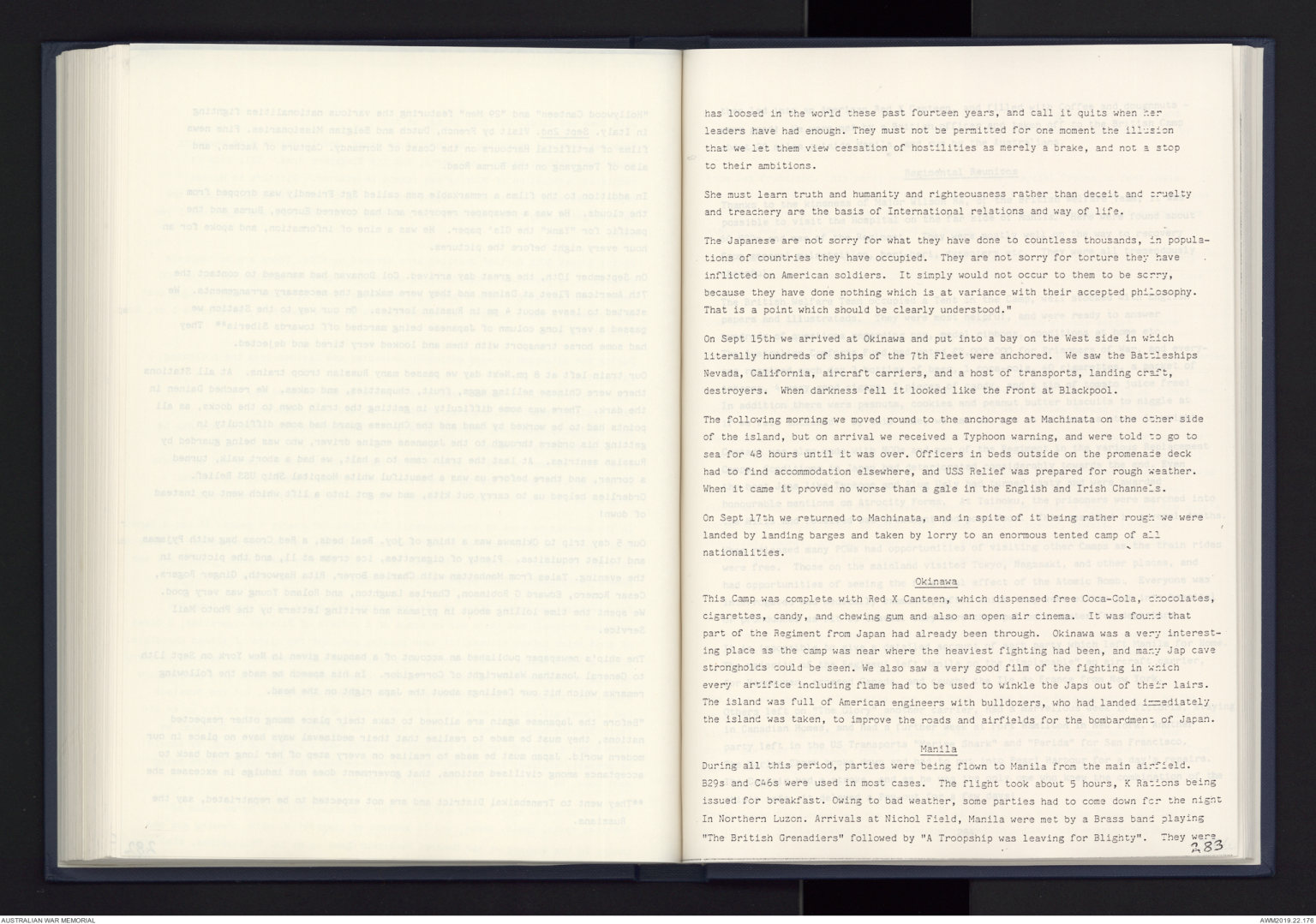
has loosed in the world these past fourteen years, and call it quits when her
leaders have had enough. They must not be permitted for one moment the illusion
that we let them view cessation of hostilities as merely a brake, and not a stop
to their ambitions.
She must learn truth and humanity and righteousness rather than deceit and cruelty
and treachery are the basis of International relations and way of life.
The Japanese are not sorry for what they have done to countless thousands, in populations
of countries they have occupied. They are not sorry for torture they have
inflicted on American soldiers. It simply would not occur to them to be sorry,
because they have done nothing which is at variance with their accepted philosophy.
That is a point which should be clearly understood."
On Sept 15th we arrived at Okinawa and put into a bay on the West side in which
literally hundreds of ships of the 7th Fleet were anchored. We saw the Battleships
Nevada, California, aircraft carriers, and a host of transports, landing craft,
destroyers. When darkness fell it looked like the Front at Blackpool.
The following morning we moved round to the anchorage at Machinata on the other side
of the island, but on arrival we received a Typhoon warning, and were told to go to
sea for 48 hours until it was over. Officers in beds outside on the promenade deck
had to find accommodation elsewhere, and USS Relief was prepared for rough weather.
When it came it proved no worse than a gale in the English and Irish Channels.
On Sept 17th we returned to Machinata, and in spite of it being rather rough we were
landed by landing barges and taken by lorry to an enormous tented camp of all
nationalities.
Okinawa
This Camp was complete with Red X Canteen, which dispensed free Coca-Cola, chocolates,
cigarettes, candy, and chewing gum and also an open air cinema. It was found that
part of the Regiment from Japan had already been through. Okinawa was a very interesting
place as the camp was near where the heaviest fighting had been, and many Jap cave
strongholds could be seen. We also saw a very good film of the fighting in which
every artifice including flame had to be used to winkle the Japs out of their lairs.
The island was full of American engineers with bulldozers, who had landed immediately
the island was taken, to improve the roads and airfields for the bombardment of Japan.
Manila
During all this period, parties were being flown to Manila from the main airfield.
B29s and C46s were used in most cases. The flight took about 5 hours, K Rations being
issued for breakfast. Owing to bad weather, some parties had to come down for the night
In Northern Luzon. Arrivals at Nichol Field, Manila were met by a Brass band playing
"The British Grenadiers" followed by "A Troopship was leaving for Blighty". They were
283
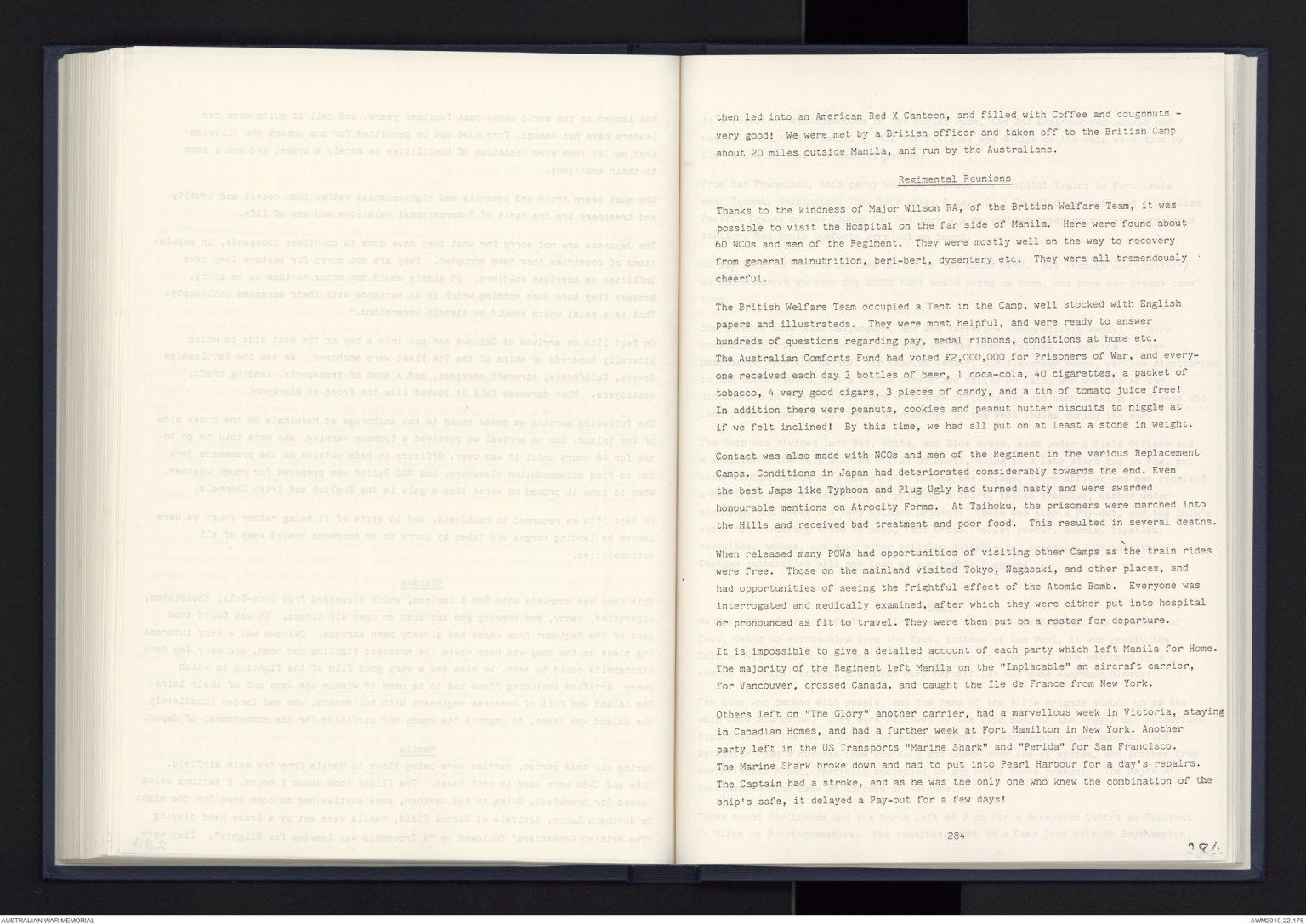
then led into an American Red X Canteen, and filled with Coffee and doughnuts -
very good! We were met by a British officer and taken off to the British Camp
about 20 miles outside Manila, and run by the Australians.
Regimental Reunions
Thanks to the kindness of Major Wilson RA, of the British Welfare Team, it was
possible to visit the Hospital on the far side of Manila. Here were found about
60 NCOs and men of the Regiment. They were mostly well on the way to recovery
from general malnutrition, beri-beri, dysentery etc. They were all tremendously
cheerful.
The British Welfare Team occupied a Tent in the Camp, well stocked with English
papers and illustrateds. They were most helpful, and were ready to answer
hundreds of questions regarding pay, medal ribbons, conditions at home etc.
The Australian Comforts Fund had voted £2,000,000 for Prisoners of War, and everyone
received each day 3 bottles of beer, 1 coca-cola, 40 cigarettes, a packet of
tobacco, 4 very good cigars, 3 pieces of candy, and a tin of tomato juice free!
In addition there were peanuts, cookies and peanut butter biscuits to niggle at
if we felt inclined! By this time, we had all put on at least a stone in weight.
Contact was also made with NCOs and men of the Regiment in the various Replacement
Camps. Conditions in Japan had deteriorated considerably towards the end. Even
the best Japs like Typhoon and Plug Ugly had turned nasty and were awarded
honourable mentions on Atrocity Forms. At Taihoku, the prisoners were marched into
the Hills and received bad treatment and poor food. This resulted in several deaths.
When released many POWs had opportunities of visiting other Camps as the train rides
were free. Those on the mainland visited Tokyo, Nagasaki, and other places, and
had opportunities of seeing the frightful effect of the Atomic Bomb. Everyone was
interrogated and medically examined, after which they were either put into hospital
or pronounced as fit to travel. They were then put on a roster for departure.
It is impossible to give a detailed account of each party which left Manila for Home.
The majority of the Regiment left Manila on the "Implacable" an aircraft carrier,
for Vancouver, crossed Canada, and caught the Ile de France from New York.
Others left on "The Glory" another carrier, had a marvellous week in Victoria, staying
in Canadian Homes, and had a further week at Fort Hamilton in New York. Another
party left in the US Transports "Marine Shark" and "Perida" for San Francisco.
The Marine Shark broke down and had to put into Pearl Harbour for a day's repairs.
The Captain had a stroke, and as he was the only one who knew the combination of the
ship's safe, it delayed a Pay-out for a few days!
284
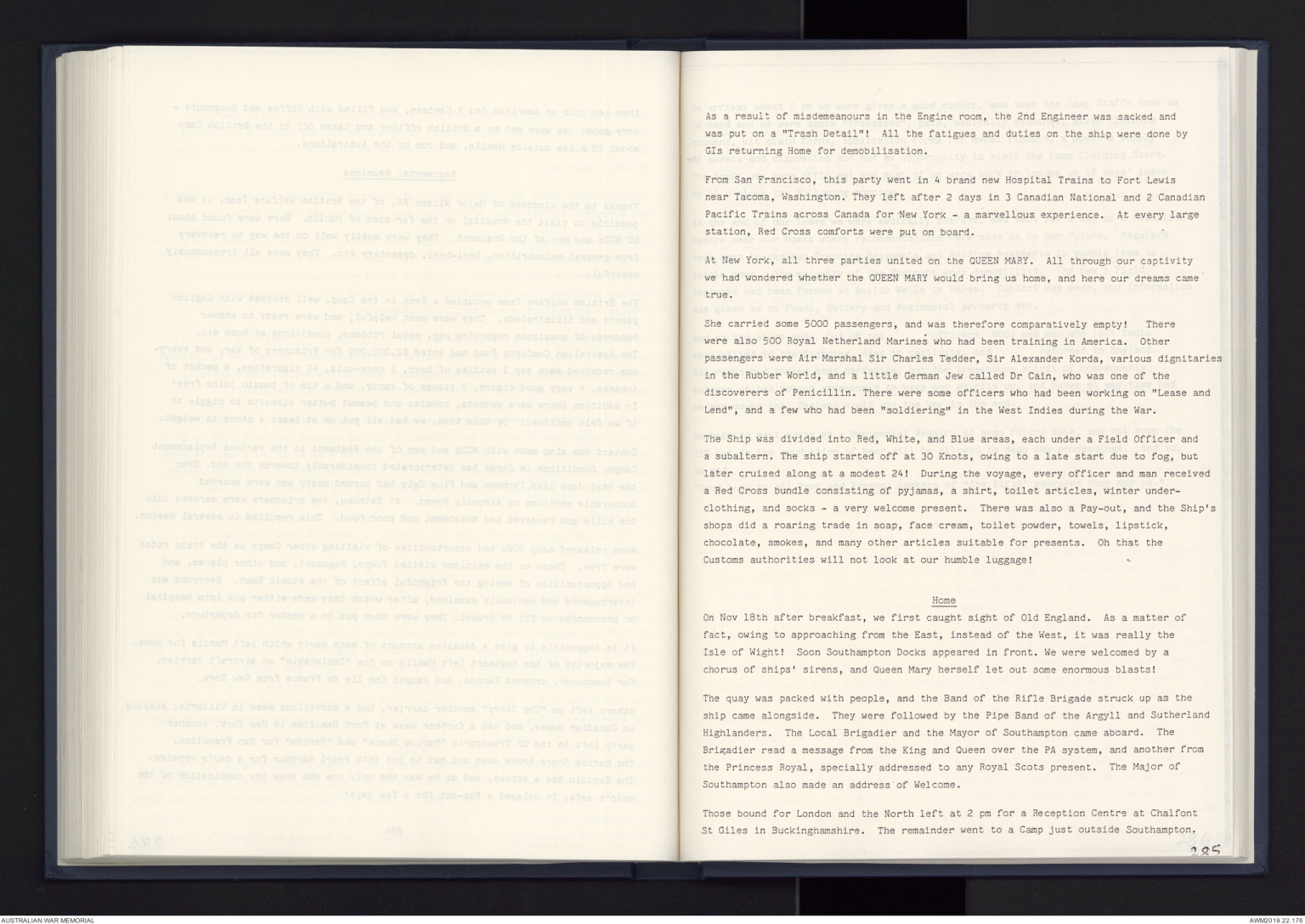
As a result of misdemeanours in the Engine room, the 2nd Engineer was sacked and
was put on a "Trash Detail"! All the fatigues and duties on the ship were done by
GIs returning Home for demobilisation.
From San Francisco, this party went in 4 brand new Hospital Trains to Fort Lewis
near Tacoma, Washington. They left after 2 days in 3 Canadian National and 2 Canadian
Pacific Trains across Canada for New York - a marvellous experience. At every large
station, Red Cross comforts were put on board.
At New York, all three parties united on the QUEEN MARY. All through our captivity
we had wondered whether the QUEEN MARY would bring us home, and here our dreams came
true.
She carried some 5000 passengers, and was therefore comparatively empty! There
were also 500 Royal Netherland Marines who had been training in America. Other
passengers were Air Marshal Sir Charles Tedder, Sir Alexander Korda, various dignitaries
in the Rubber World, and a little German Jew called Dr Cain, who was one of the
discoverers of Penicillin. There were some officers who had been working on "Lease and
Lend", and a few who had been "soldiering" in the West Indies during the War.
The Ship was divided into Red, White, and Blue areas, each under a Field Officer and
a subaltern. The ship started off at 30 Knots, owing to a late start due to fog, but
later cruised along at a modest 24! During the voyage, every officer and man received
a Red Cross bundle consisting of pyjamas, a shirt, toilet articles, winter under-clothing,
and socks - a very welcome present. There was also a Pay-out, and the Ship's
shops did a roaring trade in soap, face cream, toilet powder, towels, lipstick,
chocolate, smokes, and many other articles suitable for presents. Oh that the
Customs authorities will not look at our humble luggage!
Home
On Nov 18th after breakfast, we first caught sight of Old England. As a matter of
fact, owing to approaching from the East, instead of the West, it was really the
Isle of Wight! Soon Southampton Docks appeared in front. We were welcomed by a
chorus of ships' sirens, and Queen Mary herself let out some enormous blasts!
The quay was packed with people, and the Band of the Rifle Brigade struck up as the
ship came alongside. They were followed by the Pipe Band of the Argyll and Sutherland
Highlanders. The Local Brigadier and the Mayor of Southampton came aboard. The
Brigadier read a message from the King and Queen over the PA system, and another from
the Princess Royal, specially addressed to any Royal Scots present. The Major of
Southampton also made an address of Welcome.
Those bound for London and the North left at 2 pm for a Reception Centre at Chalfont
St Giles in Buckinghamshire. The remainder went to a Camp just outside Southampton.
285
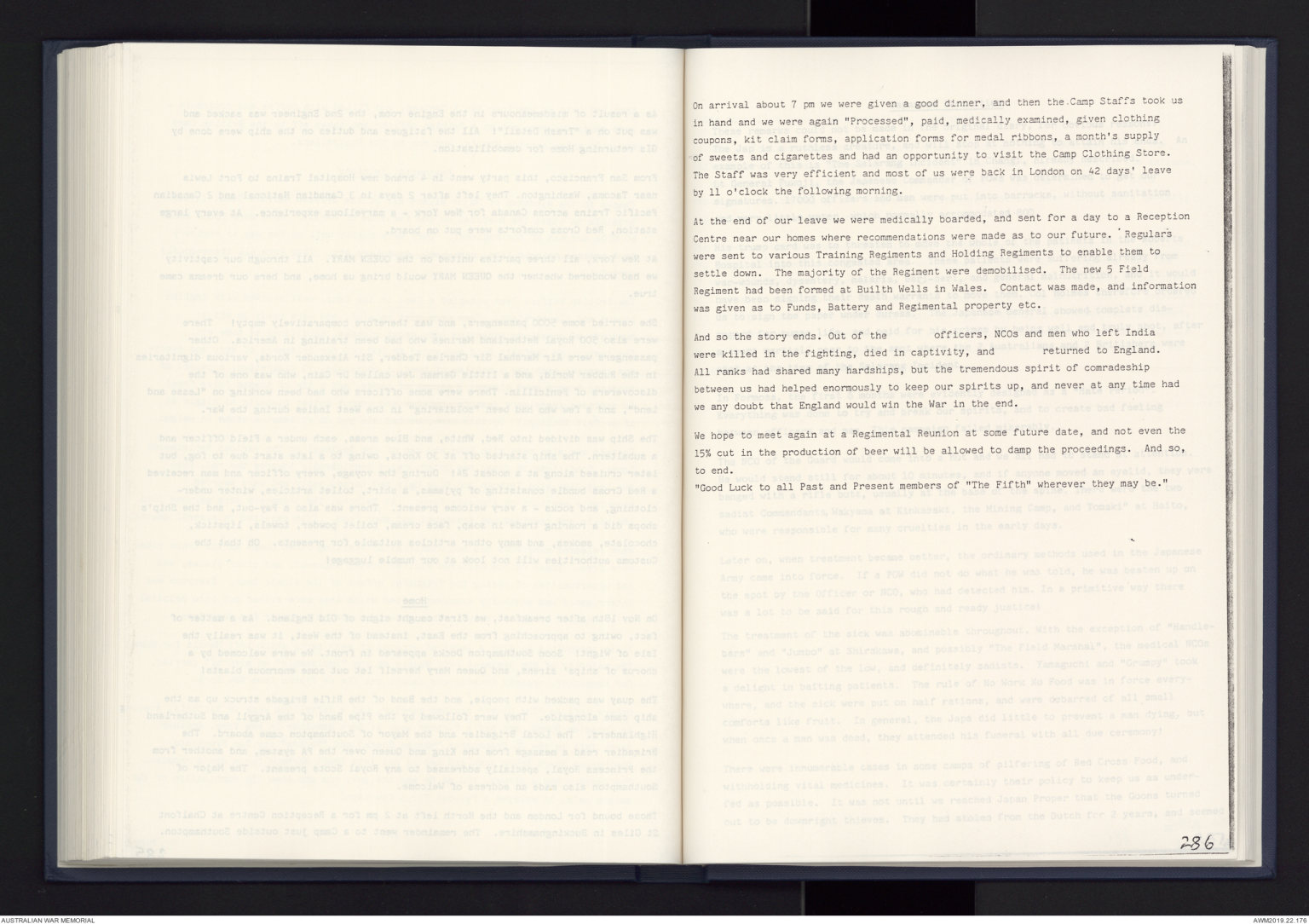
On arrival about 7 pm we were given a good dinner, and then the Camp Staffs took us
in hand and we were again "Processed", paid, medically examined, given clothing
coupons, kit claim forms, application forms for medal ribbons, a month's supply
of sweets and cigarettes and had an opportunity to visit the Camp Clothing Store.
The Staff was very efficient and most of us were back in London on 42 days' leave
by 11 o'clock the following morning.
At the end of our leave we were medically boarded, and sent for a day to a Reception
Centre near our homes where recommendations were made as to our future. Regulars
were sent to various Training Regiments and Holding Regiments to enable them to
settle down. The majority of the Regiment were demobilised. The new 5 Field
Regiment had been formed at Builth Wells in Wales. Contact was made, and information
was given as to Funds, Battery and Regimental property etc.
And so the story ends. Out of the officers, NCOs and men who left India
were killed in the fighting, died in captivity, and returned to England.
All ranks had shared many hardships, but the tremendous spirit of comradeship
between us had helped enormously to keep our spirits up, and never at any time had
we any doubt that England would win the War in the end.
We hope to meet again at a Regimental Reunion at some future date, and not even the
15% cut in the production of beer will be allowed to damp the proceedings. And so,
to end.
"Good Luck to all Past and Present members of "The Fifth" wherever they may be."
286
Japanese Atrocities
These remarks could not be made in the original diary, for obvious reasons!
The Jap is a ruthless creature, and will stop at nothing to attain his ends. An
example of this is "The Selarang Incident" in Changi, already described.
Lt General Fukoji, the Japanese Commander of POWs was determined to get our
signatures. 17000 officers and men were put into barracks, without sanitation
and very little water, which normally accommodated 800.
His trump card was to threaten to move the whole of the patients in the Roberts
Hospital into this congested area. These patients were suffering already from
war-wounds, dysentery, malaria, beri-beri, and general malnutrition, and it would
have been signing their death warrants to move them. Col Holmes therefore ordered
us to sign the paper under duress. The Japanese General showed complete disregard
for human life, and paid for his crimes by being well and truly shot, after
a court martial, near to the spot where the 2 Australians and 2 Britishers were
shot at the time of the Selarang Incident.
In Formosa, the first 6 months were evidently designed as a "Hate Period".
Everything was done to try and break our spirits, and to create bad feeling
between officers and men. This campaign failed miserably.
The NCO of the Guard would come into a hut and we all had to stand at attention.
He would stand still for about 10 minutes, and if anyone moved an eyelid, they were
banged with a rifle butt, usually at the base of the spine. There were the two
sadist Commandants, Wakyama at Kinkasaki, the Mining Camp, and Tomaki" at Haito,
who were responsible for many cruelties in the early days.
Later on, when treatment became better, the ordinary methods used in the Japanese
Army came into force. If a POW did not do what he was told, he was beaten up on
the spot by the Officer of NCO, who had detected him. In a primitive way there
was a lot to be said for this rough and ready justice!
The treatment of the sick was abominable throughout. With the exception of "Handle-bars"
and "Jumbo" at Shirakawa, and possibly "The Field Marshal", the medical NCOs
were the lowest of the low, and definitely sadists. Yamaguchi and "Grumpy" took
a delight in baiting patients. The rule of No Work No Food was in force everywhere,
and the sick were put on half rations, and were debarred of all small
comforts like fruit. In general, the Japs did little to prevent a man dying, but
when once a man was dead, they attended his funeral with all due ceremony!
There were innumerable cases in some camps of pilfering of Red Cross Food, and
withholding vital medicines. It was certainly their policy to keep us as underfed
as possible. It was not until we reached Japan Proper that the Goons turned
out to be downright thieves. They had stolen from the Dutch for 2 years, and seemed
287a
quite surprised when "the arrogant British" objected!
It was in Thailand that the Jap really excelled himself. The POWs working on the
Railway were literally worked to death. The Korean guards were brutal in the extreme.
It was inhuman and, to say the least of it, absurd to imagine that H & F Force
could possibly be fed by the Singapore Administration, and much unnecessary hardship
was caused by this stupid order.
The Japanese had the chance of a lifetime to show the World that they were civilised.
Had prisoners been treated well, many would have returned and spread the news. As
it was, all POWs have returned with feelings of hatred towards the Japs, which they
will never forget. The Americans hate them even more that we do, if that is possible!
Lin Yutang in one of his books said that the Jap is kindly and industrious at heart,
but when once you put him into any sort of uniform, he becomes an overbearing little
savage! He is just about right! The best you can say is that they all "stink" and
a very few "stink" slightly less than the others!
287B
288
287c
POW Sanity Test
If you answer "YES" to more than 6, then BEWARE!
- Do you take your food to your bunk, turn your back, then play with your meal
for 2 hours, like a dog going to its kennel? - Do you make yourself silly attempting to hear rumours?
- Do you think that everyone else is "nuts" (except yourself)?
- Do you take offence when corrected?
- Do you get enthusiastic over a hobby, and then drop it overnight?
- Do you get an inward shock when a Nip shouts "Koora" (an uncouth word meaning Hi! Oy! etc)?
- Do you think the War will end tomorrow?
- Do you think it will ever end?
- Do you never get enthusiastic except when talking about food?
- Do you always get the smallest buns, worst stew, coldest hot water like poor Little C in the mathematical problems?
- Do you write poetry or questionnaires?
- Do you say anything when you give a light to the fifth pipe from your last Camel cigarette?
- Do you eat your food at times when other people don't?
- If reveille was at 0430 instead of 0530, would you still get up ½ an hour earlier?
- Do you go to the Latrine at night with the hell of a clatter?
- Have you drawn plans of your "Dream House"?
- Do you intend to retire as a gentleman farmer after the War?
- If they were giving away "garbage" would you still be first in the queue?
- Are you afflicted with making up menus?
- Do you lick up soup drippings from the table and scrape out the "mush" bucket?
- Do you purposely provoke from sheer joy of it?
- Do you disappear just at the time when you have to put out your food bowl?
- Do you pick up fag-ends?
- Do you find an irresistible urge to chip into other people's conversation?
- Do you browse for a whole week over a 100-page "best seller" with a long waiting list?
289
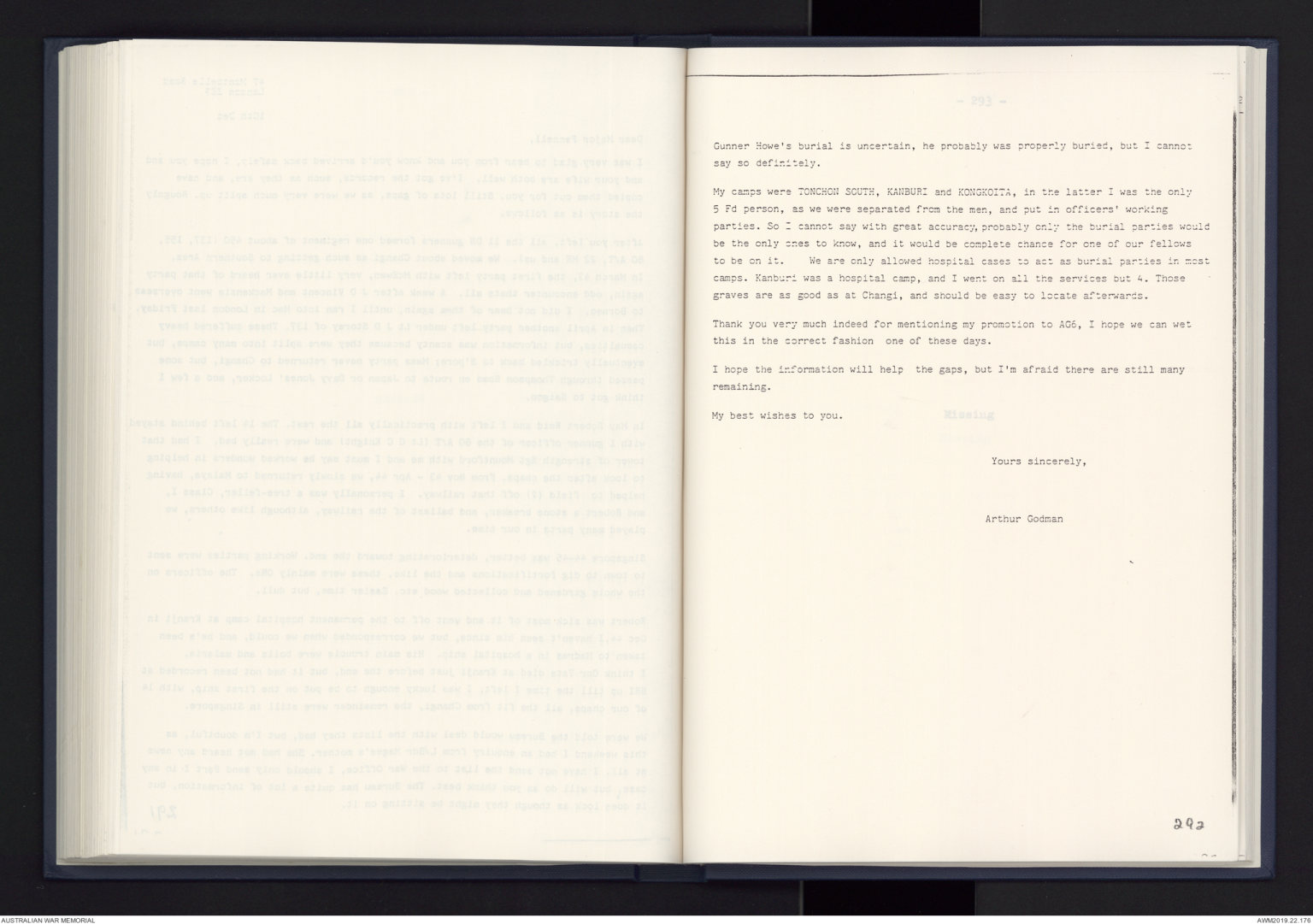
47 Montbelle Road
London SE9
10th Dec
Dear Major Fennell,
I was very glad to hear from you and know you'd arrived back safely, I hope you
and your wife are both well. I've got the records, such as they are, and have
copied them out for you. Still lots of gaps, as we were vey much split up. Roughly
the story is as follows.
After you left, all the 11 DN gunners formed one regiment of about 450 (137, 155,
80 A/T, 22 MR and us). We moved about Changi as such getting to Southern Area.
In March 43, the first party left with McEwen, very little ever heard of that party
again, odd encounter thats all. A week after J D Vincent and MacKenzie went overseas
to Borneo. I did not hear of them again, until I ran into Mac in London last Friday.
Then in April another party left under Lt J D Storey of 137. These suffered heavy
casualties, but information was scanty because they were split into many camps, but
eventually trickled back to S'pore; Mass party never returned to Changi, but some
passed through Thompson Road en route to Japan or Davy Jones' Locker, and a few I
think got to Saigon.
In May Robert Reid and I left with practically all the rest. The 14 left behind stayed
with 1 gunner officer of the 80 A/T (Lt G C Knight) and were really bad. I had that
tower of strength Sgt Mountford with me and I must say he worked wonders in helping
to look after the chaps. From Nov 43 - Apr 44, we slowly returned to Malaya, having
helped to field (?) off that railway. I personally was a tree-feller, Class 1,
and Robert a stone breaker, and ballast of the railway, although like others, we
played many parts in our time.
Singapore 44-45 was better, deteriorating toward the end. Working parties were sent
to town to dig fortifications and the like, these were mainly ORs. The officers on
the whole gardened and collected wood etc. Easier time, but dull.
Robert was sick most of it and went off to the permanent hospital camp at Kranji in
Dec 44. I haven't seen him since, but we corresponded when we could, and he's been
taken to Madras in a hospital ship. His main trouble were boils and malaria.
I think Gnr Tate died at Kranji just before the end, but it had not been recorded at
BRI up till the time I left. I was lucky enough to be put on the first ship, with 14
of our chaps, all the fit from Changi, the remainder were still in Singapore.
We were told the Bureau would deal with the lists they had, but I'm doubtful, as
this weekend I had an enquiry from L/Bdr Magee's mother. She had not heard any news
at all. I have not send the list to the War Office, I should only send Part I in any
case, but will do as you think best. The Bureau has quite a lot of information, but
it does look as though they might be sitting on it.
291
Gunner Howe's burial is uncertain, he probably was properly buried, but I cannot
say so definitely.
My camps were TONCHON SOUTH, KANBURI and KONGKOITA, in the latter I was the only
5 Fd person, as we were separated from the men, and put in officers' working
parties. So I cannot say with great accuracy, probably only the burial parties would
be the only ones to know, and it would be complete chance for one of our fellows
to be on it. We are only allowed hospital cases to act as burial parties in most
camps. Kanburi was a hospital camp, and I went on all the services but 4. Those
graves are as good as at Changi, and should be easy to locate afterwards.
Thank you very much indeed for mentioning my promotion to AG6, I hope we can wet
this in the correct fashion one of these days.
I hope the information will help the gaps, but I'm afraid there are still many
remaining.
My best wishes to you.
Yours sincerely,
Arthur Godman
292
 H.Boutell
This transcription item is now locked to you for editing. To release the lock either Save your changes or Cancel.
This lock will be automatically released after 60 minutes of inactivity.