
Unit diaries relating to service of Geoffrey W. Fennell - Wallet 2 - Part 13
We were pretty crowded. On Feb 20th it was raining hard first thing and at Taihoku we
had breakfast rice ration in the train and then marched out to our old Camp and
received a very pleasant welcome from old friends. We were billetted on straw in the
old Tailor and Fitters shop. Though we were isolated, there was quite a lot of
visiting! Though we were not really in rations, Capt Gibbons and Sgt Lungley
produced an excellent stew and lashings of tea. We mostly slept in the afternoon and
dried out in the straw as it was still raining. Good pork stew at night and early
to bed. Reveille at 5 Feb 21 and good breakfast. Marched to Station with party of
about 50 from Taihoku including Capt Francis and Lt Reeve. Train to Keelung and
marched straight to Docks about a mile away this time at far end of Harbour.
Embarked by lighter on Melbourne Maru a pretty new motor ship but usual hold
accommodation worse than was England Maru, being about 390 in the same space as 700
on this ship! Good Barley and Veg Stew with pork for dinner. A large party
from Kinkasaki joined us Feb 22.Set sail next afternoon . Barley and pickled cabbage
stew breakfast and lunch. Hit an obstruction about mile off the coast and eventually
returned to Keelung, where it was still raining! Lot of craft in harbour. Water issue
very bad being only ¾ pint during the day and no tins allowed out to collect rain
water, quite inexcusable. Good pork stew at night though and issue of Mail!
Accident did us some good! Breakfast hard bread roll with fish flakes. Mail mostly
Sept and Oct 44 Air Mail postcards. We remained on the Melbourne Maru Feb 22-26
In our crowded state it was not very pleasant and it rained most of the time, but
we were not allowed on deck to collect it as drinking water. On Feb 27th we
were told to be ready to move after lunch. A party of 100 were selected for baggage
party and they remained standing (?) on the quay and were taken across by tender to
a new cargo boat with engines at stern called Winchester Maru. Our new hold was
twice as big as the old one with the result that every one could lie down full
length. On the other hand, the food was not quite as good and plentiful and we
had no regular water issue for 3 days except the stew gravy and some got for the
sick. We set sail at 3 am on Feb 28th and continued all day in a Westerly direction
in a convoy of 8 ships escorted by a small carrier and two corvettes. At 7 pm
however, we ran into a fog and anchored and remained in the same condition for
March 1st. For food we were in messes of 30 and on March 1st we had 2 small issues
of water amounting to a few spoonfuls each. Lt Hollick became seriously ill and was
isolated. A lot of diarrhoea. We took great interest in supporting the Taiwan
sugar industry! There was a cargo of sugar below us and we took the fullest
advantage! Opportunity was taken to check up with other parties as to the accuracy
of the Register as there were parties from Taihoku, Kinkasaki, Taichu, Haito and
263
Shirakawa on the ship. It was a great time for reunions as one kept meeting old
friends when they emerged from the dark caves in which we lived! On March 3rd we
sailed all day first of all due West until some islands appeared in the Yellow Sea
and might well have been the Yangtse estuary as we then turned NE and had some
coastline on the left. During the early morning unfortunately Lt Hollick of the
Foresters died and was buried by Padre Bindeman. We were only given 2 meals a
day, no reason being given. May have been the extra length of the voyage but more
likely the amount of diarrhoea. It was raining most of the day and much colder. Much
speculation as to whether Shanghai or Moji is our destination. Rumour that Lt Cols,
Majors, Capts go to Manchuria, and Lts and BORs to working camps in Japan. Very cold
night and quite rough during day. Surprise issue of biscuits and @ 3 apiece.
Course NNW. Interpreter says bound for Transit Camp at Moji for refitting.
Matthews died (?)
March 8th was very cold and rough and the usual - routine very good onion stews
On March 9th we were passing through a number of islands and finally arrived at
Moji just after lunch. Many doctors arrived and started to put over the glass rod
test on board ship, but seeing that it was hopeless we all went on shore into what
looked like a large godown cum concert hall near the docks, and Railway station.
There the glass rodding took place and during the night parties were reorganised
and warned for parade.
Party 1. Parade 0400 hrs. Party from Taichu for Officers Concentration Camp.
Party 2. Parade 0800 hrs Advance Party from Shirakawa for No 12 Camp
Party 3. Parade 0700 hrs Old Kinkasaki Parrty for unknown destinaton.
Party 4. Parade 1300 hrs Remainder of Sirakawa Officers and sick men
Party 5. Party from Taihoku bound long distance? Hokkaido?
We had much to be thankful for our safe arrival as the fog low visibility, and choppy
sea all helped us against planes and submarines. We heard that Keelung was badly
bombed 2 days after we left. The night was bitterly cold and in spite of
fires being lit two of the sick died during the night. If only they could have been
left at Shirakawa. During the morning the heavy kit was carried to a go-down on
the quay and opportunity was given to retie up the packages which had suffered much
in transit from the Melbourne Maru to the Winchester Maru. All the packages had
to be dropped about 15 ft on to the quay which had not improved them. In fact
some bounced off the edge into the sea! We were given two boxes of rice and 2 boxes
of fish and seaweed for breakfast and lunch and they were very good. After lunch
we fell in and marched a short distance to the station and were loaded into 2 large
3rd Class carriages of best main line stock. Presently the train started and passed
through suburbs and very squalid areas most of which seemed deserted. We had
3 changes, each time to an older carriage and finally we were decanted into a small
station in what was evidently a mining area. After a short march of about a mile,
we reached our new camp on March 10th.
264
No 12 Mining Camp near Miata Kynshu
The Commandant met us and in his speech of welcome said that he knew we were tired
and therefore our Kit would be inspected tomorrow. After much preliminary
numbering, the Lt Cols were fallen out in front and a mixed bag of all ranks fell
in behind them and we were led up the hill to the huts which had just been built.
They were the usual bamboo wood and mud construction but had glass sliding windows
on the outside and paper sliding windows on the corridor side. The floor was
covered with brand new matting and we were evidently going to live all Nippon. We
found 6 good blankets on each bed space and then the cry went round BATHS! We were
all filthy as there were no facilities on the boats and were also pretty lousy.
Imagine our joy to find boiling water and the usual Nippon washing tanks, one for
soap and one for rinsing off. We shall never forget that bath! Our skins almost
cracked with joy when we got in! Then came dinner and we were delighted to find we
were again under the aegis of Red Cross. We had a large bowl of lugar, a bowl of
turnip and seaweed stew and about 4 ozs of salmon mashed up, the whole followed by
a mug of coffee, milk and sugar, and a packet of Chesterfields. And so to bed.
Next morning Roll Call was at 6.30 and it was freezing outside! During the day
we suffered much from cold. We were reorganised into new rooms by ranks, roughly
14 to a room. Our hand baggage was inspected and a number of papers and books were
taken away for censorship, including the whole of this History! The Commandant
told us that we should eventually do farm work and the men would go down the mine,
but until April 18th we should rest and he hoped our weights would improve. We
were all medically examined and as a result a number of the older officers went
into Hospital.
During the afternoon there was an issue of warm clothing which was an absolute
Godsend. Lined tunics and trousers, warm long pants, socks, lined shirt, soft
glengarry hat and a greatcoat of either British or Australian manufacture.
March 11. Bdr Trew who had had a most uncomfortable journey, but who was still in
good heart, unfortunately died, partly due to weakness and partly due to cold.
His beri beri had swelled to enormous proportions as a result of the journey.
265
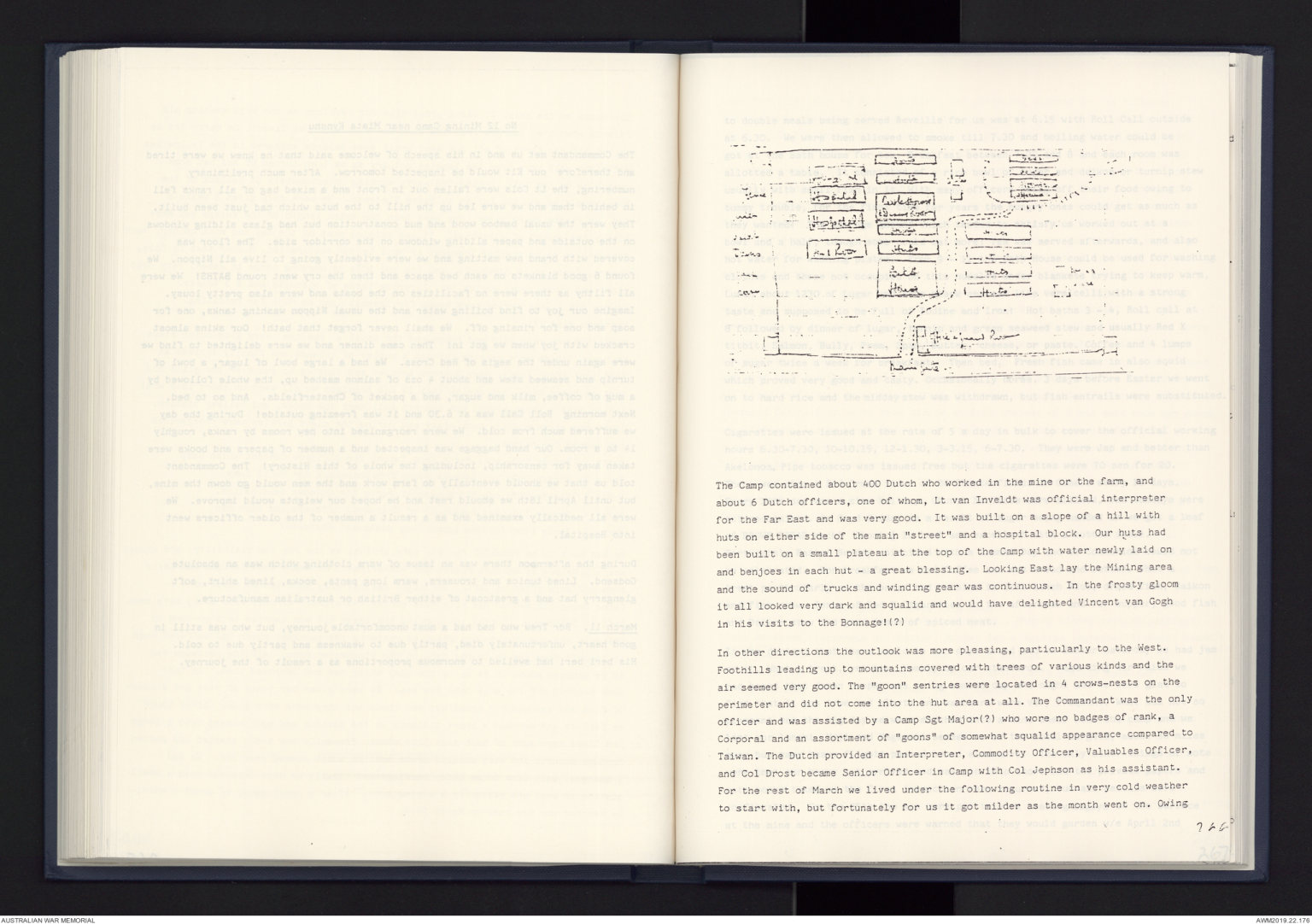
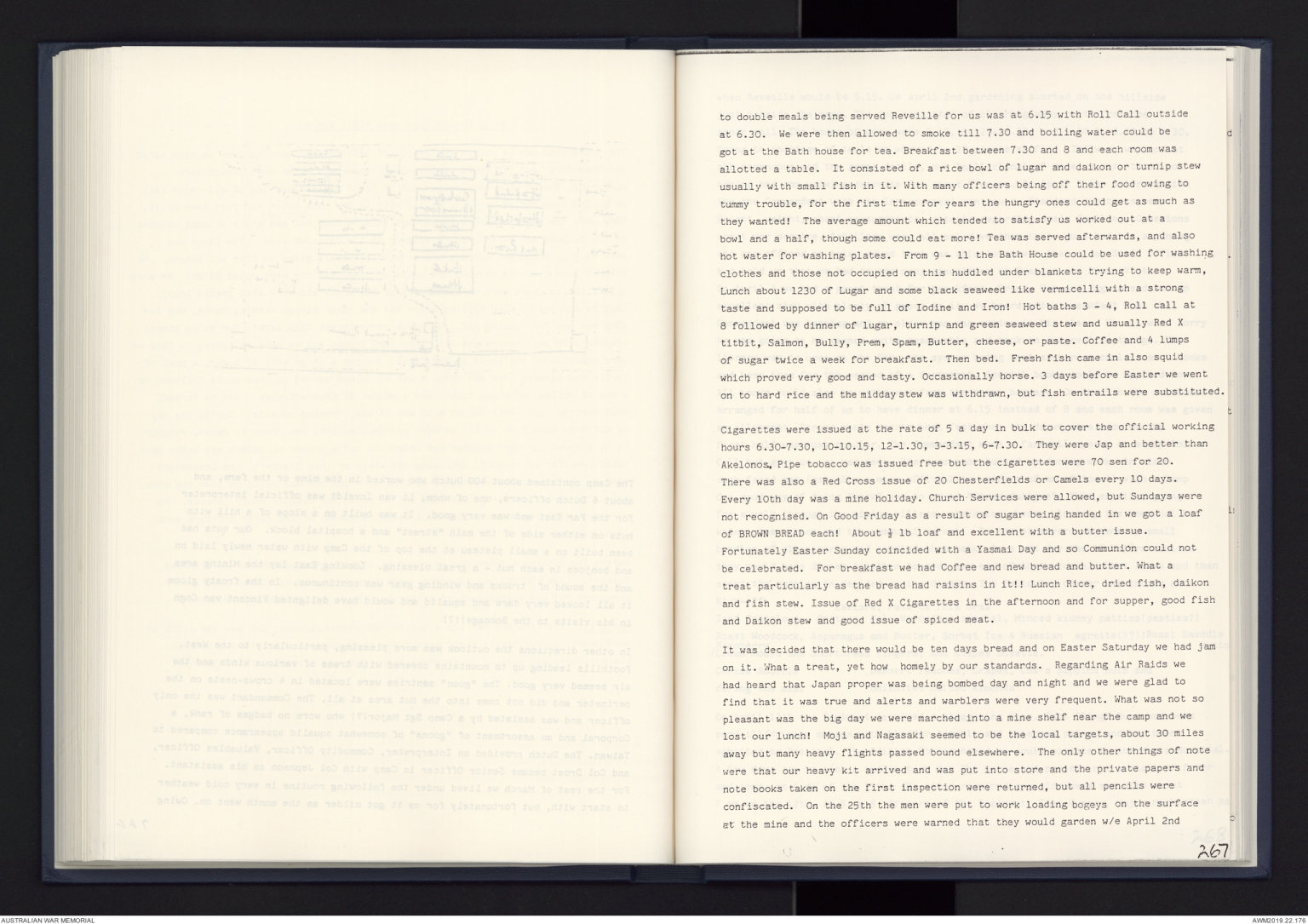
Hand drawn map - see original document
The Camp contained about 400 Dutch who worked in the mine or the farm, and
about 6 Dutch officers, one of whom, Lt van Inveldt was official interpreter
for the Far East and was very good. It was built on a slope of a hill with
huts on either side of the main "street" and a hospital block. Our huts had
been built on a small plateau at the top of the Camp with water newly laid on
and benjoes in each hut - a great blessing. Looking East lay the Mining area
and the sound of trucks and winding gear was continuous. In the frosty gloom
it all looked very dark and squalid and would have delighted Vincent van Gogh
in his visits to the Bonnage! (?)
In other directions the outlook was more pleasing, particularly to the West.
Foothills leading up to mountains covered with trees of various kinds and the
air seemed very good. The "goon" sentries were located in 4 crows-nests on the
perimeter and did not come into the hut area at all. The Commandant was the only
officer and he was assisted by a Camp Sgt Major(?) who wore no badges of rank, a
Corporal and an assortment of "goons" of somewhat squalid appearance compared to
Taiwan. The Dutch provided an Interpreter, Commodity Officer, Valuables Officer,
and Col Drost became Senior Officer in Camp with Col Jephson as his assistant.
For the rest of March we lived under the following routine in very cold weather
to start with, but fortunately for us it got milder as the month went on. Owing
266
to double meals being served Reveille for us was at 6.15 with Roll Call outside
at 6.30. We were then allowed to smoke till 7.30 and boiling water could be
got at the Bath house for tea. Breakfast between 7.30 and 8 and each room was
allotted a table. It consisted of a rice bowl of lugar and daikon or turnip stew
usually with small fish in it. With many officers being off their food owing to
tummy trouble, for the first time for years the hungry ones could get as much as
they wanted! The average amount which tended to satisfy us worked out at a
bowl and a half, though some could eat more! Tea was served afterwards, and also
hot water for washing plates. From 9 - 11 the Bath House could be used for washing
clothes and those not occupied on this huddled under blankets trying to keep warm,
Lunch about 1230 of Lugar and some black seaweed like vermicelli with a strong
taste and supposed to be full of Iodine and Iron! Hot baths 3 - 4, Roll call at
8 followed by dinner of lugar, turnip and green seaweed stew and usually Red X
titbit, Salmon, Bully, Prem, Spam, Butter, cheese, or paste. Coffee and 4 lumps
of sugar twice a week for breakfast. Then bed. Fresh fish came in also squid
which proved very good and tasty. Occasionally horse. 3 days before Easter we went
on to hard rice and the midday stew was withdrawn, but fish entrails were substituted.
Cigarettes were issued at the rate of 5 a day in bulk to cover the official working
hours 6.30-7.30, 10-10.15, 12-1.30. 3-3.15, 6-7.30. They were Jap and better than
Akelonos. Pipe tobacco was issued free but the cigarettes were 70 sen for 20.
There was also a Red Cross issue of 20 Chesterfields or Camels every 10 days.
Every 10th day was a mine holiday. Church Services were allowed, but Sundays were
not recognised. On Good Friday as a result of sugar being handed in we got a loaf
of BROWN BREAD each! About ½ lb loaf and excellent with a butter issue.
Fortunately Easter Sunday coincided with a Yasmai Day and so Communion could not
be celebrated. For breakfast we had Coffee and new bread and butter. What a
treat particularly as the bread had raisins in it!! Lunch Rice, dried fish, daikon
and fish stew. Issue of Red X Cigarettes in the afternoon and for supper, good fish
and Daikon stew and good issue of spiced meat.
It was decided that there would be ten days bread and on Easter Saturday we had jam
on it. What a treat, yet how homely by our standards. Regarding Air Raids we
had heard that Japan proper was being bombed day and night and we were glad to
find that it was true and alerts and warblers were very frequent. What was not so
pleasant was the big day we were marched into a mine shelf near the camp and we
lost our lunch! Moji and Nagasaki seemed to be the local targets, about 30 miles
away but many heavy flights passed bound elsewhere. The only other things of note
were that our heavy kit arrived and was put into store and the private papers and
note books taken on the first inspection were returned, but all pencils were
confiscated. On the 25th the men were put to work loading bogeys on the surface
at the mine and the officers were warned that they would garden w/e April 2nd
267
when Reveille would be 5.15. On April 2nd gardening started on the hillside
just outside the camp. The job consisted of clearing away roots from the
sandy soil. The hours of work were 9-10, 10.20-12.30, and 1.30-3, 3.20 to 4.30.
Owing to the shortage of tools we worked in 20 minute shifts. The work was not at
all strenuous and the goons docile, but "hill climbing" made us very tired not
having had any walking exercise for about 6 weeks. On April 3 the interrogation
(by the Commandant with the Interpreter) continued. Standard questions were
Height, weight, chest measurements, details regarding one's families. Questions
about war service. Artillery were all asked whether their guns had hit anything
and one officer on being asked that was able to answer that a Jap Staff Officer
had told us that we had caused many casualties at Kuantan and Buena Vista.
On April 4 we had a great treat for breakfast. Bread, Ham and Egg spread and an
excellent stew with plenty of green in it. We heard after breakfast that the
Commandant was leaving and an older man was coming in his place. We all were sorry
he was going as he seemed quite reasonable and took an interest in things. The
library was to open on the 6th, the system being that each room could draw 4 books
and keep them for the period of a fortnight. Special books could be applied for.
All books could also be withdrawn from the heavy baggage. On the 5th the cookhouse
arranged for half of us to have dinner at 6.15 instead of 8 and each room was given
an allotment. Strong men's hearts beat fast when the draws were made as the
first half was most popular. The Commandant made a farewell speech at early Roll
Call but gave us no war news. His successor turned up during work. An older
dark faced man (actually a mine official in uniform of an officer!) with a limp
One good way of doing "work" was to go on "Straw fatigue". This entailed going
for a walk through the mining village, observing cherry blossom, the communal hot
water pipe system and the communal market. In the strawyard we made up small
bundles of clean straw and carried them back. On a wet day the 16 Majors decided
they would have dinner together towards the end of their convalescent leave and then
spent the morning in decided on the dinner. The following dinner was chosen as a
Kick-off:
Caviare, Pate de fois Gras
Iced Cantaloup, Oysters, Sole Veronique special, Minced kidney patties (pasties?)
Roast Woodcock, Asparagus and Butter, Sorbet Ice & Russian agrette(??)) Roast Saddle Mutton
/Raspberry Cream Mould and Shortbread fingers, and Crepes Suzette.
Cheese Souffle Dessert Peaches, Grapes, Cox's pippins nuts and
during the meal unlimited Salted Almonds
On April 12th the Regiment received a staggering blow. Capt "Bing" Hunt had been
very ill for many months with bladder trouble and internal pains, and had been
admitted to Hospital. The British Doctor hoped he could operate in the Men's Hospital.
A few days ago he took a sudden turn for the worse and passed into a state of fever
and coma at 4 pm of the 11th. He never regained consciousness and died about
7am on the 12th. At 5 pm 8 officers of the Regiment, Capt Cumper, Major Mackintosh RA
268
Major Howe R Sigs and Major Murray Stewart RA carried the coffin to the Crematorium.
The following morning Major Fennell, Capt Hogshaw, Lt Bladen and Capt Cumper collected
the ashes and they were buried by Padre Bindeman in a small cemetery near the
Slag Heaps visible from the West side of the Camp. They were buried
betweeen an American Airman who had been shot down during a raid and Bdr Trew.
How tragic that he should die when we hoped that Freedom was almost in sight.
A BOR Squad in the mine had finished their task and had been given a Yasmai. Later
they started to sing. Others heard it and took up the Yasmai and Singing. Result,
bashings for all BORs on return whether involved or not!. The Dutch were not involved.
Strike of Koreans started on April 18th, the Cookhouse were asked to produce 100
breakfasts for Officers at 7 and lunch boxes, but fortunately for us they said it was
impossible to do. However the fact remains that there was a possibility of the
officers having to go to work on a farm about 2 miles away and taking their lunch
with them - a long day. Taking off the official and unofficial sick and the over
45s, it could be done, but to expect harder work is useless. No one is fit for
it on this food - the work we now do is quite sufficient. Capts Pearson and Archer
came out. April 21st, Princess Elizabeth's 19th birthday started by an Air Raid on
Moji 7.30 - 9.30 with a lot of planes over. Raisin bread, Coffee, butter for breakfast
with a good thick fish stew for lunch, issue of chocolate and 20 Chesterfields
during the afternoon. Church Service 2.45 and for dinner Bully Beef with mixed veg
stew. April 23rd, Paid Y50. April 24th. Just after morning roll call we were
warned that 100 of the Senior Officers were moving tomorrow under orders of the
Nippon Army. Cl Jephson, Major Fennell, Capts Archer, Frith and Pearson were due
to go, but the remaining officers were staying. On April 26th we were told we were moving
about 11 so got packed up immediately after reveille. Our heavy baggage was taken to
the station by the officers not leaving and after unpromising first rumours our
chance of seeing it again increased. We left our other kit in front of the bathroom
for inspection but nothing was taken. Here came the great excitement - Breakfast
(1) Currant bead and butter, good fish stew and leggy stew, Salmon issue and small
fish, Coffee, Milk and sugar. For the journey we had 3 plain rolls and much was the
knife borrowing and spreading though we had the awful temptation of eating the lot
in one go! We left at 11 for the same station and after 3 changes we reached the
main line junction not far from Moji, but this time turned left and about 3 in the
afternoon we reached the sea at a place called Fukuoka, and marched to a little
grove near the station to rest until about 5 where an American Party was waiting. We
then marched to the docks to our surprise as we thought we were continuing our journey
by train. At the quay was a Ferry boat and a two funnelled cross-channel steamer
and it was into this we went into the 2nd Class with matting bedspaces, and proper
lavatories, hard to believe, after our journeys in holds! The Jap Interpreter,
who spoke with a marked American accent, told us to go to bed as we should be called
at 4 o'clock in the morning. Our American friends were able to check up on old
friends from their compatriots who joined our party. We tried to snatch a few moments o
sleep but it was too cold and we spent the time in talking and smoking with our next
group. We still thought that we would march back to the station but were soon told we
[[?]]
should be staying on board. We had been joined by a large party of American
officers who had left the Philippines 1600 strong. They had been torpedoed once and
bombed at Takao and were in very bad condition most of them. There were then about
500 left. April 26th, about 6.30 a small box of rice and veg was produced and was
very nice but not very much. We were moved a floor below into the third class
and at 8.30 we set off. The next problem was to decide whether our destination was to
be Fusen in Korea or an island in the inland sea where we heard there was a Camp.
Our course most of the time was NNW, which rather pointed to the first alternative.
For lunch was rice and barley and a little very good stew. About two o'clock the
Interpreter came down and said the ship would be in at 3 and we should go straight
off the boat and in due course we marched about ¼ mile past the Railway Station
in which was SMR (South Manchurian Railway) which enabled those who bet on Fusen to
collect their money! From the main square we went into the local cinema where we
had the usual "benta" for supper, roll call and then went to sleep. We had plenty of room
to stretch out full length and the most of us slept the sleep of the just as few
people had slept the night before. Incidentally we heard that it was a momentous day
in the History of the World as the World Conference was being opened at San Francisco
and it was the last day of the Russia-Japan neutrality pact!
April 27th. Reveille 5.30 and left at 6.30 for the Station. SMR was found to be
broad gauge and 3rd Class cariages the usual "open type" with plush covered seats.
Our party being 102 was just over a carriage-worth and the usual trick was to pack
the balance on the floor! Imagine our joy when the balance went into the next coach,
and we were all seated! Hot rice and Barley came round in bamboo boxes with mixed
Veg including Shrimps and our old friend the soya bean. At 0810 we started off on our
2 day journey. It was a very long train with streamlined Baltic(?) 4 -8 -2 engine
with small driving wheels. The railway first ran along the side of a rather pretty
lake on which was a small junk with white sails, with mountains on ether side of
the valley. There were no restrictions on windows open and our escort from the
Kwangtung Army seemed to be considerate, in fact for the moment anyway, everything
seemed to be for the best. At 50 KM (1015) we reached a junction and took the right
fork up another valley under a col (?) then into a very broad fertile valley with
river. The line appeared to have been recently doubled. Plenty of people about,
Koreans in top hats and many (?) women with silk blouses, and frequent
churches. After a short time we reached a much narrower rocky valley and we continued
to climb continuously. With the aid of a Map with the History of the Orient, we
were in the province of Silla, and various towns up to the Yalu River were noted in
case we met any ? The prevailing gradient (?) seemed to be about 1 in 100 (9 in per
1 KM). Suddenly we saw a familiar thing. BM 124 - Beneta Mark with little
whitewashed stones around it! About 100 Km we went through a big tunnel and the
descent followed immediately and by 108 Km we emerged into a plain. 176 Km started
climbing again high mountains far right and left. Ground not as fertile and more
like "sweet potato" country! We approached a town with Wireless factories. Would ther
be eats?? Yes there were and proved to be most intriguing. In the Rice bowl were the
270
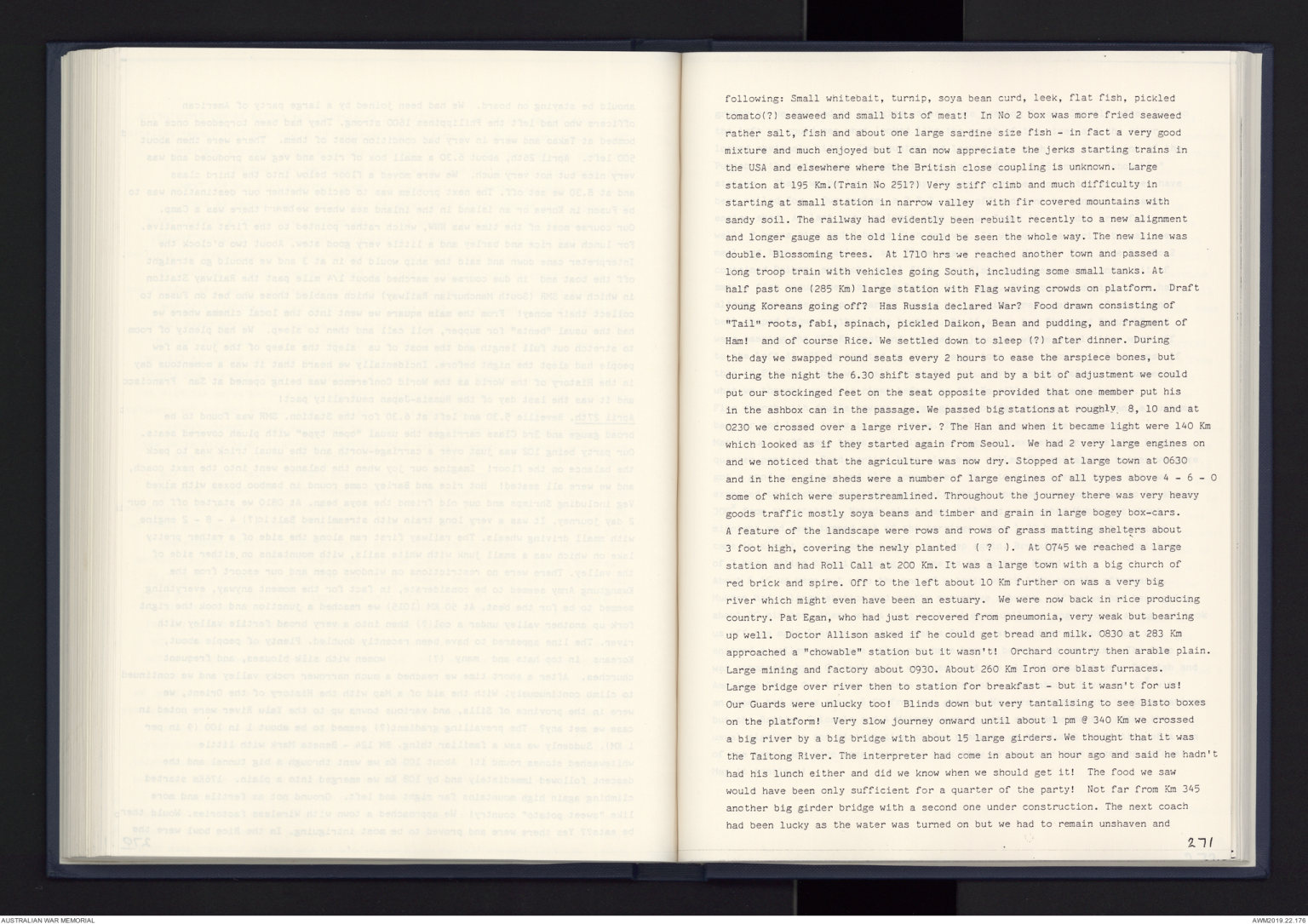
following: Small whitebait, turnip, soya bean curd, leek, flat fish, pickled
tomato(?) seaweed and small bits of meat! In No 2 box was more fried seaweed
rather salt, fish and about one large sardine size fish - in fact a very good
mixture and much enjoyed but I can now appreciate the jerks starting trains in
the USA and elsewhere where the British close coupling is unknown. Large
station at 195 Km.(Train No 251?) Very stiff climb and much difficulty in
starting at small station in narrow valley with fir covered mountains with
sandy soil. The railway had evidently been rebuilt recently to a new alignment
and longer gauge as the old line could be seen the whole way. The new line was
double. Blossoming trees. At 1710 hrs we reached another town and passed a
long troop train with vehicles going South, including some small tanks. At
half past one (285 Km) large station with Flag waving crowds on platform. Draft
young Koreans going off? Has Russia declared War? Food drawn consisting of
"Tail" roots, fabi, spinach, pickled Daikon, Bean and pudding, and fragment of
Ham! and of course Rice. We settled down to sleep (?) after dinner. During
the day we swapped round seats every 2 hours to ease the arspiece bones, but
during the night the 6.30 shift stayed put and by a bit of adjustment we could
put our stockinged feet on the seat opposite provided that one member put his
in the ashbox can in the passage. We passed big stations at roughly 8, 10 and at
0230 we crossed over a large river. ? The Han and when it became light were 140 Km
which looked as if they started again from Seoul. We had 2 very large engines on
and we noticed that the agriculture was now dry. Stopped at large town at 0630
and in the engine sheds were a number of large engines of all types above 4 - 6 - 0
some of which were superstreamlined. Throughout the journey there was very heavy
goods traffic mostly soya beans and timber and grain in large bogey box-cars.
A feature of the landscape were rows and rows of grass matting shelters about
3 foot high, covering the newly planted ( ? ). At 0745 we reached a large
station and had Roll Call at 200 Km. It was a large town with a big church of
red brick and spire. Off to the left about 10 Km further on was a very big
river which might even have been an estuary. We were now back in rice producing
country. Pat Egan, who had just recovered from pneumonia,very weak but bearing
up well. Doctor Allison asked if he could get bread and milk. 0830 at 283 Km
approached a "chowable" station but it wasn't! Orchard country then arable plain.
Large mining and factory about 0930. About 260 Km Iron ore blast furnaces.
Large bridge over river then to station for breakfast - but it wasn't for us!
Our Guards were unlucky too! Blinds down but very tantalising to see Bisto boxes
on the platform! Very slow journey onward until about 1pm @ 340 Km we crossed
a big river by a big bridge with about 15 large girders. We thought that it was
the Taitong River. The interpreter had come in about an hour ago and said he hadn't
had his lunch either and did we know when we should get it! The food we saw
would have been only sufficient for a quarter of the party! Not far from Km 345
another big girder bridge with a second one under construction. The next coach
had been lucky as the water was turned on but we had to remain unshaven and
271
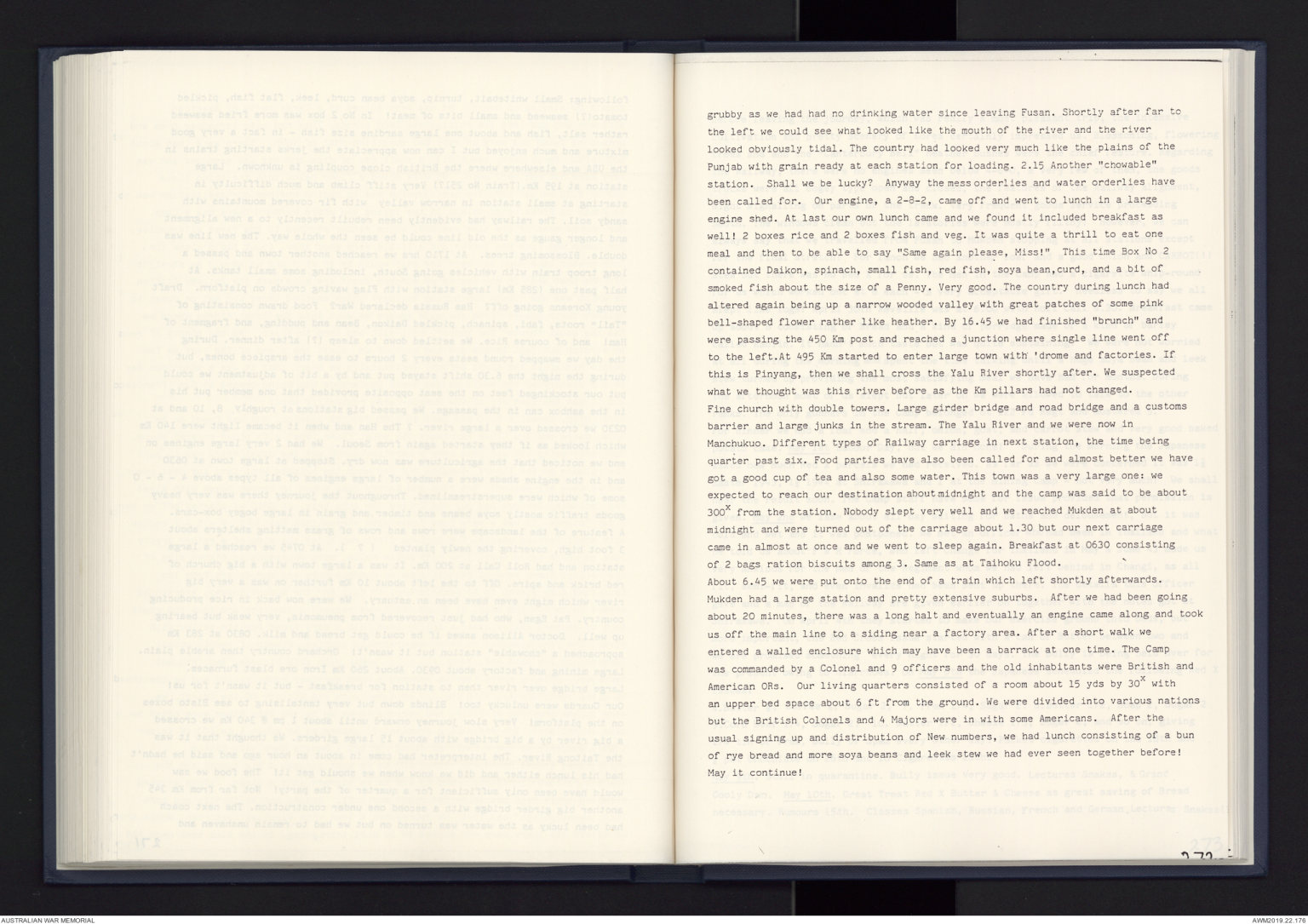
grubby as we had had no drinking water since leaving Fusan. Shortly after far to
the left we could see what looked like the mouth of the river and the river
looked obviously tidal. The country had looked very much like the plains of the
Punjab with grain ready at each station for loading. 2.15 Another "chowable"
station. Shall we be lucky? Anyway the mess orderlies and water orderlies have
been called for. Our engine, a 2-8-2, came off and went to lunch in a large
engine shed. At last our own lunch came and we found it included breakfast as
well! 2 boxes rice and 2 boxes fish and veg. It was quite a thrill to eat one
meal and then to be able to say "Same again please, Miss!". This time Box No 2
contained Daikon, spinach, small fish, red fish,soya bean,curd, and a bit of
smoked fish about the size of a Penny. Very good. The country during lunch had
altered again being up a narrow wooded valley with great patches of some pink
bell-shaped flower rather like heather. By 16.45 we had finished "brunch" and
were passing the 450 Km post and reached a junction where single line went off
to the left.At 495 Km started to enter large town with 'drome and factories. If
this is Pinyang, then we shall cross the Yalu River shortly after. We suspected
what we thought was this river before as the Km pillars had not changed.
Fine church with double towers. Large girder bridge and road bridge and a customs
barrier and large junks in the stream. The Yalu River and we were now in
Manchukuo. Different types of Railway carriage in the next station, the time being
quarter past six. Food parties have also been called for and almost better we have
got a good cup of tea and also some water. This town was a very large one: we
expected to reach our destination about midnight and the camp was said to be about
300x from the station. Nobody slept very well and we reached Mukden at about
midnight and were turned out of the carriage about 1.30 but our next carriage
came in almost at once and we went to sleep again. Breakfast at 0630 consisting
of 2 bags ration biscuits among 3. Same as at Taihoku Flood.
About 6.45 we were put onto the end of a train which left shortly afterwards.
Mukden had a large station and pretty extensive suburbs. After we had been going
about 20 minutes, there was a long halt and eventually an engine came along and took
us off the main line to a siding near a factory area. After a short walk we
entered a walled enclosure which may have been a barrack at one time. The Camp
was commanded by a Colonel and 9 officers and the old inhabitants were British and
American ORs. Our living quarters consisted of a room about 15 yds by 30x with
an upper bed space about 6ft from the ground. We were divided into various nations
but the British Colonels and 4 Majors were in with some Americans. After the
usual signing up and distribution of New numbers, we had lunch consisting of a bun
of rye bread and more soya beans and leek stew we had ever seen together before!
May it continue!
[[272?]]
 Sam scott
This transcription item is now locked to you for editing. To release the lock either Save your changes or Cancel.
This lock will be automatically released after 60 minutes of inactivity.