
Unit diaries relating to service of Geoffrey W. Fennell - Wallet 2 - Part 3
There was however a chance that, for medicinal reasons, this feast was appearing
in instalments. As a matter of fact this proved to be correct and extras were
produced for the next three days, culminating in some more battered pork for
Saturday night’s dinner.
Taking it by and large, the new year had started well, but the Clerk of the Weather
soon showed that he did not intend to play ball with us for the present, as the
first week of the New Year was so cold and wet it was almost a relief to work and
get out of the huts, which were bitterly cold! It also increased our hunger
and woe betide anyone who was reading a book in which meals were described - and
there appeared to be many such, judging by various remarks heard.
More General Events and Medical Treatment
The weather continued to be vile for the first half of January. It eventually
became so wet that the men were taken off the trucks, as it became practically
impossible to push them through the mud. Their boots were by now in a very poor
state, and many men had none at all. Some had been issued with rubber and canvas
boots by the IJA, but they were quite useless in wet weather.
Instead of the trucks, the men were put onto clearing a hill behind the Camp on
part of which was an old Chinese graveyard. It was much easier work and had it
not been for the nattering linnets, it would have been quite pleasant, though the
East wind was still bitterly cold.
Beri-beri began to be on the increase, and the legs and feet of some men swelled
to an extraordinary size. The only form of medicine the Doctors had were Wakomoto
Tablets. These were of Japanese manufacture, and widely advertised in the papers
as containing extra vitamins, and were probably made of rice polishings. A supply
of these were bought by the Officers for use in the Hospital, but as the daily
dose was 12 per day as a minimum, the supply did not meet the demand. The only
way to decrease the swelling was to give a man a complete rest, but the Doctors
only had a very limited number of Red tickets, so many men had to go to work when
they really were not fit to do so.
A word should now be said on the subject of Medical treatment. Major Wheeler and
Capt Blair were assisted by 6 RAMC and Regimental medical orderlies, and Capt Fifield
DAPM 11 Div kept the Hospital records. There was a Japanese Doctor who visited the
Camp about once a week, but the main work devolved on a Japanese Medical Orderly
known as “Franki”, who had only received very elementary training, and yet was able
to override any recommendations made by the qualified Doctors - a most unsatisfactory
business.
163
Sick parade for new cases was held at 7.30, and men had to attend it dressed for
work. After being examined by the MO on duty for the day, a man was either
given “Medicine & Duty” and fell in with the workers, or a green tally meaning
light work only in the Camp area. A Red Tally meaning excused all work with
permission to “Bed down”. These awards were all subject to Franki’s approval,
and very largely depended on what mood he was in. Sick parade for old cases
was held at 9.30, and about 10 o’clock the men with green tallies were fallen in
and put on weeding, clearing drains, or other forms of light work. The same
thing happened in the afternoon. Whenever the Japanese Medical Officer visited
the camp, he saw all fresh cases and probably reduced the number of Red and Green
Tally men. The Hospital, which held about a dozen beds, was first of all in the
office block, but was moved later to the block near the Cookhouse - it was
warmer there as there were proper windows. Medicines and ointments were woefully
short, but the Japanese were very short of them themselves, and supplied as much
as they could.
There were 5 deaths shortly after arriving in the Camp, mostly from a mysterious
disease which started off with a sore throat, and finally affected the heart. L/Bdr
Beaverstock and Sub Conductor Price IAOC, who had been in charge of the LAD, died
in this manner. The procedure for a funeral was as follows: If a man died, the
Japanese Doctor was informed and he decided whether there was to be a post mortem
or not. The body was then put in a coffin and “lay in state” in the office, and
a Guard of Honour of 4 Officers or men was mounted, each period being for 1 hour
day and night.
Funerals were usually held in the afternoons at 1330 hrs. The Padre held a short
service by the coffin, and the Japanese Commandant or Orderly Officer invariably
attended and laid a gift of fruit, cakes or sweets on the coffin. Everyone fell
in on both sides of the main street facing inwards. Usually 8 bearers were
allowed but this was increased to 12 later. Two officers were allowed to attend
as chief mourners, and carried the wreaths and a wooden cross with the man’s name
on it very well mounted by Capt Forbes.
The procession then went down the street to the accompaniment of “Abide with Me”
turned left and went onto the main road by the gate near the Cookhouse. Here the
Commandant returned and the party were accompanied by the Orderly Officer or NCO
and about 4 sentries. The route ran past the Labour Camp, then to the left onto
a road running parallel with the river. After passing through a small village
about a mile away, a very rocky path led into the hills and a stiff climb became
necessary. The coffin was carried on a stretcher and owing to our weak state,
changes of bearer became frequent. On reaching the top of the hill, the path
got flatter and led across a small Col onto the hillside opposite, where the
cemetery ended. The graves were mostly Chinese, but some Christian crosses could
164
be seen.
A small area had been cleared and a Chinese coolie was found by an open grave ready
to assist with ropes. The Burial Service was then read, all present saluted, and
the Sentries presented Arms. The party then left the cemetery and were given a
rest and a smoke, and were allowed to consume the “offerings” as they were not
buried with the coffin. They then returned to barracks by a short cut down the
hillside.
Apart from the sadness of the occasion, the walk was a very pleasant change. The
view from the top of the hill was very extensive and revealed the course of the
river, also the aerodrome, the railway and the town of Taihoku with the mountains
on the far side of the valley. It had always been suspected that there was a camp
similar to ours on the far side of the valley, but it was never spotted. (As a
matter of fact there wasn’t one!) It was also quite pleasant to see home life in
the village for a change. A small aluminium painted bus connected the village
with Taihoku, and appeared to carry out an hourly service with a mate.
The Japanese authorities did what they could to combat disease, and during this period
we had 9 inoculations dealing with malaria, dysentery and diptheria. In addition
they produced a gargle to be taken by every man who had a suspicion of a sore throat,
morning and evening. This proved very successful and the weekly roll of death
ceased, much to our relief as it looked at one time as if we were due for a real
epidemic which would have been very serious in our crowded condition. So much for
medical matters for the present.
One feature of our night life was the frequency with which all ranks had to visit
the latrine. The cold, coupled with the fact that the rice and vegetables quickly
changed to water, had a disastrous effect on most bladders, so that nightly visits
varied from anything up to 8! Each hut formed two vigilant guards, one at each
end. Their joint duties were to prevent escape and to see the mosquito nets were
tucked in. In addition, the guard on duty at the latrine end had to keep a
written record showing the Name, number, mess, time of exit and time of return of
all nocturnal wanderers. After various experiments, the shift was made an hourly
one. At first the guard on duty with the record was allowed to read, but later
this was stopped, and both guards had to stand up and not lean against posts,
pillars etc. The nights were dark, however, and the sentries boots usually
advertised their approach! Still some got a bashing for relaxing from the
upright whilst on duty! The only cure for these visits to the latrine seemed to be
to try and keep one’s feet as warm as possible and to reduce one’s water drinking
to a minimum.
165
Each Mess leader in turn did Camp Orderly Officer. His duties were from 1800 hrs
to 1800 hrs but usually his first job was to check this issue of the breakfasts. The
numbers of men in each mess varied considerably. Small messes were mostly 9 or 10
but large messes might be anything from 17 - 24, owing to men being in hospital.
The rice was adjusted to the number in Mess by using a sort of dipstick, but the
result was very unsatisfactory sometimes, and, as a general rule it was the smaller
messes who fared best. Certainly the 24 men messes never did! The stew was ladled
out on the ration of a ladle full for every 10 men. The job of the Orderly Officer
was to check gross errors and try and adjust minor errors before the buckets were
handed over to mess orderlies. Some Orderly Officers then went round the meals to
see if the distribution was satisfactory. In definite cases of shortage it would
be adjusted the following meal. Sgt Hughes proved a first rate NCO i/c Cookhouse.
He did not go out to work, but was present when the parade fell in. After that he
inspected the swill tubs to see that Paper, Rags, Dust, vegetable peelings, fruit
skins, tins, bad rice and Good Rice(!) were put into the appropriate buckets.
Needless to say the last tub mentioned was invariably empty! He then took a look
at what came in on the daily ration lorry, and spread the news if such delicacies
as tomatoes or meat bones were visible. Apart from dinners and suppers, his other
jobs depended on the whim of the Japanese Orderly Officer. He also detailed "Green
tallies" for any job required, detailed fly-swatters, and took charge of any
parades such as inoculations.
Cigarettes were now coming in fairly regularly. The men received an issue every
Wednesday and Sunday, 20 per gunner, 30 for NCOs and 40 for Mess Leaders. They
were a cheap form of cigarette priced at 4 sen a packet. The officers were allowed
to buy Akemonos @ 15 Sen, Herons (so called from the picture on the packet) @ 40 Sen
and Yellow packets of 20 @ 70 sen. The latter had a cardboard holder and filter
attached but produced only a very quick smoke. It was found better to remove the
holders and, with the aid of a pencil, push the tobacco of one into the other.
This produced a tightly packed cigarette which lasted from 10 - 15 minutes, and
the flavour of cardboard was absent.
In addition, all ranks were allowed to buy "Noko" Cigars (quite good) @ 70 Sen, and
a small cheroot called "Daltons Opera Cigar" for 45 Sen, though the men could not
indulge much owing to the price. All the packets and wrappings of any kind had to
be returned to the office, and were sent back to the factory. Cigarette ends
were cherished by pipe smokers and the remainder, if any, were taken to the
incinerator. On the whole, the supply of smokes was kept up regularly.
166
"Porky"
At the end of January a new officer turned up to reinforce Moonface and Groucher.
He had been fighting in the Philippines, and had been wounded in the neck, and,
at first, seemed to be a good sort. He was called "Porky" for obvious reasons.
After a quiet start he became a positive nuisance. His chief delight was to try
and make jokes at the expense of Padre Pugh. He rejoiced in continually numbering
and dressing any squad in which he came in contact, and always took the maximum
time to dismiss any parade - always with a drawn sword.
One evening he found four men playing cards and accused them of gambling. No
exception had been taken up till now about card playing. Eventually 7 men were
put into the guard room chiefly owing to the fact that one of the players had kept
an account showing his wins and losses, and the names of the people he played with.
He was NOT popular! The affair became a "case celebre", and a Court Martial in
Taihoku followed, but as only a few sen were involved, it was decided that a
mountain had been made out of a molehill, and it was understood that Porky got a
rocket from the Commandant.
Another joke of his was to gallop a horse up and down the main-street, hoping no
doubt that the animal would oblige by dropping turds all over the place, which
would of course have to be removed! In this he was unlucky. He also thought
that he was creating an impression that he was a bit of a horseman. In point of
fact he gave us a real good laugh as the positions of his hands was not up to
Artillery Signals standards, and you could have driven a coach and four between
his knees and the saddle!
His final joke was with the officers. They were out on road-making just outside
the camp, and made teams of the tallest officers run with the roller. When the
time for the break came, he issued out the bananas, waited till people had put
their bananas away into the pockets of their shorts and then changed the resting
place to the top of a high bank, hoping no doubt that the bananas would be ruined
in scrambling up. From this it will be seen that he was a thoroughly vicious and
unpleasant piece of work. Fortunately he was stupid enough to have a row with
"Moonface" and struck him. This was reported to the Colonel, and he was sacked
the following day. Good riddance!!
167
Recreation
Apart from Sundays, the men had very little time to themselves except between
supper and Roll Call. Whatever time they had was spent in the following ways.
There were still a certain number of books in circulation, and these were
usually being read by about 3 people at a time. Bridge, whist, solo, Fat and
Monopoly were played a lot.
Suddenly there was an issue of one notebook a head and this produced other forms
of diversion. As we were all still very hungry, the favourite topic of conversation
was food. Now was obviously the time to collect favourite recipes and
plan meals for the future. There were men from every county among the POWs,
and dishes peculiar to each county were in great demand. In passing along the
huts, small groups could be seen taking down details of Yorkshire Parkin,
Lancashire Hotpot, Irish potato cakes, Dorset apple dumpling and Lardy cake,
Devonshire splits,Cornish pasties and saffron cake, tripe and onions, black
puddings, pigs trotters and a host of others.
Another pastime was to plan tours either by car or on foot in various parts of
the British Isles. It not being desired to stay at **** Hotels, experts were
called in to give advice on small hotels, pubs, farmhouses, specialising in
good food and comfortable beds. Things to see in various districts were also
faithfully recorded. All books contained Malayan recipes as various tasty
dishes had been tried out at Changi. In fact the two which were most sought
after in the Camp were a Malayan Cookery Book belonging to Capt Hunt, and an
AA handbook belonging to Lt Beecroft!
On the evening of Sunday Jan 31st a singsong was held (for the first time) in
the main street by kind permission of Lt Issi, the acting Camp Commandant.
Apparently he was very fond of music himself, and had been making inquiries
whether we should like a concert. We had brought the piano accordion which
we bought in Nowshera for the dance band, and L/Bdr Lowe provided the music.
The evening was much enjoyed, the high spot of the evening being a tap dance by
L/Bdr Goldberg on a very rickety platform, which finally deposited him into the
audience!
On Tuesday evening February 2nd, it started to rain heavily, and it rained
solidly all the week. Fortunately the British and the Japs had identical views
about working in the rain, and all labour was at a standstill and the rest was
much enjoyed by all. By now the camp paths had been well gravelled and consequently
we did not have to tramp about in a sea of mud. The majority of the
roofs were in good repair and did not leak. Owing to the cold we closed the
shutters by day and the authorities kindly let us keep the electric lights on - a
great blessing. There was a cigarette issue on Wednesday which was also a good thing.
Lt Bew the Quartermaster of the Signals had been a prisoner of war in Germany in
1916-1917. On comparing our food with his, he said that he only got very mediocre
bread and poor stew and the food he was now getting was slightly better. On the
other hand he got a Red Cross parcel regularly every month and Mail; being an NCO
he did no work at all and therefore was not as hungry as we were. The Basic
ration was not bad for us on working days, but our enforced holiday caused them
to remove some rice and barley out of the cookhouse, though in actual fact it only
made a difference of a few spoonfuls to the individual - though how precious were
those spoonfuls! On Friday a cold white cabbage salad with tomatoes was served up
as an experiment, and was voted a success in spite of the cold. The Quartermaster
also issued Soya sauce to go with it.
Working again
Work was resumed on the 9th, and we were quite glad to get onto the working ration
of rice and barley again. The reclaimed land was in an awful mess, and all the men
were put onto shovels and changkuls to get it sorted out a bit. Part of the fence
on the far side of the exercise ground had fallen down, owing to the bank having
given way, and the officers, with some BORs to assist, were put onto cutting and
bringing grass sods to deal with the wall bank first. This job took about a week
and then the fence was repaired.
On Feb 10th, the Camp Fire Brigade was formed! After a few preliminary arrangements
the alarm went at 1830 hrs. It was a gaff! The Guards rushed about screaming
orders in Nipponese, which no-one could understand, but eventually we sent one party
onto the roof of a hut, which was supposed to be on fire, with axes and swabs and
poles, and another party made a chain of buckets. We all thought it the hell of a
joke, and were reproved in due course for our levity! After this, Messes 5-8 were
appointed official Fire Brigade under Sgt Scott, and they had frequent fire practices
later.
Feb 12th was the Anniversary of the Accession of the first Emperor of Japan. The
day started with a practice Fire Alarm, and all, less the Fire Brigade, were marched
out of the way onto the exercise ground. After that was finished we were all formed
up in the Main Street together with all the Camp Staff and then turned and bowed
towards the Imperial Palace. 3 Banzais were then given, and, what was more important,
we were told that there would be no work as it was drizzling. Groucher made one
attempt to get us out but was stopped by the Commandant who came in the nick of time!
The welcome order "Return boots to store" was given and we were able to bed down.
During the afternoon the Leggy Buckets and Washbowls were called for to the cookhouse.
The result was Course 1 An excellent curry stew with plenty of vegetables
porkfat, and a very good bowlful of rice. Course 2 Another bowl of rice with a
tomato stew. Course 3 2 oranges, 1 tomato, and 2 bananas which made up a good Fruit
Salad! The Oranges were first class. In fact the whole meal was a great success.
169
The washers up had quite a job on!
Monday February 15th, being the Anniversary of the Fall of Singapore, we had nothing
to enthuse about. In keeping with our feelings of depression for the day, the
rations were extremely bad, and the rice ration came only to 3/4 of a bowl per meal.
Mention should be made of an event, which took place the previous Thursday night.
A gunner, driven to it by hunger, had been found removing food from the Japanese
swill tub, and had been reported to Moonface. About 9 o'clock he was told to
stand on a form outside the office and remained there the whole night in the freezing
cold. He was still there after breakfast having collapsed several times.
The interpreter told us about his crime, and said that in addition he had stolen
the pants of another man as he had had an "accident" in his own. Although there
was a certain amount of pity for him for the most unpleasant ordeal he went through,
yet most people thought that it was pretty low descending to rob a Japanese swill
tub. We were all hungry, and were prepared to tighten our belts rather than do that.
In spite of this punishment he was in trouble again. Two nights later, he was on
Vigilant Guard and was found absent from his post prowling round the cookhouse with
a sack full of salt in his possession. The Interpreter came into the Officers hut,
and asked whether the man was right in his head. Major Fennell told him that he did
it because he was hungry; in fact we were all hungry, though only a few had
descended to rummaging in the swill tubs. He was not trying to escape, although
this was the charge put in against him when he was put in the Guard Room.
It seemed a good opportunity to tell the Interpreter that, in addition to getting no
European food, in Taihoku we were only getting 9 ozs of rice, on a non working day
and 10 ozs on a working day, as against 17 ozs we got in Changi. In fact in some
working camps the scale was as high as 25 ozs. He was very surprised to hear this,
and said he would tell the Commandant whom, he said, appeared now to be more interested
in our food. We had been asked to write our impressions about the food on the 11th,
and many people had mentioned Curry powder. The Colonel had ordered the Quartermaster
to get some.
On the evening of February 15th, a Memorial Service was held for those who had been
killed in the Malayan Campaign. Their names were read out, also the fallen in the
R Signals, RAMC and 21st Mountain Regiment.
On Tuesday Feb 16th,"Baggage", who was now on the HQ Staff in Taihoku, suddenly
turned up and told Col Jephson that as a result of orders received from above,
officers were to be allowed to employ 10 Batmen. As far as possible they were to
be men on the light duty list; as a result of this, 3 were allotted to 1, 2 and 3 Messes
and 1 to No 4 Mess. The present occupants of No 4 Mess were distributed among other
Messes, and No 4 now contained 7 officers, the RAMC Orderlies and the Batmen, making
24 in all. In 2 and 3 Messes they were allotted 6 or 7 officers each for washing
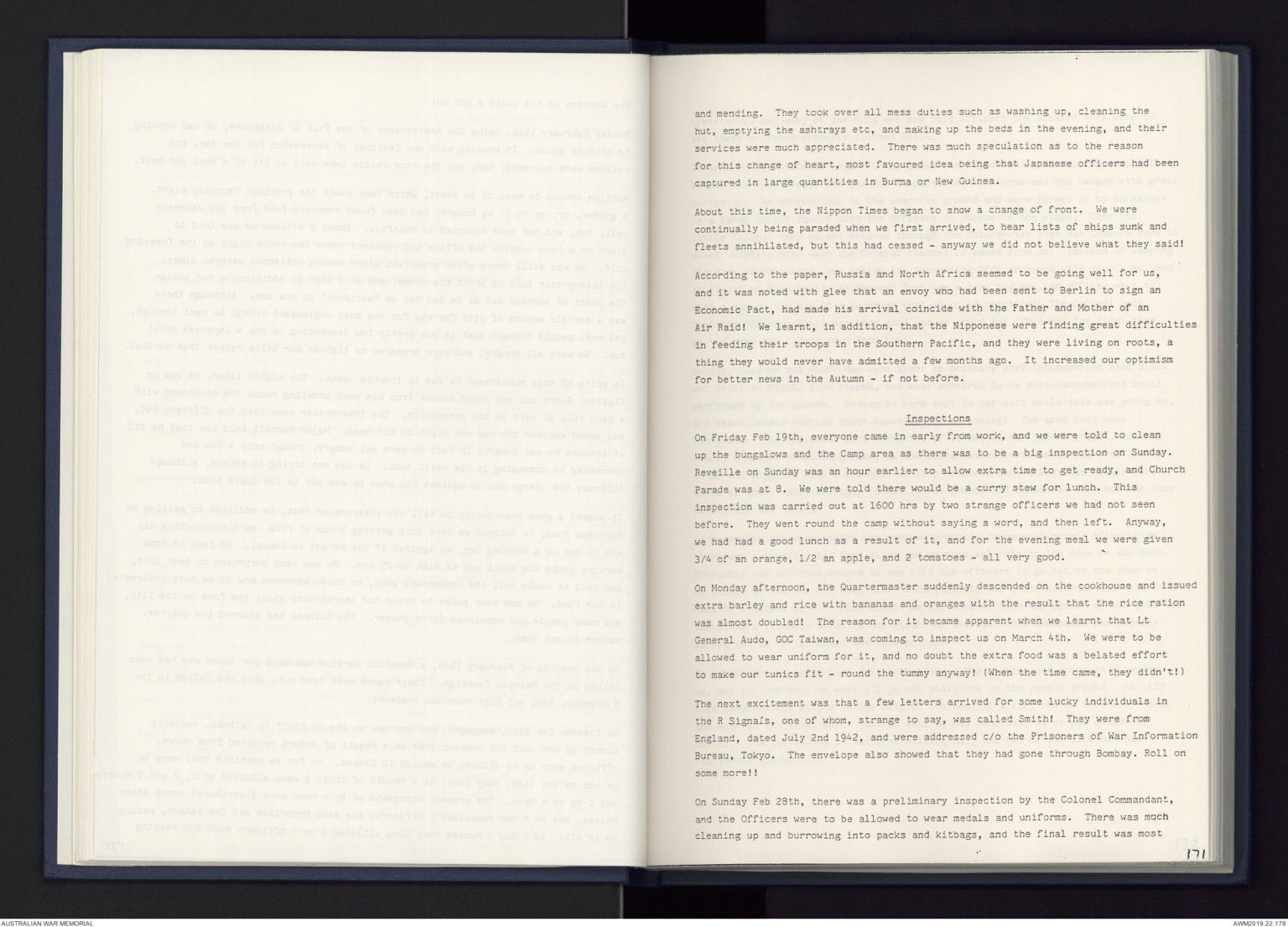
170
and mending. They took over all mess duties such as washing up, cleaning the
hut, emptying the ashtrays etc, and making up the beds in the evening, and their
services were much appreciated. There was much speculation as to the reason
for this change of heart, most favoured idea being that Japanese officers had been
captured in large quantities in Burma or New Guinea.
About this time, the Nippon Times began to show a change of front. We were
continually being paraded when we first arrived, to hear lists of ships sunk and
fleets annihilated, but this had ceased - anyway we did not believe what they said!
According to the paper, Russia and North Africa seemed to be going well for us,
and it was noted with glee that an envoy who had been sent to Berlin to sign an
Economic Pact, had made his arrival coincide with the Father and Mother of an
Air Raid! We learnt, in addition, that the Nipponese were finding great difficulties
in feeding their troops in the Southern Pacific, and they were living on roots, a
thing they would never have admitted a few months ago. It increased our optimism
for better news in the Autumn - if not before.
Inspections
On Friday Feb 19th, everyone came in early from work, and we were told to clean
up the bungalows and the Camp area as there was to be a big inspection on Sunday.
Reveille on Sunday was an hour earlier to allow extra time to get ready, and Church
Parade was at 8. We were told there would be a curry stew for lunch. This
inspection was carried out at 1600 hrs by two strange officers we had not seen
before. They went round the camp without saying a word, and then left. Anyway,
we had had a good lunch as a result of it, and for the evening meal we were given
3/4 of an orange, 1/2 an apple, and 2 tomatoes - all very good.
On Monday afternoon, the Quartermaster suddenly descended on the cookhouse and issued
extra barley and rice with bananas and oranges with the result that the rice ration
was almost doubled! The reason for it became apparent when we learnt the Lt
General Audo, GOC Taiwan, was coming to inspect us on March 4th. We were to be
allowed to wear uniform for it, and no doubt the extra food was a belated effort
to make our tunics fit - round the tummy anyway! (When the time came, they didn't!)
The next excitement was that a few letters arrived for some lucky individuals in
the R Signals, one of whom, strange to say, was called Smith! They were from
England, dated July 2nd 1942, and were addressed c/o the Prisoners of War Information
Bureau, Tokyo. The envelope also showed that they had gone through Bombay. Roll on
some more!!
On Sunday Feb 28th, there was a preliminary inspection by the Colonel Commandant,
and the Officers were to be allowed to wear medals and uniforms. There was much
cleaning up and burrowing into packs and kitbags, and the final result was most
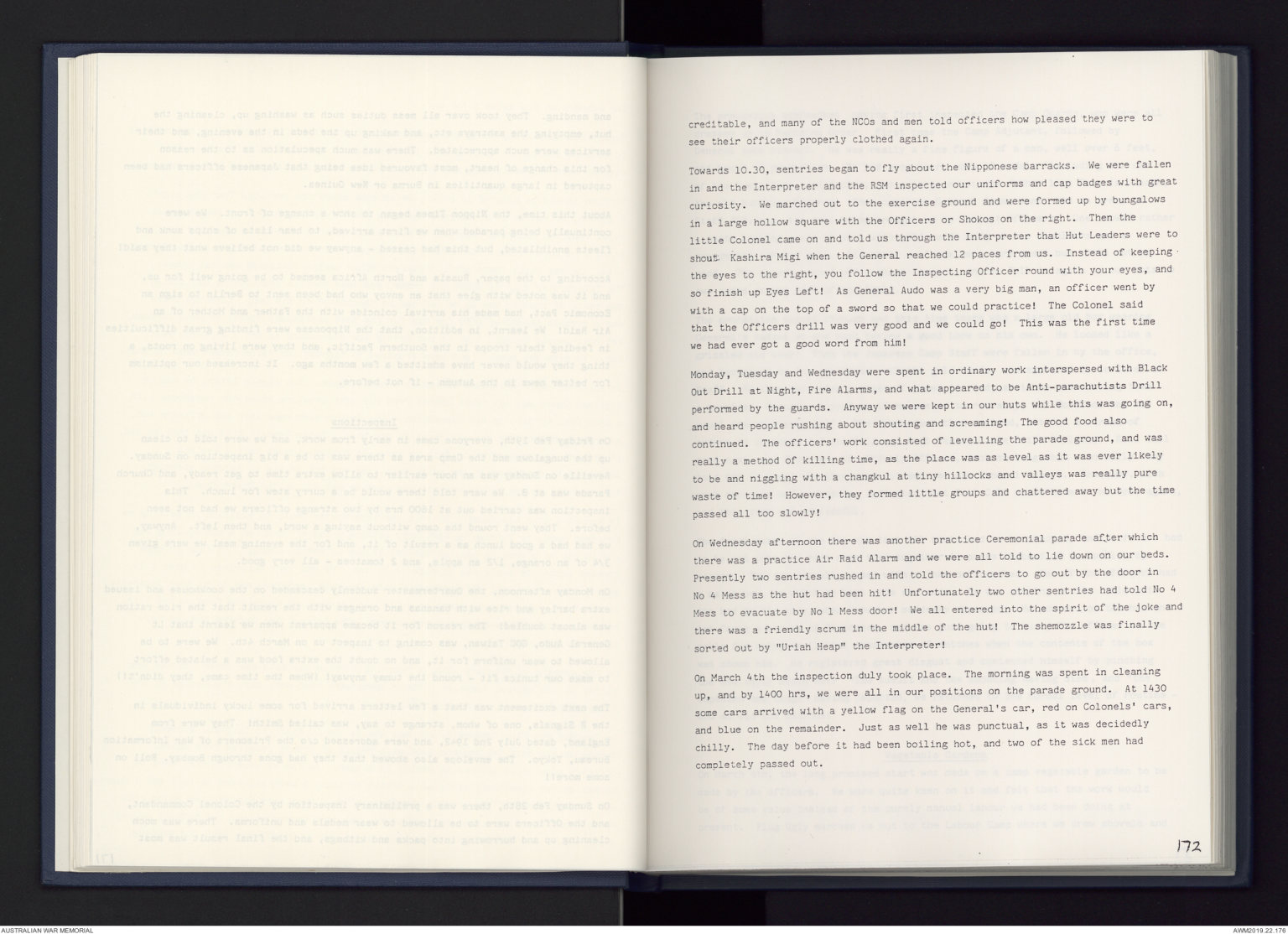
171
creditable, and many of the NCOs and men told officers how pleased they were to
see their officers properly clothed again.
Towards 10.30, sentries began to fly about the Nipponese barracks. We were fallen
in and the Interpreter and the RSM inspected our uniforms and cap badges with great
curiosity. We marched out to the exercise ground and were formed up by bungalows
in a large hollow square with the Officers or Shokos on the right. Then the
little Colonel came on and told us through the Interpreter that Hut Leaders were to
shout Kashira Migi when the General reached 12 paces from us. Instead of keeping
the eyes to the right, you follow the Inspecting Officer round with your eyes, and
so finish up Eyes Left! As General Audo was a very big man, an officer went by
with a cap on the top of a sword so that we could practice! The Colonel said
that the Officers drill was very good and we could go! This was the first time
we had ever got a good word from him!
Monday, Tuesday and Wednesday were spent in ordinary work interspersed with Black
Out Drill at Night, Fire Alarms, and what appeared to be Anti-parachutists Drill
performed by the guards. Anyway we were kept in our huts while this was going on,
and heard people rushing about shouting and screaming! The good food also
continued. The officers' work consisted of levelling the parade ground, and was
really a method of killing time, as the place was as level as it was ever likely
to be and niggling with a changkul at tiny hillocks and valleys was really pure
waste of time! However, they formed little groups and chattered away but the time
passed all too slowly!
On Wednesday afternoon there was another practice Ceremonial parade after which
there was a practice Air Raid Alarm and we were all told to lie down on our beds.
Presently two sentries rushed in and told the officers to go out by the door in
No 4 Mess as the hut had been hit! Unfortunately two other sentries had told No 4
Mess to evacuate by No 1 Mess door! We all entered into the spirit of the joke and
there was a friendly scrum in the middle of the hut! The shemozzle was finally
sorted out by "Uriah Heap" the Interpreter!
On March 4th the inspection duly took place. The morning was spent in cleaning
up, and by 1400 hrs, we were all in our positions on the parade ground. At 1430
some cars arrived with a yellow flag on the General's car, red on Colonels' cars,
and blue on the remainder. Just as well he was punctual, as it was decidedly
chilly. The day before it had been boiling hot, and two of the sick men had
completely passed out.
172
 Daphne
This transcription item is now locked to you for editing. To release the lock either Save your changes or Cancel.
This lock will be automatically released after 60 minutes of inactivity.