
Unit diaries relating to service of Geoffrey W. Fennell - Wallet 2 - Part 2
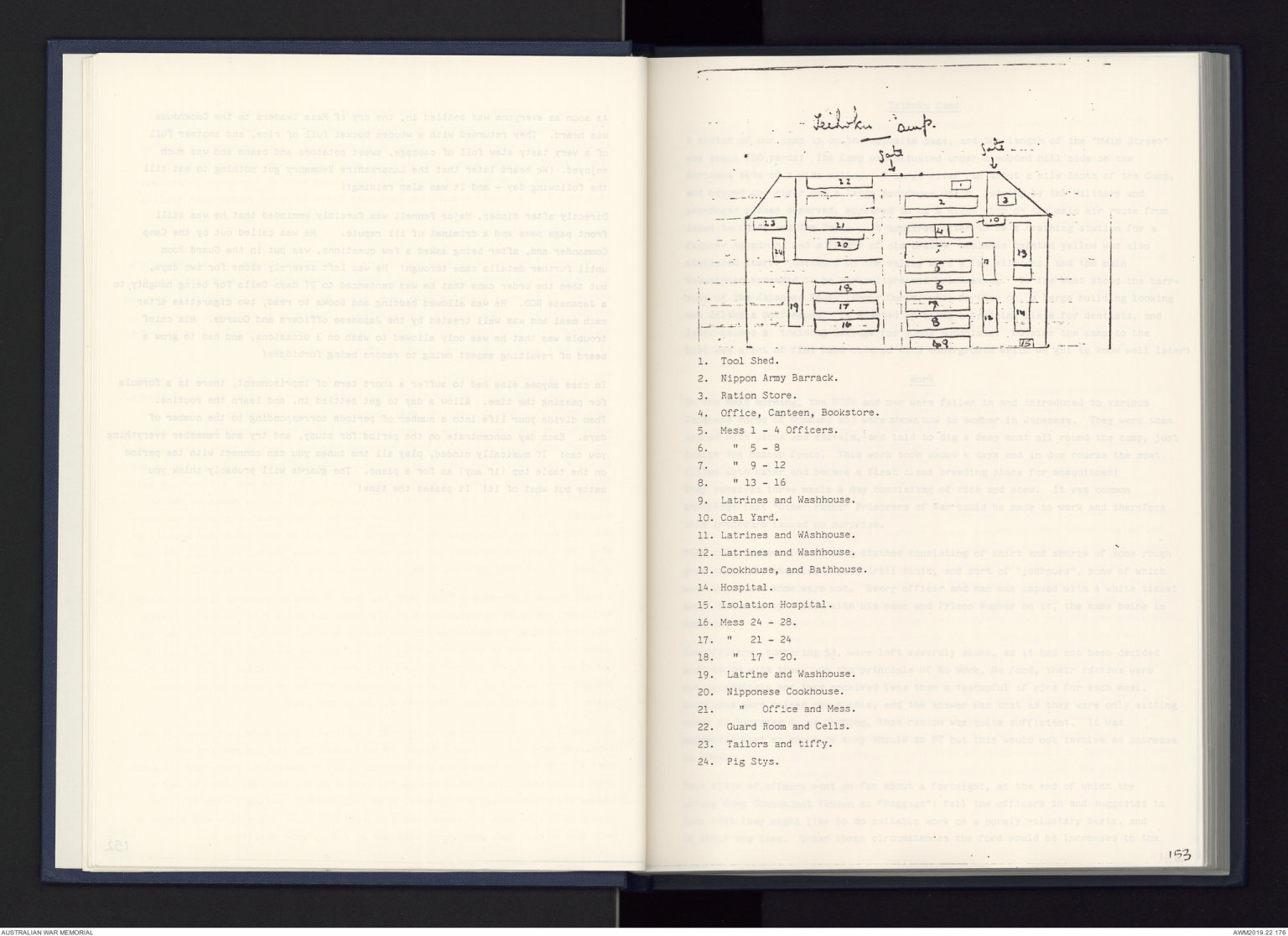
Hand drawn map - see original document
1. Tool Shed.
2. Nippon Army Barrack.
3. Ration Store.
4. Office, Canteen, Bookstore.
5. Mess 1 - 4 Officers.
6. “ 5 - 8
7. “ 9 - 12
8. “ 13-16
9. Latrines and Washhouse.
10. Coal Yard.
11. Latrines and WAshhouse.
12. Latrines and Washhouse.
13. Cookhouse, and Bathhouse.
14. Hospital.
15. Isolation Hospital.
16. Mess 24 - 28
17. “ 21 - 24
18. “ 17 - 20.
19. Latrine and Washhouse.
20. Nipponese Cookhouse.
21. “ Office and Mess.
22. Guard Room and Cells.
23. Tailors and tiffy.
24. Pig Stys.
153
Teihoku Camp
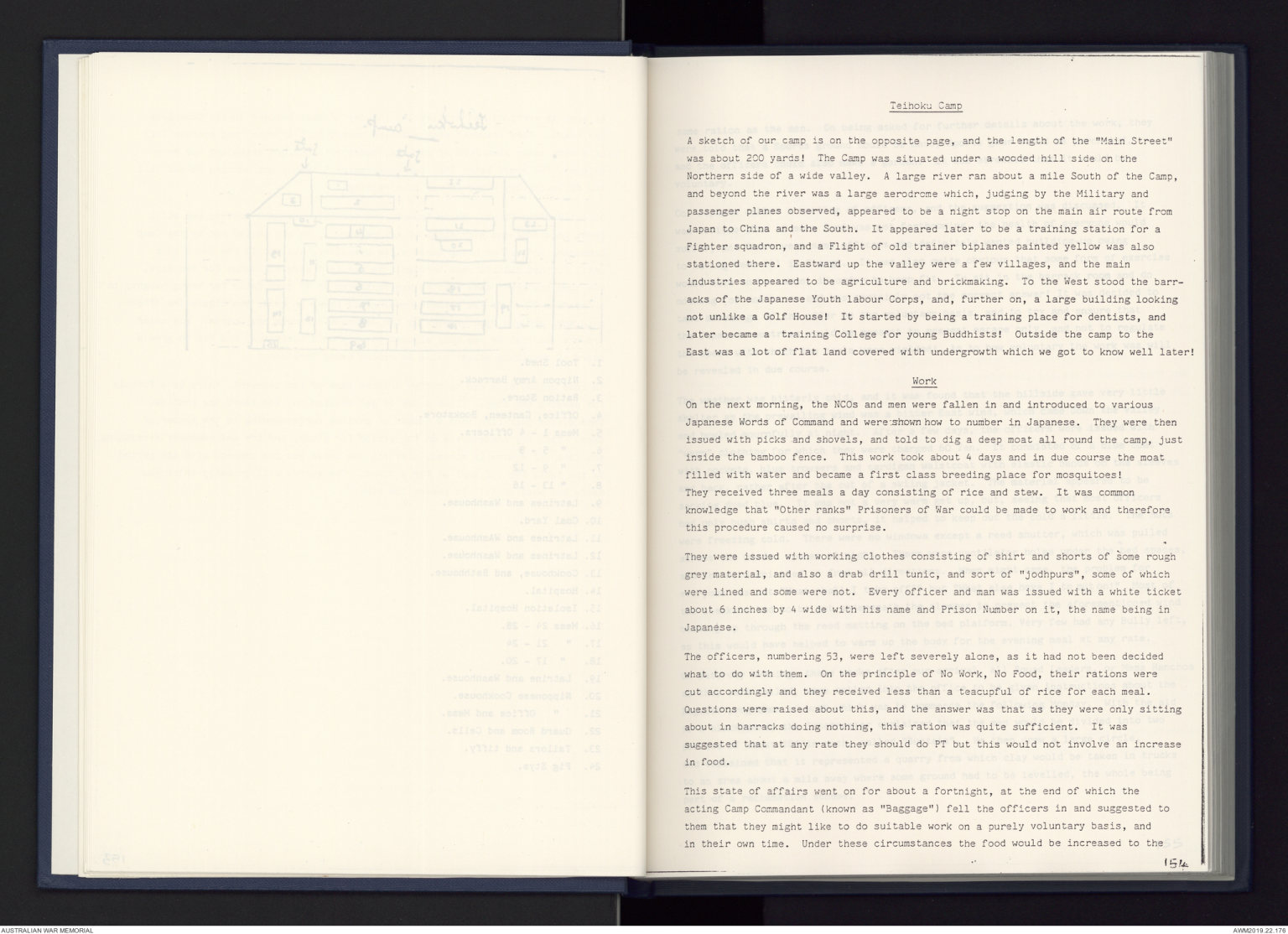
A sketch of our camp is on the opposite page, and the length of the “Main Street”
was about 200 yards! The Camp was situated under a wooded hill side on the
Northern side of a wide valley. A large river ran about a mile South of the Camp,
and beyond the river was a large aerodrome which, judging by the Military and
passenger planes observed, appeared to be a night stop on the main air route from
Japan to China and the South. It appeared later to be a training station for a
Fighter squadron, and a Flight of old trainer biplanes painted yellow was also
stationed there. Eastward up the valley were a few villages, and the main
industries appeared to be agriculture and brickmaking. To the West stood the barracks
of the Japanese Youth labour Corps, and, further on, a large building looking
not unlike a Golf House! It started by being a training place for dentists, and
later became a training College for young Buddhists! Outside the camp to the
East was a lot of flat land covered with undergrowth which we got to know well later!
Work
On the next morning, the NCOs and men were fallen in and introduced to various
Japanese Words of Command and were shown how to number in Japanese. They were then
issued with picks and shovels, and told to dig a deep moat all round the camp, just
inside the bamboo fence. This work took about 4 days and in due course the moat
filled with water and became a first class breeding place for mosquitoes!
They received three meals a day consisting of rice and stew. It was common
knowledge that "Other ranks" Prisoners of War could be made to work and therefore
this procedure caused no surprise.
They were issued with working clothes consisting of shirt and shorts of some rough
grey material, and also a drab drill tunic, and sort of "jodhpurs", some of which
were lined and some were not. Every officer and man was issued with a white ticket
about 6 inches by 4 wide with his name and Prison Number on it, the name being in
Japanese.
The officers, numbering 53, were left severely alone, as it had not been decided
what to do with them. On the principle of No Work, No Food, their rations were
cut accordingly and they received less than a teacupful of rice for each meal.
Questions were raised about this, and the answer was that as they were only sitting
about in barracks doing nothing, this ration was quite sufficient. It was
suggested that at any rate they should do PT but this would not involve an increase
in food.
This state of affairs went on for about a fortnight, at the end of which the
acting Camp Commandant (known as "Baggage") fell the officers in and suggested to
them that they might like to do suitable work on a purely voluntary basis, and
in their own time. Under these circumstances the food would be increased to the
154
same ration as the men. On being asked for further details about the work, they
were told that a Sports ground could be made, Sports gear would be purchased,
and the officers could also make a garden. It was stressed that it would be
voluntary.
Col Jephson called a meeting of officers, and the suggestion was discussed. It
was obvious that if more food was not forthcoming, the health of everyone would
suffer, and there were some officers who definitely wanted building-up owing
to having been ill in Changi. It was also quite obvious that some form of exercise
would have to be taken, in order to keep fit. To sit in the barrack room and do
nothing for months on end was certainly not the correct answer! It was decided to
take advantage of the offer on the voluntary basis, and to try and ensure that
the Japanese sentries would be present to prevent escape only, and not to regulate
the speed with which the tools were wielded! As to how voluntary the work was will
be revealed in due course.
The weather was bitterly cold, and it was found that the hillside gave very little
shelter as the prevailing wind was a bitter East wind, which came down the valley
and howled mournfully at night. After a few days, the officers were issued with
"warm" clothing for which they were charged 60 Yen. It consisted of a blue coat
with pockets, blue trousers and cardigan waistcoat with elastic bands on the sleeves
and back, rather after the cut of a skiing jacket. The material appeared to be
sacking dyed blue. It was not a very warm get up, but, seeing that most officers
had only bush shirts and shorts, it helped to keep out the cold a little. The huts
were freezing cold. There were no windows except a reed shutter, which was pulled
across the window spaces at night. There were ventilator holes under the bed spaces,
and the wind whistled in from all directions. When night came, the problem for
everyone was not "What shall I take off?" but "What else have I to put on!" Most of
the blankets had to be put underneath the sleeper to prevent the aforementioned wind
blowing up through the reed matting on the bed platform. Very few had any Bully left,
as this would have helped to warm up the body for the evening meal at any rate.
On Saturday evening, three weeks after our arrival, all Squad Leaders, or Mess Hanchos
as they were called, were called into the office to be given instructions about the
Regular programme of work which was to commence the following Monday. With the aid
of a blackboard, the Interpreter explained that the men would be divided into two
parties of about 200 in each, called "Buntais". He then drew a large circle,
and explained that it represented a quarry from which clay would be taken in trucks
to an area about a mile away where some ground had to be levelled, the whole being
part of a reclamation scheme.
155
He also gave out the routine timings for the day during the winter period.
Reveille 0630
Roll Call 0650 followed by Bowing East to Imperial Palace
Breakfast 0700
Fall in for work 0810
Back in Camp 1200
Dinner 1215
Fall in for work 1315
Back in Camp 1715
Supper 1730
Roll Call 2000
Lights out 2030
The procedure at Roll Call was as follows. Everyone stood in line on the bed
space with toes on the edge, wearing socks or barefooted, and any clothing worn had
to have the Number ticket on it. As soon as the Orderly Officer or NCO arrived at
the end of the hut, the Mess Leader nearest him shouted out KIOTSKE (Attention),
KASHIRA MIGI (Eyes Right) or KASHIRA HIDARI (Eyes left) according to which end
they came in. This was followed by NAORI (Eyes Front). Each Mess Leader in turn
would then recite:
SOIN (Total) say NIJU (20)
GENZAI (Present) say JUHACHI (18)
KETSIN (Absent) say NEE ( 2)
NYOSHITSU (Hospital) say ICHI ( 1)
NICHUK HANCHO (Orderly Officer) say ICHI ( 1)
Then BANGO = Number. The mess then numbered, and if lucky the
answer was OK! The Orderly officer was accompanied by an NCO with the Roll Call
Statement, and an NCO from the Guard and maybe a sentry. At first the latter were
very meticulous about dressing, thumb and fingers straight down, wooden clogs in
dressing under the bed space etc, and any transgressors were hit. After a short
period there were only occasional outbursts. In the morning, after they had gone,
the Bungalow leader then gave HIDARI-MIGI-HIDARI (Ranks right and left turn) bringing
both ranks facing the East. SAI KERE (Bow) followed, and then another right and
left turn followed by YASMAI (Stand at ease). How much we moved about then depended
on whether the Guard was a "Barbary" one or not! At last came the welcome cry
TENKO ARI or Roll Call finished, followed by a trumpet call, and then we got down.
156
Beds had to be made by early morning roll call. The 4 blankets were each folded
corner to corner along the widest side, then folded again, then folded in half
and once more. The sheets and palliasse were folded the same way. They were then
dressed in line at the back of the bed space, leaving room for personal belongings
behind, the four blankets being at the bottom, then the palliasse, then the sheets,
and pillow on top, all smooth edges front and right. In keeping with IJA orders,
the bedding could not be used for lying on or against, or sitting on during the
hours of daylight. It could not be put down until after afternoon work unless the
Orderly Officer gave a special Order of "All men bed down" on Sunday afternoons or
on wet afternoons. This order was always received with suppressed cheers! They
were very strict about this at first, but except when "barbary" guards were on duty,
it was much relaxed later.
On every table was a square tin full of water, and strictly speaking, smoking was
only allowed while sitting at the table, or on the edge of the bed space. All
cigarette ends were to be put in these tins, and if any were found on the floor
or on the bed space, there weren't 'arf a row! After a bit we used to use tins and
hollow bamboo as private ashtrays, and recline back on the sacred bedding;
occasionally malefactors were caught out by sentries or officers looking in at the
window! There were 2 electric lighters in each hut, but they were frequently out
of order, and a pioneer light had to be fetched from the cookhouse "Sub rosa". No
smoking was allowed outside the bungalows, which was a nuisance. All matches,
petrol lighters, flint and tinderboxes (if any) were confiscated.
There was a long shelf just above head level, when standing on the bed space, and
this was used for keeping private belongings. The Mess Bowls lived on a shelf under
the tables and were washed after each meal by Mess Orderlies detailed daily, or by
sick, who did not go out to work. Each Mess had a Rice Bucket, Stew Bucket, and
Washing up Bucket, the latter also being used for tea. It was also called the
"Lagi" Bucket"; Lagi (pronounced Leggy) is the Malay for More or Spare, and the cry
of "Leggy buckets to the cookhouse" meant extra rice, bananas, tomatoes, salt, sugar,
extra stew, spinach and various other things and when ordered, was cause for much
rejoicing!
Food for the sick was always a problem, as men not working always got their rice cut.
Most messes divided up all their rice equally, but a few messes only gave to the
sick men whatever they were entitled to. In domestic matters like this each mess
formulated its own policy, usually by vote under the guidance of the Mess Leader,
and this scheme was found to work very satisfactorily. Having given a general
outline of our domestic life, a more detailed account will now be given of events
as they actually took place.
157
1. General Routine BORs Contract Work.
2. Xmas and New Year Celebrations.
3. Medical arrangements and funerals.
4. Methods of Recreation.
5. Inspections and Final Inspection by General Audo.
6. Vegetable Gardens.
7. New systems of Roll Calls.
8. "Voluntary" work with trucks and BORs.
9. Red X Stores.
10. Various uses of Bamboo.
11. Departure of Colonel Commandant.
159
The routine of the work performed by the Other Ranks was as follows. They were
marched from the Camp to the parade ground of the Labour Corps by the Camp NCOs
and sentries. There they drew tools and each squad was taken over by a member of
the Labour corps who wore a green uniform, an armband and carried a stick.
Their ages varied from about 16 - 20 and they were speedily nicknamed The Green
Linnets on account of their nattering habits. They had no idea how to get the best
work out of BORs and were loathed by everyone, as they could never leave people
alone to get on with the job in hand, and were continually yapping like a lot of
pi-dogs.
The squad of men was put on trucks, and divided into teams of four, three to work
the truck and the fourth remained at the loading end. The truck had 4 wheels on
the framework, and on top of it was a square box frame which could be lifted off,
or else the whole truck could be tipped over. The earth was mostly blue clay and
was awful stuff to dig in wet weather. After landing the truck at the "quarry"
it was pushed on rails about 3/4 of a mile, and emptied onto the area which was to
be levelled. Here the other squad was waiting with changkuls, a kind of hoe, and
they did the levelling. The whole show was in charge of a Civilian contractor,
assisted by men with tapes and theodolites, and a Japanese Sergt Major, who came from
the Linnets camp and was known as Hitler, owing to his moustache! On the whole he
was liked by the men. At first the number of tubs was 4 in the morning and 4 in the
afternoon, though this was increased later. 13 trips was the greatest number
reached. In fine weather this form of work was not too bad but in the wet it was
very hard work indeed. This work went on continuously for about two months, with
one rest of 15 minutes morning and afternoon.
The officers on the first day drew shovels, changkuls and small sickles from the
toolshed, and were marched to some rough ground just outside the camp, and told to
start clearing it. It had a side slope, and was covered with coarse grass and
bramble bushes. They were informed that in due course it would be an exercise and
sports ground. The Camp RSM was in charge to start with, but later he and two
Corporals known as "Plug Ugly" and "Tashy" took a day each. In the morning shift
there was a rest for half an hour about 9.30 and again in the afternoon about
1500 hrs.
On December 19th we were given a pleasant surprise as were were given a printed postcard
to send home. It was like a Field Service postcard with headings:
I am interned in TAIWAN CAMP
My health is Excellent - Average - Poor
I am working for pay
I am working for health (Officers' only)
Please...................................................... take care of,
a queer missive in which to cram the 10001 things one wanted to say. The postcards
were handed in by Mess Leaders to the Interpreter, who read them through and the
159
total numbers sent were entered into a book, those for India being kept separate.
There was no information as to how they would reach their destination but we were
told they would go to Tokyo first, and thence to Geneva, though whether by Siberia
or ship to Lorenzo Marquez we knew not.
The exercise ground began to take shape, but before long, other jobs such as wood
cutting, road and path making near the camp, rubbish shifting and bamboo cutting
were found. Finally the whole of the camp fence was taken and rebuilt with fresh
bamboos, so that it became quite evident that the IJA was in no hurry to get the
Recreation ground ready!
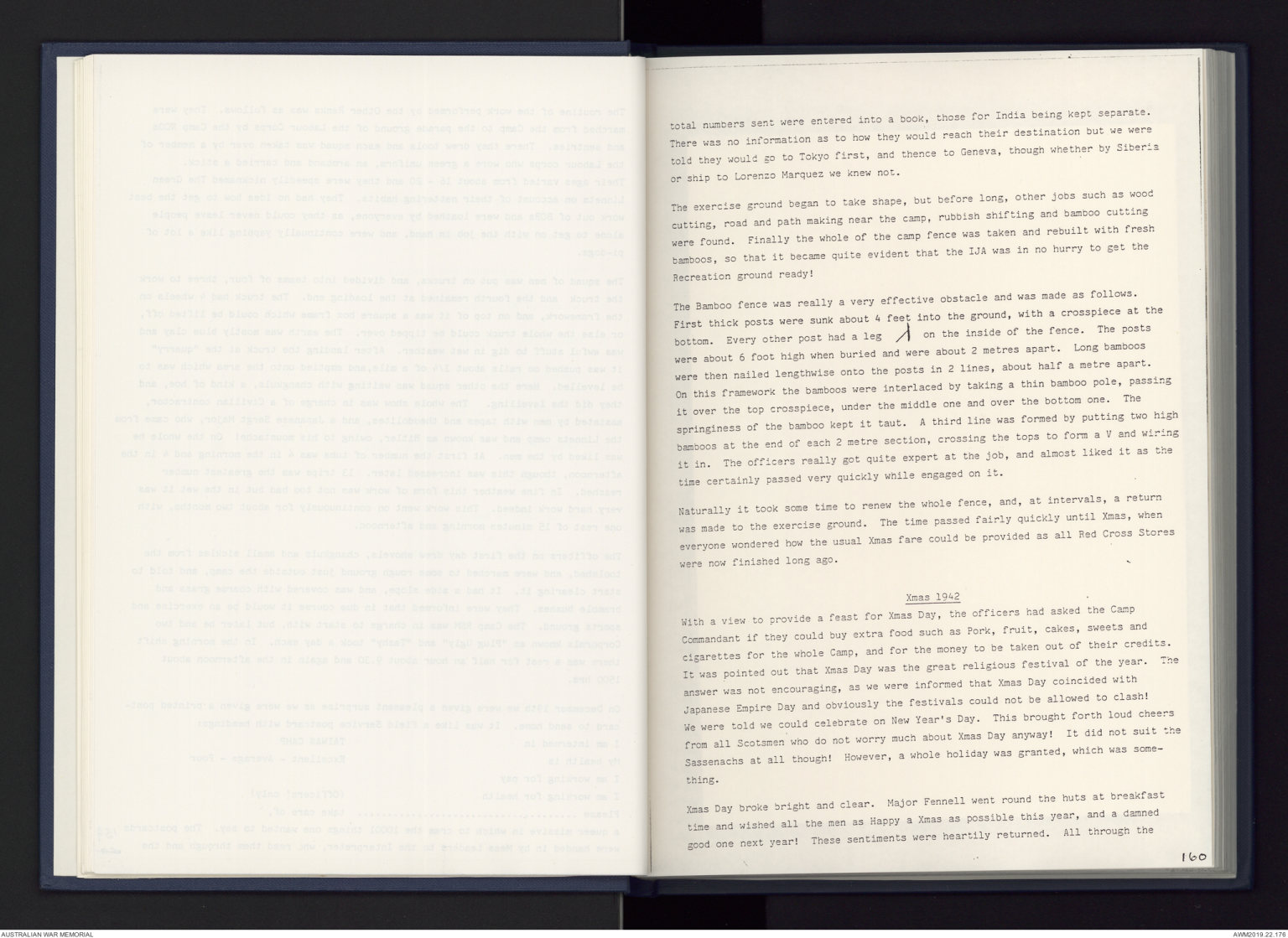
The Bamboo fence was really a very effective obstacle and was made as follows.
First thick posts were sunk about 4 feet into the ground, with a crosspiece at the
bottom. Every other post had a leg
Diagram - see original document
on the inside of the fence. The posts
were about 6 foot high when buried and were about 2 metres apart. Long bamboos
were then nailed lengthwise onto the posts in 2 lines, about half a metre apart.
On this framework the bamboos were interlaced by taking a thin bamboo pole, passing
it over the top crosspiece, under the middle one and over the bottom one. The
springiness of the bamboo kept it taut. A third line was formed by putting two high
bamboos at the end of each 2 metre section, crossing the tops to form a V and wiring
it in. The officers really got quite expert at the job and almost liked it as the
time certainly passed very quickly while engaged on it.
Naturally it took some time to renew the whole fence, and, at intervals, a return
was made to the exercise ground. The time passed fairly quickly until Xmas, when
everyone wondered how the usual Xmas fare could be provided as all Red Cross Stores
were now finished long ago.
Xmas 1942
With a view to provide a feast for Xmas Day, the officers had asked the Camp
Commandant if they could buy extra food such as Pork, fruit, cakes, sweets and
cigarettes for the whole Camp, and for the money to be taken out of their credits.
It was pointed out that Xmas Day was the great religious festival of the year. The
answer was not encouraging, as we were informed that Xmas Day coincided with
Japanese Empire Day and obviously the festivals could not be allowed to clash!
We were told we could celebrate on New Year's Day. This brought forth loud cheers
from all Scotsmen who do not worry much about Xmas Day anyway! It did not suit the
Sassenachs at all though! However, a whole holiday was granted, which was something.
Xmas Day broke bright and clear. Major Fennell went round the huts at breakfast
time and wished all the men as Happy a Xmas as possible this year, and a damned
good one next year! These sentiments were heartily returned. All through the
160
trials and tribulations the men had been marvellously cheerful, and were determined
at all times not to let adverse circumstances get the better of them, and damp
their spirits, even though the IJA forbade all whistling and singing!
As a matter of fact, work took place as usual in the morning but ended rather
earlier that usual, and meals were as usual except that a few had kept back a tin
of bully or M&V just in case of accidents! In the afternoon there was a well-attended
Carol Service held in the "Main Street"; the hymns were "Hark the Herald
Angels Sing", "Oh! Come all ye Faithful", "While Shepherds Watched their Flocks
by Night", "Christians Awake", "The First Noel", "Silent Night", and "God Rest You
Merry Gentlemen", and the heartiness of the singing certainly showed that we had
not lost our voices! A party then went on and sang outside the Hospital , an
action much appreciated by the patients.
During the afternoon there was a sudden stir in the neighbourhood of the Cookhouse;
some stores were seen emerging from the Quartermaster's abode, and spies reported
that there would be more in the Xmas Dinner than met the eye! It turned out that
Santa Claus Groucher had produced 200 lbs of Pork, flour, beans and carrots at the
last moment and the cooks set to work with great glee. When at last the cry of "Dinner
Up" arose, it was found that the meal consisted of an extra good ration of Rice and
barley, a good thick stew, and about half a pound of good fat pork fried in batter
per person!!!
Then came the problem - would the digestive organs compete with the rich fare!
Well! One can only die once, and everyone set to work with gusto. Some ate it all
at once, some finished it off after Lights Out, some kept some for breakfast the
following morning, but suffice it to say that the Feast was enjoyed immensely
even though it did cause some extra visits to the latrine - what of it!! It did us
a power of good, and the Japanese Staff seemed genuinely pleased that the surprise
was such a success.
As a result of having a full stomach for the first time for weeks, everyone slept
like a top, and felt much better for it. On Boxing Day there was only a short
period of work, and there was a holiday in the afternoon - and we were inoculated
against Diptheria! In some cases an inoculation against stomach ache would have been
more suitable!
And so 1942 gradually drew to a close. It had been a year which none of us will
ever forget. The Regiment had gained a fine reputation from the Indian Army and the
Australian Forces during the Campaign. At Changi they had got a reputation of
getting things done, and being well to the fore in introducing new novelties.
Horner's Stadium was the envy of all. In Taihoku, Officers and Men had shared the
same hardships and trials (though of course the men had a harder time in some
respects) and had done all they could to keep each other in good spirits. As a
161
result an even greater spirit of comradeship had grown up between them, a
comradeship which will never be forgotten, and will be the foundation of many a
Troop, Battery and Regimental Reunion long after the War is over, and Demobilisation
has taken place. Even from the Japan Times it could be seen that the tide of
Victory was turning slowly but surely in our favour, and it was with a decided
feeling of optimism that we prepared to embark on 1943. And yet we could not
but remember those- who had died during the campaign; and even more, those who had
died since they became prisoners of War and the sad news, which some day would
have to be broken to their relatives. There was even the thought that if only
medical stores had been available and the attitude of the Nipponese towards
the sick been different, some of them might have still been with us.
New Year's Day 1943
The last day of the Old Year was spent in giving the whole camp a thorough clean
up. All the huts, British and Nipponese, were all scrubbed inside and outside,
stores were dressed, and all grass, weeds and whatnot been removed.
Shelves were tidied, and a final inspection was held by the Colonel Commandant
to see if everything was ready to let the New Year in. Everything was satisfactory
except that he gave the Camp staff a rocket because they had now shown us how to
fold 2 of our blankets into the palliasse covers.
To do this, place the cover inside out flat on the ground. On it place your two
best blankets and fold them exactly the same size. Then get hold of a friend and
get him to start rolling towards the centre from two corners, while you, do the
other two. When it all gets to the centre, it looks like a couple of all-in
wrestlers in mortal combat! You then pull the cover from inside-out until it
becomes outside-in, and the result is a flat mattress! Sew at each corner, and
in the middle, to prevent the blankets rucking up and getting to one end, and the
deed is done.
For breakfast on New Year's Day we had 8 bananas a head, rice, an extra thick
stew, and some Japanese food call Moochi which was a sort of rice dumpling; it is
only eaten at New Year. Far more important, it was filling! At 0930 we were all
marched to the exercise ground which by now had been completed (so we thought!)
and when all was ready, we and the Nipps bowed towards the Imperial Palace. The
Nipponese gave 3 Banzais for the Emperor, and we were supposed to as well.
For lunch the extras were two oranges and half an apple, and there was a little
pork in the stew. We had hoped to get more battered pork for dinner, but in the
end there was a fairly large ration in the stew with extra rice and 3 more
bananas. The officers were told that the extras were being paid for by them but
could not reconcile wha had been subscribed with what had actually appeared.
[[162?]]
 Loretta Corbett
This transcription item is now locked to you for editing. To release the lock either Save your changes or Cancel.
This lock will be automatically released after 60 minutes of inactivity.