
Unit diaries relating to service of Geoffrey W. Fennell - Wallet 1 - Part 11
Padre Pugh held a service in a large workshop, and the place was packed out,
and there was certainly plenty of noise when the hymns started. He was
allotted a small room in the office block and with the aid of the Regimental
Fitters, he converted it into a Chapel complete with an Altar, and the fitters
made some wooden candlesticks. Being a Welshman, he called it the Chapel of
St David, but this was changed to the Chapel of St Barbara as he was reminded
that she was the patron Saint of Gunners who provided his congregation.
It was decided that the best way to occupy the men would be to start classes in
languages, shorthand, book-keeping, motor mechanics, carpentry etc, and to use
the prison workshops to the fullest extent. With this in view, a list of
Officer and NCO instructors was made, and the Regiment was found to be very well
off. Lt Godman was put in charge.
Having set such things in motion we naturally began to think of "Absent Friends".
Some were suspected of still being in Hospital in Singapore, and it was with some
concern that we heard that the Alexandra Hospital had been bombed during the
fighting, and there had also been fighting in the Hospital itself. Nothing
further had been heard of Major Bland and BSM Cooper, who had last been seen at
HQ 15th Bde north of Bukit Timah. Major Don had been seen in the Chinese General
Hospital, and his wounds were healing well. He had been put down for evacuation
to India and had, we believed, left on a Hospital Ship the Monday before the
capitulation. Lists of Prisoners of War had been forwarded to Malaya Command
for onward transmission to the Red Cross, through the Japanese, but
no-one could
tell when and how they were to get through to Geneva. One imagined that there
were about 40,000 prisoners in the area, though only about half of them were
fighting troops. All the Indian troops had been separated from the British, and
were located near Farrar Park, and would no doubt have plenty of propaganda talks
given them.
After we had been in the Jail for a few days, we were told that we were being
inspected by General Tomokuji Yamashita, Japanese GOC. All the British and
Australian troops had to line the road from a point close to Birdwood Camp, up to
Roberts Barracks, Changi, and back through the Australian area to the main road
again, thus forming a loop.
The Regiment had about a mile to march, and formed up with 155 and 80 Anti Tank
Regts on the South side of the road, with the Australians on the North side.
Then came 18 Div units and so on. About 1500 hours things began to move.
First came a car bearing Col Sugita, the Officer in charge of Prisoners of War,
for a look-see. It was reported that he had been once Military Attache in London,
and seemed very Anti British as a result, judging from his subsequent behaviour!
About a quarter of an hour later, the main procession started. First came some
cars full of Staff Officers and escort; then came an open car with 4 men armed
99
with rifles, then a car armed with a Cine-camera crew, and finally Tomakuji
Yamashita himself. He turned out to be an enormous man, and there was no doubt
that he had put up a very fine job of work during the operations in Malaya so that
we were rather curious to see what he looked like. We then marched back to the
Jail.
The normal routine worked out to be on the following lines. Reveille was at 07.30,
and troops were allowed out to wash, and take a walk around the outside of the jail
in formal parties. Breakfast was at 9 consisting of bully and biscuits and tea.
From 10 o’clock onwards there were various fatigues such as cleaning up, fetching
wood. Dinner was at 1300 hrs consisting of rice and bully stew, and possibly a
smear of jam as well. Rice was issued as a ration almost from the start, but units
were dependent on their own stocks for anything else at first. In the afternoon
there were various classes, and supper was at 1900 hrs and consisted of more rice
and stew, though the cooks turned out chupatties now and then out of the flour
stocks. No-one knew when there would be a regular supply of rations, so one had
to be very careful in what was issued from our store. A little condensed milk
was served out once a day, but the supply was jealously guarded in case of there
being cases of illness taking place later.
And so life went on until about March 10th, when we were told that we should have
to move again as the Jail was wanted for Civilian internees. At first we felt
very sorry to leave the Jail as we had got used to it, but it was realised that
we should get very tired of looking at the high Wall! At last, a recce party of
Civilians arrived to look round, and one of them was recognised as being the
Inspector of Prisons, Malaya; he was to get a dose of his own medicine!
On March 12th we moved to some bungalows and huts down by the sea shore, and our new
quarters looked very promising as they were intact. 5 Field Regt were allotted a
Bungalow belonging to a Capt Henly RA, and the huts of an experimental Wireless
station close by. 2 lorries were again allotted, and the Australian drivers did not
mind how many trips were made. Just as well as for this move there was a considerable
amount of furniture, cooking utensils, stationery, books, rice boilers and
other spoil to be shifted, in addition to the rations. One driver, however,
complained that he had been constipated for 9 days!
As soon as the move had been completed, news of a further move was received, and
we were told to move to Birdwood Camp, a collection of huts about a mile down
the road towards Changi. A reconnaissance party was sent down, and found that
the present occupants were our old friends the 2/10 and 2/15 Field Regts Royal
Australian Artillery. The bungalows were wooden huts with attap roofs and seemed
to be in a fairly good state of repair, and the area had been thoroughly cleaned.
Also we were confronted with a level padang, on which were 3 Football grounds, and
a Hockey ground complete with posts right in our area, and these proved a positive
100
Godsend, as will be seen later. It was arranged that the Australians would move
the following morning, and we would start moving after lunch.
Again, a very short march was necessary, again 2 lorries were available and again
there was extra spoil to move in the shape of more furniture, pictures, cooking
utensils, a frigidaire (in case the electric supply ever came on), firewood, more
books, and last but by no means least, a perfectly good piano and set of drums!
We had no qualms of conscience in removing what we did as the Japanese were
taking over and the rightful owners were unknown. Another good find were some
barrels of Chloride of Lime and a lot of gardening tools and seeds. Still, we
left the area with regrets, in spite of having the bodies of three dead Chinamen
being washed about in the sea just below.
BIRDWOOD CAMP
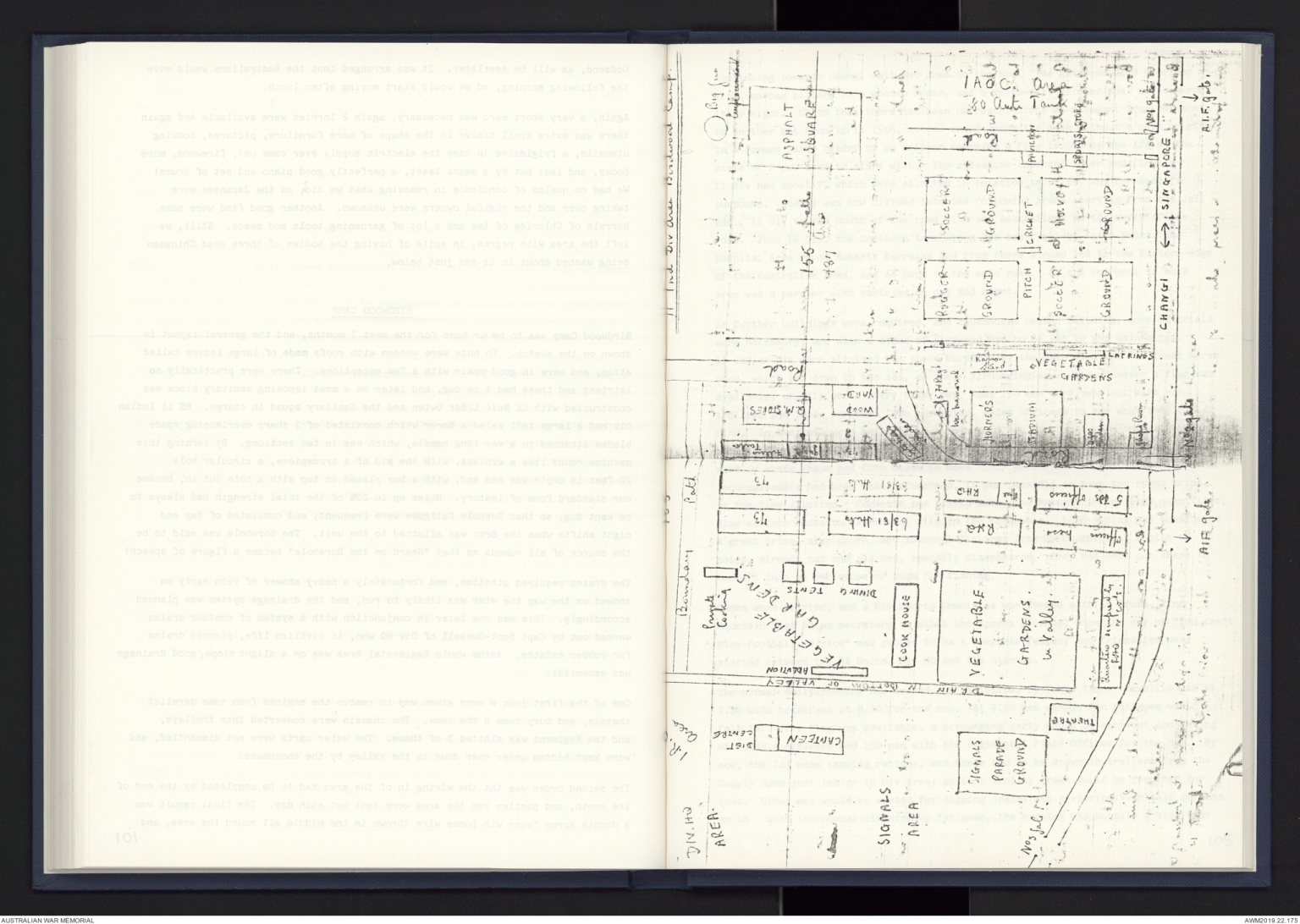
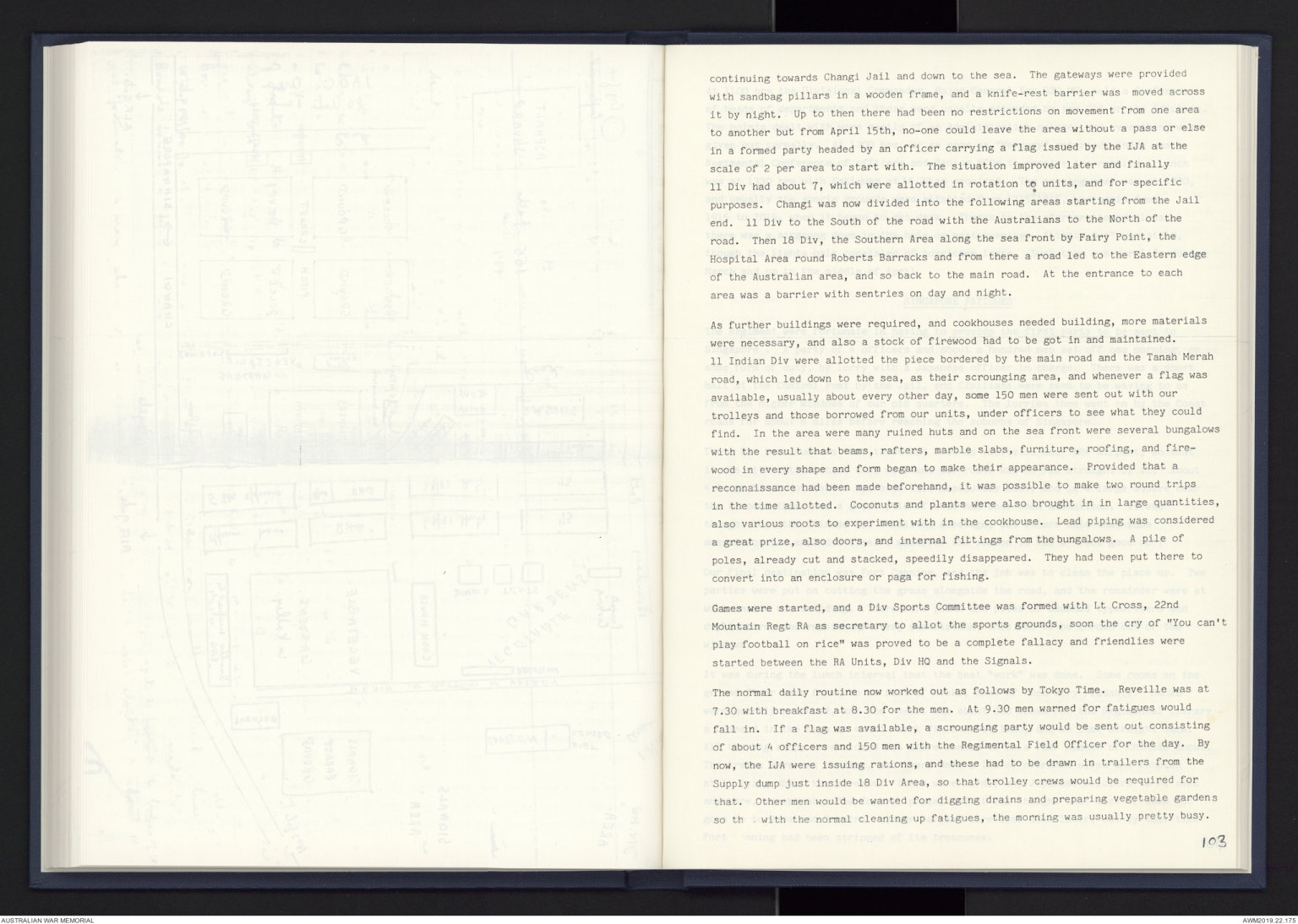
Birdwood Camp was to be our home for the next 7 months, and the general layout is
shown on the sketch. The huts were wooden with roofs made of large leaves called
attap, and were in good repair with a few exceptions. There were practically no
latrines and these had to be dug, and later on a most imposing sanitary block was
constructed with Lt Reid, L/Bdr Owten and the Sanitary squad in charge. RE 11 Indian
Div had a large tool called a Borer which consisted of 3 sharp overlapping spade
blades attached to a very long handle, which was in two sections. By turning this
machine round like a windlass, with the aid of a crosspiece, a circular hole
20 feet in depth was made and, with a box placed on top with a hole cut in, became
our standard form of lavatory. Holes up to 20% of the total strength has always to
be kept dug, so that Borehole fatigues were frequent, and consisted of day and
night shifts when the Borer was allotted to the unit. The Borehole was said to be
the source of all rumours so that “Heard on the Borehole” became a figure of speech!
The drains required attention, and fortunately a heavy shower of rain early on
showed us the way the water was likely to run, and the drainage system was planned
accordingly. This was done later in conjunction with a system of contour drains
worked out by Capt Scott-Russell of Div HQ who, in civilian life, planned drains
for rubber estates. As the whole Regimental Area was on a slight slope, good drainage
was essential.
One of the first jobs we were given was to remove the engines from some derelict
chassis, and bury them in the bank. The chassis were converted into trolleys,
and the Regiment was allotted 3 of these. The water carts were not dismantled, and
were kept hidden under cover down in the valley by the cookhouse.
The second order was that the wiring in of the area had to be completed by the end of
the month, and parties from the area were sent out each day. The final result was
a double apron fence with loose wire thrown in the middle all round the area, and
101
Hand drawn diagram - see original
continuing towards Changi Jail and down to the sea. The gateways were provided
with sandbag pillars in a wooden frame, and a knife-rest barrier was moved across
it by night. Up to then there had been no restrictions on movement from one area
to another but from April 15th, no-one could leave the area without a pass or else
in a formed party headed by an officer carrying a flag issued by the IJA at the
scale of 2 per area to start with. The situation improved later and finally
11 Div had about 7, which were allotted in rotation to units, and for specific
purposes. Changi was now divided into the following areas starting from the Jail
end. 11 Div to the South of the road with the Australians to the North of the
road. Then 18 Div, the Southern Area along the sea front by Fairy Point, the
Hospital Area round Roberts Barracks and from there a road let to the Eastern edge
of the Australian area, and so back to the main road. At the entrance to each
area was a barrier with sentries on day and night.
As further buildings were required, and cookhouses needed building, more materials
were necessary, and also a stock of firewood has to be got in and maintained.
11 Indian Div were allotted the piece bordered by the main road and the Tanah Merah
road, which led down to the sea, as their scrounging area, and whenever a flag was
available, usually about every other day, some 150 men were sent out with our
trolleys and those borrowed from our units, under officers to see what they could
find. In the area were many ruined huts and on the sea front were several bungalows
with the result that beams, rafters, marble slabs, furniture, roofing, and firewood
in every shape and form began to make their appearance. Provided that a
reconnaissance had been made beforehand, it was possible to make two round trips
in the time allotted. Coconuts and plants were also brought in in large quantities,
also various roots to experiment with in the cookhouse. Lead piping was considered
a great prize, also doors, and internal fittings from the bungalows. A pile of
poles, already cut and stacked, speedily disappeared. They had been put there to
convert into an enclosure or paga for fishing.
Games were started, and a Div Sports Committee was formed with Lt Cross, 22nd
Mountain Regt RA as secretary to allot the sports grounds, soon the cry of "You can't
play football on rice" was proved to be a complete fallacy and friendlies were
started between the RA Units, Div HQ and the Signals.
The normal daily routine now worked out as follows by Tokyo Time. Reveille was at
7.30 with breakfast at 8.30 for the men. At 9.30 men warned for fatigues would
fall in. If a flag was available, a scrounging party would be sent out consisting
of about 4 officers and 150 men with the Regimental Field Officer for the day. By
now, the IJA were issuing rations, and these had to be drawn in trailers from the
Supply dump just inside 18 Div Area, so that trolley crews would be required for
that. Other men would be wanted for digging drains and preparing vegetable gardens
so that with the normal cleaning up fatigues, the morning was usually pretty busy.
103
At 1100 hrs the Divisional Commander, Major-General Key DSO MC, held a Conference
of heads of departments and these were usually attended by the CO2 or the Adjutant.
The points dealt with were mostly of an Administrative nature, and everything was
given out verbally. At 1200 hrs, or as soon as "Mercury" returned, there was a
Regimental Conference of officers and Senior NCOs to receive the results. Lunch
was at 1330 hrs with fatigues at 14.30 as required. The evening meal was at 1830,
and usually the sports grounds were allotted from 1715-1815, and again from
1915 to 2015, when it began to get dark. Thanks to the aforementioned plans,
there was a singsong down in the hut on most evenings. "Lights Out" was at 10,
though the lights only consisted of hurricane lamps. Such then was our life during
March and up to the middle of April.
SINGAPORE FATIGUES
The Regiment were fortunate in having to provide the first party to be sent to
Singapore. A party of 4 officers and about a hundred men set off one morning, on
some form of duty, by lorry with a Japanese officer in charge. There was a short
halt at the Control Post by the Jail, and Civilians were seen to be waving to us
from the higher windows of our old quarters. The lorries then went on by the Coast
roads for about 6 miles before reaching the suburbs of Singapore.
There has been rumours that there had been an explosion near the Airport, so that
it was with satisfaction that we found our route was to run straight by it. About
4 large blocks of houses had been laid absolutely flat, and in a large square near
the Airport there was a great pile of what had once been ammunition. It was
thought that the Chinese had committed sabotage, but others said that some
ammunition had exploded itself; whatever the reason it was a “reet good do”!
Our final destination was Fort Canning, and the job was to clean the place up. Two
parties were put on cutting the grass alongside the road, and the remainder were at
work inside the building. There were piles and piles of smashed typewriters and
duplicators, and rubbish of every description; this had to be thrown out of the
windows.
It was during the lunch interval that the best “work” was done. Some rooms on the
ground floor were found to be full of books, most of them very readable. Sacks
were quickly produced, and the result was about 300 books for the Regimental Library —
a Godsend in the days to come! Work finished at 1630, and we came straight back.
All the big shops were closed but there seemed to be a fair number of Chinese about.
The trains were not running, and there were a lot of overhead wires and rubbish
still lying about the streets. There were hardly any Japanese soldiers to be seen
anywhere, except at a few Control posts, and it was thought that most of them had
gone on to Java and Sumatra. Other parties were sent down later, but by that time
Fort anning had been stripped of its treasures.
104
“THE SIKHS”
Early in April, we were assailed by a fresh nuisance. As previously stated, all
the Indian Forces remained in Singapore, and were put into Camps near Farrar Park,
the Great World and New World, two Chinese Amusement Parks, now deserted. The
Japanese authorities set to work at once to create an Indian National Army for duty
abroad and guard duties in Singapore; extra food and good treatment being promised
in addition to the Liberation of India! They had practically no success at first
but eventually Captains Dhillon Singh, Mohan Singh and about 100 Sikhs of the 1/14
Punjab Regt went over and were joined by some of the Singapore Police and Warders
from the Jail. Such was the Indian National Army - rather less than 1% of the
whole!
A detachment of “the Army” was located in a collection of huts near the Jail called
Curran Camp, and appeared each day at 8 am to take up sentry duties at various
control posts, and to provide patrols on the main road and in the scrounging area.
As far as we were concerned, there was a Sikh Guard Room just inside the Australian
Area opposite our No 2 Gate, and there was a sentry during the hours of daylight.
The IJA ordered that all these guards and sentries should be saluted.
General Percival protested promptly that it was entirely against our code of honour
to salute men whom we regarded as traitors, and at the same time asked Area
Commanders to find out whether officers and men were prepared to make a stand against
it, even though it might involve hardship. 11 Ind Div with a few exceptions in
the IAOC were against saluting, and so were the Australians, but there was considerable
differences of opinions in 18 Div and Southern Area, and therefore, when the
protest was ignored by the IJA nothing further was done. Every effort was made to
avoid saluting the Sikhs, in many cases with success; but more will be written about
them later.
KRANJI
Towards the middle of April, 11 Div were told to have a party of 500 in readiness
to go over to work near our old friend Bukit Timah. The party was made up from
5th Field Regt, the Lanarkshire Yeomanry, 137 and 80 Anti Tank. There would also
be 1500 going from Southern Area. Lt Col Napier, of 80 Anti Tank, was to be CO,
Major Fennell andCapt Adams, both of 5 Field Regt, were to be CO2 and Adjt;
A Troop 63/81 and D Troop 73 were detailed with Capts Pearson and Firth, and Lts
Marsden, Bladen and Armstrong. It was expected that the job would last 6 weeks.
Full kits could be taken and a full cookhouse staff went as well, with a proportion
of utensils. The main body were to march, but lorries would be available for kits.
105
At 8.30 2 days later the party set off under Major Fennell, Col Napier, Capt
Adams and the cooks having gone on in a 30 cwt as Advance Party. It was
reckoned that a march of some 16 miles was necessary, though this distance
would be lessened if we could take our old route via the Tampines Road, Bradfield Road
and Thomson Road. This however was not allowed and a halt was made
at the Jail to collect a flag and a Jap guide on a bicycle under whose escort
it was possible to avoid saluting the Sikh Sentry at the Jail!
The day was fine, though not too hot, and the party set off into the unknown in
high spirits, the general thought being “Anything for a change”. A halt was made
every 10 minutes to the clock hour, and at the second halt some Malays did a
roaring trade with bread and cigarettes. Picnic lunch was taken on a strip of
grass just outside Singapore. The guide turned right handed along the Rochelle
Canal, and before long we reached the beginning of the Bukit Timah road.
It was thought that our destination was only about 8 miles away, so that, all
being well, we should be settled in comfortably by tea time. Presently, we began
to pass old landmarks of the fighting days, Cluny Road leading to the Botanic
Gardens, Farrar Road, and Adam Road opposite it. A little further on, Swiss
Cottage Road and the little lane leading to the Chinese “Love Nest”, where RHQ
had been on a somewhat exciting night! At last, Bukit Timah village was reached
and we expected our guide to halt, but he showed no signs of doing so! On and on
we went, and got more and more tired, but at last a camp loomed up in front. It
was found to contain Australians, who told us we had some way to go yet! However,
the guide appeared to know where he was going, which was a relief.
A halt was made at Pasar Panjang village, where there was a coffee stall, and it
was realised that, if we went much further we should reach the sea! At last,
just as it was beginning to get dark, some wooden huts, stone bungalows and a
water tower, were seen on a small hill on the left, and we hardly dared to hope
that it was our camp, but, to our joy, the guide turned up a track, crossed the
Railway, and we were there! It was worked out later that we had marched 27 miles —
not bad for mechanised gunners on a rice diet, and very few dropped out — an
excellent performance.
The Regiment were allotted a large double-decker wooden hut, which was absolutely
filthy, but the first idea was to get a meal and get to bed! In spite of the
protests of Col Napier, work was to start the following morning, as a senior
Japanese Officer would be there, and the young officer in charge dare not alter
existing arrangements. He promised however that work would cease as soon as the
senior officer had gone, which was something. “The lorries” for the kits turned
out to be only the 30 cwt lorry, but at least everything arrived, and all went to
sleep. The party from Southern Area were not so fortunate, as they came in at all
106
hours during the night, with many stragglers, and their kits did not arrive
until the following day.
Next morning, after an early breakfast, the working parties set off for the site
of the work some 3 miles away, and needless to say they were very tired and footsore.
They reached a hill just beyond the Australian Camp, and were told that
a road was to be built up to the top, and a War Memorial would eventually be
erected. Tools were handed out, and the time until the arrival of the Senior
Officer was occupied in clearing undergrowth. At last the Senior Officer turned
up, had a look round, said “You are all very good Boys” and departed. Lt Akematsu
was as good as his word, and the party returned to Camp.
In the meanwhile, those left behind had had time to take stock of their new home.
Kranji had been the Naval Wireless Station about 3 or 4 miles from the Johore
Causeway. There were some Naval Oil tanks, which had been well and truly blown
up. The station had been bombed, and all the rooms were full of filthy clothes;
wet bedding, and sheer muck! The lavatories were chocked with excreta and maggots,
and the water supply and electric light did not work; the lalang grass round the
huts was feet high — truly a revolting prospect! It seemed a shame that we
should be sent to such a place, as Changi by now was very clean. Here, we looked
like getting anything from plague downwards!
The trouble about getting the place clean was that all fit men hat to go to work
and the sick men left behind were really not up to much. However, a start was made
and soon bonfires were seen all over the place. Lt Akematsu was really very help-
full, and sent Major Dunlop, the senior MO, down to Singapore in a car to contact
the European Sanitary Staff, who had been left to continue their jobs. Major Dunlop
was a Hygiene Expert, and had worked in Malaya for the past 15 years looking
after the health of the rubber estates in Kedah. He proved a tower of strength.
He came back with two civilians called Murray and Cessford, who had a good look
round, and found that the Camp was connected up with the main water supply
at Johore Bahru; provided that there was no serious damage, the water supply should
be all right in a few days. The Electric Light, they suspected should come
direct from the mains at the Naval Base. They promised to make enquiries and
come back next day.
Things began to look brighter. The following day there were no working parties
required so that Fatigues were possible and a whole day’s cleaning up certainly
made a power of difference. The Sanitary experts were as good as their word, and
returned with a lorry load of coolies, armed with long brushes, and attacked the
drains with vigour, with the result that two days later, all the bungalows had
running water, and the lavatories could be used. The guess about the Electric
Light proved correct, and current was turned on shortly after.
107
The working parties were divided into morning and afternon shifts. The morning
shift started off about 7.30, and commenced work about 9. They had a break for
lunch from 12/30 to 1.15. handed over to the afternoon shift at about 12.30,
and then returned. The afternoon party knocked off about 18.30. The 11 Div
Party were lucky in being in the morning shift, and the allotment was:
Morning Afternoon
5 Field RAOC
155 Field East Surreys
137 Field Command Sigs
122 Field Argylls
80 Anti Tank Manchesters
Loyals
Gordons
making about 1000 in each party, though the average was much less owing to sickness.
The job was to construct a road from the 8th Miles stone on the Bukit
Timah Road
to the top of a Hill called Bukit Batock. The work consisted of digging out the
line of the road as indicated by Japanese surveyors, and was not really very hard
as the tools were new, and the earth was soft. The sentries were all from a
Japanese Regular Sapper unit, who had fought in China and Malaya, and were a very
reasonable lot. During the campaign they had been working on repairing bridges
demolished during the retreat.
The Camp Commandant was Lt Col Bretherton of the Malay Regt, with the CO2 and Adjutant
from the same unit, but the 11 Div Party remained independent in most respects.
One feature of the Camp was the marvellous series of sunsets. Looking North from
the top of the Camp, the Straits and Johore Palace and Government Buildings were
visible. In the distance were the mountains on the mainland. There was one very
large one called Mount Ophir, not far from our old friend Segamat, and the sun sank
behind it every night like a ball of fire with the most marvellous colour effects,
the reflection of this being seen over towards Singapore. In front, were a lot of
litte hills and three quarries, while to the West were more hills and
rubber
trees, with the Wireless Station pylons near Jurong clearly visible, Singapore lay
due South but was not visible from Camp.
The Railway ran quite close to the camp. There were very few passenger trains, but
goods trains were frequent, and it was surmised that stores of all kinds were
being removed from up-country, and also from the Naval Base. The night
train still
left Singapore about 2200 hrs, but was a shadow of its former self. It no
longer
consisted of air-conditioned sleepers and corridor stock; 3rd Class coaches were
provided for upper class passengers, and open trucks for the remainder.
108
 Sam scott
This transcription item is now locked to you for editing. To release the lock either Save your changes or Cancel.
This lock will be automatically released after 60 minutes of inactivity.