
Unit diaries relating to service of Geoffrey W. Fennell - Wallet 1 - Part 10
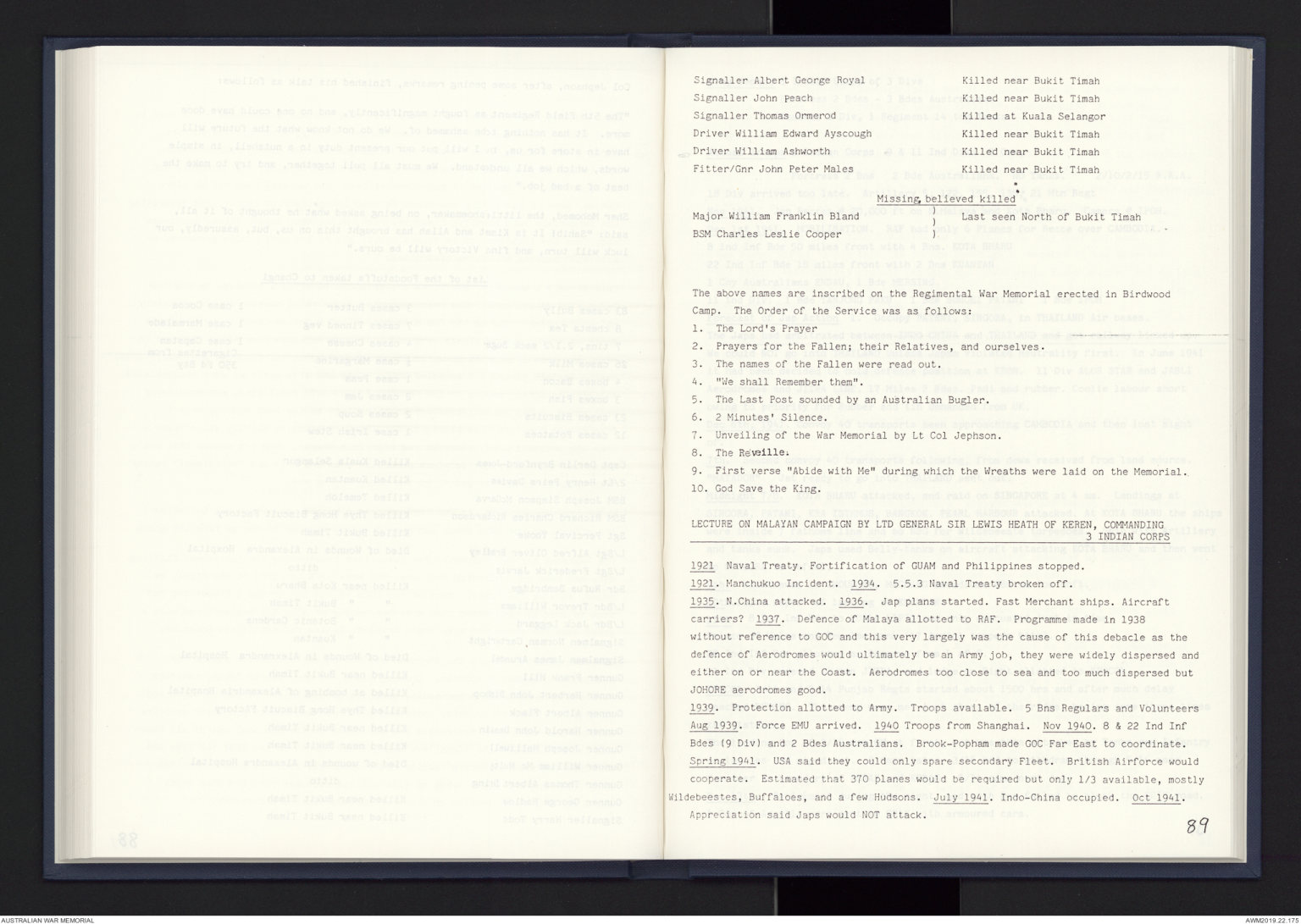
Signaller Albert George Royal Killed near Bukit Timah
Signaller John Peach Killed near Bukit Timah
Signaller Thomas Ormerod Killed at Kuala Selangor
Driver William Edward Ayscough Killed near Bukit Timah
Driver William Ashworth Killed near Bukit Timah
Fitter/Gnr John Peter Males Killed near Bukit Timah
Missing, believed killed
Major William Franklin Bland } Last seen North of Bukit Timah
BSM Charles Leslie Cooper }
The above names are inscribed on the Regimental War Memorial in Birdwood
Camp. The Order of the Service was as follows:
1. The Lord's Prayer
2. Prayers for the Fallen; their Relatives, and ourselves.
3. The names of the Fallen were read out.
4. "We shall Remember them".
5. The Last Post sounded by an Australian Bugler.
6. 2 Minutes' Silence.
7. Unveiling of the War Memorial by Lt Col Jephson.
8. The Reveille.
9. First verse "Abide with Me" during which the Wreaths were laid on the Memorial.
10. God Save the King.
LECTURE ON MALAYAN CAMPAIGN BY LTD GENERAL SIR LEWIS HEATH OF KEREN, COMMANDING
3 INDIAN CORPS
1921 Naval Treaty. Fortification of GUAM and Philippines stopped.
1921. Manchuko Incident. 1934. 5.5.3 Naval Treaty broken off.
1935. N. China attacked. 1936. Jap planes started. Fast Merchant ships. Aircraft
carriers? 1937. Defence of Malaya allotted to RAF. Programme made in 1938
without reference to GOC and this very largely was the cause of this debacle as the
defence of Aerodromes would ultimately be an Army job, they were widely dispersed and
either on or near the Coast. Aerodromes too close to sea and too much dispersed but
JOHORE aerodromes good.
1939. Protection allotted to Army. Troops available. 5 Bns Regular and Volunteers
Aug 1939. Force EMU arrived. 1940 Troops from Shanghai. Nov 1940. 8 & 22 Ind Inf
Bdes (9 Div) and 2 Bdes Australians. Brook-Popham made GOC Far East to coordinate.
Spring 1941. USA said they could ony spare secondary Fleet. British Airforce would
cooperate. Estimated that 370 planes would be required but only 1/3 available, mostly
Wildebeestes, Buffaloes, and a few Hudsons. July 1941. Indo-China occupied. Oct 1941.
Appreciation said Japs would NOT attack.
89
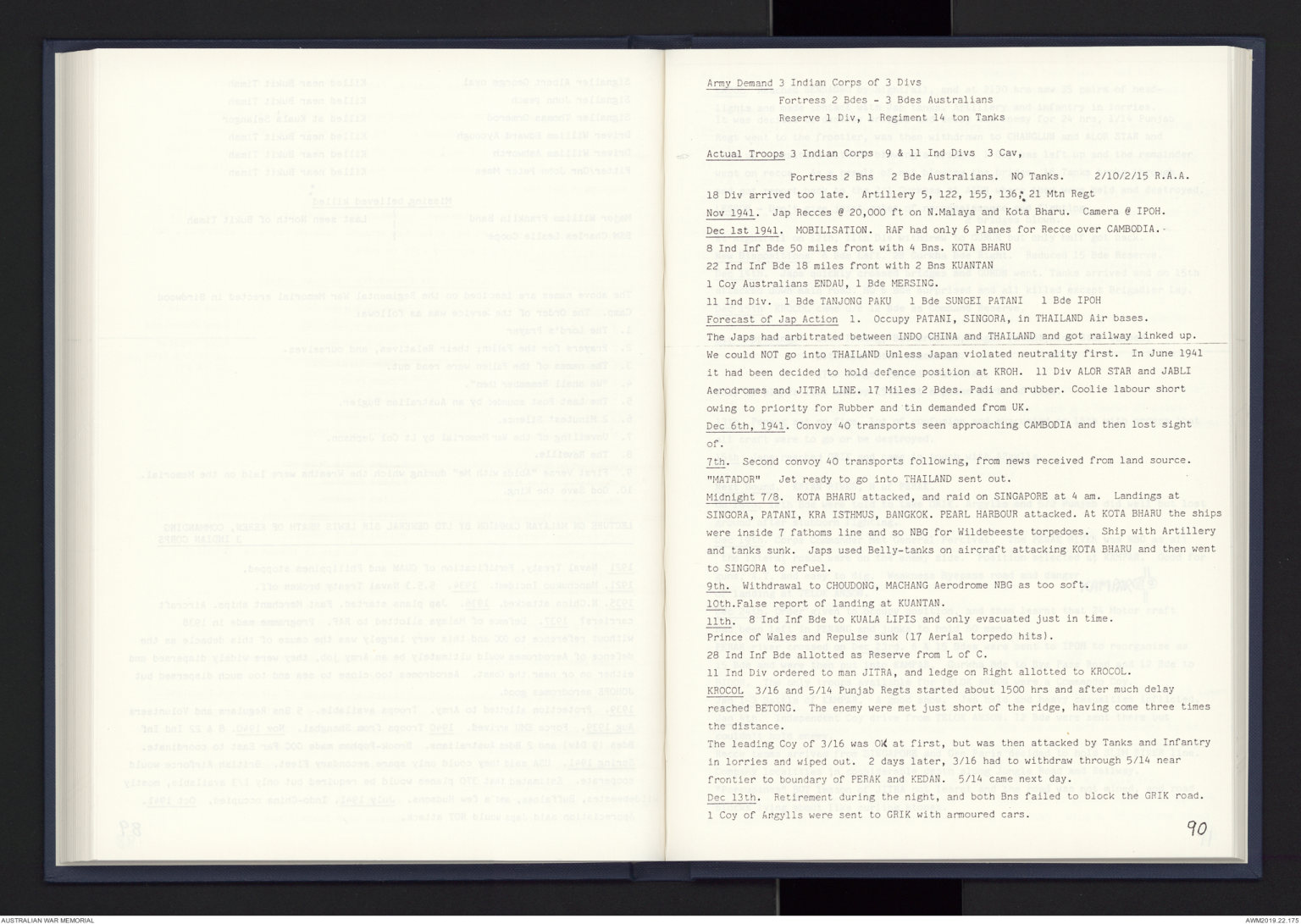
Army Demand 3 Indian Corps of 3 Divs
Fortress 2 Bdes - 3 Bdes Australians
Reserve 1 Div, 1 Regiment 14 ton Tanks
Actual Troops 3 Indian Corps 9 & 11 Divs 3 Cav,
Fortress 2 Bns 2 Bde Australians. NO Tanks. 2.10.2.15 R.A.A.
Nov 1941. Jap Recces @ 20,000ft on M. Malaya and Kota Bharu.
Camera @ IPOH.
Dec 1st 1941. MOBILISATION. RAF hd ony 6 Planes for Recce over CAMBODIA.
8 Ind Inf Bde 50 miles front with 4 Bns. KOTA BHARU
22 Ind Inf Bde 18 miles front with 2 Bns KUANTAN
1 Coy Australians ENDAU, 1 Bde MERSING.
11 Ind Div. 1 Bde TANJONG PAKU 1 Bde SUNGEI PATANI 1 Bde IPOH
Forecast of Jap Action 1. Occupy PATANI, SINGORA, in THAILAND Air Bases.
The Japs had arbitrated between INDO CHINA and THAILAND and got railway linked up.
We could NOT go into THAILAND Unless Japan violated neutrality first. In June 1941
it had been decided to hold defence position at KROH. 11 Div ALOR STAR and JABLI
Aerodromes and JITRA LINE. 17 Miles 2 Bdes. Padi and rubber. Coolie labour short
owing to priority for Rubber and tin demanded from UK.
Dec 6th, 1941. Convoy 40 transports seen approaching CAMBODIA and then lost sight
of.
7th. Second convoy transports following, from news received from land source.
"MATADOR" Jet ready to go into THAILAND sent out.
Midnight 7/8. KOTA BHARU attacked, and raid on SINGAPORE at 4 am. Landings at
SINGORA, PATANI, KRA ISTHMUS, BANGKOK. PEARL HARBOUR attacked. At KOTA BHARU the ships
were inside 7 fathoms line and so NBG for Wildebeeste torpedoes. Ship with Artillery
and tanks sunk. Japs used Belly-tanks on aircraft attacking KOTA BHARU and then went
to SINGORA to refuel.
9th. Withdrawal to CHOUDONG, MACHANG Aerodreome NBG as too soft.
10th. False report of landing at KUANTAN.
11th. 8 Ind Inf Bde to KUALA LIPIS an only evacuated just in time.
Prince of Wales and Repulse sunk (17 Aerial torpedo hits).
28 Ind Inf Bde allotted as Reserve fro L of C.
11 Ind Div ordered to a JITRA, and ledge on Right allotted to KROCOL.
KROCOL 3/16 and 5/14 Punjab Regts started about 1500 hrs and after much delay
reached BETONG. The enemy were met just short of the ridge, having come three times
the distance.
The leading Coy of 3/16 was OK at first, but was then attacked by Tanks and Infantry
in lorries and wiped out. 2 days later, 3/16 had to withdraw through 5/14 near
frontier to boundary of PERAK and KEDAN. 5/14 came next day.
Dec 13th. Retiremet during the night, and both Bns failed to block the GRIK road.
1 Coy of Argylls were sent to GRIK with armoured cars.
90
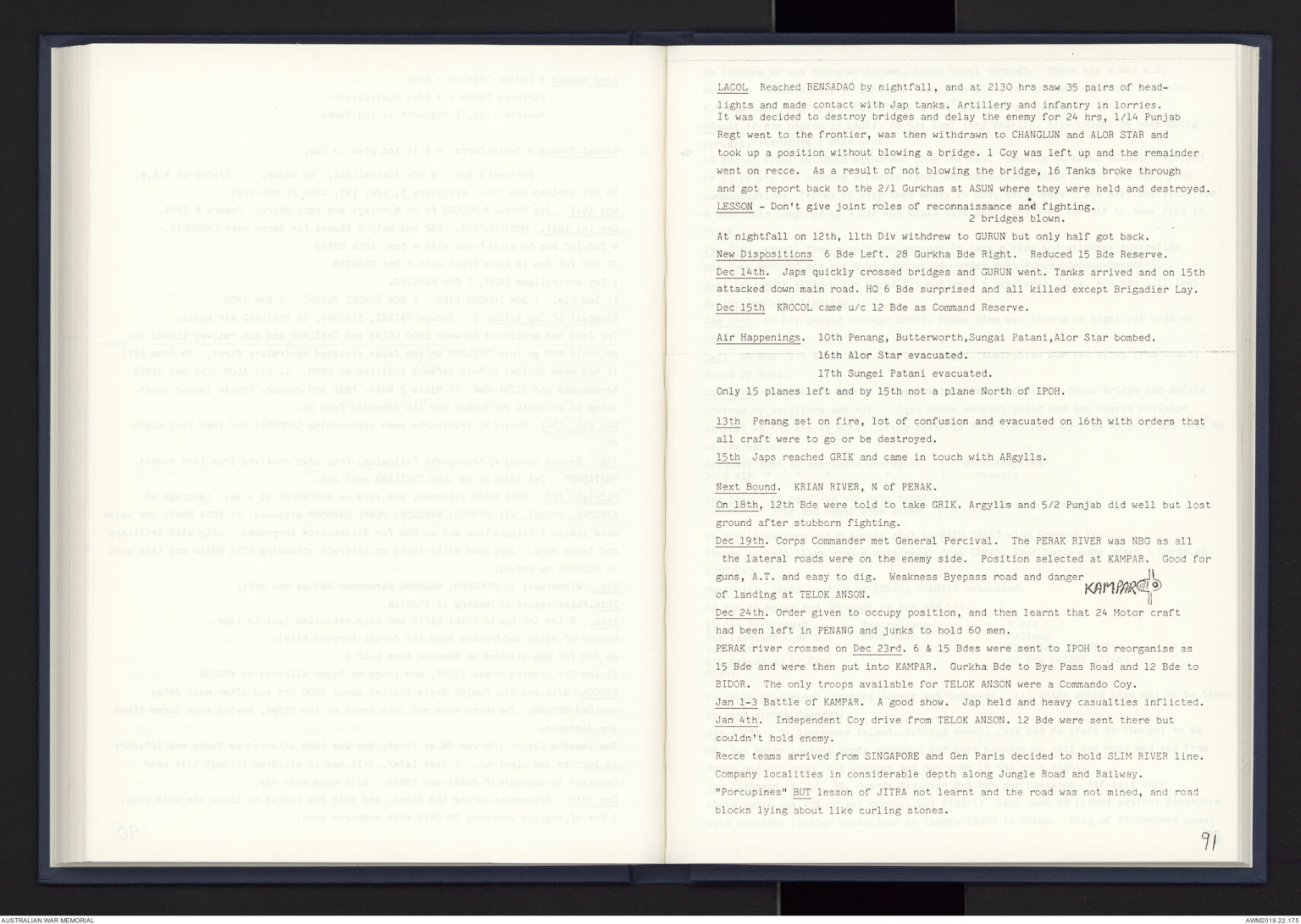
LACOL. Reached BENSADAO by nightfall, and at 2130 hrs saw 35 pairs of headlights
and made contact with Jap tanks. Artillery and infantry in lorries.
It was decided to destroy bridges and delay the enemy for 24 hrs, 1/14 Punjab
Regt went to the frontier, was then withdrawn to CHANGLUN and ALOR STAR and
took up a position without blowing a bridge. 1 Coy was left up and the remainder
went on recce. As a result of not blowing the bridge, 16 Tanks broke through
and got report back to the 2/1 Gurkhas at ASUN where they were held and destroyed.
LESSON - Don't give joint roles of reconnaissance and fighting.
2 bridges blown.
At nightfall on the 12th, 11th Div withdrew to GURUN but only half got back.
New Dispositions 6 Bde Left. 28 Gurkha Bde Right. Reduced 15 Bde Reserve.
Dec 14th. Japs quickly crossed bridges and GURUN went. Tanks arrived and on the 15th
attacked down main road. HQ 6 Bde surprised and all killed except Brigadier Lay.
Dec 15th KROCOL came u/c 12 Bde as Command Reserve.
Air Happenings. 10th Penang, Butterworth, Sungai Patani, Alor Star bombed.
16th Alor Star evacuated.
17th Sungei Patai evacuated.
Only 15 planes left and by 15th not a plane North of IPOH.
13th Penang set on fire, lot of confusion and evacuated on 16th with orders that
all craft were to go or be destroyed.
15th Japs reached GRIK and came in touch with ARgylls.
Next Bound. KRIAN RIVER, N of PERAK.
On 18th, 12th Bde were told to take GRIK. Argylls and 5/2 Punjab did well but lost
ground after stubborn fighting.
Dec 19th. Corps Commander met General Percival. The PERAK RIVER as NBG as all
the lateral roads were on the enemy side. Position selected at KAMPAR. Good for
guns, A.T. and easy to dig. Weakness Byepass road and dager
of landng at TELOK ANSON.
(KAMPAR + hand drawn diagram see original )
Dec 24th. Order given to occupy position, and then learnt that 24 Motor craft
had been left in PENANG and junks to hold 60 men.
PERAK river crossed on Dec 23rd. 6 & 15 Bdes were sent to IPOH to reorganise as
15 Bde and were then put into KAMPAR. Gurkha Bde to Bye Pass Road and 12 Bde to
BIDOR. The only troops available for TELOK ANSON were a Commando Coy.
Jan 1-3 Batle of KAMPAR. A good show. Jap held and heavy casualties inflicted.
Jan 4th. Independent Coy drive from TELOK ANSON. 12 Bde were sent there but
couldn't hold enemy.
Recce teams arrived from SINGAPORE and Gen Paris decided to hold SLIM RIVER line.
Company localities in considerable depth along Jungle Road and Railway.
"Porcupines" BUT lesson of JITRA not learnt and the road was not mined, and road
blocks lying about like curling stones.
91
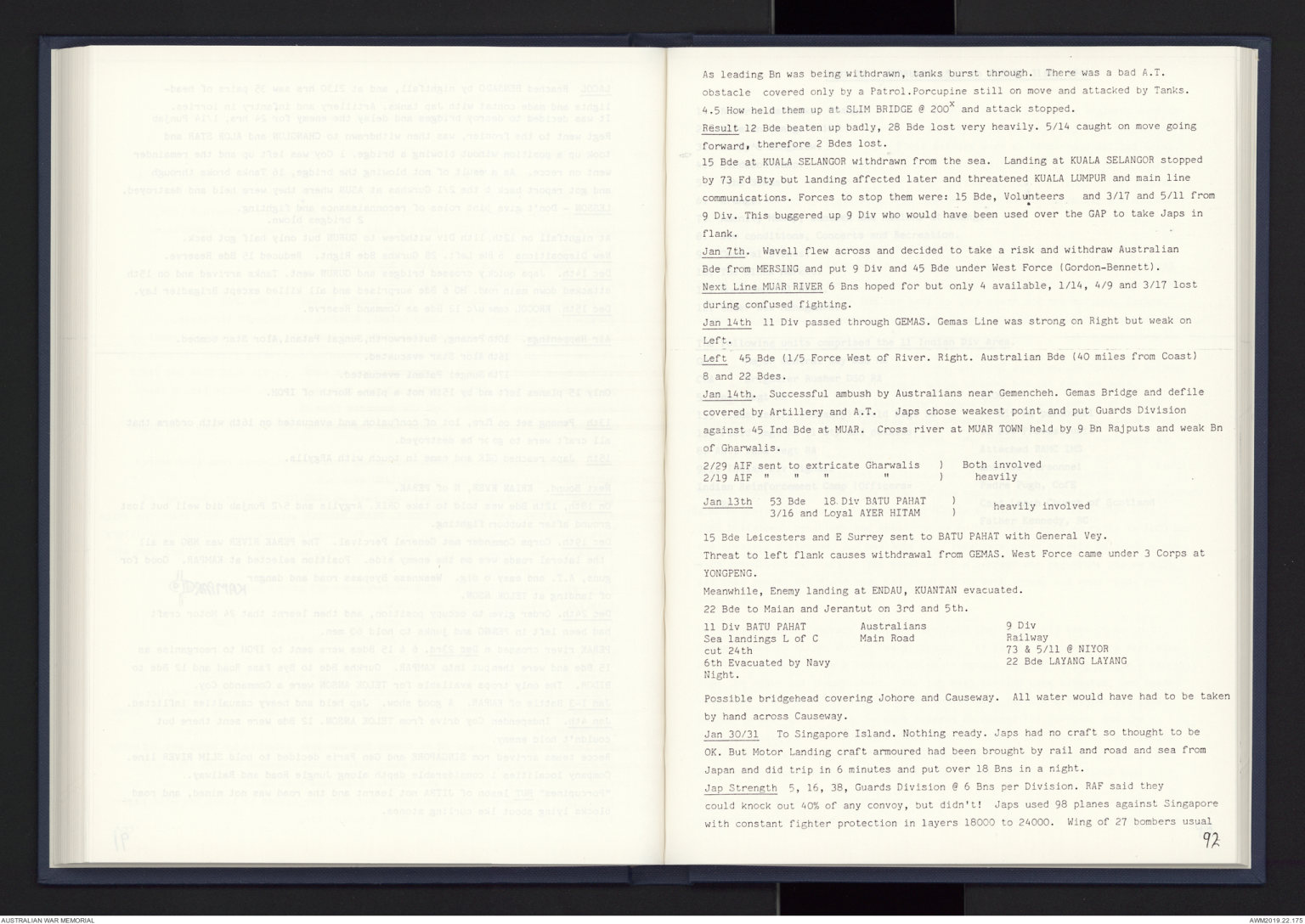
As leading Bn was being withdrawn, tanks burst through. There was bad A.T.
obstacle covered only by a Patrol. Porcupine still on move and attacked by Tanks.
4.5 How held them up at SLIM BRIDGE 200x and attack stopped.
Result 12 Bde beaten up badly, 28 Bde lost very heavily. 5/14 caught on move going
forward, therefore 2 Bdes lost.
15 Bde at KUALA SELANGOR withdrawn from the sea. Landing at KUALA SELANGOR stopped
by 73 FD Bty but landing affected later and threatened KUALA LUMPUR and main line
communications. Forces to stop them were: 15 Bde, Volunteers and 3/17 and 5/11 from
9 Div. This buggered up 9 Div who would have been used over the GAP to take Japs in
flank.
Jan 7th. Wavell flew across and decided to take a risk and withdraw Australian
Bde from MERSING and put 9 Div and 45 Bde under West Force (Gordon-Bennett).
Next Line MUAR RIVER 6 Bns hoped for but only 4 available, 1/14, 4/9 and 3/17 lost
during confused fighting.
Jan 14th 11 Div passed through GEMAS. Gemas Line was strong on Right but weak on
Left.
Left 45 Bde (1/5 Force West of River. Right. Australian Bde ( 40 miles from Coast)
8 and 22 Bds.
Jan 14th. Successful ambush by Australians near Gemencheh. Gemas Bridge and defile
covered by Artillery and A.T. Japs chose weakest point and put Guards Division
against 45 Ind Bde at MUAR. Cross river at MUAR TOWN held by 9 Bn Rajputs and weak BN
of Gharwalis.
2/29 AIF sent to extricate Gharwalis } Both involved
2/19 AIF " " " " } heavily
Jan 13th 53 Bde 18 Div BATU PAHAT } heavily involved
3/16 and Loyal AYER HITAM }
15 Bde Leicesters and E Surrey sent to BATU PAHAT with General Vey.
Threat to left flank causes withdrawal from GEMAS. West Force came under 3 Corps at
YONGPENG.
Meanwhile, Enemy landing at ENDAU, KUANTAN evacuated.
22 Bde to Maian and Jerantut on 3rd and 5th.
11 Div BATU PAHAT Australians 9 Div
Sea landings L of C Main Road Railway
cut 24th 73 & 5/11 @ NIYOR
6th Evacuated by Navy 22 Bde LAYANG LAYANG
Night.
Possible bridgehead covering Johore and Causeway. All water would have had to be taken
by hand across Causeway.
Jan 30/31 To Singapore Island. Nothing ready. Japs had no craft so thought to be
OK. But Motor Landing craft armoured had been brought by rail and road and sea from
Japan and did trip in 6 minutes and put over 18 Bn in a night.
Jap Strength 5,16, 38, Guards Division @ 6 Bns per Division. RAF said they
could knock out 40% of any convoy, but didn't! Japs used 98 planes against Singapore
with constant fighter protection in layers 18000 to 24000. Wing of 27 bombers usual
92
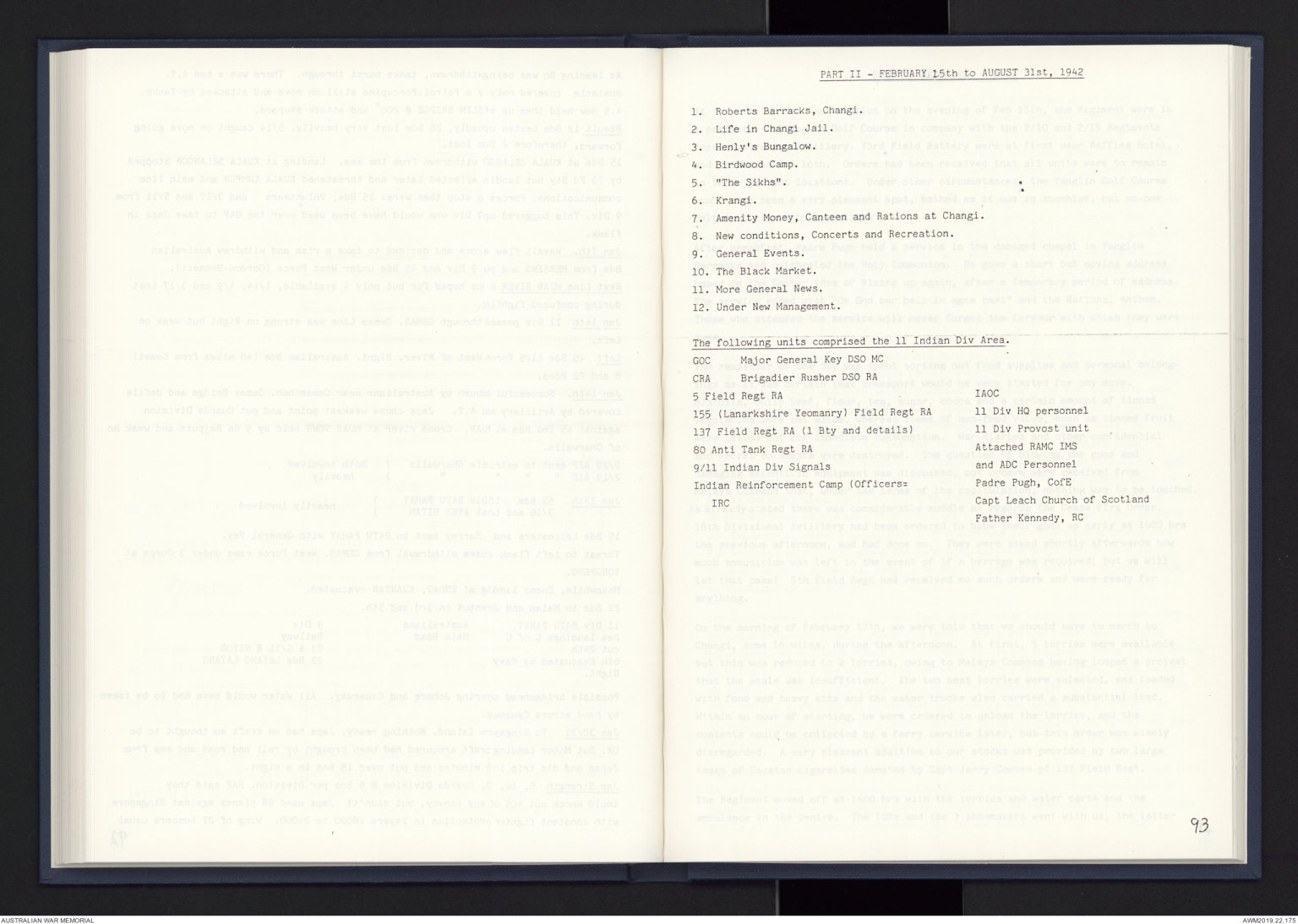
PART 11 - FEBRUARY 15th to AUGUST 31st, 1942
- Roberts Barracks, Changi.
- Life in Changi Jail.
- Henly's Bungalow
- Birdwood Camp
- "The Sikhs".
- Krangi
- Amenity Money, Canteen and Rations at Changi.
- New Conditions, Concerts and Recreation.
- General Events.
- The Black Market.
- More General News.
- Under New Management.
The following units comprised the 11 Indian Div. Area.
GOC Major General Key DSO MC
CRA Brigadier Rusher DSO RA
5 Field Regt RA IAOC
155 (Lanarkshire Yeomanry) Field Regt RA 11 Div HQ personnel
137 Field Regt RA (1 Bty and details) 11 Div Provost unit
80 Anti Tank Regt RA Attached RAMC IMS
9/11 Indian Div Signals and ADC personnel
Indian Reinforcement Camp Officers= Padre Pugh, Cof E
IRC Capt Leach Church of Scotland
Father Kennedy, RC
93
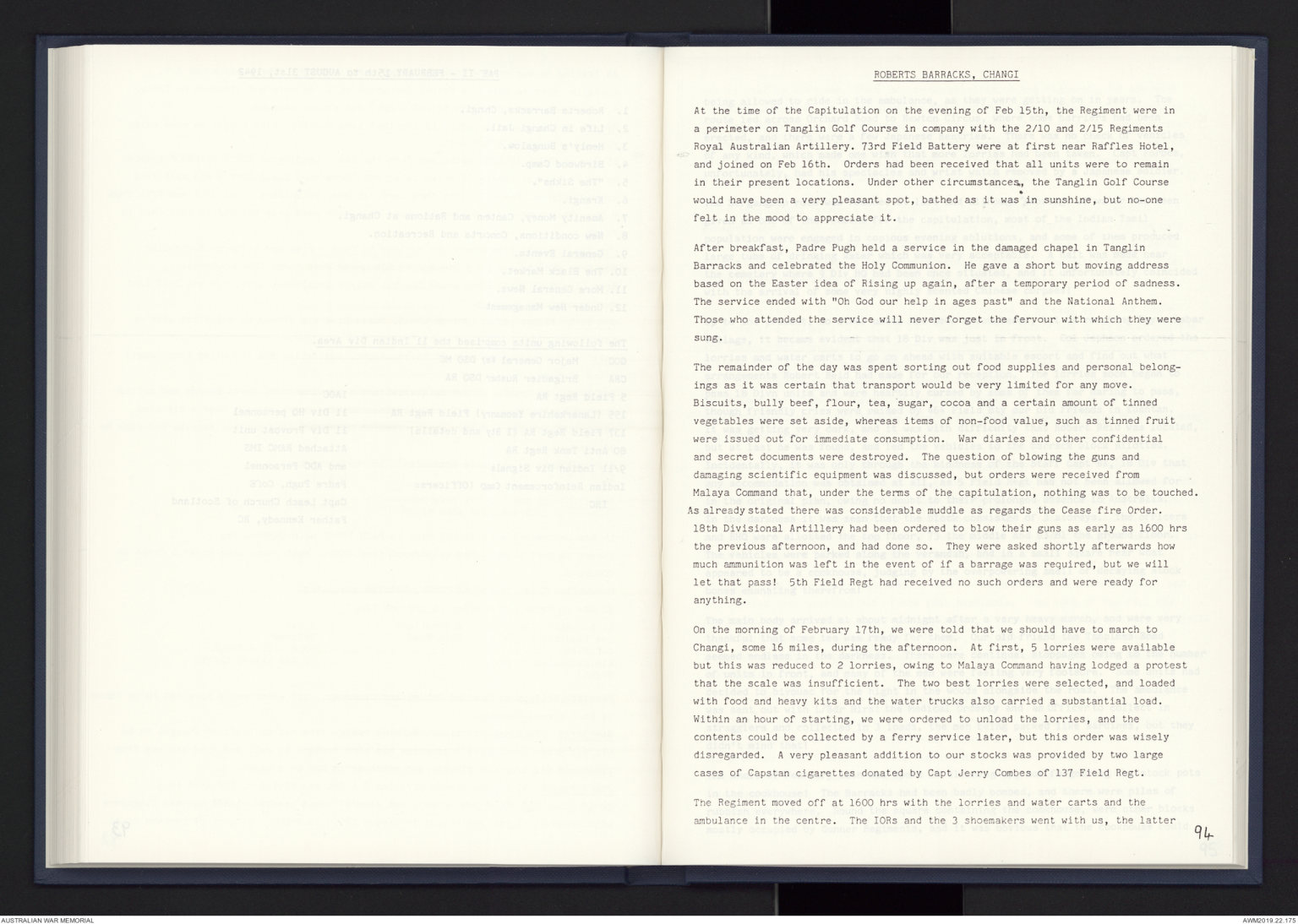
ROBERTS BARRACKS, CHANGI
At the time of the Capitulation on the evening of Feb 15th, the Regiment were in
a perimeter on Tanglin Golf Course in company with the 2/10 and 2/15 Regiments
Royal Australian Artillery. 73rd Field Battery were at first near Raffles Hotel,
and joined om Feb 16th. Orders had been received that all units were to remain
in their locations. Under other circumstances, the Tanglin Golf Course
would have been a very pleasant spot, bathed as it was in sunshine, but no-one
felt in the mood to appreciate it.
After breakfast, Padre Pugh held a service in the damaged chapel in Tanglin
Barracks and celebrated the Holy Communion. He gave a short but moving address
based on the Easter idea of Rising agan, after a temporary period of sadness.
The service ended with "Oh God our help in ages past" and the National Anthem.
Those who attended the service will never forget the fervour with which they were sung.
The remainder of the day was spent sorting out food supplies and personal belongings
as it was certain that transport would be very limited for any move.
Biscuits, bully beef, flour, tea, sugar, cocoa and a certain amount of tinned
vegetables were set aside, whereas items of non-food value, such as tinned fruit
were issued out for immediate consumption. War diaries and other confidential
and secret documents were destroyed. The question of blowing the guns and
damaging scientific equipment was discussed, but orders were received from
Malaya Command that, under the terms of capitulation, nothing was to be touched.
As already stated there was considerable muddle as regards the Cease fire Order.
18th Divisional Artillery had been ordered to blow their guns as early as 1600 hrs
the previous afternoon, and had done so. They were asked shortly afterwards how
much ammunition was left in the event of if a barrage was required, but we will
let that pass! 5th Field Regt had received no such orders and were ready for
anything.
On the morning of February 17th, we were told that we should have to march to
Changi, some 16 miles, during the afteroon. At first, 5 lorries were available
but this was reduced to 2 lorries, owing to Malaya Command having lodged a protest
that the scale was insufficient. The two best lorries were selected, and loaded
with food and heavy kits and the water trucks also carried a substantial load.
Within an hour of starting, we were ordered to unload the lorries, and the
contents could be collected by a ferry service later, but this order was wisely
disregarded. A very pleasant addition to our stocks was provided by two large
cases of Capstan cigarettes donated by Capt Jerry Combes of 137 Field Regt.
The Regiment moved off at 1600 hrs with the lorries and water carts and the
ambulance in the centre. The IORs and the 3 shoemakers went with us, the latter
94
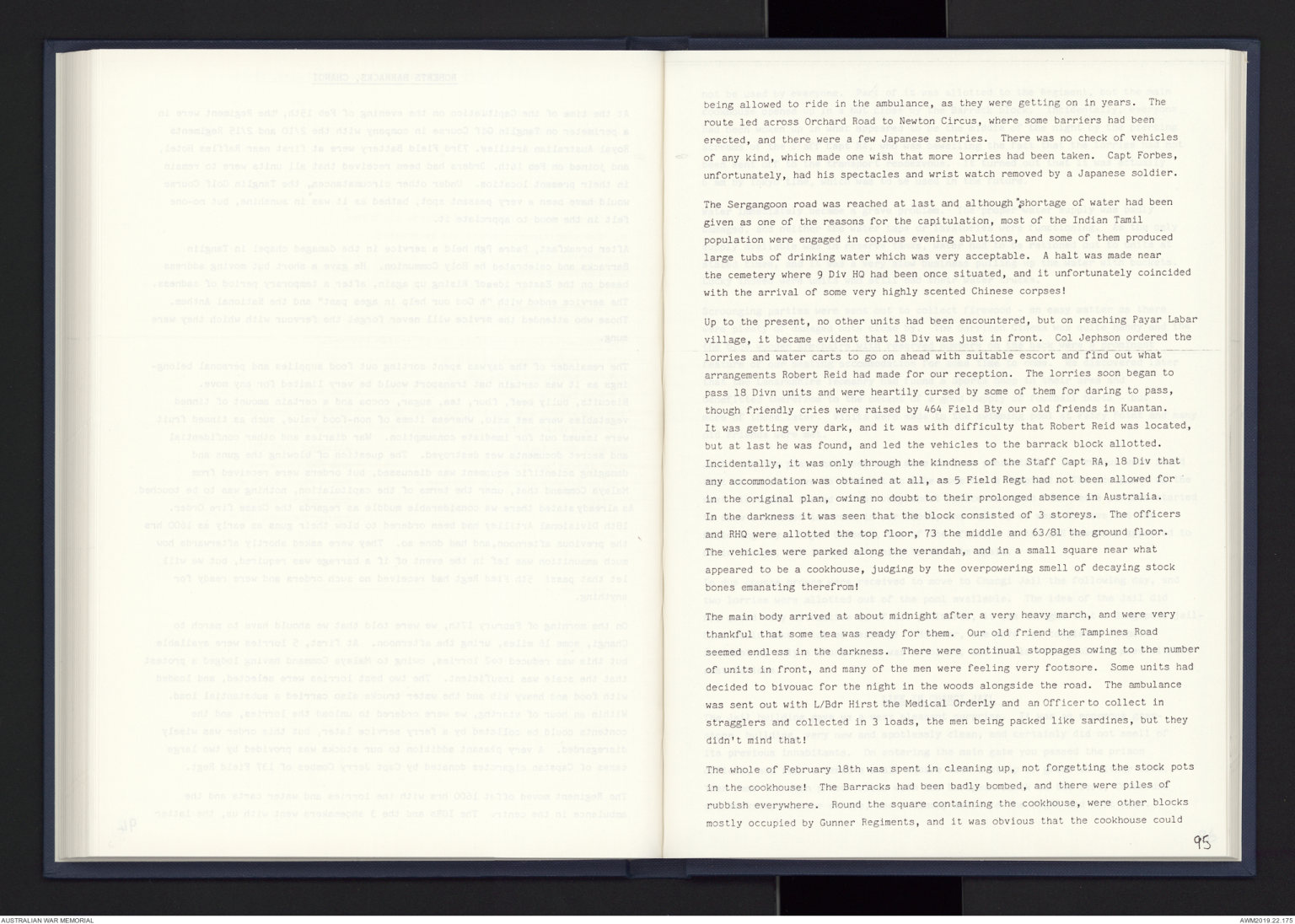
being allowed to ride in the ambulance, as they were getting on in years. The
route led across Orchard Road to Newton Circus, where some barriers had been
erected, and there were a few Japanese sentries. There was no check of vehicles
of any kind, which made one wish that more lorries had been taken. Capt Forbes,
unfortunately, had his spectacles and wrist watch removed by a Japanese soldier.
The Sergangoon road was reached at last and although shortage of water had been
given as one of the reasons for the capitulation, most of the Indian Tamil
population were engaged in copious evening ablutions, and some of them produced
large tubs of drinking water which was very acceptable. A halt was made near
the cemetery where 9 Div HQ had been once situated, and it unfortunately coincided
with the arrival of some very highly scented Chinese corpses!
Up to the present, no other units had been encountered, but on reaching Payar Labar
village, it became evident that 18 Div was just in front. Col Jephson ordered the
lorries and water carts to go on ahead with suitable escort and find out what
arrangements Robert Reid had made for our reception. The lorries soon began to
pass 18 Divn units and were heartily cursed by some of them for daring to pass,
though friendly cries were raised by 464 Field Bty our old friends in Kuantan.
It was getting very dark, and it was with difficulty that Robert Reid was located,
but at last he was found, and led the vehicles to the barrack block allotted.
Incidentally, it was only through the kindness of the Staff Capt RA, 18 Div that
any accommodation was obtained at all, as 5 Field Regt had not been allowed for
in the original plan, owing no doubt to their prolonged absence in Australia.
In the darkness it was seen that the block consisted of 3 storeys. The officers
and RHQ were allotted the top floor, 73 the middle and 63/81 the ground floor.
The vehicles were parked along the verndah, and in a small square near what
appeared to be a cookhouse, judging by theoverpowering smell of decaying stock
bones emanating therefrom!
The main body arrived at about midnight after a very heavy march, and were very
thankful that some tea as ready for them. Our old friend the Tampines Road
seemed endless in the darkness. There were continual stoppages owing to the number
of units in front, and many of the men were feeling very footsore. Some units had
decided to bivouac for the night in the woods alongside the road. The ambulance
was sent out with L/Bdr Hirst the Medical Orderly and an Officer to collect in
strugglers and collected 3 loads, the men being packed like sardines, but they
didn't mind that!
The whole of February 18th was spent in cleaning up, not forgetting the stock pots
in the cookhouse! The Barracks had been badly bombed, and there were piles of
rubbish everywhere. Round the square containing the cookhouse, were othe blocks
mostly occupied by Gunner Regiments, and it was obvious that the cookhouse could
95
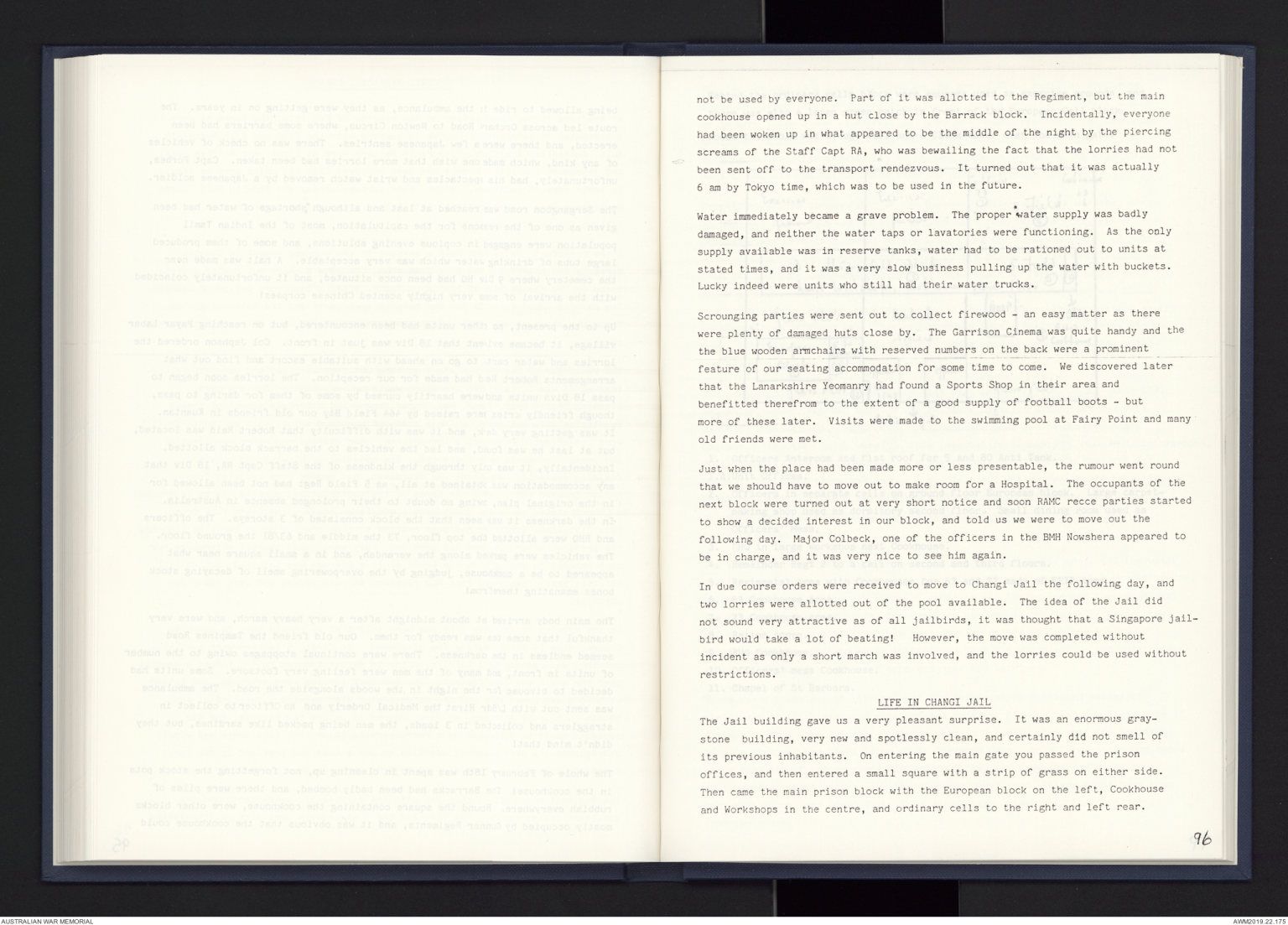
not be used by everyone. Part of it was allotted to the Regiment, but the main
cookhouse opened up in a hut close by the Barrack block. Incidentally, everyone
had been woken up in what appeared to be the middle of the night by the piercing
screams of the Staff Capt RA, who was bewailing the fact that the lorries had not
been sent off to the transport rendezvous. It turned out that it was actually
6 am by Tokyo time, which was to be used in future.
Water immediately became a grave problem. The proper water supply was badly
damaged, and neither the water taps or lavatories were functioning. As the only
supply available was in reserve, tanks, water had to be rationed out to units at
stated times, and it was a very slow business pulling up the water with buckets.
Lucky indeed were units who still had their water trucks.
Scrounging parties were sent out to collect firewood - an easy matter as there
were plenty of damaged huts close by. The Garrison Cinema was quite handy and the
the blue wooden armchairs with reserved numbers on the back were a prominent
feature of our seating accommodation for some time to come. We discovered later
that the Lanarkshire Yeomanry had found a Sports Shop in their area and
benefitted therefrom to the extent of a good supply of football boots - but
more of these later. Visits were made to the swimming pool at Fairy Point and many
old friends were met.
Just when the place had been made more or less presentable, the rumour went round
that we should have to move out to make room for a Hospital. The occupants of the
next block were turned out at very short notice and soon RAMC recce parties started
to show a decided interest in our block, and told us we were to move out the
following day. Major Colbeck, one of the officers in the BHM Nowshera appears to
be in charge, and it was nice to see him again.
In due course orders were received to move to Changi Jail the following day, and
two lorries were allotted out of the pool available. The idea of the Jail did not
sound very attractive as all jailbirds, it was thought that a Singapore jailbird
would take a lot of beating! However, the move was completed without
incident as only a short march was involved, and the lorries could be used without
restrictions.
LIFE IN A CHANGI JAIL
The Jail building gave us a very pleasant surprise. It was an enormous graystone
building, very new and spotlessly clean, and certainly did not smell of
its previous inhabitants. On entering the main gate you passed the prison
offices, and then entered a small square with a strip of grass on either side.
Then came the main prison block with the European block on the left, Cookhouse
and Workshops in the centre, and ordinary cells to the right and left rear.
96
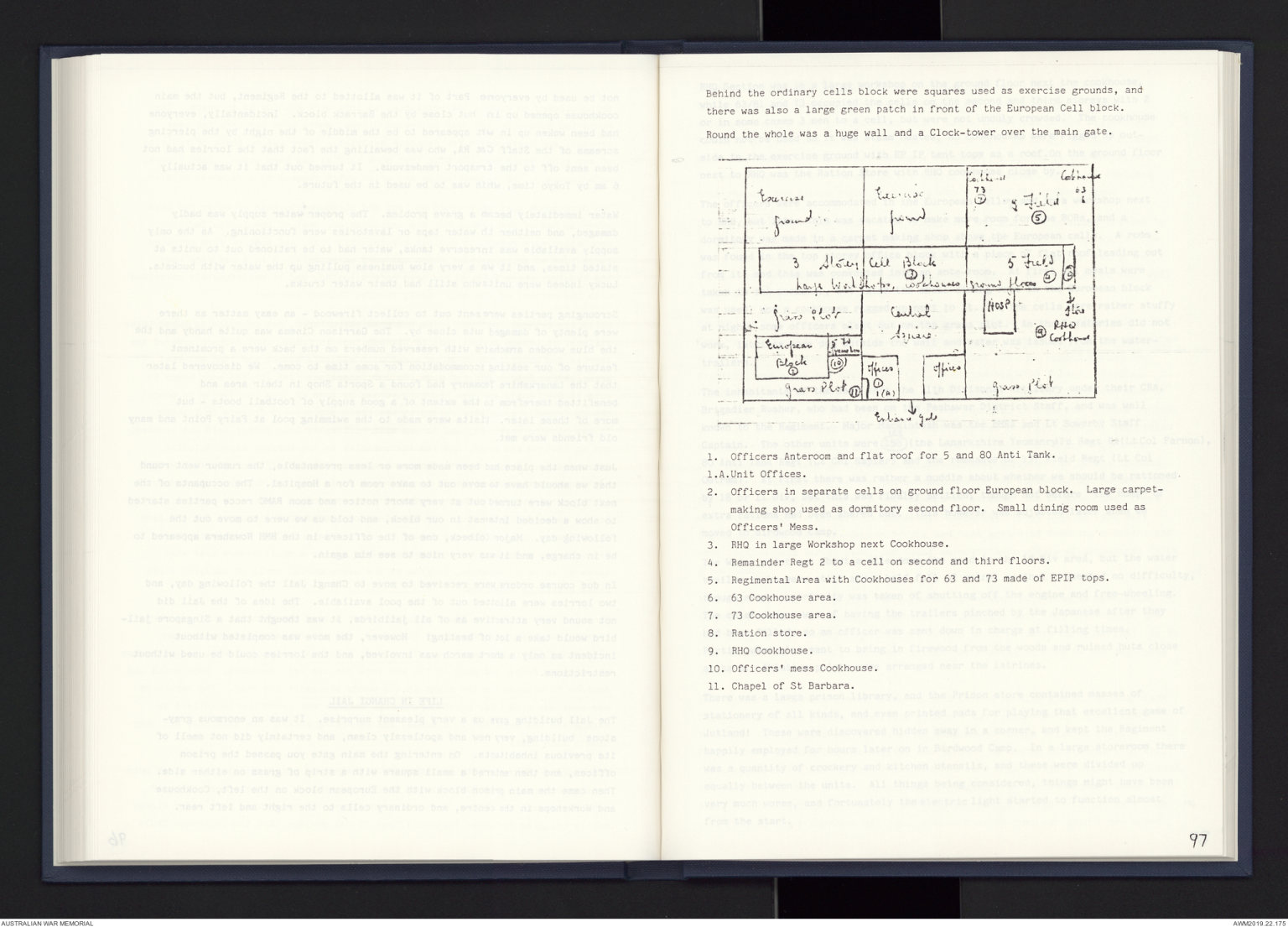
Behind the ordinary cells block were squares used as exercise grounds, and
there was also a large green patch in front of the European Cell block.
Round the whole was a huge wall and a Clock-tower over the main gate.
(Hand drawn diagram - see original document)
-
Officers Anteroom and flat roof for 5 and 80 Anti Tank.
1.A Unit Offices
- Officers in separate cells on ground floor European block. Large carpetmaking
shop used as a dormitory second floor. Small dining room used as
Officers' mess. - RHQ in large Workshop next Cookhouse.
- Remainder Regt 2 to a cell on second and third floors.
- Regimental Area with Cookhouses for 63 and 73 made of EPIP tops.
- 63 Cookhouse area.
- 73 Cookhouse area.
- Ration Store.
- RHQ Cookhouse.
- Officers’ mess Cookhouse
- Chapel of St. Barbara.
97
RHQ Section was in a large workshop on the ground floor next the cookhouse,
while 63/81 and 73 occupied the cells on the second and third storeys with 2
or in some cases 3 men to a cell, but were not unduly crowded. The cookhouse
could not be used as it was steam hated, so cookhouses were rigged up outside
in the exercise ground with EP IP tent tops as a roof.On the ground floor
next to RHQ was the Ration Store with RHQ cookhouse close by.
The officers were accommodated in the European cells and in a workshop next
to RHQ, but later this was vacated to make more room for the BORs, and a
dormitory was made in a carpet making shop above the European cells. A room
was found in the top storey office block with a piece of flat roof leading out
from it, and this was converted into an ante-room. At first all meals were
taken in the workshop, but later the small dining room in the European block
was used, and a cookhouse rigged up next to it. As the cells were rather stuffy
at night, some officers slept out on the grass plot. As the lavatories did not
work, latrines were dug outside the wall and water was indued from the water-trailers.
The inhabitants of the Jail were the 11th Divisional Artillery under their CRA,
Brigadier Rusher, who had been on the Peshawar District Staff, and was well
known to the Regiment. Major Mackintosh was the BMRA and Lt Sowerby Staff
Captain. The other units were ^155 (158) (the Lanarkshire Yeomanry)Fd Regt RA(Lt Col Farnon),
80 Anti Tank Regt (Lt Col Napier) and the remnants of 137 Field Regt (Lt Col
Outram). At first there was rather a muddle about whether we should be rationed
by 18 or 11 Div, but this was finally settled, though not before “the hump” of
extra rations had been shared out. This however was adjusted later when we
moved to Birdwood Camp.
The Water point was about a mile down the road in the 18 Div area, but the water
trailer tanks were still about half full of petrol so that presented no difficulty,
though every opportunity was taken of shutting off the engine and free-wheeling.
The chief danger was of having the trailers pinched by the Japanese after they
had been filled, so an officer was sent down in charge at filling times.
Parties were also sent to bring in firewood from the woods and ruined huts close
at hand. Ablution points were arranged near the latrines.
There was a large prison library, and the Prison store contained masses of
stationery of all kinds, and even printed pads for playing that excellent game of
Jutland! These were discovered hidden away in a corner, and kept the Regiment
happily employed for house later on in Birdwood Camp. In a large storeroom there
was a quantity of crockery and kitchen utensils, and those were divided up
equally between the units. All things being considered, things might have been
very much worse, and fortunately the electric light started to function almost
from the start.
98
 H.Boutell
This transcription item is now locked to you for editing. To release the lock either Save your changes or Cancel.
This lock will be automatically released after 60 minutes of inactivity.