
Unit diaries relating to service of Geoffrey W. Fennell - Wallet 1 - Part 9
Capt Pearson was faced with two alternatives, walking back across country, or
risking it on the road. He decided to adopt the latter method. In the rear of
the truck was Sgt Brighton with a Tommy gun and Gunner Rabbi with a rifle. As
they turned the corner at great speed, they opened fire on the tank, and though
it replied, the truck got safely away. Capt Ratcliffe was at the Racecourse OP
and came back with the Norfolks.
The Final Perimeter
Back at RHQ orders had come in that a perimeter was being formed round SINGAPORE
as follows:- Starting at the CIVIL AIRPORT, it ran NORTH to SERANGOON ROAD and
WOODLEIGH filter beds to the WEST along BRADDELL ROAD and THOMSON ROAD to the
SOUTHSIDE of MACRITCHIE RESERVOIR and then down ADAM ROAD and FARRAR ROAD, BUONA
VISTA ROAD and the hills immediately to the North of it, and then across the
high ground to PASIR PANJANG village on the coast. 5 Field Regt, with 350 Field
Battery (Major Gill), of 137 Field Regt, were still to work under the Australian
CRA, and to support the zone between the BUKIT TIMAH ROAD and the West Coast - a
pretty large one!
On the return of 63/81 Fd Bty, the 5 Fd Regt Group were disposed as follows: RHQ
at the TINY TOTS CLINIC with "B" Troop 63/81 Fd Bty in a large garden about 300
in rear, a troop of Australians from 2/15 Field Regt in a garden just in front,
RHQ 2/15 Field Regt in the next house to the right, and a Battery of Heavy AA
guns to the Right Rear. As in the charge of the Light Brigade, "Guns to the
Right of them, guns to the Left of them, guns to the front of them, volleyed and
thundered!" The "Shot and shell" being provided by Jap bombers.
78 Fd Battery occupied two troop positions near the THYE HONG BISCUIT FACTORY
at the junction of ALEXANDRA ROAD and TIONG BHARU ROAD. "A" Troop were in
action in a quiet shady lane called ST THOMAS' WALK, with 350 Fd Bty opposite in
the grounds of a Malay Club called the PRAGLIMA PRANG, close to the GREAT WORLD
Chinese Amusement Park on RIVER VALLEY road. OPs were:- Lt Bladen on ADAM ROAD
with the Australians, and Capt Hunt and Capt Grimes (350) on CLUNY HILL with
Bn HQ of the 4/17 Dogras.
Before the return of 63/81 Fd Bty, 73 Fd Bty were in action on the morning of
Feb 11th on BUONA VISTA ROAD, and trying to get in touch with 22 Australian
Infantry Brigade, which had been isolated. About 0730 hrs, the Armoured Car
Section reported that the Japs were about a mile away, and there was nothing
between 73 Fd Bty and the enemy. About 20 minutes later, machine gun fire was
heard coming gradually closer. Major MacEwen ordered the Battery to withdraw
and go into action near the ARCHIPELAGO BREWERY near ALEXANDRA BARRACKS. One
Troop went to the BREWERY, and the other to the THYE HONG BISCUIT FACTORY.
79
Major MacEwen went to RHQ to report, and was told to get in touch with the
Malay Regt on the GAP RIDGE. On return, he sent Capt Archer to establish an
OP on the GAP RIDGE, 2Lt Armstrong as Liaison Officer to the Norfolks on the
Right, and went himself to the Bn HQ of the Malay Regt. Nothing more happened
during the night, except that 44 Ind Inf Bde reappeared, and came in on the
Right flank.
February 12th
B Echelon had found no suitable place to park in, so were formed up on the front
by the sea shore close to RAFFLES HOTEL, and near an IASC MT Coy. To reach the
European part of SINGAPORE from RHQ, the route first led down a main thoroughfare
called ORCHARD ROAD. The crossroads where TANGLIN ROAD, running SW to NE, met
ORCHARD ROAD, running NW to SE, were a very favourite spot for Japanese harassing
fire, and the houses in ORCHARD ROAD had suffered considerably from searching
fire. At the crossroads, about 400 yds from RHQ, there was a large bomb crater
into which a 3 tonner had conveniently tipped itself. At the far end of ORCHARD
ROAD was the CAPITOL CINEMA and, close by, the CATHAY CINEMA and FORT CANNING.
From there, many parallel roads led to the sea-front.
In SINGAPORE itself, things were going on much as usual, except for taking cover
during Air Raids. As yet, the Japanese Artillery fire had only been directed
against FORT CANNING RIDGE. The streets were crowded with traffic, and hundreds
of cars were parked in the business area. Rather a disturbing sight, however,
were small gangs of soldiers, mostly Australian Infantry, wandering about
unshaven and dirty, with their rifles on their shoulders. The stock excuse was
that they had lost their units. That may have been true, but they were making
no attempt to get back to the firing line, where men were so urgently wanted.
On the grass plots near B Echelon, and on the beach itself, things were even
worse. Here men were lying about in heaps, the general attitude being "I have had
a dose of shelling, and that is quite enough for me, thank you!" Small encouragement
to the other troops, British, Indian and Australian, who had been fighting
continuously since the beginning of January. There was certainly an air of
depression on the Waterfront.
The Hong Kong and Shanghai Bank proved a welcome change. All the up-country
branches had had counters assigned to them, and many meetings between Military
and Civilians took place there. Owing to breaks in the overhead wires, the Electric
bus service had ceased. A number of houses had been damaged, but owing to the
size of the place, long distances could be covered without seeing any damage,
except of course in the Dock area, which had been bombed continuously. The
Governor, Sir Shenton Thomas, had issued an order that all liquor was to be
80
destroyed in the Hotels, Shops, and bonded warehouses. It was not until the
night of the 12th, that the Japanese Artillery started shelling the town more or less
indiscriminately, assisted by heavy bombing.
During the afternoon, Capt Firth came up to RHQ, and asked for Col Jephson's
permission to take a section of guns up HOLLAND ROAD, and see what he could find,
as there had been continued rumours of enemy tanks in HOLLAND ROAD, and as yet
none had arrived. Permission was granted, and he set off with a Section of
E Troop. He had gone about 2 miles up the road, when he met Brigadier Taylor of
the Australian Brigade, who greeted him with joy, as he had not seen any gunners
that day. At the same time, an Australian Colonel came up, and asked for some
covering fire for his Battalion, who were withdrawing to a new position. The
section was put into action, and fired for half an hour on areas pointed out to
Capt Firth. As a reward for this, they were machine-gunned by two fighters, but
there were no casualties. Seeing that the position had been spotted, the section
was pulled out, and put under cover, and Capt Firth went back to Brigadier Taylor.
Late in the afternoon, the Brigadier arranged a programme of harassing fire tasks
for the night. The section returned to the Troop, and 120 Rounds per gun were
fired on targets in the REFORMATORY ROAD area during the night. A wire was run
out to Capt Firth, who remained with the Brigadier. The following morning an
Australian Gunner representative turned up, and Capt Firth left, having set in
motion a very useful piece of work.
In addition, an attempted landing South of the GAP had been repulsed during the
12th, and a big ship had been sunk by the Coast Battery at PASIR PANJANG. The
forward Troop position in front of the Biscuit Factory was shelled, and there was
a direct hit on the Command Post, BSM Richardson being killed, and Bdr Quilter
severely wounded.
February 13th
During the morning, the enemy started to shell up and down the GAP RIDGE. Capt
Archer established 3 OPs and was shelled out of each of them in turn. The
Bombers' circus had been very active, and about 1200 hrs a load was dropped on
the Oil Tanks West of ALEXANDRA HOSPITAL, and set them on fire, causing an enormous
pall of black smoke and flames. The Road House at the GAP was shelled all the
morning.
About 1300 hrs a Battalion of Japanese Infantry advanced down the Coast Road
towards BUONA VISTA village. By 1530 hrs, they were in touch with the FDLs. The
Malay Regt who held them had been unnerved by constant shelling and bombing, and
most of them fled though not before they had done very useful work. The OP was
left with the Regt at about 1/4 strength. The enemy attacked along the GAP RIDGE,
81
supported by heavy Artillery fire, and captured BUONA VISTA HILL (Pt 270), the
highest feature at the North end of the ridge.
The Battalion HQ dug-out received a direct hit. Fire from the Battery had been
directed chiefly against enemy supporting Batteries during this attack. The wire
was continually getting cut, and, sometimes, orders had to be sent up by truck.
44 Ind Inf Bde had been driven back to the BUONA VISTA ROAD, and the enemy were
now only 500 yards from the GAP ROAD HOUSE. Major MacEwen went back to give
orders to the Battery, and on his return met Brigadier Williams, commanding 1st
Malayan Brigade at the cross-road below the GAP. He said that the GAP RIDGE had
been overrun, and it was impossible to get back.
As 73 Fd Bty had been told to come under command of Lt Col Dyson, 122 Field Regt,
Major MacEwen gave the Battery a rendezvous, and eventually found Col Dyson's RHQ down
by the Docks. Col Dyson said that he had been told to withdraw, and he ordered
his REgiment and 73 Fd Bty to the Sea Front by RAFFLES HOTEL, and established his
Head Quarters in the SUPREME COURT OF JUSTICE, with an OP on the top of it.
73 Fd Bty are the first battery, therefore, to have a command post in RAFFLES
HOTEL!
As it was Friday the 13th, the Australian CRA, Col McEachern, decided to provide
a pleasant surprise for the hosts of Nippon. He worked out a programme of
harassing fire to cover the area round the RACE COURSE, and also a forming up
area round the CHINESE HIGH SCHOOL between REFORMATORY ROAD and FARRAR ROAD. The
tasks were divided up between the 2/10 and 2/15 Royal Australian Field Regts,
63/81 and 350 Field Batteries. The firing went on all night, and proved
a great tonic to all concerned, and also to the Infantry. The impression was that
at last we were giving back some return for the very heavy bombing received.
An alternative RHQ had been reconnoitred in a house in OXLEY ROAD, and Lt Robert
Reid was left to keep watchdog until the move was made. Actually, the move was
cancelled, but Robert remained faithful to the last, and watched his charge night
and day, and was very well treated by his host, a Dutchman, and an old gent with
a black eyeshade, tweed coat, no collar, and grey flannel trousers!
The same day, about tea time, there were rumours that the Staff of the Ordnance
Depot on ALEXANDRA ROAD had closed down, and units could help themselves. This
sounded too good to be true, but the CO2 and the Quartermaster went down in a
3 ton lorry - just in case! They found that it was true, and made straight for
the Science Block! The doors of Aladdin's Cave stood open wide, and they helped
themselves to wire, torches, batteries, protractors, and a few spare dial-sights.
There were no Compasses however. If only this opportunity had occurred up Country!
Just as darkness fell, an Ordnance officer drove up and said "You can have what
you have got, but don't come again!" Next day, the Staff came back again and our
82
old friend, Capt Howard, was detailed to make an inventory of the contents to
find out if anything had been moved during this momentary lapse!
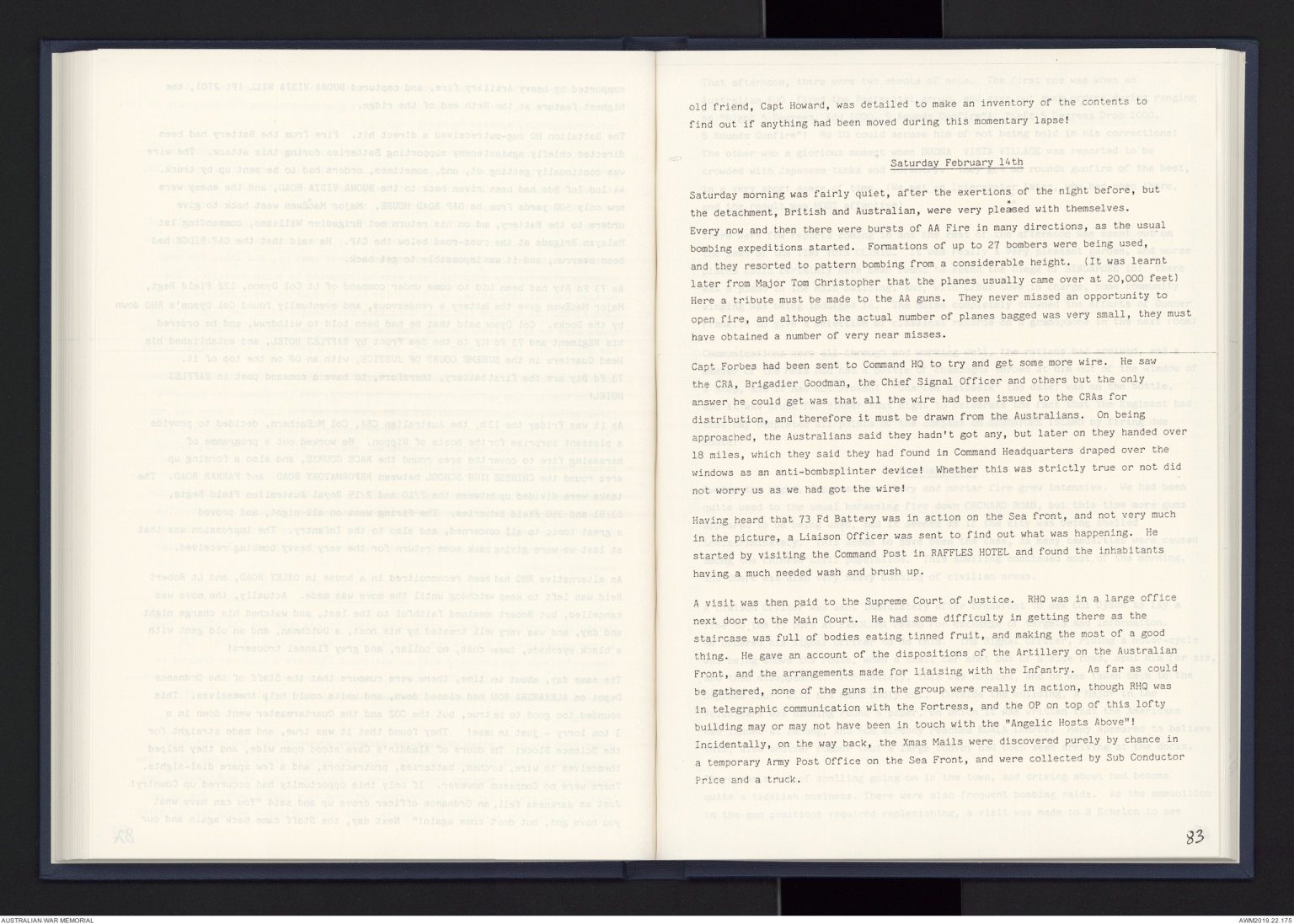
Saturday February 14th
Saturday morning was fairly quiet, after the exertions of the night before, but
the detachment, British and Australian, were very pleased with themselves.
Every now and then there were bursts of AA Fire in many directions, as the usual
bombing expeditions started. Formations of up to 27 bombers were being used,
and they resorted to pattern bombing from a considerable height. (It was learnt
later from Major Tom Christopher that the planes usually came over at 20,000 feet)
Here a tribute must be made to the AA guns. They never missed an opportunity to
open fire, and although the actual number of planes bagged was very small, they must
have obtained a number of very near misses.
Capt Forbes had been sent to Command HQ to try and get some more wire. He saw
the CRA, Brigadier Goodman, the Chief Signal Officer and others but the only
answer he could get was that all the wire had been issued to the CRAs for
distribution, and therefore it must be drawn from the Australians. On being
approached, the Australians said they hadn't got any, but later on they handed over
18 miles, which they said they had found in Command Headquarters draped over the
windows as an anti-bombsplinter device! Whether this was strictly true or not did
not worry us as we had got the wire!
Having heard that 73 Fd Battery was in action on the Sea Front, and not very much
in the picture, a Liaison Officer was sent to find out what was happening. He
started by visiting the Command Post in RAFFLES HOTEL and found the inhabitants
having a much needed wash and brush up.
A visit was then paid to the Supreme Court of Justice. RHQ was in a large office
next door to the Main Court. He had some difficulty in getting there as the
staircase was full of bodies eating tinned fruit, and making the most of a good
thing. He gave an account of the dispositions of the Artillery on the Australian
Front, and the arrangements made for liaising with the Infantry. As far as could
be gathered, none of the guns in the group were really in action, though RHQ was
in telegraphic communication with the Fortress, and the OP on top of this lofty
building may or may not have been in touch with the "Angelic Hosts Above"!
Incidentally, on the way back, the Xmas Mails were discovered purely by chance in
a temporary Army Post Office on the Sea Front, and were collected by Sub Conductor
Price and a truck.
83
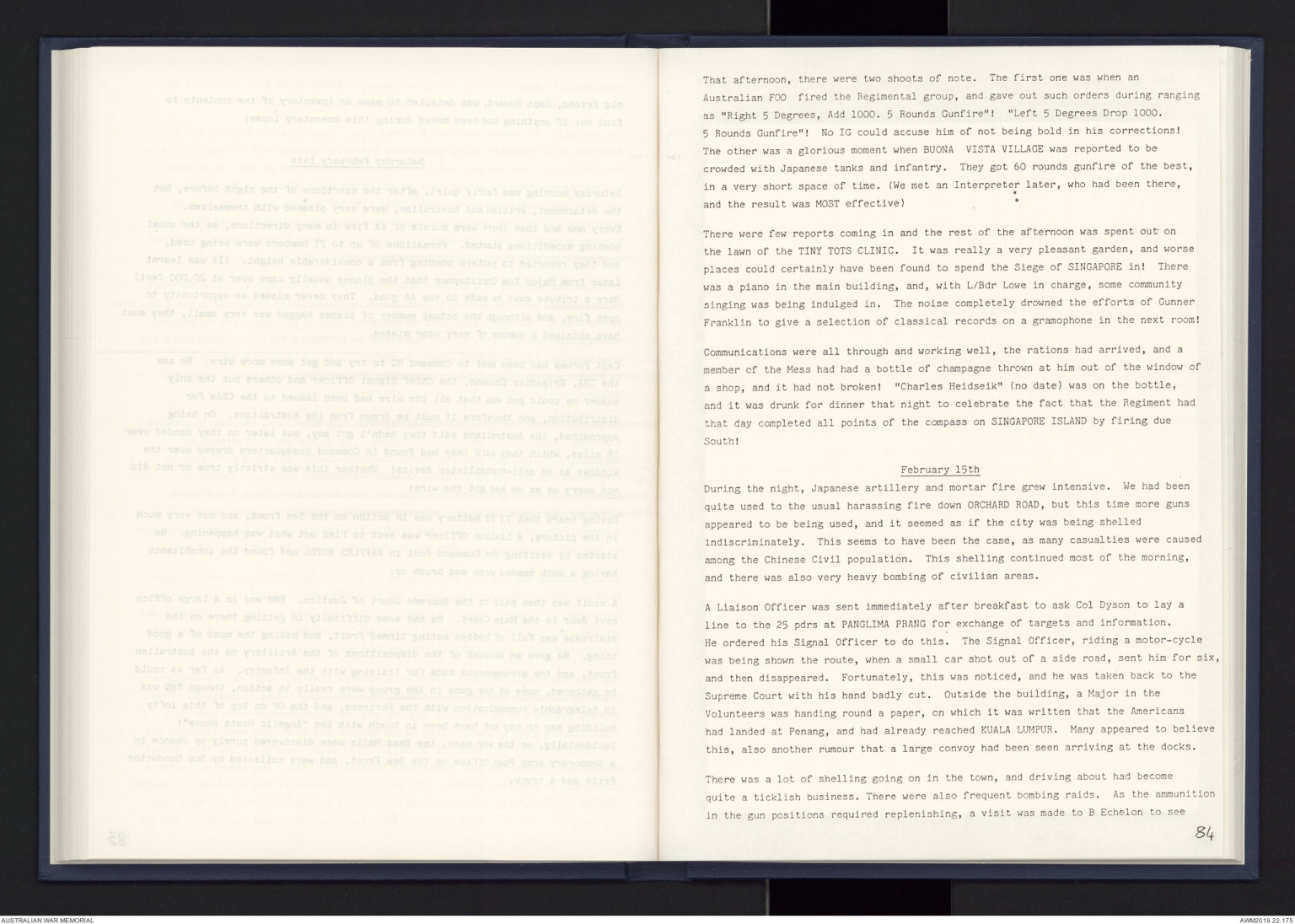
That afternoon, there were two shoots of note. The first one was when an
Australian FOO fired the Regimental group, and gave out such orders during ranging
as “Right 5 Degrees, Add 1000. 5 Rounds Gunfire”! “Left 5 Degrees Drop 1000.
5 Rounds Gunfire”! No IG could accuse him of not being bold in his corrections!
The other was a glorious moment when BUONA VISTA VILLAGE was reported to be
crowded with Japanese tanks and infantry. They got 60 rounds gunfire of the best,
in a very short space of time. (We met an Interpreter later, who has been there,
and the result was MOST effective)
There were few reports coming in and the rest of the afternoon was spent out on
the lawn of the TINY TOTS CLINIC. It was really a very pleasant garden, and worse
places could certainly have been found to spend the Siege of SINGAPORE in ! There
was a piano in the main building, and, with L/Bdr Lowe in charge, some community
singing was being indulged in. The noise completely drowned the efforts of Gunner
Franklin to give a selection of classical records on a gramophone in the next room!
Communications were all through and working well, the rations had arrived, and a
member of the Mess had had a bottle of champagne thrown at him out of the window of
a shop, and it had not broken! “Charles Heidseik” (no date) was on the bottle,
and it was drunk for dinner that night to celebrate the fact that the Regiment had
that day completed all points of the compass on SINGAPORE ISLAND by firing due
South!
February 15th
During the night, Japanese artillery and mortar fire grew intensive. We had been
quite used to the usual harassing fire down ORCHARD ROAD, but this time more guns
appeared to be being used, and it seemed as if the city was being shelled
indiscriminately. This seems to have been the case, as many casualties were caused
among the Chinese Civil population. This shelling continued most of the morning,
and there was also very heavy bombing of civilian areas.
A Liaison Officer was sent immediately after breakfast to ask Col Dyson to lay a
line to the 25 pdrs at PANGLIMA PRANG for the exchange of targets and information.
He ordered his Signal Officer to do this. The Signal Officer, riding a motor-cycle
was being shown the route, when a small car shot out of a side road, sent him for six,
and then disappeared. Fortunately, this was noticed, and he was taken back to the
Supreme Court with his hand badly cut. Outside the building, a Major in the
Volunteers was handing round a paper, on which it was written that the Americans
had landed at Penang, and had already reached KUALA LUMPUR. Many appeared to believe
this, also another rumour that a large convoy had been seen arriving at the docks.
There was a lot of shelling going on in the town, and driving about had become
quite a ticklish business. There were also frequent bombing raids. As the ammunition
in the gun positions required replenishing, a visit was made to B Echelon to see
84
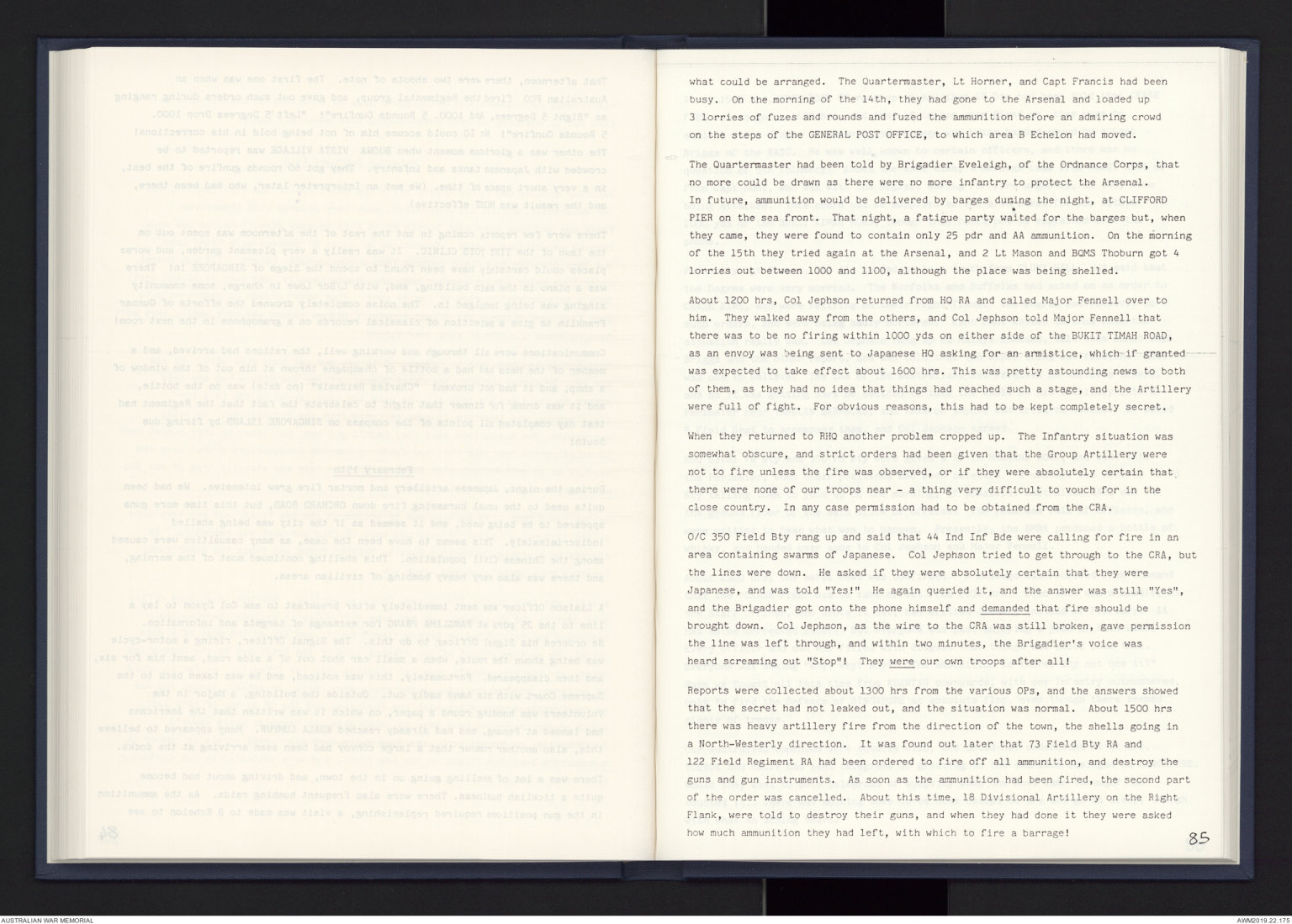
what could be arranged. The Quartermaster, Lt Horner, and Capt. Francis had been
busy. On the morning of the 14th, they had gone to the Arsenal and loaded up
3 lorries of fuzes and rounds and fuzed the ammunition before an admiring crowd
on the steps of the GENERAL POST OFFICE, to which are B Echelon had moved.
The Quartermaster had been told by Brigadier Eveleigh, of the Ordnance Corps, that
no more could be drawn as there were no more infantry to protect the Arsenal.
In future, ammunition would be delivered by barges during the night, at CLIFFORD
PIER on the sea front. That night, a fatigue party waited for the barges but, when
they came. They were found to contain only 25 pdr and AA ammunition. On the morning
of the 15th they tried again at the Arsenal, and 2 Lt Mason and BQMS Thoburn got 4
lorries out between 1000 and 1100, although the place was being shelled.
About 1200hrs, Col Jephson returned from HQ RA and called Major Fennell over to
him. They walked away from the others, and Col Jephson told Major Fennell that
there was to be no firing within 1000 yds on either side of BUKIT TIMAH ROAD,
as an envoy was being sent to Japanese HQ asking for an armistice, which if granted
was expected to take effect about 1600hrs. This was pretty astounding news to both
of them, as they had no idea that things had reached such a stage, and the Artillery
were full of fight. For obvious reason, this was to be kept completely secret.
When they returned to RHQ another problem cropped up. The Infantry situation was
somewhat obscure, and strict orders had been given that the Group Artillery were
not to fire unless the fire was observed, or if they were absolutely certain that
there were none of our troops near – a thing very difficult to vouch for in the
close country. In any case permission had to be obtained from the CRA.
O/C 350 Field Bty rang up and said that 44 Ind Inf Bde were calling for fire in an
area containing swarms of Japanese. Col Jephson tried to get through to the CRA, but
the lines were down. He asked if they were absolutely certain that they were
Japanese, and was told “Yes!” He again queried it, and the answer was still “Yes”,
and the Brigadier got onto the phone himself and demanded that the fire should be
brought down. Col Jephson, as the wire to the CRA was still broken, gave permission
the line was left through, and within two minutes, the Brigadier’s voice was
heard screaming out “Stop”! They were our own troops after all!
Reports were collected about 1300 hrs from the various Ops, and the answers showed
that the secret had not been leaked out, and the situation was normal. About 1500 hrs
there was heavy artillery fire from the direction of the town, the shells going in
a North-Westerly direction. It was found out later that 73 Field Bty RTA and
122 Field Regiment RA had been ordered to fire off all ammunition, and destroy the
guns and gun instruments. As soon as the ammunition had been fired, the second part
of the order was cancelled. About this time, 18 Divisional Artillery on the Right
Flank, were told to destroy their guns, and when they had done it they were asked
how much ammunition they had left, with which to fire a barrage!
85
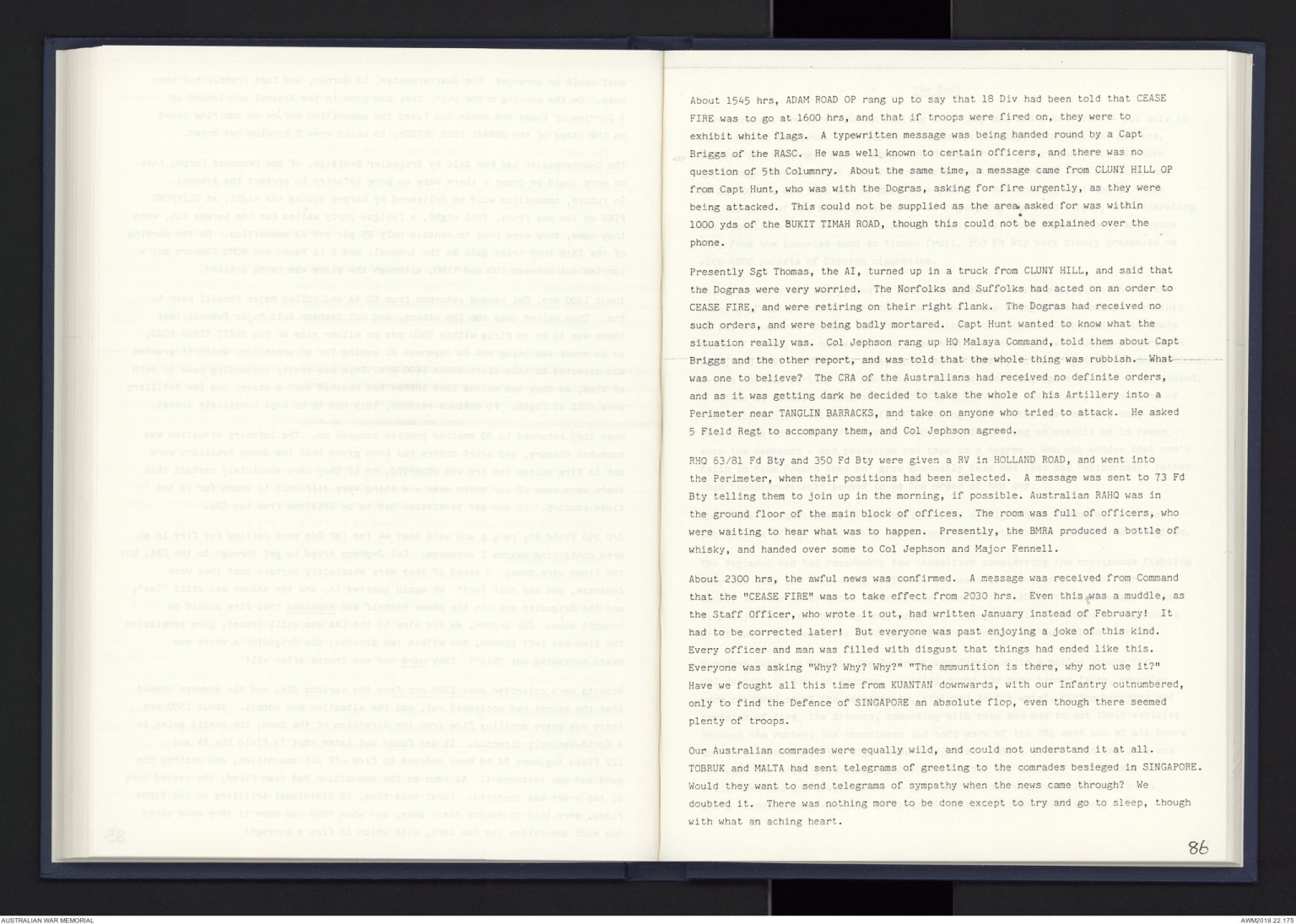
About 1545 hrs, ADAM ROAD OP rang up to say that 18 Div had been told that CEASE
FIRE was to go at 1600 hrs, and that if troops were fired on, they were to
exhibit white flags. A typewritten message was being handed round by a Capt
Briggs of the RASC. He was well known to certain officers, and there was no
question of 5th Columnry. About the same time, a message came from CLUNY HILL OP
from Capt Hunt, who was with the Dogras, asking for fire urgently, as they were
being attacked. This could not be supplied as the area asked for was within
1000 yds of the BUKIT TIMA ROAD, though this could not be explained over the
phone.
Presently Sgt Thoms, the AI, turned up in a truck from CLUNY HILL, and said that
the Dogras were very worried. The Norfolks and Suffolks had dated on an order to
CEASE FIRE, and were retiring on their right flank. The Dogras had received no
such orders, and were being badly mortared. Capt Hunt wanted to know what the
situation really was. Col Jephson rang up HQ Malaya Command, told them about Capt
Briggs and the other report, and was told that the whole thing was rubbish. What
was one to believe? The CRA of the Australians had received no definite orders,
and as it was getting dark he decided to take the whole of his Artillery into a
Perimeter near TANGLIN BARRACKS, and take on anyone who tried to attack. He asked
5 Field Regt to accompany them, and Col Jephson agreed.
RHQ 63/81 Fd Bty and 350 Fd Bty were given a RV in HOLLAND ROAD, and went into
the Perimeter, when their positions had been selected. A message was sent to 73 Fd
Bty telling them to join in the morning, if possible. Australian RAHQ was in
the ground floor of the main block of offices. The room was full of officers, who
were waiting to hear what was to happen. Presently, the BMRA produced a bottle of
whisky, and handed over some to Col Jephson and Major Fennell.
About 2300 hrs, the awful news was confirmed. A message was received from Command
that the “CEASE FIRE” was to take effect from 2300 hrs. Even this was a muddle, as
the Staff Officer, who wrote it out, had written January instead of February! It
had to be corrected later! But everyone was past enjoying a joke of this kind.
Every officer and man was filled with disgust that things had ended like this.
Everyone was asking “Why? Why? Why?” “The ammunition is there, why not use it?”
Have we fought all this time from KUANTAN downwards, with our Infantry outnumbered,
only to find the Defence of SINGAPORE an absolute flop even though there seemed
plenty of troops.
Our Australian comrades were equally wild, and could not understand it at all.
TOBRUK and MALTA had sent telegrams of greeting to the comrades besieged in SINGAPORE.
Would they want to send telegrams of sympathy when the news came through? We
doubted it. There was nothing more to be done except to try and go to sleep, though
with what an aching heart.
86
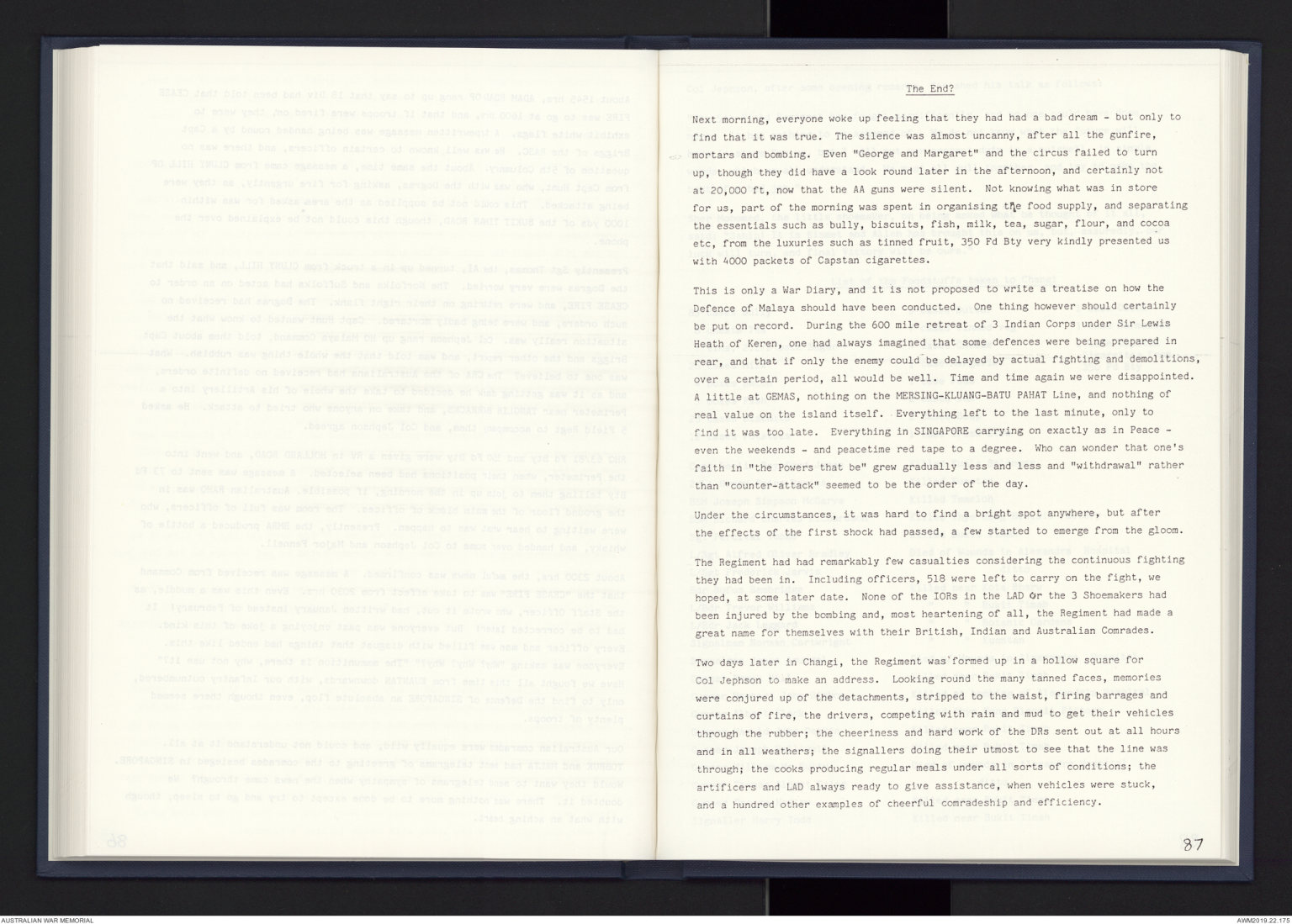
The End?
Next morning, everyone woke up feeling that they had had a bad dream - but only to
find that it was true. The silence was almost uncanny, after all the gunfire,
mortars and bombing. Even “George and Margaret” and the circus failed to turn
up, though they did have a look round later in the afternoon, and certainly not
at 20,000 ft, now that the AA guns were silent. Not knowing what was in store
for us, part of the morning was spent in organising the food supply, and separating
the essentials such as bully, biscuits, fish, milk, tea, sugar, flour, and cocoa
etc, from the luxuries such as tinned fruit, 350 Fd Bty very kindly presented us
with 4000 packets of Capstan cigarettes.
This is only a War Diary, and it is not proposed to write a treatise on how the
Defence of Malaya should have been conducted. One thing however should certainly
be put on record. During the 600 mile retreat of 3 Indian Corps under Sir Lewis
Heath of Keren, one had always imaged that some defences were being prepared in
rear, and that if only the enemy could be delayed by actual fighting and demolitions,
over a certain period, all would be well. Time and time again we were disappointed.
A little at GEMAS, nothing on the MERSING-KLUANG-BATU PAHAT Line, and nothing of
real value on the island itself. Everything left to the last minute, only to
find it was too late. Everything in SINGAPORE carrying on exactly as in Peace -
even the weekends - and peacetime red tape to a degree. Who can wonder that one’s
faith in “the Powers that be” grew gradually less and less and “withdrawal” rather
than “counter-attack” seemed to be the order of the day.
Under the circumstances, it was hard to find a bright spot anywhere, but after
the effects of the first shock had passed, a few started to emerge from the gloom.
The Regiment had had remarkably few casualties considering the continuous fighting
they had been in. Including officers, 518 were left to carry on the fight, we
hoped, at some later date. None of the IORs in the LAD or the 3 Shoemakers had
been injured by the bombing and, most heartening of all, the Regiment had made a
great name for themselves with their British, Indian and Australian Comrades.
Two days later in Changi, the Regiment was formed up in a hollow square for
Col Jephson to make an address. Looking round the many tanned faces, memories
were conjured up of the detachments, stripped to the waist, firing barrages and
curtains of fire, the drivers, competing with rain and mud to get their vehicles
through; the cooks producing regular meals under all sorts of conditions; the
artificers and LAD always ready to give assistance, when vehicles were stuck,
and a hundred other examples of cheerful comradeship and efficiency.
87
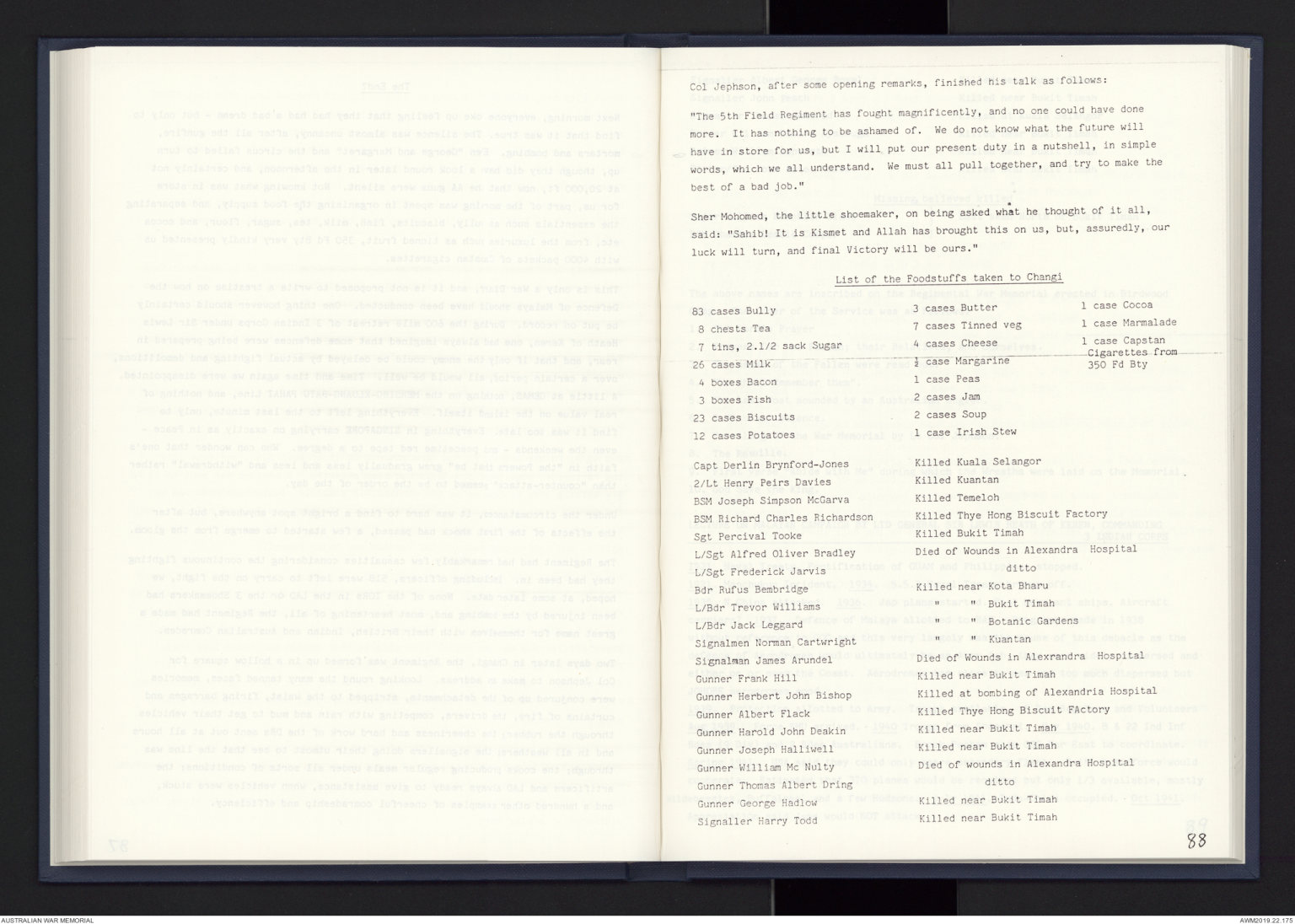
Col Jephson, after some opening remarks, finished his talk as follows:
“The 5th Field Regiment has fought magnificently, and no one could have done
more. It has nothing to be ashamed of. We do not know what the future will
have in store for us, but I will put our present duty in a nutshell, in simple
words, which we all understand. We must all pull together, and try to make the
best of a bad job.”
Sher Mohomed, the little shoemaker, on being asked what he thought of it all,
said “Sahib! It is Kismet and Allah has brought this on us, but, assuredly, our
luck will turn, and final Victory will be ours.”
List of Foodstuffs taken to Changi
83 cases Bully 3 cases Butter 1 case Cocoa
8 chests Tea 7 cases Tinned veg 1 case Marmalade
7 tins, 2.½ sack Sugar 4 cases Cheese 1 case Capstan
26 cases Milk ½ case Margarine Cigarettes from
4 boxes Bacon 1 case Peas 350 Fd Bty
3 boxes Fish 2 cases Jam
23 cases Biscuits 2 cases Soup
12 cases Potatoes 1 case Irish Stew
Capt Derlin Brynford-Jones Killed Kuala Selangor
2/Lt Henry Peirs Davies Killed Kuantan
BSM Joseph Simpson McGarva Killed Temeloh
BSM Richard Charles Richardson Killed Thye Hong Biscuit Factory
Sgt Percival Tooke Killed Bukit Timah
L/Sgt Alfred Oliver Bradley Died of Wounds in Alexandra Hospital
L/Sgt Frederick Jarvis ditto
Bdr Rufus Bembridge Killed near Kota Bharu
L/Bdr Trevor Williams " " Bukit Timah
L/Bdr Jack Leggard " " Botanic Gardens
Signalmen Norman Cartwright " " Kuantan
Signalman James Arundel Died of Wounds in Alexrandria Hospital
Gunner Frank Hill Killed near Bukit Timah
Gunner Herbert John Bishop Killed at bombing of Alexandria Hospital
Gunner Albert Flack Killed Thye Hong Biscuit FActory
Gunner Harold John Deakin Killed near Bukit Timah
Gunner Joseph Halliwell Killed near Bukit Timah
Gunner William Mc Nulty Died of wounds in Alexandra Hospital
Gunner Thomas Albert Dring ditto
Gunner George Hadlow Killed near Bukit Timah
Signaller Harry Todd Killed near Bukit Timah
88
 Loretta Corbett
This transcription item is now locked to you for editing. To release the lock either Save your changes or Cancel.
This lock will be automatically released after 60 minutes of inactivity.