
Unit diaries relating to service of Geoffrey W. Fennell - Wallet 1 - Part 5
The day the Frontier Force arrived it was decided to form a proper perimeter.
VICTORY CAMP was like a large sausage in shape, about 600 yards long, consisting
as it did of a block of six huts the end nearest the Main road and a double row
of huts on the South side of the road. Then came vehicle parks and the ammunition
dump among the trees, and beyond that, the Kingdom of ''the Gallant Ten''.
It was found that, with the aid of 2 Coys of the Frontier Force, a proper perimeter
could just be manned, and the necessary posts were dug. The 3 Light Automatics
had had their posts dug already on the edge of the open space, and were mounted
on stands, constructed from lead piping by the LAD under the leadership of SSgt
Price.
The posts on the perimeter were manned by night, and there were patrols by day, and
those not on duty slept even more soundly than before! Also, a telephone line
connected the Guard Room with AIR, who had the open space silently registered as
a Target.
On Dec 26th, however, the Frontier Force left for GAMBUNG, and the original
arrangements had to be resorted to. On Jan 1st about 1800 hrs A Sikh on a motor
cycle came tearing down the road from the Jungle and shouting "Dushman ati!" He
then disappeared in a cloud of dust to report same, we hoped! All the men available,
a very few as it happened, seized their rifles and rushed to support "The Gallant
Ten" along the Wire. The LA posts were also manned. There was considerable
excitement at the thought of the Wagon Lines being engaged in a real fight instead
of having to indulge in fighting fires, which sprang up every now and then on the
open space.
Presently, some men were seen approaching, dodging from tree to tree. They were seen
to be wearing pagris and turned out to be a Jemedar of the Sikhs and about 20 men.
The Jemedar said that he had been on patrol about 1½ miles away on path and had
been fired on from a hill by a number of Japanese. They had advanced from the
hill and were following him when he retired to report to his Bn Cdr. Unfortunately
he had no map and could not say which hill it was, so that, when the only answer
to a report made to RHQ was a just demand by the Adjutant as to "Which hill and how
many Japanese" the only possible answer was "How the Hell do we know"!
The defenders clutched their rifles grimly and prepared to send thousands of Japs,
or Nips as one should now call them, to Valhalla, Nuvana, Paradise or wherever a
good Nip goes. QM Horner rushed the telephone and wire up from the office to the
Guard Room, and O/C Wagon Lines prepared to give a commentary on the Battle.
The next arrivals were 2 Armoured cars manned by Volunteers. They went forward,
and then one halted, while the other went on to the end of the road, where the
Jungle path started. They were followed shortly after by 6 Carriers from the
Gharwalis under 2Lt Hawkes.
38
One armoured car came back and reported that nothing had been seen. However it
was decided that 10 RNDS Gunfire should be put down on the line of the Jungle
path near a Malay Village, which had always been thought to harbour 5th Columnists.
This was done, the Carriers followed it up, and also a platoon which had
arrived. About half an hour later, they returned having seen traces of Japanese
but not having found any. They were probably a patrol reconnoitring approaches
to the aerodrome from the back. As a matter of fact, it was the route they
eventually used. The Wagon Lines “stood to” for the remainder of the night.
FINAL EVACUATION OF KUJANTAN
On Jan 2nd, partly as a result of the Alarm, the Wagon lines moved into the
Brigade Headquarters Perimeter on the aerodrome, and later in the day, a Section
of A Troop, under Lt Bladen, was brought up to the Aerodrome to a position near
the Water Tower, from which the Open Space and VICTORY CAMP could be shelled if
necessary. The remaining guns were at SETO, MILO and near the old AIR position
overlooking the landing ground. The Section of 21st Mountain Bty had been sent
on the GAMBANG to join the remainder of the Battery.
On the morning of January 3rd, orders had been received that 22 Ind Inf Bde and
attached troops were to move from KUANTAN to JERANTUT to join up with 8th Infantry
Bde, who were in that Area. The move would be by MT, and the first bound would
be to the MARAN area 90 miles from the aerodrome.
RHQ, 63/81 and B Echelon were to move direct to JERANTUT, and come under command
of 8th Indian Infantry Brigade. 21st Mountain Battery with their 6 guns were to
provide Artillery support during the retirement. It was decided that B Echelon
was to move at 1730 hrs, and the remainder at dusk, about 1½ hours later, the Padre
and the MO being sent forward as Advance Agents.
About 1430 hrs, there was an alarm that the Japanese were on the Open Space and
Artillery fire was wanted. Lt Baden’s section had withdrawn to the main position
but was quickly rushed to the old position near the Water Tower. As orders for
directing the Fire were coming from Bde HQ to RHQ, a chain of men was run up the
hill to the Gun position to transmit orders. Preliminary Orders were sent up
“Map Reference…… No 1, 25 Rounds Gunfire”, the Map Reference indicating the
centre of the Open Space. This apparently did the trick, as there were no further
calls for fire. The section, however, remained in position.
After a meal, B Echelon rendezvou’d on the main road, and moved off at 1730 hrs
according to plan, and arrived at the hide in the bye-pass near JERANTUT FERRY about
2300 hrs, and there spent the night and slept soundly having been up the night
39
before, undisturbed by Japs, mosquitoes or anything else. The Ferry was crossed
at dawn, and B Echelon moved into the grounds of a positive Chateau found by the
Padre about 3 miles on the far side of JERANTUT.
At 1830 hrs, the 2/18 RGR on the aerodrome withdrew, and Left Section A Troop
with 2Lts Mason and Davies went with them from AIR. SETO left according to plan,
followed by MILO. There remained Lt Bladen’s Section still in action near
Brigade HQ with Bladen himself at the OP in the RHQ office, with Col Jephson
and the Adjutant, who were near Brigadier Painter. There were also 2/12 FF Regt,
less 2 Coys, who had been brought up from GAMGANG to help protect Bde HQ
perimeter. The lorries had arrived and 5/11 Sikhs had started to move off.
The Japanese then decided to interfere with the withdrawal. Soon after 1830 hrs
an enemy mortar opened up and a patrol reported it to be in the Bomb Store on
the Aerodrome, though not before the Adjutant of the Frontier Force had accused
us of firing on our own troops! A few pithy remarks from Capt Forbes on the subject
of detonation and time of flight moon put this accusation on a firm basis!
The Bomb Store was shelled, and also two targets in VICTORY CAMP itself.
Just before Lt Bladen’s Section was due to leave at 2000 hrs, rifle fire broke
to very near the Brigade office, accompanied by MG and mortar fire. The
Section was ordered by Brigadier Painter to put down 3 rounds gunfire on the
three targets already engaged. No sooner had this order been complied with,
when things began to get hot. Col Jephson appears at the office window and told
Lt Bladen to get the guns out onto the main road. Lt Bladen passed the order on
to 2Lt Reeve and then barricaded the front door of the Brigade office, and got
through the back window with Signaller Guy, the OP telephonist. They crawled
back to the section, which by then had limbered up. Bullets were flying all
over the place. The Section started to move off, but, at this precise moment,
the engine of one of the gun towers refused to start! It got going after
5 minutes delay, but that 5 minutes appeared the longest 5 minutes this detachment
had ever spent in their lives.
They reached the main road with Lt Bladen and Sgt “Happy” Brighton in the
leading vehicle, when, suddenly, they saw a party of men on the road, and got
ready to meet trouble. However they turned out to be a detachment of Sikhs.
They then stepped on the gas, roared by the turning to VICTORY CAMP, and
narrowly escaped being shot up by the Japs coming down the road. About 3 miles
further on the stopped to reform, and were relieved to find that the only two
casualties were 2 motorcycles, which had been parked side by side, and had
unluckily stopped a few bullets in their internals.
Meanwhile, firing round Brigade Headquarters became hotter. Some men of the
Frontier Force Regt came running up, and said that there were Japanese on the
40
was off and told him to follow. Col Jephson and Capt Forbes did so in their
trucks and got safely to the main road, and rejoined Lt Bladen’s Section further
down, though not before M/M Beaverstock had done some pretty shooting with his
rifle from the car.
The aerodrome was now being attacked from all sides at close quarters.
Col Cummins, commanding the Frontier Force Regt, had been wounded and was on the
ground with a Jap trying to bayonet him. He fortunately got his arm free and
shot the Jap with his revolver. He then mounted a carrier, and drove up
and down along the company front cheering on his men and shooting up the
Japanese with the Bren gun. He was again wounded severely, and finally fainted
from loss of blood, but not before the attack had been beaten off, and the
remains of the Company had retired to safety. By this very gallant action, he
saved the lives of many of his men, and enabled the remaining Sikhs to withdraw
unmolested. He was recommended for the VC and fortunately recovered from his
wounds.
During the closing stages of the KUANTAN operations, the chief difficulty that
had confronted Brigadier Painter had been his two conflicting roles:
(1) To defend the aerodrome for 5 days to the last.
(2) Not to jeopardise his Brigade and equipment.
This dual role was carried out by harassing the enemy continuously with aggressive
and imaginative Artillery fire by sections and even single guns, and continuous
movement. The Japanese admitted later that this had been very effective,
particularly the bombardment of KUANTAN, which caused 2000 casualties. Brigadier
Painter was also told that 3 Battalions had been sent round to block the road
between KUANTAN and GAMBANG, but they had fortunately lost their way!
JERANTUT and KUALA PILAH
Contact was made the following morning with Brigadier Key DSO MC, commanding
8th Indian Infantry Bde. His HQ was at the Rest House and he very kindly gave
the Regimental Envoy an excellent breakfast. He had had 73rd Field Battery
under his command at KOTA BHARU, and he gave them a first class report,
especially mentioning Major P A C Don. He had one battalion, 2/10 Baluch Regt,
with him in the JERANTUT area, and his plan was to keep one troop at JERANTUT
and to send the other to a town called TEMELOH about 50 miles away to the South,
also on the PEHANG RIVER. This troop would come under command of O/C 1/13 FF
Regt.
41
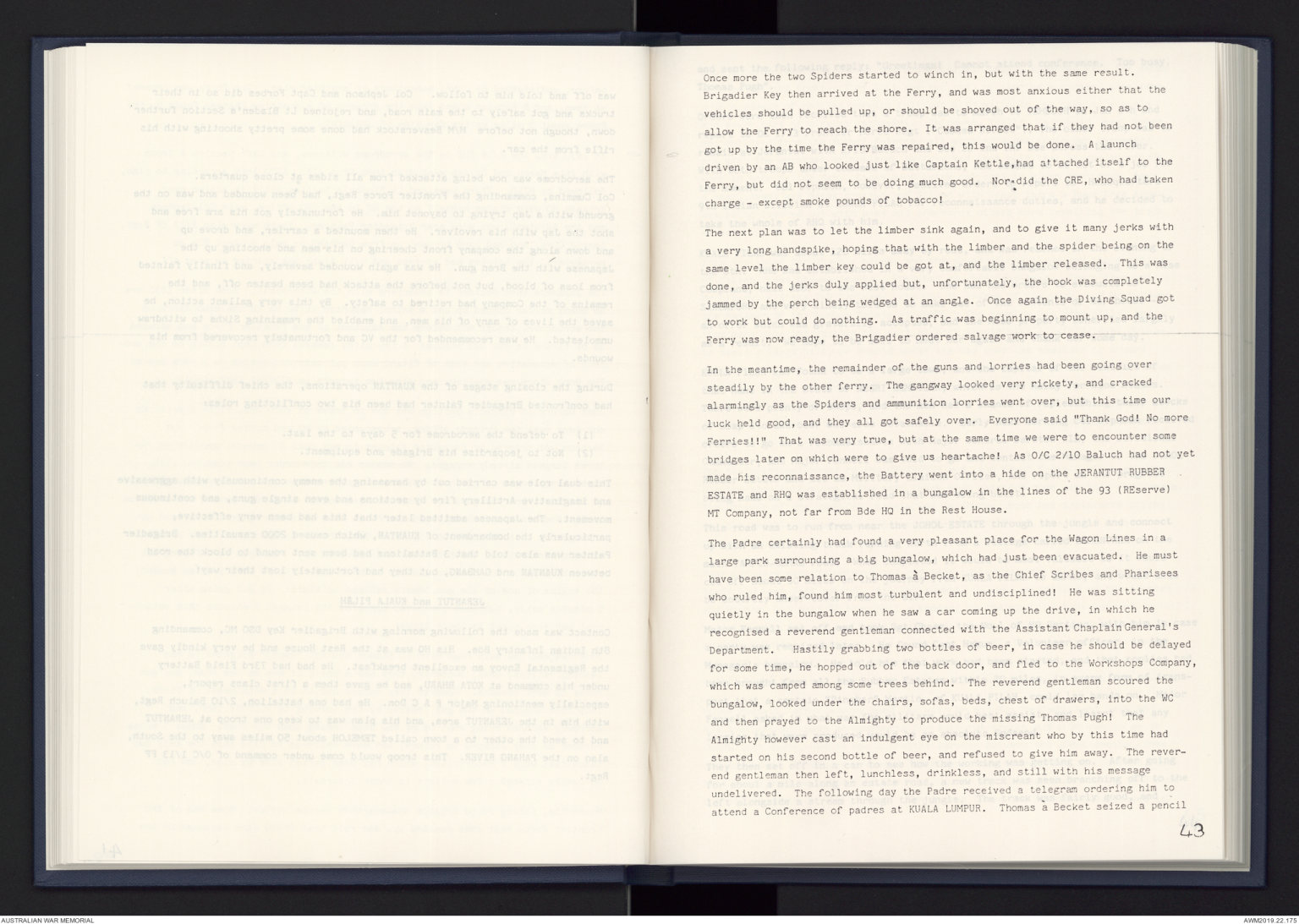
Once more the two Spiders started to winch in, but with the same result.
Brigadier Key then arrived at the Ferry, and was most anxious either that the
vehicles should be pulled up, or should be shoved out of the way, so as to
allow the Ferry to reach the shore. It was arranged that if they had not been
got up by the time the Ferry was repaired, this would be done. A launch
driven by an AB who looked just like Captain Kettle,had attached itself to the
Ferry, but did not seem to be doing much good. Nor did the CRE, who had taken
charge - except smoke pounds of tobacco!
The next plan was to let the limber sink again, and to give it many jerks with
a very long handspike, hoping that with the limber and the spider being on the
same level the limber key could be got at, and the limber released. This was
done, and the jerks duly applied but, unfortunately, the hook was completely
jammed by the perch being wedged at an angle. Once again the Diving Squad got
to work but could do nothing. As traffic was beginning to mount up, and the
Ferry was now ready, the Brigadier ordered salvage work to cease.
In the meantime, the remainder of the guns and lorries had been going over
steadily by the other ferry. The gangway looked very rickety, and cracked
alarmingly as the Spiders and ammunition lorries went over, but this time our
luck held good, and they all got safely over. Everyone said “Thank God! No more
Ferries!!” That was very true, but at the same time we were to encounter some
bridges later on which were to give us heartache! As O/C 2/10 Baluch had not yet
made his reconnaissance, the Battery went into a hide on the JERANTUT RUBBER
ESTATE and RHQ was established in a bungalow in the lines of the 93 (REserve)
MT Company, not far from Bde HQ in the Rest House.
The Padre certainly had found a very pleasant place for the Wagon Lines in a
large park surrounding a big bungalow, which had just been evacuated. He must
have been some relation to Thomas á Becket, as the Chief Scribes and Pharisees
who ruled him, found him most turbulent and undisciplined! He was sitting
quietly in the bungalow when he saw a car coming up the drive, in which he
recognised a reverent gentleman connected with the Assistant Chaplain General’s
Department. Hastily grabbing two bottles of beer, in case he should be delayed
for some time, he hopped out of the back door, and fled to the Workshops Company,
which was camped among some trees behind. The reverend gentleman scoured the
bungalow, looked under the chairs, sofas, beds, chest of drawers, into the WC
and then prayed to the Almighty to produce the missing Thomas Pugh! The
Almighty however cast an indulgent eye on the miscreant who by this time had
started on his second bottle of beer, and refused to give him away. The reverend
gentleman then left, lunchless, drinkless, and still with his message
undelivered. The following day the Padre received a telegram ordering him to
attend a Conference of padres at KUALA LUMPUR. Thomas á Becket seized a pencil
43
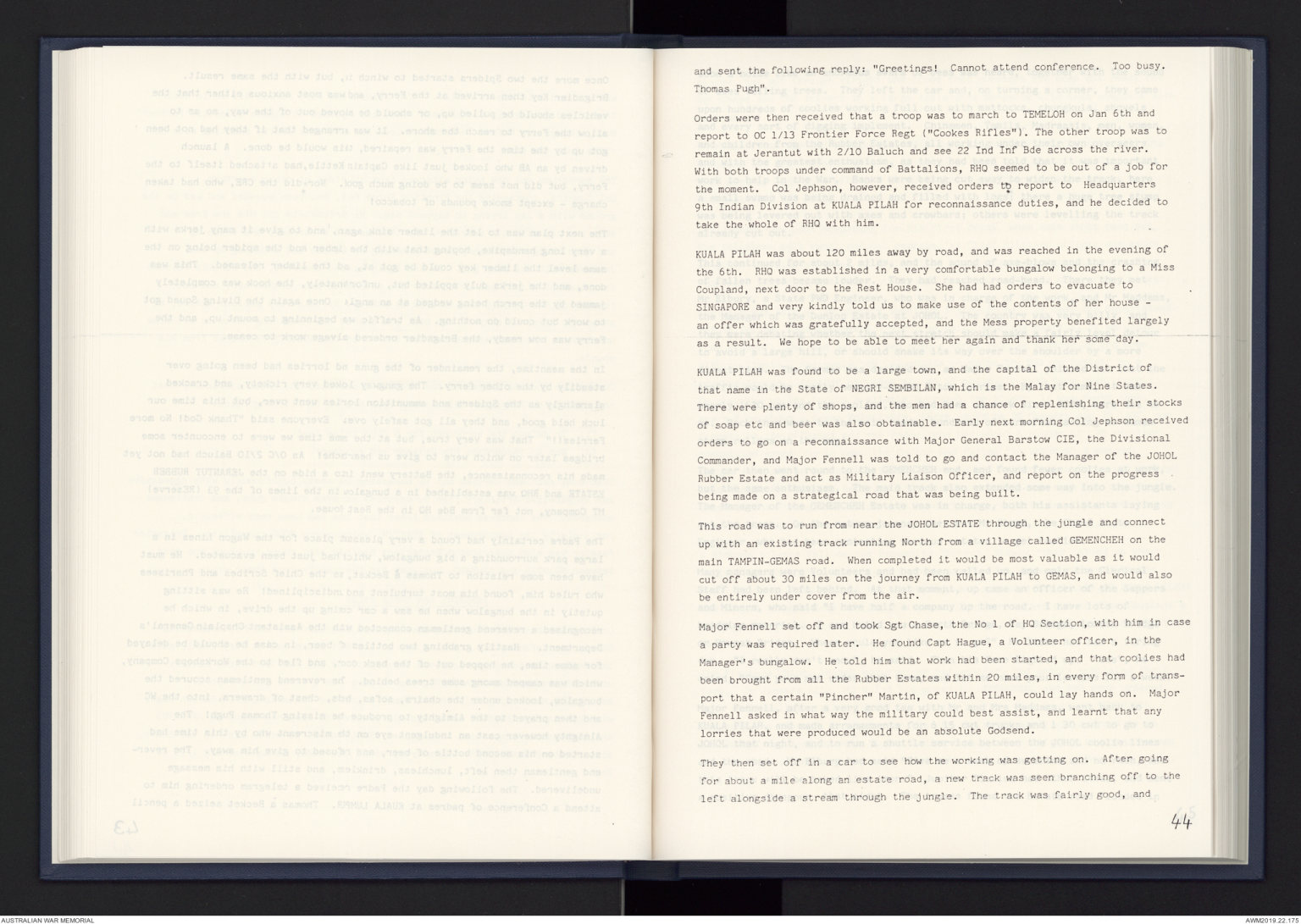
and sent the following reply: “Greetings! Cannot attend conference. Too busy.
Thomas Pugh”.
Orders were then received that a troop was to march to TEMELOH on Jan 6th and
report to OC 1/13 Frontier Force Regt (“Cookies Rifles”). The other troop was to
remain at Jerantut with 2/10 Baluch and see 22 Ind Inf Bde across the river.
With both troops under command of Battalions, RHQ seemed to be out for a job for
the moment. Col Jephson, however, received orders to report to Headquarters
9th Indian Division at KUALA PILAH for reconnaissance duties, and he decided to
take the whole of RHQ with him.
KUALA PILAH was about 120 miles away by road and was reached in the evening of
the 6th. RHQ was established in a very comfortable bungalow belonging to a Miss
Coupland, next door to the Rest House. She had had orders to evacuate to
SINGAPORE and very kindly told us to make use of the contents of her house -
an offer which was gratefully accepted, and the Mess property benefited largely
as a result. We hope to be able to meet her again and thank her some day.
KUALA PILAH was found to be a large town, and the capital of the District of
that name in the state of NEGRI SEMBILAN, which is the Malay for Nine States.
There were plenty of shops, and the men had a chance of replenishing their stocks
of soap etc and beer was also obtainable. Early next morning Col Jephson received
orders to go on a reconnaissance with Major General Barstow CIE, the Divisional
Commander, and Major Fennell was told to go and contact the Manager of the JOHOL
Rubber Estate and act as Miliary Liaison Officer, and report on the progress
being made on a strategical road that was being built.
This road was to run from near the JOHOL ESTATE through the jungle and connect
up with an existing track running North from a village called GEMENCHEH on the
main TAMPIN-GEMAS road. When completed it would be most valuable as it would
cut off about 30 miles on the journey from KUALA PILAH to GEMAS, and would also
be entirely under cover from the air.
Major Fennell set off and took Sgt Chase, the No 1 of HQ Section, with him in case
a party was required later. He found Capt Hague, a Volunteer Officer, in the
Manager’s bungalow. He told him that work had been started, and that the coolies had
been brought from all the Rubber Estates within 20 miles, in every form of transport
that a certain “Pincher” Martin, of KUALA PILAH, could lay hands on. Major
Fennell asked in what way the military could best assist, and learnt that any
lorries that were produced would be an absolute Godsend.
They then set off in a car to see how the working was getting on. After going
for about mile along an estate road, a new track was seen branching off to the
left alongside a stream through the jungle. The track was fairly good, and
44
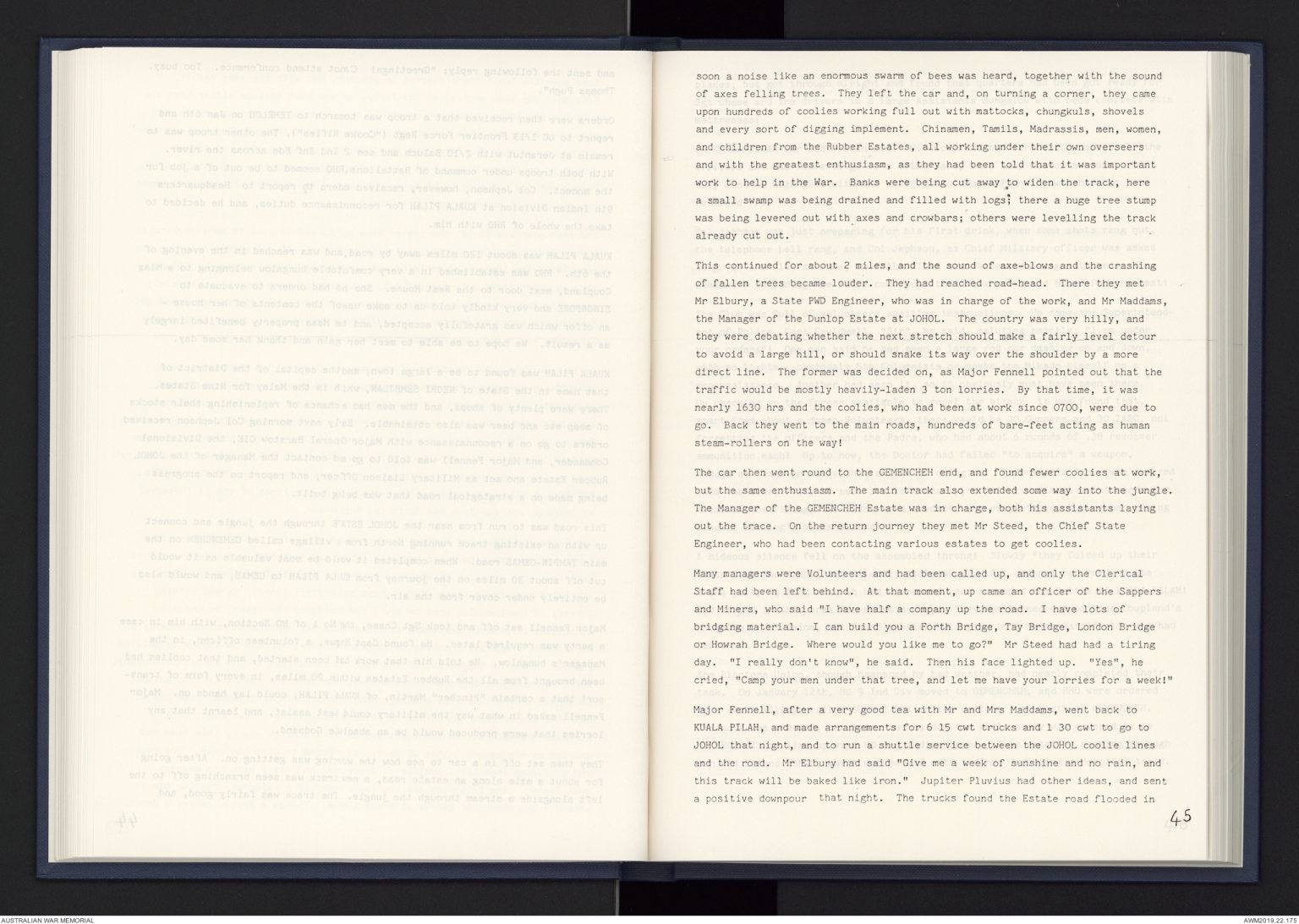
soon a noise like an enormous swarm of bees was heard, together with the sound
of axes felling tees. They left the car and, on turning a corner, they came
upon hundred of coolies working full out with mattocks, chungkuls, shovels
and every sort of digging implement. Chinamen, Tamils, Madrassis, men, women,
and children from the Rubber Estates, all working under their own overseers
and with the greatest enthusiasm as they had been told that it was important
work to help in the War. Banks were being cut away to widen the track, here
a small swamp was being drained and filled with logs; there a huge tree stump
was being levered out with axes and crowbars; others were levelling the track
already cut out.
This continued for about 2 miles, and the sound of axe-blows and the crashing
of fallen trees became louder. They had reached road-head. There they met
Mr Elbury, A State PWD Engineer, who was in charge of the work, and Mr Maddams,
the Manager of the Dunlop Estate at JOHOL. The country was very hilly, and
they were debating whether the next stretch should make a fairly level detour
to avoid a large hill, or should snake its way over the shoulder by a more
direct line. The former was decided on, as Major Fennell pointed out that the
traffic would be mostly heavily-laden 3 ton lorries. By that time, it was
nearly 1630 hrs and the coolies, who had been at work since 0700, were due to
go. Back they went to the main roads, hundreds of bare-feet acting as human
steam-rollers on the way!
The car then went round to GEMENCHEH end, and found fewer coolies at work,
but the same enthusiasm. The main track also extended some way into the jungle.
The Manager of the GEMENCHEH Estate was in charge, both his assistants laying
out the trace. On the return journey they met Mr Steed, the Chief State
Engineer, who had been contacting various estates to get coolies.
Many managers were Volunteers and had been called up, and only the Clerical
Staff had been left behind. At that moment, up came an officer of the Sappers
and Miners, who said “I have half a company up the road. I have lots of
bridging material. I can build you a Forth Bridge, Tay Bridge, London Bridge
or Howrah Bridge. Where would you like me to go?” Mr Steed had a tiring
day. “I really don’t know”, he said . Then his face lighted up. “Yes”, he
cried, “Camp your men under that tree, and let me have your lorries for a week!”
Major Fennell, after a very good tea with Mr and Mrs Maddams, went back to
KUALA PILAH, and made arrangements for 6 15 cwt trucks and 1 30 cwt to go to
JOHOL that night, and to run a shuttle service between the JOHOL coolie lines
and the road. Mr Elbury had said “Give me a week of sunshine and no rain, and
this track will be baked like iron.” Jupiter Pluvius had other ideas, and sent
a positive downpour that night. The tracks found the Estate road flooded in
45
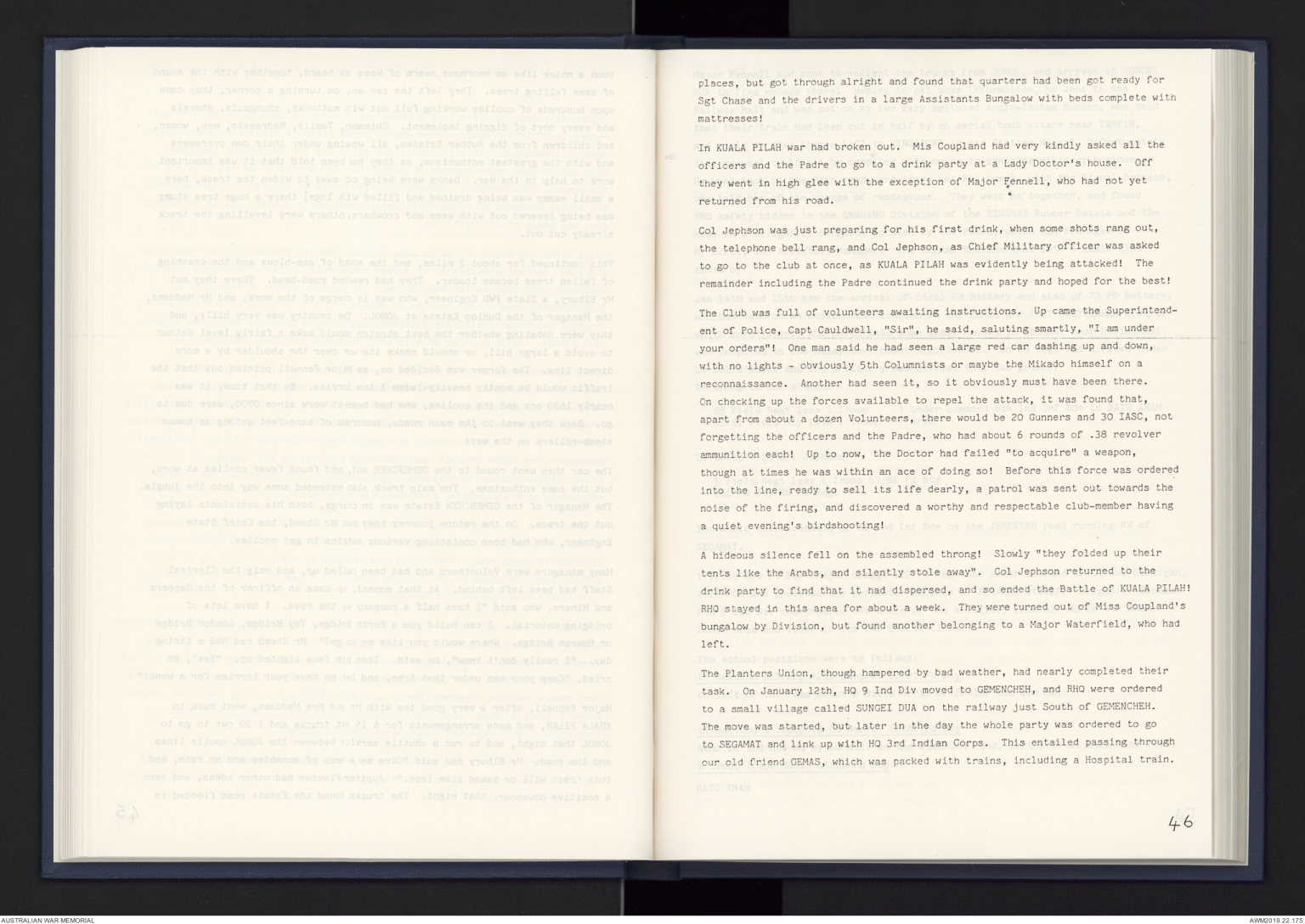
places, but got through alright and found that quarters had been got ready for
Sgt Chase and the drivers in a large Assistants Bungalow with beds complete with
mattresses!
In KUALA PILAH war had broken out. Mis Coupland had very kindly asked all the
officers and the Padre to go to a drink party at a Lady Doctors house. Off
they went in high glee with the exception of Major Fennell, who had not yet
returned from his road.
Col Jephson was just preparing for his first drink, when some shots rang out,
the telephone bell rang, and Col Jephson, as Chief Military officer was asked
to go to the club at once, as JUALA PILAH was evidently being attacked! The
remainder including the Padre continued the drink party and hoped for the best!
The Club was full of volunteers awaiting instructions. Up came the Superintendent
of Police, Capt Cauldwell, “Sir”, he said, saluting smartly, I am “I am under
your orders”! One man said he had seen a large red car dashing up and down,
with no lights - obviously 5th Columnists or maybe the Mikado himself on a
reconnaissance. Another had seen it, so it obviously must have been there.
On checking up the forces available to repel the attack, it was found that,
apart from about a dozen Volunteers, there would be 20 Gunners and 30 IASC, not
forgetting the officers and the Padre, who had about 6 rounds of .38 revolver
ammunition each! Up to now, the Doctor had failed “to acquire” a weapon,
though at times he was within an ace of doing so ! Before this force was ordered
into the line, ready to sell its life deals, a patrol was sent out towards the
noise of the firing, and discovered a worthy and respectable club-member having
a quiet evening’s birdshooting!
A hideous silence fell on the assembled throng! Slowly “they folded up their
tents like the Arabs, and silently stole away”. Col Jephson returned to the
drink party to find that it had dispersed, and so ended the Battle of KUALA PILAH!
RHQ stayed in this area for about a week. They were turned out of Miss Coupland’s
bungalow by Division, but found another belonging to a Major Waterfield, who had
left.
The Planters Union, though hampered by bad weather, had nearly completed their
task. On January 12th, HQ 9 Ind Div moved to GEENCHEH, and RHQ were ordered
to a small village called SUNGEI DUA on the railway just South of GEMENCHEH.
The move was started, but later in the day the whole party was ordered to go
to SEGAMAT and link up with HQ 3rd Indian Corps. This entailed passing through
our old friend GEMAS, which was packed with trains, including a Hospital train.
46
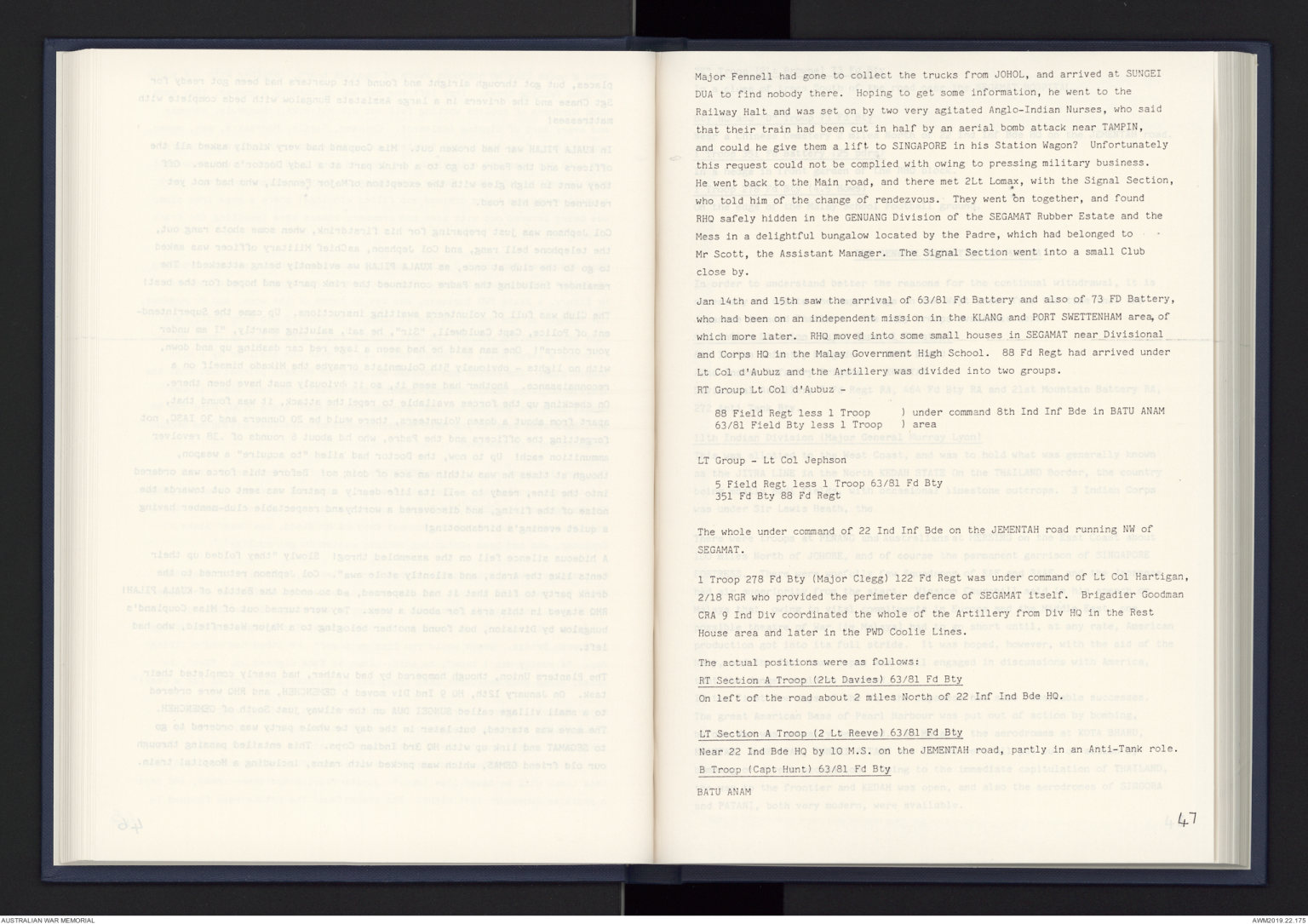
Major Fennell had gone to collect the trucks from JOHOL, and arrived at SUNGEI
DUA to find nobody there. Hoping to get some information, he went to the
Railway Halt and was set on by two very agitated Anglo-Indian Nurses, who said
that their train had been cut in half by an aerial bomb attack near TAMPIN,
and could he give them a lift to SINGAPORE in his Station Wagon? Unfortunately
this request could not be complied with owing to present military business.
He went back to the Main road, and there met 2Lt Lomax, with the Signal Section,
who told him of the change in rendezvous. They went on together, and found
HQ safely hidden in the GENUANG Division of the SEGAMAT Rubber Estate and the
Mess in a delightful bungalow located by the Padre, which had belonged to
Mr Scott, the Assistant Manager. The Signal Section went into a small Club
close by.
Jan 14th and 15th saw the arrival of 63/81 Fd Battery and also of 73 FD Battery,
who had been on an independent mission in the KLANG and PORT SWETTENHAM area, of
which more later. RHQ moved into some small houses in SEGAMAT near Divisional
and Corps HQ in the Malay Government High School. 88 Fd Regt had arrived under
Lt Col D’Aubuz and the Artillery was divided into two groups.
RT Group Lt Col d'Aubuz -
88 Field Regt less 1 Troop } under command 8th Ind Inf Bde in BATU ANAM
63/81 Field Bty less 1 Troop } area
LT Group - Lt Col Jephson
5 Field Regt less 1 Troop 63/81 Fd Bty
351 Fd Bty 88 Fd Regt
The whole under command of 22 Ind Inf Bde on the JEMENTAH road running NW of
SEGAMAT.
1 Troop 278 Fd Bty (Major Clegg) 122 Fd Regt was under command of Lt Col Hartigan,
2/18 RGR who provided the perimeter defence of SEGAMAT itself. Brigadier Goodman
CRA 9 Ind Div coordinated the whole of the Artillery from Div HQ in the Rest
House are and later in the PWD Coolie Lines.
The actual positions were as follows:
RT Section A Troop (2Lt Davies) 63/81 Fd Bty
On left of the road about 2 miles North of 22 Inf Ind Bde HQ.
LT Section A Troop (2 Lt Reeve) 63/81 Fd Bty
Near 22 Ind Bde HQ by 10 M.S. on the JEMENTAH road, partly in an Anti-Tank role.
B Troop (Capt Hunt) 63/81 Fd Bty
BATU ANAM
47
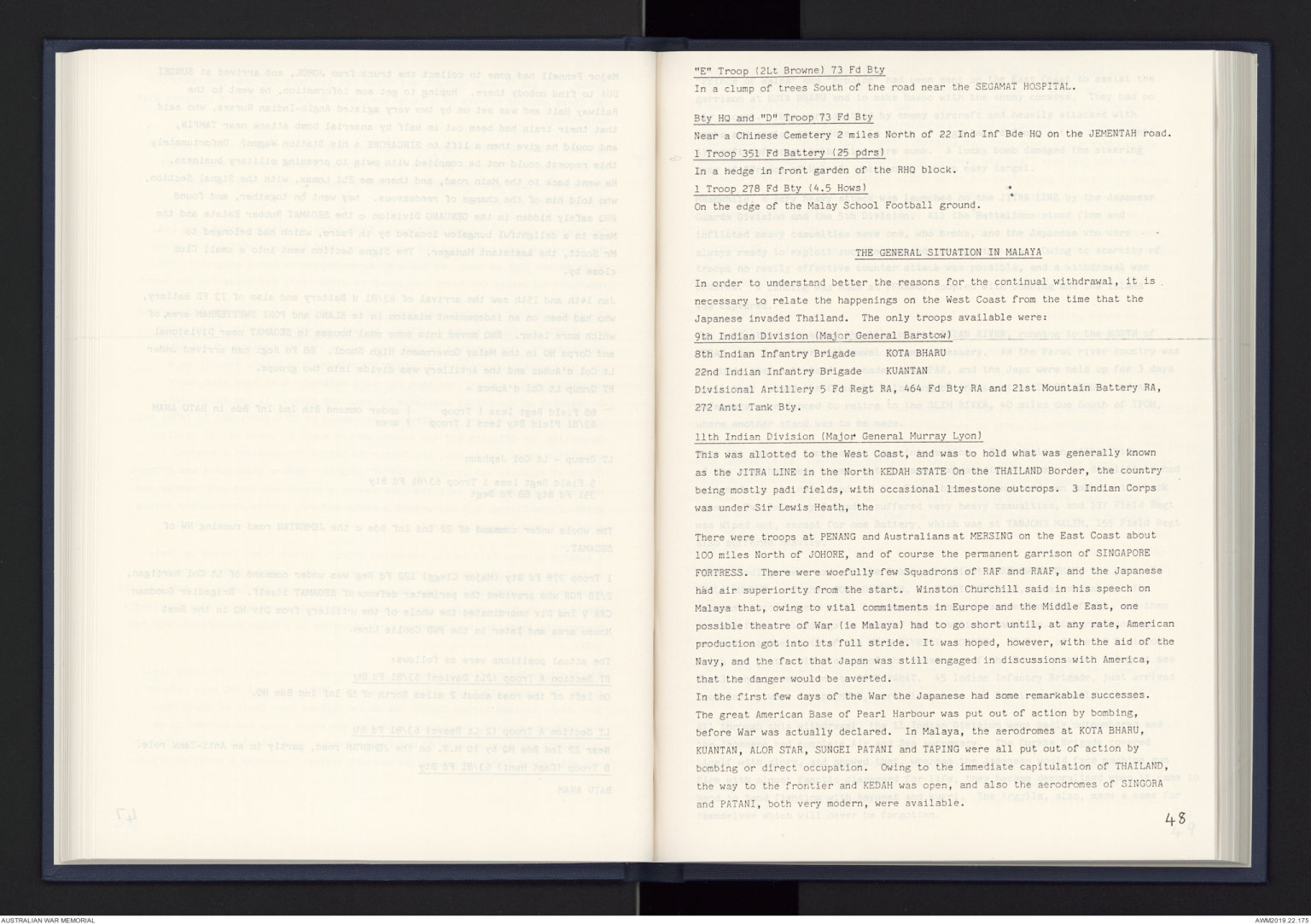
“E” Troop (2Lt Browne) 73 Fd Bty
In a clump of trees South of the road near the SEGAMAT HOSPITAL.
Bty HQ and “D” Troop 73 Fd Bty
Near a Chinese Cemetery 2 miles North of 22 Ind Inf Bde HQ on the JEMENTAH road.
1 Troop 351 Fd Battery (25 pdrs)
In a hedge in front garden of the RHQ block.
1 Troop 278 Fd Bty (4.5 Hows)
On the edge of the Malay School Football ground.
THE GENERAL SITUATION IN MALAYA
In order to understand better the reasons for the continual withdrawal, it is
necessary to relate the happenings on the West Coast from the time that the
Japanese invaded Thailand. The only troops available were:
9th Indian Division (Major General Barstow)
8th Indian Infantry Brigade KOTA BHARU
22nd Indian Infantry Brigade KUANTAN
Divisional artillery 5 Fd Regt RA, 464 Fd Bty RA and 21st Mountain Battery RA,
272 Anti Tank Bty.
11th Indian Division (Major General Murray Lyon)
This was allotted the West Coast, and was to hold what was generally known
as the JITRA LINE in the North KEDAH STATE On the THAILAND Border, the country
being mostly padi fields, with occasional limestone outcrops. 3 Indian Corps
was under Sir Lewis Heath, the
There were troops at PENANG and Australians at MERSING on the East Coast about
100 miles North of JOHORE, and of course the permanent garrison of SINGAPORE
FORTRESS. There were woefully few Squadrons of RAF and RAAF, and the Japanese
had air superiority from the start. Winston Churchill said in his speech on
Malaya that, owing to vital commitments in Europe and Middle East, one
possible theatre of War (ie Malaya) had to go short until, at any rate, American
production got into its full stride. It was hoped, however, with the aid of the
Navy, and the fact that Japan was still engaged in discussions with America,
that the danger would be averted.
In the first few days of the War the Japanese had some remarkable successes.
The great American Base of Pearl Harbour was put out of action by bombing,
before War was actually declared. In Malaya, the aerodromes of KOTA BHARU,
KUATAN, ALOR STAR, SUNGEI PATANI and TAPING were all put out of action by
bombing or direct occupation. Owing to the immediate capitulation of THAILAND,
the way to the frontier and KEDAH was open, and also the aerodromes of SINGORA
and PATANI, both very modern, were available.
48
 Sam scott
This transcription item is now locked to you for editing. To release the lock either Save your changes or Cancel.
This lock will be automatically released after 60 minutes of inactivity.