
Unit diaries relating to service of Geoffrey W. Fennell - Wallet 1 - Part 12
A considerable amount of scrounging had been going on, and disused quarters and
the officers' mess were denuded of their furniture. Many reading books were
found together with a large supply of Naval stationery of all kinds, some of
which was taken back to Changi. There were rumours that a Canteen was to start,
and that we should be given some money to spend in it. In fact the general
impression was that things might be a good deal worse, and it would be our own
fault if we did not make ourselves comfortable.The chief trouble was footwear.
The condition of the boots had not been too good in Changi, and the march had
not improved them, but the Japanese promised that more would be provided.
COOK HOUSE AND CANTEEN
From the start the Regiment had a separate cookhouse in a hut adjoining the
barrack block, and was presided over by Sgt James and later Sgt Pring, with
Bdr May to assist. A visit had been made to the ruined NAAFI cookhouse with
satisfactory results, and many experiments were made trying to make rice
attractive. There was a Central Ration store presided over by the RQMS of the
Malay Regt and a Captain of the RASC. The rations provided by the IJA consisted
of rice in varying quantities, ghi, and meat very occasionally. Bully, milk,
sugar and salt had been brought from Changi. Coconuts could be obtained locally
by scrounging parties.
Breakfast consisted of the usual rice and stew with rice chupatties. Picnic
lunch was sent out by lorry at midday, and usually consisted of rice cakes,
coconut fingers, chupatti and sugar and tea. A large new dustbin had been found
and this proved invaluable as a container! "The Luncheon car Express" is
certainly a thing to be remembered by those who travelled on it. Each unit sent
out its own food and containers together with a couple of cooks to dish out.
When a 3 tonner was provided, well and good, except that the travellers had a
sporting chance of being scalded by boiling tea! Occasionally only a 15 cwt was
available - not very much for about 24 containers and 14 humans, the latter
having to cling on to the vehicle like flies! There was no room to sit and
anyway the containers were either hot already or quickly became so in the boiling
sun! The vehicles never overturned, however, though why not always remained a
mystery, as the drivers often took the corners at speed! For dinner, there was
either a bully pasty or fresh meat, according to the IJA issue.
Has any reader eaten Petroleum Jelly? We have! The site of the work was near the
Ford Works; and in the wood half way up the hill there were a number of metal
barrels. After examining the markings, these were found to contain Grade A pure
petroleum jelly which Major Dunlop and Capt Adams both agreed would be quite safe
for cooking, provided that the quick frying method was used. A barrel was
rolled down the hill surreptitiously, and taken back in the Luncheon car express.
109
Various experiments were made to get the proper amounts and although it proved
a mild aperient at first, the experiment was a great success. 137 however went
too far and it was found out later that, in addition to using the jelly for
frying, they mixed it up with the ingredients as well. The result was acute
diarrhoea, which was at first attributed to flies, the drains etc before being
tracked to its proper source.
After about 10 days, the Canteen came into being, and working pay @ 10 cents a
day for Officers and men was issued. Some units still had private money of
their own, but the Regiment, including the officers, were pretty poverty stricken
by now! On the great day, a Chinese Towkay or shopkeeper turned up with a small
lorry, and that evening opened up with the sale of bread @ 9 cts, fruit and
Chinese cakes. An enormous queue formed stretching right down the road, and it
was soon seen that the supply did not meet the demand, and that strict rationing
was necessary.
Major Fennell and Capt Bailey of the Malay Regt were put in charge of the organisation
but had nothing to do with the cash side of the business. It was decided
that the Canteen would open in the morning for the afternoon shift, and the
afternoon for the morning shift. Each unit was allotted a separate time, and
the order of entrance was changed each day. Bread and Chinese cigarettes were
allotted in bulk to unit representatives. As time went on the supply of tinned
goods improved, but varied greatly from day to day, and had to be rationed to
units. As a general rule, the following foodstuffs were obtainable. Bread,
Chinese cigarettes, sardines, herrings, bully, jam, chutney, sugar twists, curry
puffs, biscuits, M&V, eggs, Cigarette papers, pipe tobacco, tinned butter and
margarine, ketchup, soap, toothpaste, cheese, fresh pork, and bananas, pineapple
and papayas in the fruit line. All right for those who had more than 10 cts a day!
At first, some units did not take kindly to the queue system, but public opinion
supported it, and there was a great glee when gatecrashers were thrown out! The staff
consisted of the Towkay, two young Chinamen (one a gloomy individual called Happy
who did Nowt) and about 3 young Malays, all very cheerful and hard working. The
Pork was sold by a one-eyed Chinaman, whose language sounded like a duck quacking!
By now the Camp was looking like a small garden city! The old open air swimming
bath had been cleaned out, and repaired and filled, and gave a lot of pleasure.
Plants were brought down from the old Mess Garden. Electric light was available
from Reveille to 0800 hrs, and 2000-2300 hrs.
The health of the men had improved, but a fresh form of skin disease started called
Bukit Timah Bollocks! The time had come for metalling the road. Each day a unit
worked in a quarry, a very dusty proceeding. The men used to sweat a lot and get
rubbed with the quarry dust on the march back - hence the skin trouble. Medicines
110
and ointments were very scarce. Diarrohea on the other hand was definitely under
control, and any bad cases of illness were sent into Roberts Barracks Hospital
Changi by lorry, about once a week.
About May 16th there was a stir among our guards. They were suddenly ordered
overseas, and, for a few days, guards were very scarce. We were very sorry to
lose Lt Akamatsu, as he had been very pleasant and helpful. His successor was very
young and very frightened of higher authority, so would never do anything on his
own initiative. It was rumoured that Lt Akamatsu and his unit were bound for Burma
and it was also rumoured that their ship was sunk by an American submarine on the
way as the Syonan Times reported activity in this direction later. The chief
result about the change was that we got no fresh rations for 6 days, and so lived
on rice and coconuts!
Such was the normal routine at Kranji, and the conditions were really quite
reasonable. The IJA took over the running of the Canteen eventually and the
supply of tinned stuff slightly increased. The prices remained the same, however,
although we were told that prices would be reduced, as the stock came from the IJA
Canteens and not the open market.
AMENITY MONEY, CANTEEN AND RATIONS
AT CHANGI
It is now time to return to Changi and see what changes had come to pass in the
meantime. By the middle of May, the building programme had been completed, and
fatigues had been reduced as a result. More ground had been put under cultivation
and sweet potato tops were put into the cookhouse to supplement the somewhat
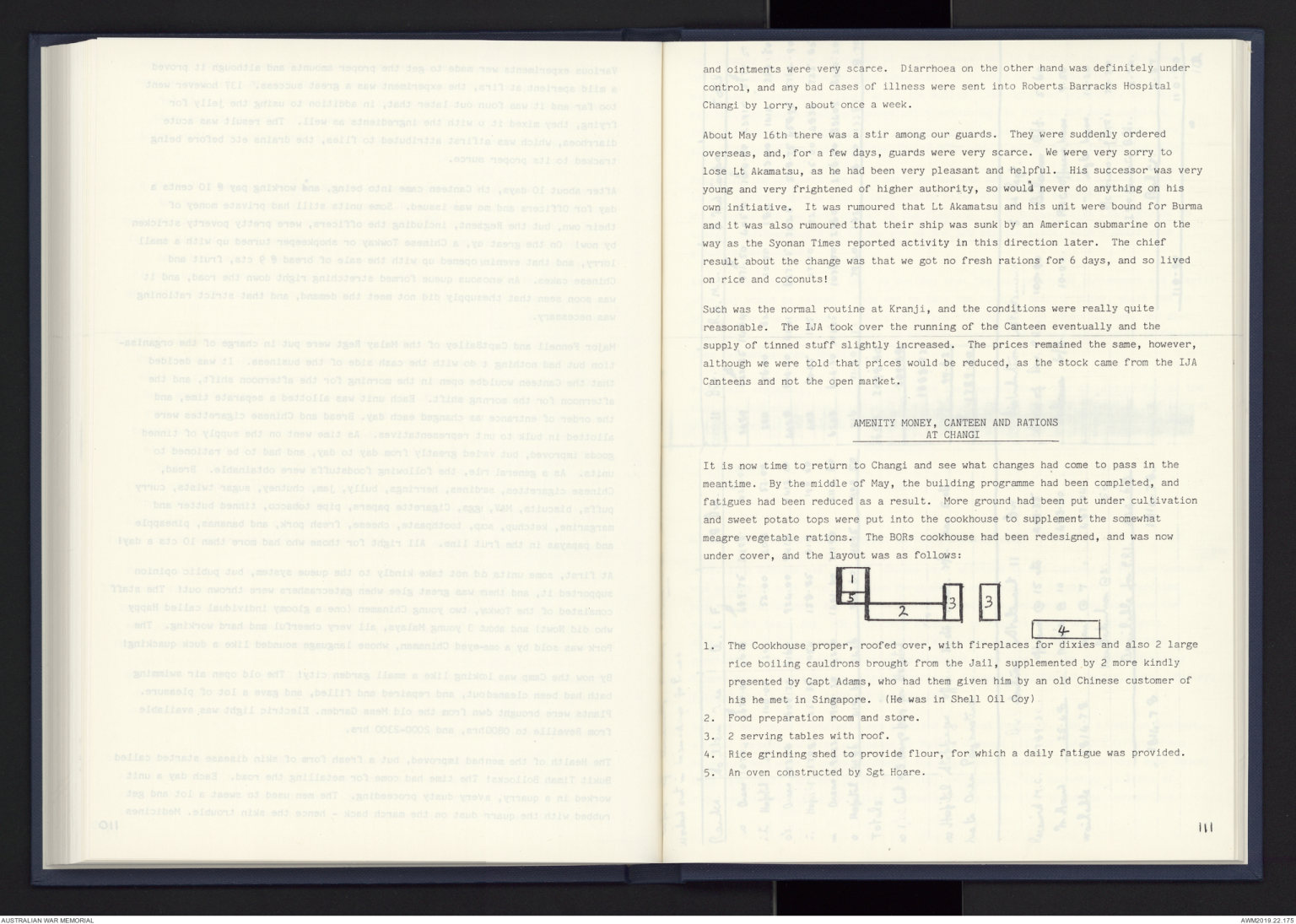
meagre vegetable rations. The BORs cookhouse had been redesigned, and was now
under cover, and the layout was as follows:
Diagram - see original
1. The Cookhouse proper, roofed over, with fireplaces for dixies and also 2 large
rice boiling cauldrons brought from the Jail, supplemented by 2 more kindly
presented by Capt Adams, who had then given him by an Old Chinese customer of
his he met in Singapore. (He was in Shell Oil Coy)
2. Food preparation room and store.
3. 2 serving tables with roof.
4. Rice grinding shed to provide flour, for which a daily fatigue was provided.
5. An oven constructed by Sgt Hoare.
111
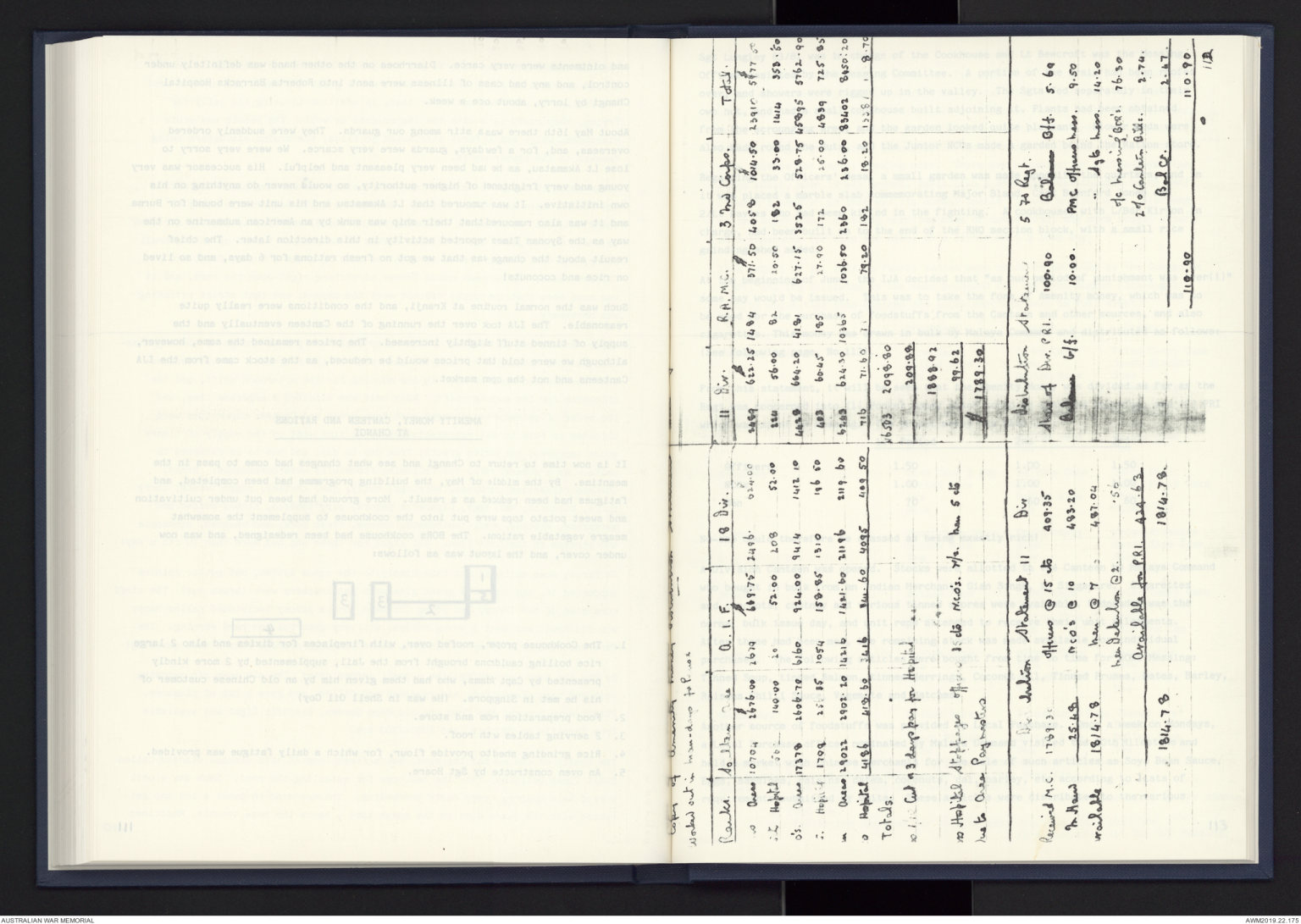
Copy of Amenity money [[??]]
Worked out in man-days for period
Ranks
Southern Area
A.I.F.
| 18 Div. | 11 Div. | R.A.M.C. | 3 Md Corps. | Total. | ||||||||||
| $ | $ | $ | $ | $ | $ | $ | ||||||||
| [[?]] Areas | 10704 | 2676.00 | 2679 | 669.75 | 2496 | 624.00 | 2489 | 622.25 | 1484 | 371.50 | 4058 | 1014.50 | 23910 | 5477.50 |
| Stn Hospital | 50 | 140.00 | 20 | 52.00 | 208 | 52.00 | 284 | 56.00 | 82 | 20.50 | 182 | 33.00 | 1414 | 353.50 |
| O' Areas | 17378 | 2606.78 | 6160 | 924.00 | 9414 | 1412.10 | 4428 | 664.20 | 4181 | 627.15 | 3525 | 528.75 | 45895 | 5762.90 |
| S. Hospital | 1708 | 25.15 | 1054 | 158.85 | 1310 | 186.50 | 403 | 60.45 | 185 | 27.90 | 172 | 26.00 | 4839 | 725.45 |
| [[?]] Areas | 29022 | 2902.20 | 14216 | 1421.60 | 21196 | 2119.60 | 6289 | 624.30 | 10365 | 1036.50 | 2360 | 236.00 | 83402 | 8450.20 |
| [[?]] Hospital | 4186 | 418.60 | 3616 | 314.60 | 4095 | 409.50 | 716 | 71.60 | 1 | 79.20 | 182 | 18.20 | 13381 | 8.70 |
| Totals. | 16503 | 2098.80 | ||||||||||||
| *1 Cut of 3 boys pay for Hospital | 209.80 | |||||||||||||
| 1868.92 | ||||||||||||||
| 99.62 | ||||||||||||||
| $1789.30 | ||||||||||||||
112
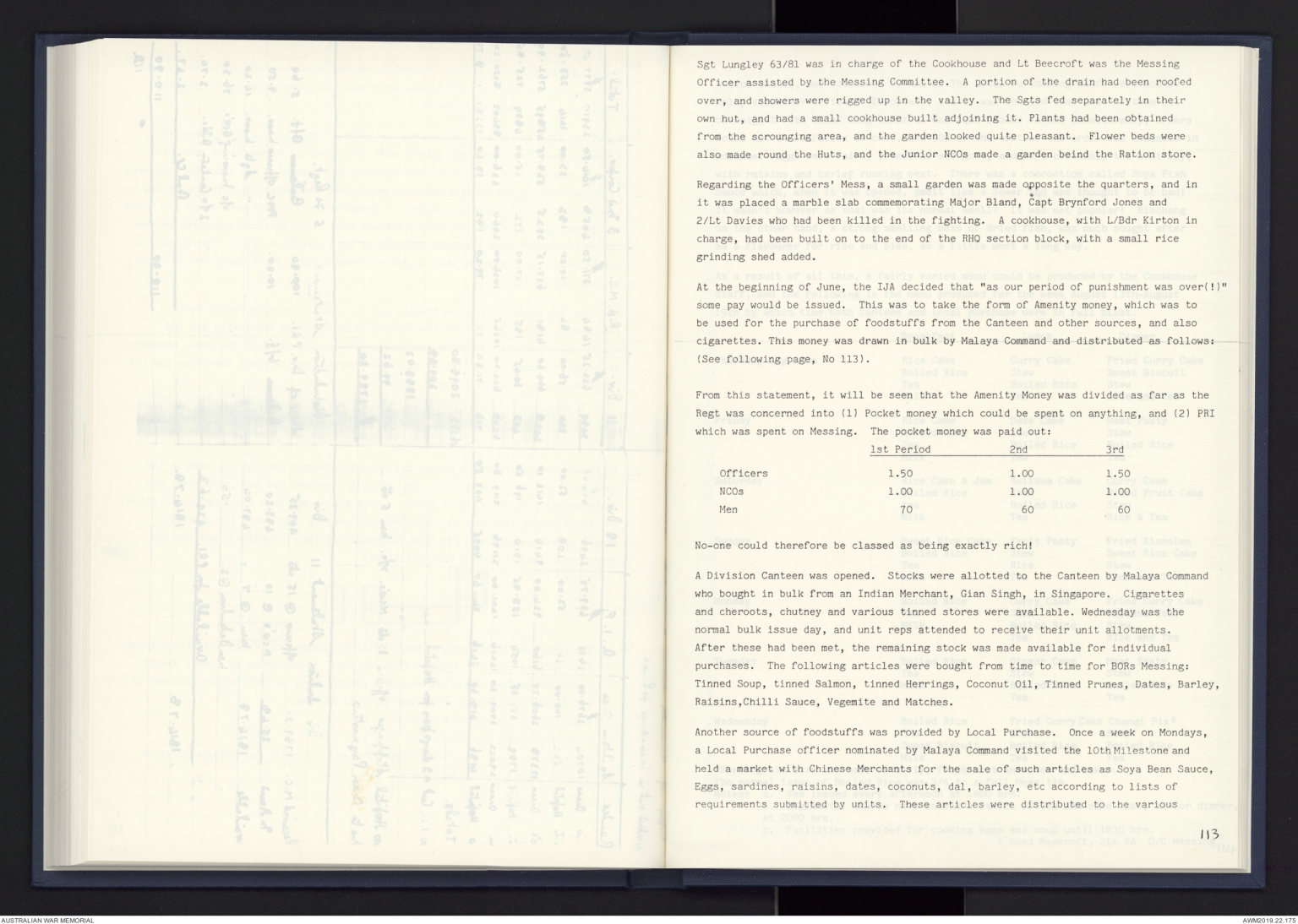
Sgt Lungly 63/81 was in charge of the Cookhouse and Lt Beecroft was the Messing
Officer assisted by the Messing Committee. A portion of the drain had been roofed
over, and showers were rigged up in the valley. The Sgts fed separately in their
own hut, and had a small cookhouse built adjoining it. Plants had been obtained
from the scrounging area, and the garden looked quite pleasant. Flower beds were
also made round the Huts, and the Junior NCOs made a garden beind the Ration store.
Regarding the Officer's Mess, a small garden was made opposite the quarters, and in
it was placed a marble slab commemorating Major Bland, Capt Brynford Jones and
2/Lt Davies who had been killed in the fighting. A cookhouse with L/Bdr Kirton in
charge, had been built on to the end of the RHQ section block, with a small rice
grinding shed added.
At the beginning of June, the IJA decide that "as our period of punishment was over(!)"
some pay would be issued. This was to take the form of Amenity money, which was to
be used for the purchase of foodstuffs from the Canteen and other sources, and also
cigarettes. This money was drawn in bulk by Malay Command and distributed as follows:
(See following page, No 113).
From this statement, it will be seen that the Amenity Money was divided as far as the
Regt was concerned into (1) Pocket money which could be spent on anything, and (2) PRI
which was spent on Messing. The pocket money was paid out:
1st Period 2nd 3rd
Officers 1.50 1.00 1.50
NCOs 1.00 1.00 1.00
Men. 70 60 60
No-one could therefore be classed as being exactly rich!
A Division Canteen was opened. Stocks were allotted to the Canteen by Malaya Command
who bought in bulk from an Indian Merchant, Gian Singh, in Singapore. Cigarettes
and cheroots, chutney and various tinned stores were available. Wednesday was the
normal bulk issue day, and unit reps attended to receive their unit allotments.
After these had been met, the remaining stock was made available for individual
purchases. The following articles were bought from time to time for BOR's Messing:
Tinned Soup, tinned Salmon, tinned Herrings, Coconut Oil, Tinned Prunes, Dates, Barley
Raisins,Chilli Sauce, Vegemite and Matches.
Another source of foodstuffs was provided by Local Purchase. Once a week on Mondays,
a Local Purchase Officer nominated by Malaya Command visited the 10th Milestone and
held a market with Chinese Merchants for the sale of such articles as Soya Bean Sauce,
Eggs, sardines, raisins, dates, coconuts, dal, barley, etc according to lists of
requirements submitted by units. These articles were distributed to the various
113
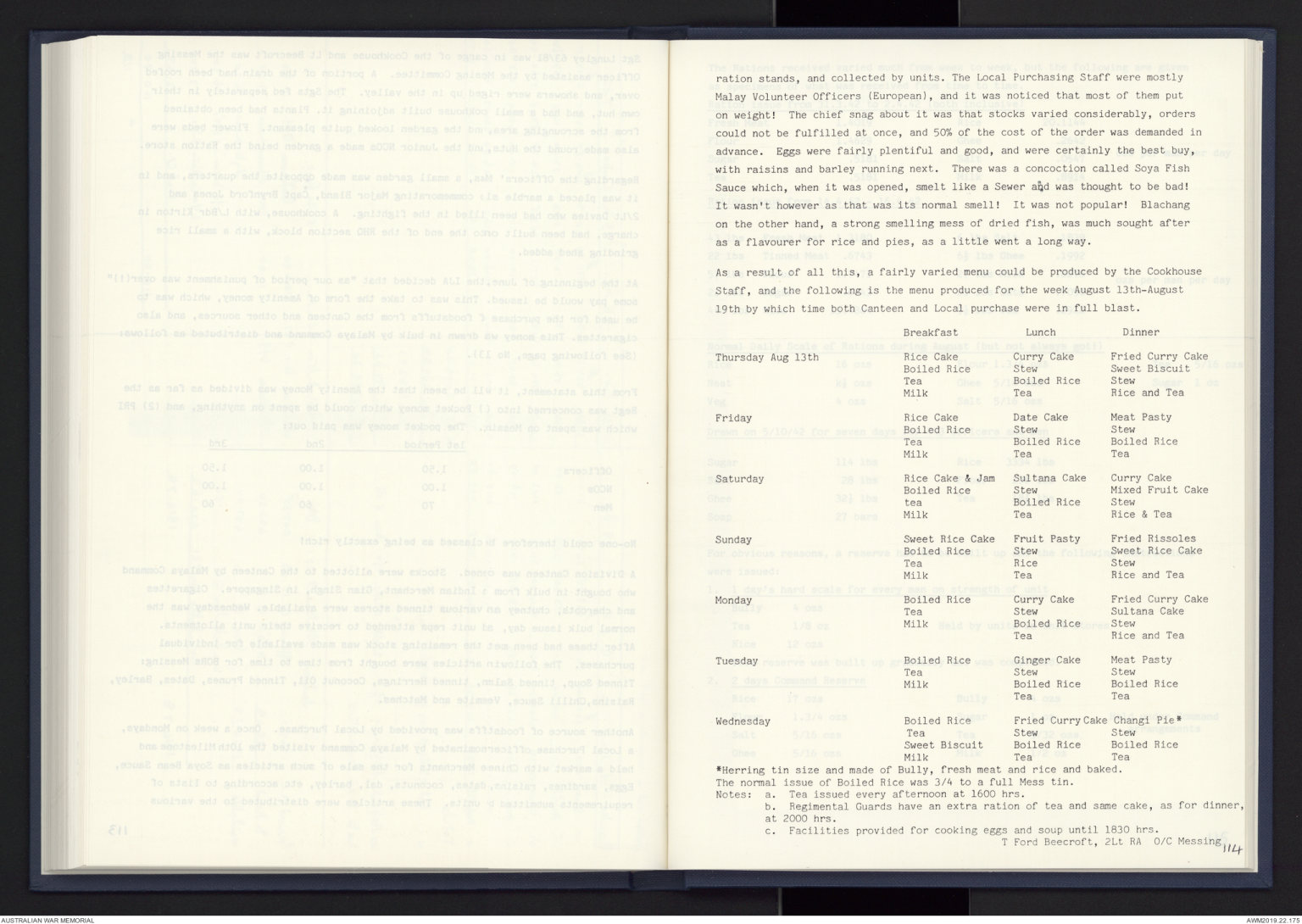
ration stands, and collected by units. The Local Purchasing Staff were mostly
Malay Volunteer Officers (European) and it was noticed that most of them put
on weight! The chief snag about it was stocks varied considerably, orders
could not be fulfilled at once, and 50% of the cost of the order was demanded in
advance. Eggs were fairly plentiful and good, and were certainly the best buy,
with raisins and barley running next. There was a concoction called Soya Fish
Sauce which, when it was opened, smelt like a Sewer and was thought to be bad!
It wasn't however as that was its normal smell! It was not popular! Blachang
on the other hand, a strong smelling mess of dried fish, was much sought
as a flavourer for rice and pies, as a little went a long way.
As a result of all this, a fairly varied menu could be produced by the Cookhouse
Staff, and the following is the menu produced for the week August 13-August
19th by which time Canteen and Local purchase were in full blast.
Breakfast Lunch Dinner
Thursday Aug 13th Rice Cake Curry Cake Fried Curry Cake
Boiled Rice Stew Sweet Biscuit
Tea Boiled Rice Stew
Milk Tea Rice and Tea
Friday Rice Cake Date Cake Meat Pasty
Boiled Rice Stew Stew
Tea Boiled Rice Boiled Rice
Milk Tea Tea
Saturday Rice Cake & Jam Sultana Cake Curry Cake
Boiled Rice Stew Mixed Fruit Cake
tea Boiled Rice Stew
Milk Tea Rice & Tea
Sunday Sweet Rice Cake Fruit Pastry Fried Rissoles
Boiled Rice Stew Sweet Rice Cake
Tea Rice Stew
Milk Tea Rice & Tea
Monday Boiled Rice Curry Cake Fried Curry Cake
Tea Stew Sultana Cake
Milk Boiled Rice Stew
Tea Rice & Tea
Tuesday Boiled Rice Ginger Cake Meat Pasty
Tea Stew Stew
Milk Boiled Rice Boiled Rice
Tea Tea
Wednesday Boiled Rice Fried Curry Cake Changi Pie *
Tea Stew Stew
Sweet Biscuit Boiled Rice Boiled Rice
Milk Tea Tea
*Herring tin size and made of Bully, fresh meat and rice and baked.
The normal issue of Boiled Rice was ¾ to a full mess tin.
Notes: a. Tea issued every afternoon at 1600 hrs.
b. Regimental Guards have an extra ration of tea and some cake for dinner,
at 2000 hrs.
c. Facilities provided for cooking eggs and soup until 1830 hrs.
T. Ford Beecroft, 2Lt RA O/C Messing
114
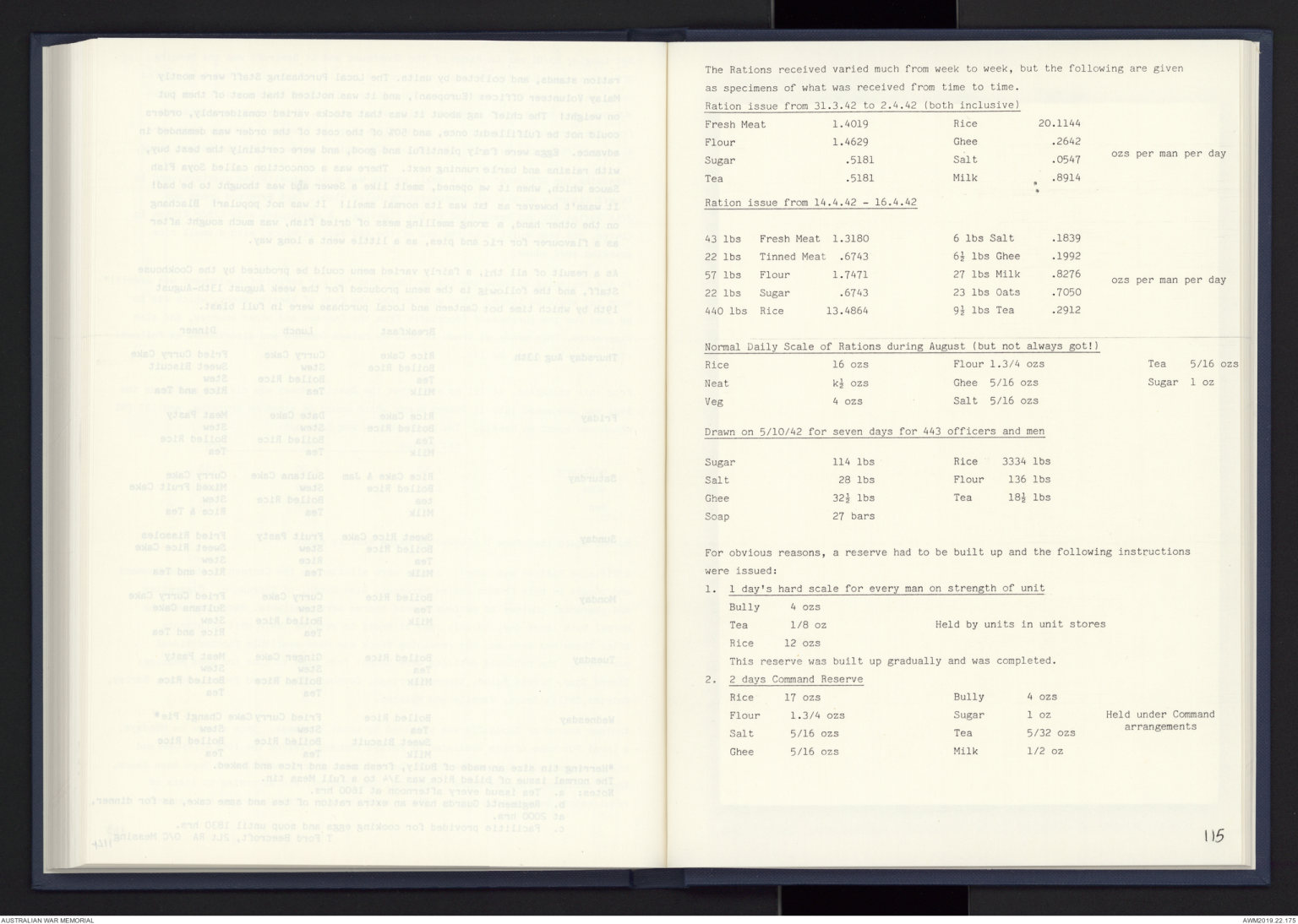
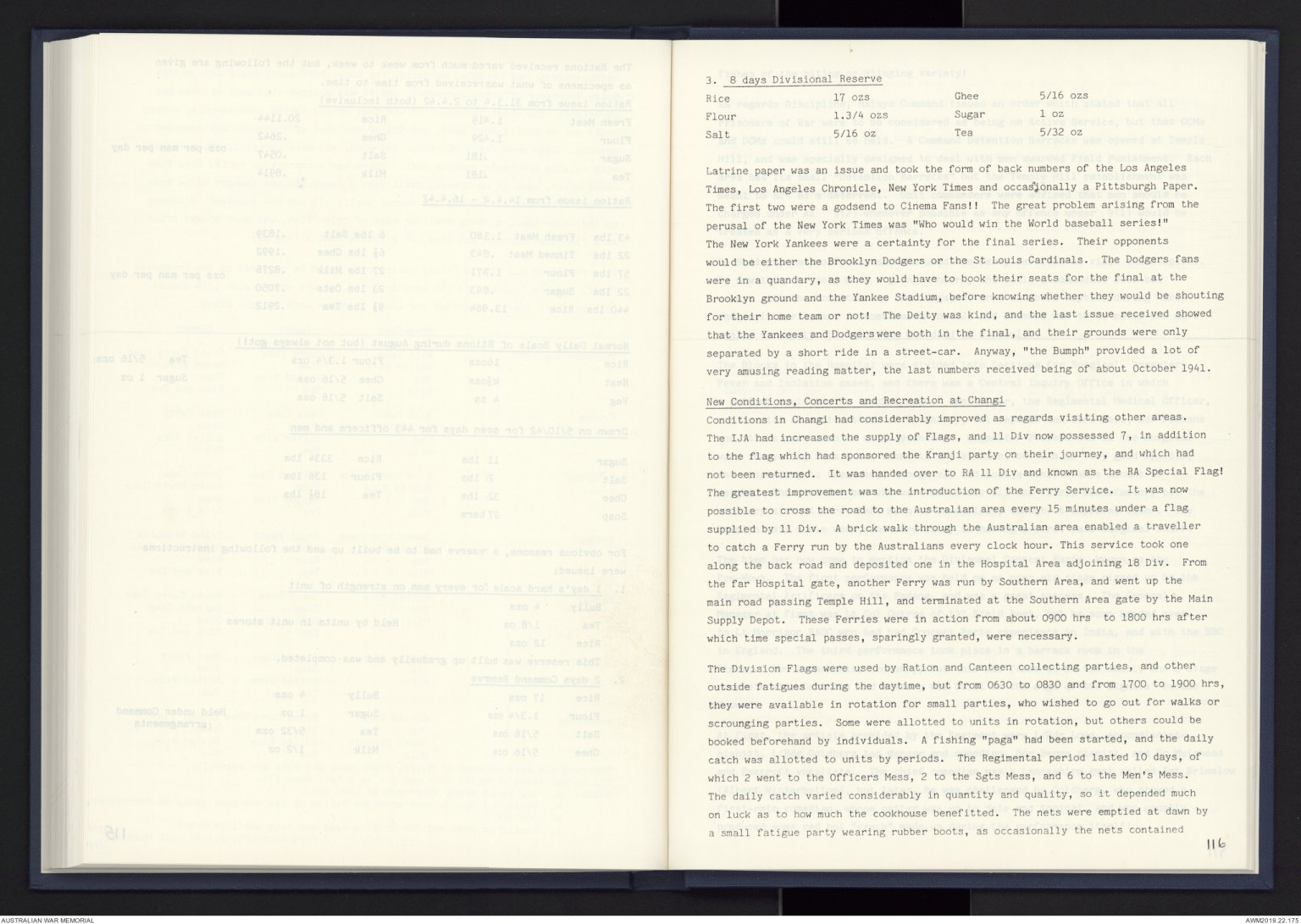
The Rations received varied much from week to week, but the following are given
as specimens of what was received from time to time.
Ration issue from 31.3.42 to 2.4.42 (both inclusive)
Fresh Meat 1.4019 Rice 20.21144
Flour 1.4629 Ghee .2642 ozs per man per day
Sugar .5181 Salt .0547
Tea .5181 Milk .8914
Ration issue from 14.4.42 - 16.4.42
43 lbs Fresh Meat 1.3180 6 lbs Salt .1839
22 lbs Tinned Meat .6743 6½ lbs Ghee .1992 ozs per man per day
57 lbs Flour 1.7471 27 lbs Milk .8276
22 lbs Sugar .6743 23 lbs Oats .7050
440 lbs Rice 13.4864 9½ lbs Tea . 2912
Normal Daily Scale of Rations during August (but not always got!)
Rice 16 ozs Flour 1.3/4 ozs Tea 5/16 ozs
Neat k½ ozs Ghee 5/16 ozs Sugar 1 oz
Veg 4 ozs Salt 5/16 ozs
Drawn on 5/10/42 for 7 days for 443 officers and men
Sugar 114 lbs Rice 3334 lbs
Salt 28 lbs Flour 136 lbs
Ghee 32½ lbs Tea 18½ lbs
Soap 27 bars
For obvious reasons, a reserve had to be built up and the following instructions
were issued:
1. 1 day's hard scale for every man on strength of unit
Bully 4 ozs
Tea 1/8 oz Held by units in unit stores
Rice 12 ozs
This reserve was built up gradually and was completed.
2. 2 days Command Reserve
Rice 17 ozs Bully 4 ozs
Flour 1.3/4 ozs Sugar 1 oz Held under Command
Salt 5/16 ozs Tea 5/32 ozs arrangements
Ghee 5/16 ozs Milk 1/2 oz
115
3. 8 days Divisional Reserve
Rice 17 ozs Ghee 5/16 ozs
Flour 1.3/4 ozs Sugar 1 oz
Salt 3/16 oz Tea 5/31 oz
Latrine paper was an issue and took the form of back numbers of the Los Angeles
Times, Los Angeles Chronicle, New York Times and occasionally a Pittsburgh Paper.
The first two were a godsend to Cinema Fans!! The great problem arising from the
perusal of the New York Times was "Who would win the World baseball series!"
The New York Yankees were a certainty for the final series. Their opponents
would be either the Brooklyn Dodgers or the St Louis Cardinals. The Dodgers fans
were in a quandary, as they would have to book their seats for the final at the
Brooklyn ground and the Yankee Stadium, before knowing whether they would be shouting
for their home team or not! The Deity was kind, and the last issue received showed
that the Yankees and Dodgers were both in the final, and their grounds were only
separated by a short ride in a street-car. Anyway, "the Bumph" provided a lot of
very amusing reading matter, the last numbers received being of about October 1941.
New Conditions, Concerts and Recreation at Changi
Conditions in Changi had considerably improved as regards visiting other areas.
The IJA had increased the supply of Flags, and 11 Div now possessed 7, in addition
to the flag which had sponsored the Kranji party on their journey, and which had
not been returned. It was handed over to RA 11 Div and known as the RA Special Flag!
The greatest improvement was the introduction of the Ferry Service. It was now
possible to cross the road to the Australian area every 15 minutes under a flag
supplied by 11 Div. A brick walk through the Australian area enabled a traveller
to catch a Ferry run by the Australians every clock hour. This service took one
along the back road and deposited one in the Hospital Area adjoining 18 Div. From
the far Hospital gate, another Ferry was run by Southern Area, and went up the
main road passing Temple Hill, and terminated at the Southern Area gate by the Main
Supply Depot. These Ferries were in action from about 0900 hrs to 1800 hrs after
which time special passes, sparingly granted, were necessary.
The Division Flags were used by Ration and Canteen collecting parties, and other
outside fatigues during the daytime, but from 0630 to 0830 and from 1700 to 1900 hrs,
they were available in rotation for small parties, who wished to go out for walks or
scrounging parties. Some were allotted to units in rotation, but others could be
booked beforehand by individuals. A fishing "paga" had been started, and the daily
catch was allotted to units by periods. The Regimental period lasted 10 days, of
which 2 went to the Officers Mess, 2 to the Sgts Mess, and 6 to the Men's Mess.
The daily catch varied considerably in quantity and quality, so it depended much
on luck as to how much the cookhouse benefitted. The nets were emptied at dawn by
a small fatigue party wearing rubber boots, as occasionally the nets contained
116
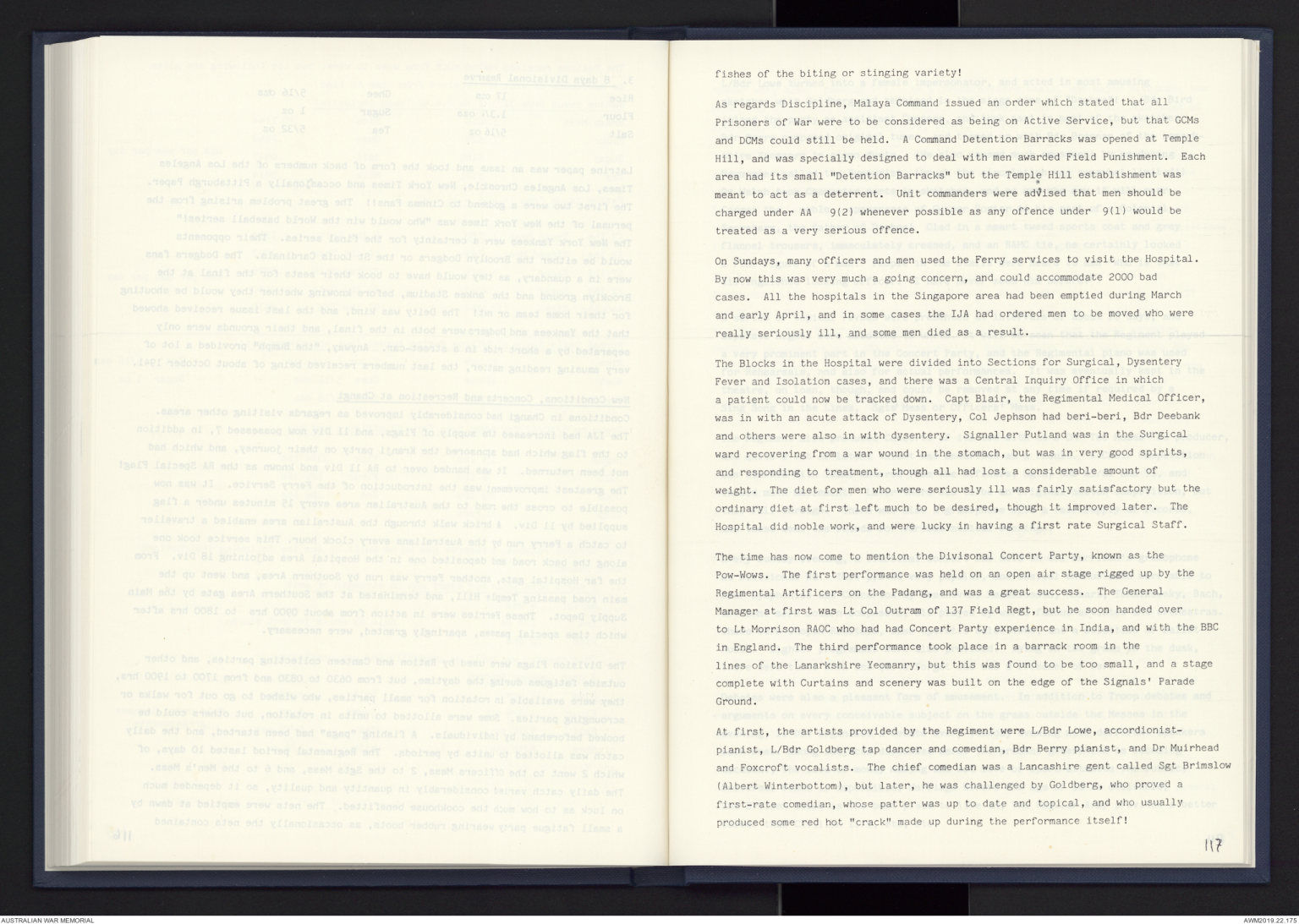
fishes of the biting or stinging variety!
As regards Discipline, Malaya Command issued an order which stated that all
Prisoners of War were to be considered as being on Active Service, but that GCMs
and DCMs could still be held. A Command Detention Barracks was opened at Temple
Hill, and was specially designed to deal with men awarded Field Punishment. Each
area had its small "Detention Barracks" but the Temple Hill establishment was
meant to act as a deterrent. Unit commanders were advised that men should be
charged under AA 9(2) whenever possible as any offence under 9(1) would be
treated as a very serious offence.
On Sundays, many officers and men used the Ferry services to visit the Hospital.
By now this was very much a going concern, and could accommodate 2000 bad
cases. All the hospitals in the Singapore area had been emptied during March
and early April, and in some cases the IJA had ordered men to be moved who were
really seriously ill, and some men died as a result.
The Blocks in the Hospital were divided into Sections for Surgical, Dysentery
Fever and Isolation cases, and there was a Central Inquiry Office in which
a patient could now be tracked down. Capt Blair, the Regimental Medical Officer,
was in with an acute attack of Dysentery, Col Jephson had beri-beri, Bdr Deebank
and others were also in with dysentery. Signaller Putland was in the Surgical
ward recovering from a war wound in the stomach, but was in very good spirits,
and responding to treatment, though all had lost a considerable amount of
weight. The diet for men who were seriously ill was fairly satisfactory but the
ordinary diet at first left much to be desired, though it improved later. The
Hospital did noble work, and were lucky in having a first rate Surgical Staff.
The time has now come to mention the Divisional Concert Party, known as the
Pow-Wows. The first performance was held on an open air stage rigged up by the
Regimental Artificers on the Padang, and was a great success. The General
Manager at first was Lt Col Outram of 137 Field Regt, but he soon handed over
to Lt Morrison RAOC who had had Concert Party experience in India, and with the BBC
in England. The third performance took place in a barrack room in the
lines of the Lanarkshire Yeomanry, but this was found to be too small, and a stage
complete with Curtains and scenery was built on the edge of the Signals' Parade
Ground.
At first, the artists provided by the Regiment were L/Bdr Lowe, accordionist-pianist,
L/Bdr Goldberg tap dancer and comedian, Bdr Berry pianist, and Dr Muirhead
and Foxcroft vocalists. The chief comedian was a Lancashire gent called Sgt Brimslow
(Albert Winterbottom), but later, he was challenged by Goldberg, who proved a
first-rate comedian, whose patter was up to date and topical, and who usually
produced some red hot "crack" made up during the performance itself!
117
 H.Boutell
This transcription item is now locked to you for editing. To release the lock either Save your changes or Cancel.
This lock will be automatically released after 60 minutes of inactivity.