
Unit diaries relating to service of Geoffrey W. Fennell - Wallet 1 - Part 2
Our efficient doctor, had allotted this van as a Hospital and had
fitted it up with borrowed camp beds. This did not suit the
Scotch gentleman
at all and he quoted Railway Regulations by the yard to prove this. Nor could
it be used for luggage owing to the presence of the aforementioned wee pipe! To
avoid trouble with Higher Authority, the van was duly cleared, though the
necessary readjustments were made at Johore Bharu Station, 10 miles further on!
The Doctor's troubles were not yet over. Ten minutes before the train was due to
start, a young and very officious Major in the RAMC arrived and insisted that the
few sick men were to be evacuated to Hospital immediatey. He had not been among
the aformentioned crowd of locusts but had been informed
by the ship's cat that
some MO had dared to continue looking after his own patients! All the professional
pride rose in Lt Blair and he quite rightly protested rigorously
to O/C Train.
O/C Train informed the Major gently but firmly that:
1. Lt Blair had tended our sick through the whole Malaria season in India and we
had every confidence in him. (The first part of the statement was quite untrue
Lt Blair having joined just prior to sailing, but may the lie be
forgiven!)
2. The train was due to start in 5 minutes time and the sick could not be removed
in the time. In this, Humpty Dumpty heartily agreed and squealed with rage at the
thought of his timetable being upset! The Major then started to quote Malayan
Command Medical Regulations at length and, to keep the peace, some of the sick
men were removed. The train then moved off to the accompaniment of growls from
the MO, in which the O/C Train and the Adjutant joined heartily.
The following morning at 0630 hrs the train was found to be at GEMAS station. At
0730 hrs it was still at GEMAS Station! A goods train had been derailed. Wires
got busy, and the Australians from SEGAMAT Camp, 10 miles away, produced breakfast
at 0820, also a midday meal - a very pleasant contrast to the Bumbleism of the
night before. The train left at 1500 hrs and, after an evening meal at KUALA
LUMPUR, arrived at IPOH in the early hours
IPOH
At 0630 hrs, the Reception Committee arrived at the Station. First, Capt Lucas,
the 28th Indian Infantry Bde MT officer, clad in a motor cycle and large leather
jerkin, and, secondly, Capt Ogilvie, the Adjutant of the 2/1st Gurkha Rifles.
Excellent arangements had been made to transport the whole party to Canning Camp
by lorry, and shortly afterwards we found ourselves in our new homes in huts
under the rubber.
Capt Ogilvie proved to be a tower of strength. He was pestered during the next
week with innumerable queries, sch as:
[*9*]
Where are the best training areas? How can on get beer and cigarettes duty free?
Can you get us a Chinese dhobi? What about a tailor. Who does one have to call on?
How do you join the Club? Where can you find (a) The Field Cashier (b) the local
Workshop Company (c) the best food (d) the chap who runs the local Rugger (e) Will
the Battalion play us at Football? To every question he produced the right answer
and the Regiment cannot be too grateful to him. It has been said that his efficiency
was due to him being a Scotsman from Calcutta, but we will let that pass!
IPOH, the capital of Perak State proved to be a very modern town with first class
shops. It was a paradise for the troops as it contained two good Cinemas and a
large well run Dance Hall called "The Celestial" complete with Chinese Dance Hostesses
rejoicing in names like "Rosy Wee"! The difficulty was to make the weekly pay last
out more than one visit and also the fact that the Camp was nearly 4 miles from the
Town. This last difficulty was lessened by running a limited lorry service as
soon as the vehicles arrived.
The civilians of IPOH were most hospitable. The Perak Turf Club (Secretary
Mr Byers) provided three Frigidaires and three Wireless Sets. Parties were
arranged every Sunday for selected NCOs and men by the
Kinta Club and others.
The officers were given a Cocktail Party on the day of their arrival by a Capt
and Mrs Dane, and were taken to the Annual Poppy Dance at the Club and divided
up among various parties. They were also made Military Members of the IPOH Club
and Swimming Club. There was a first-class Rugger ground at the Club, and, in due
course, the Regimental side, captained by 2 Lt Armstrong played the Perak Club
side and were beaten by 26-0, all the scoring being in the first half and every
try converted. The local paper preferred to say “trounced”, but it was observed
later that the reporter’s vocabulary must have been very limited, as in accounts of
games, every win by 10 points or over constituted a trouncing!
On arrival of the Road Party, 63/81 Fd Battery was affiliated to 2/2 Gurkha Rifles
and 73 Fd Battery to 2/1 Gurkha Rifles for purposes of training. It was evident
from the start that, owing to the close nature of the country, previous methods
had to go by the board, and more work would have to be done by sections and even
by single guns. Lessons were learnt, which were of the greatest use later on, and
both battalions proved to be the most helpful and co-operative.
In addition, small parties of officers were sent as Umpires for manoeuvres held
in the KUALA LUMPUR area and also in KEDAH. A reconnaissance was also made in
the KUANTAN area on the East Coast, as it was expected that the Regiment would be
moving there in the early spring. Regimental Headquarters attended an exercise
conducted by HQ 28th Indian Infantry Bde.
[*10*]
On the Administrative side, a branch of the NAAFI was at last opened, two Chinese
tailors were installed in the Quartermaster’s Stores, a Dhobi contract was
started with a Chinese laundryman in IPOH. This proved a failure as, at the end
of November, he almost owed more for articles lost than the amount due to him!
The 6 IORs in the LAD arrived safely from PENANG complete with their cook,
also the 3 shoemakers. They had been in PENANG some time as nobody knew anything
about them. Col Jephson had previously made enquiries and had been told by the
officer in charge of the party they travelled with that he had personally put them
ashore at SINGAPORE!
A YMCA Cafe, staffed by local residents, proved very popular. The inhabitants
of IPOH had made great plans for the entertainment of the troops at Xmas. It had
been arranged that British troops would be dined and wined in batches of 100
during the Xmas period, and suggestions were asked for as to what else they would
like.The Perak Turf Club sent enclosure badges for every officer, NCO and man who
wished to attend the Race Meeting due to be held early in December.
In the meantime, the tension with the Japanese increased. Talks were still going
on between Mr Kusuru and President Roosevelt in Washington, but it was felt that
the Japanese were simply playing for time, and the bellicose speeches of
General Tojo, the Japanese Prime Minster, did nothing to lessen the feeling that
war was imminent. So that the Regiment should not be “caught with its trousers
down”, on November 25th Col Jephson ordered a practice pack in vehicles of everything
the Regiment possessed since arriving in the Country, more stores had been
received and other items had been acquired, which would certainly have to be taken
to any new station. After a final check, as many vehicles as possible were left
loaded in case of a sudden order to move.
On Nov 29th, various Scotsmen in the Regiment were preparing to celebrate St Andrew’s
Night. One Scotsman was so elated at the thought that he invited a Yorkshireman
and a native of Westmorland to dinner at the Eastern Hotel. They both accepted
with alacrity. During the pink gin period and while the dinner was being ordered,
2Lt Taffy Davies, the Orderly Officer turned up with a message that the Regiment
was to be ready to move at 12 hours notice. It was decided unanimously that there
was time to eat the dinner, and it was so, and greatly enjoyed. May the hospitality
be returned some day without the necessity of having to make a “Things to be
done” list between the courses!
Move to War Stations
The Regiment was ordered to proceed to its War Station on Dec 3rd. RHQ and
63/81 Fd Bty were to march to KUANTAN by road, with halts at THE GAP and JERANTUT.
73 Fd Bty were to march to KUALA LUMPUR and to be ready for a railway journey
from there. It was decided that RHQ and 73 Fd Battery would move on Dec 3rd,
[*11*]
while 63/81 Fd Bty was to leave on Dec 4th. Major Bland went to Hospital with
Malaria and Capt Pearson took over 63/81 Fd Bty.
Regarding the possible Rail move of 73 Fd Bty, owing to the fact that Railways in
Malaya are meter gauge, experiments had to be made on Dec 2nd with a Spider, a
30ton lorry, and the Workshops lorry. The spider passed the loading gauge with
flying colours. The Breakdown lorry was tried next, but it presented an important
problem. The loading gauge was some distance away, and to reach it, the truck had
to go under two low bridges. Would it be safe? It was decided to risk it, with
the result that there was a clearance of about 2 inches, and the driver of the
vehicle certainly had the fright of his life!
RHQ and 73 Fd Bty set off next morning for the GAP and KUALA LUMPUR. The route was
by the main road South through country which was not particularly interesting, mostly
covered by tin workings and ordinary woodland. On the East of the road, about
50 miles from IPOH was a road leading from TAPAH to CAMERON HIGHLANDS, a well known
hill station, and later KAMPAR and SLIM RIVER,where there was heavy fighting later,
were passed. At 90 miles TANJONG MALIM, in which was a large Military Hospital in the
Sultan Idris college, was encountered. From KUALA KUBU BHARU the road to the GAP
branched off to the left, and here 73 Fd Bty must be left until later.
The road now started to climb upwards along a gorge with hills rising on either
side to between 4 and 5 thousand feet. Alongside the road ran the SELANGOR RIVER
- in fact in all cases except NEGRI SEMBILAN (9 states), the states are named after the
chief river running through them.
The GAP is the name given to the top of the Pass on the boundary between the States
of SELANGOR and PAHANG. It consisted of about half a mile of level road with a few
shops and a really excellent Rest house built of stone, just like an English County
House. A one-way road led to FRAZERS HILL, another Hillstation, built at 4260 ft.
On arrival, the Military Traffic Post took charge and the vehicles were parked by
the side of the road. In honour of the occasion, there was a severe thunderstorm
but the night was beautifully cool. The MO was absent as he and his lorry had
unfortunately gone over a bank near TANJONG MALIM and he was in the aforementioned
Hospital.
The following morning the march to JERANTUT was resumed. At WALSHE’S CORNER, some
2 miles beyond the GAP, a wonderful view was obtained of miles and miles of forest
country, broken here and there by pointed hills and valleys which, in the early morning, were
still full of mist. After an easy ten mile descent RAUB, the chief
town of the district was reached and one was confronted with the notice ‘RAUB
AUSTRALIAN GOLD MINES” but there was unfortunately no time to collect any. Later
[*12*]
RAUB became CHQ 9 Ind Div. The country was very similar, most of the way being
forest, and JERANTUT was reached about 1600 hrs, the vehicles being parked on
a Rubber Estate road.
In the morning, the PAHANG RIVER was crossed by a rather ingenious type of ferry.
It consisted of a pontoon, capable of holding 3 vehicles of the 15 cwt type, and
was connected on the left side to an overhead cable by two hawsers, to which
pulleys, which were free to run along the cables, were attached. The PAHANG
RIVER was about 400 yards wide and had a strong current. To get the ferry across,
it was necessary to let the hawsers go slack and the current pulled the pontoon
downstream away from the bank. The hawsers were then tightened and the friction
of the pulleys on the cable, combined with the current of the River, caused the
pontoon to cross. The average time to cross was ten minutes, but, when the river
was either too high or too low, it was anything up to 3/4 hour, owing to the
manoeuvres necessary to reach harbour the far side. As a curiosity, the ferry was
interesting, but one could not help wondering “What about getting a troop, let
alone a Battery over the thing under machine gun fire or bombing!”
All the vehicles got over without mishap, and, for the next 90 miles, travelled on
a narrow twisty road with dense jungle on either side. When travelling on this
road in the evening, the most extraordinary colour effects are seen. The road
itself is nearly dark owing to the height of the trees on either side, and yet,
at times, the tops of the trees are golden, where the sun reaches them. Towards
sunset the gold turns to russet brown and even fiery red according to the sunset.
The result is most impressive. At MARAN, a tiny village 50 miles from KUANTAN,
a halt was made at midday, and VICTORY CAMP, 11 miles from KUANTAN was reached at
tea time.
Kuantan
As the KUANTAN area was to be our home for the next month, a short description of
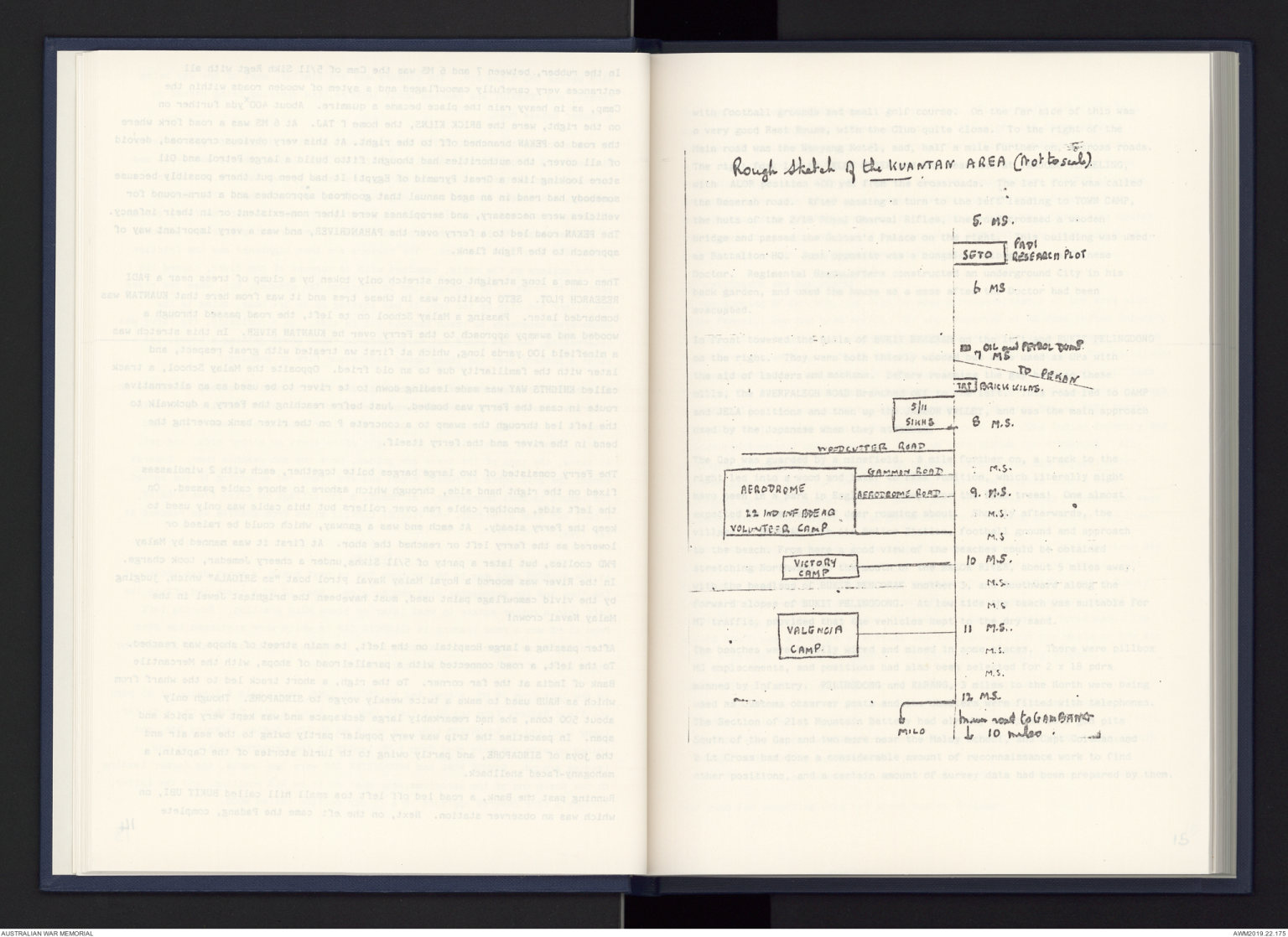
the town and its approaches will now be given. Near 12 MS a track led off to the
left into a rubber estate to what later on became MILO position. Running left
from 11 MS was a road leading to VALENCIA CAMP in which were stationed the 22nd
Field Coy Bengal Sappers and Miners, RAMC, Workshops, Supplies, a Malay Bn and the
Wagon Lines of 21st Mountain Battery and 5/11 Sikhs.
To the left from 10 MS, a road led to VICTORY CAMP, which held B Echelon on 25 pdrs
464 Field Battery from the 88th Field Regt RA. About ½ mile further on, a rather
lumpy road led to VOLUNTEER CAMP, in which was HQ 22nd Indian Infantry Bde, and
joined up with the main road from 9 MS leading to the Aerodrome building and
landing ground. GAMMON ROAD and WOODCUTTER ROAD were two tracks, the former leading
to the North end of the aerodrome, near what was to be AIR position, and the latter,
through a fine covered approach to a 25 pdr position called WOOD.
[*13*]
In the rubber, between 7 and 6 MS was the Camp of 5/11 Sikh Regt with all
entrances very carefully camouflaged and a system of wooden roads within the
Camp, as in heavy rain the place became a quagmire. About 400xyds further on
on the right, were the BRICK KILNS, the home of TAJ. At 6 MS was a road fork where
the road to PEKAN branched off to the right. At this very obvious crossroad, devoid
of all cover, the authorities had thought fit to build a large Petrol and Oil
store looking like a Great Pyramid of Egypt! It had been put there possibly because
somebody had read in an aged manual that good road approaches and a turn-round for
vehicles were necessary, and aeroplanes were either non-existent or in their infancy.
The PEKAN road led to a ferry over the PAHANG RIVER, and was a very important way of
approach to the Right flank.
Then came a long straight open stretch only broken by a clump of trees near a PADI
RESEARCH PLOT. SETO position was in these trees and it was from here that KUANTAN was
bombarded later. Passing a Malay School on the left, the road passed through a
wooded and swampy approach to the Ferry over the KUANTAN RIVER. In this stretch was
a minefield 100 yards long, which at first was treated with great respect, and
later with the familiarity due to an old friend. Opposie the Malay School, a track
called KNIGHTS WAY was made leading down to the river to be used as an aternative
route in case the Ferry was bombed. Just before reaching the Ferry a duckwalk to
the left led through the swamp to a concrete OP on the river bank covering the
bend in the river and the ferry itself.
The Ferry consisted of two large barges bolted together, each with 2 windlasses
fixed on the right hand side, through which a shore to shore cable passed. On
the left side, another cable ran over rollers, but this cable was only used to
keep the Ferry steady. At each end was a gangway, which could be raised or
lowered as the ferry left or reached the shore. At first it was manned by Malay
PWD coolies, but later a party of 5/11 Sikhs, under a cheery Jemedar, took charge.
In the River was moored a Royal Malay Naval Patrol boat “ss SRIGALA” which, judging
by the vivid camouflage paint used, must have been the brightest Jewel in the
Malay Naval crown!
After passing a large Hospital on the left, the main street of shops was reached.
To the left, a road connected with a parallel road of shops, with the Mercantile
Bank of India at the far corner. To the right, a short track led to the wharf from
which ss RAUB used to make a twice weekly voyage to SINGAPORE. Though only
about 500 tons, she had remarkably large deck space and was kept very spick and
span. In peacetime the trip was very popular, partly owing to the sea air and
the joys of SINGAPORE, and partly owing to the lurid stories of the captain, a
mahogany-faced shellback.
Running past the Bank, a road led off left to a small hill called BUKIT UBI, on
which was an observer station. Next, on the left came the Padang, complete
[*14*]
Rough sketch of th KUANTAN AREA (no to scale)
Hand drawn diagram/map - see original document
with football grounds and small golf course. On the far side of this was
a very good Rest House, with the Club quite close. To the right of the
Main road was the Nanyang Hotel, and, half a mile further on, a cross roads.
The right fork led to TELOK SISEK and the headland at TANJONG TEMBELING,
with ALOR position 400 yds from the crossroads. The left fork was called
the Beserah road. After passing a turn to the left leading to TOWN CAMP,
the huts of the 2/18 Royal Gharwal Rifles, the road crossed a wooden
bridge and passed the Sultan’s Palace on the right. This building was used
as Battalion HQ. Just opposite was a bungalow belonging to a Chinese
Doctor. Regimental Headquarters constructed an underground City in his
back garden, and used the house as a mess after the Doctor had been evacuated.
In front towered the hills of BUKIT BESERAH on the left and BUKIT PELINGDONG
on the right. They were both thickly wooded but were used as OPs with
the aid of ladders and machans. Before reaching the gap between these
hills, the AVERPALEGH ROAD Branched off to the left. This road led to GAMP
and JELA positions and then up the JABBOR VALLEY, and was the main approach
used by the Japanese when they attacked.
The Gap was guarded by a minefield. A mile further on, a track to the
right led into a wood and later to PARK Position, which literally might
have been in a park in England - except for the Palm trees! One almost
expected to see herds of deer roaming about. Shortly afterwards, the
village of BESARAH with its Police Station, football ground and approach
to the beach. From here a good view of the beaches could be obtained
stretching Northward to the mouth of the BALOK RIVER, about 5 miles away,
with the headland of BUKIT PENGORAK another 3, and Southward along the
forward slopes of BUKIT PENINGDONG. At low tide the beach was suitable for
MI traffic, provided that the vehicles kept to the dry sand.
The beaches were heavily wired and mined in some places. There were pillbox
MG emplacements, and positions had also been selected for 2 x 18 pars
manned by Infantry. PELINGDONG and KARANG, 3 miles to the North were being
used as Customs observer posts and the shelters were fitted with telephones.
The Section of 21st Mountain Battery had already constructed 2 gun pits
South of the Gap and two more near the Malay School, and Capt Coleman and
2 Lt Cross had done a considerable amount of reconnaissance work to find
other positions, and a certain amount of survey data had been prepared by them.
[*15*]
The importance of KUANTAN lay in its aerodrome. It was newly built and well
supplied with Hangars, Workshops, bomb-store, SAA store and there were in
addition 21 aerial torpedoes. The quarters for officers and men were most
up to date and far ahead of anything we had seen before. The small port and
road to JERRANTUT also offered a method of entry into Malaya. KUANTAN had been
selected as the site(?) of an aerodrome at the time defence of Malaya had
been entrusted to the RAF. One could not help thinking that inspecting bodies
had travelled by air, and not by the road from JERANTUT with its hundreds of
small bridges - not to mention the two ferries!
RECONNAISSANCE AND DEPLOYMENT
On the morning of Dec 6th, Col Jephson made a reconnaissance of the area with
Major Fennell, who had been before. He then reported at HQ 22nd Indian Infantry
Brigade. This Brigade was commanded by Brigadier G W A Painter, a gunner, with
Major Davidson as Brigade Major and Capt Harvey as Staff Captain. The Battalions
in the Brigade were the 2/18 Royal Gharwal Rifles (Lt Col Hartigan), 5/11 Sikh
Regt (Lt Col Parkin), and the 2/12th Frontier Force Regt (Lt Col Cummins) though
this Battalion had been sent to assist 8th Indian Infantry Bde at KOTA BHARU,
200 miles North on the Coast. The Regiment worked with 22nd Indian Infantry Bde
almost continuously until January 26th, when we left RENGAM for SINGAPORE. All
officers and men have feelings of the greatest admiration and affection for
this Brigade and also for the 8th Infantry Bde. The Brigade Staffs were
efficient and most helpful and the men themselves proved tough fighters and easy
to work with. The Gunners in the detachments had nothing but praise for them.
Other troops under command of the Brigadier were a section of 21st Mountain Bty
(Captain Coleman), 22 Field Coy Bengal Sappers and Miners (Major Herd), 27th
Field Ambulance (Lt Col Benson), 42nd Workshop Coy (Major Hill), and a Supply
Depot. On the aerodrome was a Squadron of Lockheed-Hudson bombers manner by
the RAAF. In addition were a few Wildebeestes for the aerial torpedoes. The
ground staff was a mixture of British and Australians, but the whole of the Air
Force personnel was under strength. It was really a bombing school.
The problems confronting Brigadier Painter were as follows:
- The primary task of the Defence of the Aerodrome from attach by parachutists or by land.
- Defence of the beaches from the mouth of the KUANTAN RIVER to the mouth
of BALOK RIVER, 10 miles to the North. - Preventing an advance on KANTAN from the South along the PEKAN road.
His plan for competing with the above was as follows:
[*16*]
The defences were divided into a Forward and Rear Sector, the boundary being the
RIVER KUANTAN the holding of which being considered vital to the defence.
The forward Sector was allotted to 2/18 Royal Gharwal Rifles who were to man the
beach defences, and maintain a striking force in TOWN CAMP area to deal with any
attack inland from the North.
The rear Sector was to be held by 5/11 Sikhs, who were to hold the Southern bank
of the River, a line astride the PEKAN road called the TAJ line, named after
Capt Taj Mohamed MC the Company Commander, and to have a Company detailed to
assist in the defence of the aerodrome. The Rear sector was to be prepared to
work independently under Lt Col Parkin in event of the destruction of the Ferry
or a breakdown in communication.
Col Jephson made the following Artillery dispositions:
RT Section A Troop “PARK”
Gun Position Football ground BESERAH GPO (BSM McGarva)
OP Rest House BESERAH (2Lt K B Davies)
LT Section A Troop “GAMP”
Gun position Up the AVERPALEH ROAD and then through the Rubber to cover the BALOK
RIVER (GPO 2 Lt Reeve)
OP KAMPONG BALOK (Lt Bladen)
RT Section B Troop TAJ
Gun position PADI research dump covering PEKAN road (2Lt McKenzie)
OP with Coy Cdr 5/11 Sikh Regt up PEKAN road (Capt Hunt)
LT Section B Troop TOWN
Gun position TOWN CAMP 2Lt Hogshaw
OPs TEMBELING POINT (2Lt Mason)
RANGE CAMP (Lt Reid)
Battery HQ TOWN CAMP
Section 21st Mountain Battery
Gun position Right of road West of the Gap (2Lt Cross)
OP BUKIT PELINGDONG (Capt Coleman)
RHQ
Chinese Doctors compound opposite Sultan’s Palace in BESERAH ROAD
B Echelon
VICTORY CAMP
62/81 Field Battery RA arrived from JERANTUT during the afternoon and went straight
into action. During the night, 1200 rounds were taken across the river and dumped
at the positions and 400 were dumped at TAJ. The aforementioned minefield was
treated with the greatest respect! The ammunition had to be fetched from Brigade
Headquarters dump in VOLUNTEER CAMP, and,
for some of the gunners, it was their
first experience in loading large quantities of ammunition. They all worked hard
and the job was completed in the early hours of the morning.
[*17*]
 D Coates
This transcription item is now locked to you for editing. To release the lock either Save your changes or Cancel.
This lock will be automatically released after 60 minutes of inactivity.