
Letters of Thomas Rampton Hunter, 1940-1944 - Part 10
AWM2017.208.1
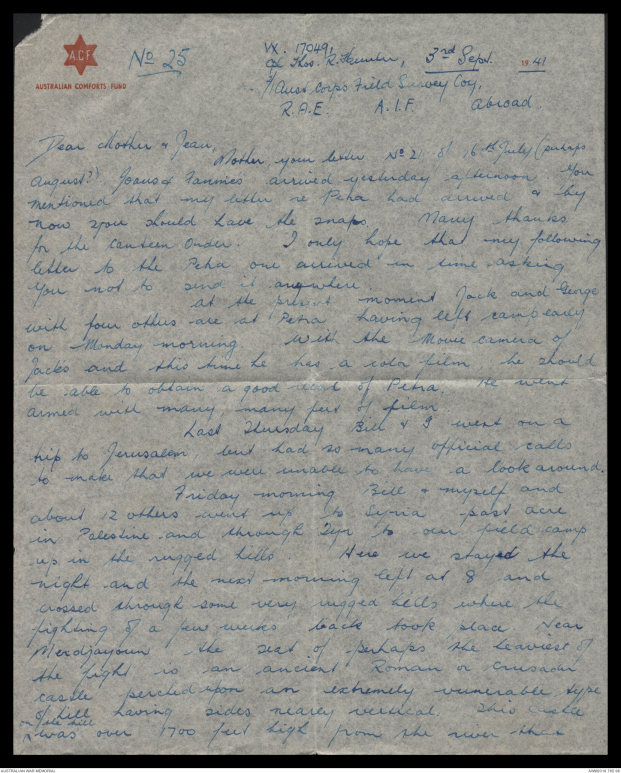
AUSTRALIAN COMFORTS FUND
No 25
VX 17049
Cpl Thos. R. Hunter, 3rd Sept 1941
2/1 Aust Corps Field Survey Coy,
R.A.E. A.I.F. Abroad
Dear Mother & Jean
Mother your letter No 21 of 16th July (perhaps
August?) Joans & Fannies arrived yesterday afternoon. You
mentioned that my letter re Petra had arrived & by
now you should have the snaps. Many thanks
for the canteen Order. I only hope that my following
letter to the Petra one arrived in time asking
you not to send it anywhere.
At the present moment Jack and George
with four others are at Petra having left camp early
on Monday morning. With the Movie camera of
Jack's and this time he has a color film, he should
be able to obtain a good record of Petra. He went
armed with many, many feet of film.
Last Thursday Bill & I went on a
trip to Jerusalem, but had so many official calls
to make that we were unable to have a look around.
Friday morning Bill & myself and
about 12 others went up to Syria past Acre
in Palestine and through Tyre to our field camp
up in the rugged hills. Here we stayed the
night and the next morning left at 8 and
crossed through some very rugged hills where the
fighting of a few weeks back took place. Near
Merdjayoun - the seat of perhaps the heaviest of
the fight is an ancient Roman or Crusader
castle perched upon an extremely vunerable type
of hill having sides nearly vertical. This castle
^on the hill was over 1700 feet high from the river that
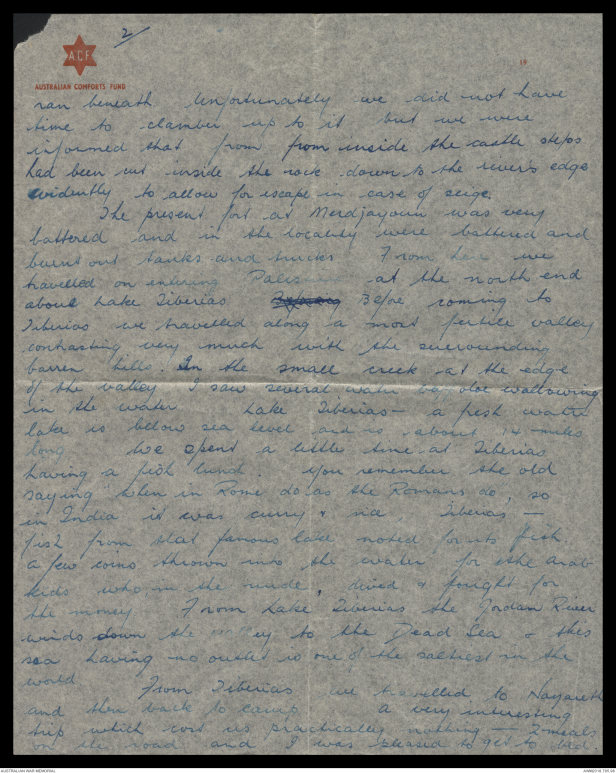
2
AUSTRALIAN COMFORTS FUND
ran beneath. Unfortunately we did not have
time to clamber up to it but we were
informed that from from inside the castle steps
had been cut inside the rock down to the river's edge
evidently to allow for escape in case of seige.
The present fort at Merdjayoun was very
battered and in the locality were battered and
burnt out tanks and trucks. From here we
travelled on entering Palestine - at the north end
about Lake Tiberias Before Before coming to
Tiberias we travelled along a most fertile valley
contrasting very much with the surrounding
barren hills. In the small creek at the edge
of the valley I saw several water buffaloe wallowing
in the water. Lake Tiberias - a fresh water
lake is below sea level and is about 14 miles
long. We spent a little time at Tiberias
having a fish lunch. You remember the old
saying when in Rome do as the Romans do, so
in India it was curry & rice, Tiberias —
fish from that famous lake noted for its fish.
A few coins thrown into the water for the Arab
kids who, in the nude, dived & fought for
the money. From Lake Tiberias the Jordan River
winds down the valley to the Dead Sea & this
sea having no outlet is one of the saltiest in the
world.
From Tiberias we travelled to Nazareth
and then back to camp. A very interesting
trip which cost us practically nothing — 2 meals
on the road and I was pleased to get to bed.
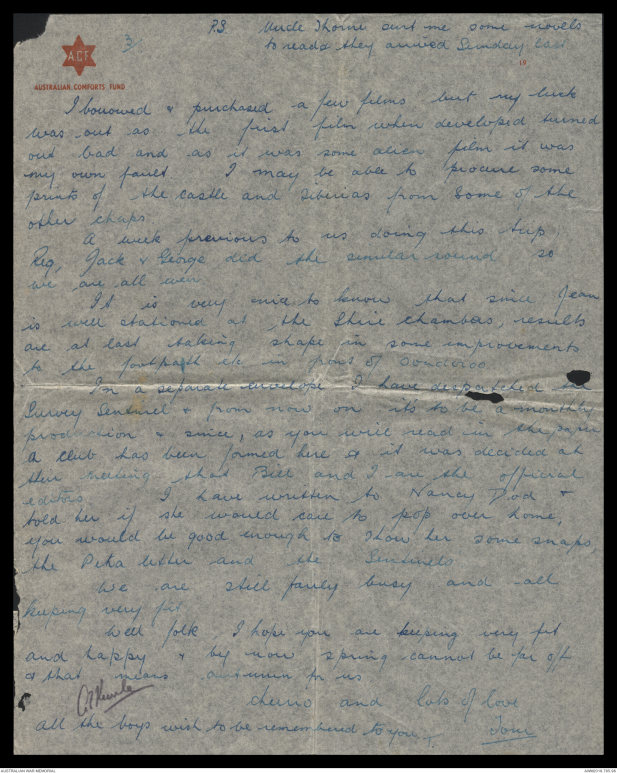
3
AUSTRALIAN COMFORTS FUND
[[*P.S. Uncle Thorne sent me some novels
to read & they arrived Sunday last*]]
I borrowed & purchased a few films but my luck
was out as the first film when developed turned
out bad and as it was some alien film it was
my own fault. I may be able to procure some
prints of the castle and Tiberias from some of the
other chaps.
A week previous to us doing this trip
Reg, Jack & Goerge did the similar round so
we are all even.
It is very nice to know that since Jean
is well stationed at the Shire Chambers, results
are at last taking shape in some improvements
to the foot path etc in front of Ooudoroo.
In a separate envelope I have despatched the
Survey Sentinel & from now on it's to be a monthly
production & since, as you will read in the paper
a club has been formed here & it was decided at
their meeting that Bill and I are the official
editors. I have written to Nancy Dad &
told her if she would care to pop over home,
you would be good enough to show her some snaps,
the Petra letter and the Sentinels
We are still fairly busy and all
keeping very fit.
Well folk I hope you are keeping very fit
and happy & by now spring cannot be far off
& that means autumn for us.
Cheerio and lots of love
Tom
[[*G. Hunter*]]
[[*all the boys wish to be remembered to you*]]
T.
25th
[[*G. Hunter*]]
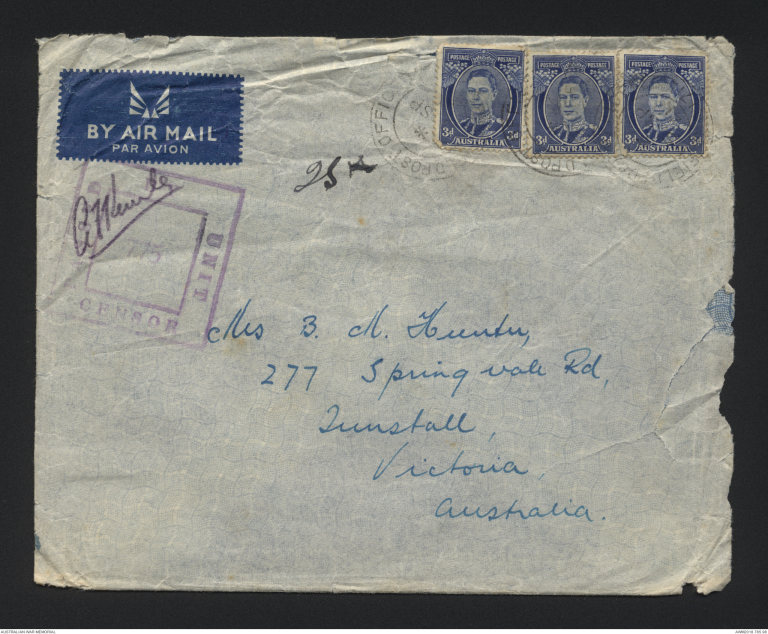
Mrs B.M. Hunter
277 Springvale Rd,
Tunstall,
Victoria,
Australia.
AWM2017.208.1
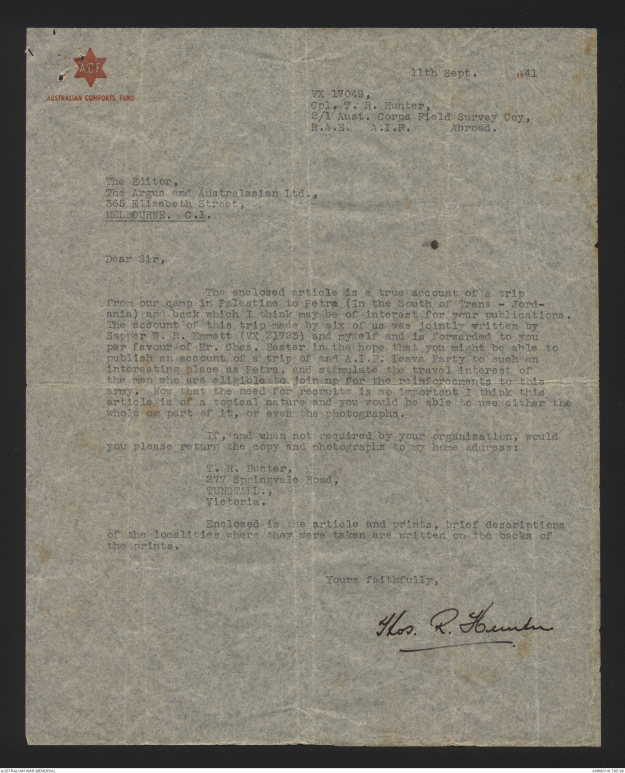
AUSTRALIAN COMFORTS FUND
11th Sept. 1941
VX 17049
Cpl. T.R Hunter,
2/1 Aust. Corps Field Survey Coy,
R.A.E. A.I.F. Abroad.
The Editor
The Argus and Australasian Ltd.,
365 Elizabeth Street,
MELBOURNE. C.1.
Dear Sir,
The enclosed article is a true account of a trip
from our camp in Palestine to Petra (In the South of Trans - Jordania)
and back which I think may be of interest for your publications.
The account of this trip made by six of us was jointly written by
Sapper W.R. Emmett (VX 21723) and myself and is forwarded to you
per favour of Mr Ches. Baster in the hope that you might be able to
publish an account of a trip of and A.I.F. Leave pParty to such an
interesting place as Petra, and stimulate the travel interest of
the men who are eligible to join up for the reinforcements to this
army. Now that the need for recruits is so important I think this
article is of a topical nature and you would be able to use either the
whole or part of it, or even the photographs.
If, and when no required by your organization, would
you please return the copy and photographs to my home address:
T.R. Hunter,
277 Springvale Road,
TUNSTALL.,
Victoria.
Enclosed is the article and prints, brief descriptions
of the localities where they were taken are written on the backs of
the prints.
Yours faithfully,
Thos. R. Hunter.
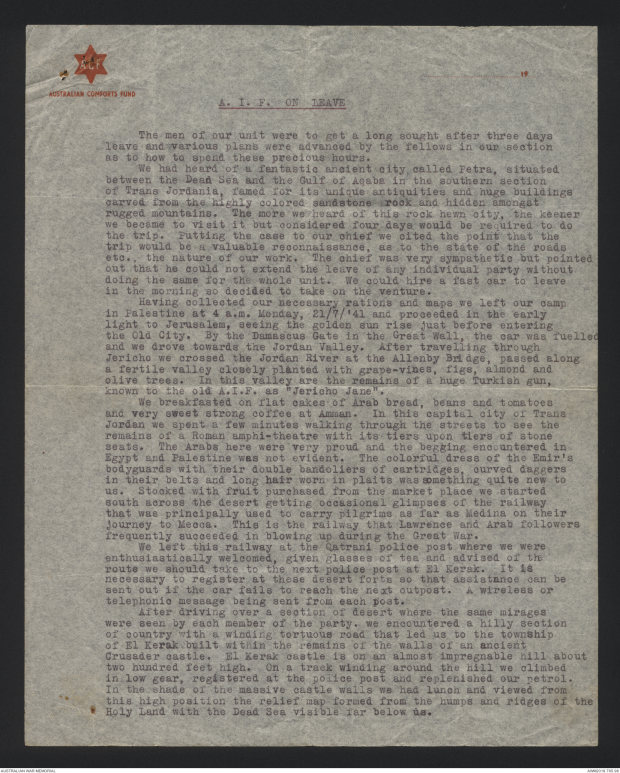
AUSTRALIAN COMFORTS FUND
A.I.F. ON LEAVE
The men of our unit were to get a long sought after three days
leave and various plans were advanced by the fellows in our section
as to how to spend these previous hours.
We had heard of a fantastic ancient city called Petra, situated
between the Dead Sea and the Gulf of Aqaba in the southern section
of Trans Jordania, famed for its unique antiquities and huge buildings
carved from the highly colored sandstone rock and hidden amongst
rugged mountains. The more we heard of this rock hewn city, the keener
we became to visit it but considered four days would be required to do
the trip. Putting the case to our chief we cited the point that the
trip would be a valuable reconnaissance, as to the state of the roads
etc., the nature of our work. The chief was very sympathetic but pointed
out that he could not extend the leave of any individual party without
doing the same for the whole unit. We would hire a fast car to leave
in the morning so decided to take on the venture.
Having collected our necessary rations and maps we left our camp
in Palestine at 4 a.m. Monday, 21/7/'41 and proceeded in the early
light to Jerusalem, seeing the golden sun rise just before entering
the Old City. By the Damascus Gate in the Great Wall, the car was fuelled
and we drove towards the Jordan Valley. After travelling through
a fertile valley closely planted with grape-vines, figs, almond and
olive trees. In this valley are the remains of a huge Turkish gun,
known to the old A.I.F. as "Jericho Jane".
We breakfasted on flat cakes of Arab bread, beans and tomatoes
and very sweet strong coffee at Amman. In this capital city of Trans
Jordan we spent a few minutes walking through the streets to see the
remains of a Roman amphi-theatre with its tiers upon tiers of stone
seats. The Arabs here were very proud and the begging enccountered in
Egypt and Palestine was not evident. The colorful dress of the Emirs
bodyguards with their double bandoliers of cartridges, curved daggers
in their belts and long hair worn in plaits was something quite new to
us. Stocked with fruit purchased from the market place we started
south across the desert getting occasional glimpses of the railway
that was principally used to carry pilgrims as far as Medina on their
journey to Mecca. This is the railway that Lawrence and Arab followers
frequently succeeded in blowing up during the Great War.
We left this railway at the Qatrani police post where we were
enthusiastically welcomed, given glasses of tea and advised of the
route we should take to the next police post at El Kerak. It is
necessary to register at these desert forts so that assistance can be
sent out if the car fails to reach the next outpost. A wireless or
telephone message being sent from each post.
After driving over a section of desert where the same mirages
were seen by each member of the party, we encountered a hilly section
of country with a winding torturous road that led us to the township
of El Kerak built within the remains of the walls of an ancient
Crusader castle. El Kerak castle is on an almost impregnable hill about
two hundred feet high. On a track winding around the hill we climbed
in low hear, registered at the police post and replenished our petrol.
In the shade of the massive castle walls we had lunch and viewed from
this high position the relief map formed from the humps and ridges of the
Holy Land with the Dead Sea visible far below us.
AUSTRALIAN COMFORTS FUND
PAGE 2
2.
Travelling on and on we came to a huge ravine which reminded us
of pictures of the Grand Canyon. Twisting and turning down a narrow road,
the bottom was eventually reached and soon the climb up the other side
made us realize just how deep and steep was this gorge. Low gear for
most of the climb made our engine boil and gave us a couple of spells
to review this wadi. Back to the high ground again we picked up our
speed and passed several forts or police posts. The forts are as
the pictures show us in the P.C. Wren type of books.
As the sun was falling myriads of jagged mountains to the west
could be seen and amidst these was our objective - Petra. At dusk,
seven weary persons arrived at Wadi Musa, an Arab village and Arab
Legion Post. Hurriedly we grabbed our packs and accessories and after
the formality of signing a book at the post, six tired soldiers scrambled
on to arab ponies, proceeded through the village which is built on the
side of a hill and terraces of vines, figs and pomegranates $ were about
on the outskirts of the village. About a mile away, now quite dark, we
entered the Siq - a gorge or wadi which leads to Petra and the only
noise was that of the steel plated from the ponies' hoofs. The wadi
wandered about and became narrower. Already carvings in Roman and what
appeared to be Greek design could just be discerned by the aid of a
torch. The wadi deepened, perhaps in places to two hundred feet or more
and throughout our journey an Arab sang in a minor key to scare away
the evil spirits of the departed race which Arab legend tells exists.
Finally we dismounted and paid the respective owners of the ponies two
ackers (6d.) and Fooks, the official Arab tea-maker had our billy boiling
in a few minutes. A much wanted cup of tea and some salmon satisfied
our hunger and in about five minutes we were all fast asleep, our guides
sleeping about ten feet away with ancient rifles by their sides.
On awakening at 5.30, we found ourselves on a ledge outside a Nabataean
cave. The Nabataeans were a race who lived here before being
captured by the Romans. The view was beautiful - soft pleasant pastel
shades that continually changed with the sun's movement. Colors and
tints that could not be expressed in words. The only way to appreciate
them is to see them. A refreshing cup of tea and off we went, climbing
a wadi for one hour and all the time one did not know where to look for
the colors and views were magnificient in every direction. Our objective,
the "Dier" or Convent was reached, a huge carved temple about 150 feet
high stood before us. The symmetry of design was perfect and on closer
study the fine tool work could be seen, in many places as good as the
day it was performed. Carved in sandstone of magenta coloring with gentle
shades of buffs, brown, creams and pinks meandering through it, it was
a sight never to be forgotten. The interior was plainly but accurately
cut and a set-in, stone dais completed the furnishings.
Climbing around the rough rock at the back we reached the top and
from here the Wadi Arabah which is an extension of the valley of the
Dead Sea could be seen some 4000 feet beneath us and to the west.
On the return journey to the camp we detoured up a stepped path
cut in the side of a ravine, where from a fissure water dripped and
maiden hair fern with the gorgeous striped rock back ground formed a
grand setting for the Roman baths that had been hews in the rock. The
water was cool and most delightful to drink and we would have been
contented to have stayed at this delightful spot for the rest of the
AUSTRALIAN COMFORTS FUND
PAGE 3
3.
of the/
day but were anxious to see more of the wonders of this forgotten
city in the limited time at our disposal. Wending our way back over
stone steps, in places almost worn away by time, we viewed carvings
and caves but in the cliff face with steps and small footpaths leading
to them.
Another mug of tea at our base and thence to the Sacrificial Rock,
a place where human sacrifice was performed upon one of the highest
cliffs. After much climbing on narrow ledges - in one place only
a foot wide and a drip of possibly 150 feet, we reached this
Rock and here - perfectly hewn out was a level platform on one side of
which stood a raised section shaped to take the human offering and
behind the section was a place where the priests stood. It is presumed
that from here the body was cast into the very deep gorge below. The
main pastime of the Arab guide who accompanied us was to unload and
reload his long rifle then ask for a cigarette or a drink from our
water bottles. From this high place of the Sacrificial Rock we were
again presented with a colorful panoramic view of the rugged country
and to our left on the highest point could be seen Aaron's Tomb, where
only Moslems are allowed to visit.
In the afternoon we visited more large buildings and carvings in
the facades of the surrounding cliffs. There were only a few buildings
here and nearly all the temples etc. were carved from the solid rock.
Some possessed Latin inscriptions and designs were to be seen on the
exteriors and interiors and some had Assyrian writings. On entering
some of the more accessible tombs it was seen that the Bedouins and
their goats frequented these places during winter time and the beauty
of the colored stone was marred from their camp fires. Some temples
side by side were respectively Roman and Greek in their design which
tells one of the great age of time of the occupation of Petra. The
Nabataeans combined the Greek features in their buildings but had not
learned the Roman style of architecture.
An amphi-theatre, the capacity of which makes one realize that
the population must have been of many thousands is carved in mauve
colored rock and the seats in the rear or "In the Gods" reached a
height of 70 to 80 feet. Further up the Siq past the Amphi-theatre is
Pharoah's treasury or Tomb of the Urn. Treasure looted from the caravans
travelling along the nearby routes from Arabia is said to be hidden
in this building and the walls and the Urn surmounting the building are
pitted by bullet marks fired by people in the hope of releasing the
treasure which local tradition says is hidden there.
One of the problems which they faced and overcame with great
ingenuity was that of the water supply. The two springs in the city
soon became insufficient to supply the constantly increasing demands
of the population. Vast cisterns were cut in the rock and lined with
plaster, and channels were cut in every hillside, which collected the
rain-water as it poured over the rock-face, and conducted it to the
cisterns. Everywhere you look you will see these channels, evidence of
the care and fore-thought of the rulers of the city.
 Jasmine Hatharasinghe
This transcription item is now locked to you for editing. To release the lock either Save your changes or Cancel.
This lock will be automatically released after 60 minutes of inactivity.