
Letters from Harold Edward 'Pompey' Elliott to his cousin Emily Edwards, July 1916 - December 1918 - Part 10
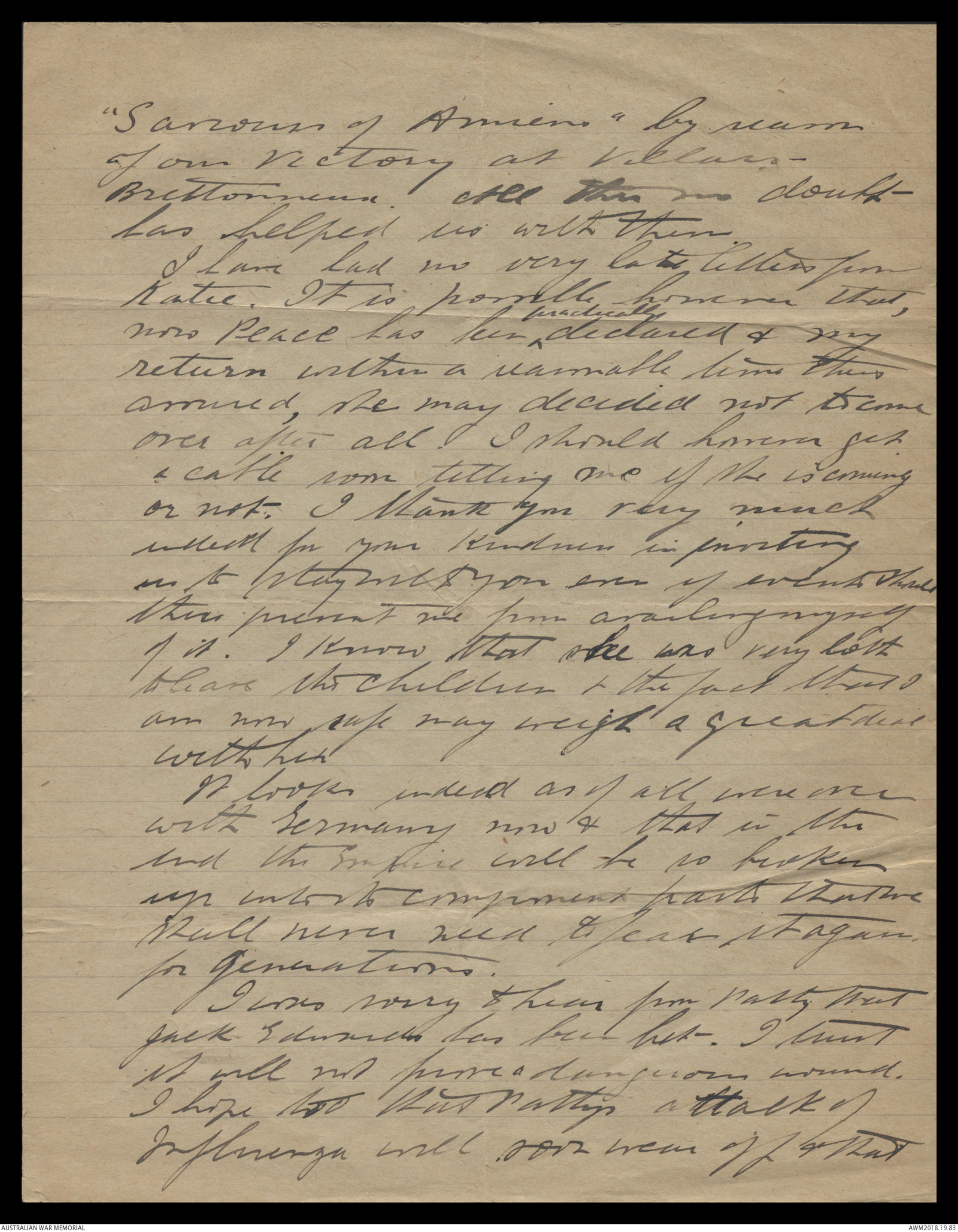
"Saviours of Amien" by reason
of our victory at Villars-Brettonneux.
All this no doubt
has helped us with them.
I have had no very late letters from
Katie. It is possible however that,
now Peace has been ∧practically declared & my
return within a reasonable time thus
assured, she may decided not to come
over after all. I should however get
a cable soon telling me if she is coming
or not. I thank you very much
indeed for your kindness in inviting
us to stay with you even if events should
then prevent me from availing myself
of it. I know that she was very loth
to leave the children & the fact that I
am now safe may weigh a great deal
with her.
It looks indeed as if all were over
with Germany now & that in the
end the Empire will be so broken
up into its component parts that we
shall never need to fear it again,
for generations.
I was sorry to hear from Patty that
Jack Edwards has been hit. I trust
it will not prove a dangerous wound.
I hope too that Pattys attack of
Influenza will soon wear off & that
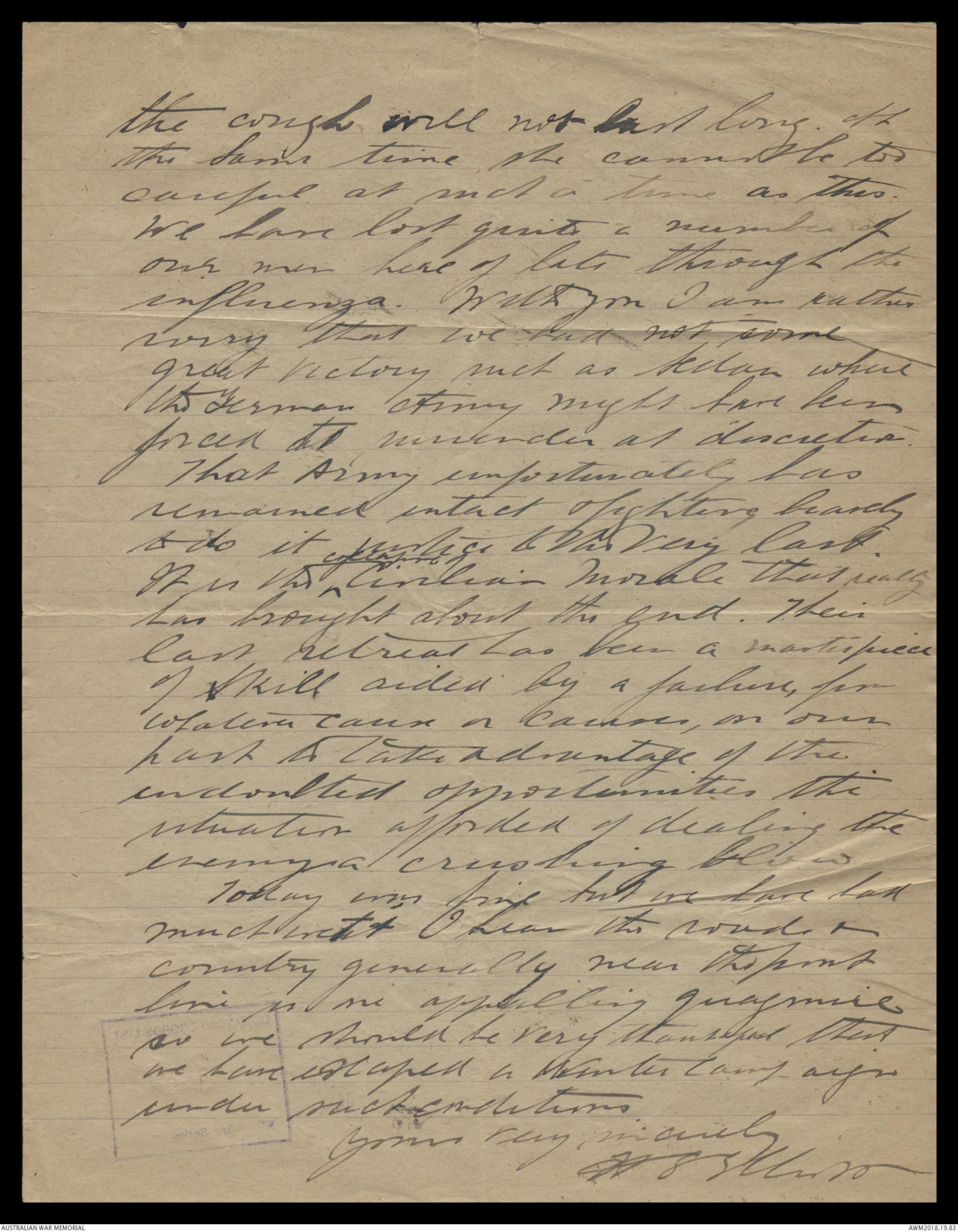
the cough will not last long. At
the same time she cannot be too
careful at such a time as this.
We have lost quite a number of
our men here of late through the
influenza. With you I am rather
sorry that we had not some
great Victory such as Sudan where
the German Army might have been
forced to surrender at discretion.
That Army unfortunately has
remained intact & fighting bravely
to do it justice to the very last.
It is the ^collapse of Civilian Morale that really
has brought about the end. Their
last retreat has been a masterpiece
of skill aided by a failure, for
whatever cause or causes, on our
part to take advantage of the
undoubted opportunities the
situation afforded of dealing the
enemy a crushing blow
Today was fine but we have had
much wet & I hear the roads on
country generally near the front
line is an appalling quagmire
so we should be very thankful that
we have escaped a winter campaign
under such conditions.
Yours very sincerely
H E Elliott
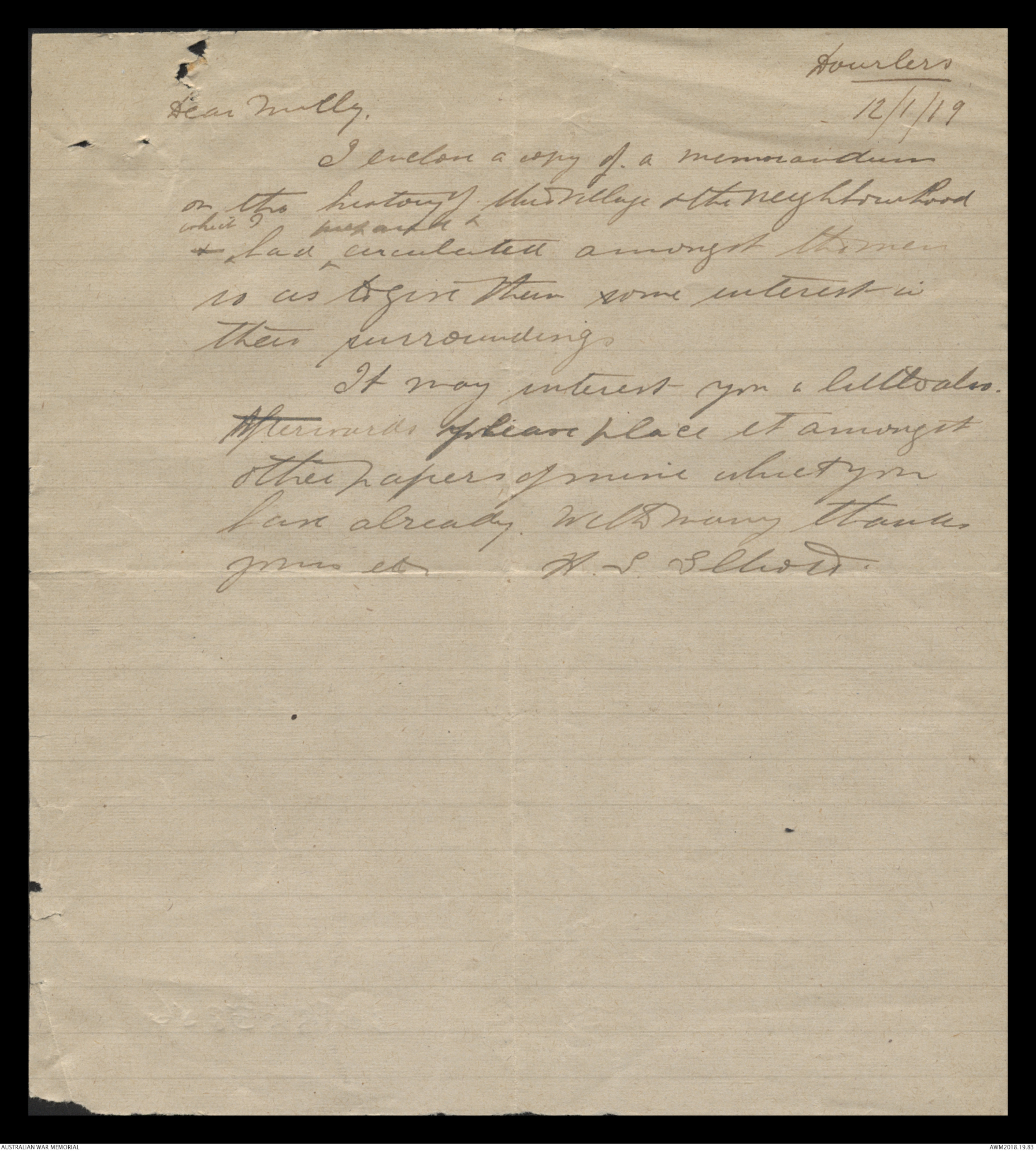
Dourlers
12/1/19
Dear Milly,
I enclose a copy of a memorandum
on the history of this village & the neighbourhood& ^which I had ^prepared & circulated amongst the men
so as to give them some interest in
their surroundings.
It may interest you a little also.
Afterwards please place it amongst
other papers of mine which you
have already. With many thanks
yours etc H.E. Elliott
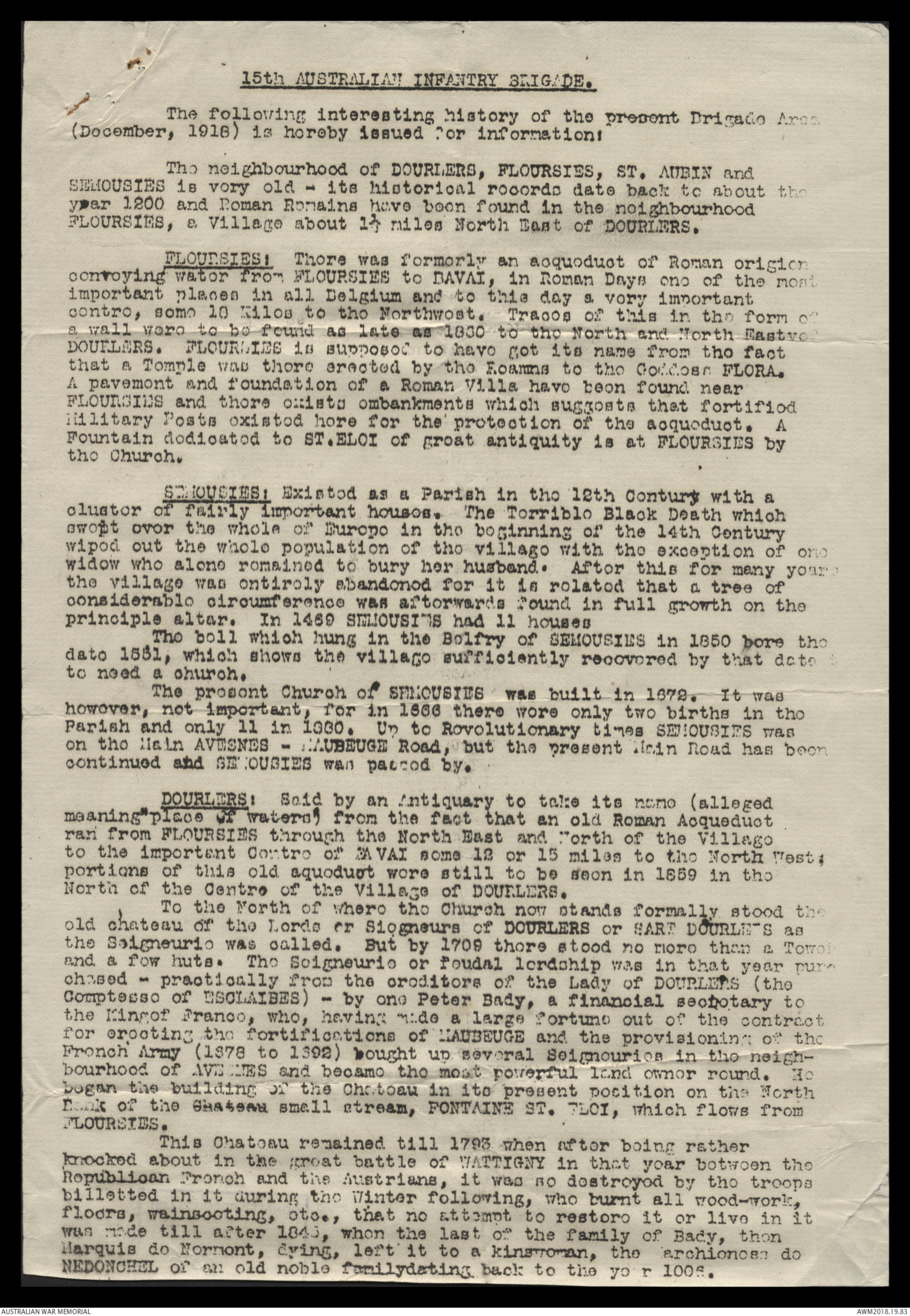
15th AUSTRALIAN INFANTRY BRIGADE.
The following interesting history of the present Brigade Area
(December, 1918) is hereby issued for information:
The neighbourhood of DOURLERS, FLOURSIES, ST. AUBIN and
SEMOUSIES is very old - its historical records date back to about the
year 1200 and Roman Remains have been found in the neighbourhood
FLOURSIES, a Village about 1½ miles North East of DOURLERS.
FLOURSIES: There was formerly an acqueduct of Roman origion
conveying water from FLOURSIES to BAVAI, in Roman Days one of the most
important places in all Belgium and to this day a very important
centre, some 18 Kilos to the Northwest. Traces of this in the form of
a wall were to be found as late as 1830 to the North and Worth Eastvof
DOURLERS. FLOURSIES is supposed to have got its name from the fact
that a Temple was there erected by the Roamns to the Goddess FLORA.
A pavement and foundation of a Roman Villa have been found near
FLOURSIES and there exists embankments which suggests that fortified
Military Posts existed here for the protection of the acqueduct. A
Fountain dedicated to ST.ELOI of great antiquity is at FLOURSIES by
the Church.
SEMOUSIES: Existed as a Parish in the 12th Century with a
cluster of fairly important houses. The Terrible Black Death which
swept over the whole of Europe in the beginning of the 14th Century
wiped out the whole population of the village with the exception of one
widow who alone remained to bury her husband. After this for many years
the village was entirely abandoned for it is related that a tree of
considerable circumference was afterwards found in full growth on the
principle altar. In 1469 SEMOUSIES had 11 houses
The bell which hung in the Belfry of SEMOUSIES in 1850 bore the
date 1551, which shows the village sufficiently recovered by that date
to need a church.
The present Church of SEMOUSIES was built in 1672. It was
however, not important, for in 1666 there were only two births in the
Parish and only 11 in 1880. Up to Revolutionary times SEMOUSIES was
on the Main AVESNES - MAUBEUGE Road, but the present Main Road has been
continued and SEMOUSIES was passed by.
DOURLERS: Said by an Antiquary to take its name (alleged
meaning "place of waters") from the fact that an old Roman Acqueduct
ran from FLOURSIES through the North East and North of the Village
to the important Centre of BAVAI some 12 or 15 miles to the North West,
portions of this old aqueduct were still to be seen in 1859 in the
North of the Centre of the Village of DOURLERS.
To the North of where the Church now stands formally stood the
old chateau of the Lords or Siegneurs of DOURLERS or SART DOURLES as
the Seigneurio was called. But by 1709 there stood no more than a Tower
and a few huts. The Seigneurie or feudal lordship was in that year purchased
- practically from the creditors of the Lady of DOURLERS (the
Comptesse of ESCLAIBES) - by one Peter Bady, a financial secretary to
the King of France, who, having made a large fortune out of the contract
for erecting the fortifications of MAUBEUGE and the provisioning of the
French Army (1678 to 1692) bought up several Seignouries in the neighbourhood
of AVERNES and became the most powerful land owner round. He
began the building of the Chateau in its present position on the North
Bank of the Chateau small stream, FONTAINE ST. FLOI, which flows from
FLOURSIES.
This Chateau remained till 1793 when after being rather
Knocked about in the great battle of WATTIGNY in that year between the
Republican French and the Austrians, it was so destroyed by the troops
billetted in it during, the Winter following, who burnt all wood-work,
floors, wainscoting, etc., that no attempt to restore it or live in it
was made till after 1845, when the last of the Family of Bady, then
Marquis de Normont, dying, left it to a kinswoman, the archieness de
NEDONCHEL of an old noble familydating back to the year 1006.
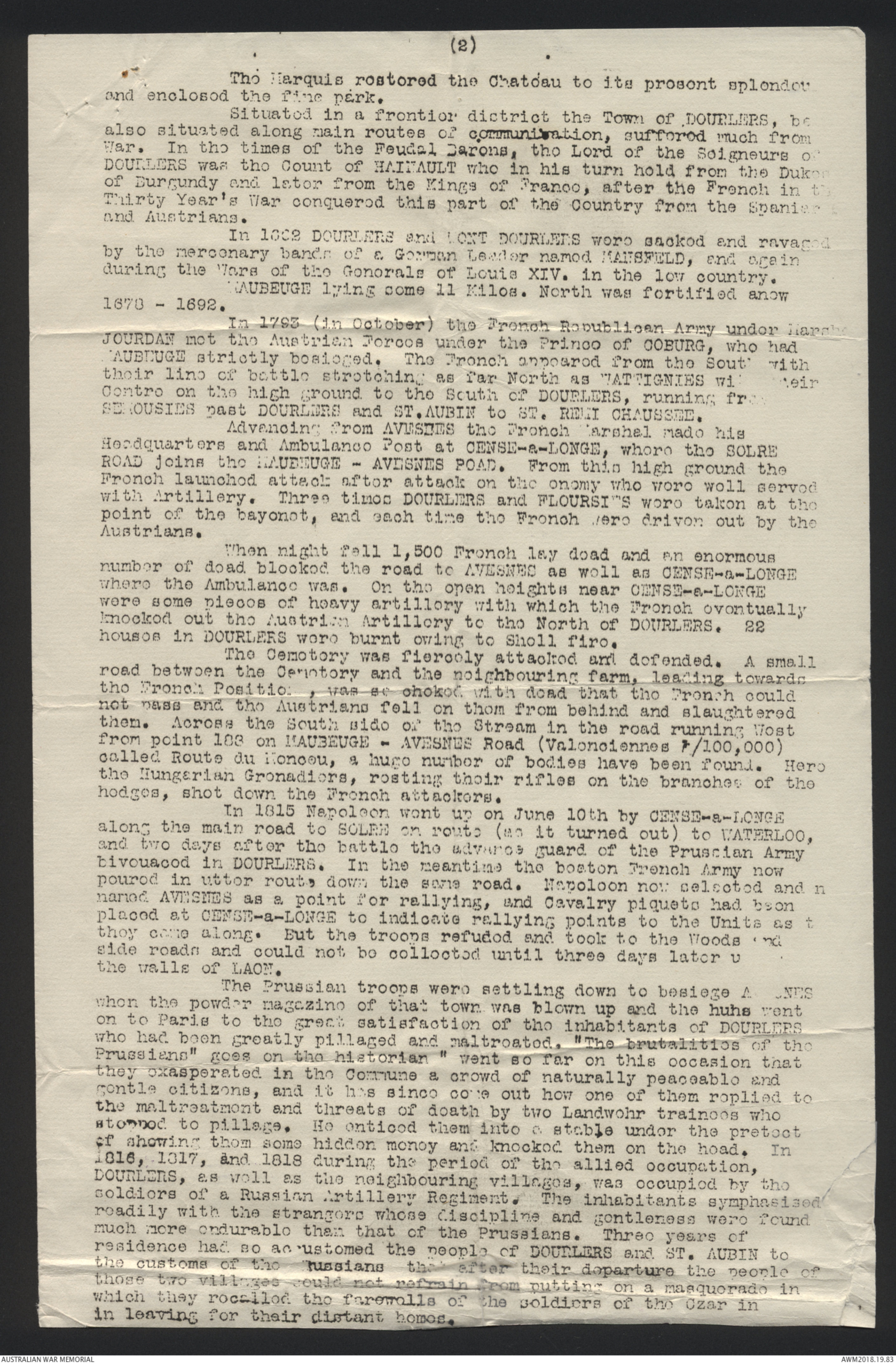
(2)
The Marquis restored the Chateau to its present splendour
and enclosed the fine park.
Situated in a frontier district the Town of DOURLERS, be
also situated along main routes of communication, suffered much from
War. In the times of the Feudal Barons, the Lord of the Seigneurs of
DOURLERS was the Count of HAINAULT who in his turn hold from the Dukes
of Burgundy, and later from the Kings of France, after the French in the
Thirty Year's War conquered this part of the Country from the Spanish
and Austrians.
In 1662 DOURLERS and MONT DOURLERS were sacked and ravaged
by the mercenary bands of a German Leader named MANSFELD, and again
during the Wars of the Generals of Louis XIV. in the low country.
MAUBEUGE lying some 11 Kilos. North was fortified anew
1678 - 1692.
In 1793 (in October) the French Republican Army under Marshal
JOURDAN met the Austrian Forces under the Prince of COBURG, who had
MAUBEUGE strictly besieged. The French appeared from the South with
their line of battle stretching as far North as WATTIGNIES with their
Centre on the high ground to the South of DOURLERS, running from
SEMOUSIES past DOURLERS and ST. AUBIN to ST. REMI CHAUSSEE.
Advancing from AVESNES the French Marshal made his
Headquarters and Ambulance Post at CENSE-a-LONGE, where the SOLRE
ROAD Joins the MAUBEUGE - AVESNES ROAD. From this high ground the
French launched attack after attack on the enemy who wore well served
with Artillery. Three times DOURLERS and FLOURSIES were taken at the
point of the bayonet, and each time the French were driven out by the
Austrians.
When night fell 1,500 French lay dead and an enormous
number of dead blocked the road to AVESNES as well as CENSE-a-LONGE
where the Ambulance was. On the open heights near CENSE-a-LONGE
were some pieces of heavy artillery with which the French eventually
knocked out the Austrian Artillery to the North of DOURLERS. 22
houses in DOURLERS were burnt owing to Shell fire.
The Cemetery was fiercely attacked and defended. A small
road between the Cemetery and the neighbouring farm, leading towards
the French Position, was so choked with dead that the French could
not pass and the Austrians fell on them from behind and slaughtered
them. Across the South side of the Stream in the road running West
from point 183 on MAUBEUGE - AVESNES Road (Valenciennes 1/100,000)
called Route du Monceu, a huge number of bodies have been found. Here
the Hungarian Grenadiers, resting their rifles on the branches of the
hedges, shot down the French attackers.
In 1815 Napoleon want up on June 10th by CENSE-a-LONGE
along the main road to SOLRE en route (as it turned out) to WATERLOO,
and two days after the battle the advance guard of the Prussian Army
bivouaced in DOURLERS. In the meantime the beaten French Army now
poured in utter route down the same road. Napoleon now selected and n
named AVESNES as a point for rallying, and Cavalry piquets had been
placed at CENSE-a-LONGE to indicate rallying points to the Units as t
they came along. But the troops refused and took to the Woods and
side roads and could not be collected until three days later u
the walls of LAON.
The Prussian troops were settling down to besiege AVESNES
when the powder magazine of that town was blown up and the huns went
on to Paris to the great satisfaction of the inhabitants of DOURLERS
who had been greatly pillaged and maltreated. "The brutalities of the
Prussians" goes on the historian "went so far on this occasion that
they exasperated in the Commune a crowd of naturally peaceable and
gentle citizens, and it has since come out how one of them replied to
the maltreatment and threats of death by two Landwehr trainees who
stopped to pillage. He enticed them into a stable under the pretect
of showing them some hidden money and knocked them on the head. In
1816, 1817, and 1818 during the period of the allied occupation,
DOURLERS, as well as the neighbouring villages, was occupied by the
soldiers of a Russian Artillery Regiment. The inhabitants symphasised
readily with the strangers whose discipline, and gentleness were found
much more endurable than that of the Prussians. Three years of
residence had so accustomed the people of DOURLERS and ST. AUBIN to
the customs of the Russians that after their departure the people of
those two villages could not refrain from putting on a masquerade in
which they recalled the farewells of the soldiers of the Czar in
in leaving for their distant homes.
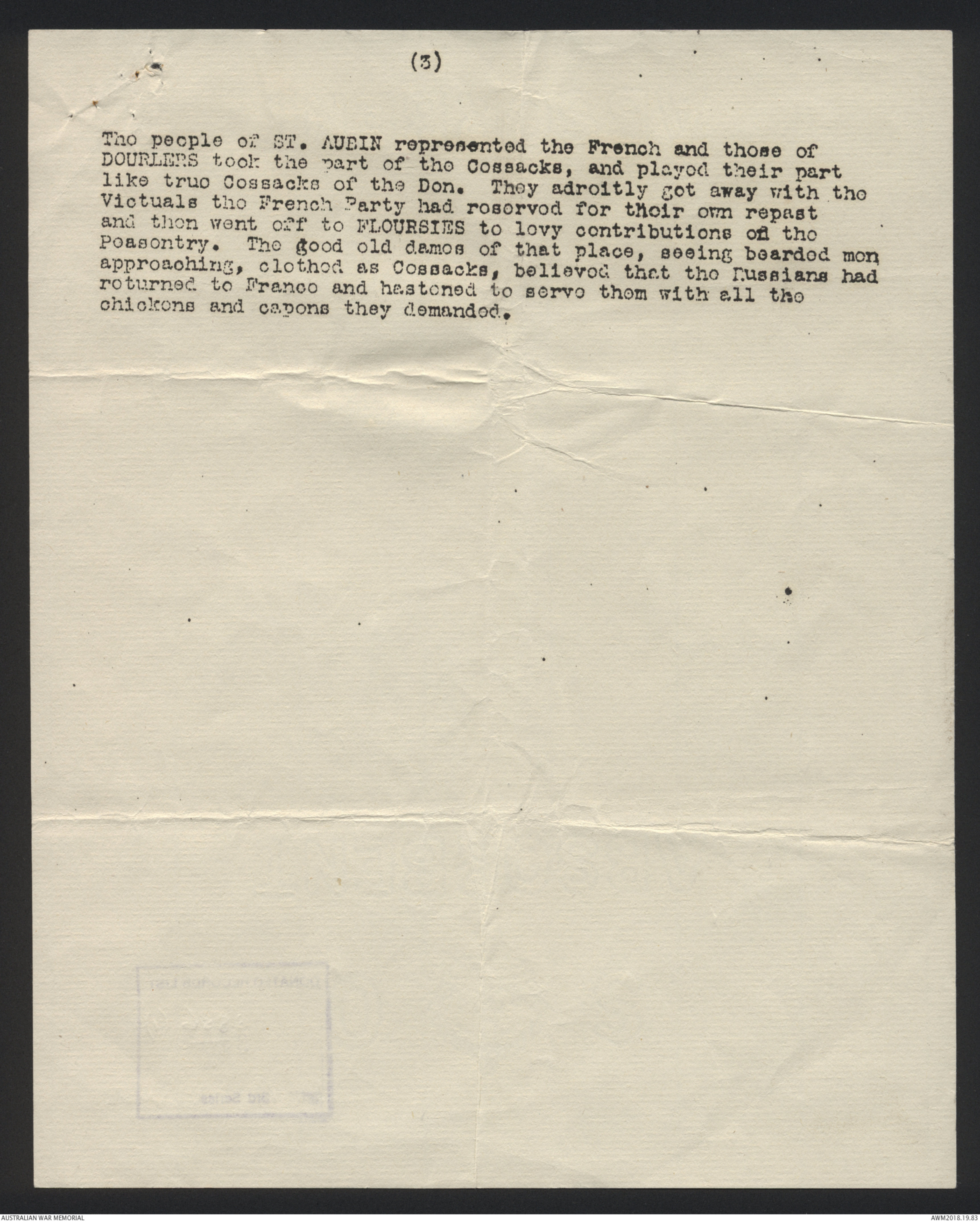
(3)
The people of ST. AUBIN represented the French and those of
DOURLERS took the part of the Cossacks, and played their part
like true Cossacks of the Don. They adroitly got away with the
Victuals the French Party had reserved for their own repast
and then went off to FLOURSIES to levy contributions of the
Peasentry. The good old dames of that place, seeing bearded men
approaching, clothed as Cossacks, believed that the Russians had
returned to France and hastened to serve them with all the
chickens and capons they demanded.
 Marisa Bortolotto
This transcription item is now locked to you for editing. To release the lock either Save your changes or Cancel.
This lock will be automatically released after 60 minutes of inactivity.