
Diary written by Eric Giles Miller, 1914-1917 - Part 1
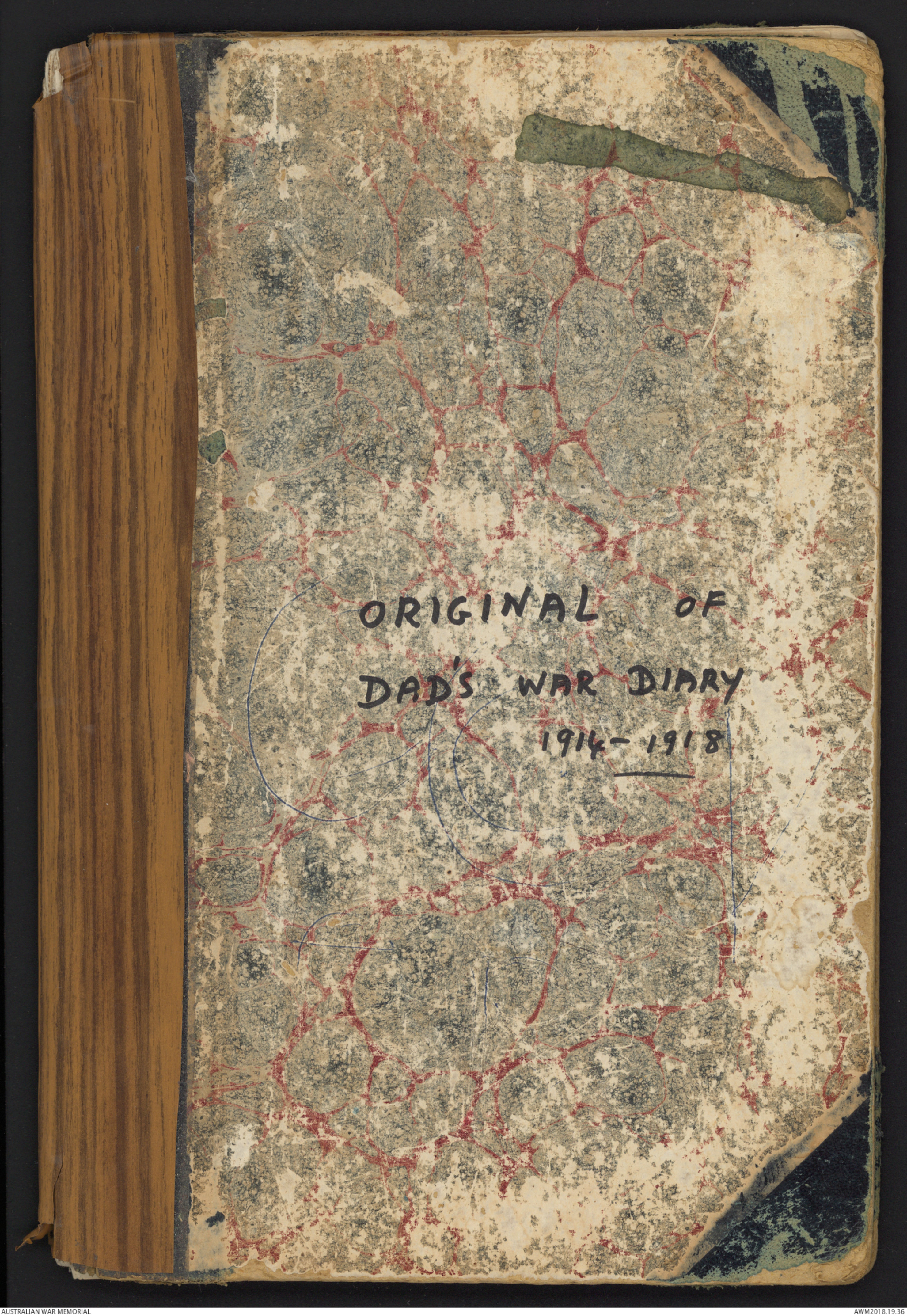
ORIGINAL OF
DAD'S WAR DIARY
1914 - 1918
Front Cover of Diary - refer to original document
|
Barndioota |
|||
| Agreement | Selector | Default | Remarks |
| 14238 | Cotrell T.L. | Insolvent | No ppl pts cell 17.8.86 |
|
Boncaut |
|||
| 17959 | Freebairn W. | Non-resident | Caution 2/12/86 |
| Agreement | Selector | Default | Remarks |
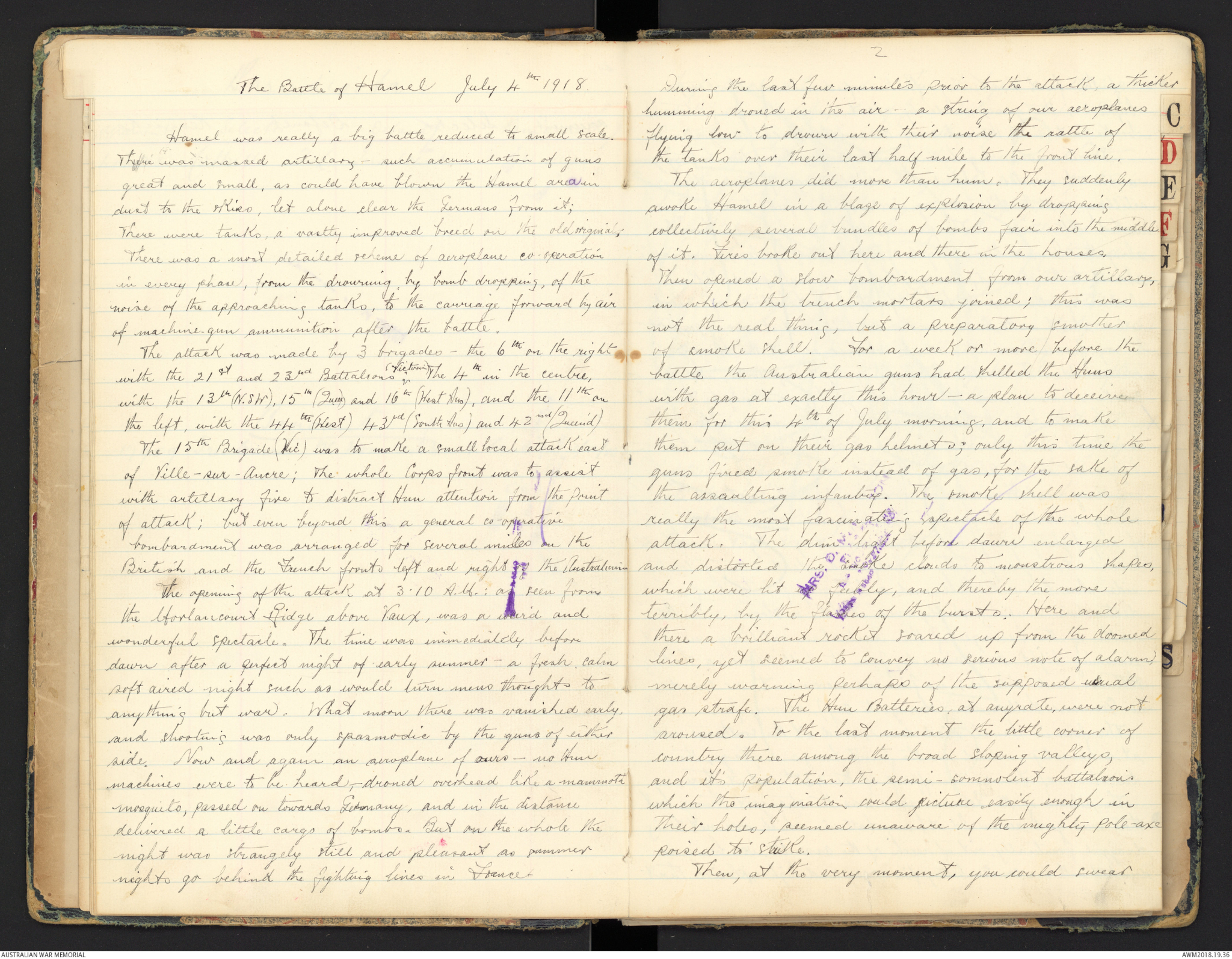
The Battle of Hamel July 4th 1918.
Hamel was really a big battle reduced to small scale.
There was massed artillary - such accumulation of guns
great and small, as could have blown the Hamel area in
dust to the skies, let alone clear the Germans from it;
There were tanks, a vastly improved breed on the old original;
There was a most detailed scheme of aeroplane co-operation
in every phase, from the drowning, by bomb dropping, of the
noise of the approaching tanks, to the carriage forward by air
of machine-gun ammunition after the battle.
The attack was made by 3 brigades - the 6th on the right
with the 21st and 23rd Battalions ^(Victoria) The 4th in the centre,
with the 13th (N.S.W), 15th (Queen) and 16th (West Aus), and the 11th on
the left, with the 44th (West) 43rd (South Aus) and 42nd (Queen'd)
The 15th Brigade (Vic) was to make a small local attack east
of Ville-sur-Ancre; The whole Corps front was to assist
with artillary fire & distract Hun attention from the point
of attack; but even beyond this a general co-operative
bombardment was arranged for several miles on the
British and the French fronts left and right of the Australians.
The opening of the attack at 3.10 A.M.: as seen from
the Morlancourt Ridge above Vaux, was a weird and
wonderful spectacle. The time was immediately before
dawn after a perfect night of early summer - a fresh, calm
soft aired night such as would turn mens thoughts to
anything but war. What moon there was vanished early,
and shooting was only spasmodic by the guns of either
side. Now and again an aeroplane of ours - no Hun
machine guns were to be heard, - droned overhead like a mammoth
mosquito, passed on towards Germany, and in the distance
delivered a little cargo of bombs. But on the whole the
night was strangely still and pleasant as summer
nights go behind the fighting lines in France.
2
During the last few minutes prior to the attack, a thicker
humming droned in the air - a string of our aeroplanes
flying low to drown with their noise the rattle of
the tanks over their last half mile to the front line.
The aeroplanes did more than hum. They suddenly
awoke Hamel in a blaze of explosion by dropping
collectively several bundles of bombs fair into the middle
of it. Fires broke out here and there in the houses.
Then opened a slow bombardment from our artillary,
in which the trench mortars joined; this was
not the real thing, but a preparatory smother
of smoke shell. For a week or more before the
battle the Australian guns had killed the Huns
with gas at exactly this hour - a plan to deceive
them for this 4th July morning, and to make
them put on their gas helmets; only this time the
guns fired smoke instead of gas, for the sake of
the assaulting infantry. The smoke shell was
really the most fascinating spectacle of the whole
attack. The dim light before dawn enlarged
and distorted the smoke clouds to monstrous shapes,
which were hit up feebly, and thereby the more
terribly, by the flames of the bursts. Here and
there a brilliant rocket soared up from the doomed
lines, yet seemed to convey no serious note of alarm,
merely warning perhaps of the supposed usual
gas strafe. The Hun Batteries, at anyrate, were not
aroused. To the last moment the little corner of
country there among the broad sloping valleys,
and it's population, the semi-somnolent battalions
which the imagination could picture easily enough in
Their holes, seemed unaware of the mighty pole-axe
poised to strike.
Then, at the very moment, you could swear
of the first awakening flicker of dawn over the horizon
beyond, the guns, suddenly alert and changing tone,
broke out into the salvo of the instant called Zero.
There was a big boom from the first counter-battery gun
a 12 inch monster behind the ordered array of the smaller
artillary, and the still morning air was thenceforth torn and
racked with noise. The previous slow succession of bursts
along the German line, irregular and rather careless, inumerable
almost the observer, now quickened and multiplied like
electric sparks over the whole front. Vast billows of smoke
rolled about with them, smoke so thick that it was impossible
to say for ten minutes or so whether or not the barrage
advanced. Gradually the morning light improved and the
smoke cleared, and Hamel village began dimly to stand out.
A little later the contours of the ground were visible up to
Vaire Wood and Accroche Wood and other timber above the
high road on the plateau. A tank or two could be seen
crawling near Hamel. The barrage dust smothered the
village, lashed it furiously, and passed on. No vestige
of any fighting going on - there was not yet light enough to
reveal it, anyway, only a half-dark dead-seeming countryside
close below the hill, and a low vengeful trail of
destruction sweeping slowly over it like a storm. In the
wake of the barrage of the Australian artillary in that
dawning light, there seemed, from the hill above, a striking
stillness and silence; no fires, no movement, no sounds,
no German shells even (strange to say), or very few.
The fires in Hamel died down, and at the southern end
at a housetop, waved on the faint breeze a flag, the
tri colour of France. An officer of the 43rd put it there.
The silence of the German guns was the strangest thing, but
there was good reason for it; any batteries which were not being
dragged frantically, out of reach of the assault were being so
drenched with our counter-battery fire of gas and high-explosive that
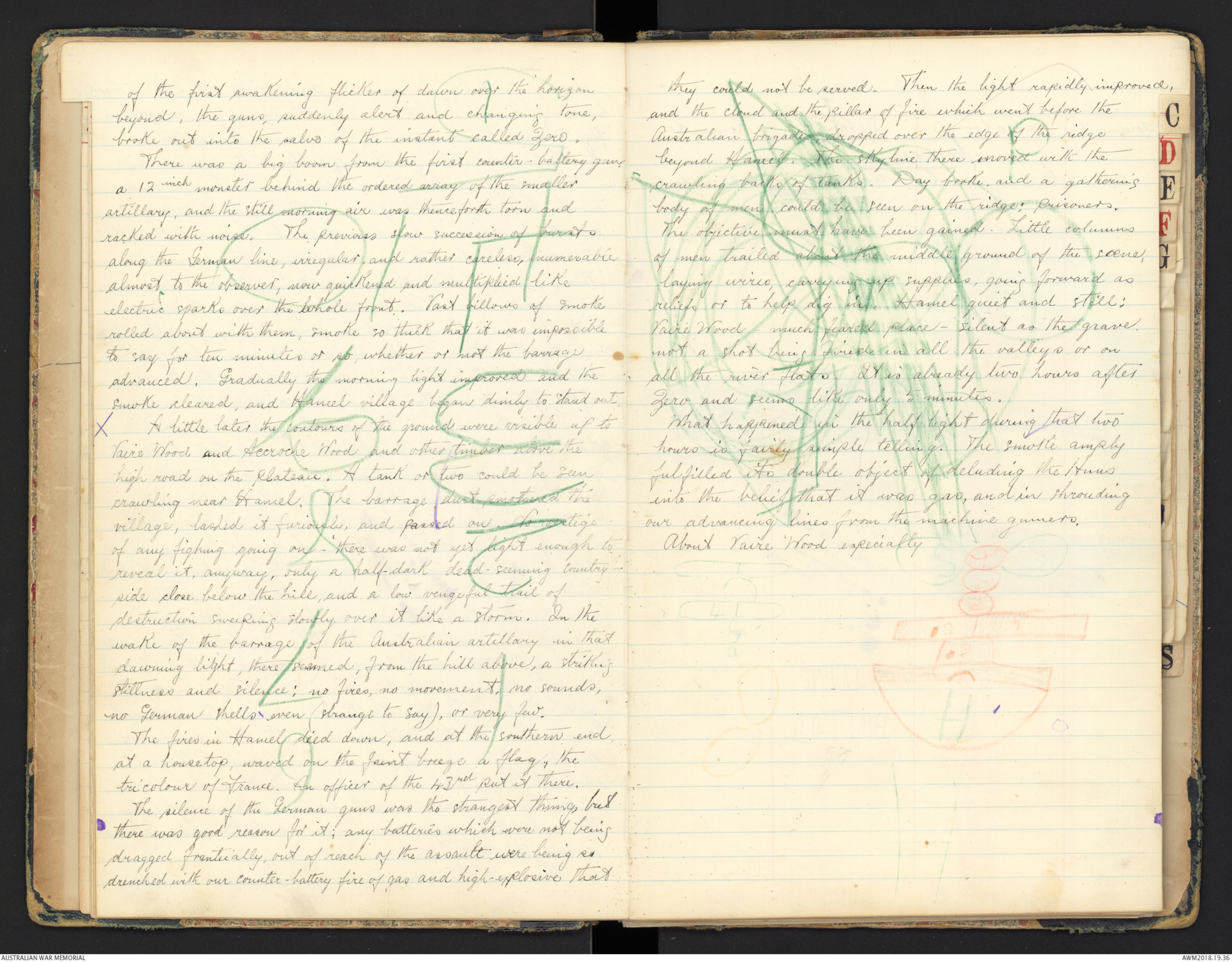
hand-drawn toddler-like scribble over pages - see original document
they could not be served. Then the light rapidly improved,
and the cloud and the pillar of fire which went before the
Australian brigade, dropped over the edge of the ridge
beyond Hamel. The skyline there moved with the
crawling backs of tanks. Day broke, and a gathering
body of men could be seen on the ridge; prisoners.
The objective must have been gained. Little columns
of men trailed about the middle ground of the scene,
laying wires, carrying up supplies, going forward as
reliefs or to help dig in. Hamel quiet and still;
Vaire Wood - much feared place - silent as the grave.
not a shot being fired in all the valleys or on
all the river flats. It is already two hours after
Zero and seems like only 5 minutes.
What happened in the half light during that two
hours is fairly simple telling. The smoke amply
fulfilled its double object of deluding the Huns
into the belief that it was gas, and in shrouding
our advancing lines from the machine gunners.
About Vaire Wood especially.
hand-drawn toddler-like scribble over pages - see original document
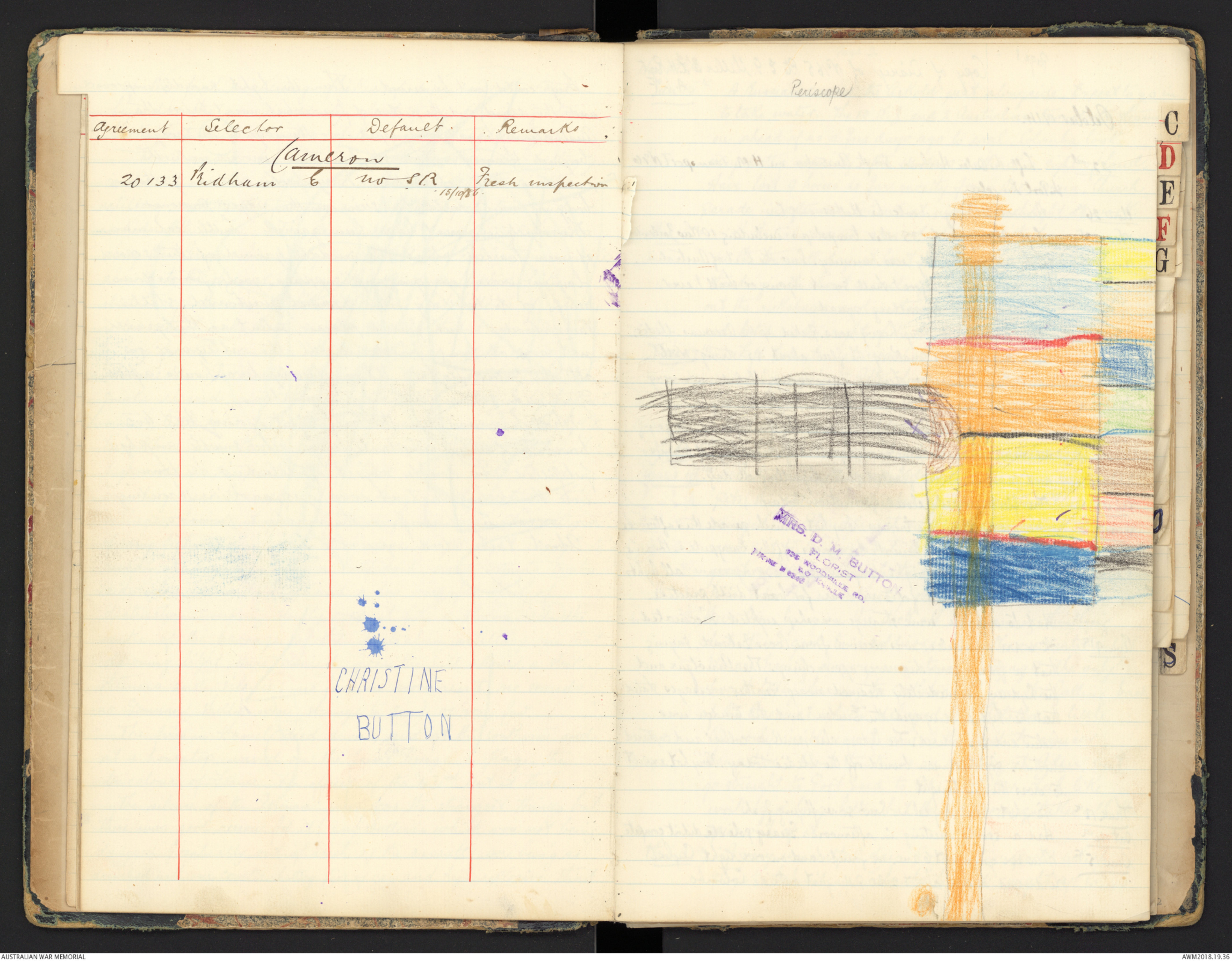
| Agreement | Selector | Default | Remarks |
| Cameron | |||
| 20133 | Pridham E |
No S.R. 15/10/86 |
Fresh inspection |
CHRISTINE
BUTTON
Periscope
Hand drawn diagram - see original document
MRS. D. M. BUTTON
FLORIST
136 WOODVILLE RD,
WOODVILLE.
PHONE [[?]]
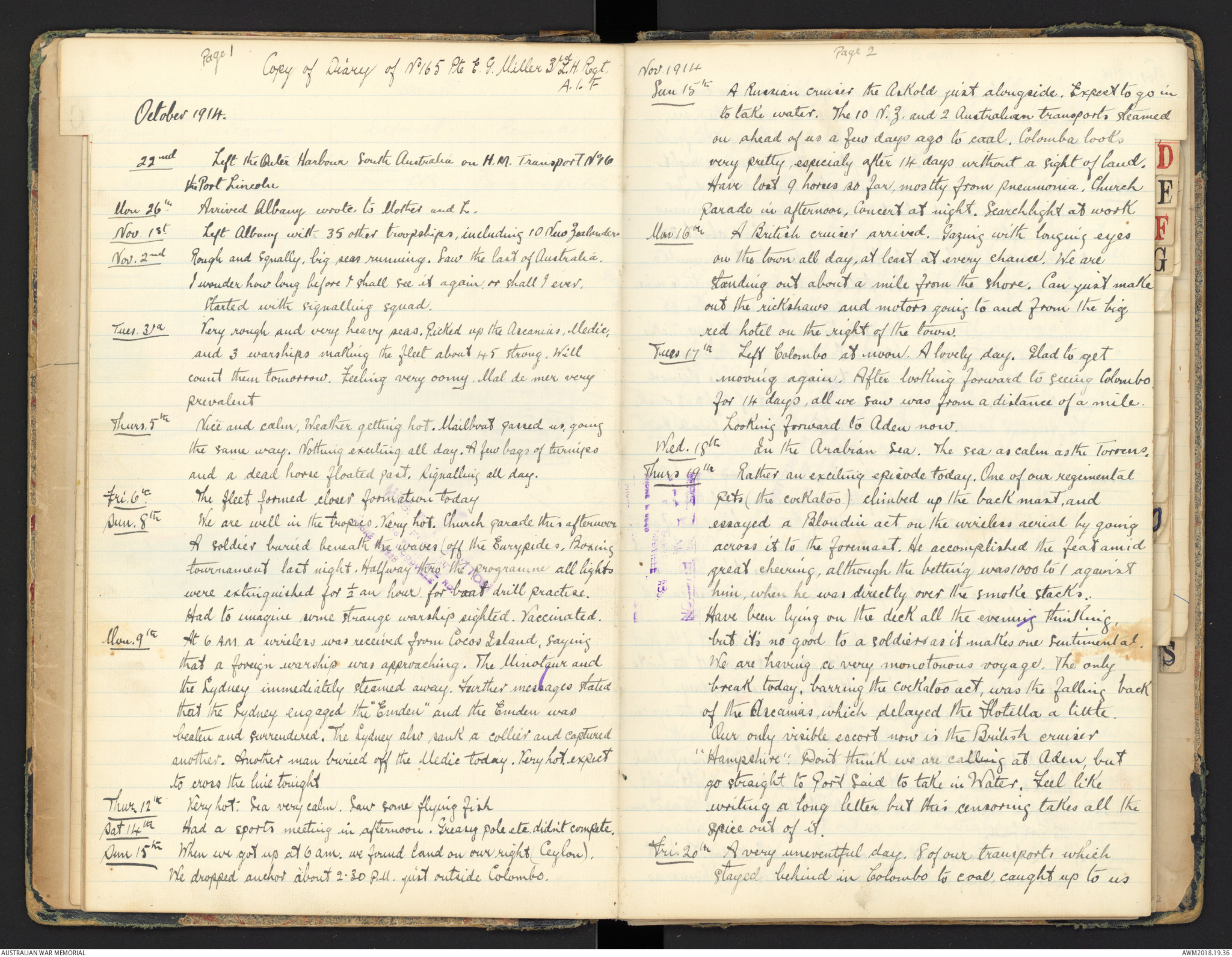
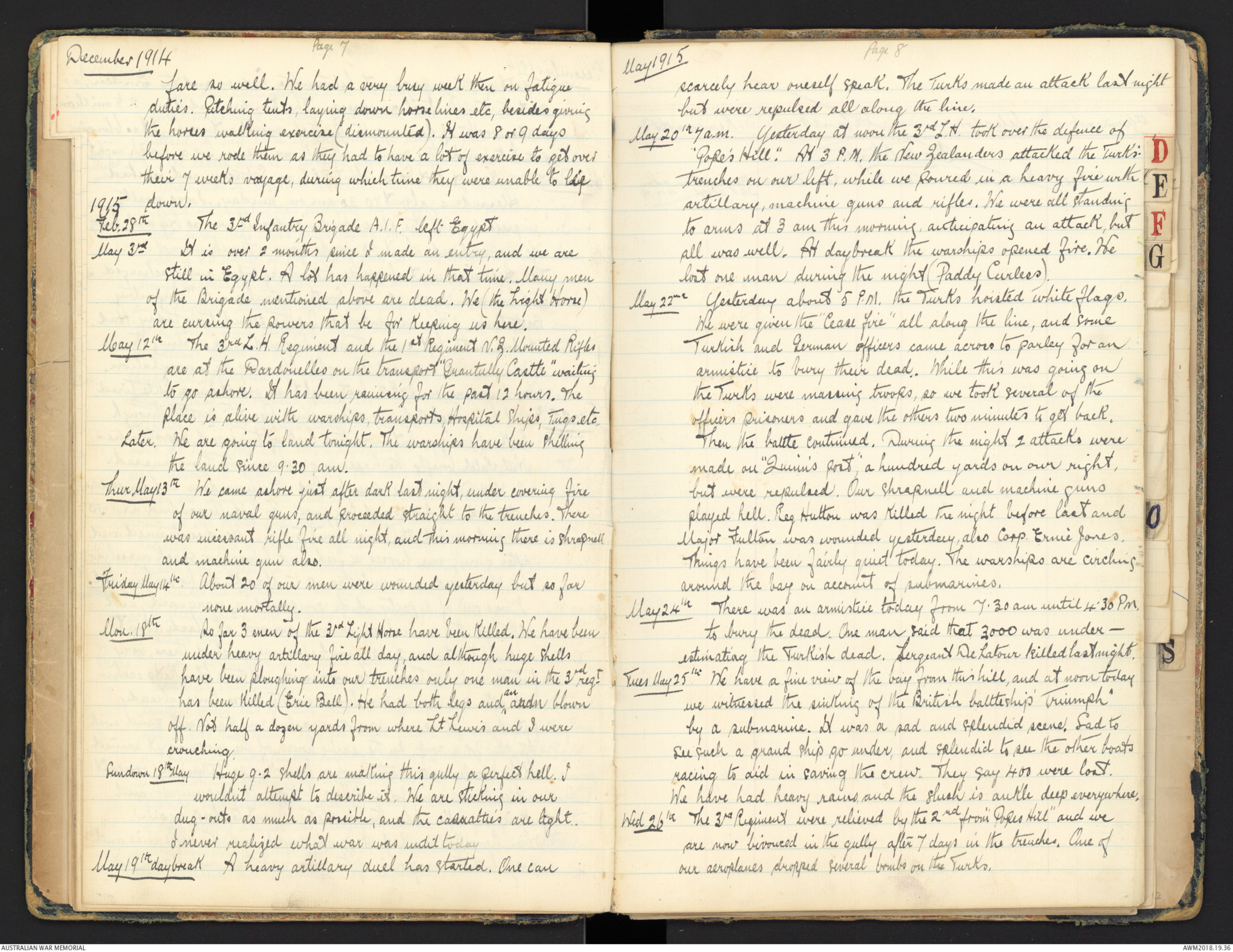
Page 1
Copy of Diary of No165 Pte E. G. Miller 3rd L.H. Regt,
A.I.F
[*October 1914.*]
22nd Left the Outer Harbour South Australia on H.M. Transport No 16
the Port Lincoln.
[*Mon 26th*] Arrived Albany wrote to Mother and L.
[*Nov 1st*] Left Albany with 35 other troopships, including 10 New Zealanders
[*Nov. 2nd*] Rough and squally, big seas running. Saw the last of Australia.
I wonder how long before I shall see it again or shall I ever.
Started with signalling squad.
[*Tues. 3rd *] Very rough and very heavy seas. Picked up the Ascanius, Medic,
and 3 warships making the fleet about 45 strong. Will
count them tomorrow. Feeling very sorry. Mal de mer very
prevalent
[*Thurs. 5th*] Nice and calm, Weather getting hot. Mailboat passed us, going
the same way. Nothing exciting all day. A few bags of turnips
and a dead horse floated past. Signalling all day.
[*Fri. 6th *] The fleet formed closer formation today.
[*Sun. 8th*] We are well in the tropics. Very hot. Church parade this afternoon.
A soldier buried beneath the waves (off the Eurypides, Boxing
tournament last night. Halfway thro' the programme all lights
were extinguished for ½ an hour for boat drill practise.
Had to imagine some strange warship sighted. Vaccinated.
[*Mon. 9th*] At 6 A.M. a wireless was received from Cocos Island, saying
that a foreign warship was approaching. The Minotaur and
the Sydney immediately steamed away. Further messages stated
that the Sydney engaged the "Emden" and the Emden was
beaten and surrendered. The Sydney also sank a collier and captured
another. Another man buried off the Medic today. Very hot, expect
to cross the line tonight
[*Thur. 12th*] Very hot. Sea very calm. Saw some flying fish
[*Sat 14th*] Had a sports meeting in the afternoon. Greasy pole etc. didn't compete.
[*Sun 15th*] When we got up at 6 am. we found land on our right (Ceylon).
We dropped anchor about 2.30 P.M. just outside Colombo.
Page 2
[*Nov. 1914*]
[*Sun 15th*] A Russian cruiser the Askold just alongside. Expect to go in
to take water. The 10 N.Z. and 2 Australian transports steamed
on ahead of us a few days ago to coal. Colombo looks
very pretty, especialy after 14 days without a sight of land.
Have lost 9 horses so far, mostly from pneumonia. Church
parade in afternoon, Concert at night. Searchlight at work
[*Mon 16th*] A British cruiser arrived. Gazing with longing eyes
on the town all day, at least at every chance. We are
standing out about a mile from the shore. Can just make
out the rickshaws and motors going to and from the big
red hotel on the right of the town.
[*Tues 17th*] Left Colombo at noon. A lovely day. Had to get
moving again. After looking forward to seeing Colombo
for 14 days, all we saw was from a distance of a mile.
Looking forward to Aden now.
[*Wed. 18th*] In the Arabian Sea. The sea as calm as the Torrens.
[*Thurs 19th*] Rather an exciting episode today. One of our regimental
pets (the cockatoo) climbed up the back mast, and
essayed a Blondin act on the wireless aerial by going
across it to the foremast. He accomplished the feat amid
great cheering, although the betting was 1000 to 1 against
him, when he was directly over the smoke stacks.
Have been lying on the deck all the evening thinking,
but it's no good to a soldier as it makes one sentimental.
We are having a very monotonous voyage. The only
break today, barring the cockatoo act, was the falling back
of the Ascanius, which delayed the Flotilla a little.
Our only visible escort now is the British cruiser
"Hampshire". Don't think we are calling at Aden, but
go straight to Port Said to take in Water. Feel like
writing a long letter but this censoring takes all the
spice out of it.
[*Fri 20th*] A very uneventful day. 8 of our transports which
stayed behind in Colombo to coal caught up to us
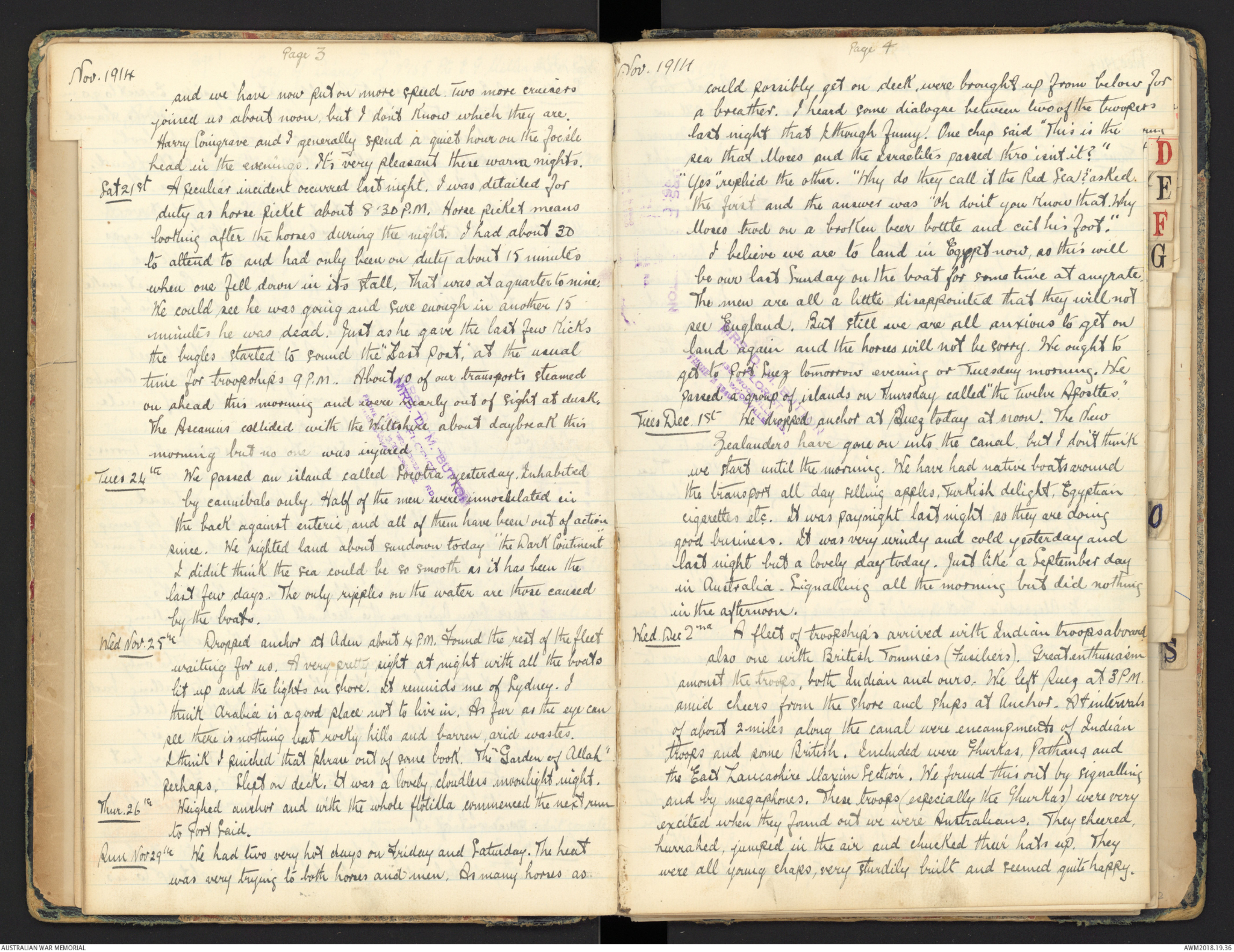
Page 3
[*Nov. 1914*]
and we have now put on more speed. Two more cruisers
joined us about noon, but I don't know which they are.
Harry Conigrave and I generally spend a quiet hour on the foc'sle
head in the evenings. It's very pleasant these warm nights.
[*Sat 21st*] A peculiar incident occurred last night. I was detailed for
duty as horse picket about 8.30 P.M. Horse picket means
looking after the horses during the night. I had about 30
to attend to and had only been on duty about 15 minutes
when one fell down in its stall. That was at a quarter to nine.
We could see he was going and sure enough in another 15
minutes he was dead. Just as he gave the last few kicks
the bugles started to sound the "Last Post", at the usual
time for troopships 9 P.M. About 10 of our transports steamed
on ahead this morning and were nearly out of sight at dusk.
The Ascanius collided with the Wiltshire about daybreak this
morning but no one was injured.
[*Tues 24th*] We passed an island called Socotra yesterday. Inhabited
by cannibals only. Half of the men were innoculated in the
back against enteric, and all of them have been out of action
since. We sighted land about sundown today "the Dark Continent"
I didn't think the sea could be so smooth as it has been the
last few days. The only ripples on the water are those caused
by the boats.
[*Wed Nov. 25th*] Dropped anchor at Aden about 4 P.M. Found the rest of the fleet
waiting for us. A very pretty sight at night with all the boats
lit up and the lights on shore. It reminds me of Sydney. I
think Arabia is a good place not to live in. As far as the eye can
see there is nothing but rocky hills and barren, arid wastes.
I think I pinched that phrase out of some book. The "Garden of Allah"
perhaps. Slept on deck. It was a lovely cloudless moonlight night.
[*Thurs. 26th*] Weighed anchor and with the whole flotilla commenced the next run
to Port Said.
[*Sun Nov 29th*] We had two very hot days on Friday and Saturday. The heat
was very trying to both horses and men. As many horses as
Page 4
[*Nov 1914*]
could possibly get on deck, were brought up from below for
a breather. I heard some dialogue between two of the troopers
last night that I thought funny. One chap said "This is the
sea that Moses and the Israelites passed thro' isn't it?"
"Yes" replied the other. "Why do they call it the Red Sea?" asked
the first and the answer was "Oh don't you know that. Why
Moses trod on a broken beer bottle and cut his foot."
I believe we are to land in Egypt now, as this will
be our last Sunday on the boat for some time at anyrate.
The men are all a little disappointed that they will not
see England. But still we are all anxious to get on
land again and the horses will not be sorry. We ought to
get to Port Suez tomorrow evening or Tuesday morning. We
passed a group of islands on Thursday called "the Twelve Apostles".
[*Tues Dec. 1st*] We dropped anchor at Suez today at noon. The New
Zealanders have gone on into the canal, but I don't think
we start until the morning. We have had native boats around
the transport all day selling apples, Turkish delight, Egyptian
cigarettes etc. It was paynight last night so they are doing
good business. It was very windy and cold yesterday and
last night but a lovely day today. Just like a September day
in Australia. Signalling all the morning but did nothing
in the afternoon.
[*Wed Dec 2nd *] A fleet of troopships arrived with Indian troops aboard
also one with British Tommies (Fusiliers). Great enthusiasm
amonst the troops, both Indian and ours. We left Suez at 3 P.M.
amid cheers from the shore and ships at Anchor. At intervals
of about 2 miles along the canal were encampments of Indian
troops and some British. Included were Ghurkas, Pathans, and
the East Lancashire Maxim Section. We found this out by signalling
and by megaphones. These troops (especially the Ghurkas) were very
excited when the found out we were Australians. They cheered,
hurrahed, jumped in the air and chucked their hats up. They
were all young chaps, very sturdily built and seemed quite happy.
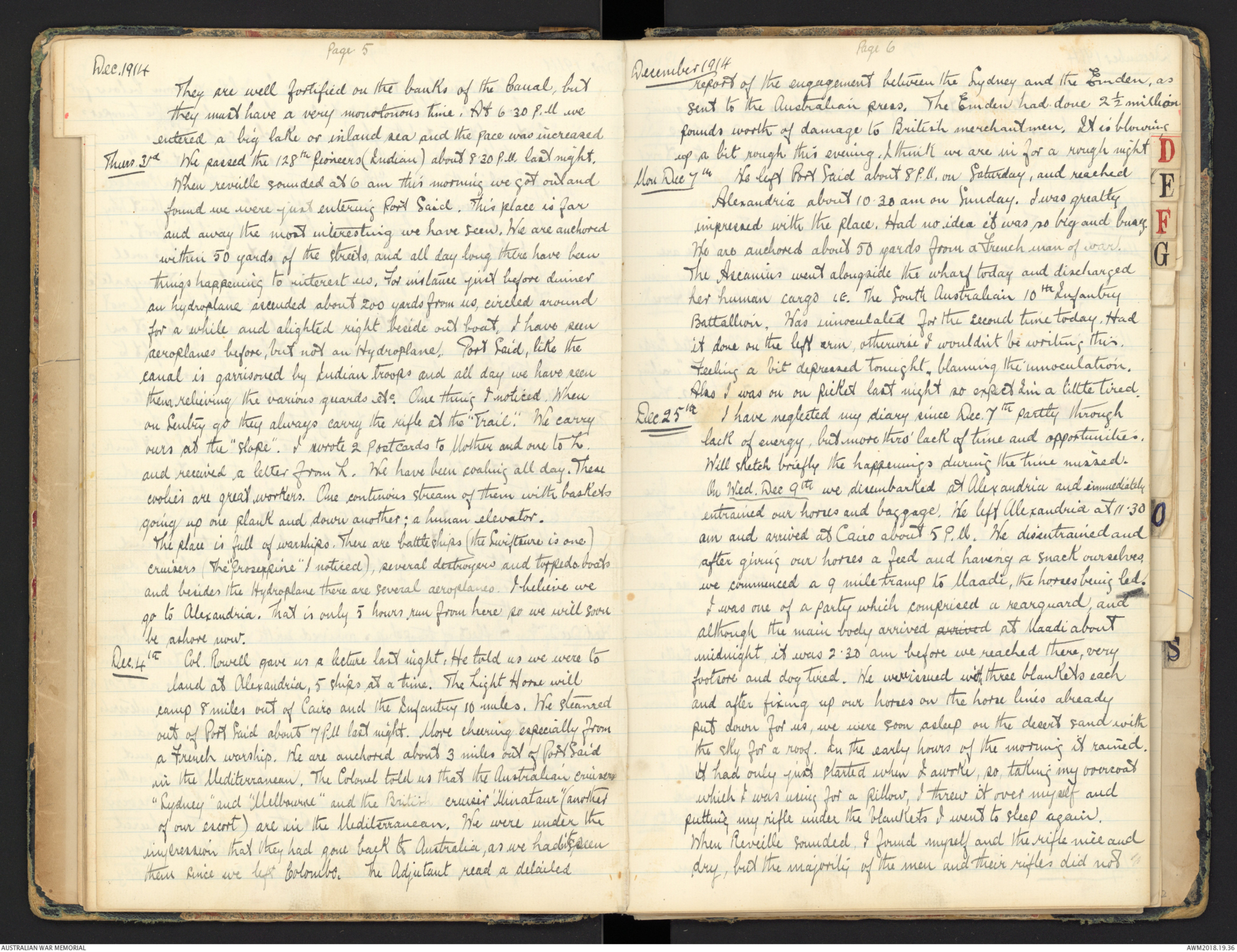
Page 5
[*Dec.1914*]
They are well fortified on the banks of the Canal, but
they must have a very monotonous time. At 6.30 P.M we
entered a big lake or inland sea and the pace was increased.
[*Thurs 3rd *] We passed the 128th Pioneers (Indian) about 8.30 P.M. last night.
When reveille sounded at 6 am this morning we got out and
found we were just entering Port Said. This place is far
and away the most interesting we have seen. We are anchored
within 50 yards of the streets, and all day long there have been
things happening to interest us. For instance just before dinner
an hydroplane ascended about 200 yards from us, circled around
for a while and alighted right beside our boat. I have seen
aeroplanes before, but not an Hydroplane. Port Said, like the
canal is garrisoned by Indian troops and all day we have seen
them relieving the various guards etc. One thing I noticed. When
on Sentry go they always carry the rifle at the "Trail". We carry
ours at the "slope". I wrote 2 postcards to Mother and one to L.
and received a letter from L. We have been coaling all day. These
coolies are great workers. One continuous stream of them with baskets
going up one plank and down another; a human elevator.
The place is full of warships. There are battleships (the Swiftsure is one)
cruisers (The "Proserpine" I noticed), several destroyers and torpedo boats
and besides the Hydroplane there are several aeroplanes. I believe we
go to Alexandria. That is only 5 hours run from here so we will soon
be ashore now.
[*Dec. 4th *] Col. Rowell gave us a lecture last night. He told us we were to land
at Alexandria, 5 ships at a time. The Light Horse will
camp 8 miles out of Cairo and the Infantry 10 miles. We steamed
out of Port Said about 7 P.M. last night. More cheering especially from
a French warship. We are anchored about 3 miles out of Port Said
in the Mediterranean. The Colonel told us that the Australian cruisers
"Sydney" and "Melbourne" and the British cruiser "Minotaur" (another
of our escort) are in the Mediterranean. We were under the
impression that they had gone back to Australia, as we hadn't seen
them since we left Colombo. The Adjutant read a detailed
Page 6
[*December 1914*]
report of the engagement between the Sydney and the Emden, as
sent to the Australian press. The Emden had done 2½ million
pounds worth of damage to British merchantmen. It is blowing
up a bit rough this evening. I think we are in for a rough night.
[*Mon Dec 7th*] We left Port Said about 8 P.M. on Saturday, and reached
Alexandria about 10.30 am on Sunday. I was greatly
impressed with the place. Had no idea it was so big and busy.
We are anchored about 50 yards from a French man of war.
The Ascanius went alongside the wharf today and discharged
her human cargo I.E. The South Australian 10th Infantry
Battallion. Was innoculated for the second time today. Had
it done on the left arm, otherwise I wouldn't be writing this.
Feeling a bit depressed tonight, blaming the innoculation.
Alas I was on on picket last night so expect I'm a little tired.
[*Dec 25th*] I have neglected my diary since Dec. 7th partly through
lack of energy, but more thro' lack of time and opportunities.
Will sketch briefly the happenings during the time missed.
On Wed. Dec 9th we disembarked at Alexandria and immediately
entrained our horses and baggage. We left Alexandria at 11.30
am and arrived at Cairo about 5 P.M. We disentrained and
after giving our horses a feed and having a snack ourselves,
we commenced a 9 mile tramp to Maadi, the horses being led.
I was one of a party which comprised a rearguard and
although the main body arrived arrived at Maadi about
midnight, it was 2.30 am before we reached there, very
footsore and dog tired. We were issued with three blankets each
and after fixing up our horses on the horse lines already
put down for us, we were soon asleep on the desert sand with
the sky for a roof. In the early hours of the morning it rained.
It had only just started when I awoke, so taking my overcoat
which I was using for a pillow, I threw it over myself and
putting my rifle under the blankets I went to sleep again.
When Reveille sounded, I found myself and the rifle nice and
dry, but the majority of the men and their rifles did not
Page 7
[*December 1914*]
fare so well. We had a very busy week there on fatigue
duties. Pitching tents, laying horse lines etc, besides giving
the horses walking exercise (dismounted). It was 8 or 9 days
before we rode them as they had to have a lot of exercise to get over
their 7 weeks voyage, during which time they were unable to lie
down.
[*1915*]
[*Feb.28th*] The 3rd Infantry Brigade A.I.F. left Egypt
May 3rd It is over 2 months since I made an entry, and we are
still in Egypt. A lot has happened in that time. Many men
of the Brigade mentioned above are dead. We (the Light Horse)
are cursing the powers that be for keeping us here.
[*May 12th*] The 3rd L.H. Regiment and the 1st Regiment N.Z. Mounted Rifles
are at the Dardonelles on the transport "Grantully Castle" waiting
to go ashore. It has been raining for the past 12 hours. The
place is alive with warships, transports, Hospital Ships, Tugs etc.
Later. We are going to land tonight The warships have been shelling
the land since 9.30 am.
[*Thur, May 13th *] We came ashore just after dark last night, covering fire
of our naval guns, and proceeded straight to the trenches. There
was incessant rifle fire all night, and this morning there is shrapnell
and machine gun also.
[*Friday May 14th *] About 20 of our men were wounded yesterday but so far
none mortally.
[*Mon. 18th*] So far 3 men of the 3rd Light Horse have been killed. We have been
under heavy artillary fire all day, and although huge shells
have been ploughing into our trenches only one man in the 3rd regt
has been killed (Eric Bell). He had both legs and ^an arm blown
off. Not half a dozen yards from where Lt Lewis and I were
crouching.
[*Sundown 18th May*] Huge 9.2 shells are making this gully a perfect hell. I
wouldn't attempt to describe it We are sticking in our
dug-outs as much as possible, and the casualties are light.
I never realised what war was until today
[*May 19th daybreak*] A heavy artillary duel has started. One can
Page 8
[*May 1915*]
scarcely hear ourself speak. The Turks made an attack last night
but were repulsed all along the line.
[*May 20th*] 7 a.m. Yesterday at noon the 3rd L.H. took over the defence of
"Pope's Hill". At 3 P.M. the New Zealanders attacked the Turks'
trenches on our left, while we poured in a heavy fire with
artillary, machine guns and rifles. We were all standing
to arms at 3 am this morning, anticipating an attack, but
all was well. At daybreak the warships opened fire. We
lost one an during the night (Paddy Curless).
[*May 22nd*] Yesterday about 5 P.M. the Turks hoisted white flags.
We were given the "Cease Fire" all along the line, and some
Turkish and German officers came across to parley for an
armistice to bury their dead. While this was going on
the Turks were massing troops, so we took several of the
officers prisoners and gave the others two minutes to get back.
Then the battle continued. During the night 2 attacks were
made on "Quinn's Post", a hundred yards on our right,
but were repulsed. Our shrapnell and machine guns
played hell. Reg Hutton was killed the night before last and
Major Fulton was wounded yesterday, also Corp. Ernie Jones.
Things have been fairly quiet today. The warships are circling
around the bay on account of submarines.
[*May 24th*] There was an armistice today from 7.30 PM. until 4.30 PM.
to bury the dead. One man said that 3000 was
under-estimating the Turkish dead. Sergeant De Latour killed last night.
[*Tues May 25th *] We have a fine view to the bay from this hill, and at noon today
we witnessed the sinking of the British battleship 'Triumph"
by a submarine. It was a sad and splendid scene. Sad to
see such a grand ship go under, and splendid to see the other boats
racing to aid in saving the crew. They say 400 were lost.
We have had heavy rains and the slush is ankle deep everywhere.
[*Wed 26th*] The 3rd Regiment were relieved by the 2nd from "Popes Hill" and we
are now bivouced in the gully after 7 days in the trenches. One of
our aeroplanes dropped several bombs on the Turks.
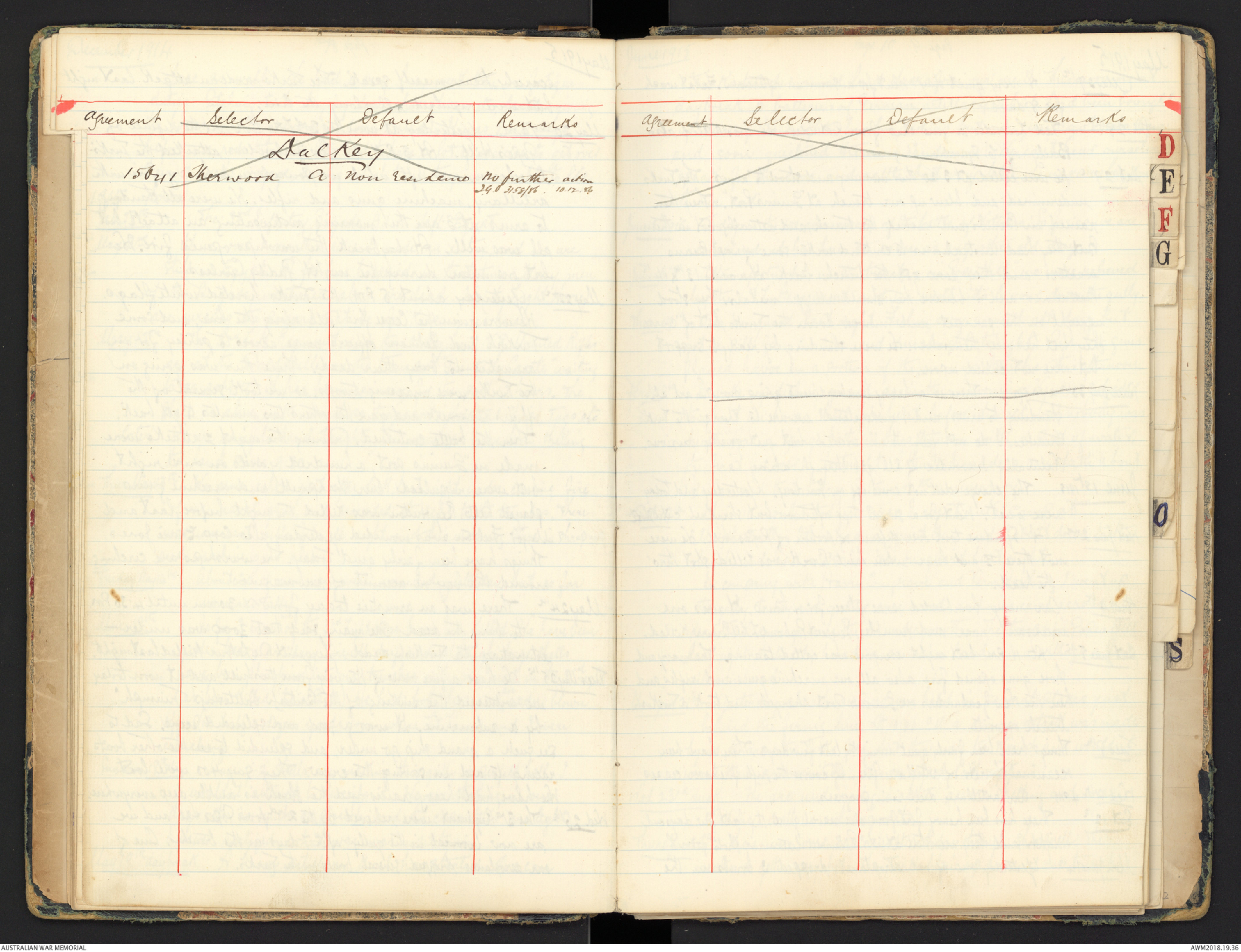
| Agreement | Selector | Default | Remarks |
| MacKey | |||
| 15041 | Sherwood A | Non [[Ess demo?]] |
No further action 2.9.0 3158/86. 10.12.86 |
| Agreement | Selector | Default | Remarks |
 Sam scott
This transcription item is now locked to you for editing. To release the lock either Save your changes or Cancel.
This lock will be automatically released after 60 minutes of inactivity.