
Correspondence between Herbert Vincent Reynolds and his family, 1914-1915 - Part 3
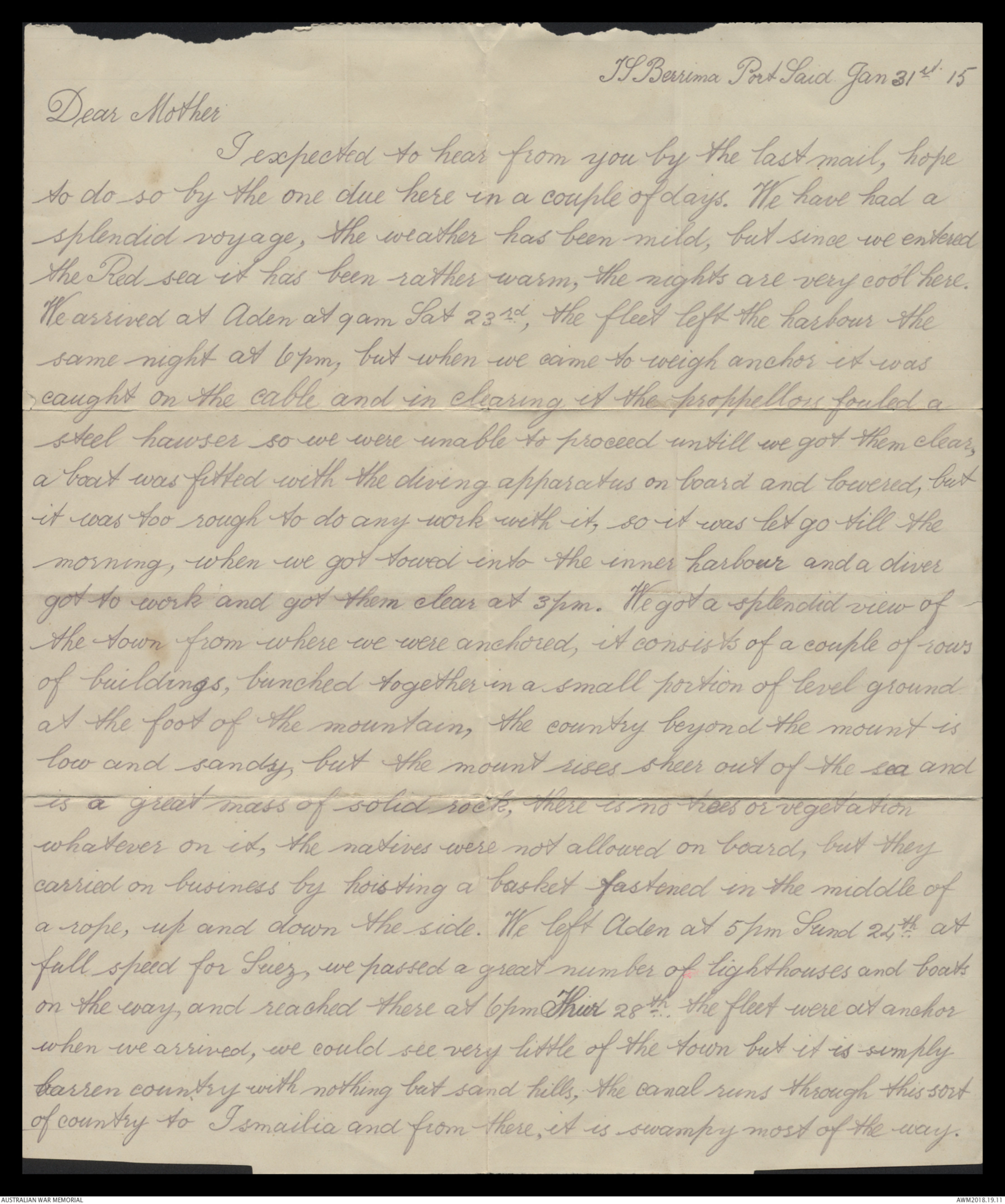
TS Berrima Port Said Jan 31st 15
Dear Mother
I expected to hear from you by the last mail, hope
to do so by the one due here in a couple of days. We have had a
splendid voyage, the weather has been mild, but since we entered
the Red sea it has been rather warm, the nights are very cool here.
We arrived at Aden at 9 am Sat 23rd, the fleet left the harbour the
same night at 6 pm, but when we came to weigh anchor it was
caught on the cable and in clearing it the proppellors fouled a
steel hawser so we were unable to proceed untill we got them clear,
a boat was fitted with the diving apparatus on board and lowered, but
it was too rough to do any work with it, so it was let go till the
morning, when we got towed into the inner harbour and a diver
got to work and got them clear at 3 pm. We got a splendid view of
the town from where we were anchored, it consists of a couple of rows
of buildings, bunched together in a small portion of level ground
at the foot of the mountain, the country beyond the mount is
low and sandy, but the mount rises sheer out of the sea and
is a great mass of solid rock, there is no trees or vegetation
whatever on it, the natives were not allowed on board, but they
carried on business by hoisting a basket fastened in the middle of
a rope, up and down the side. We left Aden at 5 pm Sund 24th at
full speed for Suez, we passed a great number of lighthouses and boats
on the way, and reached there at 6 pm Thur 28th. the fleet were at anchor
when we arrived, we could see very little of the town but it is simply
barren country with nothing but sand hills, the canal runs through this sort
of country to Ismailia and from there, it is swampy most of the way.
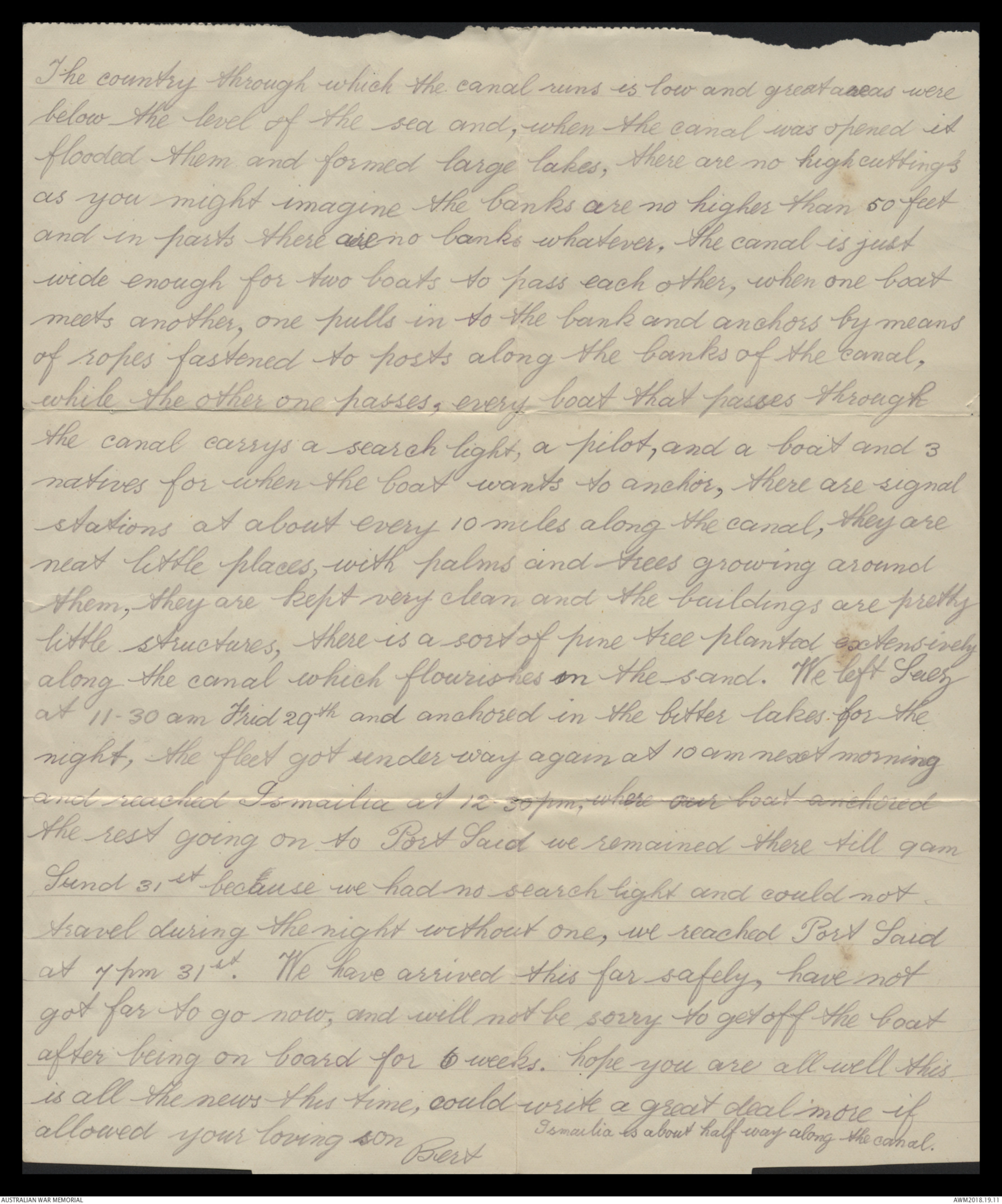
The country through which the canal runs is low and great areas were
below the level of the sea and, when the canal was opened it
flooded them and formed large lakes, there are no high cuttings
as you might imagine the banks are no higher than 50 feet
and in parts there are no banks whatever, the canal is just
wide enough for two boats to pass each other, when one boat
meets another, one pulls in to the bank and anchors by means
of ropes fastened to posts along the banks of the canal,
while the other one passes, every boat that passes through
the canal carrys a search light, a pilot, and a boat and 3
natives for when the boat wants to anchor, there are signal
stations at about every 10 miles along the canal, they are
neat little places, with palms and trees growing around
them, they are kept very clean and the buildings are pretty
little structures, there is a sort of pine tree planted extensively
along the canal which flourishes on the sand. We left Suez
at 11-30 am Frid 29th and anchored in the bitter lakes. for the
night, the fleet got under way again at 10 am next morning
and reached Ismailia at 12-30 pm, where our boat anchored
the rest going on to Port Said we remained there till 9 am
Sund 31st because we had no search light and could not
travel during the night without one, we reached Port Said
at 7 pm 31st. We have arrived this far safely, have not
got far to go now, and will not be sorry to get off the boat
after being on board for 6 weeks. hope you are all well this
is all the news this time, could write a great deal more if
allowed your loving son Bert
[*Ismailia is about half way along the canal.*]
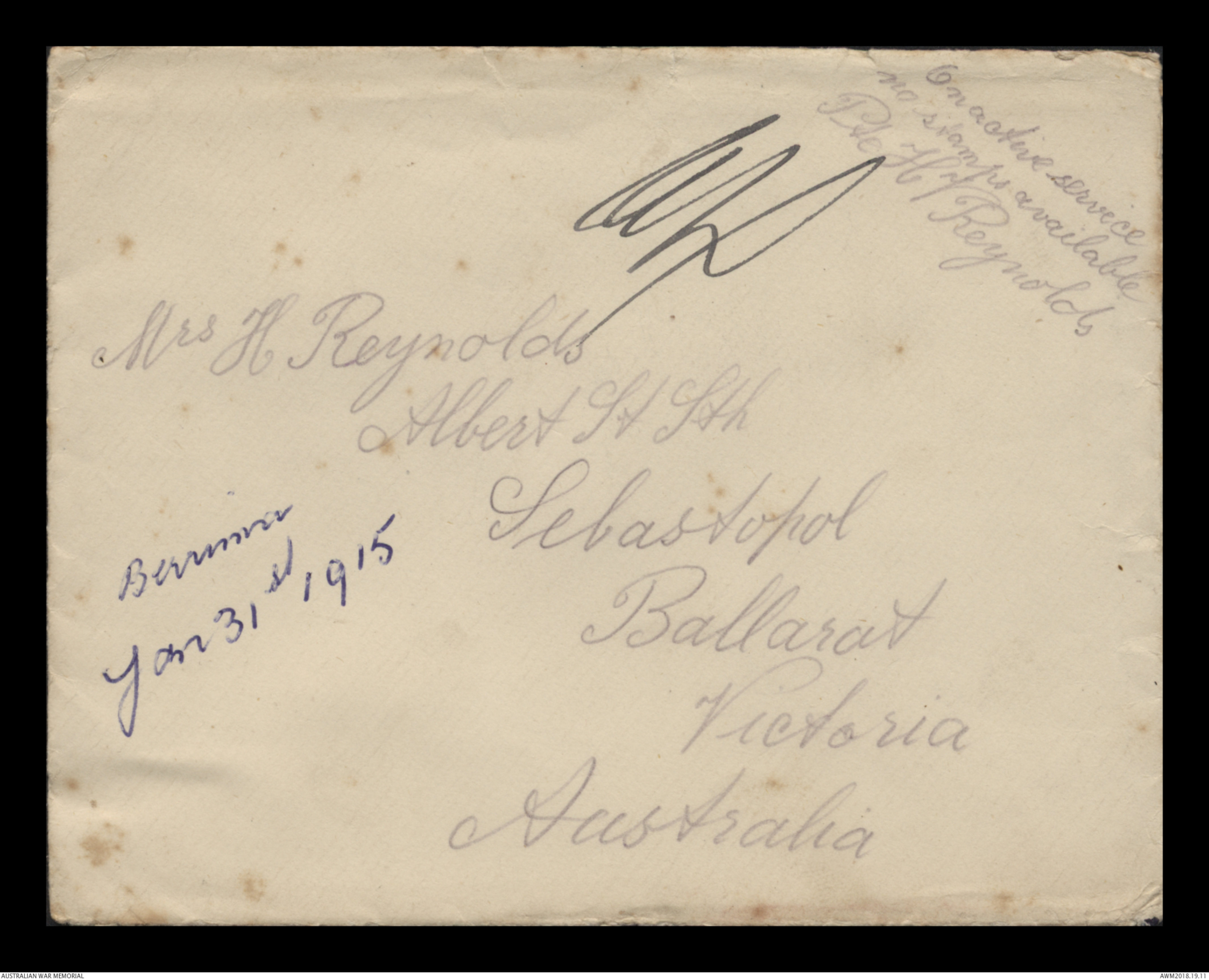
[*On active service
no stamps available
Pte HV Reynolds*]
WP
Mrs H Reynolds
Albert St Sth
Sebastopol
Ballarat
Victoria
Australia
Berrima
Jan 31st 1915
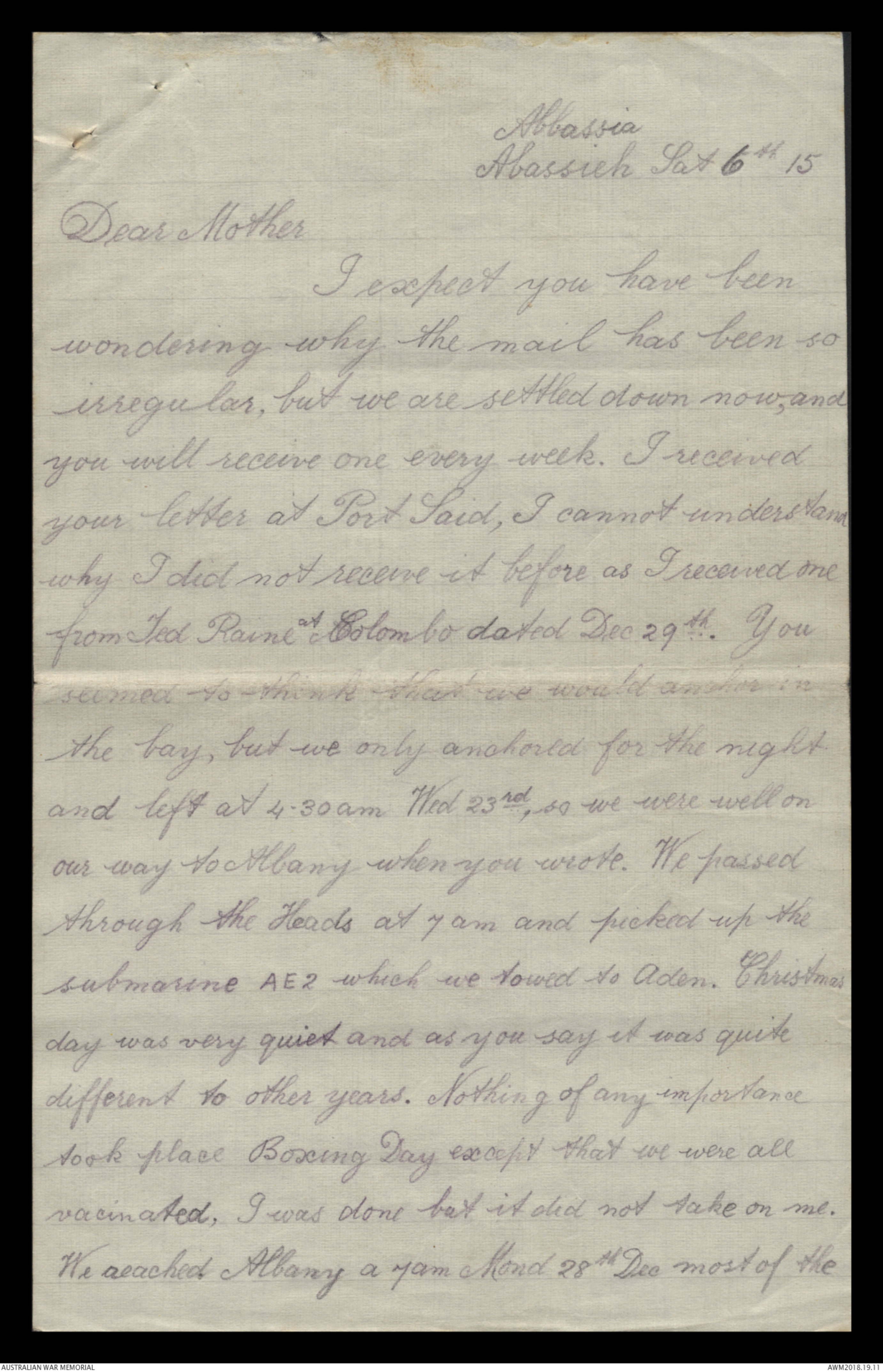
Abbassia
Abassieh Sat 6th 15
Dear Mother
I expect you have been
wondering why the mail has been so
irregular, but we are settled down now, and
you will receive one every week. I received
your letter at Port Said, I cannot understand
why I did not receive it before as I received one
from Ted Raine at Colombo dated Dec 29th. You
seemed to think that we would anchor in
the bay, but we only anchored for the night
and left at 4-30 am Wed 23rd, so we were well on
our way to Albany when you wrote. We passed
through the Heads at 7 am and picked up the
submarine AE2 which we towed to Aden. Christmas
day was very quiet and as you say it was quite
different to other years. Nothing of any importance
took place Boxing Day except that we were all
vacinated, I was done but it did not take on me.
We reached Albany a 7 am Mond 28th Dec most of the
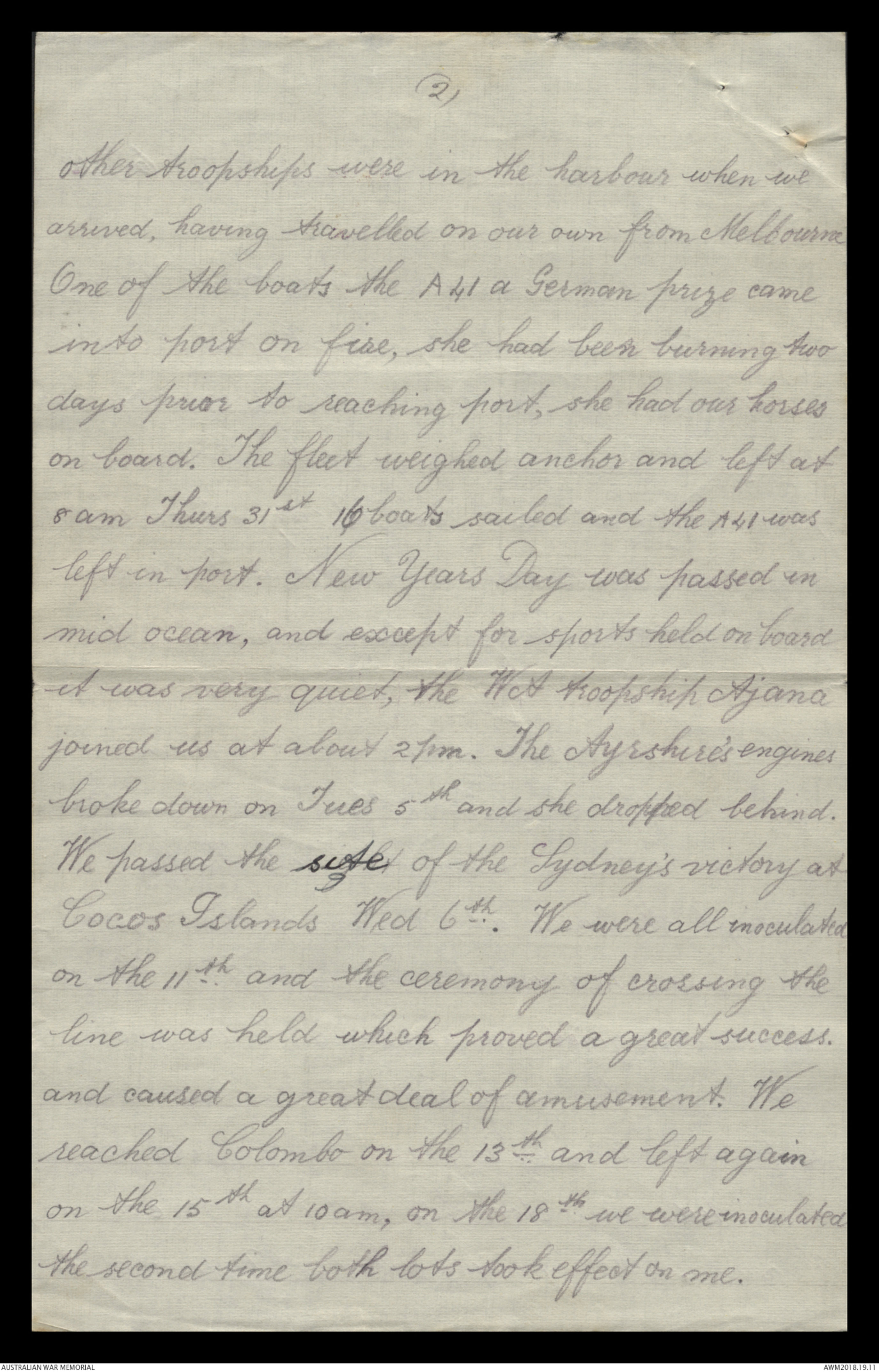
(2)
other troopships were in the harbour when we
arrived, having travelled on our own from Melbourne
One of the boats the A41 German prize came
into port on fire, she had been burning two
days prior to reaching port, she had our horses
on board. The fleet weighed anchor and left at
8 am Thurs 31st 16 boats sailed and the A41 was
left in port. New Years Day was passed in
mid ocean, and except for sports held on board
it was very quiet, the WA troopship Ajana
joined us at about 2 pm. The Ayrshire's engines
broke down on Tues 5th and she dropped behind.
We passed the site of the Sydney's victory at
Cocos Islands Wed 6th. We were all inoculated
on the 11th and the ceremony of crossing the
line was held which proved a great success.
and caused a great deal of amusement. We
reached Colombo on the 13th and left again
on the 15th at 10 am, on the 18th we were inoculated
the second time both lots took effect on me.
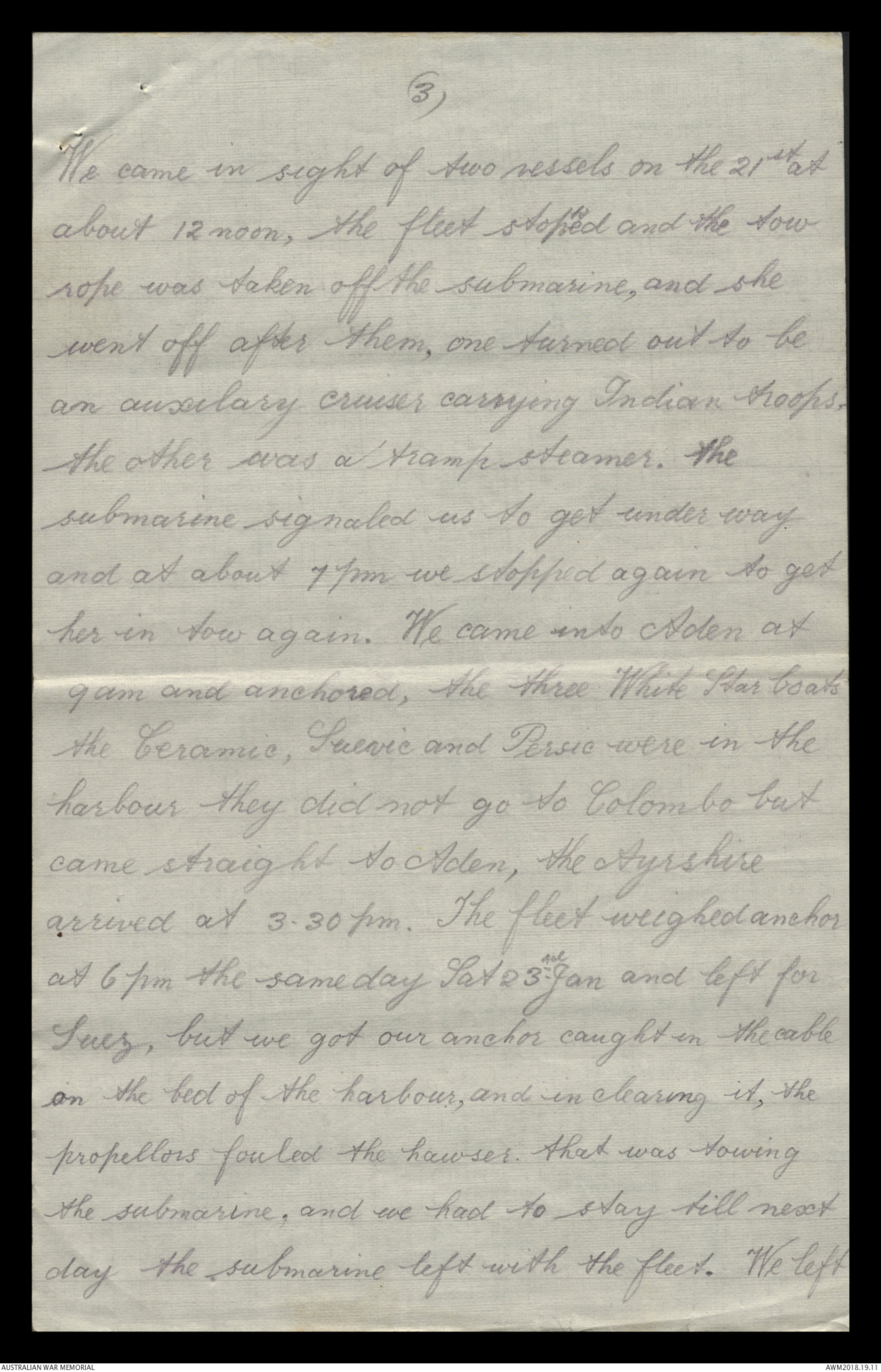
(3)
We came in sight of two vessels on the 21st at
about 12 noon, the fleet stopped and the tow
rope was taken off the submarine, and she
went off after them, one turned out to be
an auxilary cruiser carrying Indian troops,
the other was a tramp steamer. the
submarine signaled us to get under way.
and at about 7 pm we stopped again to get
her in tow again. We came into Aden at
9 am and anchored, the three White Star boats
the Ceramic, Suevic and Persic were in the
harbour they did not go to Colombo but
came straight to Aden, the Ayrshire
arrived at 3-30 pm. The fleet weighed anchor
at 6 pm the same day Sat 23rd Jan and left for
Suez, but we got our anchor caught in the cable
on the bed of the harbour, and in clearing it, the
propellors fouled the hawser. that was towing
the submarine, and we had to stay till next
day the submarine left with the fleet. We left
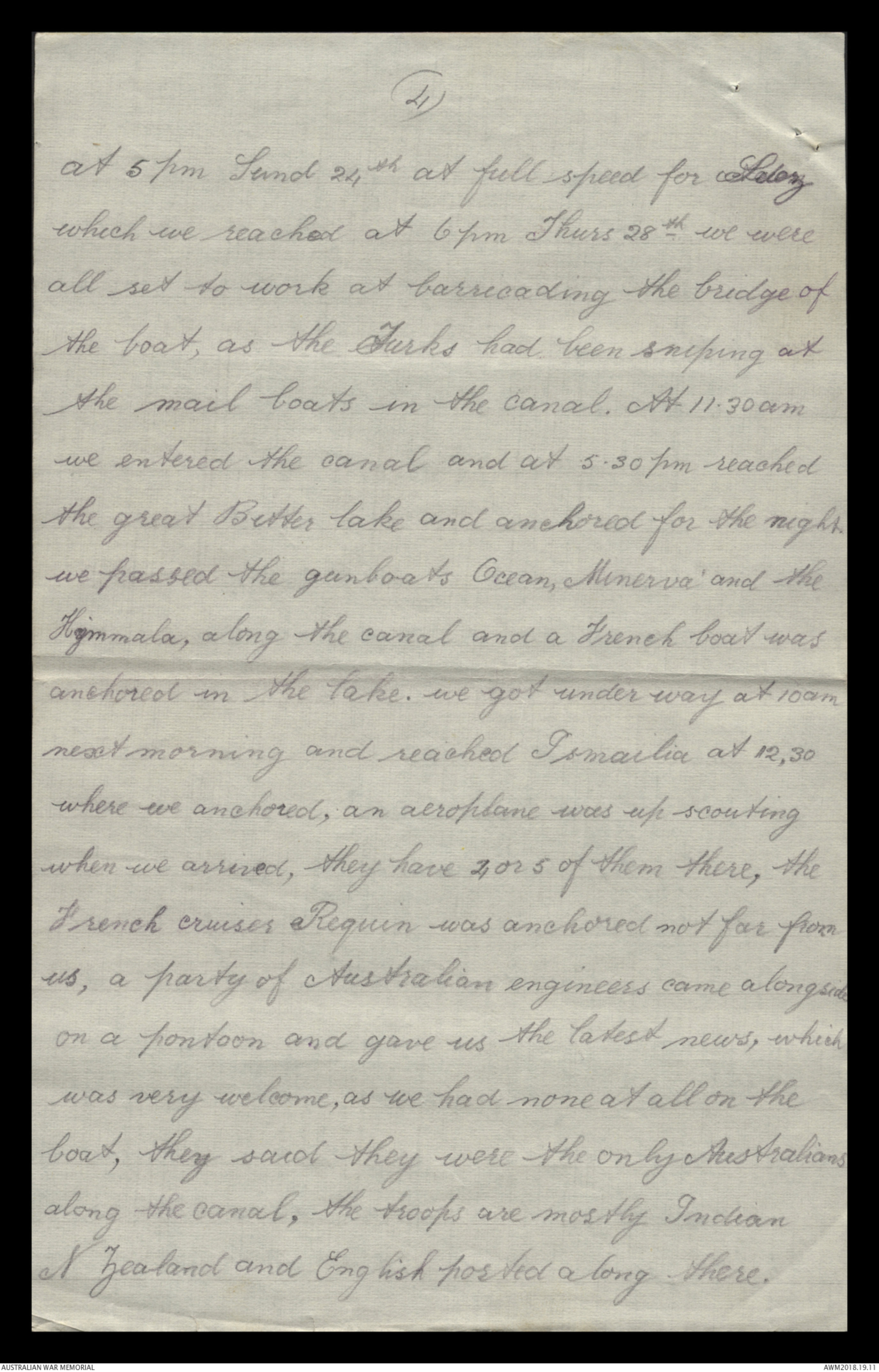
(4)
at 5 pm Sund 24th at full speed for Suez
which we reached at 6 pm Thurs 28th we were
all set to work at barricading the bridge of
the boat, as the Turks had been sniping at
the mail boats in the canal. At 11-30 am
we entered the canal and at 5-30 pm reached
the great Bitter lake and anchored for the night
we passed the gunboats Ocean, Minerva and the
Hymmala, along the canal and a French boat was
anchored in the lake. we got under way at 10 am
next morning and reached Ismailia at 12,30
where we anchored, an aeroplane was up scouting
when we arrived, they have 4 or 5 of them there, the
French cruiser Requin was anchored not far from
us, a party of Australian engineers came alongside
on a pontoon and gave us the latest news, which
was very welcome, as we had none at all on the
boat, they said they were the only Australians
along the canal, the troops are mostly Indian
N Zealand and English ported along there.
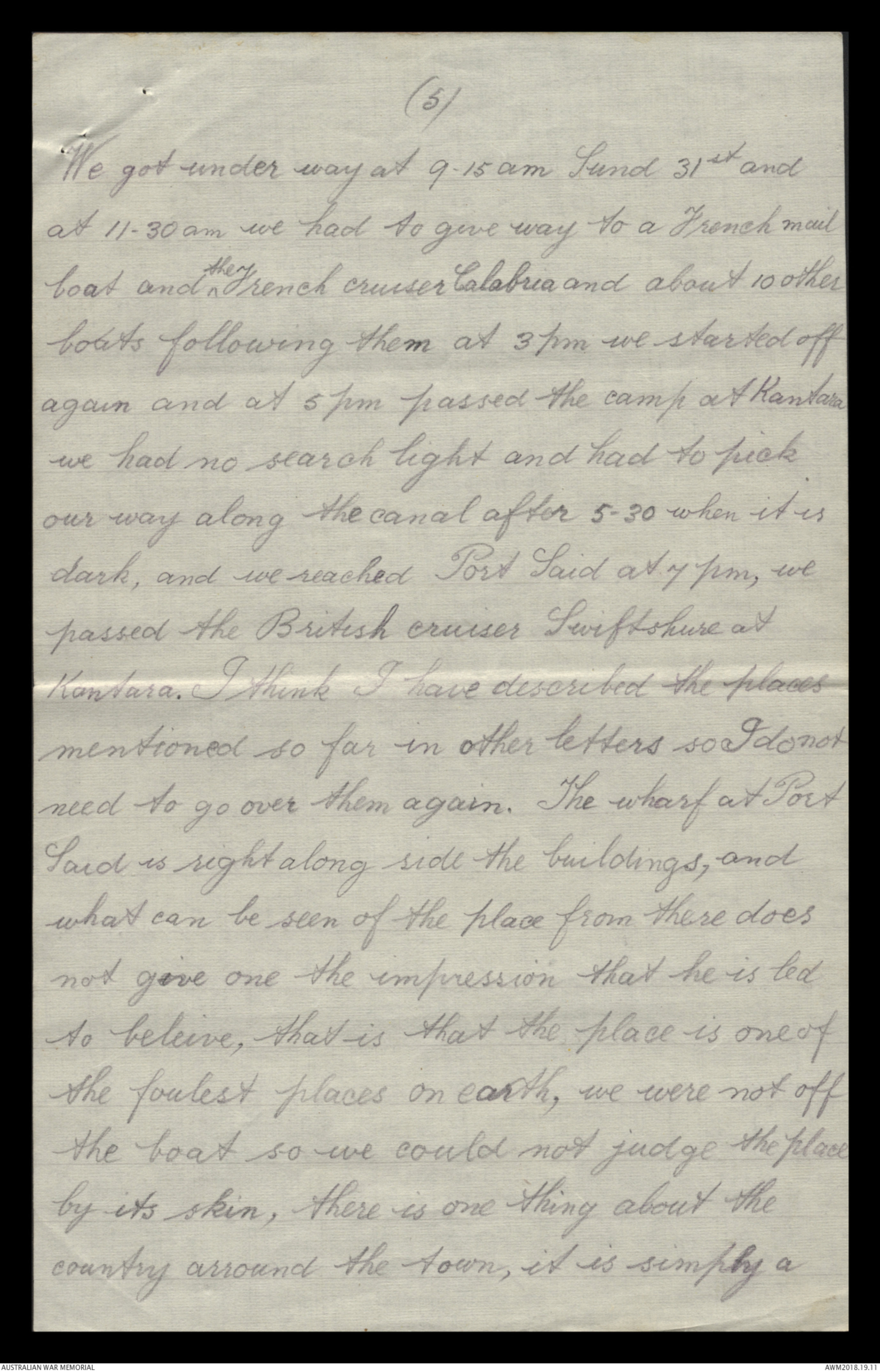
(5)
We got under way at 9-15 am Sund 31st and
at 11-30 am we had to give way to a French mail
boat and ^the French cruiser Calabria and about 10 other
boats following them at 3 pm we started off
again and at 5 pm passed the camp at Kantara
we had no search light and had to pick
our way along the canal after 5-30 when it is
dark, and we reached Port Said at 7 pm, we
passed the British cruiser Swiftshure at
Kantara. I think I have described the places
mentioned so far in other letters so I do not
need to go over them again. The wharf at Port
Said is right along side the buildings, and
what can be seen of the place from there does
not give one the impression that he is led
to beleive, that is that the place is one of
the foulest places on earth, we were not off
the boat so we could not judge the place
by its skin, there is one thing about the
country arround the town, it is simply a
(6)
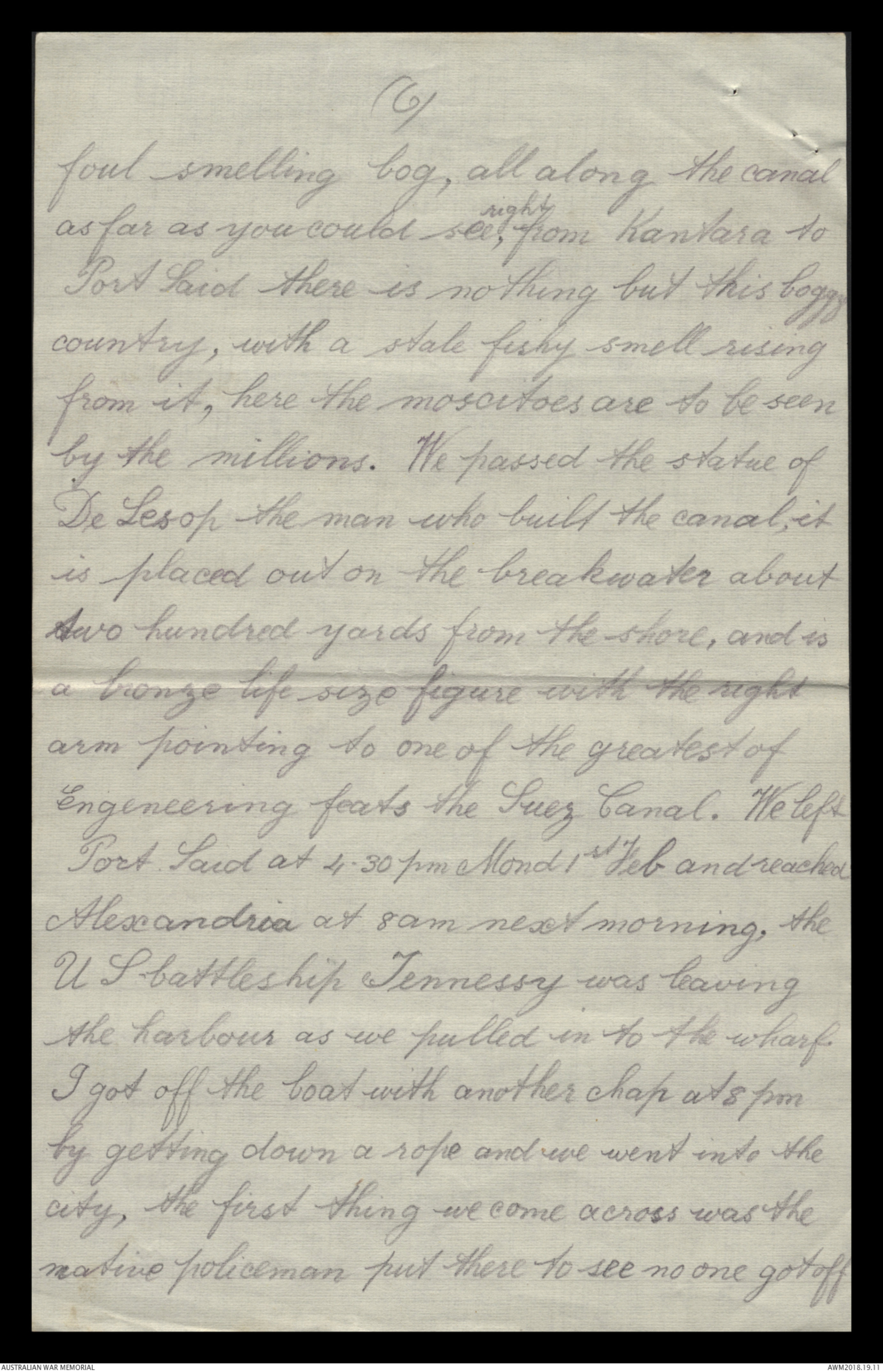
foul smelling bog, all along the canal
as far as you could see, right from Kantara to
Port Said there is nothing but this boggy
country, with a stale fishy smell rising
from it, here the moscitoes are to be seen
by the millions. We passed the statue of
De Lesop the man who built the canal, it
is placed out on the breakwater about
two hundred yards from the shore, and is
a bronze life size figure with the right
arm pointing to one of the greatest of
Engineering feats the Suez Canal. We left
Port Said at 4-30 pm Mond 1st Feb and reached
Alexandria at 8 am next morning, the
US battleship Tennessy was leaving
the harbour as we pulled in to the wharf.
I got off the boat with another chap at 8 pm
by getting down a rope and we went into the
city, the first thing we come across was the
native policeman put there to see no one got off
(7)
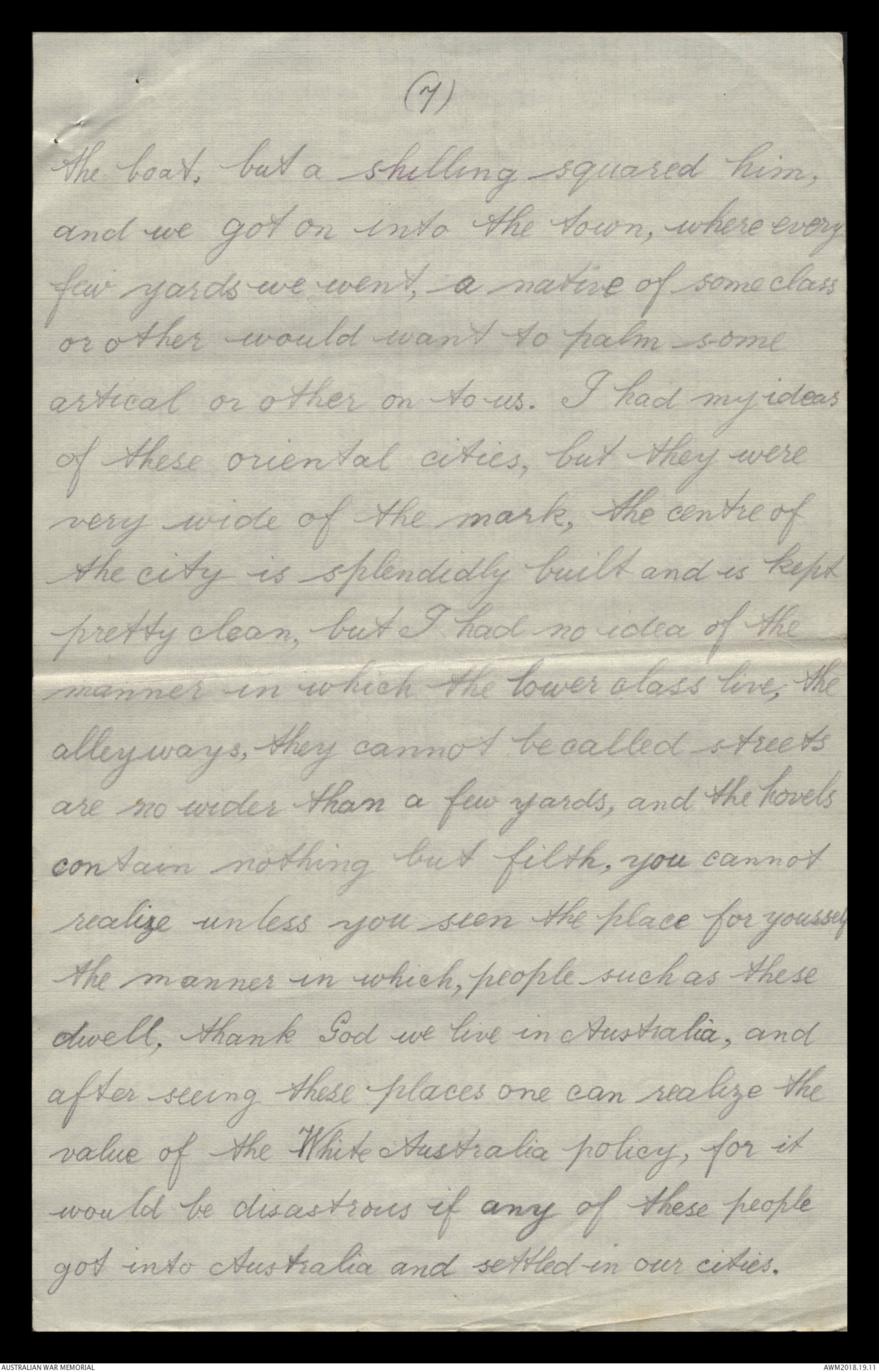
the boat, but a shilling squared him,
and we got on into the town, where every
few yards we went, a native of some class
or other would want to palm some
artical or other on to us. I had my ideas
of these oriental cities, but they were
very wide of the mark, the centre of
the city is splendidly built and is kept
pretty clean, but I had no idea of the
manner in which the lower class live, the
alleyways, they cannot be called streets
are no wider than a few yards, and the hovels
contain nothing but filth, you cannot
realize unless you seen the place for yourself
the manner in which, people such as these
dwell, thank God we live in Australia, and
after seeing these places one can realize the
value of the White Australia policy, for it
would be disastrous if any of these people
got into Australia and settled in our cities.
 Jen
Jen This transcription item is now locked to you for editing. To release the lock either Save your changes or Cancel.
This lock will be automatically released after 60 minutes of inactivity.