
Diary of Keith Morton Hickman, 1916-1919 - Part 5
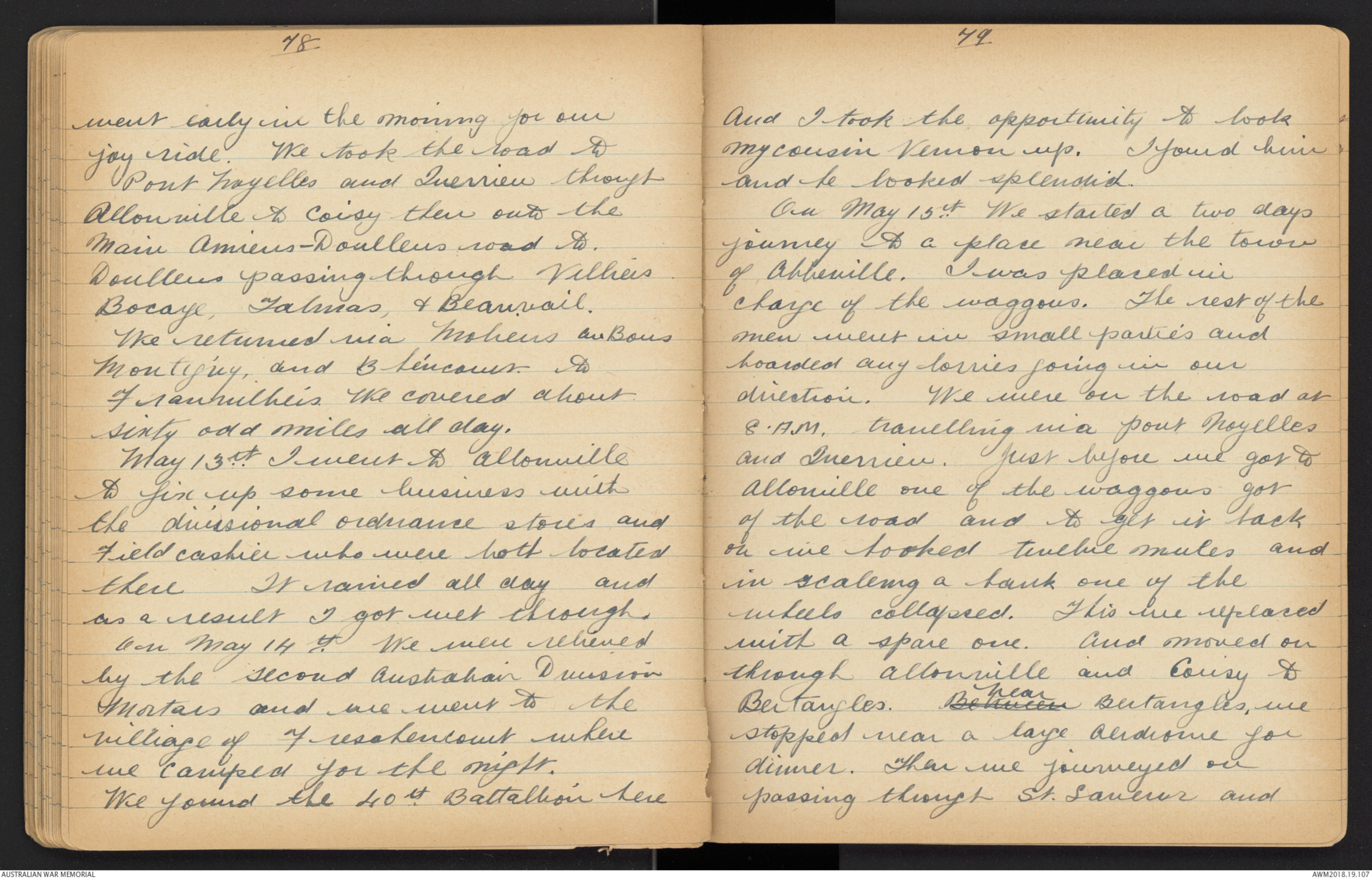
78.
went early in the morning for our
joy ride. We took the road to
Port Noyelles and Querrieu through
Allonville & Coisy then onto the
Main Amiens-Doullens road to.
Doullens passing through Villiers
Bocage, Talmas, & Beauvail.
We returned via Moliens au Bois
Montigny, and Bhencourt. to
Franvillers We covered about
sixty odd miles all day.
May 13th I went to Allonville
to fix up some business with
the divisional ordnance stores and
Field cashier who were both located
there. It rained all day and
as a result I got wet through.
On May 14th We were relieved
by the second Australian Division
Mortars and we went to the
villiage of Freschencourt where
we camped for the night.
We found the 40th Battalion here
79.
And I took the opportunity to look
my cousin Vernon up. I found him
and he looked splendid.
On May 15th We started a two days
journey to a place near the town
of Abbeville. I was placed in
charge of the waggons. The rest of the
men went in small parties and
boarded any lorries going in our
direction. We were on the road at
8.A.M. travelling via pont Noyelles
and Querrieu. Just before we got to
Allonville one of the waggons got
of the road and to get it back
on we hooked twelve mules and
in scaleing a bank one of the
wheels collapsed. This we replaced
with a spare one. And moved on
through Allonville and Corisy to
Bertangles. Between Near Bertangles, we
stopped near a large aerdrome for
dinner. Then we journeyed on
passing through St. Saveur and
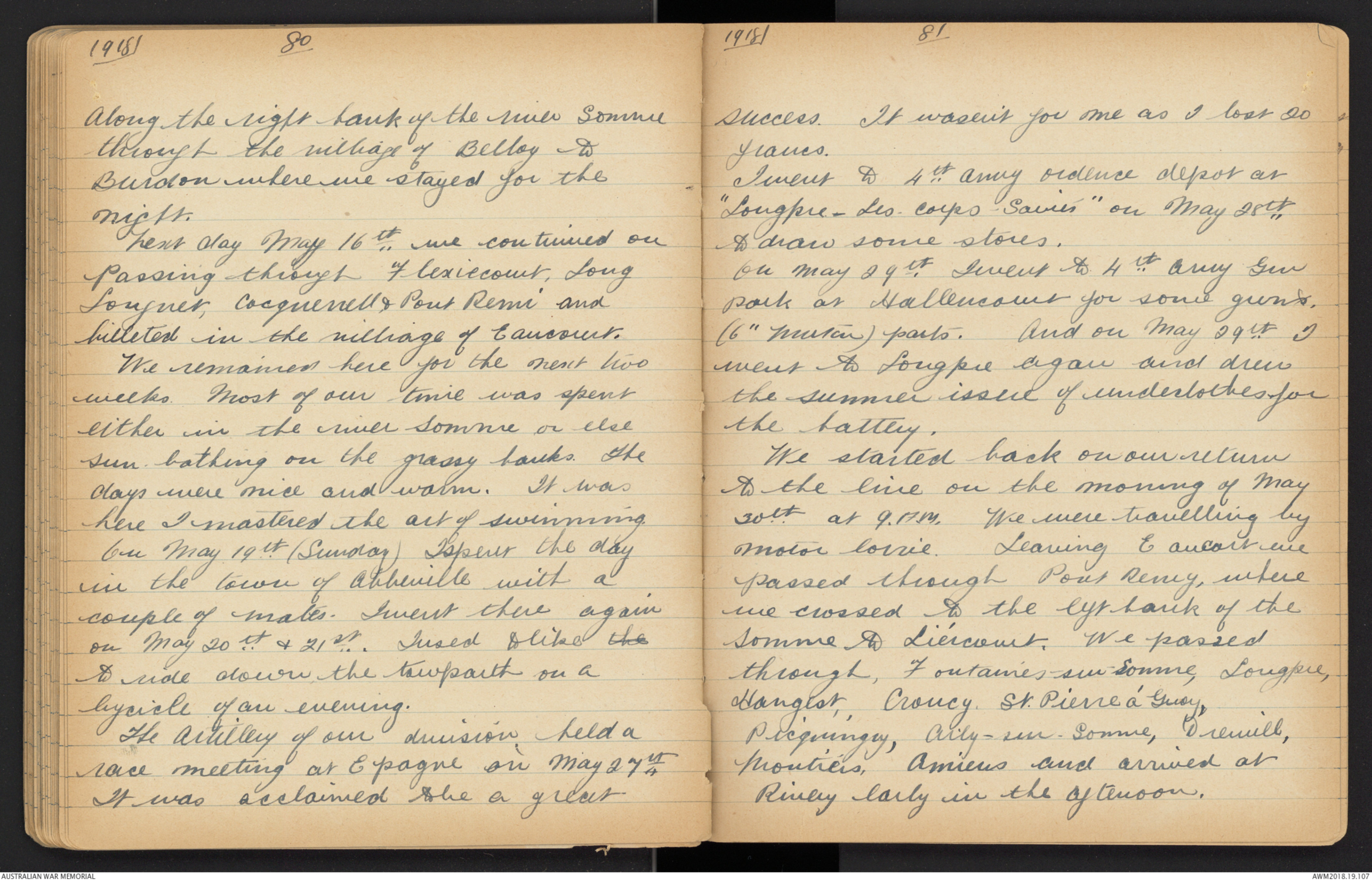
1918 80
Along the right bank up the river Somme
through the villiage of Belloy to
Burdon where we stayed for the
night.
Next day May 16th we continued on
passing through Flexiecourt, Long
Longuet, Cocquerrell & Pont Remi and
billeted in the villiage of Eaucourt.
We remained here for the next two
weeks. Most of our time was spent
either in the river Somme or else
sun bathing on the grassy banks. The
days were nice and warm. It was
here I mastered the art of swimming
On May 19th (Sunday) I spent the day
in the town of Abbeville with a
couple of mates. I went there again
on May 20th & 21st. I used to like the
to ride down the towpath on a
bycicle of an evening.
The Artillery of our division, held a
race meeting at Epagne on May 27th
It was acclaimed to be a great
1918 81
success. It wasen't for me as I lost 20
francs.
I went to 4th Army ordence depot at
"Longpre-Les. Corps-Savies" on May 28th
to draw some stores.
On May 29th I went to 4th Army Gen
park at Hallencourt for some guns.
(6" Mortar) parts. And on May 29th I
went to Lonpre again and drew
the summer issue of underclothes for
the battery.
We started back on our return
to the line on the morning of May
30th at 9.A.M. We were travelling by
motor lorrie. Leaving Eaucort we
passed through Pont Remy, where
we crossed to the left bank of the
Somme to Liércourt. We passed
through, Fontaines-sur-Somme, Longpre,
Hangest, Croucy. St. Pierre á Guoy,
Picquigny, Aily-sur-Somme, Dreuill,
Montreis, Amiens and arrived at
Rivery early in the afternoon.
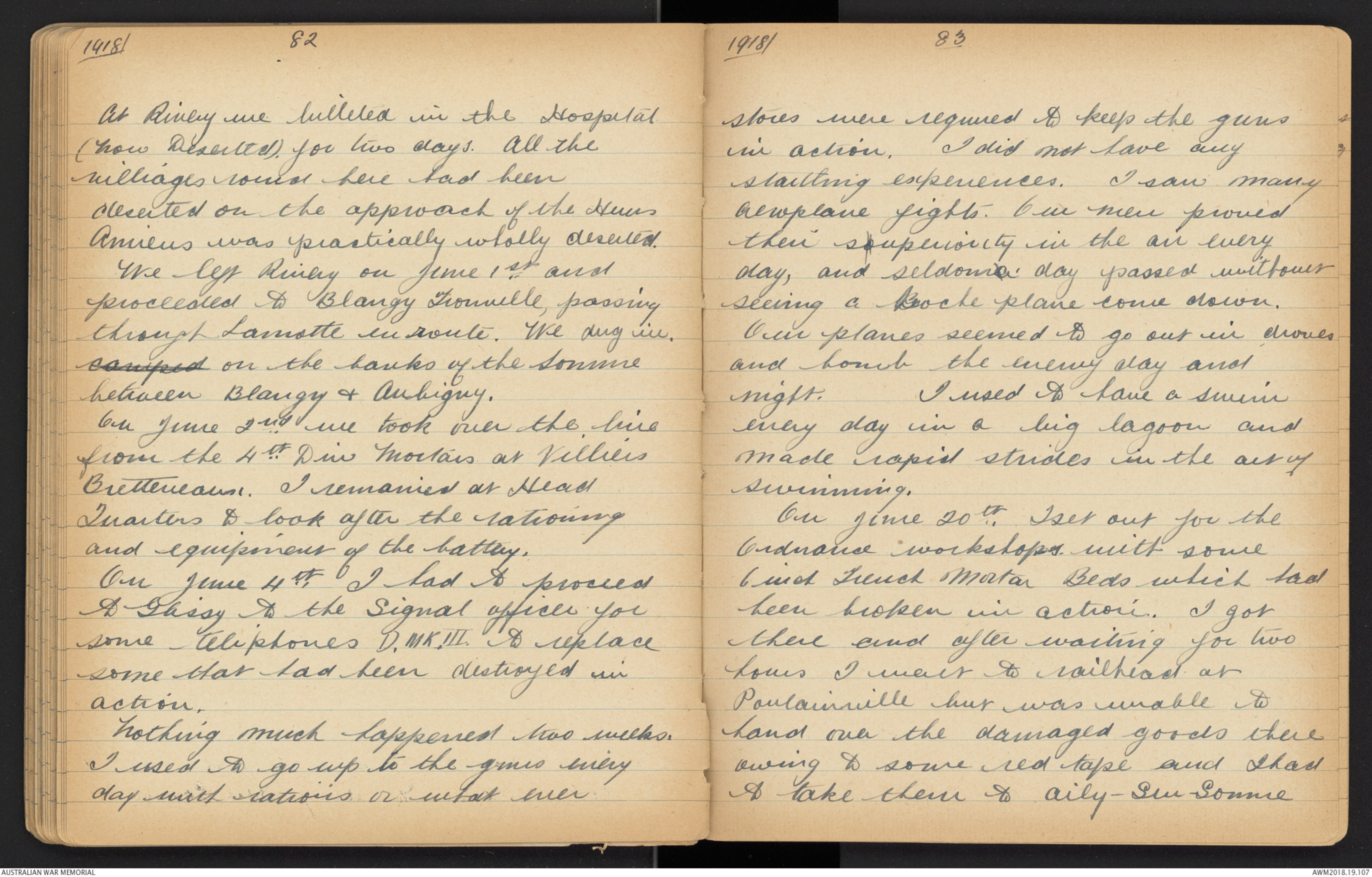
1918 82
At Rivery we billeted in the Hospital
(now Deserted), for two days. All the
villiages round here had been
deserted on the approach of the Huns
Amiens was practically wholly deserted.
We left Rivery on June 1st and
proceeded to Blangy Tronville, passing
through Lamotte en route. We dug in.
camped on the banks of the Somme
between Blangy & Aubigny.
On June 2nd we took over the line
from the 4th Div Mortars at Villiers
Bretteneaux. I remained at Head
Quarters to look after the rationing
and equipment of the battery.
On June 4th, I had to proceed
to Glissy to the Signal office for
some telephones D. MK. III. to replace
some that had been destroyed in
action.
Nothing much happened two weeks.
I used to go up to the guns every
day with rations or what ever
1918 83
stores were required to keep the guns
in action. I did not have any
startling experiences. I saw many
aeroplane fights. Our men proved
their souperiority in the air every
day, and seldom a day passed without
seeing a Boche plane come down.
Our planes seemed to go out in droves
and bomb the enemy day and
night. I used to have a swim
every day in a big lagoon and
made rapid strides in the art of
swimming.
On June 20th I set out for the
Ordnance workshops with some
6 inch Trench Mortar Beds which had
been broken in action. I got
there and after waiting for two
hours I went to railhead at
Poulainville but was unable to
hand over the damaged goods there
owing to some red tape and I had
to take them to Aily-Sur-Somme
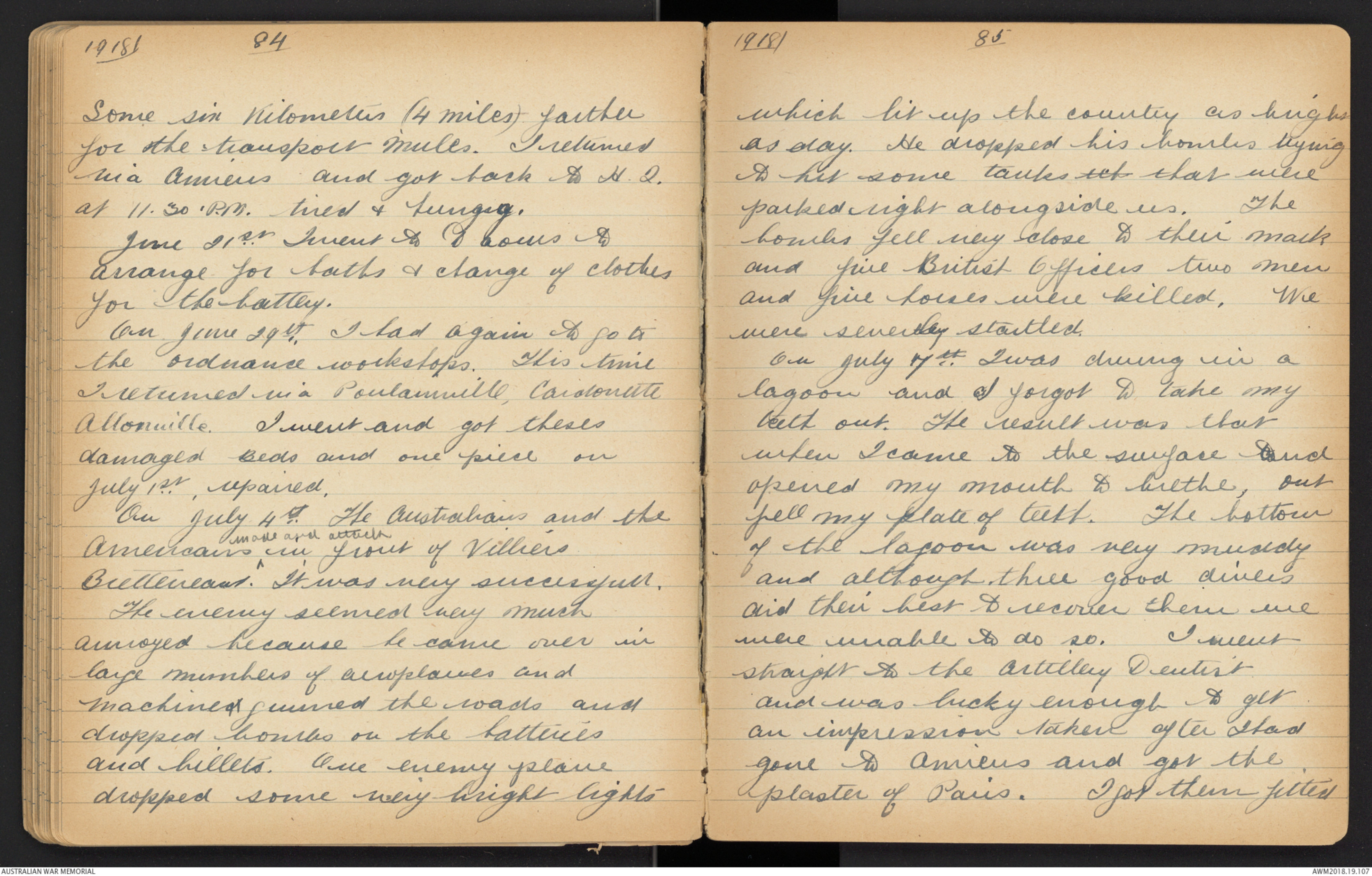
1918 84
Some six kilometers (4 miles) farther
for the transport mules. I returned
via Amiens and got back to H.Q.
at 11.30 P.M. tired & hungry.
June 21st I went to Daours to
arrange for baths & change of clothes
for the battery.
On June 29th I had again to go to
the ordnance workshops. This time
I returned via Poulainville, Cardonette
Allonville. I went and got these
damaged Beds and one piece on
July 1st repaired.
On July 4th The Australians and the
Americans ^made and attack in front of Villiers
Bretteneaux. It was very successfull.
The enemy seemed very much
annoyed because he came over in
large numbers of aeroplanes and
machined gunned the roads and
dropped bombs on the batteries
and billets. One enemy plane
dropped some very bright lights
1918 85
which lit up the country as bright
as day. He dropped his bombs trying
to hit some tanks up that were
parked right alongside us. The
bombs fell very close to their mark
and five British Officers two men
and five horses were killed. We
were severely startled.
On July 7th I was diving in a
lagoon and I forgot to take my
teeth out. The result was that
when I came to the surface and
opened my mouth to brethe, out
fell my plate of teeth. The bottom
of the lagoon was very muddy
and although three good divers
did their best to recover them we
were unable to do so. I went
straight to the Artillery Dentist
and was lucky enough to get
an impression taken after I had
gone to Amiens and got the
plaster of Paris. I got them fitted
1918 86
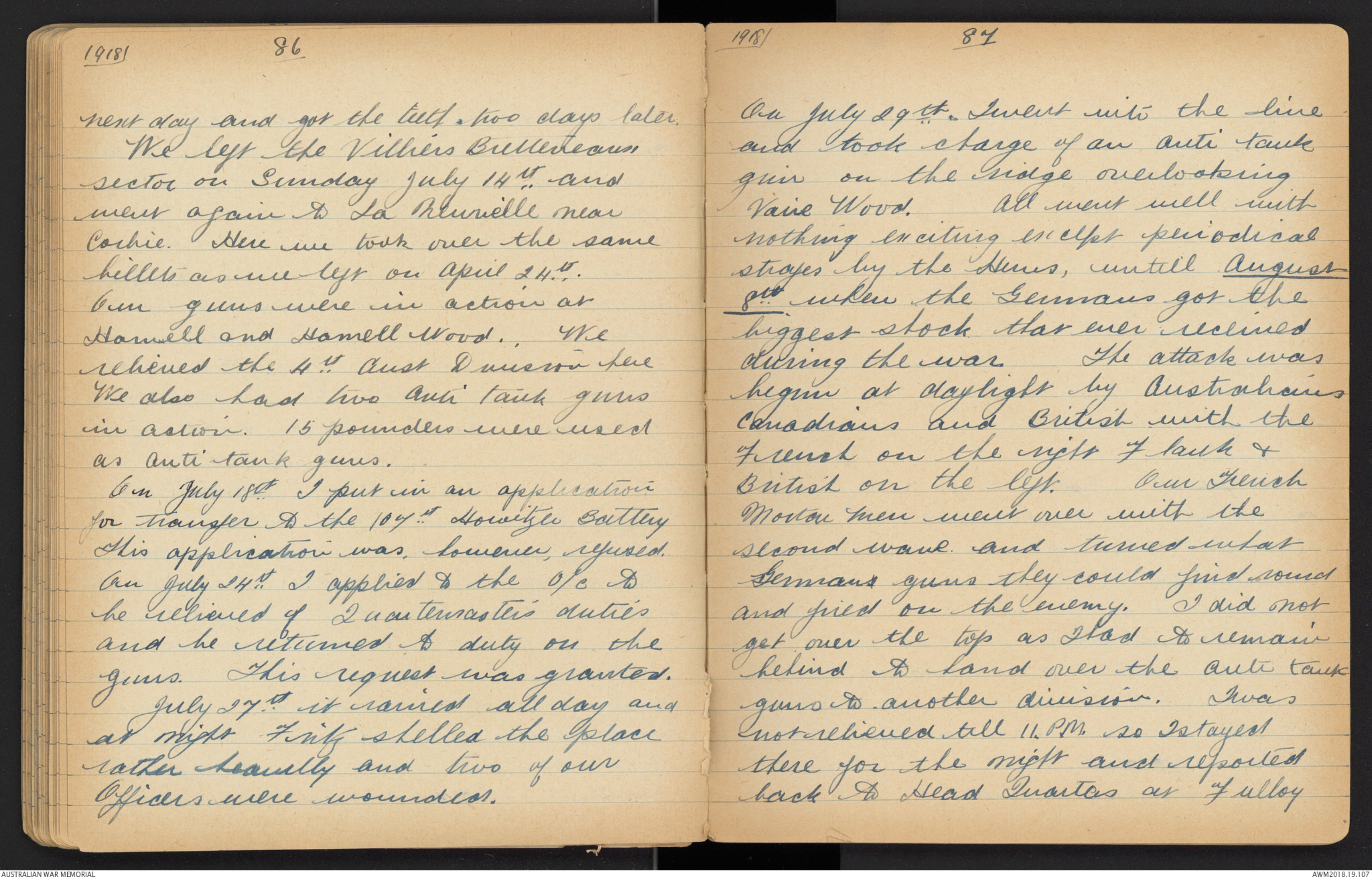
next day and got the teeth two days later.
We left the Villiers Bretteneaux
sector on Sunday July 14th and
went again to La Neuville near
Corbie. Here we took over the same
billets as we left on April 24th.
Our guns were in action at
Hamell and Hamell Wood. We
relieved the 4th Aust Division here
We also had two Anti tank guns
in action. 15 pounders were used
as anti tank guns.
On July 18th I put in an application
for transfer to the 107th Howitzer Battery
This application was, however, refused.
On July 24th I applied to the O/C to
be relieved of Quartermaster's duties
and be returned to duty on the
guns. This request was granted.
July 27th it rained all day and
at night Fritz shelled the place
rather heavily and two of our
Officers were wounded.
1918 87
On July 29th I went into the line
and took charge of an anti tank
gun on the ridge overlooking
Vaire Wood. All went well with
nothing exciting except periodical
strafes by the Huns, untill August
8th when the Germans got the
biggest shock that ever received
during the war. The attack was
begun at daylight by Australians
Canadians and British with the
French on the right Flank &
British on the left. Our Trench
Mortar men went over with the
second wave and turned what
Germans guns they could find round
and fired on the enemy. I did not
get over the top as I had to remain
behind to hand over the anti tank
guns to another division. I was
not relieved till 11.P.M. so I stayed
there for the night and reported
back to Head Quarters at Fulloy
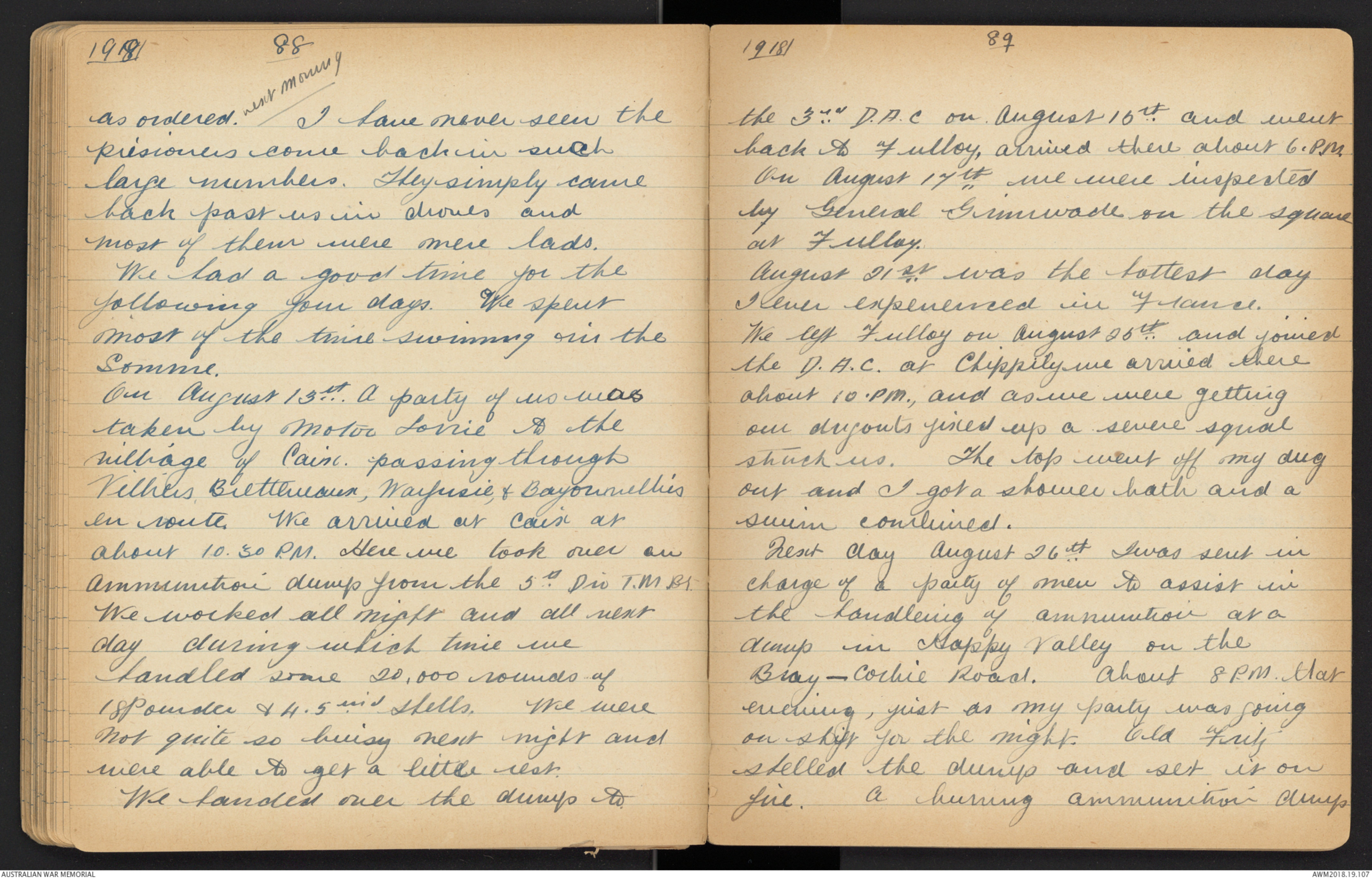
1918 88
as ordered [*next morning*]. I have never seen the
prisoners come back in such
large numbers. They simply came
back past us in droves and
most of them were mere lads.
We had a good time for the
following four days. We spent
most of the time swimming in the
Somme.
On August 13th A party of us was
taken by motor lorrie to the
villiage of Caix. passing through
Villiers Bretteneau, Warfusie, & Bayouvillies
en route. We arrived at Caix at
about 10.30 P.M. Here we took over an
ammunition dump from the 5th Div T.M.B1
We worked all night and all next
day during which time we
handled some 20,000 rounds of
18 pounder & 4.5 inch shells. We were
not quite so buisy next night and
were able to get a little rest.
We handed over the dump to
1918 89
the 3rd D.A.C on August 15th and went
back to Fulloy, arrived there about 6.P.M.
On August 17th we were inspected
by General Grimwade on the square
at Fulloy.
August 21st was the hottest day
I ever experienced in France.
We left Fulloy on August 25th and joined
the D.A.C. at Chippily. we arrived there
about 10.P.M., and as we were getting
our dugouts fixed up a severe squal
struck us. The top went off my dug
out and I got a shower bath and a
swim combined.
Next day August 26th I was sent in
charge of a party of men to assist in
the handleing of ammunition at a
dump in Happy Valley on the
Bray-Corbie Road. About 8 P.M. that
evening, just as my party was going
on shift for the night. Old Fritz
shelled the dump and set it on
fire. A burning ammunition dump
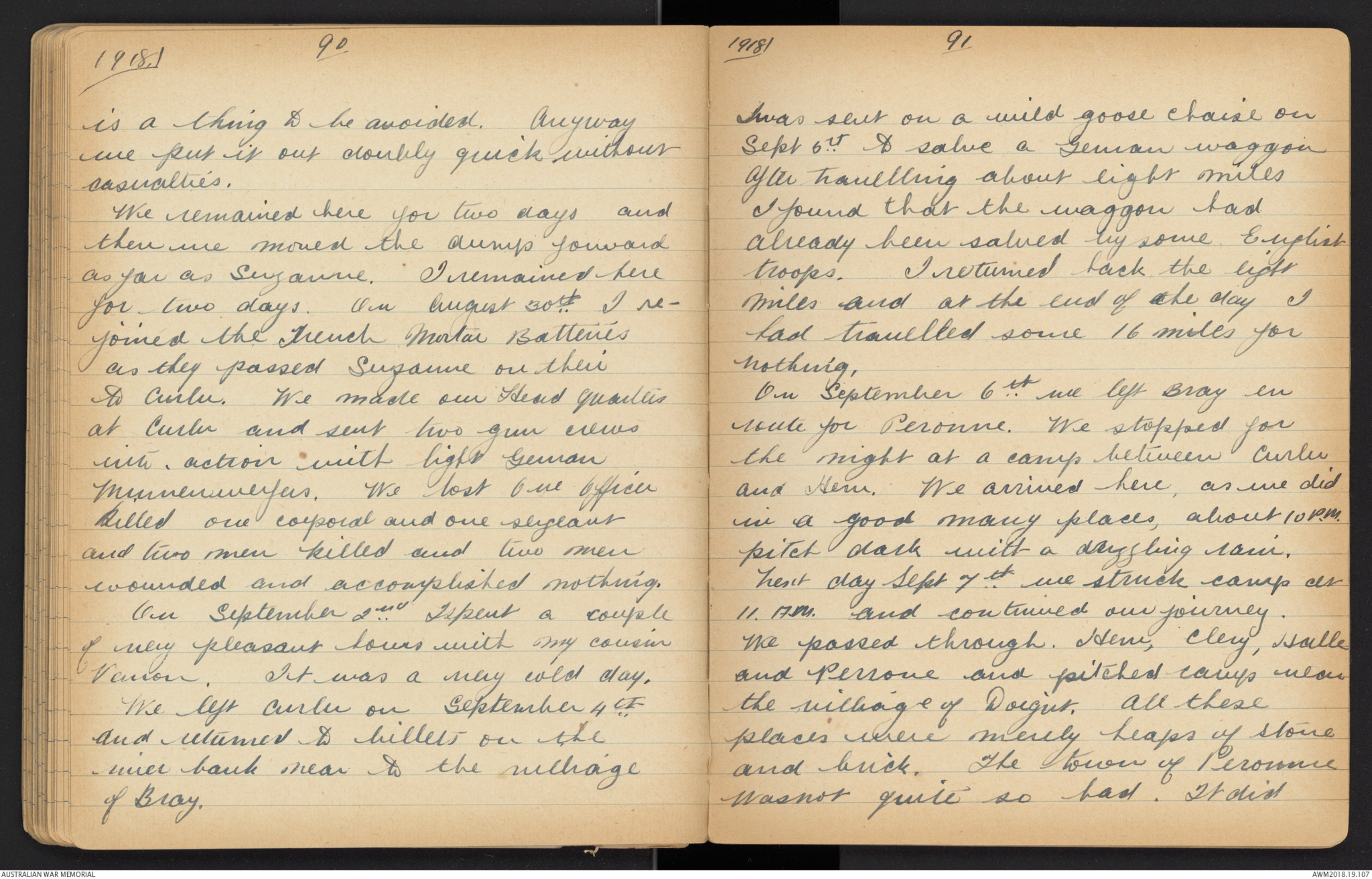
1918 90
is a thing to be avoided. Anyway
we put it out doubly quick without
casualties.
We remained here for two days and
then we moved the dump forward
as far as Suzanne. I remained here
for two days. On August 30th I rejoined
the Trench Mortar Batteries
as they passed Suzanne on their
to Curlu. We made our Head Quarters
at Curlu and sent two gun crews
into action with light German
Minnenwerfers. We lost one Officer
killed one corporal and one sergeant
and two men killed and two men
wounded and accomplished nothing.
On September 2nd I spent a couple
of very pleasant hours with my cousin
Vernon. It was a very cold day.
We left Curlu on September 4th
and returned to billets on the
river bank near to the villiage
of Bray.
1918 91
I was sent on a wild goose chaise on
Sept 5th to salve a German waggon
After travelling about eight miles
I found that the waggon had
already been salved by some English
troops. I returned back the eight
miles and at the end of the day I
had travelled some 16 miles for
nothing.
On September 6th we left Bray en
route for Peronne. We stopped for
the night at a camp between Curlu
and Hem. We arrived here, as we did
in a good many places, about 10 P.M.
pitch dark with a drizzling rain.
Next day Sept 7th we struck camp at
11.A.M. and continued our journey.
We passed through Hem, Clery, Halle
and Perronne and pitched camp near
the villiage of Doignt. All these
places were merely heaps of stone
and brick. The town of Peronne
was not quite so bad. It did
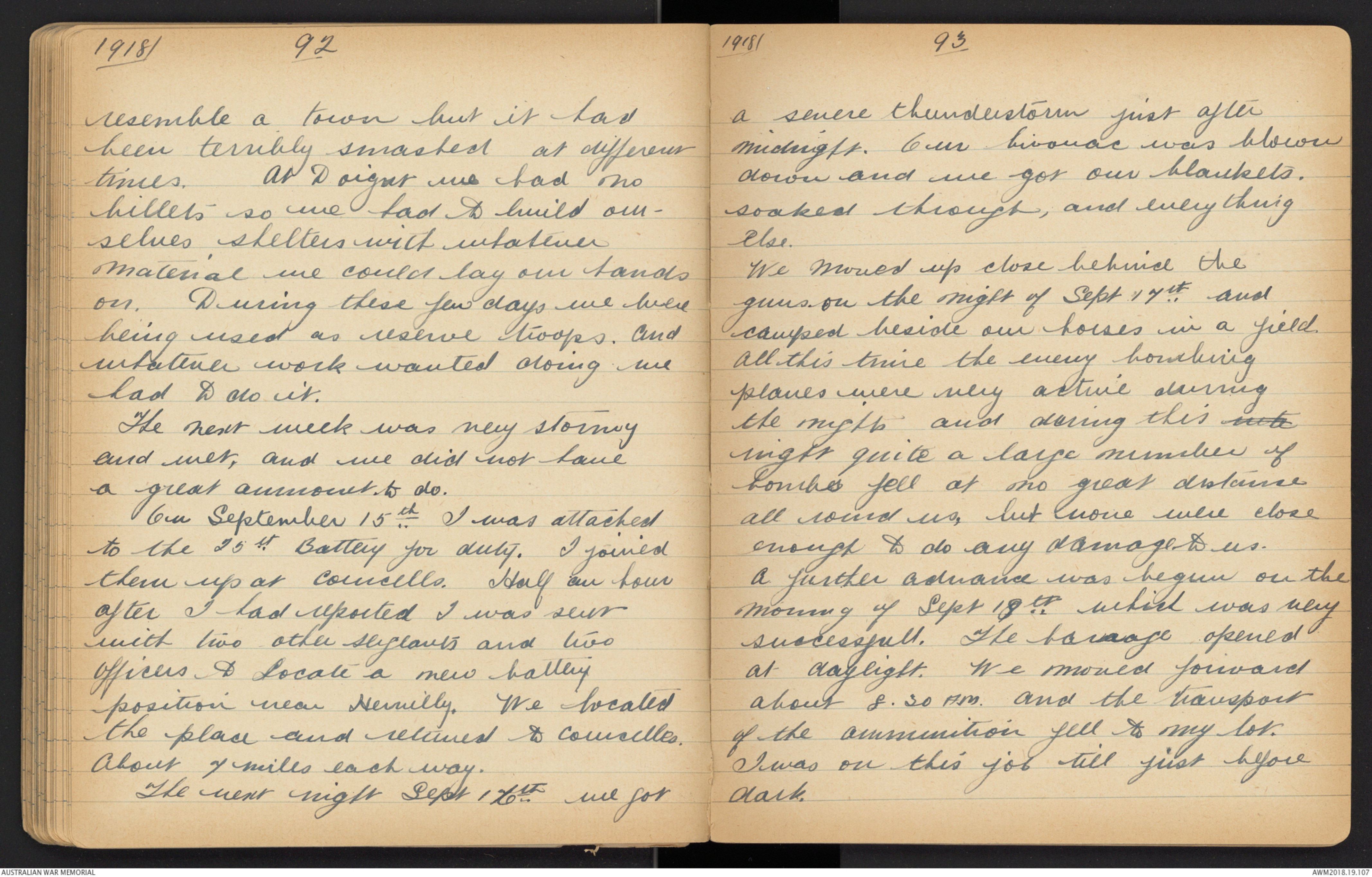
1918 92
resemble a town but it had
been terribly smashed at different
times. At Doignt we had no
billets so we had to build ourselves
shelters with whatever
material we could lay our hands
on. During these few days we were
being used as reserve troops. And
whatever work wanted doing we
had to do it.
The next week was very stormy
and wet, and we did not have
a great ammount to do.
On September 15th I was attached
to the 25th Battery for duty. I joined
them up at Courcells. Half an hour
after I had reported I was sent
with two other sergeants and two
officers to locate a new battery
position near Hermilly. We located
the place and returned to Courcelles.
About 7 miles each way.
The next night Sept 16th we got
1918 93
a severe thunderstorm just after
midnight. Our bivouac was blown
down and we got our blankets,
soaked through, and everything
else.
We moved up close behind the
guns on the night of Sept 17th and
camped beside our horses in a field.
All this time the enemy bombing
planes were very active during
the night and during this nite
night quite a large number of
bombs fell at no great distance
all round us, but none were close
enough to do any damage to us.
A further advance was begun on the
morning of Sept 18th which was very
successfull. The barrage opened
at daylight. We moved forward
about 8.30 A.M. and the transport
of the ammunition fell to my lot.
I was on this job till just before
dark.
1918 94
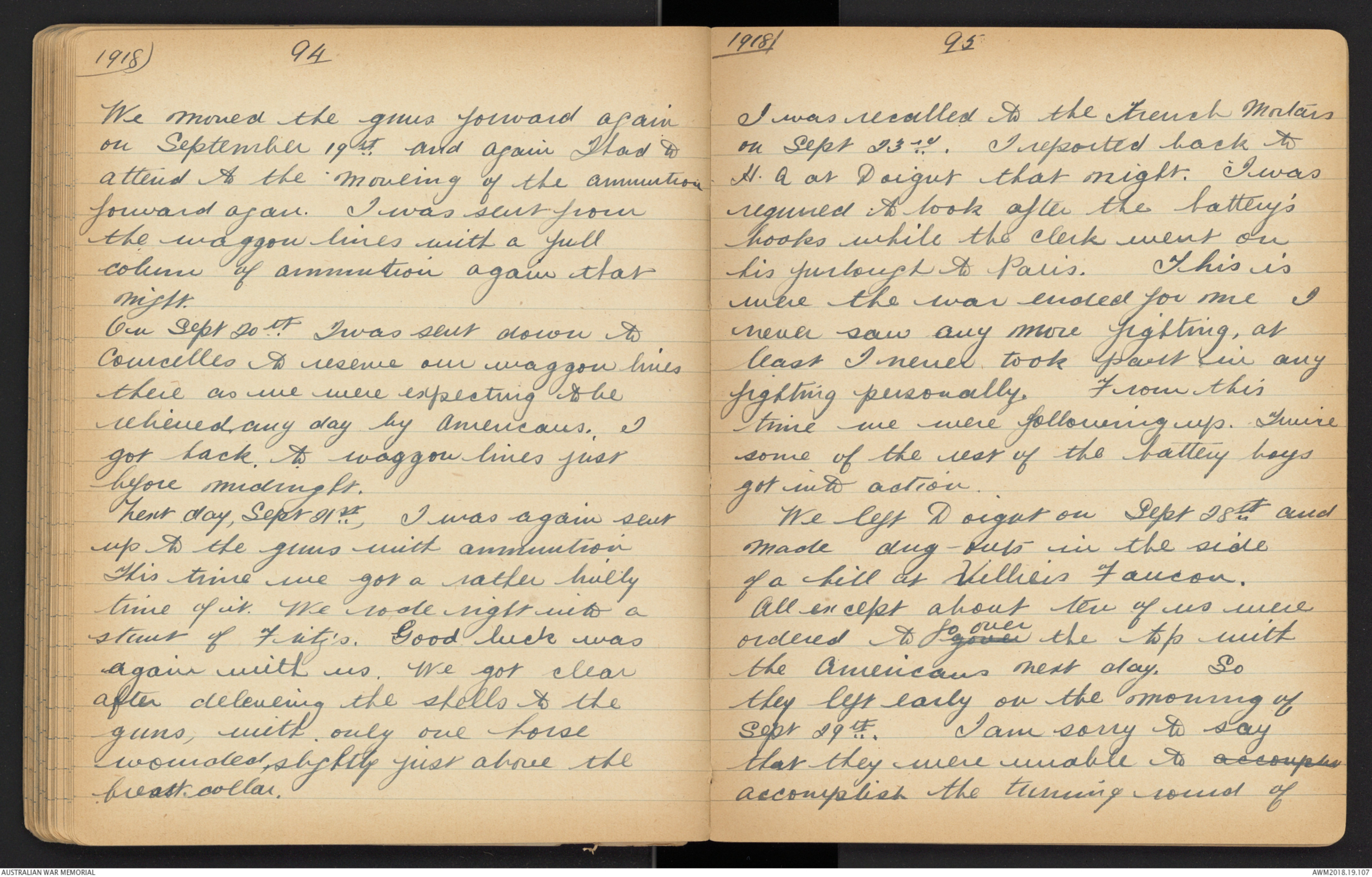
We moved the guns forward again
on September 19th and again I had to
attend to the moveing of the ammunition
forward again. I was sent from
the waggon lines with a full
column of ammunition again that
night.
On Sept 20th I was sent down to
Courcelles to reserve our waggon lines
there as we were expecting to be
relieved any day by Americans. I
got back to waggon lines just
before midnight.
Next day, Sept 21st, I was again sent
up to the guns with ammunition
This time we got a rather lively
time of it. We rode right into a
stunt of Fritz's. Good luck was
again with us. We got clear
after delevering the shells to the
guns, with only one horse
wounded slightly just above the
breast collar.
1918 95
I was recalled to the Trench Mortars
on Sept 23rd. I reported back to
H.Q. at Doignt that night. I was
required to look after the battery's
books while the clerk went on
his furlough to Paris. This is
were the war ended for me I
never saw any more fighting, at
least I never took part in any
fighting personally. From this
time we were following up. Twice
some of the rest of the battery boys
got into action.
We left Doignt on Sept 28th and
made dug-outs in the side
of a hill at Villiers Faucon.
All except about ten of us were
ordered to gover go over the top with
the Americans next day. So
they left early on the morning of
Sept 29th. I am sorry to say
that they were unable to accompl
accomplish the turning round of
1918 96
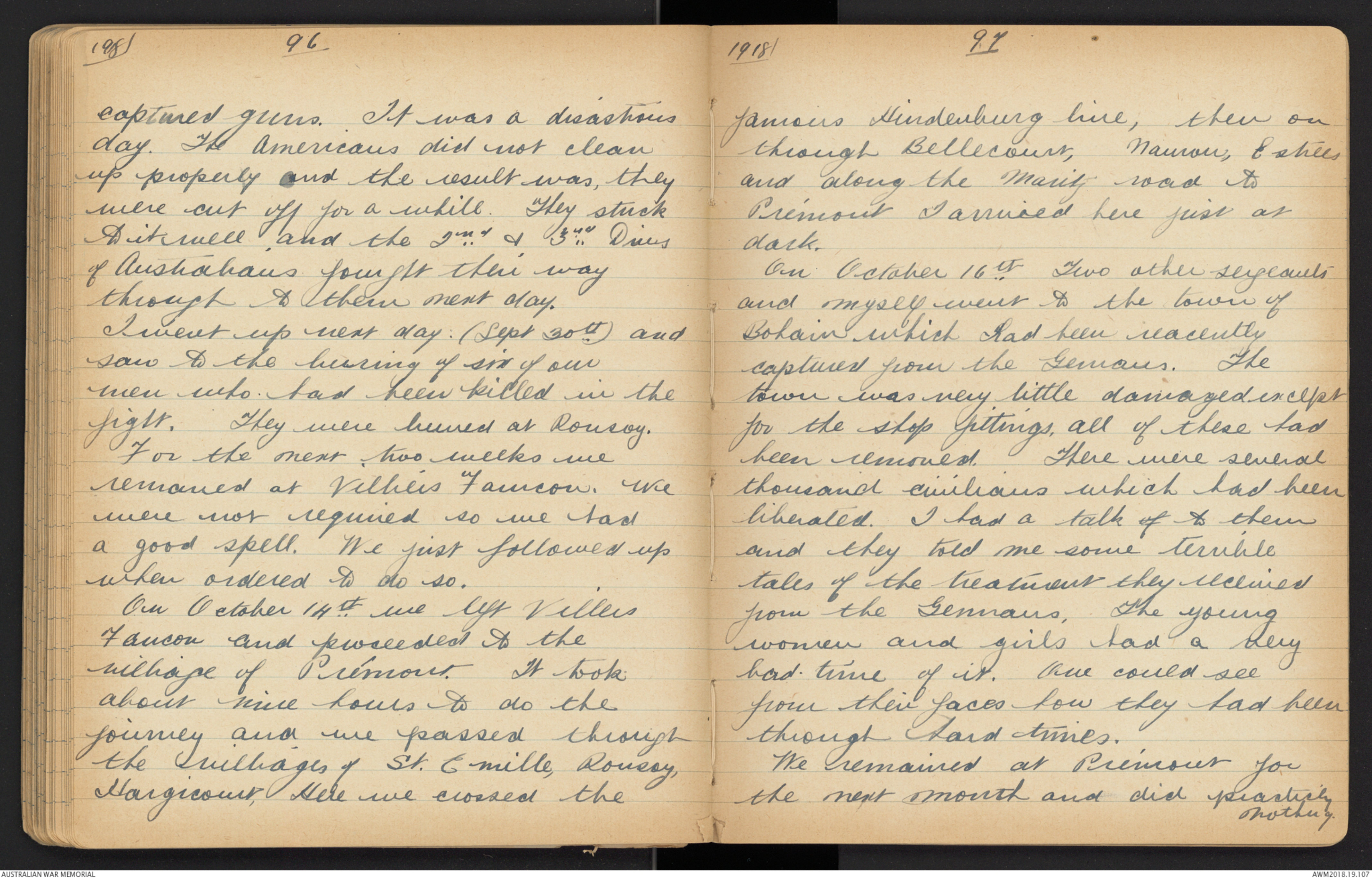
captured guns. It was a disastrous
day. The Americans did not clean
up properly and the result was, they
were cut off for a while. They stuck
to it well, and the 2nd & 3rd Divs
of Australians fought their way
through to them next day.
I went up next day (Sept 30th) and
saw to the buring of six of our
men who had been killed in the
fight. They were buried at Ronsoy.
For the next two weeks we
remained at Villiers Faucon. We
were not required so we had
a good spell. We just followed up
when ordered to do so.
On October 14th we left Villers
Faucon and proceeded to the
villiage of Prémont. It took
about nine hours to do the
journey and we passed through
the villiages of St. Emille, Ronsoy,
Hargicourt. Here we crossed the
1918 97
famous Hindenburg line, then on
through Bellecourt, Naurou, Estrees
and along the Maritz road to
Prémont I arrived here just at
dark.
On October 16th Two other sergeants
and myself went to the town of
Bohain which had been reacently
captured from the Germans. The
town was very little damaged except
for the shop fittings, all of these had
been removed. There were several
thousand civilians which had been
liberated. I had a talk of to them
and they told me some terrible
tales of the treatment they received
from the Germans. The young
women and girls had a very
bad time of it. One could see
from their faces how they had been
through hard times.
We remained at Prémont for
the next month and did practically
nothing.
 Deb Parkinson
This transcription item is now locked to you for editing. To release the lock either Save your changes or Cancel.
This lock will be automatically released after 60 minutes of inactivity.