
Diary of Keith Morton Hickman, 1916-1919 - Part 4
1917 57
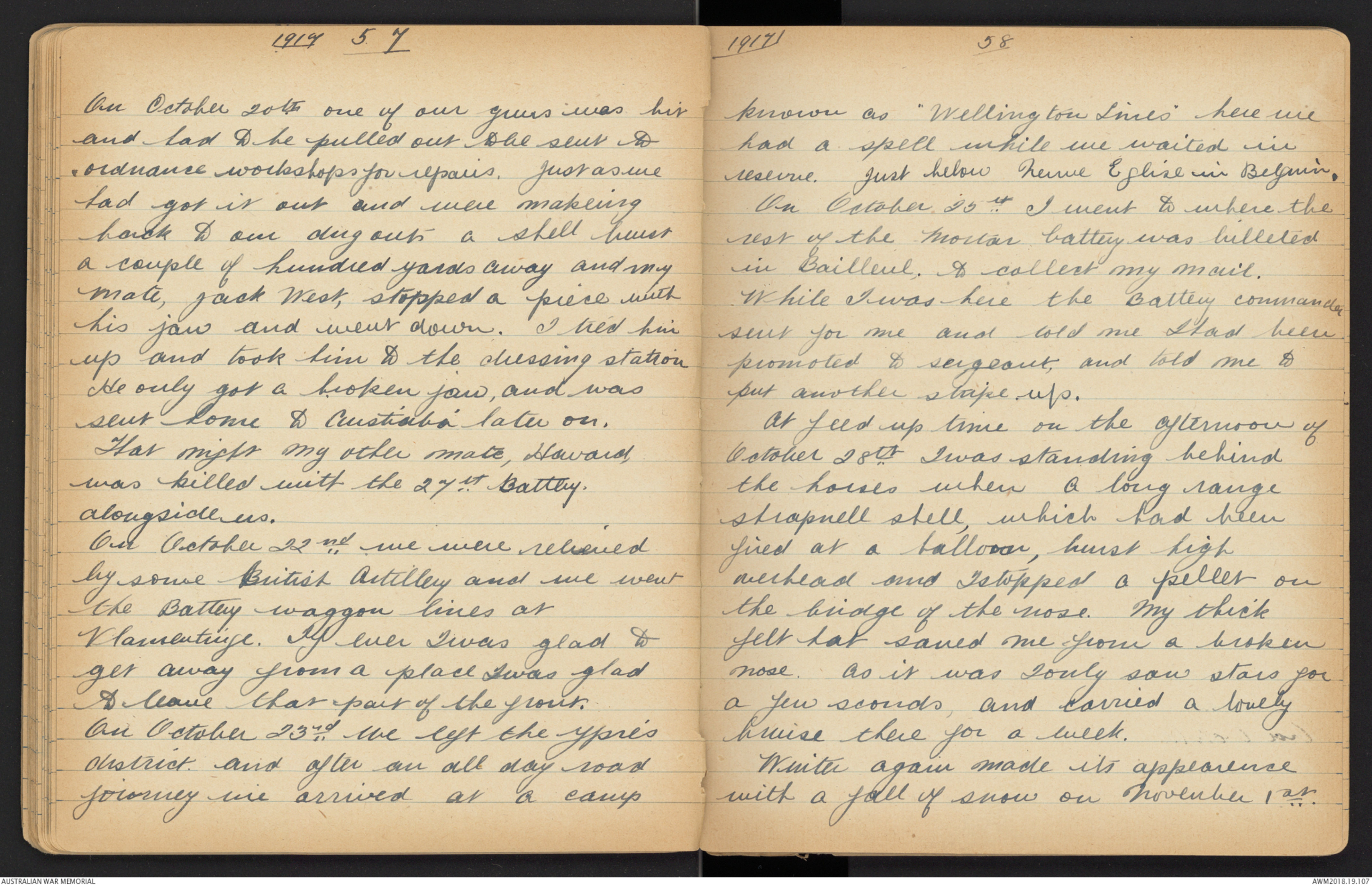
On October 20th one of our guns was hit
and had to be pulled out to be sent to
ordnance workshops for repairs. Just as we
had got it out and were makeing
back to our dug outs a shell burst
a couple of hundred yards away and my
mate, Jack West, stopped a piece with
his jaw and went down. I tied him
up and took him to the dressing station
He only got a broken jaw, and was
sent home to Australia later on.
That night my other mate, Howard,
was killed with the 27th Battery.
alongside us.
On October 22nd we were relieved
by some British Artillery and we went
the Battery waggon lines at
Vlamertinge. If ever I was glad to
get away from a place I was glad
to leave that part of the front.
On October 23rd we left the Ypre's
district and after an all day road
journey we arrived at a camp
1917 58
known as "Wellington Lines" here we
had a spell while we waited in
reserve. Just below Neuve Eglise in Belgium.
On October 25th I went to where the
rest of the Mortar battery was billeted
in Bailleul. to collect my mail.
While I was here the Battery commander
sent for me and told me I had been
promoted to sergeant, and told me to
put another stripe up.
At feed up time on the afternoon of
October 28th I was standing behind
the horses when a long range
shrapnell shell, which had been
fired at a balloon, burst high
overhead and I stopped a pellet on
the bridge of the nose. My thick
felt hat saved me from a broken
nose. As it was I only saw stars for
a few seconds, and carried a lovely
bruise there for a week.
Winter again made its appearance
with a fall of snow on November 1st
1917 59.
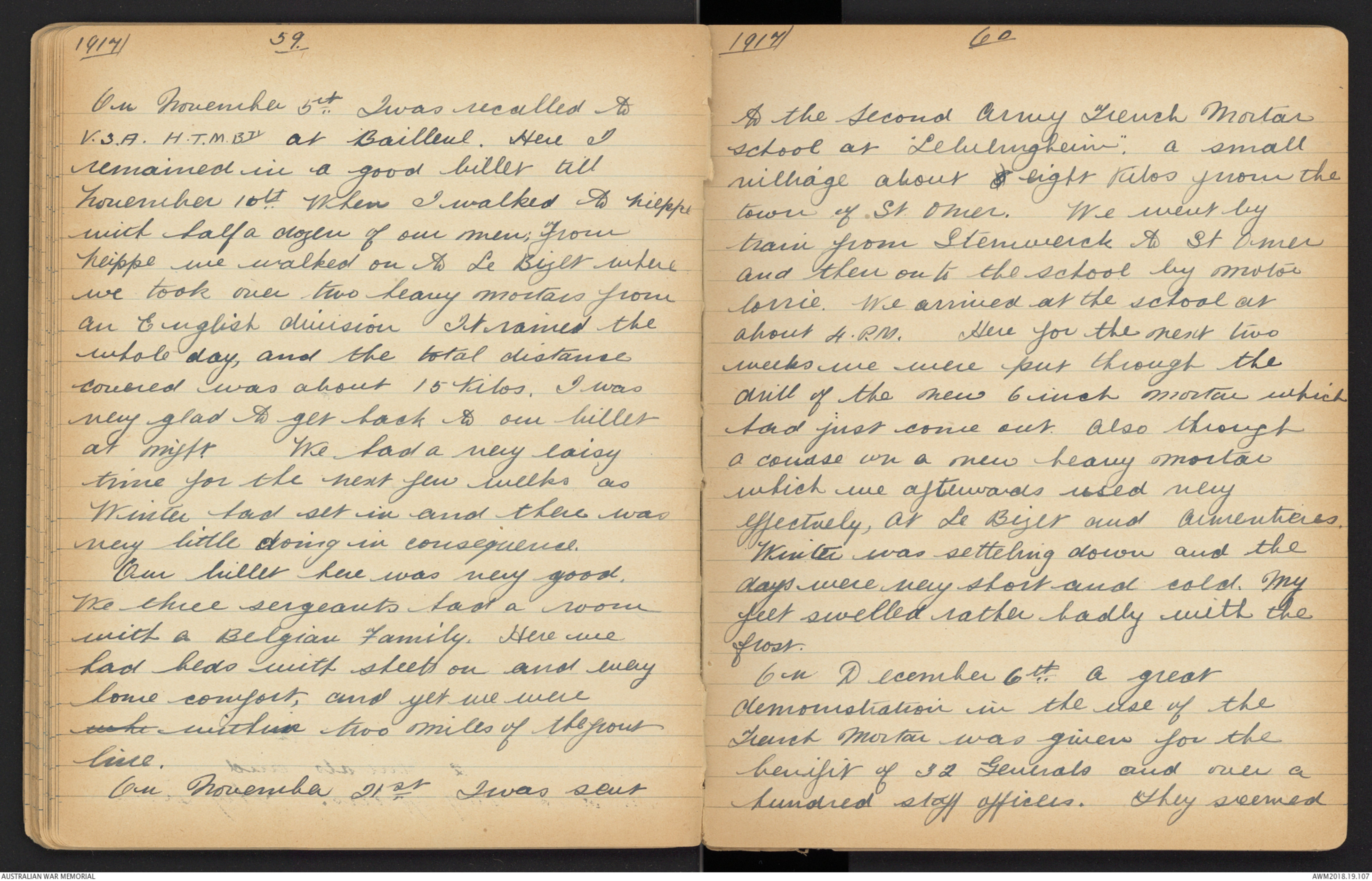
On November 5th I was recalled to
V.3.A. H.T.M. Bty at Bailleul. Here I
remained in a good billet till
November 10th When I walked to Nieppe
with half a dozen of our men; From
Neippe we walked on to Le Bizet where
we took over two heavy mortars from
an English division. It rained the
whole day, and the total distance
covered was about 15 kilos. I was
very glad to get back to our billet
at night. We had a very laisy
time for the next few weeks as
Winter had set in and there was
very little doing in consequence.
Our billet here was very good.
We three sergeants had a room
with a Belgian Family. Here we
had beds with sheets on and every
home comfort, and yet we werewhe within two miles of the front
line.
On November 21st I was sent
1917 60
to the Second Army Trench Mortar
school at Lelulingheim, a small
villiiage about 8 eight kilos from the
town of St Omer. We went by
train from Stemwerck to St Omer
and then out to the school by motor
lorrie. We arrived at the school at
about 4.P.M. Here for the next two
weeks we were put through the
drill of the new 6 inch mortar which
had just come out. Also through
a course on a new heavy mortar
which we afterwards used very
effectively, at Le Bizet and Armentieres.
Winter was setteling down and the
days were very short and cold. My
feet swelled rather badly with the
frost.
On December 6th a great
demonstration in the use of the
Trench Mortar was given for the
benefit of 32 Generals and over a
hundred staff officers. They seemed
1917 61
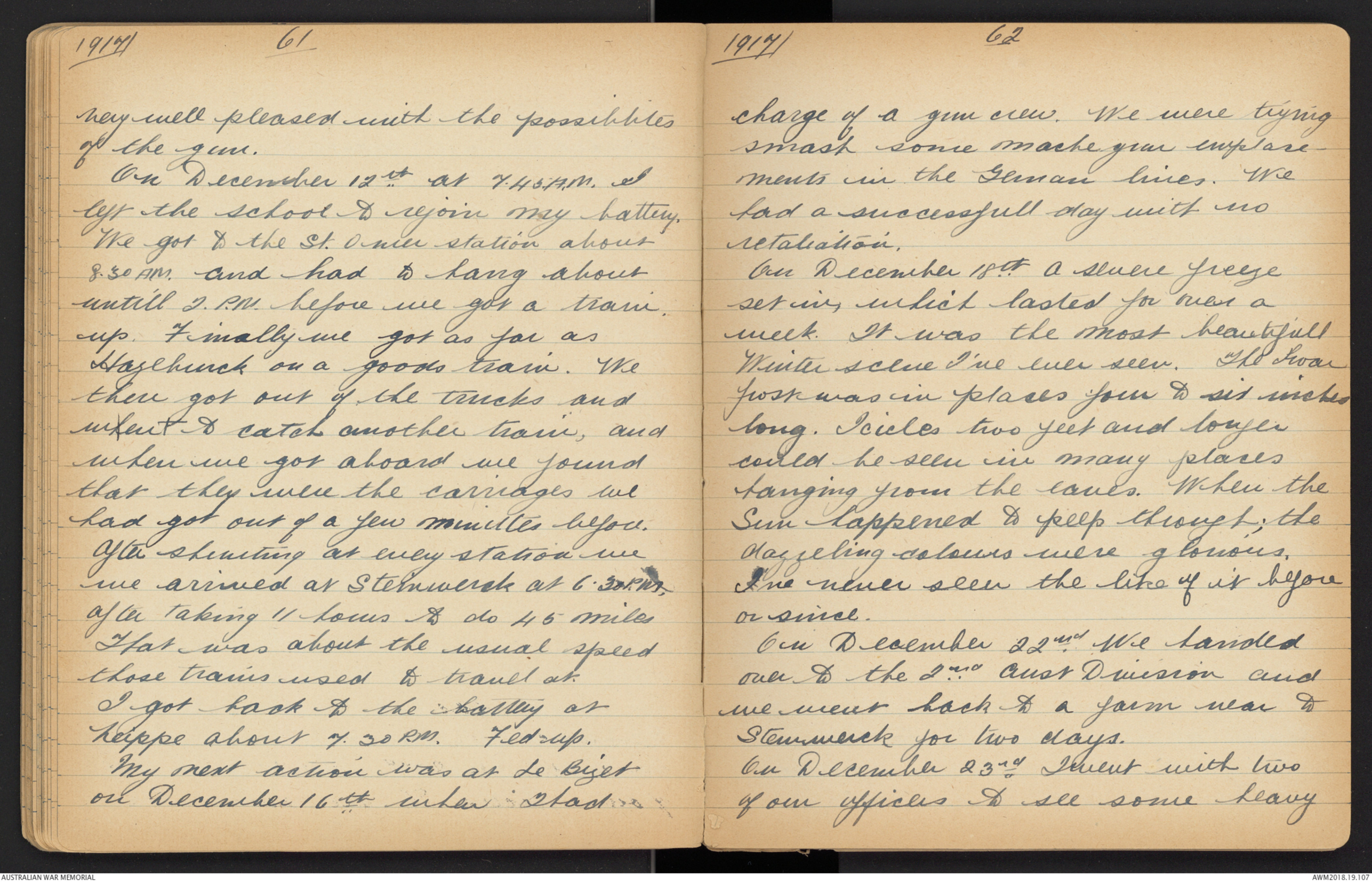
very well pleased with the possibilities
of the gun.
On December 12th at 7.45.A.M. I
left the school to rejoin my battery.
We got to the St. Omer station about
8.30 A.M. and had to hang about
untill 2.P.M. before we got a train.
up. Finally we got as far as
Hazebruck on a goods train. We
then got out of the trucks and
whent to catch another train, and
when we got aboard we found
that they were the carriages we
had got out of a few minutes before.
After shunting at every station we
we arrived at Steinwerck at 6.30P.M.
after taking 11 hours to do 45 miles
That was about the usual speed
those trains used to travel at.
I got back to battery at
Neippe about 7.30 P.M. Fed up.
My next action was at Le Bizet
on December 16th when I had
1917 62
charge of a gun crew. We were trying
smash some mache gun emplacements
in the German lines. We
had a successfull day with no
retaliation.
On December 18th a severe freeze
set in which lasted for over a
week. It was the most beautifull
Winter scene I've ever seen. The hoar
frost was in places four to six inches
long. Icicles two feet and longer
could be seen in many places
hanging from the eaves. When the
Sun happened to peep through; the
dazzeling colours were glorious.
I've never seen the like of it before
or since.
On December 22nd We handed
over to the 2nd Aust Division and
we went back to a farm near to
Steinwerck for two days.
On December 23rd I went with two
of our officers to see some heavy
1917 63
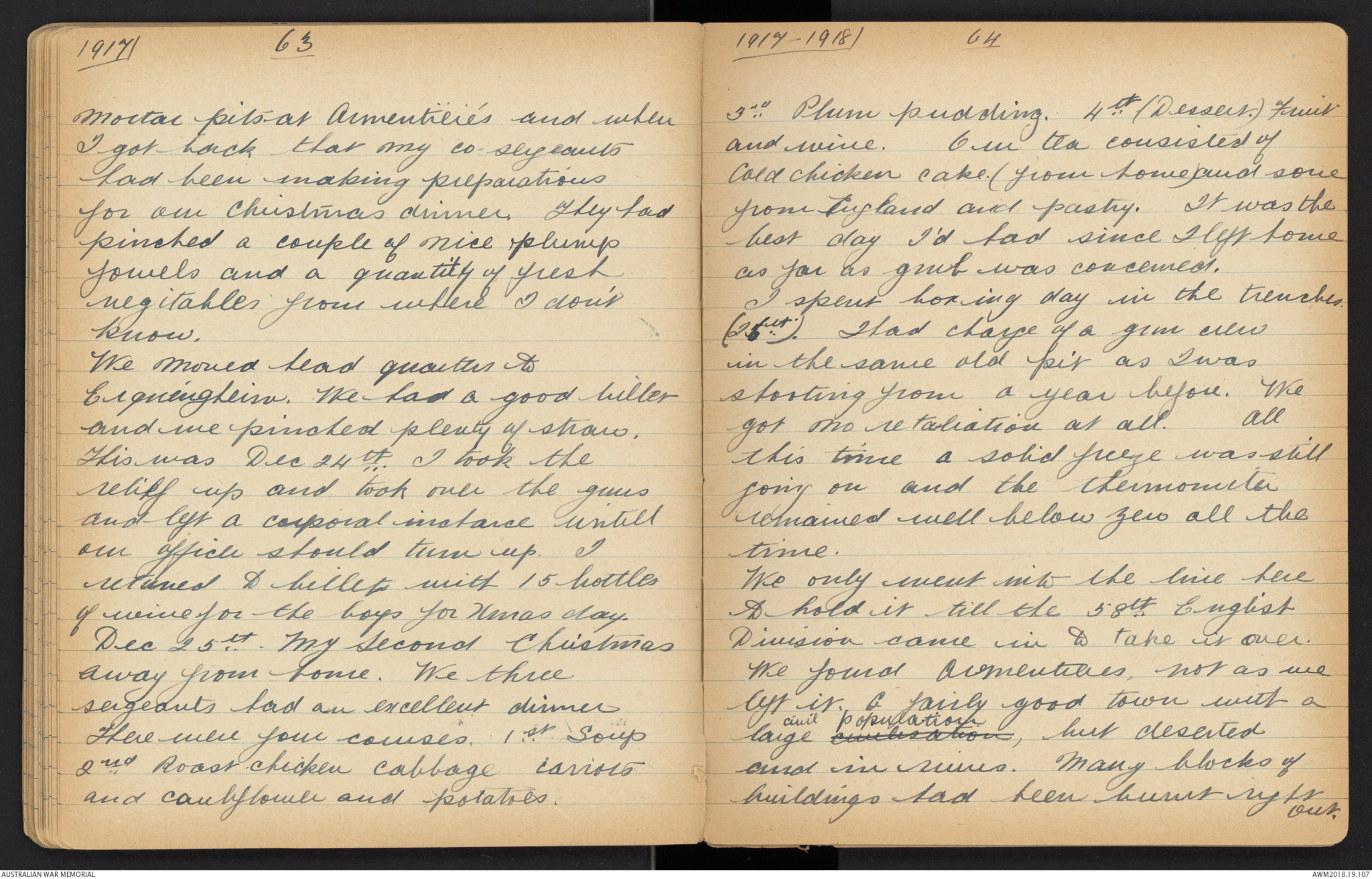
mortar pits at Armentierés and when
I got back that my co-sergeants
had been making preparations
for our Christmas dinner. They had
pinched a couple of nice plump
fowels and a quantity of fresh
vegitables from where I don't
know.
We moved head quarters to
Erquingheim. We had a good billet
and we pinched plenty of straw.
This was Dec 24th. I took the
relief up and took over the guns
and left a corporal instance untill
our officer should turn up. I
returned to billet until 15 bottles
of wine for the boys for Xmas day.
Dec 25th. My Second Christmas
away from home. We three
sergeants had an excellent dinner
There were four courses. 1st Soup
2nd Roast chicken cabbage carrots
and cauliflower and potatoes.
1917-1918 64
3rd Plum pudding. 4th (Dessert.) Fruit
and wine. Our tea consisted of
cold chicken cake. (from home) and some
from England and pastry. It was the
best day I'd had since I left home
as far as grub was concerned.
I spent boxing day in the trenches.
(26th). I had charge of a gun crew
in the same old pit as I was
shooting from a year before. We
got no retaliation at all. All
this time a solid freeze was still
going on and the thermometer
remained well below zero all the
time.
We only went into the line here
to hold it till the 58th English
Division came in to take it over.
We found Armentieres, not as we
left it. A fairly good town with a
large civil population civilisation, but deserted
and in ruins. Many blocks of
buildings had been burnt right
out.
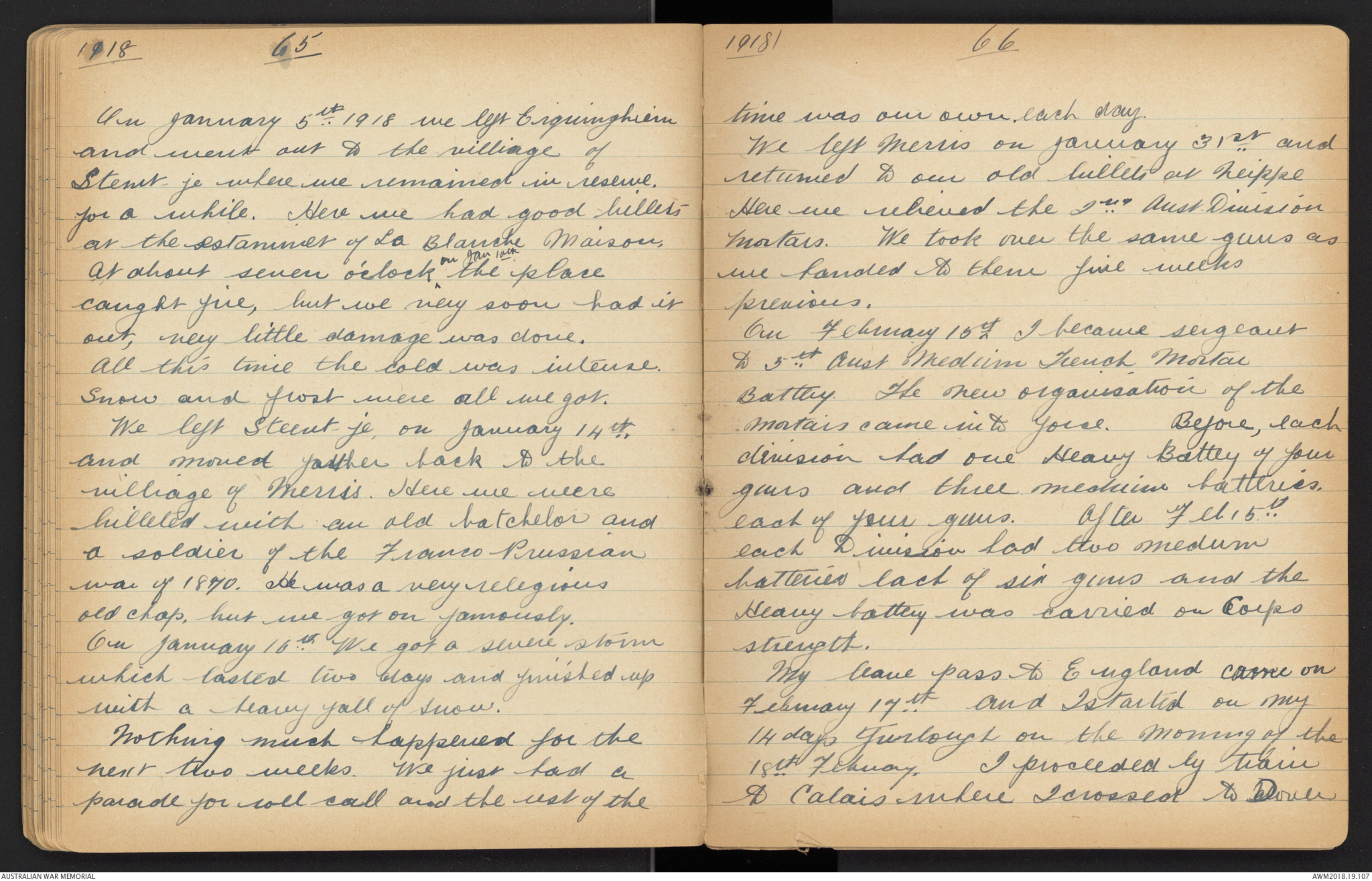
1918 65
On January 5th 1918 we left Erquinghmie
and went out to the villiage of
Steent-je where we remained in reserve
for a while. Here we had good billets
at the estaminent of La Blanche Maison.
At about seven o'clock ^on Jan 10th the place
caught fire, but we very soon had it
out, very little damage was done.
All this time the cold was intense.
Snow and frost were all we got.
We left Steent-je on January 14th
and moved farther back to the
villiage of Merris. Here we were
billeted with an old batchelor and
a soldier of the Franco Prussian
war of 1870. He was a very religious
old chap, but we got on famously.
On January 16th We got a severe storm
which lasted two days and finished up
with a heavy fall of snow.
Nothing much happened for the
next two weeks. We just had a
parade for roll call and the rest of the
1918 66
time was our own each day.
We left Merris on January 31st and
returned to our old billets at Neippe
Here we relieved the 2nd Aust. Division
Mortars. We took over the same guns as
we handed to them five weeks
previous.
On February 15th I became sergeant
to 5th Aust Medium Trench Mortar
Battery. The new organisation of the
mortars came into force. Before, each
division had one Heavy Battery of four
guns and three medium batteries,
each of four guns. After Feb 15th
each Division had two medium
batteries each of six guns and the
Heavy battery was carried on Corps
strength.
My leave pass to England came on
February 17th and I started on my
14 days furlough on the morning of the
18th February. I proceeded by train
to Calais where I crossed to Dover
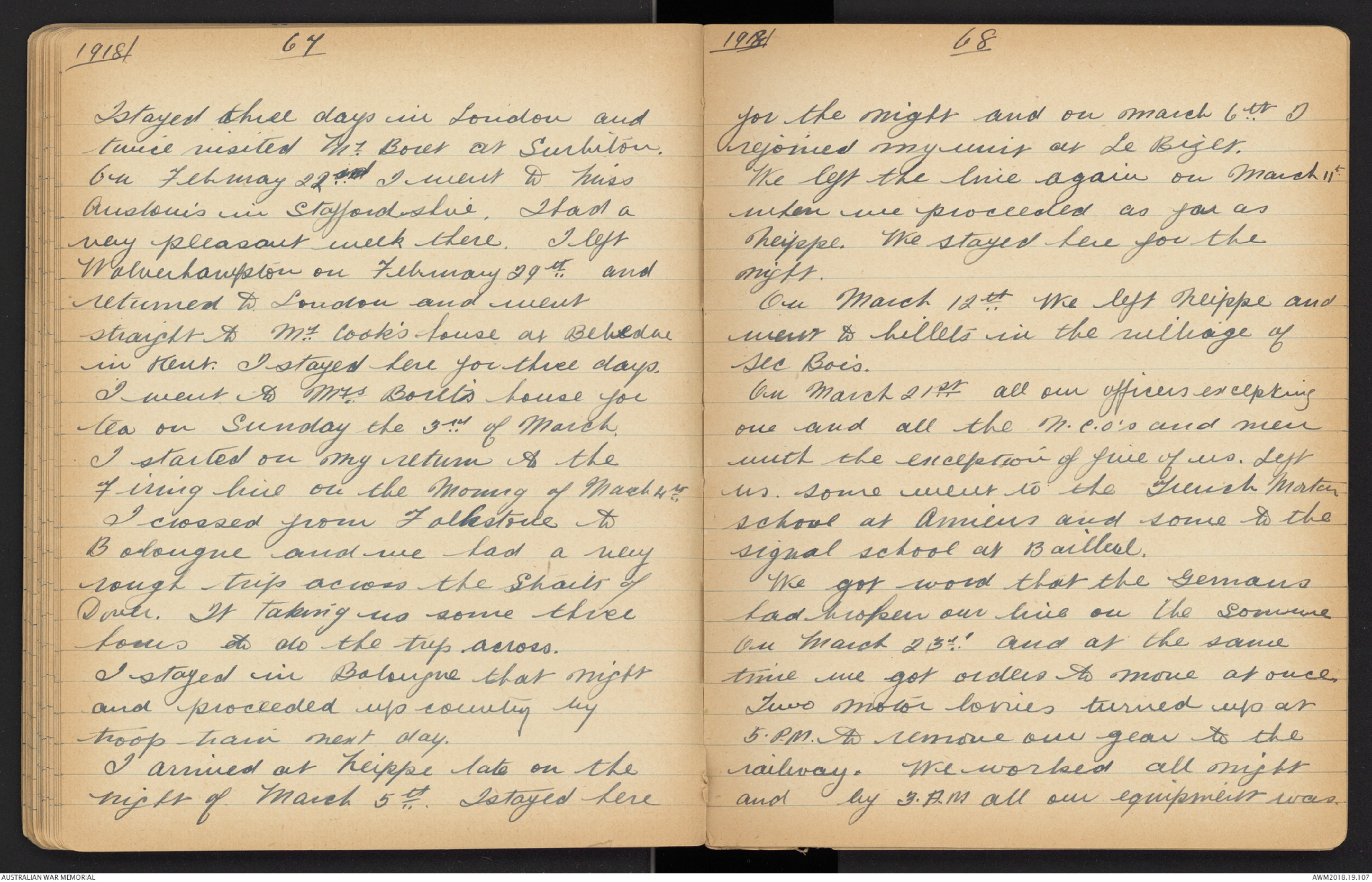
1918 67
I stayed three days in London and
twice visited Mr Boret at Surbiton.
On Februay 22nd I went to Miss
Auslouis in Staffordshire. I had a
very pleasant week there. I left
Wolverhampton on February 29th and
returned to London and went
straight to Mr Cook's house at Belvedere
in Kent. I stayed here for three days.
I went to Mrs Boret's house for
tea on Sunday the 3rd of March.
I started on my return to the
Firing line on the morning of March 4th
I crossed from Folkstone to
Bolougue and we had a very
rough trip across the Straits of
Dover. It taking us some three
hours to do the trip across.
I stayed in Bolougne that night
and proceeded up country by
troop-train next day.
I arrived at Neippe late on the
night of March 5th I stayed here
1918 68
for the night and on March 6th I
rejoined my unit at Le Bizet.
We left the line again on March 11th
when we proceeded as far as
Neippe. We stayed here for the
night.
On March 12th We left Neippe and
went to billets in the villiage of
Sec Bois.
On March 21st all our officers excepting
one and all the N.C.O's and men
with the exception of five of us. Left
us. Some went to the Trench Mortar
school at Amiens and some to the
signal school at Bailleul.
We got word that the Germans
had broken our line on the Somme
on March 23rd and at the same
time we got orders to move at once
Two motor lorries turned up at
5.P.M. to remove our gear to the
railway. We worked all night
and by 3.A.M all our equipment was
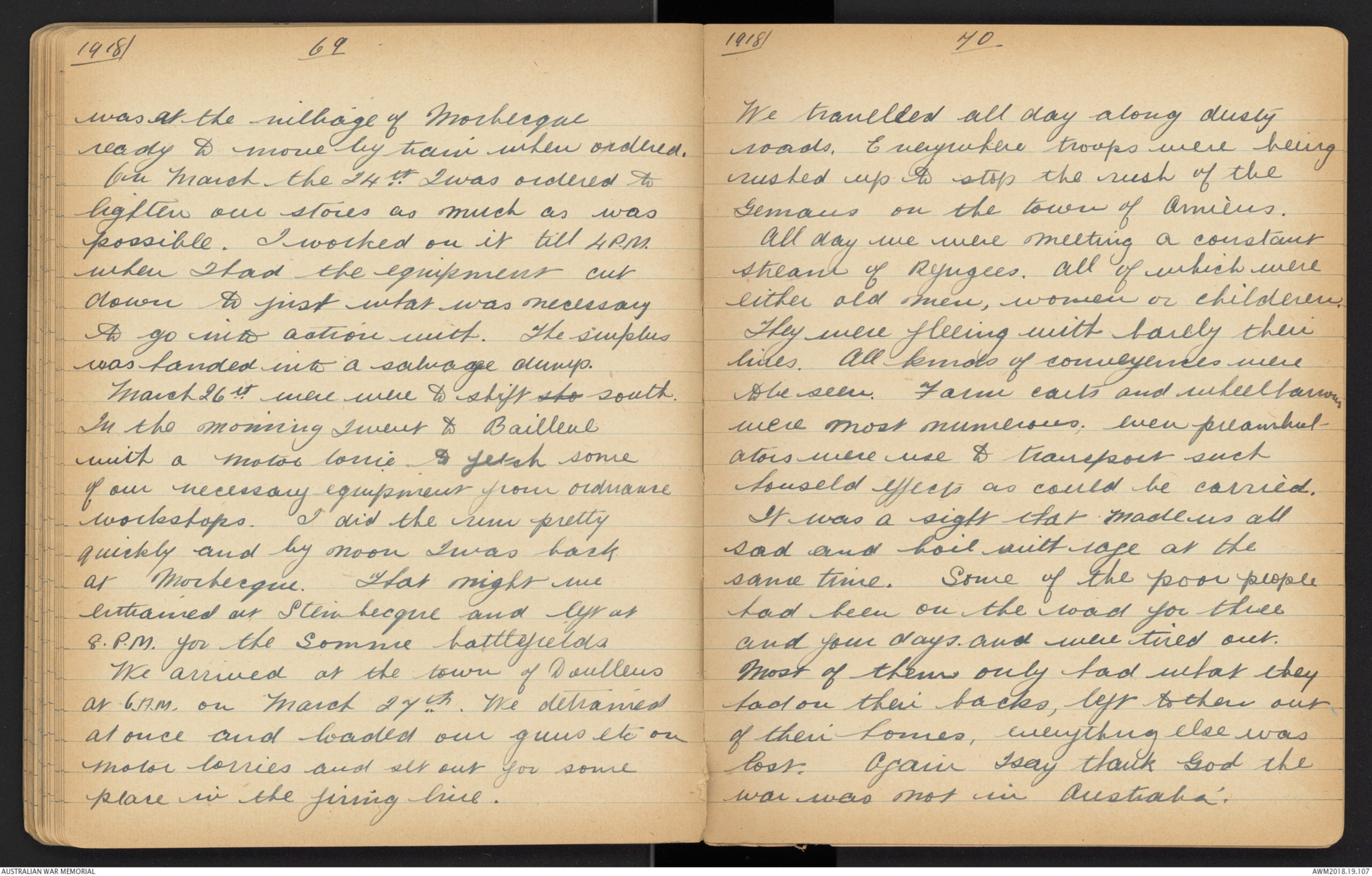
1918 69
was at the villiage of Morbecque
ready to move by train when ordered.
On March the 24th I was ordered to
lighten our stores as much as was
possible. I worked on it till 4 P.M.
when I had the equipment cut
down to just what was necessary
to go into action with. The surplus
was handed into a salvage dump.
March 26th men were to shift sho south.
In the morning I went to Bailleul
with a motor lorrie to fetch some
of our necessary equipment from ordnance
workshops. I did the run pretty
quickly and by noon I was back
at Morbecque. That night we
entrained at Steinbecque and left at
8.P.M. for the Somme battlefields.
We arrived at the town of Doullens
at 6.A.M. on March 27th. We detrained
at once and loaded our guns etc on
motor lorries and set out for some
place in the firing line.
1918 70
We travelled all day along dusty
roads. Everywhere troops were being
rushed up to stop the rush of the
Germans on the town of Amiens.
All day we were meeting a constant
stream of Refugees. All of which were
either old men, women or children.
They were fleeing with barely their
lives. All kinds of conveyences were
to be seen. Farm carts and wheelbarrows
were most numerous, even perambulators
were use to transport such
household effects as could be carried.
It was a sight that made us all
sad and boil with rage at the
same time. Some of the poor people
had been on the road for three
and four days and were tired out.
Most of them only had what they
had on their backs, left to there out
of their homes, everything else was
lost. Again I say thank God the
war was not in Australia.
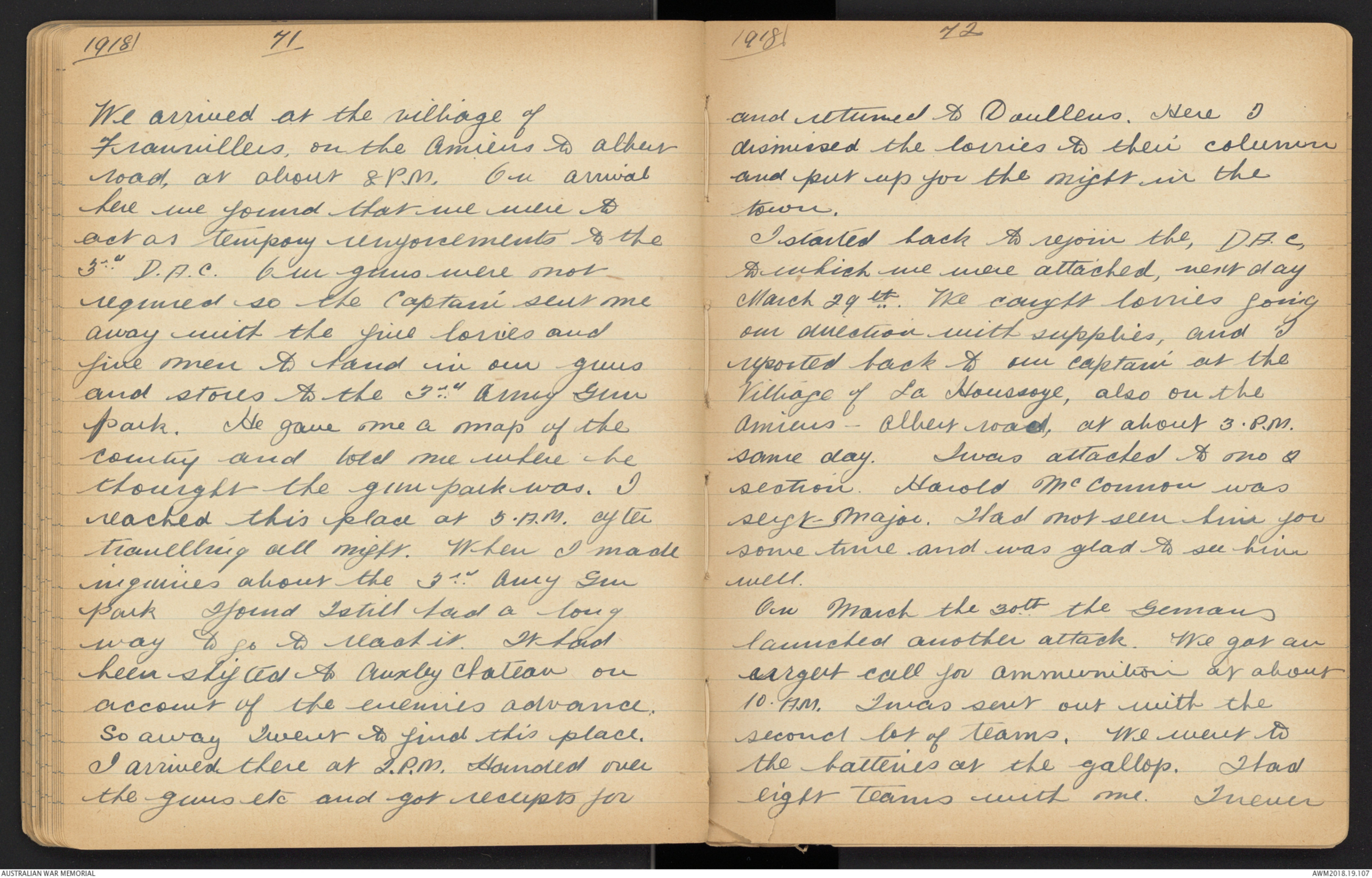
1918 71
We arrived at the villiage of
Franvillers, on the Amiens to Albert
road, at about 8.P.M. On arrival
here we found that we were to
act as temporary reinforcements to the
3rd D.A.C. Our guns were not
required so the Captain sent me
away with the five lorries and
five men to hand in our guns
and stores to the 3rd Army Gun
Park. He gave me a map of the
country and told me where he
thought the gun park was. I
reached this place at 5.A.M. after
travelling all night. When I made
inquiries about the 3rd Army Gun
Park I found I still had a long
way to go to reach it. It had
been shifted to Auxley Chateau on
account of the enemies advance.
So away I went to find this place.
I arrived there at 2.P.M. Handed over
the guns etc and got receipts for
1918 72
and returned to Doullens. Here I
dismissed the lorries to their column
and put up for the night in the
town.
I started back to rejoin the D.A.C,
to which we were attached, next day
March 29th we caught lorries going
our direction with supplies, and I
reported back to our captain at the
Villiage of La Houssoye, also on the
Amiens - Albert road, at about 3.P.M.
same day. I was attached to No 2
section. Harold McConnon was
Sergt-Major. I had not seen him for
some trine and was glad to see him
well.
On March the 30th the Germans
launched another attack. We got an
urgent call for ammunition at about
10.A.M. I was sent out with the
second lot of teams. We went to
the batteries at the gallop. I had
eight teams with me. I never
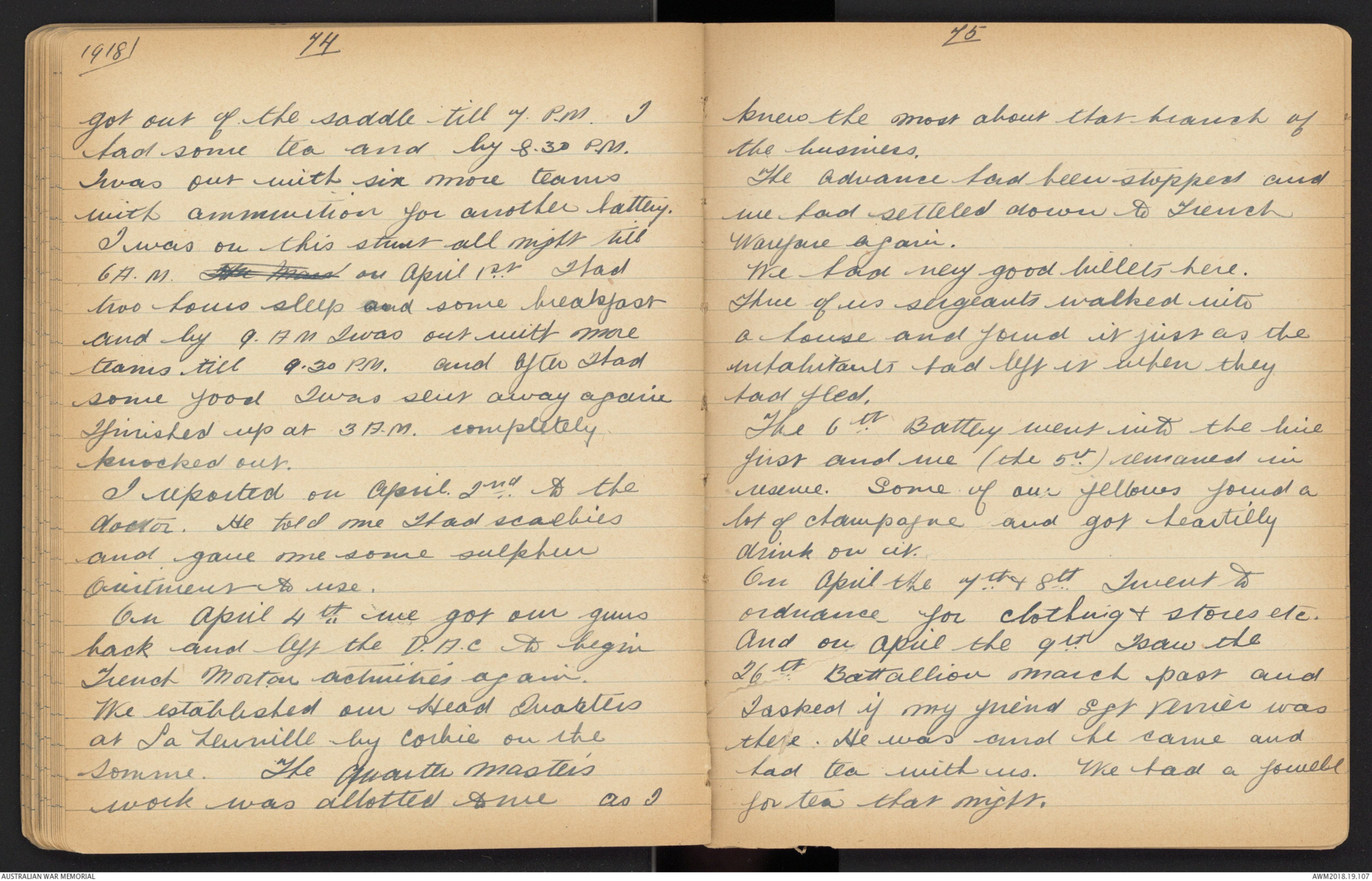
1918 74
got out of the saddle till 7.P.M. I
had some tea and by 8.30 P.M.
I was out with six more teams
with ammunition for another battery.
I was on this stunt all night till
6 A.M. on March on April 1st I had
two hours sleep and some breakfast
and by 9. AM I was out with more
teams till 9.30 P.M. and after I had
some food I was sent away again
I finished up at 3 A.M. completely
knocked out.
I reported on April 2nd to the
doctor. He told me I had scaebies
and gave me some sulphur
ointment to use.
On April 4th we got our guns
back and left the D.A.C. to begin
Trench Mortar activities again.
We established our Head Quarters
at La Leuville by Corbie on the
Somme. The quarter matster's
work was allotted to me as I
75
knew the most about that branch of
the business.
The advance had been stopped and
we had settleed down to Trench
Warfare again.
We had very good billets here.
Three of us sergeants walked into
a house and found it just as they
inhabitants had left it when they
had fled.
The 6th Battery went into the line
first and we (the 5th) remained in
reserve. Some of our fellows found a
lot of champagne and got heartily
drink on it.
On April the 7th & 8th I went to
ordnance for clothing & stores etc.
And on April the 9th I saw the
26th Battalion march past and
I asked if my friend Sgt Verrier was
there. He was and he came and
had tea with us. We had a fowell
for tea that night.
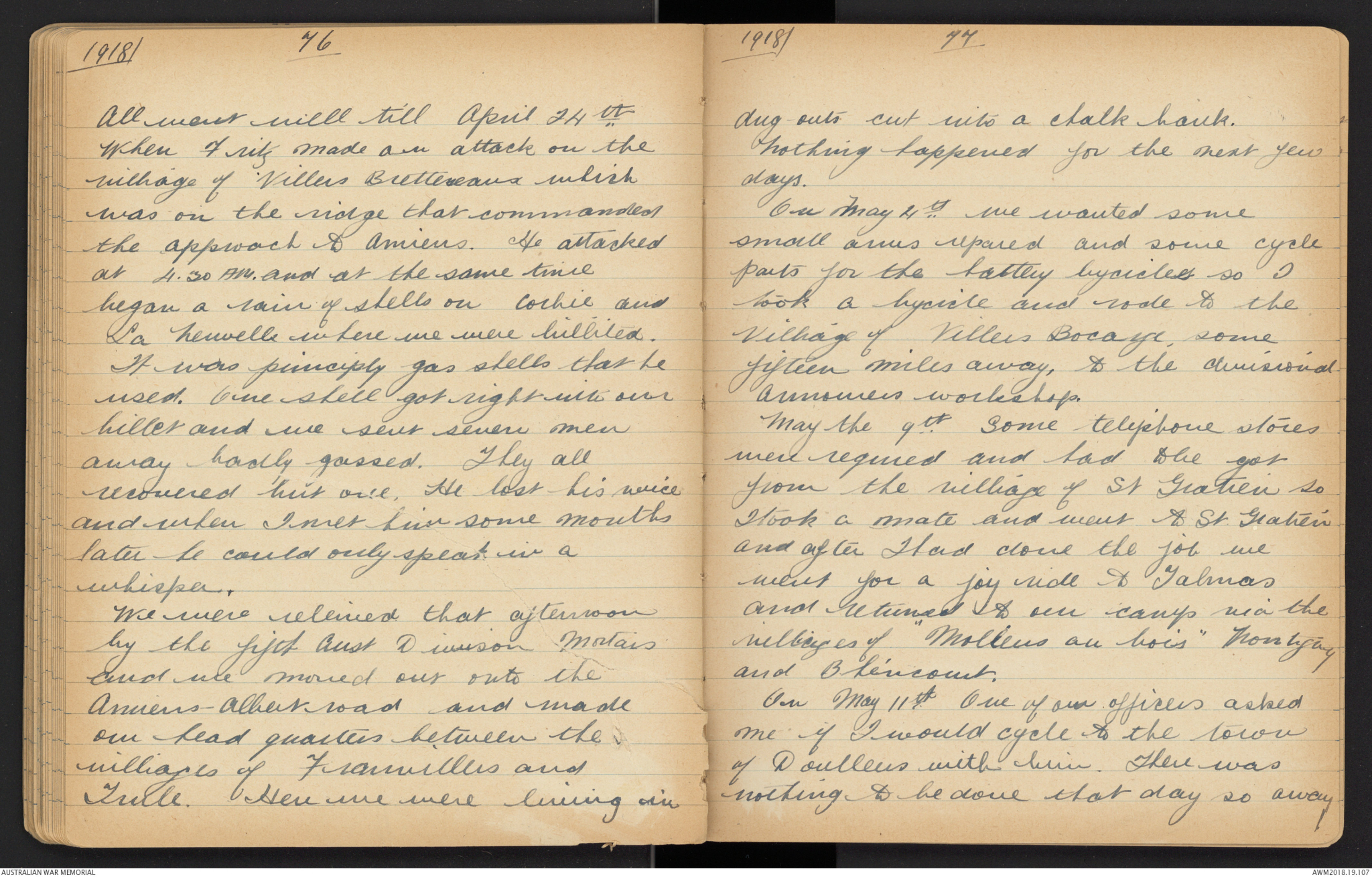
1918 76
All went well till April 24th
when Fritz made an attack on the
villiage of Villers Bretonneaux which
was on the ridge that commanded
the approach to Amiens. He attacked
at 4.30 A.M. and at the same time
began a rain of shells on Corbie and
La Neuvelle where we were billited.
It was principly gas shells that he
used. One shell got right into our
billet and we sent seven men
away badly gassed. They all
recovered but one. He lost his voice
and when I met him some months
later he could only speak in a
whisper.
We were releived that afternoon
by the fifth Aust Division Mortars
and we moved out onto the
Amiens - Albert road and made
our head quarters between the
villiages of Franvillers and
Trule. Here we were living in
1918 77
dog-outs cut into a chalk bank.
Nothing happened for the next few
days.
On May 4th we wanted some
small arms repared and some cycle
parts for the battery bycicles so I
took a bycicle and rode to the
villiage of Villiers Bocage, some
fifteen miles away, to the divisional
Armourers workshop.
May the 9th telephone stores
were required and had to be got
from the villiage of St Gratien so
I took a mate and went to St Gratien
and after I had done the job we
went for a joy ride to Talmas
and returned to our camp via the
villiages of "Moliens au bois" Montigny
and Bhencourt.
On May 11th one of our officers asked
me if I would cycle to the town
of Doullens with him. There was
nothing to be done that day so away
 Deb Parkinson
This transcription item is now locked to you for editing. To release the lock either Save your changes or Cancel.
This lock will be automatically released after 60 minutes of inactivity.