
Diary of Keith Morton Hickman, 1916-1919 - Part 3
1917
38
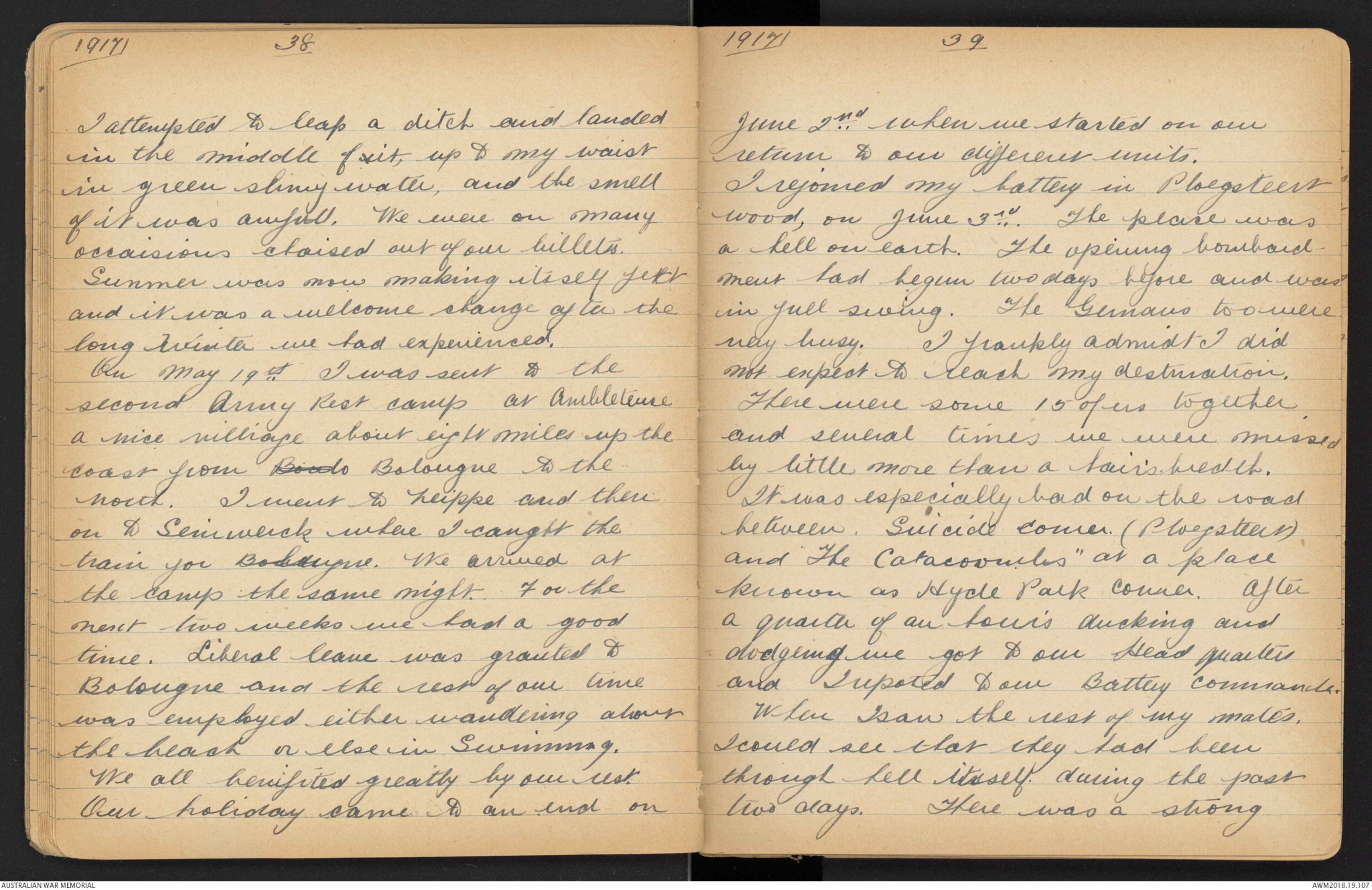
I attempted to leap a ditch and landed
in the middle of sit, up to my waist
in green slimy water, and the smell
of it was awfull. We were on many
occaisions chaised out of our billets.
Summer was now making itself felt
and it was a welcome change after the
long Winter we had experienced.
On May 19th I was sent to the
second Army Rest camp at Ambleteuse
a nice villiage about eight miles up the
coast from Boulo Bolougne to the
north. I went to Neippe and then
on to Seinwerck where I caught the
train for Bolougne. We arrived at
the camp the same night. For the
next two weeks we had a good
time. Liberal leave was granted to
Bolougne and the rest of our time
was employed either wandering about
the beach or else in Swimming.
We all benifited greatly by our rest.
Our holiday came to an end on
1917
39
June 2nd when we started on our
return to our different units.
I rejoined my battery in Ploegsteert
wood, on June 3rd. The place was
a hell on earth. The opening bombardment
had begun two days before and was
in full swing. The Germans too were
very busy. I frankly admidt I did
not expect to reach my destination.
There were some 15 of us together
and several times we were missed
by little more than a hair's bredth.
It was especially bad on the road
between Suicide Corner (Ploegsteert)
and "The Catacoombs" at a place
known as Hyde Park Corner. After
a quarter of an hour's ducking and
dodging we got to our Head quarters
and I reported to our Battery Commander.
When I saw the rest of my mates
I could see the they had been
through hell itself during the past
two days. There was a strong
1917.
40
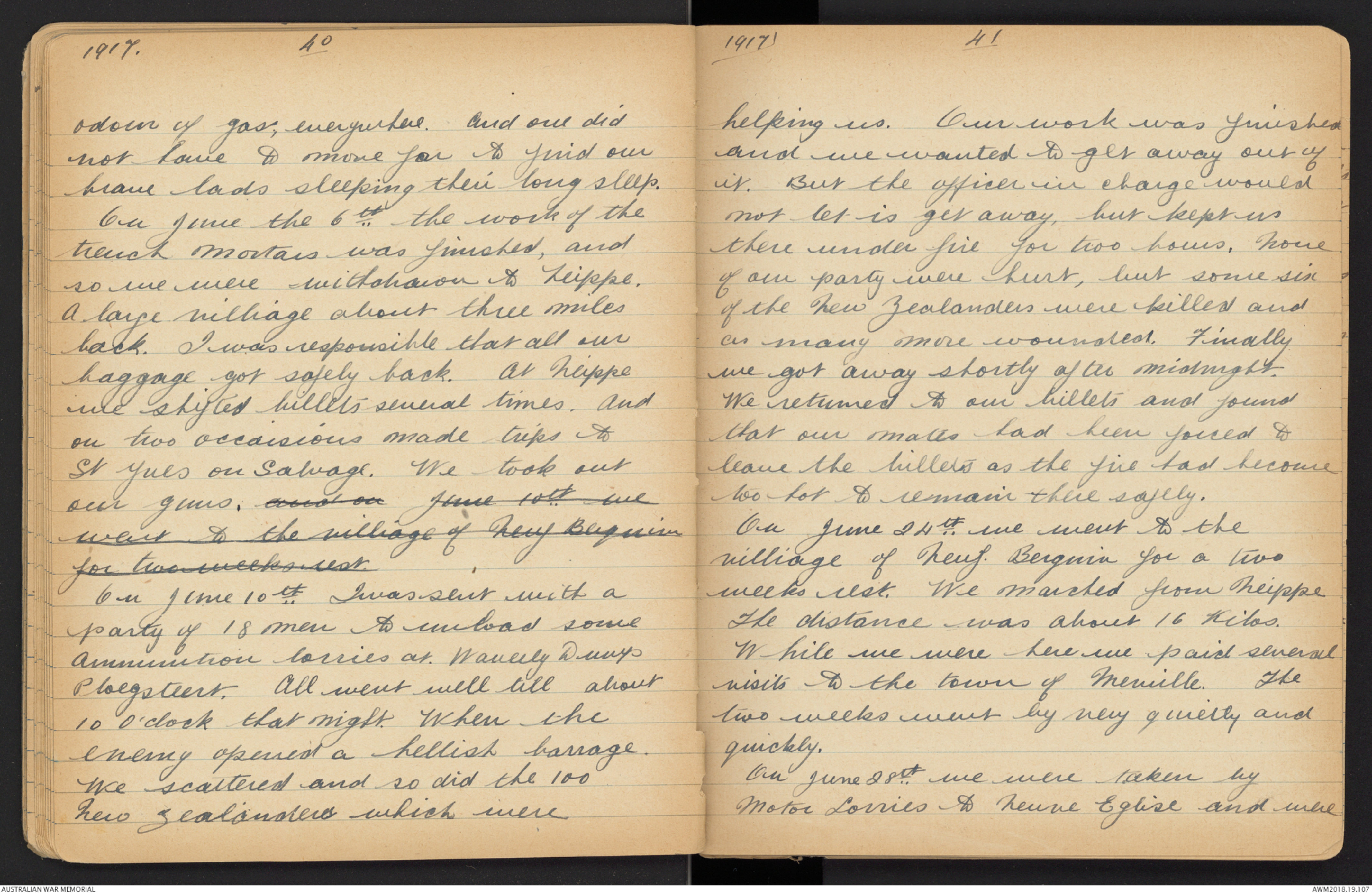
odour of gas, everywhere. And one did
not have to move far to find our
brave lads sleeping their long sleep.
On June the 6th the work of the
trench mortars was finished, and
so we were withdrawn to Neippe.
A large villiage about three miles
back. I was responsible that all our
baggage got safely back. At Neippe
we shifted billets several times. And
on two occaisions made trips to
St Yves on Salvage. We took out
our guns, and on June 10th we
went to the villiage of Neuf Berquin
for two weeks rest.
On June 10th I was sent with a
party of 18 men to unload some
Ammunition lorries at Waverly Dump
Ploegsteert. All went well till about
10 o'clock that night. When the
enemy opened a hellish barrage.
We scattered and so did the 100
New Zealanders which were
1917
41
helping us. Our work was finished
and we wanted to get away out of
it. But the officer in charge would
not let is get away, but kept us
there under fire for two hours. None
of our party were hurt, but some six
of the New Zealanders were killed and
as many more wounded. Finally
we got away shortly after midnight.
We returned to our billets and found
that our mates had been forced to
leave the billets as the fire had become
too hot to remain there safely.
On June 24th we went to the
villiage of Neuf Berquin for a two
weeks rest. We marched from Neippe.
The distance was about 16 Kilos.
While we were here we paid several
visits to the town of Merville. The
two weeks went by very quietly and
quickly.
On June 28th we were taken by
Motor Lorries to Neuve Eglise and were
1917
42
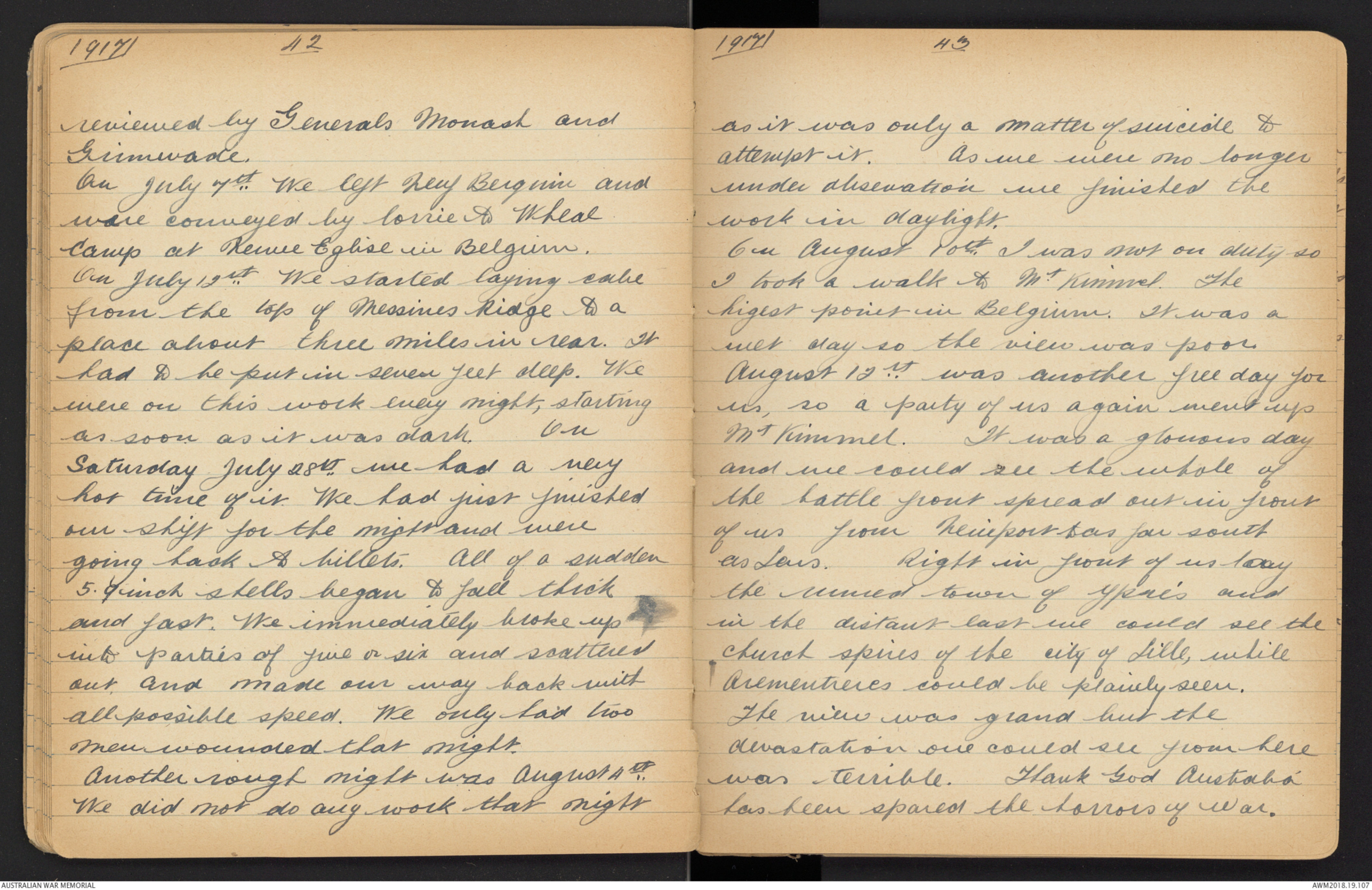
reviewed by Generals Monash and
Grimwade.
On July 7th We left Neuf Berquin and
were conveyed by lorrie to Wheal
Camp at Neuve Eglise in Belgium.
On July 12th We started laying cable
from the top of Messines Ridge to a
place about three miles in rear. It
had to be put in seven feet deep. We
were on this work every night, starting
as soon as it was dark. On
Saturday July 28th we had a very
hot time of it. We had just finished
our shift for the night and were
going back to billets. All of a sudden
5.9 inch shells began to fall thick
and fast. We immediately broke up
into parties of five or six and scattered
out, and made our way back with
all possible speed. We only had two
men wounded that night.
Another rough night was August 4th
we did not do any work that night
1917
43
as it was only a matter of suicide to
attempt it. As we were no longer
under observation we finished the
work in daylight.
On August 10th I was not on duty so
I took a walk to Mt Kimmel. The
higest point in Belgium. It was a
wet day so the view was poor
August 12th was another free day for
us, so a party of us again went up
Mt Kimmel. It was a glorious day
and we could see the whole of
the battle front spread out in front
of us from Neiuport to as far south
as Lens. Right in front of us lay
the ruined town of Yprés and
in the distant east we could see the
church spires of the city of Lille, while
Armentieres could be plainly seen.
The view was grand but the
devastation one could see from here
was terrible. Thank God Australia
has been spared the horrors of War.
1917
42
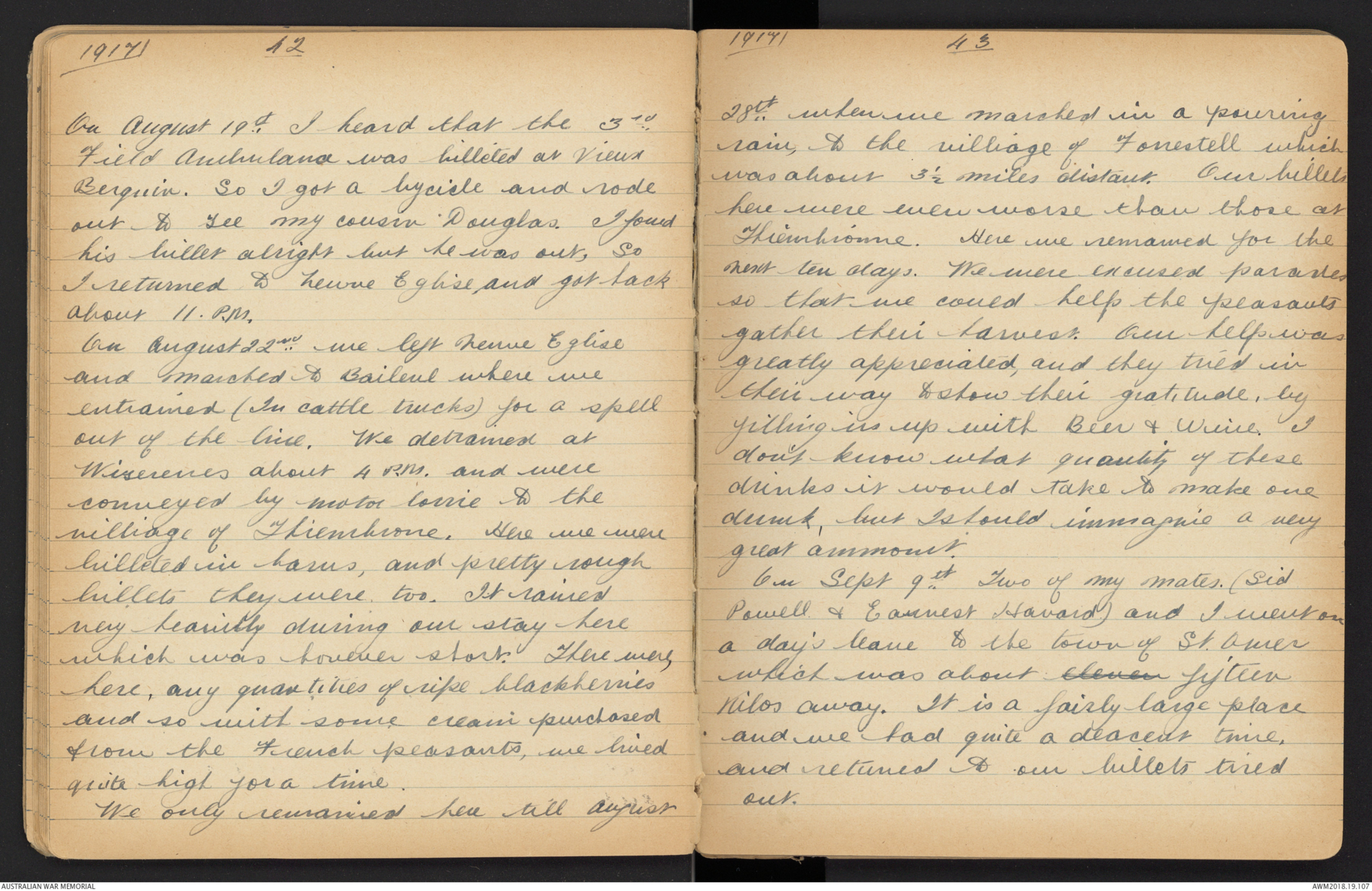
On August 19th I heard that the 3rd
Field Ambulance was billeted at Vieux
Berquin. So I got a bycicle and rode
out to see my cousin Douglas. I found
his billet alright but he was out, so
I returned to Neuve Eglise and got back
about 11.P.M.
On August 22nd we left Neuve Eglise
and marched to Baileul where we
entrained (In cattle trucks) for a spell
out of the line. We detrained at
Wiserenes about 4 P.M. and were
conveyed by motor lorrie to the
villiage of Thiembrone. Here we were
billeted in barns and pretty rough
billets they were too. It rained
very heavily during our stay here
which was however short. There were,
here, any quantities of ripe blackberries
and so with some cream purchased
from the French peasants, we lived
quite high for a time.
We only remained here till August
1917
43
28th when we marched in a pouring
rain, to the villiage of Forrestell which
was about 3½ miles distant. Our billets
here were even worse than those at
Thiembronne. Here we remained for the
next ten days. We were excused parades
so that we could help the peasants
gather their harvest. Our help was
greatly appreciated, and they tried in
their way to show their gratitude, by
filling us up with Beer & Wine. I
don't know what quantity of these
drinks it would take to make one
drunk, but I should immagine a very
great ammount.
On Sept 9th Two of my mates. (Sid
Powell & Earnest Havard) and I went on
a day's leave to the town of St Omer
which was about eleven fifteen
miles away. It is a fairly large place
and we had quite a deacent time.
and returned to our billets tired
out.
1917
44
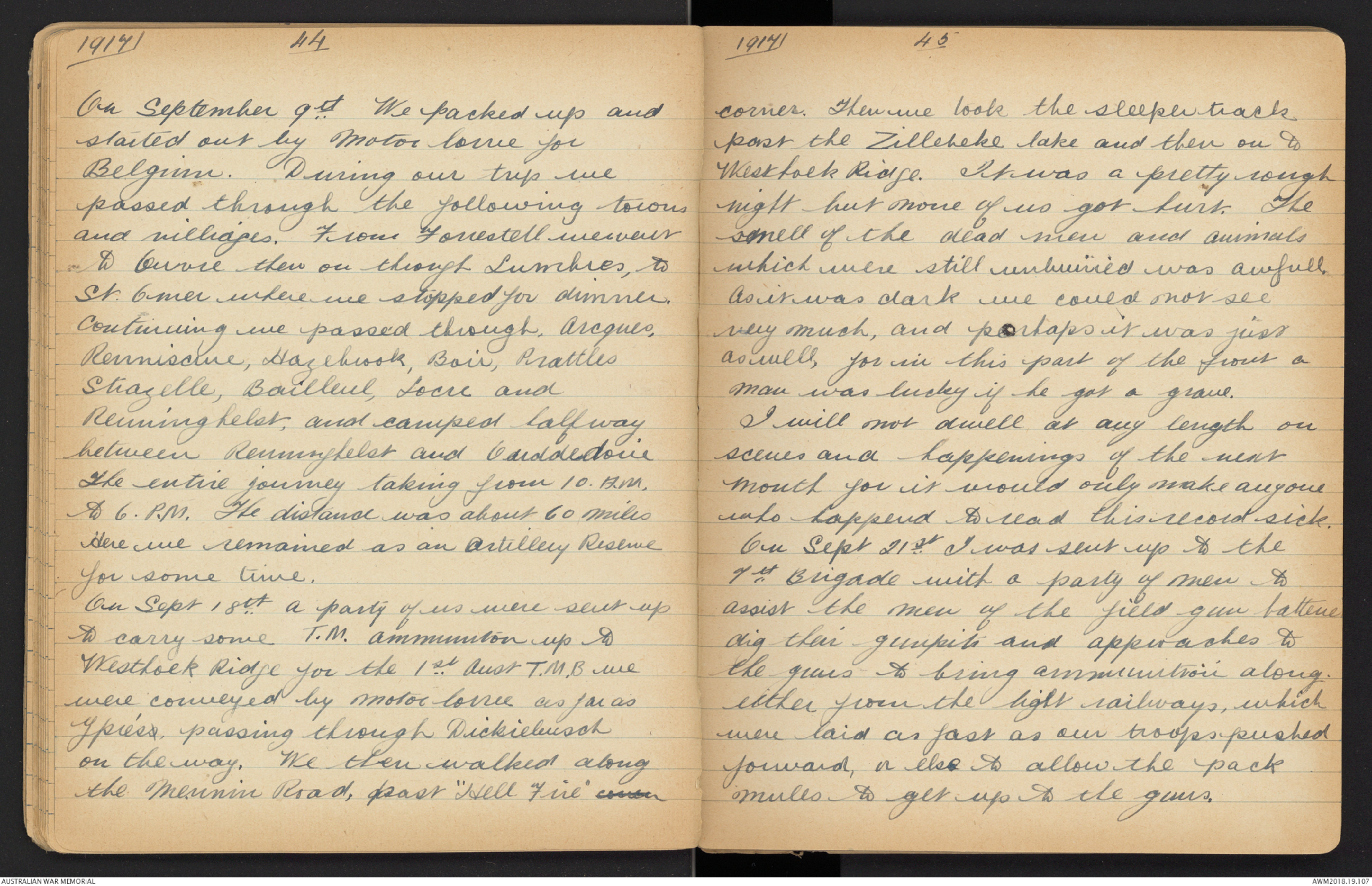
On September 9th We packed up and
started out by motor lorrie for
Belgium. During our trip we
passed through the following towns
and villiages. From Forrestell we went
to Ouvre then on through Lumbres, to
St Omer where we stopped for dinner.
Continuing we passed through Arcques,
Renniscure, Hazebrook, Boir, Prattles
Strazelle, Bailleul, Locre and
Renninghelst, and camped halfway
between Renninghelst and Ouddedorie
The entire journey taking from 10.A.M.
to 6.P.M. The distance was about 60 miles
Here we remained as an Artillery Reserve
for some time.
On Sept 18th a party of us were sent up
to carry some T.M. ammunition up to
Westhoek Ridge for the 1st Aust T.M.B. we
were conveyed by motor lorrie as far as
Ypréss, passing through Dickiebusch
on the way. We then walked along
the Mennin Road, past "Hell Fire" corner
1917
45
corner. Then we took the sleeper track
past the Zilleheke lake and then on to
Westhoek Ridge. It was a pretty rough
night but none of us got hurt. The
smell of the dead men and animals
which were still unburied was awfull.
As it was dark we could not see
very much, and perhaps it was just
as well, for in this part of the front a
man was lucky if he got a grave.
I will not dwell at any length on
scenes and happenings of the next
month for it would only make anyone
who happened to read this record sick.
On Sept 21st I was sent up to the
7th Brigade with a party of men to
assist the men of the field gun batteries
dig their gunpits and approaches to
the guns to bring ammunition along.
either from the light railways, which
were laid as fast as our troops pushed
forward, or else to allow the pack
mules to get up to the guns.
1917
46
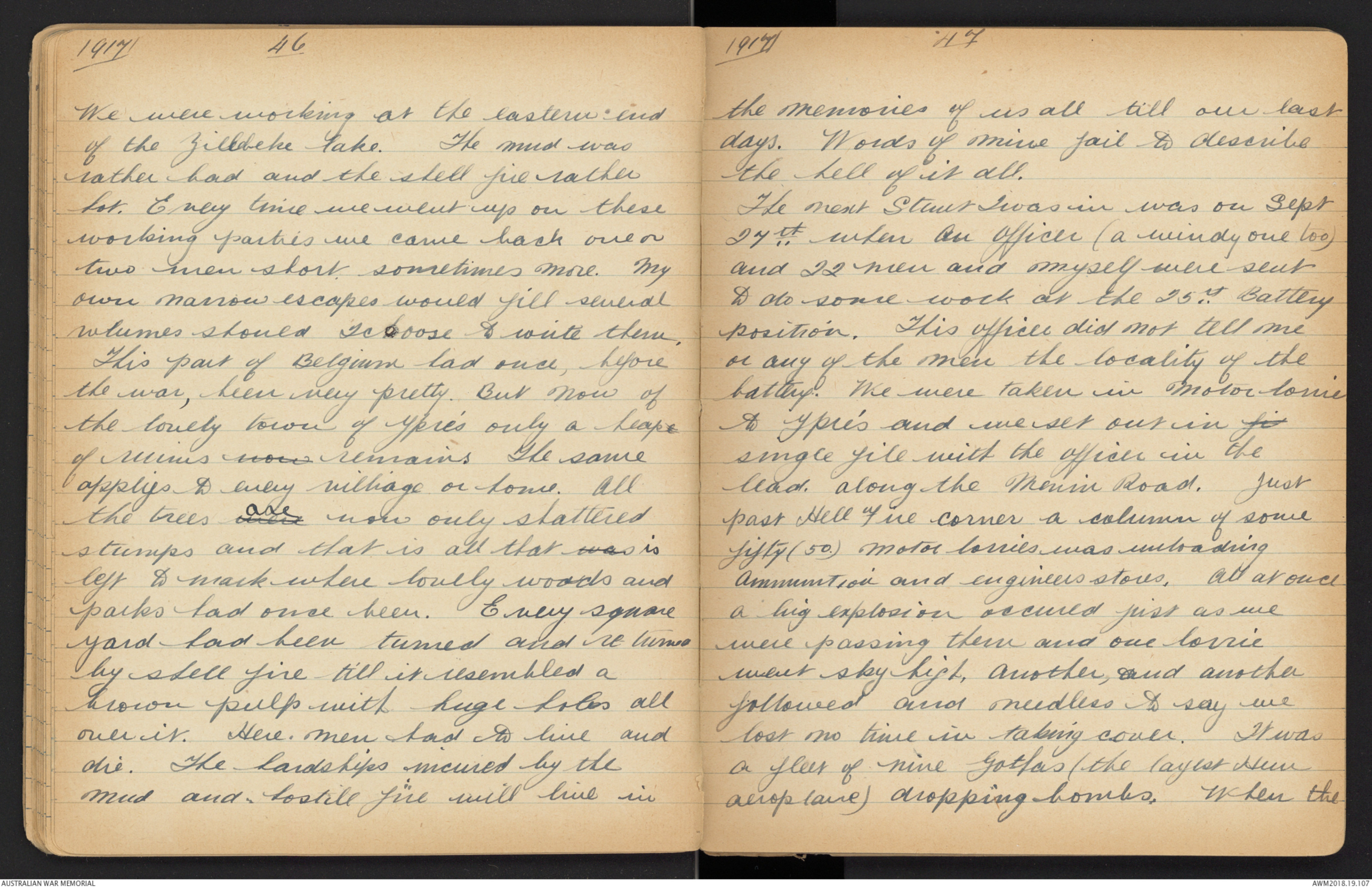
We were working at the eastern end
of the Zillebeke lake. The mud was
rather bad and the shell fire rather
hot. Every time we went up on these
working parties we came back one or
two men short sometimes more. My
own narrow escapes would fill several
volumes should I choose to write them.
This part of Belgium had once, before
the war, been very pretty. But now of
the lovely town of Yprés only a heape
of ruins now remains The same
applies to every villiage or home. All
the trees were are now only shattered
stumps and that is all that was is
left to mark where lovely woods and
parks had once been. Every square
yard had been turned and re-turned
by shell fire till it resembled a
brown pulp with huge holes all
over it. Here men had to live and
die. The hardships incured by the
mud and hostile fire will live in
1917
47
the memories of us all till our last
days. Words of mine fail to describe
the hell of it all.
The next Stunt I was in was on Sept
27th when an Officer (a windy one too)
and 22 men and myself were sent
to do some work at the 25th Battery
position. This officer did not tell me
or any of the men the locality of the
battery. We were taken in motor lorrie
to Yprés and we set out in fi
single file with the officer in the
lead, along the Menin Road. Just
past Hell Fire corner a column of some
fifty (50) motor lorries was unloading
ammunition and engineers stores. All at once
a big explosion occured just as we
were passing them and one lorrie
went sky high, another, and another
followed and needless to say we
lost no time in taking cover. It was
a fleet of nine Gothas ( the largest Hun
aeroplane) dropping bombs. When the
1917
48
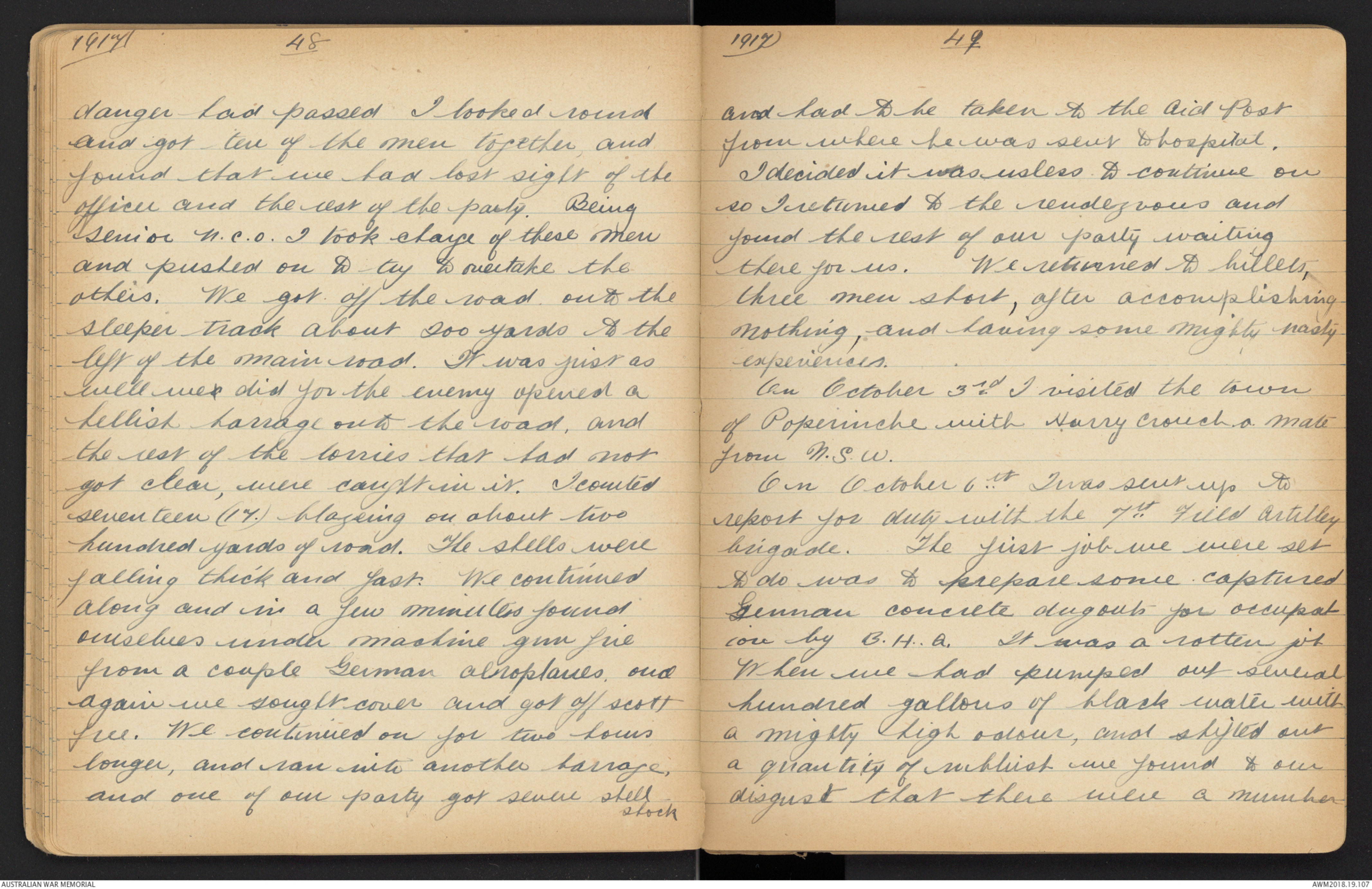
danger had passed I looked round
and got ten of the men together, and
found that we had lost sight of the
officer and the rest of the party. Being
senior N.C.O. I took charge of these men
and pushed on to try to overtake the
others. We got off the road onto the
sleeper track about 200 yards to the
left of the main road. It was just as
well wes did for the enemy opened a
hellish barrage onto the road, and
the rest of the lorries that had not
got clear, were caught in it. I counted
seventeen (17) blazing on about two
hundred yards of road. The shells were
falling thick and fast. We continued
along and in a few minutes found
ourselves under machine gun fire
from a couple German aeroplanes and
again we sought cover and got off scott
free. We continued on for two hours
longer, and ran into another barrage
and one of our party got severe shell
shock
1917
49
and had to be taken to the Aid Post
from where he was sent to hospital.
I decided it was useless to continue on
so I returned to the rendezvous and
found the rest of our party waiting
there for us. We returned to billets,
three men short, after accomplishing
nothing, and having some mighty nasty
experiences.
On October 3rd I visited the town
of Poperinche with Harry Crouch a mate
from N.S.W.
On October 6th I was sent up to
report for duty with the 7th Field Artillery
brigade. The first job we were set
to do was to prepare some captured
German concrete dugouts for occupation
by B.H.Q. It was a rotten job
When we had pumped out several
hundred gallons of black water with
a mighty high odour, and shifted out
a quantity of rubbish we found to our
disgust that there were a number
1917
50
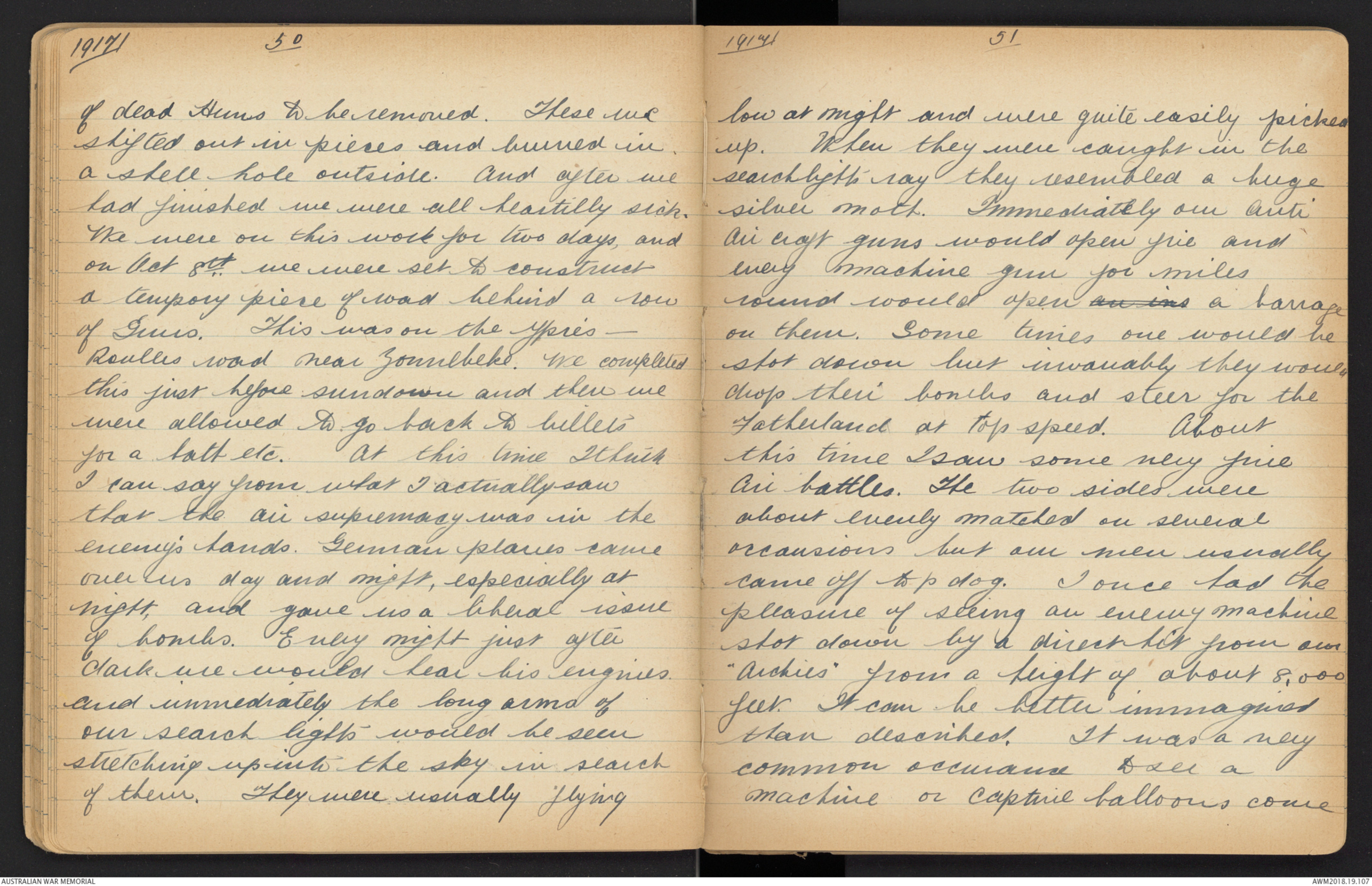
of dead Huns to be removed. These we
shifted out in pieces and buried in
a shell hole outside. And after we
had finished we were all heartilly sick.
We were on this work for two days and
on Oct 8th we were set to construct
a tempory piece of road behind a row
of Guns. This was on the Yprés -
Roulles road near Zonnebeke. We completed
this just before sundown and then we
were allowed to go back to billets
for a bath etc. At this time I think
I can say from what I actually saw
that the air supremacy was in the
enemy's hands. German planes came
over us day and night, especially at
night, and gave us a liberal issue
of bombs. Every night just after
dark we would hear his engines
and immediately the long arms of
our search lights would be seen
stretching up into the sky in search
of them. They were usually flying
1917
51
low at night and were quite easily picked
up. When they were caught in the
searchlights ray they resembled a huge
silver moth. Immediately our Anti
Air craft guns would open fire and
every machine gun for miles
round would open on ins a barrage
on them. Some times one would be
shot down but invariably they would
drop their bombs and steer for the
Fatherland at top speed. About
this time I saw some very fine
Air battles. The two sides were
about evenly matched on several
occausions but our men usually
came off top dog. I once had the
pleasure of seeing an enemy machine
shot down by a direct hit from our
"Archies" from a height of about 8,000
feet. It can be better immagined
than described. It was a very
common occurance to see a
machine or captive balloons come
1917
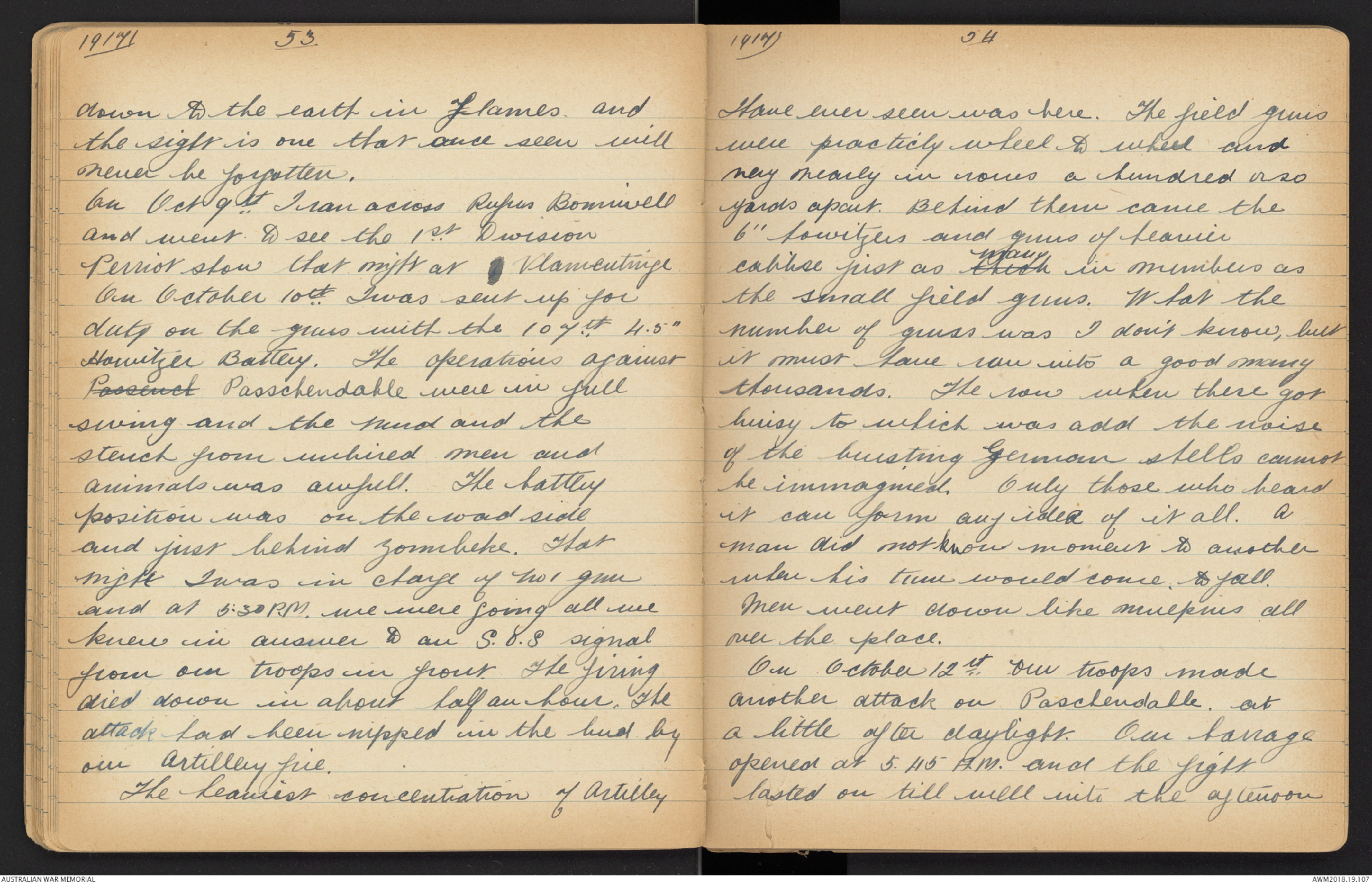
53
down to the earth in Flames and
the sight is one that once seen will
never be forgotten.
On Oct 9th I ran across Rufus Bonniwell
and went to see the 1st Division
Perriot show that night at Vlamentinge
On October 10th I was sent up for
duty on the guns with the 107th 4.5"
Howitzer Battery. The operations against
Passench Passchendahle were in full
swing and the mud and the
stench from unburied men and
animals was awfull. The battery
position was on the road side
and just behind Zonnebeke. That
night I was in charge of No 1 gun
and at 5.30P.M. we were going all we
knew in answer to an S.O.S signal
from our troops in front. The firing
died down in about half an hour. The
attack had been nipped in the bud by
our Artillery fire.
The heaviest concentration of Artillery
1917
54
I have ever seen was here. The field guns
were practicly wheel to wheel and
very nearly in rows a hundred or so
yards apart. Behind them came the
6" howitzers and guns of heavier
calibre just as thick many in numbers as
the small field guns. What the
number of guns was I don't know, but
it must have ran into a good many
thousands. The row when these got
buisy to which was add the noise
of the bursting German shells cannot
be immagined. Only those who heard
it can form any idea of it all. A
man did not know moment to another
when his time would come, to fall.
Men went down like ninepins all
over the place.
On October 12th our troops made
another attack on Paschendalle. at
a little after daylight. Our barrage
opened at 5.45 A.M. and the fight
lasted on till well into the afternoon
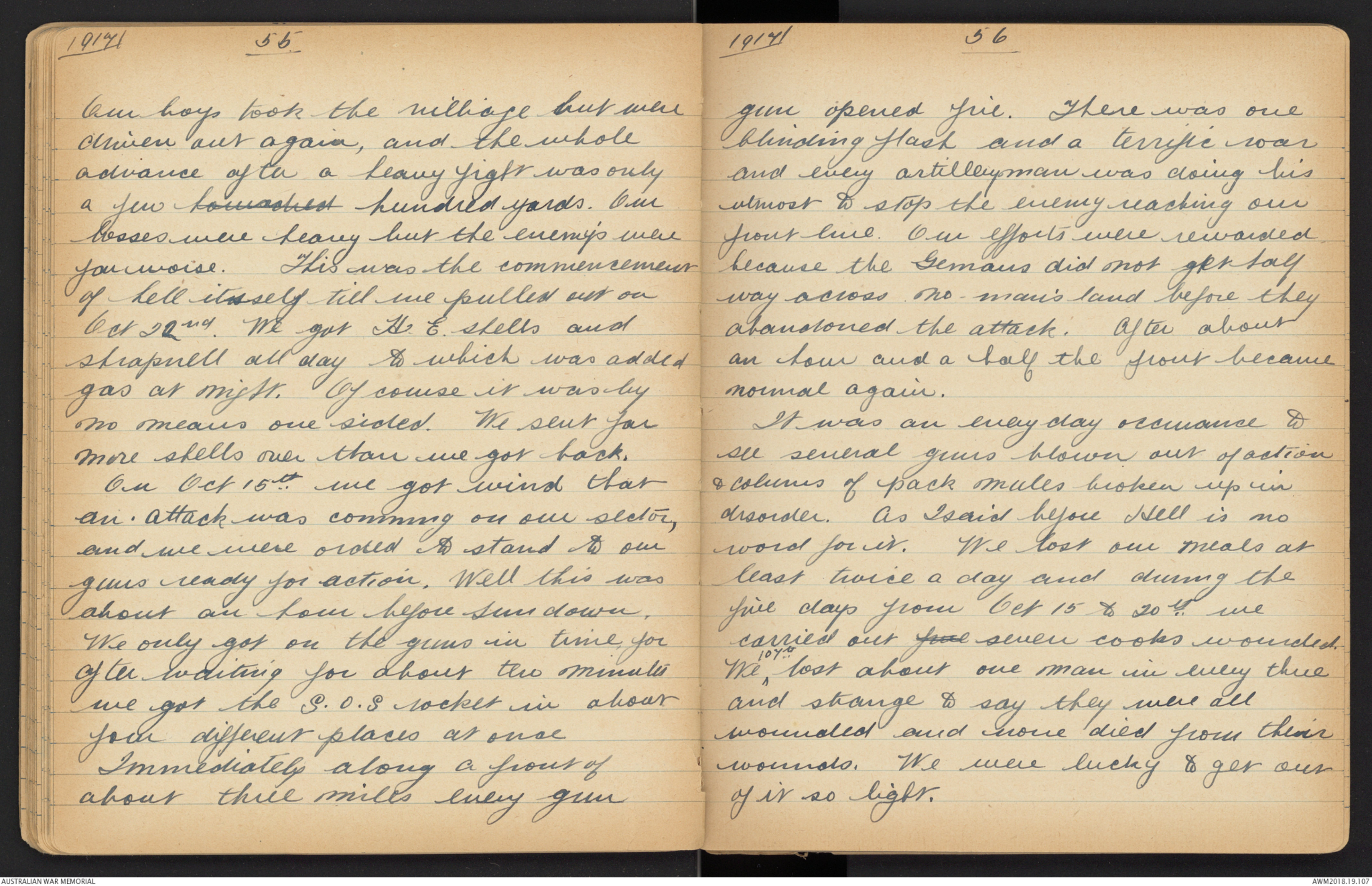
1917
55
Our boys took the villiage but were
driven out again, and the whole
advance after a heavy fight was only
a few houndred hundred yards, Our
losses were heavy but the enemy's were
far worse. This was the commencement
of hell itsself till we pulled out on
Oct 22nd. We got H.E. shells and
shrapnell all day to which was added
gas at night. Of course it was by
no means one sided. We sent far
more shells over than we got back.
On Oct 15th we got wind that
an attack was comming on our sector,
and we were ordered to stand to our
guns ready for action. Well this was
about an hour before sun down.
We only got on the guns in time, for
after waiting for about two minutes
we got the S.O.S. rocket in about
four different places at once.
Immediately along a front of
about three miles every gun
1917
56
gun opened fire. There was one
blinding flash and a terrific roar
and every artillery man was doing his
utmost to stop the enemy reaching our
front line. Our efforts were rewarded
because the Germans did not get half
way across no-man's land before they
abandoned the attack. After about
an hour and a half the front became
normal again.
It was an every day occurance to
see several guns blown out of action
& columns of pack mules broken up in
disorder. As I said before Hell is no
word for it. We lost our meals at
least twice a day and during the
five days from Oct 15 to 20th we
carried out five seven cooks wounded
We ^107th lost about one man in every three
and strange to say they were all
wounded and none died from their
wounds. We were lucky to get out
of it so light.
 Deb Parkinson
This transcription item is now locked to you for editing. To release the lock either Save your changes or Cancel.
This lock will be automatically released after 60 minutes of inactivity.