
Diary of Keith Morton Hickman, 1916-1919 - Part 2
1916 18
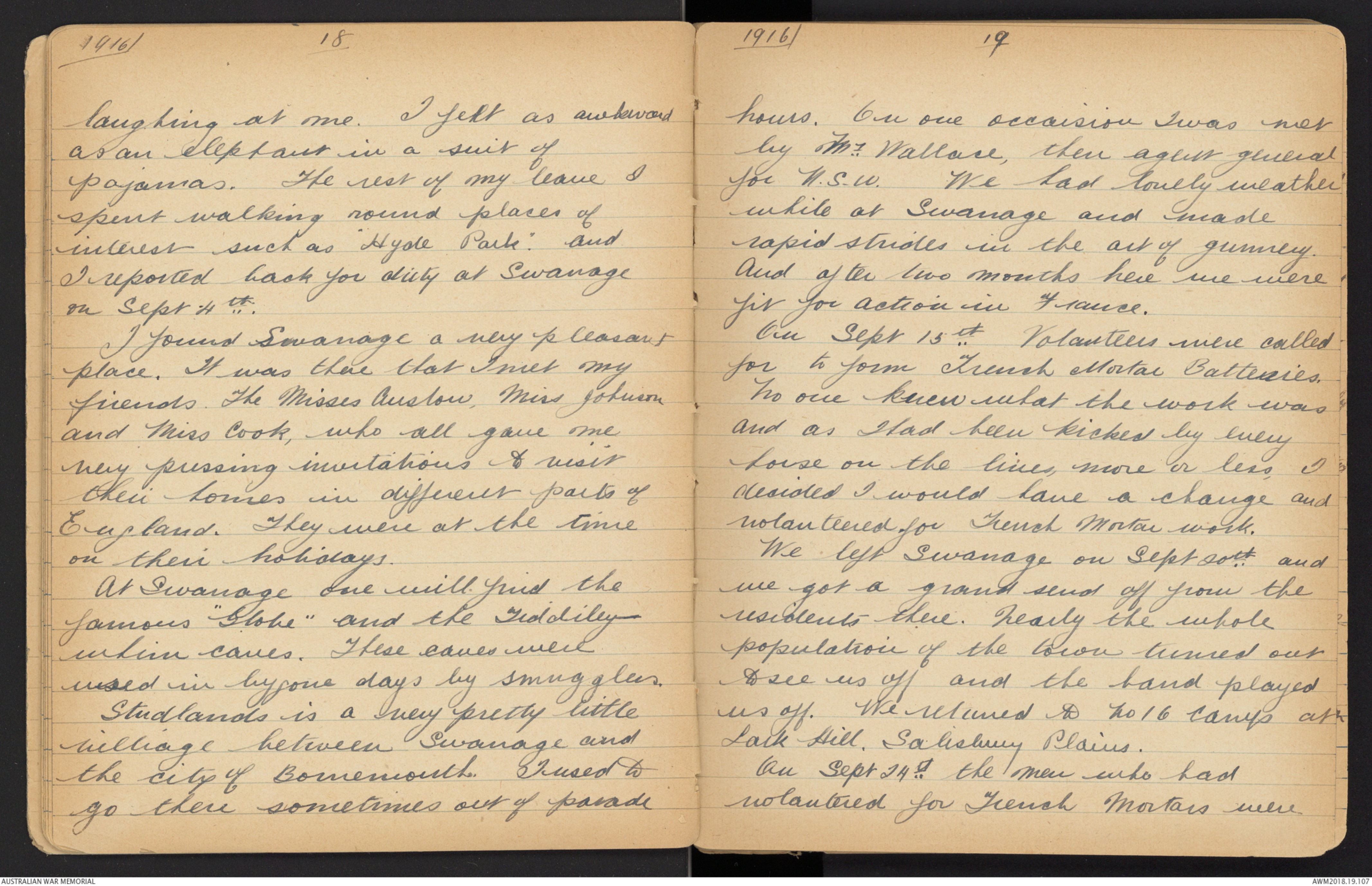
laughing at me. I felt as awkward
as an elephant in a suit of
pajamas. The rest of my leave I
spent walking round places of
interest such as "Hyde Park". and
I reported back for duty at Swanage
on Sept 4th.
I found Swanage a very pleasant
place. It was there that I met my
friends The Misses Auslow, Miss Johnson
and Miss Cook, who all gave me
very pressing invitations to visit
their homes in different parts of
England. They were at the time
on their holidays.
At Swanage one will find the
famous "Globe" and the Tiddiley-whim
caves. These caves were
used in bygone days by smugglers.
Studlands is a very pretty little
villiage between Swanage and
the city of Bornemouth. I used to
go there sometimes out of parade
1916 19
hours. On one occasion I was met
by Mr Wallace, then agent general
for N.S.W. We had lovely weather
while at Swanage and made
rapid strides in the art of gunnery.
And after two months here we were
fit for action in France.
On Sept 15th Volunteers were called
for to form Trench Mortar Batteries.
No one knew what the work was
and as I had been kicked by every
horse on the lines, more or less, I
decided I would have a change and
volunteered for Trench Mortar work.
We left Swanage on Sept 20th and
we got a grand send off from the
residents there. Nearly the whole
population of the town turned out
to see us off and the band played
us off. We returned to No 16 camp at
Lark Hill, Salisbury Plains.
On Sept 24th the men who had
volunteered for Trench Mortars were
1916 20
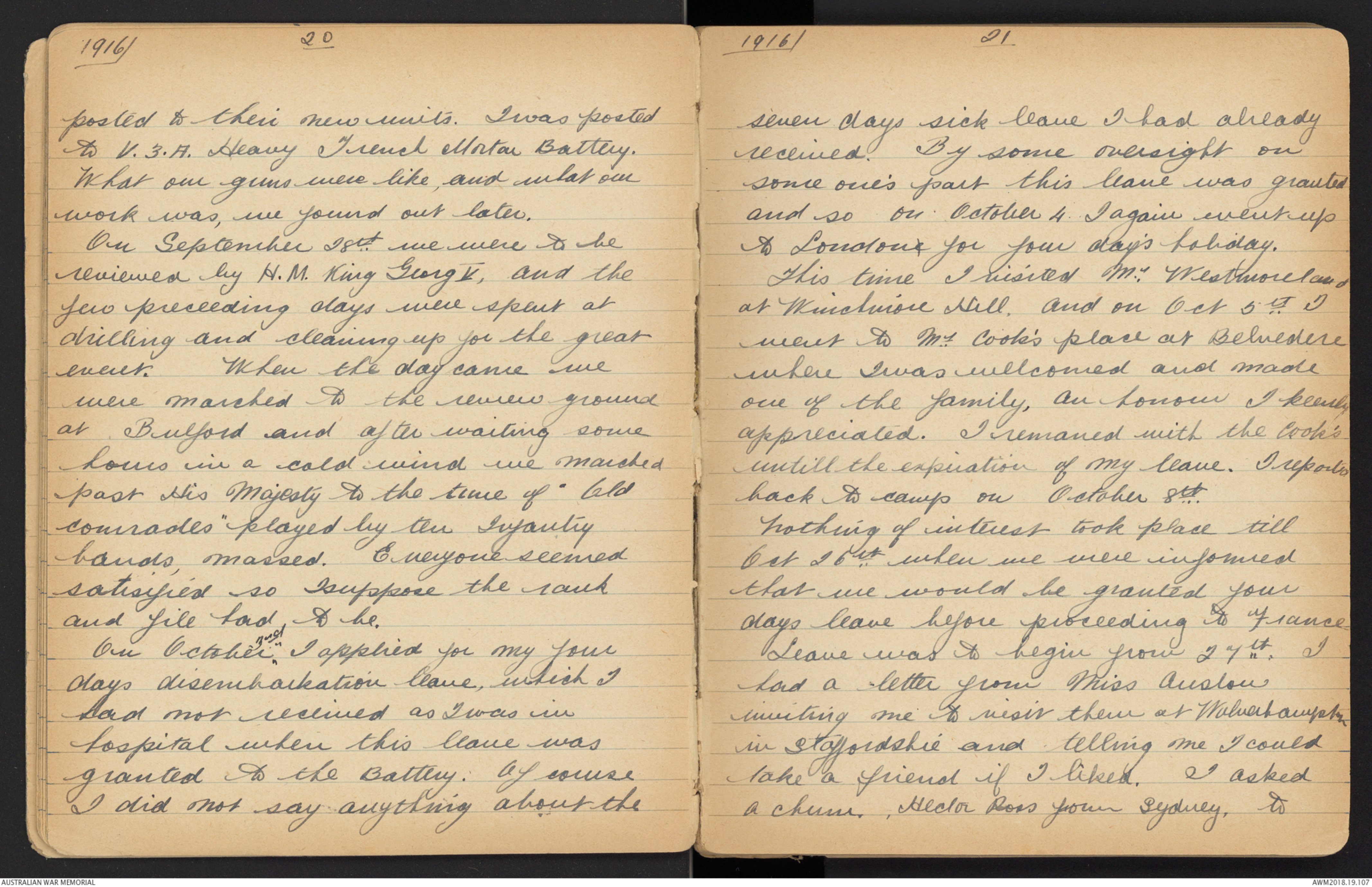
posted to their new units. I was posted
to V.3.A. Heavy Trench Mortar Battery.
What our guns were like, and what our
work was, we found out later.
On September 28th we were to be
reviewed by H.M. King Georg V, and the
few preceeding days were spent at
drilling and cleaning up for the great
event. When the day came we
were marched to the review ground
at Bulford and after waiting some
hours in a cold wind we marched
past His Majesty to the tune of "Old
Comrades" played by ten Infantry
bands, massed. Everyone seemed
satisfied so I suppose the rank
and file had to be.
On October ^3rd I applied for my four
days disembarkation leave, which I
had not received as I was in
hospital when this leave was
granted to the Battery. Of course
I did not say anything about the
1916 21
seven days sick leave I had already
received. By some oversight on
some one's part this leave was granted
and so on October 4 I again went up
to Londone for four day's holiday.
This time I visited Mr Westmoreland
at Winchmore Hill. And on Oct 5th I
went to Mr Cook's place at Belvedere
where I was welcomed and made
one of the family, an honour I keenly
appreciated. I remaned with the Cook's
untill the expiration of my leave. I reported
back to camp on October 8th.
Nothing of interest took place till
Oct 26th when we were informed
that we would be granted four
days leave before proceeding to France.
Leave was to begin from 27th. I
had a letter from Miss Anslow
inviting me to visit them at Wolverhampton
in Staffordshire and telling me I could
take a friend if I liked. I asked
a chum, Hector Ross from Sydney, to
1916
22
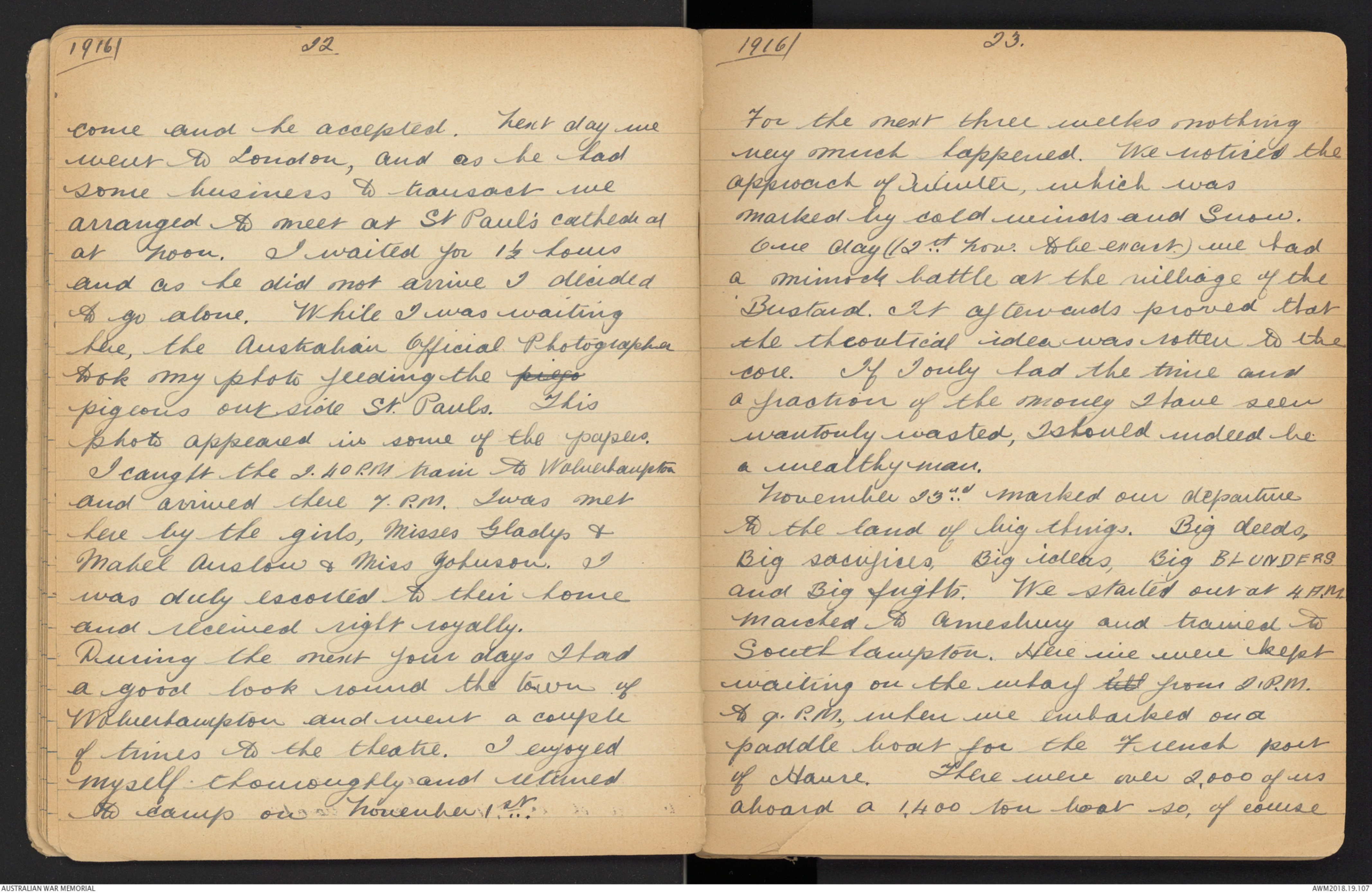
come and he accepted. Next day we
went to London, and as he had
some business to transact we
arranged to meet at St Paul's cathedral
at noon. I waited for 1½ hours
and as he did not arrive I decided
to go alone. While I was waiting
here, the Australian Official Photographer
took my photo feeding the piego
pigeons outside St. Pauls. This
photo appeared in some of the papers.
I caught the 2.40 P.M train to Wolverhampton
and arrive there 7.P.M. I was met
here by the girls, Misses Gladys &
Mabel Anslow & Miss Johnson. I
was duly escorted to their home
and received right royally.
During the next four days I had
a good look round the town of
Wolverhampton and went a couple
of times to the theatre. I enjoyed
myself thouroughly and returned
to camp on November 1st.
1916
23.
For the next three weeks nothing
very much happened. We noticed the
approach of WInter, which was
marked by cold winds and Snow.
One day (12th Nov. to be exact) we had
a mimock battle at the villiage of the
'Bustard. It afterwards proved that
the theoritical idea was rotten to the
core. If only I had the time and
a fraction of the money I have seen
wantonly wasted, I should indeed be
a wealthy man.
November 23rd marked our departure
to the land of big things. Big deeds,
Big sacrifices, Big ideas, Big BLUNDERS.
and Big fights. We started out at 4.A.M.
Marched to Amesbury and trained to
Southhampton. Here we were kept
waiting on the wharf till from 2.P.M.
to 9.P.M., when we embarked on a
paddle boat for the French port
of Havre. There were over 2,000 of us
aboard a 1,400 ton boat so, of course
24 1916
24
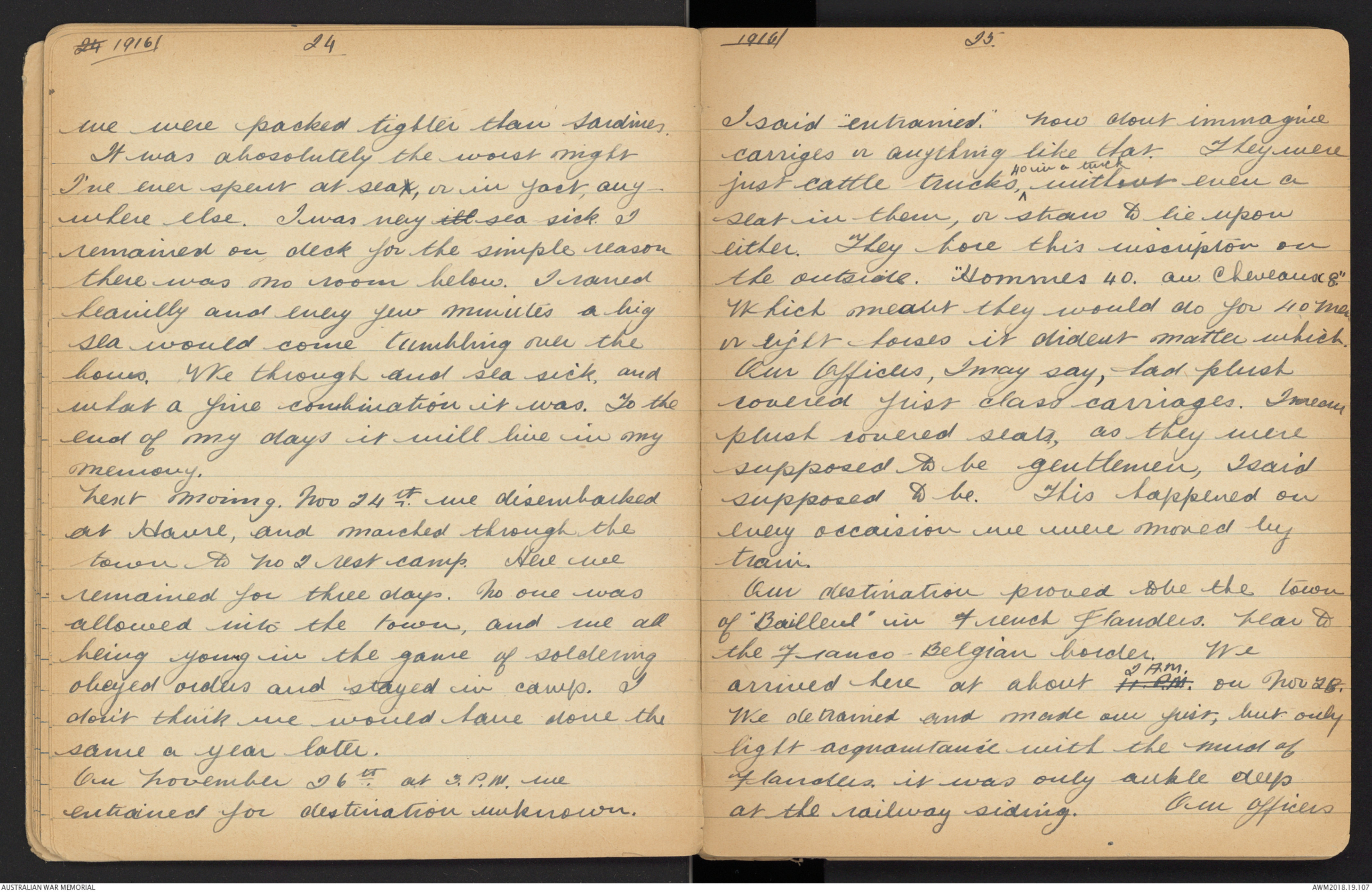
we were packed tighter than sardines.
It was absolutely the worst night
I've ever spent at seas, or in fact, anywhere
else. I was very ill sea sick. I
remained on deck for the simple reason
there was no room below. I rained
heavilly and every few minutes a big
sea would come tumbling over the
bows. We through and sea sick, and
what a fine combination it was. To the
end of my days it will live in my
memory.
Next morning, Nov 24th we disembarked
at Havre, and marched through the
town to the No 2 rest camp. Here we
remained for three days. No one was
allowed into the town, and we all
being young in the game of soldering
obeyed orders and stayed in camp. I
don't think we would have done the
same a year later.
On November 26th at 3.P.M. we
entrained for destination unknown.
1916
25
I said "entrained." Now dont immagine
carriges or anything like that. They were
just cattle trucks, ^40 in a truck without even a
slat in them, or straw to lie upon
either. They have this inscription on
the outside. "Hommes 40. au Chevaux 8."
Which meant they would do for 40 men
or eight horses it dident matter which.
Our Officers, I may say, had plush
covered first class carriages. I mean
plush covered seats, as they were
supposed to be gentlemen, I said
supposed to be. This happened on
every occaision we were moved by
train.
Our destination proved to be the town
of "Bailleul" in French Flanders. Near to
the Franco-Belgian border. We
arrived here at about 11.P.M. 2 A.M. on Nov 28.
We detrained and made our first, but only
light acquaintance with the mud of
Flanders. it was only ankle deep
at the railway siding. Our Officers
1916
26
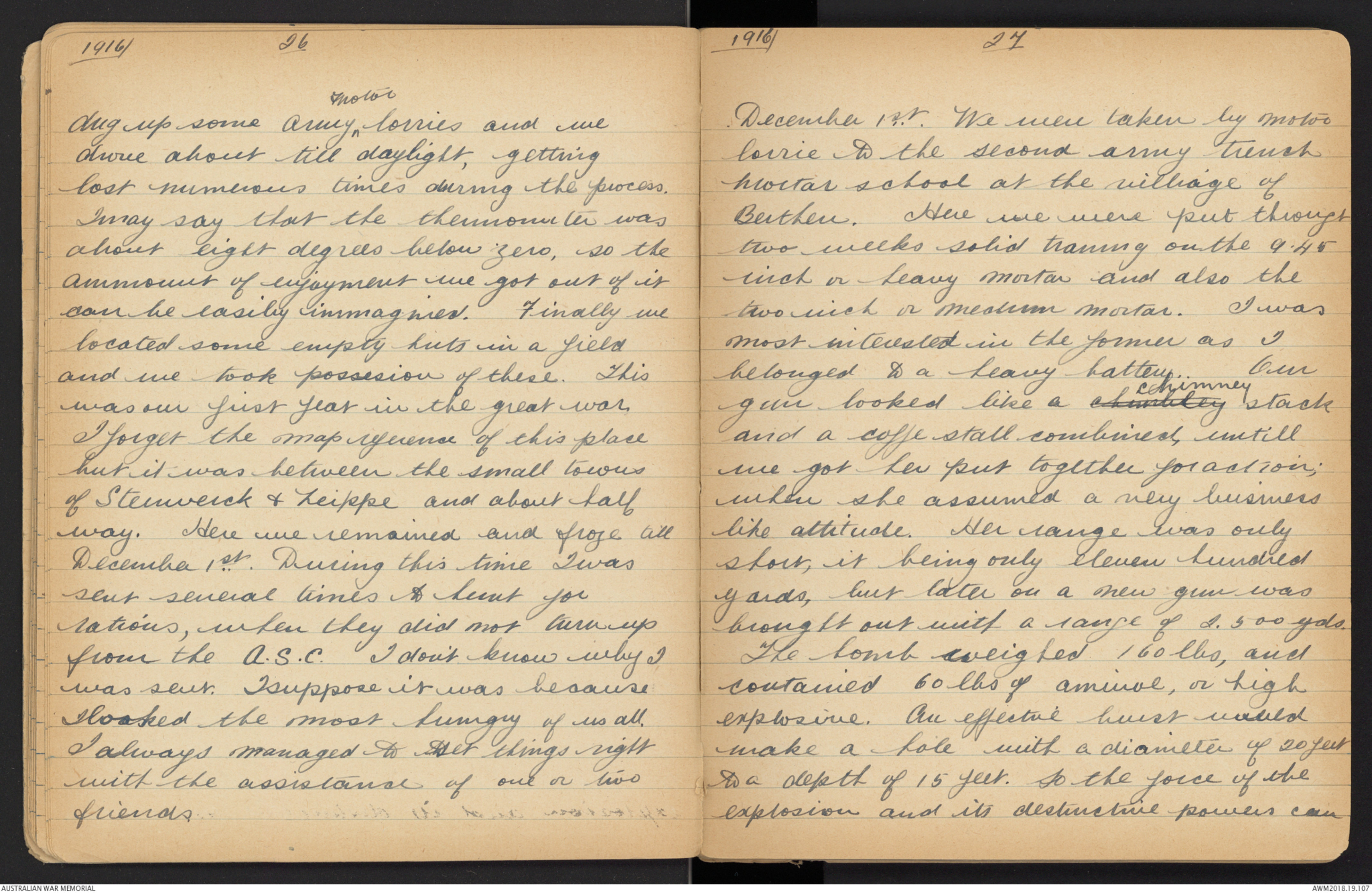
dug up some army ^motor lorries and we
drove about till daylight, getting
lost numerous times during the process.
I may say that the thermometer was
about eight degrees below zero, so the
ammount of enjoyment we got out of it
can be easily immagined. Finally we
located some empty huts in a field
and we took possesion of these. This
was our first feat in the great war.
I forget the map reference of this place
but it was between the small towns
of Steenwerck & Neippe and about half
way. Here we remained and froze till
December 1st. During this time I was
sent several times to hunt for
rations, when they did not turn up
from the A.S.C. I don't know why I
was sent. I suppose it was because
I looked the most hungry of us all.
I always managed to set things right
with the assistance of one or two
friends.
1916
27
December 1st. We were taken by motor
lorrie to the second army trench
mortar school at the villiage of
Berthen. Here we were put through
two weeks solid training on the 9.45
inch or heavy mortar and also the
two inch or medium mortar. I was
most interested in the former as I
belonged to a heavy battery. Our
gun looked like a chimbley chimney stack
and a coffe stall combined, untill
we got her put together for action;
when she assumed a very business
like attitude. Her range was only
short, it being only eleven hundred
yards, but later on a new gun was
brought out with a range of 2.500 yds.
The bomb weighed 160 lbs, and
contained 60 lbs of aminol, or high
explosive. An effective burst would
make a hole with a diameter of 20 feet
to a depth of 15 feet. So the force of the
explosion and its destructive powers can
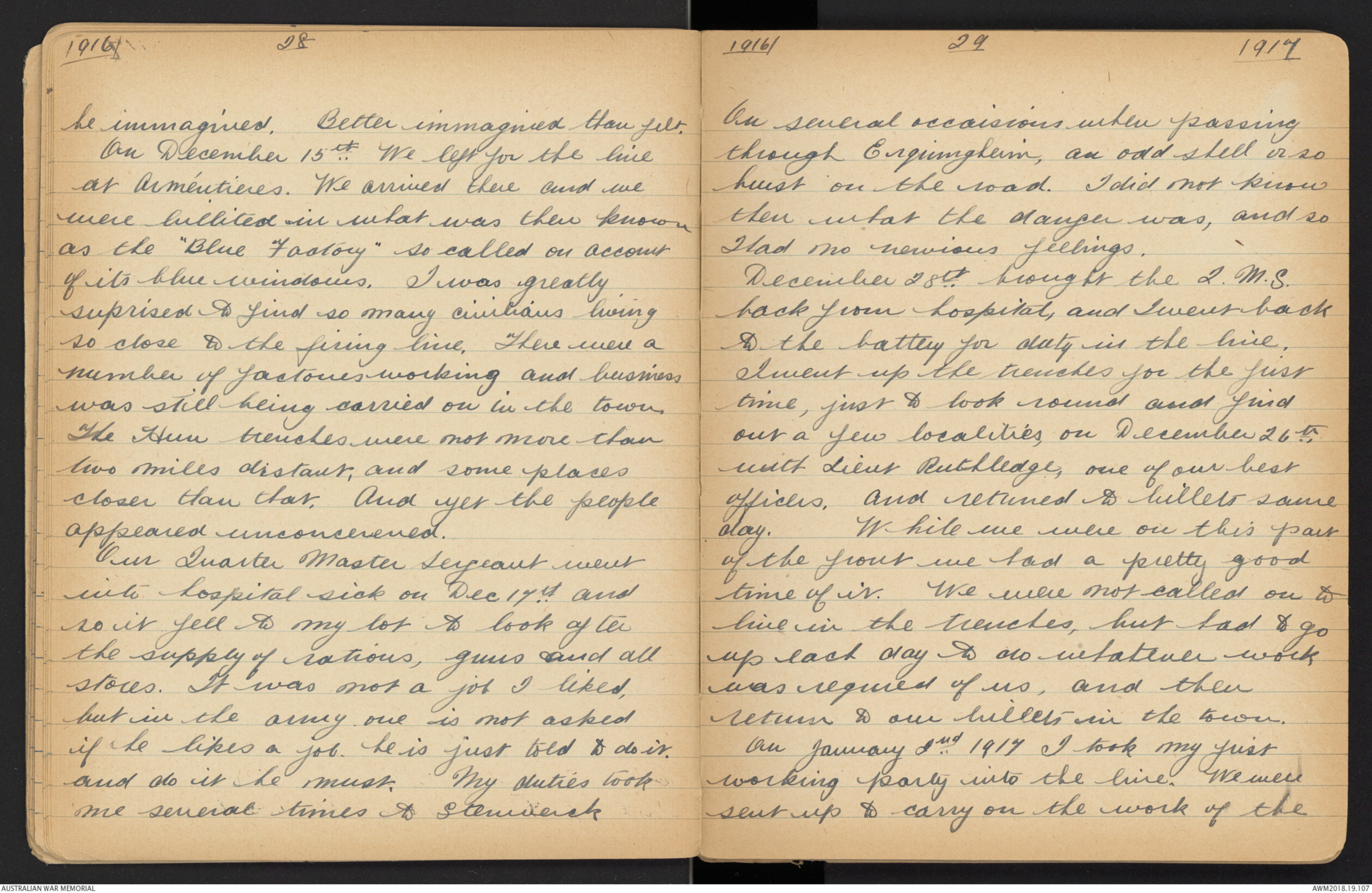
1916
28
be immagined. Better immagined than felt.
On December 15th We left for the line
at Arméntieres. We arrived there and we
were billited in what was then known
as the "Blue Factory" so called on account
of it blue windows. I was greatly
suprised to find to find so many civilians living
so close to the firing line. There were a
number of factories working and business
was still being carried on in the town.
The Hun trenches were not more than
two miles distant, and some places
closer than that. And yet the people
appeared unconcerned.
Our Quarter Master Sergeant went
into hospital sick on Dec 17th and
so it fell to my lot to look after
the supply of rations, guns and all
stores. It was not a job I liked,
but in the army one is not asked
if he likes a job. he is just told to do it.
and do it he must. My duties took
me several times to Stenwerck
1916
29
1917
On several occasions when passing
through Erquiungheim, an odd shell or so
burst on the road. I did not know
then what the danger was, and so
I had no nervious feelings.
December 28th brought the Q.M.S.
back from hospital, and I went back
to the battery for duty in the line.
I went up the trenches for the first
time, just to look round and find
out a few localities, on December 26th
with Lieut Ruthledge, one of our best
officers, and returned to billets same
day. While we were on this part
of the front we had a pretty good
time of it. We were not called on to
live in the trenches, but had to go
up each day to do whatever work
was required of us, and then
return to our billets in the town.
On January 2nd 1917 I took my first
working party into the line. We were
sent up to carry on the work of the
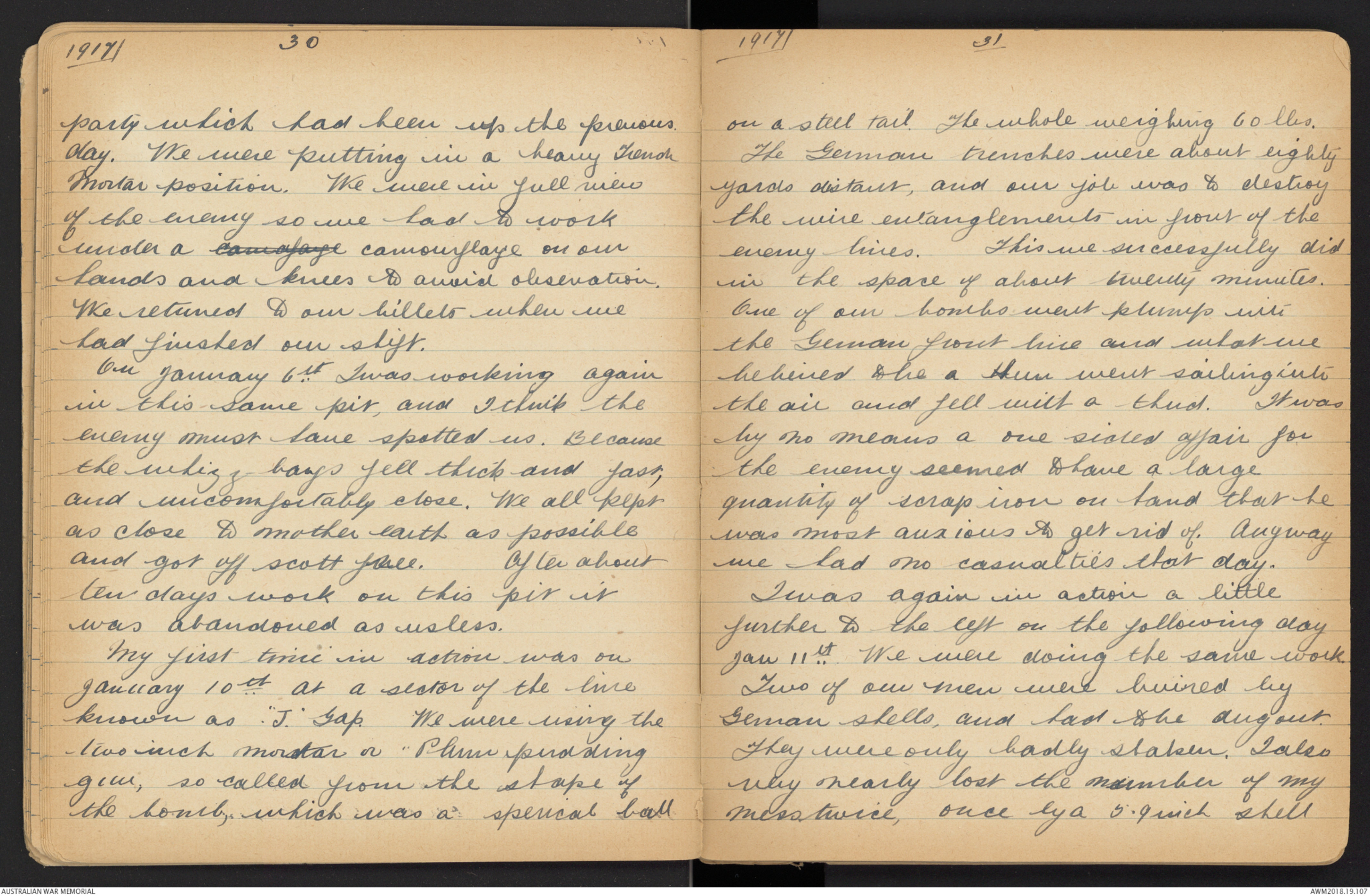
1917
30
party which had been up the previous
day. We were putting in a heavy Trench
Mortar position. We were in full view
of the enemy so we had to work
under a camafage camourflage on our
hands and knees to avoid observation.
We returned to our billets when we
had finished our shift.
On January 6th I was working again
in this same pit, and I think the
enemy must have spotted us. Because
the whizz-bangs fell thick and fast,
and uncomfortably close. We all kept
as close to mother earth as possible
and got off scott free. After about
ten days work on this pit it
was abandoned as useless.
My first time in action was on
January 10th at a sector of the line
known as "J." Gap. We were using the
two inch mortar or "Plum pudding
gun, so called from the shape of
the bomb, which was a sperical ball
1917
31
on a steel tail. The whole weighing 60 lbs.
The German trenches were about eighty
yards distant, and our job was to destroy
the wire entanglements in front of the
enemy lines. This we successfully did
in the space of about twenty minutes.
One of our bombs went plump into
the German front line and what we
believed to be a Hun went sailing into
the air and fell with a thud. It was
by no means a one sided affair for
the enemy seemed to have a large
quantity of scrap iron on hand that he
was most anxious to get rid of. Anyway
we had no casualties that day.
I was again in action a little
further to the left on the following day
Jan 11th We were doing the same work.
Two of our men were buried by
German shells, and had to be dug out.
They were only badly shaken. I also
very nearly lost the number of my
mess twice, once by a 5.9 inch shell
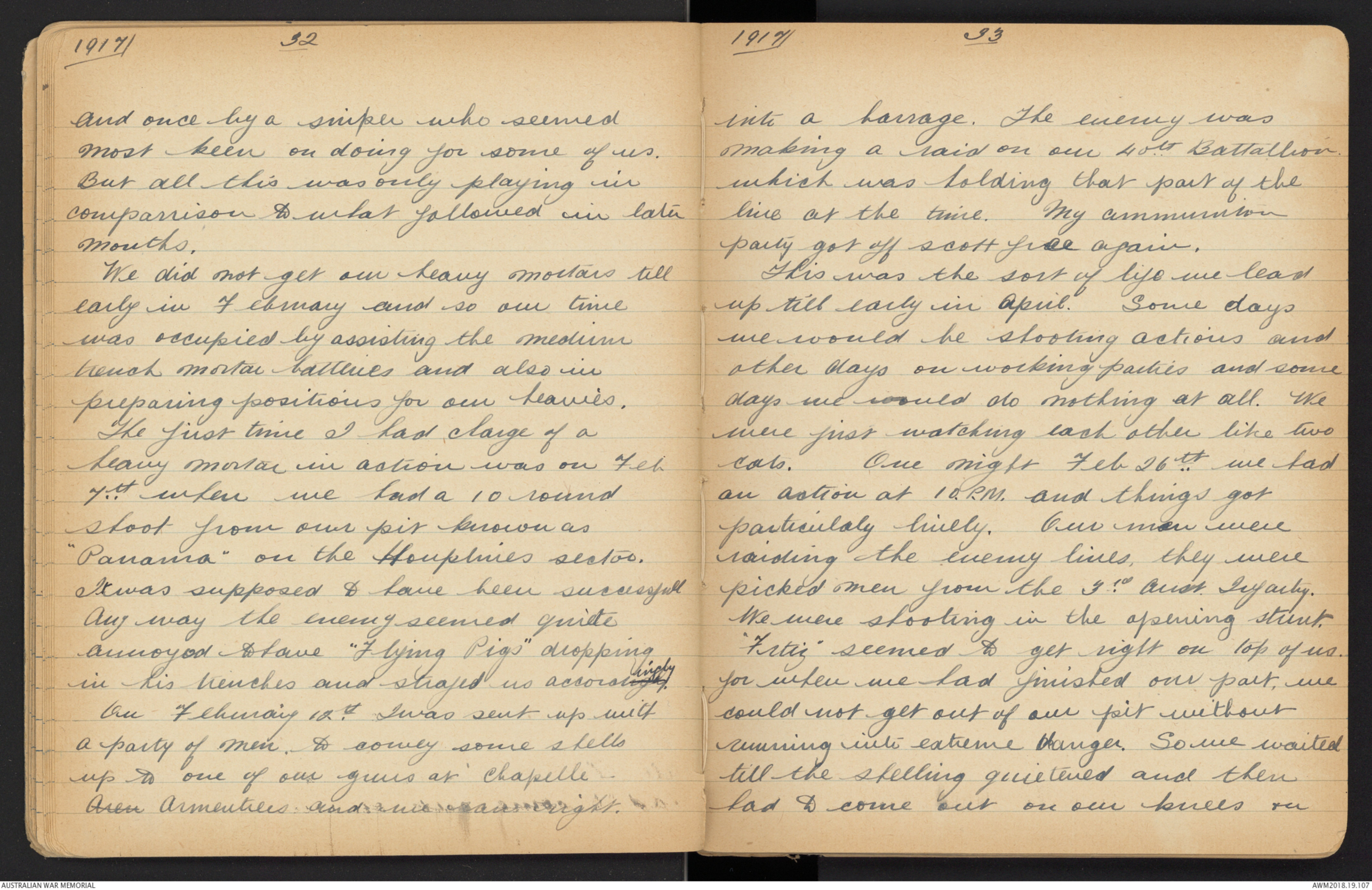
1917
32
and once by a sniper who seemed
most keen on doing for some of us.
But all this was only playing in
comparrison to what followed in later
months.
We did not get our heavy mortars till
early in February and so our time
was occupied by assisting the medium
trench mortar batteries and also in
preparing positions for our heavies.
The first time I had charge of a
heavy mortar in action was on Feb
7th when we had a 10 round
shoot from our pit known as
"Panama" on the Houplines sector.
It was supposed to have been successfull
Any way the enemy seemed quite
annoyed to have "Flying Pigs" dropping
in his trenches and strafed us accordiglingly.
On February 12th I was sent up with
a party of men to convey some shells
up to one of our guns at Chapelle -Aren Armentiers and we ran right.
1917
33
into a barrage. The enemy was
making a raid on our 40th Battallion
which was holding that part of the
line at the time. My ammunition
party got off scott free again.
This was the sort of life we lead
up till early in April. Some days
we would be shooting actions and
other days on working parties and some
days we would do nothing at all. We
were just watching each other like two
cats. One night Feb 26th we had
an action at 10.P.M. and things got
particularly lively. Our men were
raiding the enemy lines, they were
picked men from the 3rd Aust. Infantry.
We were shooting in the opening stunt.
"Fritz" seemed to get right on top of us.
for when we had finished our part, we
could not get out of our pit without
running into extreme danger. So we waited
till the shelling quietened and then
had to come out on our knees on
1917
34
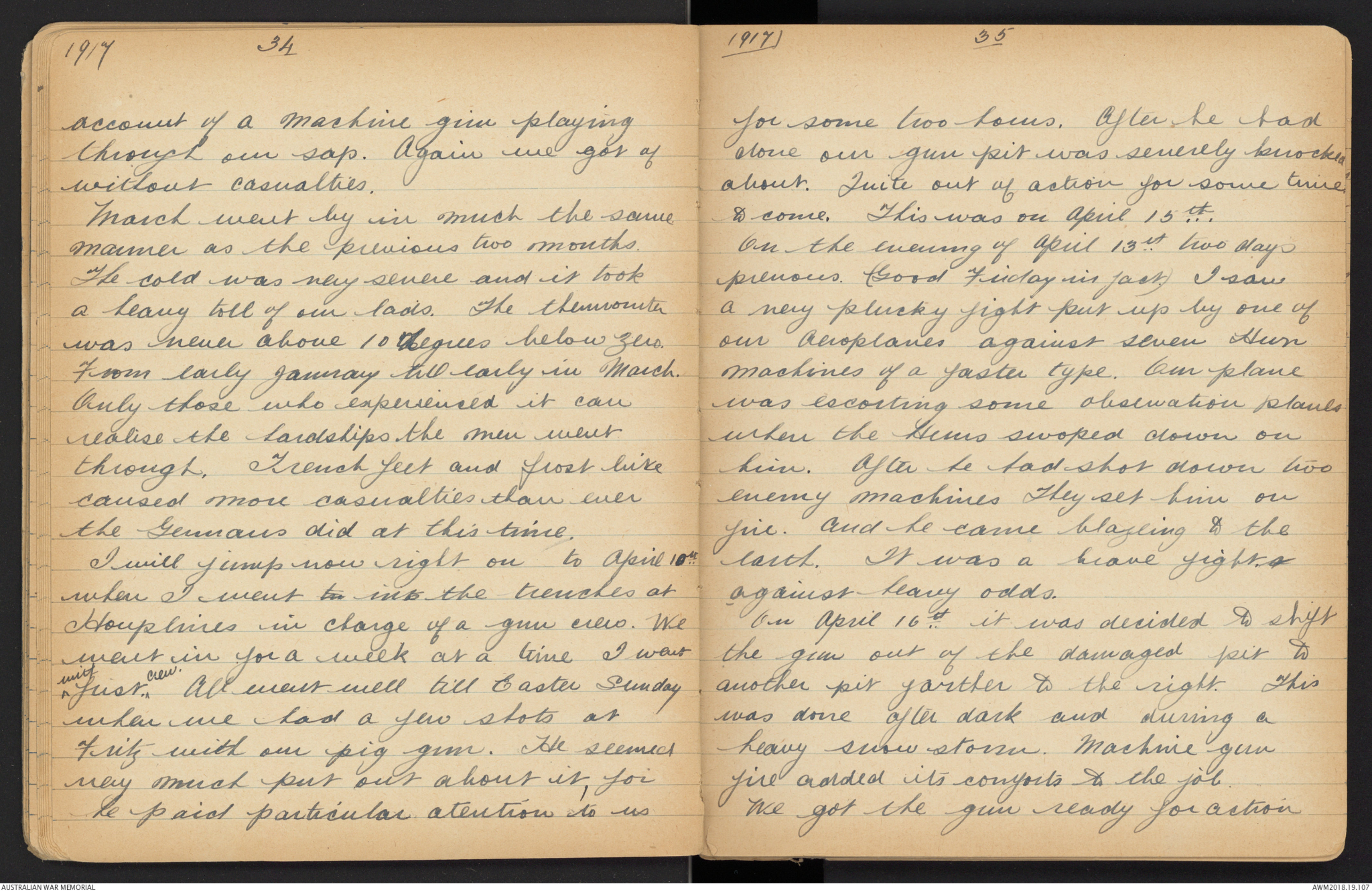
account of a machine gun playing
through our sap. Again we got of
without casualties.
March went by in much the same
manner as the previous two months.
The cold was very severe and it took
a heavy toll of our lads. The thermometer
was never above 10 degrees below zero.
From early January till early in March.
Only those who experienced it can
realise the hardships the men went
through. Trench feet and frost bite
caused more casualties than ever
the Germans did at this time.
I will jump now right on to April 10th
when I went to into the trenches at
Houplines in charge of a gun crew. We
went in for a week at a time I went
^with first ^crew. All went well till Easter Sunday
when we had a few shots at
Fritz with our pig gun. He seemed
very much put out about it, for
he paid particular atention to us
1917
35
for some two hours. After he had
done our gun pit was severely knocked
about. Quite out of action for some time
to come. This was on April 15th.
On the evening of April 13th two days
previous (Good Friday in fact) I saw
a very plucky fight put up by one of
our Aeroplanes against seven Hun
machines of a faster type. Our plane
was escorting some observation planes
when the Huns swoped down on
him. After he had shot down two
enemy machines They set him on
fire. And he came blazing to the
earth. It was a brave fight s
against heavy odds.
On April 16th it was decided to shift
the gun out of the damaged pit to
another pit farther to the right. This
was done after dark and during a
heavy snow storm. Machine gun
fire added to its comforts to the job.
We got the gun ready for action
1917
36
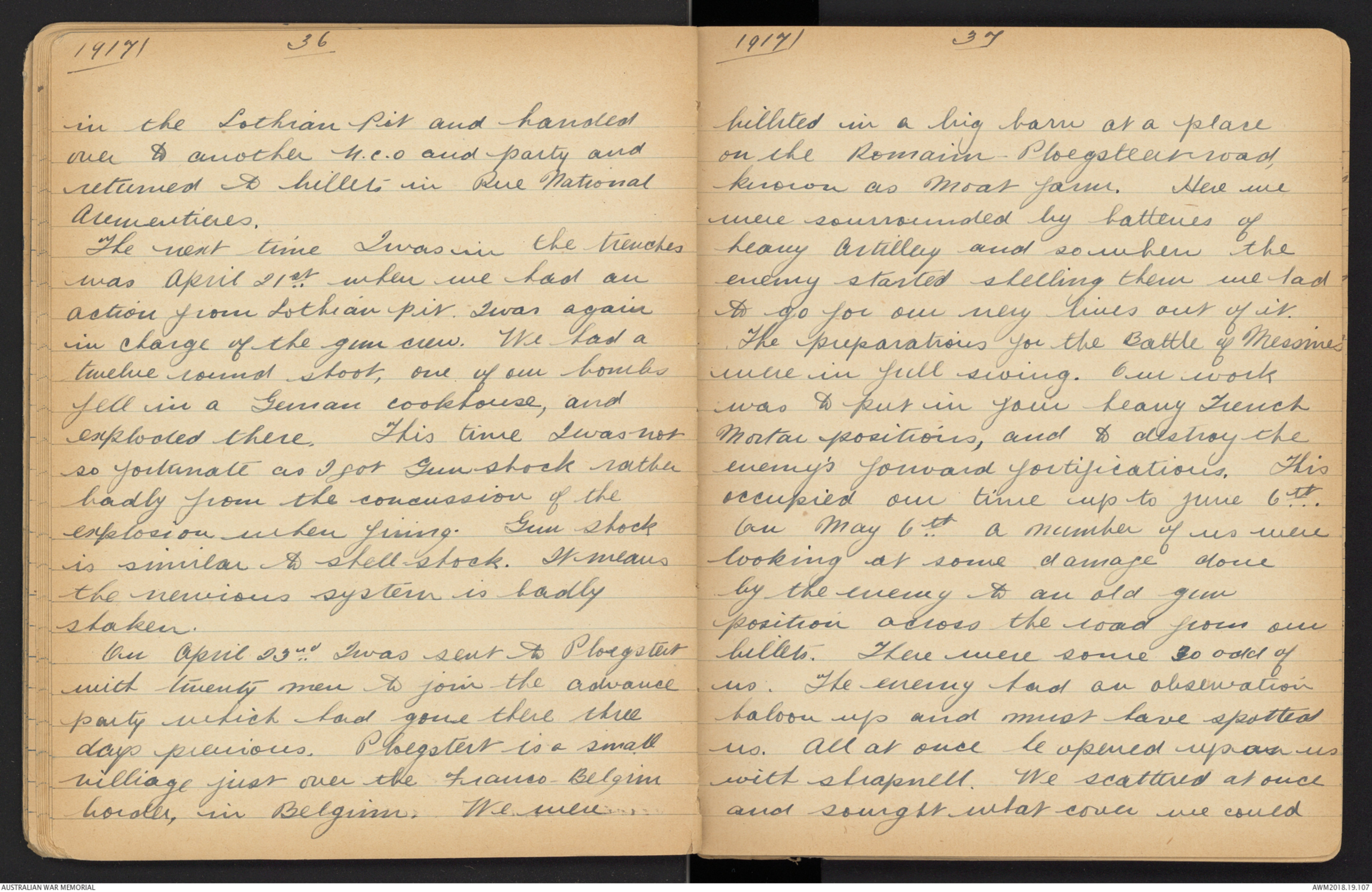
in the Lothian Pit and handed
over to another N.C.O. and party and
returned to billets in Rue National
Armentieres.
The next time I was in the trenches
was April 21st when we had an
action from Lothian Pit. I was again
in charge of the gun crew. We had a
twelve round shoot, one of our bombs
fell in a German cookhouse, and
exploded there. This time I was not
so fortunate as I got Gun shock rather
badly from the concussion of the
explosion when firing. Gun shock
is similar to shell shock. It means
the nervious system is badly
shaken.
On April 23rd I was sent to Ploegstert
with twenty men to join the advance
party which had gone there three
days previous. Ploegstert is a small
villiage just over the Franco-Belgium
border, in Belgium. We were
1917
37
billited in a big barn at a place
on the Romain-Ploegsteert road,
known as Moat farm. Here we
were surrounded by batteries of
heavy Artillery and so when the
enemy started shelling them we had
to go for our very lives out of it.
The preparations for the Battle of Messines
were in full swing. Our work
was to put in four heavy Trench
Mortar positions, and to destroy the
enemy's forward fortifications. This
occupied our time up to June 6th.
On May 6th a number of us were
looking at some damage done
by the enemy to an old gun
position across the road from our
billets. There were some 30 odd of
us. The enemy had an observation
baloon up and must have spotted
us. All at once he opened up on us
with shrapnell. We scattered at once
and sought what cover we could
 Deb Parkinson
This transcription item is now locked to you for editing. To release the lock either Save your changes or Cancel.
This lock will be automatically released after 60 minutes of inactivity.