
Diary of Keith Morton Hickman, 1916-1919 - Part 1
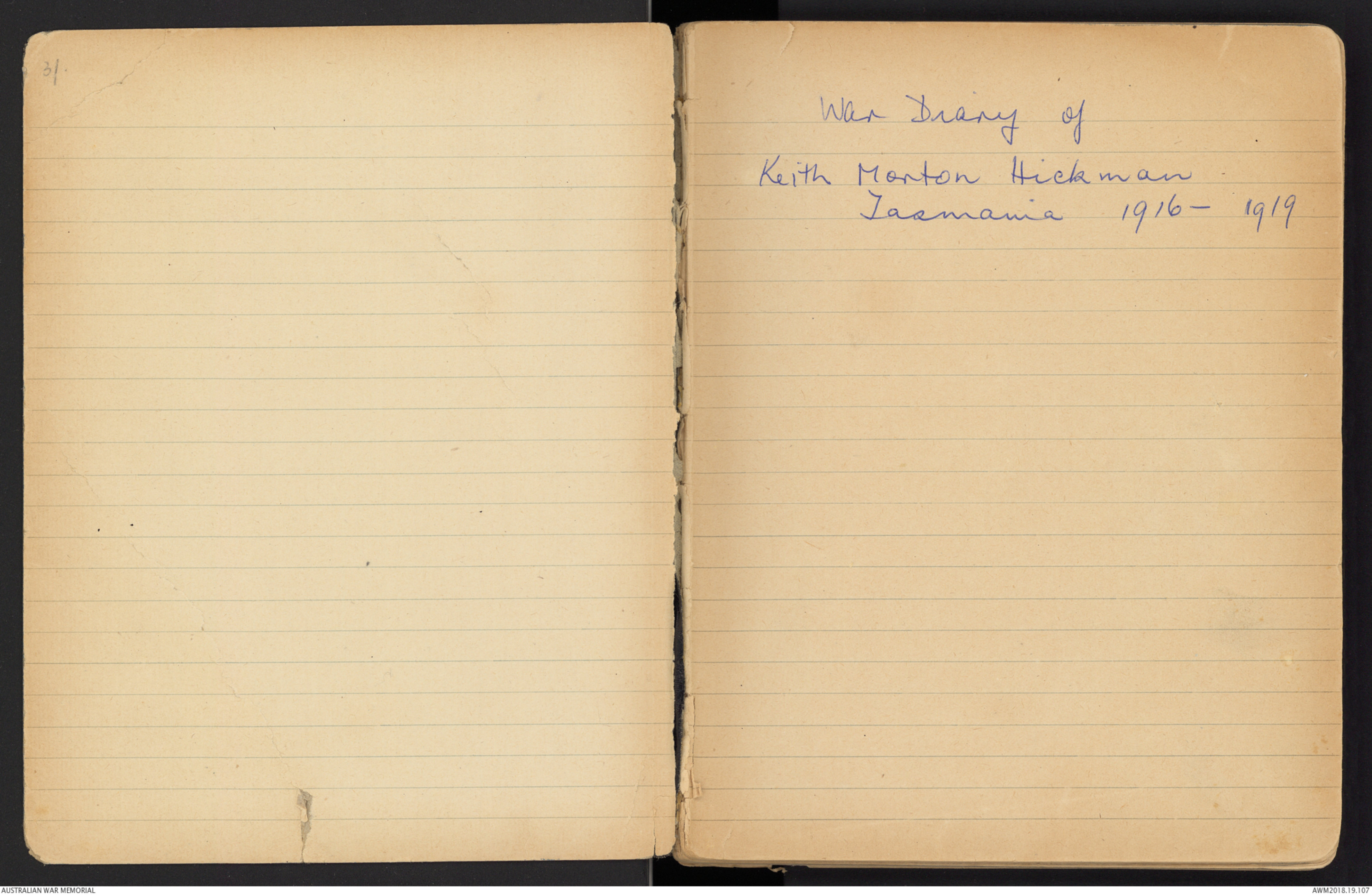
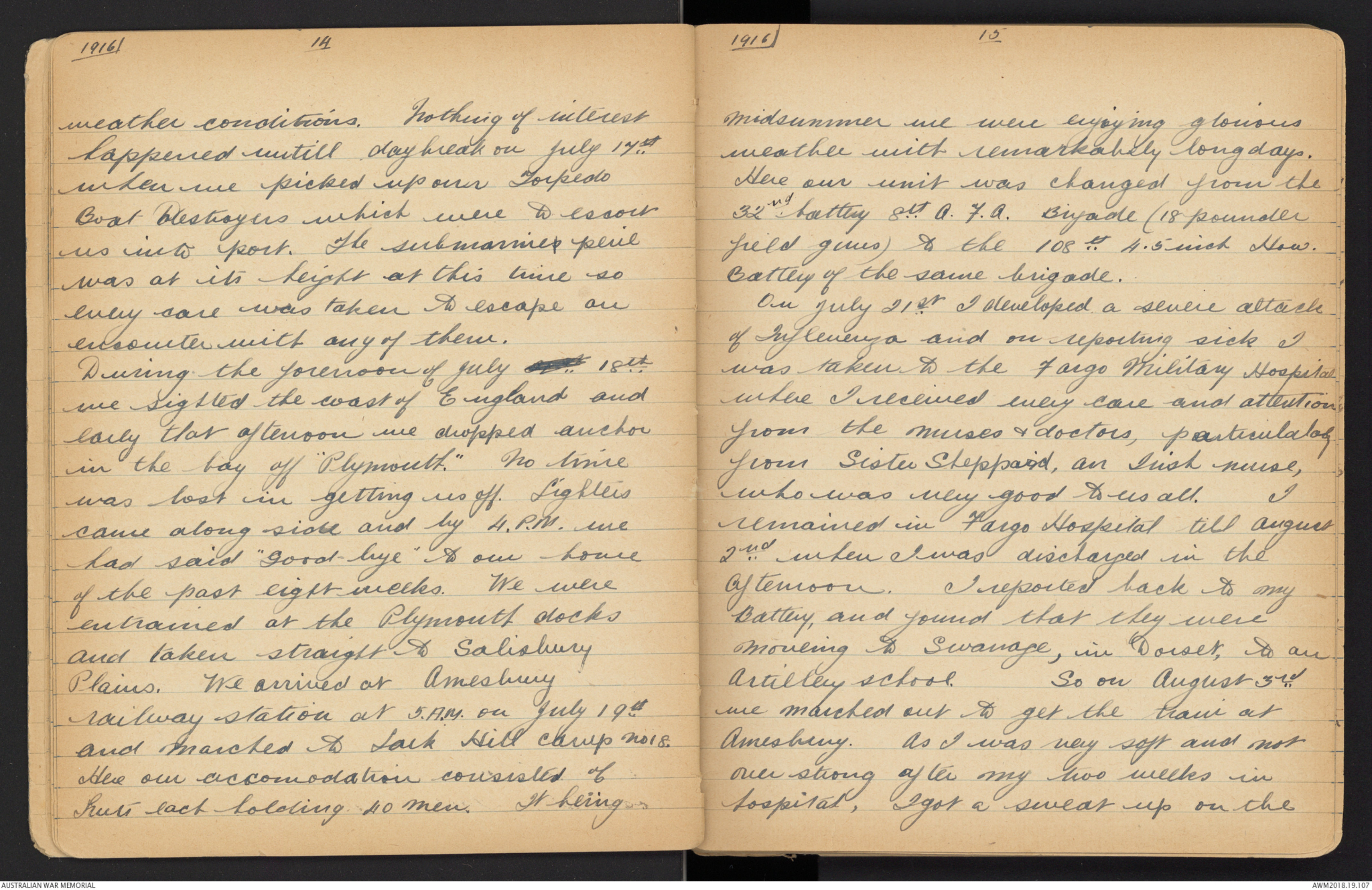
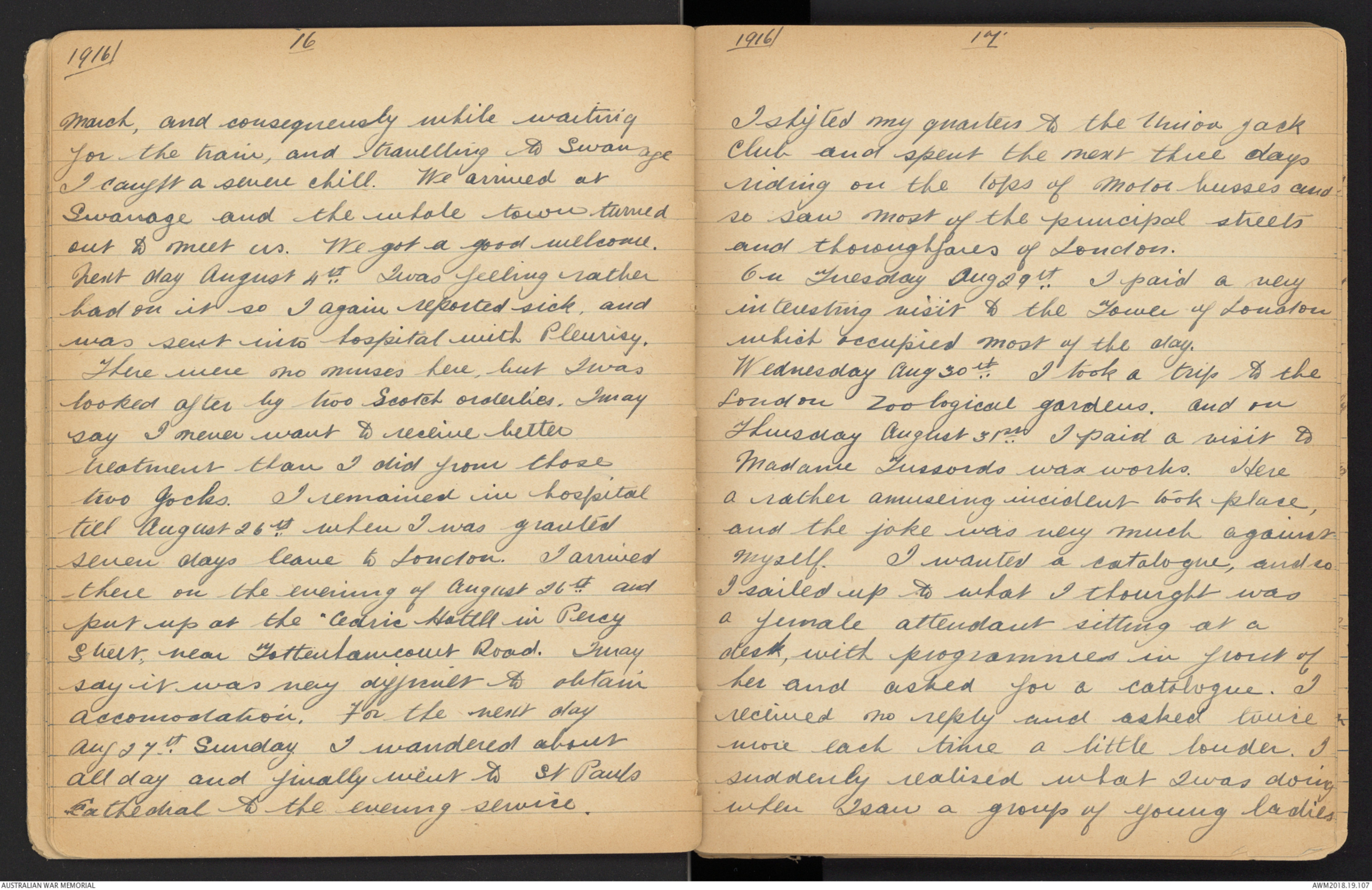
War Diary of
Keith Morton Hickman
Tasmania 1916 — 1919
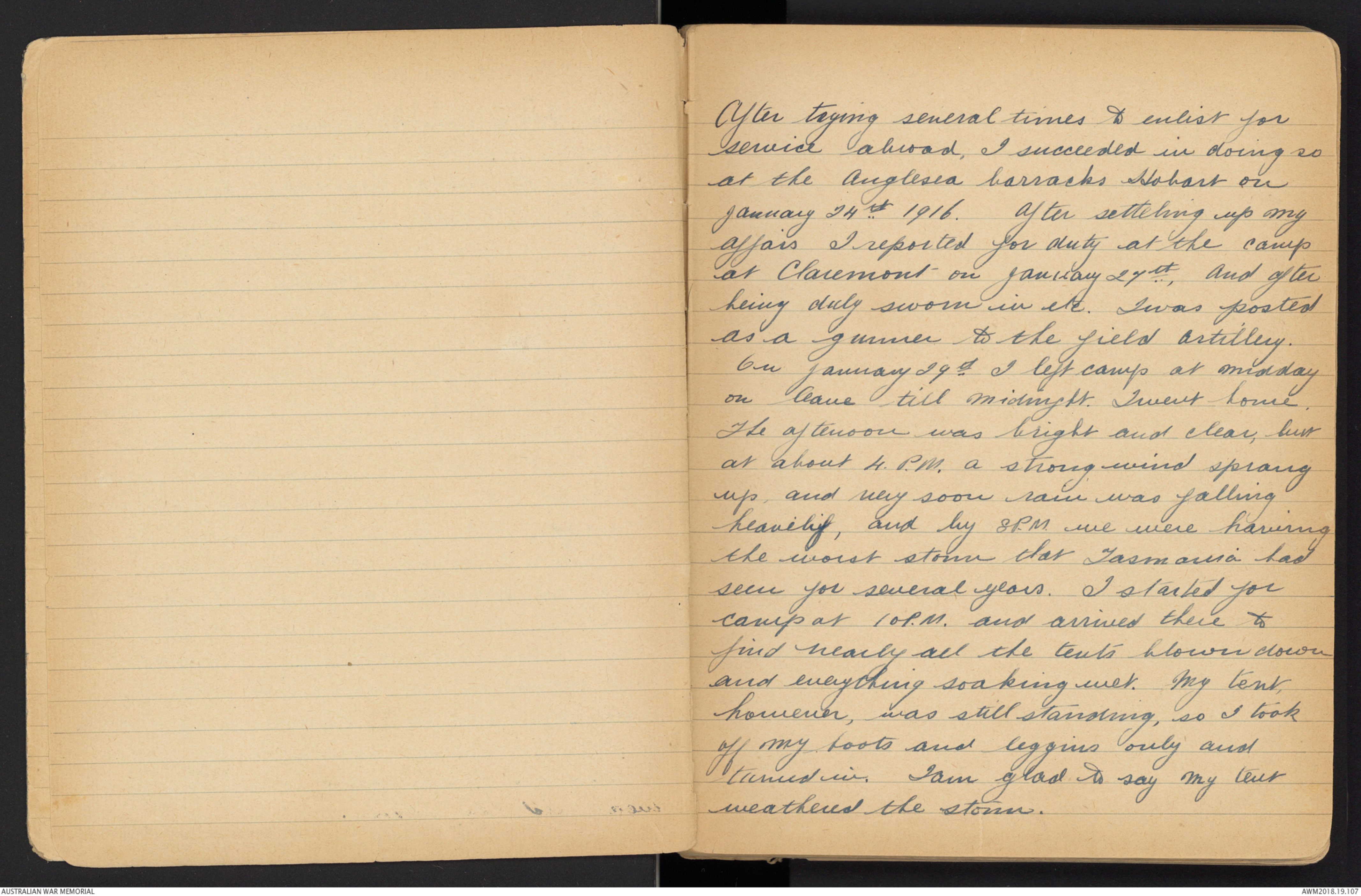
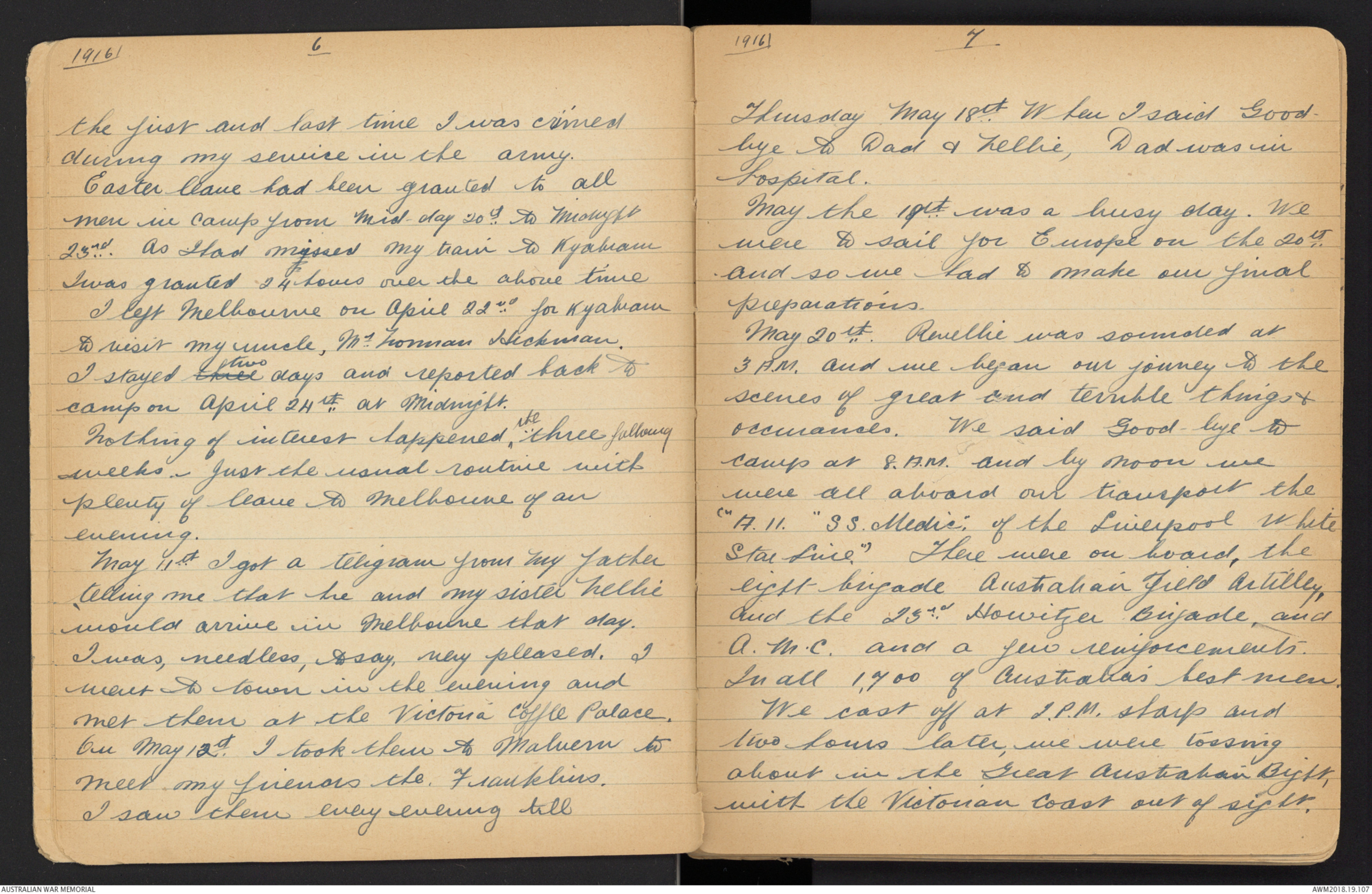
After trying several times to enlist for
service abroad, I succeeded in doing so
at the Anglesea barracks Hobart on
January 24th 1916. After setteling up my
affairs I reported for duty at the camp
at Claremont on January 27th, and after
being duly sworn in etc. I was posted
as a gunner to the field artillery.
On January 29th I left camp at midday
on leave till midnight. I went home.
The afternoon was bright and clear, but
at about 4.P.M. a strong wind sprang
up, and very soon rain was falling
heavily, and by 8 P.M. we were having
the worst storm that Tasmania had
seen for several years. I started for
camp at 10 P.M. and arrived there to
find nearly all the tents blown down
and everything soaking wet. My tent,
however, was still standing, so I took
off my boots and leggins only and
turned in. I am glad to say my tent
weathered the storm.
1916
2
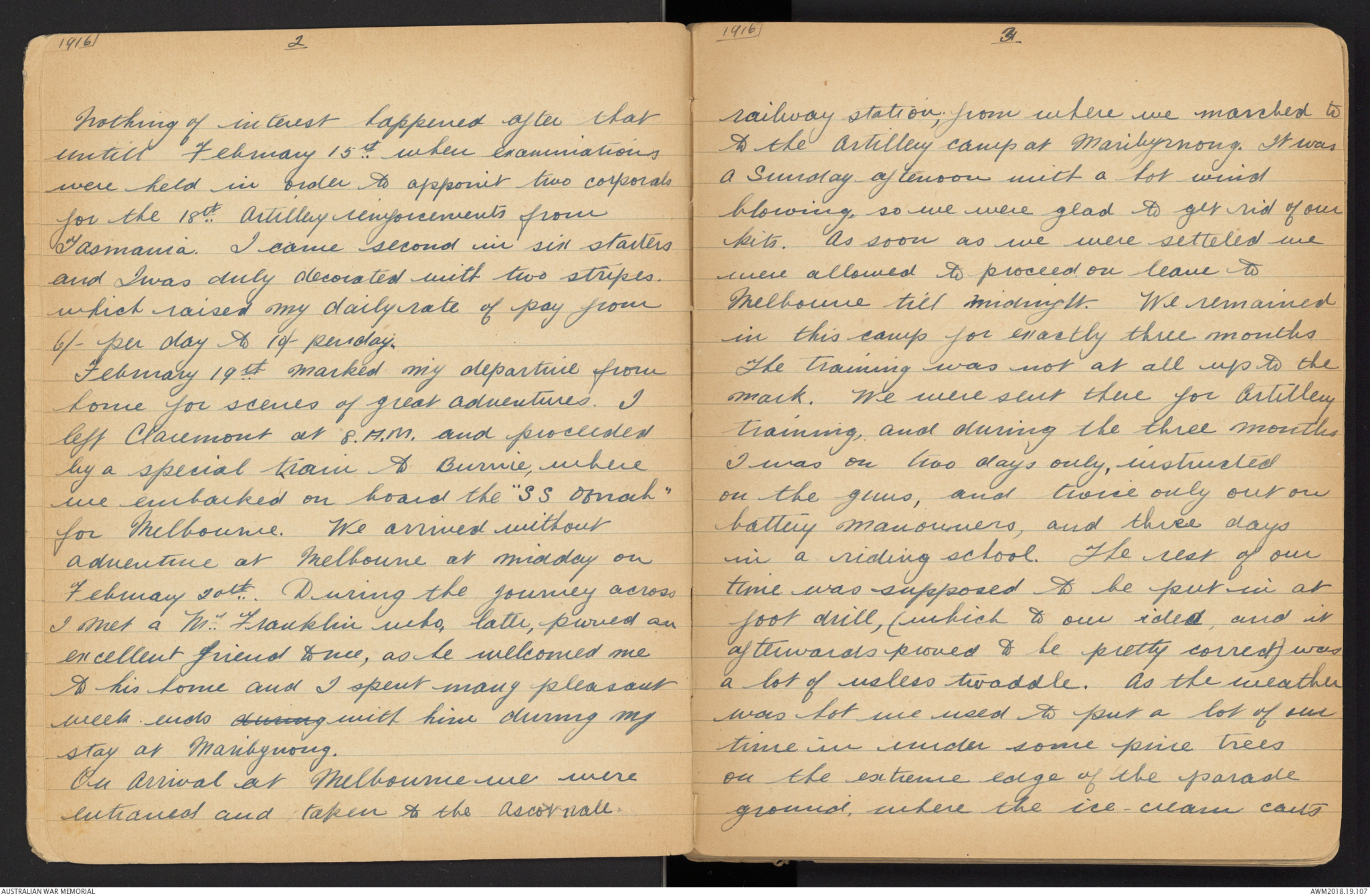
Nothing of interest happened after that
untill February 15th when examinations
were held in order to appoint two corporals
for the 18th Artillery reinforcements from
Tasmania. I came second in six starters
and I was duly decorated with two stripes.
which raised my daily rate of pay from
6/- per day to 10/- per day.
February 19th marked my departure from
home for scenes of great adventures. I
left Claremont at 8.A.M. and proceeded
by a special train to Burnie, where
we embarked on board the "SS Oonah"
for Melbourne. We arrived without
adventure at Melbourne at midday on
February 20th. During the journey across
I met a Mr Franklin who, later, proved an
excellent friend to me, as he welcomed me
to his home and I spent many pleasant
week ends during with him during my
stay at Maribynong.
On arrival at Melbourne we were
entrained and taken to the Ascot Vale
1916
3
railway station; from where we marched to
to the Artillery camp at Maribyrnong. It was
a Sunday afternoon with a hot wind
blowing, so we were glad to get rid of our
kits. As soon as we were setteled we
were allowed to proceed on leave to
Melbourne till midnight. We remained
in this camp for exactly three months
The training was not at all up to the
mark. We were sent there for Artillery
training, and during the three months
I was on two days only, instructed
on the guns, and twice only out on
battery manouvers, and three days
in a riding school. The rest of our
time was supposed to be put in at
foot drill, (which to our idea, and it
afterwards proved to be pretty correct) was
a lot of useless twaddle. As the weather
was hot we used to put a lot of our
time in under some pine trees
on the extreme edge of the parade
ground, where the ice-cream carts
1916
4
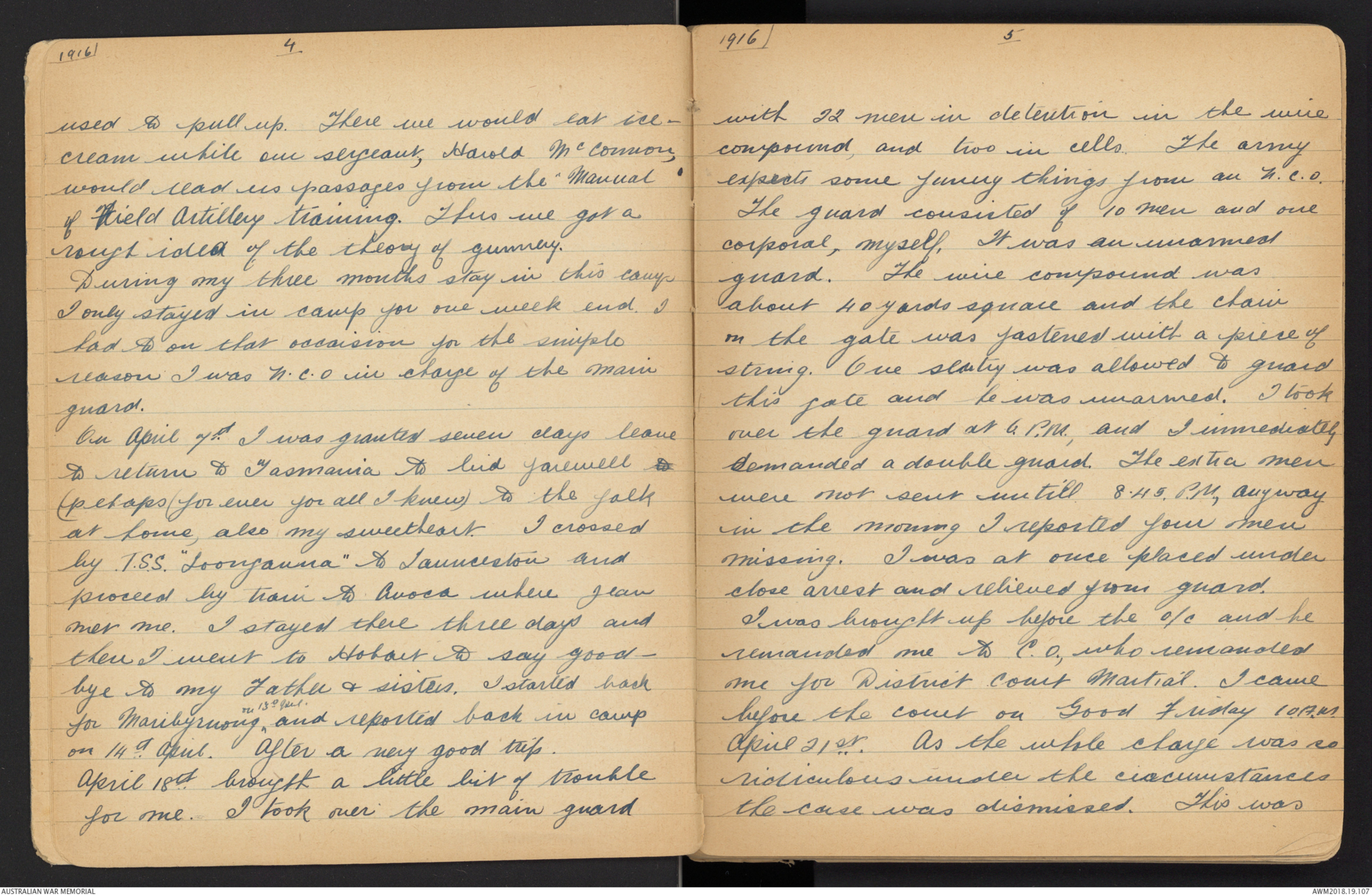
used to pull up. There we would eat ice-cream
while our sergeant, Harold McConnon,
would read us passages from the "Manual"
of Field Artillery training. Thus we got a
rough idea of the theory of gunnery.
During my three months stay in this camp
I only stayed in camp for one week end. I
had to on that occaision for the simple
reason I was N.C.O in charge of the main
guard.
On April 7th I was granted seven days leave
to return to Tasmania to bid farewell to
(pehaps (for ever for all I knew) to the folk
at home, also my sweetheart. I crossed
by T.S.S. "Loonganna" to Launceston and
proceed by train to Avoca where Jean
met me. I stayed there three days and
then I went to Hobart to say good-bye
to my Father & sisters. I started back
for Maribyrnong ^on 13th Apil. and reported back in camp
on 14th April. After a very good trip.
April 18th brought a little bit of trouble
for me. I took over the main guard
1916
5
with 22 men in detention in the wire
compound and two in cells. The army
expects some funny things from an N.C.O.
The guard consisted of 10 men and one
corporal, myself. It was an unarmed
guard. The wire compound was
about 40 yards square and the chain
on the gate was fastened with a piece of
string. One sentry was allowed to guard
this gate and he was unarmed. I took
over the guard at 6.P.M., and I immediately
demanded a double guard. The extra men
were not sent untill 8.45.P.M., anyway
in the morning I reported four men
missing. I was at once placed under
close arrest and relieved from guard.
I was brought up before the O/C and he
remanded me to C.O., who remanded
me for District Court Martial. I came
before the court on Good Friday 10.A.M.
April 21st. As the whole charge was so
ridiculous under the circumstances
the case was dismissed. This was
1916
6
the first and last time I was crimed
during my service in the army.
Easter leave had been granted to all
men in camp from Mid-day 20th to Midnight
23rd. As I had missed my train to Kyabram
I was granted 24 hours over the above time
I left Melbourne on April 22nd for Kyabram
to visit my uncle, Mr Norman Hickman.
I stayed three two days and reported back to
camp on April 24th at Midnight.
Nothing of interest happened ^the three followg
weeks. - Just the usual routine with
plenty of leave to Melbourne of an
evening.
May 11th I got a telegram from my father
telling me that he and my sister Nellie
would arrive in Melbourne that day.
I was, needless, to say, very pleased. I
went to town in the evening and
met them at the Victoria Coffee Palace.
On May 12th I took them to Malvern to
meet my friends the Franklins.
I saw them every evening till
1916
7
Thursday May 18th When I said Good-bye
to Dad & Nellie, Dad was in
hospital.
May the 19th was a busy day. We
were to sail for Europe on the 20th
and so we had to make our final
preparations.
May 20th Revellie was sounded at
3 A.M. and we began our journey to the
scenes of great and terrible things &
ocurances. We said Good-bye to
camp at 8.A.M. and by noon we
were all aboard our transport the
"A.11. "SS. Medic", of the Liverpool White
Star Line." There were on board, the
eight brigade Australian Field Artilley,
and the 23rd Howitzer Brigade, and
A.M.C. and a few reinforcements.
In all 1,700 of Australia's best men.
We cast off at 2.P.M. sharp and
two hours later, were were tossing
about in the Great Australian Bight,
with the Victorian Coast out of sight.
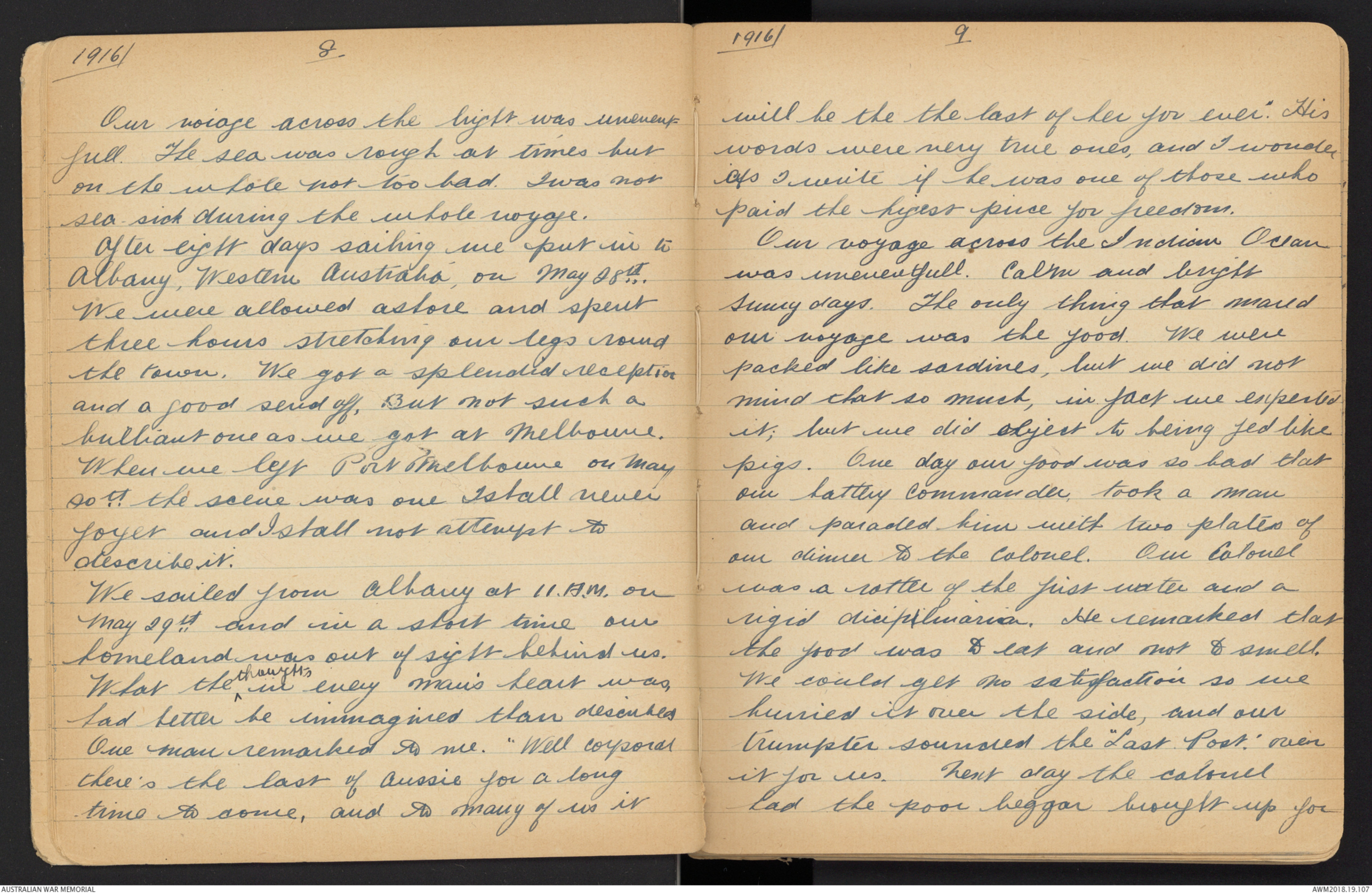
1916
8
Our voiage across the bight was uneventfull.
The sea was rough at times but
on the whole not too bad. I was not
sea sick during the whole voyage.
After eight days sailing we put in to
Albany, Western Australia, on May 28th.
We were allowed ashore and spent
three hours stretching our legs round
the town. We got a splendid reception
and a good send off, But not such a
brilliant one as we got at Melbourne.
When we left Port Melbourne on May
20th the scene was one I shall never
forget and I shall not attempt to
describe it.
We sailed from Albany at 11.A.M. on
May 29th and in a short time our
homeland was out of sight behind us.
What the ^thoughts in every man's heart was
had better be immagined than described
One man remarked to me. "Well corporal
there's the last of Aussie for a long
time to come, and to many of us it
1916
9
will be the the last of her for ever." His
words were very true ones, and I wonder
as I write if he was one of those who
paid the higest price for freedom.
Our voyage across the Indian Ocean
was uneventfull. Calm and bright
sunny days. The only thing that mared
our voyage was the food. We were
packed like sardines, but we did not
mind that so much, in fact we expected
it; but we did object to being fed like
pigs. One day our food was so bad that
our battery Commander took a man
and paraded him with two plates of
our dinner to the Colonel. Our Colonel
was a rotter of the first water and a
rigid dicipilinarian. He remarked that
the food was to eat and not to smell.
We could get no satisfaction so we
hurried it over the side, and our
trumpter sounded the "Last Post." over
it for us. Next day the colonel
had the poor beggar brought up for
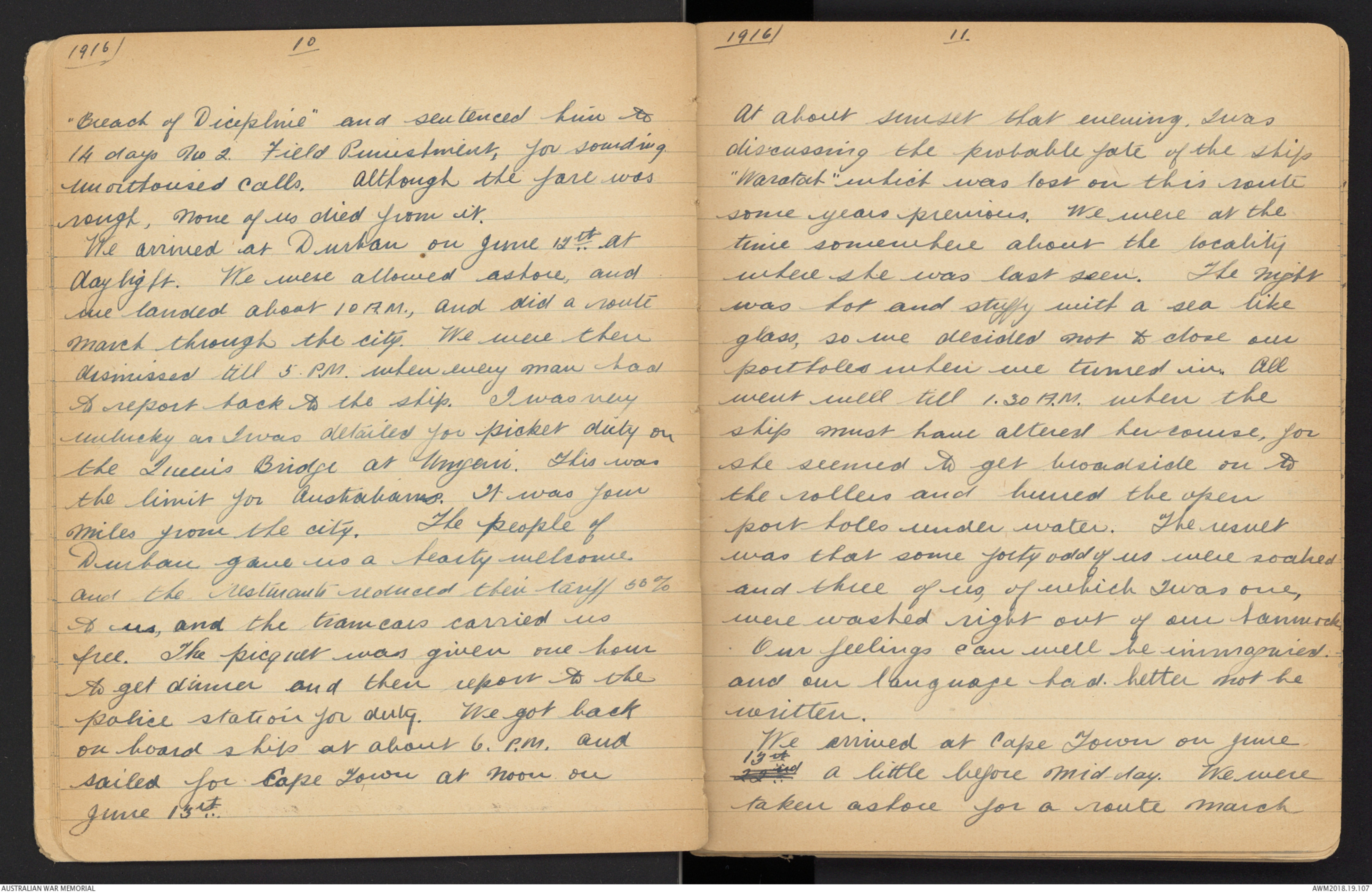
1916
10
"Breach of Dicipline" and sentenced him to
14 days No 2. Field Punishment, for sounding
unorthorised calls. Although the fare was
rough, none of us died from it.
We arrived at Durban on June 12th at
daylight. We were allowed ashore, and
we landed about 10 A.M., and did a route
march through the city. We were then
dismissed till 5.P.M. when every man had
to report back to the ship. I was very
unlucky as I was detailed for picket duty on
the Queen's Bridge at Umgeni. This was
the limit for Australians. It was four
miles from the city. The people of
Durban gave us a hearty welcome.
and the resturants reduced their tariff 50%
to us, and the tramcars carried us
free. The picquet was given one hour
to get dinner and then report to the
police station for duty. We got back
on board ship at about 6.P.M. and
sailed for Cape Town at noon on
June 13th.
1916
11
At about sunset that evening. I was
discussing the probable fate of the ship
"Waratah" which was lost on this route
some years previous. We were at the
time somewhere about the locality
where she was last seen. The night
was hot and stuffy with a sea like
glass, so we decided not to close our
portholes when we turned in. All
went well till 1.30 A.M. when the
ship must have altered her course, for
she seemed to get broadside on to
the rollers and buried the open
port holes under water. The result
was that some forty odd of us were soaked
and three of us, of which I was one,
were washed right out of our hammock.
Our feelings can well be immagined
and our language had better not be
written.
We arrived at Cape Town on June22nd 13th a little before mid-day. We were
taken ashore for a route march
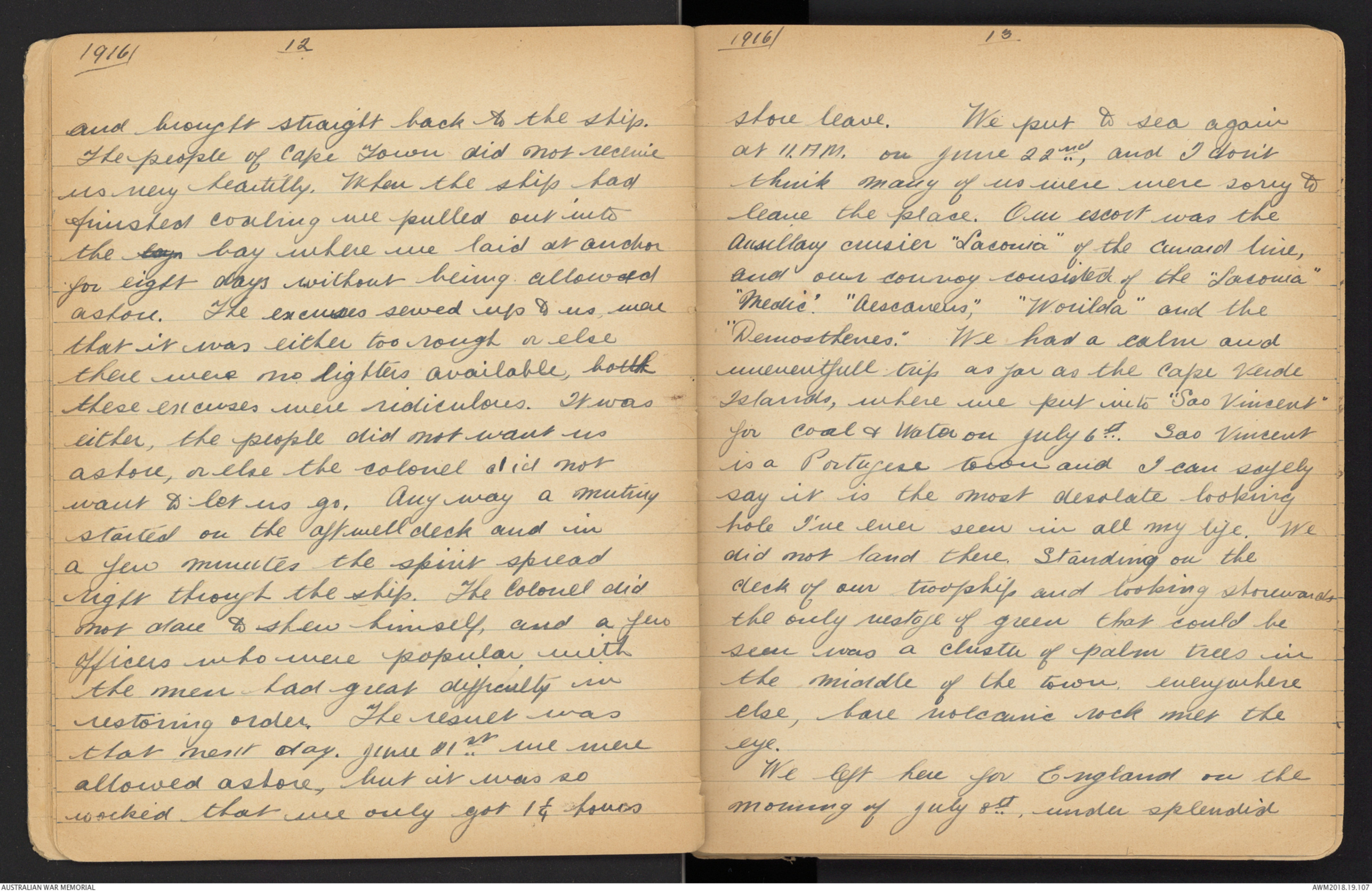
1916
12
and brought straight back to the ship.
The people of Cape town did not receive
us very heartily. When the ship had
finished coaling we pulled out into
the bay bay where we laid at anchor
for eight days without being allowed
ashore. The excuses served up to us were
that it was either too rough or else
there were no lighters available, both
these excuses were ridiculous. It was
either, the people did not want us
ashore, or else the colonel did not
want to let us go. Any way a mutiny
started on the aft well deck and in
a few minutes the spirit spread
right through the ship. The Colonel did
not dare to show himself, and a few
officers who were popular with
the men had great difficulty in
restoring order. The result was
that next day, June 21st we were
allowed ashore, but it was so
worked that we only got 1¼ hours
1916
13
shore leave. We put to sea again
at 11.A.M. on June 22nd, and I don't
think many of us were were sorry to
leave the place. Our escort was the
Auxillary crusier "Laconia" of the Cunard line,
and our convoy consisted of the "Laconia"
"Medic" "Aescaneus" "Worilda" and the
"Demosthenes." We had a calm and
uneventfull trip as far as the Cape Verde
Islands, where we put into "Sao Vincent"
for coal & water on July 6th. Sao Vincent
is a Portugese town and I can safely
say it is the most desolate looking
hole I've ever seen in all my life. We
did not land there. Standing on the
deck of our troopship and looking shorewards
the only vestage of green that could be
seen was a cluster of palm trees in
the middle of the town, everywhere
else, bare volcanic rock met the
eye.
We left here for England on the
morning of July 8th, under splendid
1916
14
weather conditions. Nothing of interest
happened untill daybreak on July 17th
when we picked up our Torpedo
Boat Destroyers which were to escort
us into port. The submarines peril
was at its height at this time so
every care was taken to escape an
encounter with any of them.
During the forenoon of July 21st 18th
we sighted the coast of England and
early that afternoon we dropped anchor
in the bay off "Plymouth." No time
was lost in getting us off. Lighters
came along side and by 4.P.M. we
had said "Good-bye" to our home
of the past eight weeks. We were
entrained at the Plymouth docks
and taken straight to Salisbury
Plains. We arrived at Amesbury
railway station at 5.A.M. on July 19th
and marched to Lark Hill camp No 18.
Here our accomodation consisted of
huts each holding 40 men. It being
1916
15
midsummer we were enjoying glorious
weather with remarkabely long days.
Here our unit was changed from the
32nd battery 8th A.F.A. Brigade (18 pounder
field guns) to the 108th 4.5 inch How.
Battery of the same brigade.
On July 21st I developed a severe attack
of Influenza and on reporting sick I
was taken to the Fargo Military Hospital
where I received every care and attention
from the nurses & doctors, particularly
from Sister Sheppard, an Irish nurse,
who was very good to us all. I
remained in Fargo Hospital till August
2nd when I was discharged in the
afternoon. I reported back to my
Battery, and found that they were
moveing to Swanage, in Dorset, to an
Artillery school. So on August 3rd
we marched out to get the train at
Amesbury. As I was very soft and not
over strong after my two weeks in
hospital, I got a sweat up on the
1916
16
march, and consequensly while waiting
for the train, and travelling to Swanage
I caught a severe chill. We arrived at
Swanage and the whole town turned
out to meet us. We got a good welcome.
Next day August 4th I was feeling rather
bad on it so I again reported sick, and
was sent into hospital with Pleurisy.
There were no nurses here but I was
looked after by two Scotch orderlies. I may
say I never want to receive better
treatment than I did from those
two Jocks. I remained in hospital
till August 26th when I was granted
seven days leave to London. I arrived
there on the evening of August 26th and
put up at the "Cedric Hotell in Percy
Street, near Tottenhamcourt Road. I may
say it was very difficult to obtain
accomodation. For the next day
Aug 27th Sunday I wandered about
all day and finally went to St Pauls
Cathedral to the evening service.
1916
17
I shifted my quarters to the Union Jack
Club and spent the next three days
riding on the tops of motor busses and
so saw most of the principal streets
and thoroughfares of London.
On Tuesday Aug 29th I paid a very
interesting visit to the Tower of London
which occupied most of the day.
Wednesday Aug 30th I took a trip to the
London Zoological gardens. And on
Thursday August 31st I paid a visit to
Madame Tussords wax works. Here
a rather amuseing incident took place,
and the joke was very much against
myself. I wanted a catalogue, and as
I sailed up to what I thought was
a female attendant sitting at a
desk, with programmes in front of
her and asked for a catalogue. I
received no reply and asked twice
more each time a little louder. I
suddenly realised what I was doing
when I saw a group of young ladies
 AW AWM
This transcription item is now locked to you for editing. To release the lock either Save your changes or Cancel.
This lock will be automatically released after 60 minutes of inactivity.