
Letters from John Hardie to his family, 1917-1918 - Part 4
2
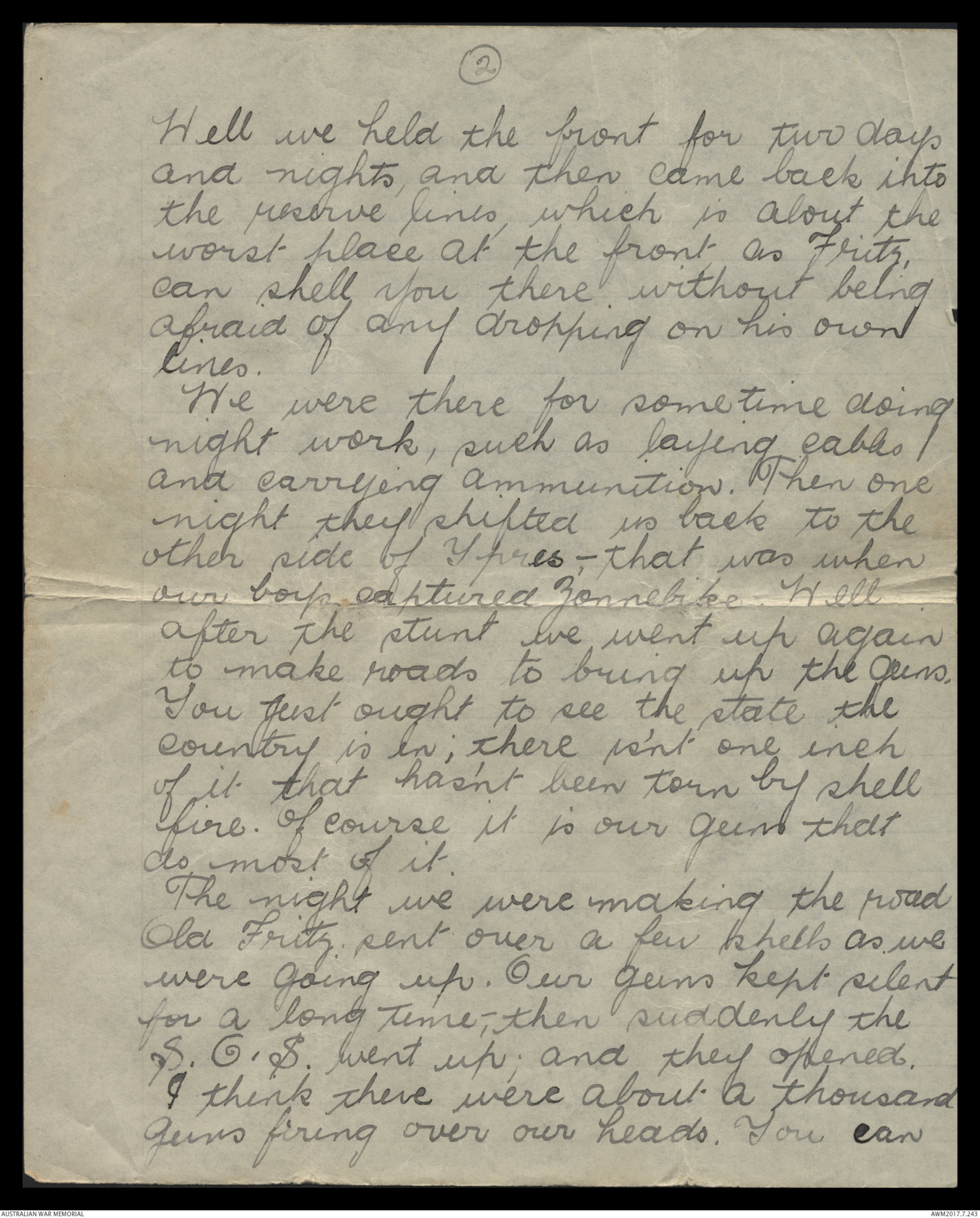
Well we held the front for two days
and nights, and then came back into
the reserve lines, which is about the
worst place at the front as Fritz
can shell you there without being
afraid of any dropping on his own
lines.
We were there for some time doing
night work, such as laying cables
and carrying ammunition. Then one
night they shifted us back to the
other side of Ypres - that was when
our boys captured Zonnebeke. Well
after the stunt we went up again
to make roads to bring up the guns.
You just ought to see the state the
country is in, there went isn’t one inch
of it that hasn't been torn by shell
fire. Of course it is our guns that
do most of it.
The night we were making the road
Old Fritz sent over a few shells as we
were going up. Our guns kept silent
for a long time,- then suddenly the
S.O.S. went up; and they opened
I think there were about a thousand
guns firing over our heads. You can
3
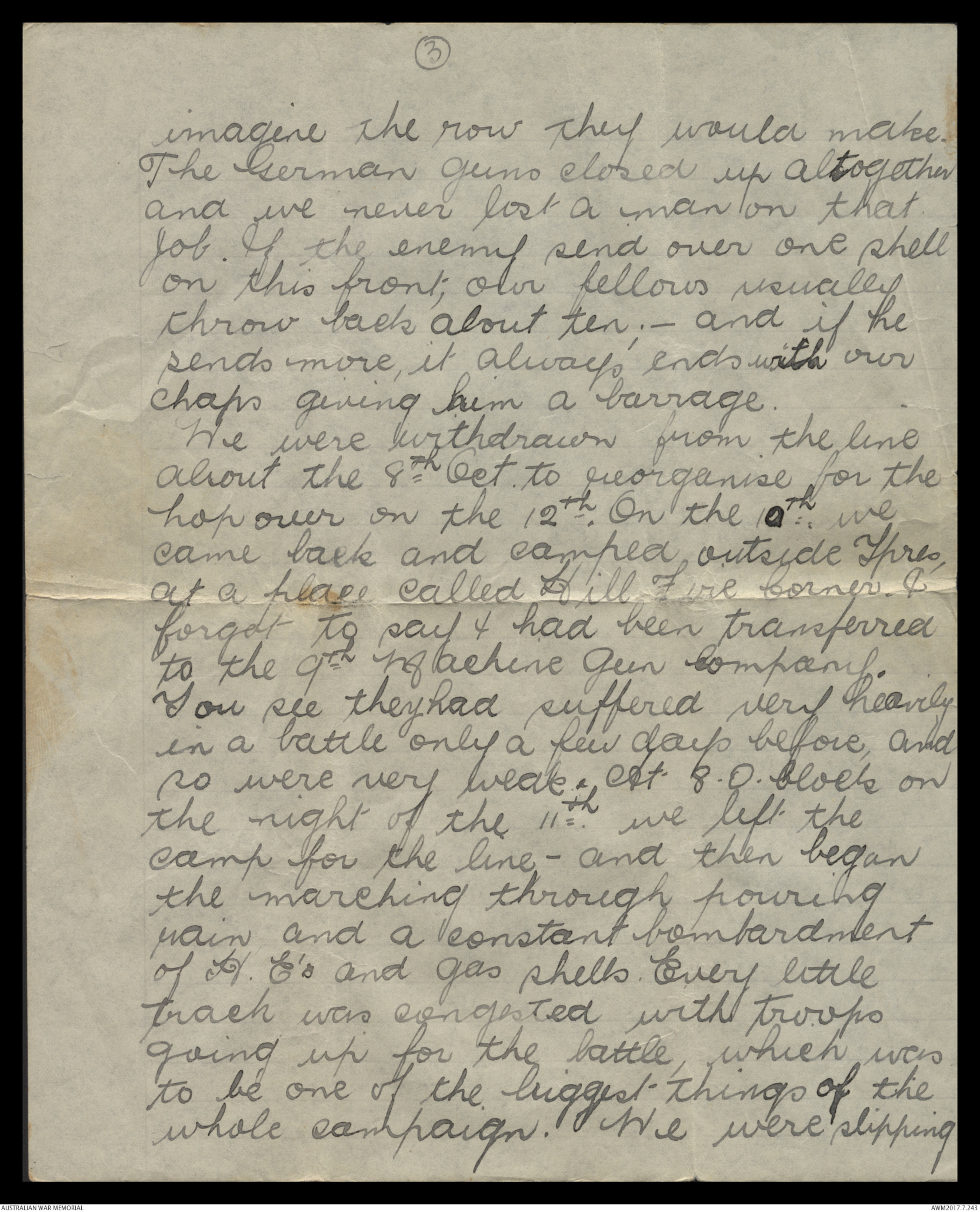
imagine the row they would make
The German guns closed up altogether
and we never lost a man on that
job. If the enemy send over one shell
on this front, our fellows usually
throw back about ten. - and if he
sends more, it always ends with our
chaps giving him a barrage.
We were withdrawn from the line
about the 8th Oct to reorganize for the
hop over on the 12th. On the 10th we
came back and camped outside Ypres
at a place called Hill Fire Corner. I
forgot to say I had been transferred
to the 9th Machine Gun Company
You see they had suffered very heavily
in a battle only a few days before, and
so were very weak. At 8 O.Clock on
the night of the 11th we left the
camp for the line,- and then began
the marching through pouring
rain and a constant bombardment
of H.E’s and gas shells Every little
track was congested with troops
going up for the battle, which was
to be one of the biggest things of the
whole campaign. We were slipping
4
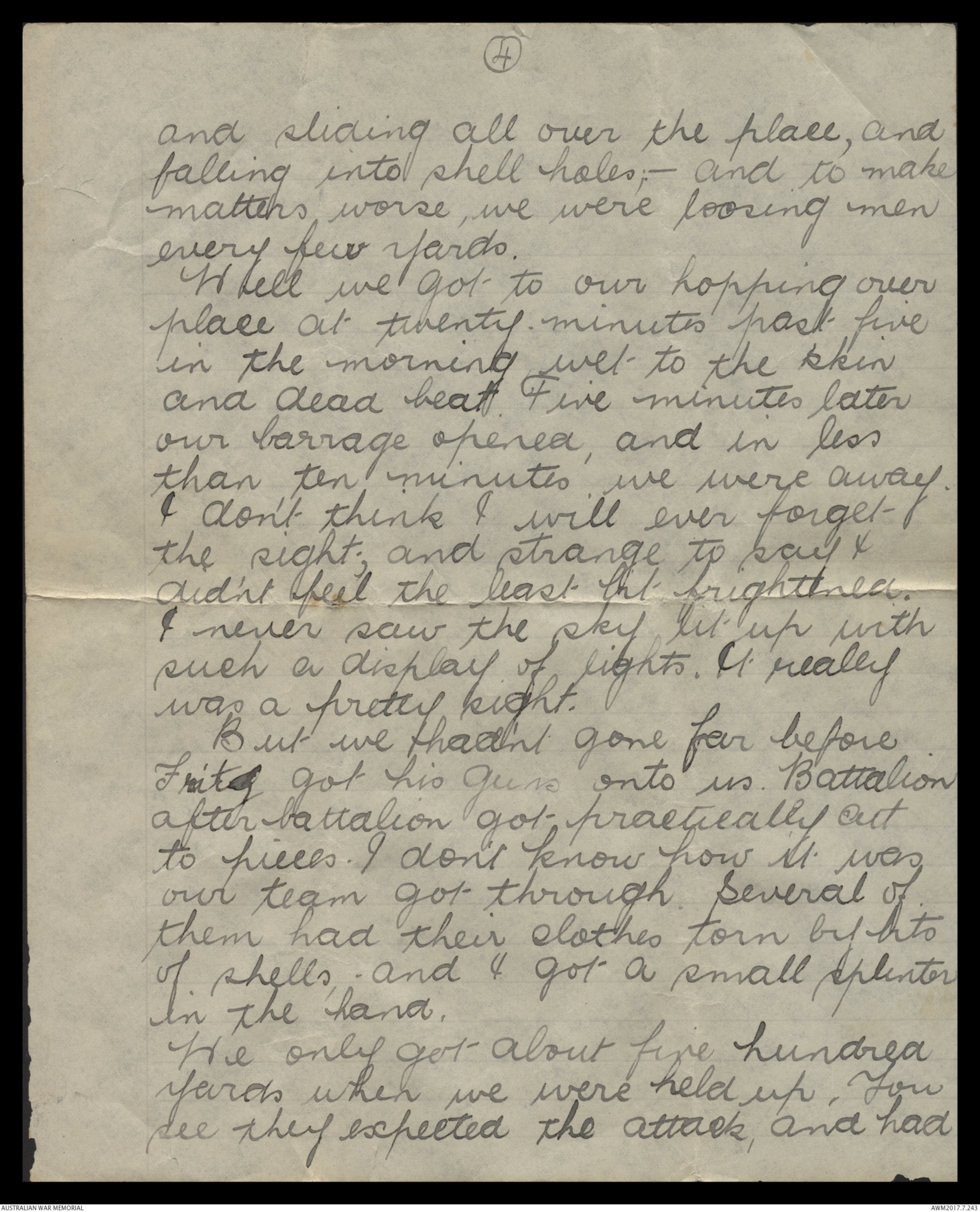
and sliding all over the place, and
falling into shell holes; - and to make
matters worse, we were loosing men
every few yards.
Well we got to our hopping over
place at twenty minutes past five
in the morning wet to the skin
and dead beat. Five minutes later
our barrage opened, and in less
than ten minutes we were away
I don't think I will ever forget
the sight, and strange to say I
didn't feel the least bit frightened.
I never saw the sky lit up with
such a display of lights. It really
was a pretty sight.
But we hadn't gone far before
Fritz got his guns onto us. Battalion
after battalion got practically cut
to pieces. I don't know how it was
our team got through. Several of
them had their clothes torn by bits
of shells and I got a small splinter
in the hand.
We only got about five hundred
yards when we were held up. You
see they expected the attack, and had
5
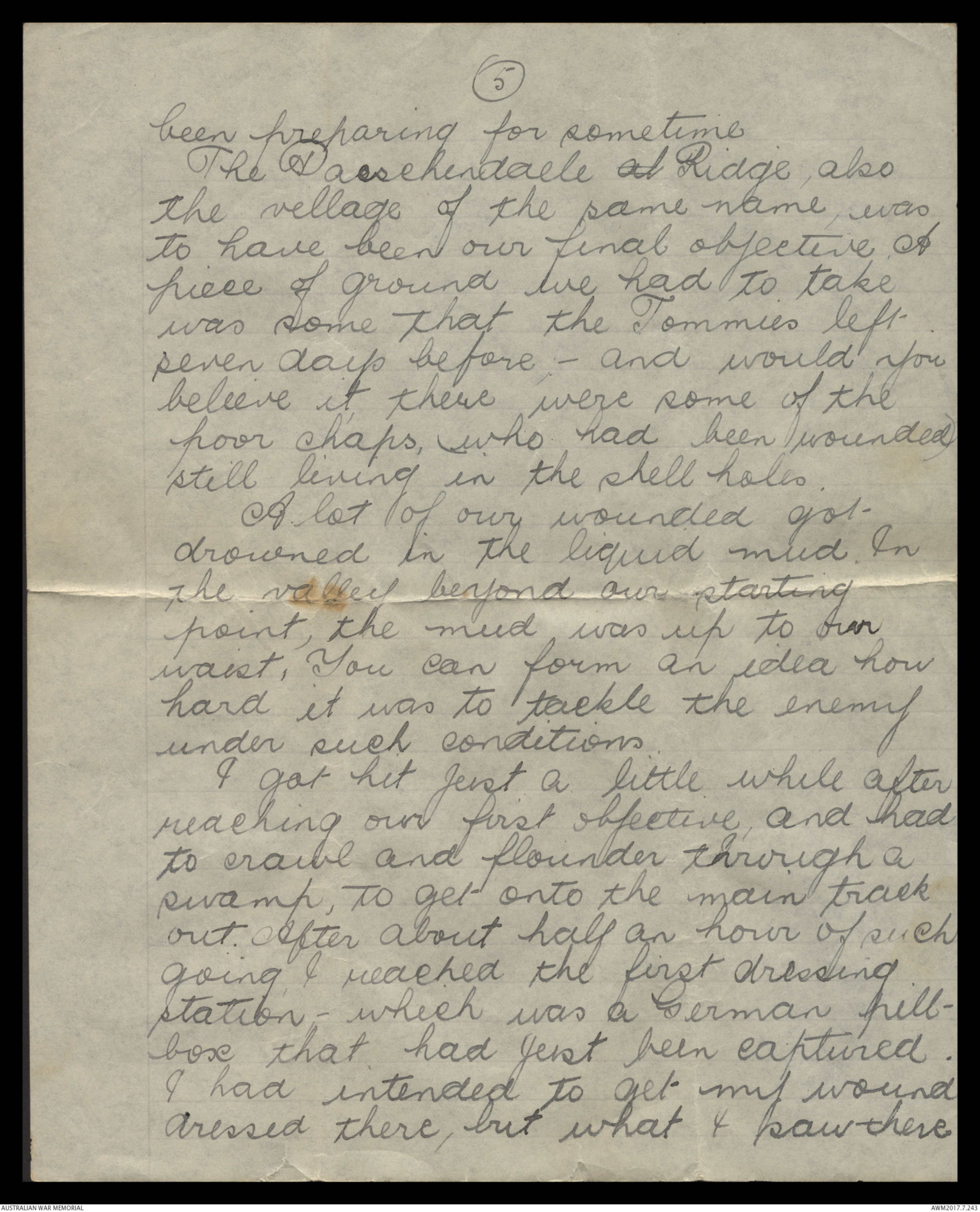
been preparing for sometime
The Passchendaele Ridge, also
the village of the same name, was
to have been our final objective. A
piece of ground we had to take
was some that the Tommies left
seven days before - and would you
believe it there were some of the
poor chaps, (who had been wounded)
still living in the shell holes.
A lot of our wounded got
drowned in the liquid mud. In
the valley beyond our starting
point, the mud was up to our
waist, You can form an idea how
hard it was to tackle the enemy
under such conditions.
I got hit just a little while after
reaching our first objective, and had
to crawl and flounder through a
swamp, to get onto the main track
out. After about half as hour of such
going, I reached the first dressing
station - which was a German hill
box that had been captured.
I had intended to get my wound
dressed there, but what I saw there
6
was the cause of me going on, as
there were stretchers lined up
outside, besides those inside waiting
their turn. You see it was an
advanced dressing station.
I hadn’t gone far before I came
across my Battalion, which was in
reserve sheltering in a railway
cutting.
I don't think I will ever forget
the sights I saw along there. Chaps
whom I had seen alive only a day
or so before were lying in little
groups, just as they were killed
by the shells - and all the way
down the road it got worse. This
was the Mennin Road.
I heard afterwards what was left
of our boy went up and helped
in an attack just after I came out.
I also heard poor Bob Pearce got
slightly wounded and when
coming out got killed by a shell.
I think I told you before about
having to make my way out
about five miles on to the fifth dressing
station. You just ought to
7
have seen the traffic on that
Mennin Rd. On one side there
were fresh troops coming up, on
the other a constant stream of
wounded going out. Nearly all
the stretchers were carried by
German prisoners, as our bearers
were about wiped out.
In the centre were guns being
brought up, and also an endesss
line of shell carriers. The German
guns were constantly hitting the
road, but instead of getting afraid
and mixed up the traffic still
went on. Sometimes a gun and its
team would get hit there would be
a bit of a halt until they shoved
the broken gun and the dead over
the side of the road, then everything
went on as before.
When I got about two miles from
the front lines, I came across the
guns which had been brought up
during the night. They had been
placed in position just off the road
and were blazing away
Farther down there were eight
8
inch guns also out in the open We
must have had thousands of guns
on that sector.
Well there is very little else I can
tell you about that part, - except
Ypres - which is only a heap of
ruins. There isn’t one building standing
in the whole of what was once a
beautiful town. The streets are still
kept in good order, and the cellars
are used for billeting troops. In some
places it is just like a town underground.
There are heaps of things I would
like to tell you, but a person never
knows when a letter may be opened.
One thing I will say though is that
our boys got cut to pieces in this last
affair. Battalion after Battalion, just
seemed to melt away before the
German guns. And I know for a
fact that our guns fired about ten
times as much as Fritz, so you
can form an idea of what it was
like.
I reached a dressing station about
2. 0.clock on the Saturday afternoon
9
about fifteen miles from the line, and
had my bit of a scratch seen to for
the first time. By word it was
lovely to get a nice hot drink of
tea again and everyone was so
good to us.
At every place we stopped we got
a drink of hot tea and a bag of
biscuits. On the train it was the
same, (on which we travelled all
the next day and part of the night.)
About midnight we landed at
Abbeville a small town on the lower
part of the Somme. I was there for a
couple of weeks and then took the
train again for Darve, - which we
reached after travelling all night.
We got on the boat at 9- 0-clock
next morning and moved out into
the bay, where we stopped until
dark that night.
When I woke up next morning
we were off Southampton. Everyone
was quite pleased, and even the seriously
wounded were quite cheerful.
I know at one time I never expected
10
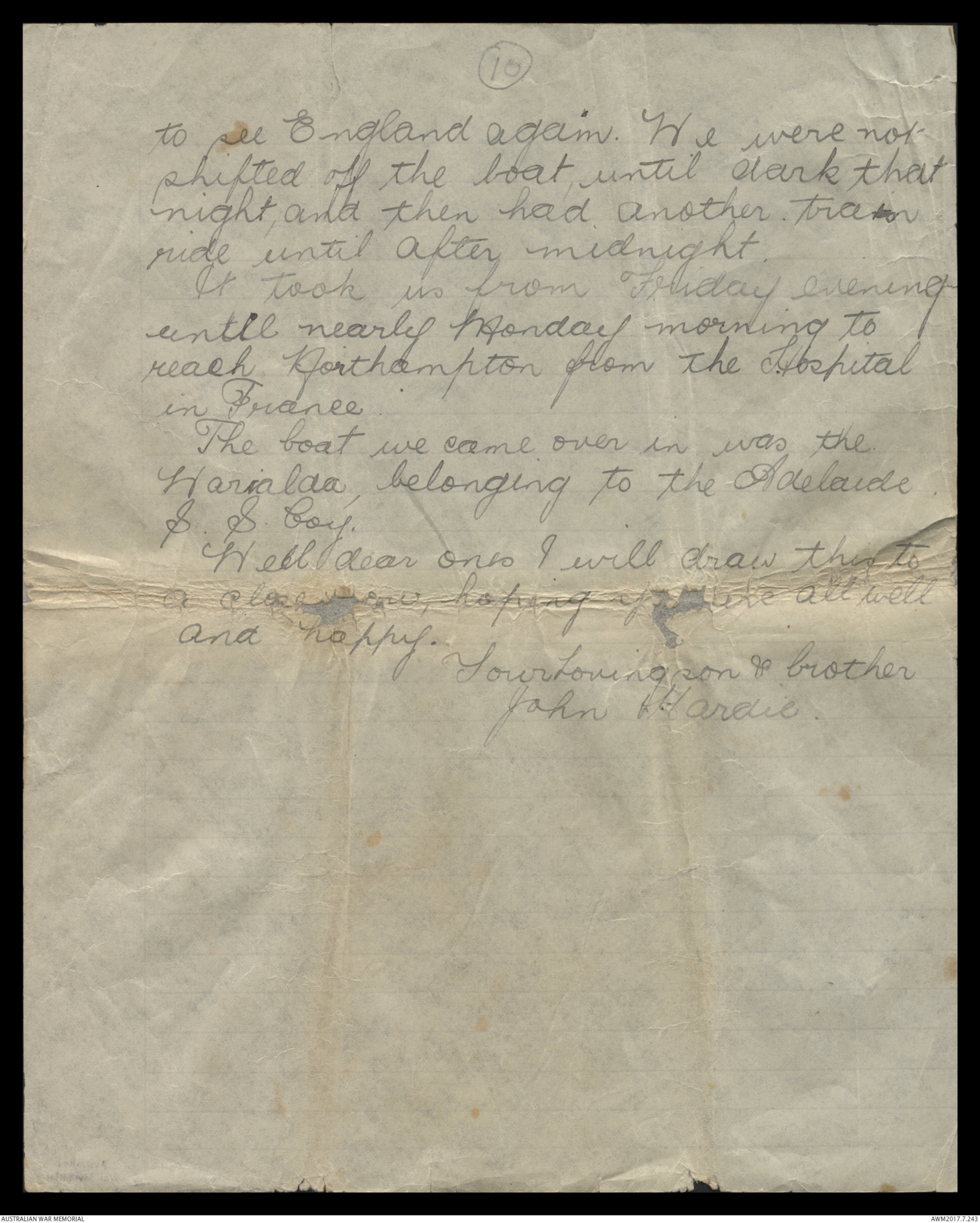
to see England again. We were not
shifted off the boat, until dark that
night, and then had another train
ride until after midnight
It took us from Friday evening
until nearly Monday morning to
reach Northampton from the Hospital
in France.
The boat we came over in was the
Warialda, belonging to the Adelaide
S.S. Coy.
Well I dear ones I will draw this to
a close now, hoping [??] all well
and happy.
Your loving son & brother
John Hardie
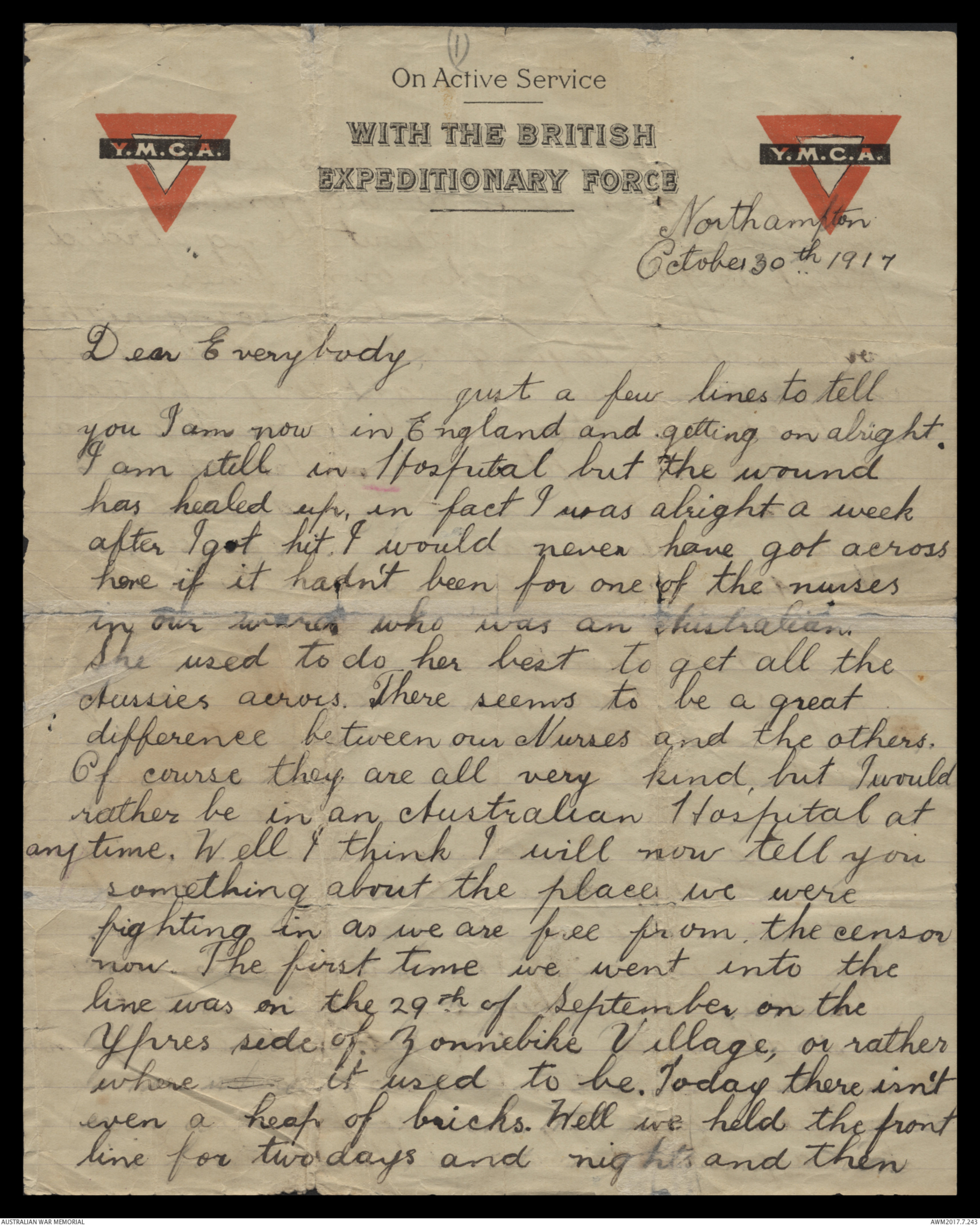
(1)
Northampton
October 30th 1917
Dear Everybody
Just a few lines to tell
you I am now in England and getting on alright.
I am still in Hospital but the wound
has healed up, in fact I was alright a week
after I got hit. I would never have got across
here if it hadn't been for one of the nurses
in our ward who was an Australian.
She used to do her best to get all the
Aussies across. There seems to be a great
difference between our Nurses and the others.
Of course they are all very kind, but I would
rather be in an Australian Hospital at
anytime. Well I think I will now tell you
something about the place we were
fighting in as we are free from the censor
now. The first time we went into the
line was on the 29th of September on the
Ypres side of Zonnebeke Village, or rather
were it used to be. Today there isn’t
even a heap of bricks. Well we held the from
line for two days and nights and then
 Sandy Mudie
This transcription item is now locked to you for editing. To release the lock either Save your changes or Cancel.
This lock will be automatically released after 60 minutes of inactivity.