
Letters from John Hardie to his family, 1917-1918 - Part 1
1
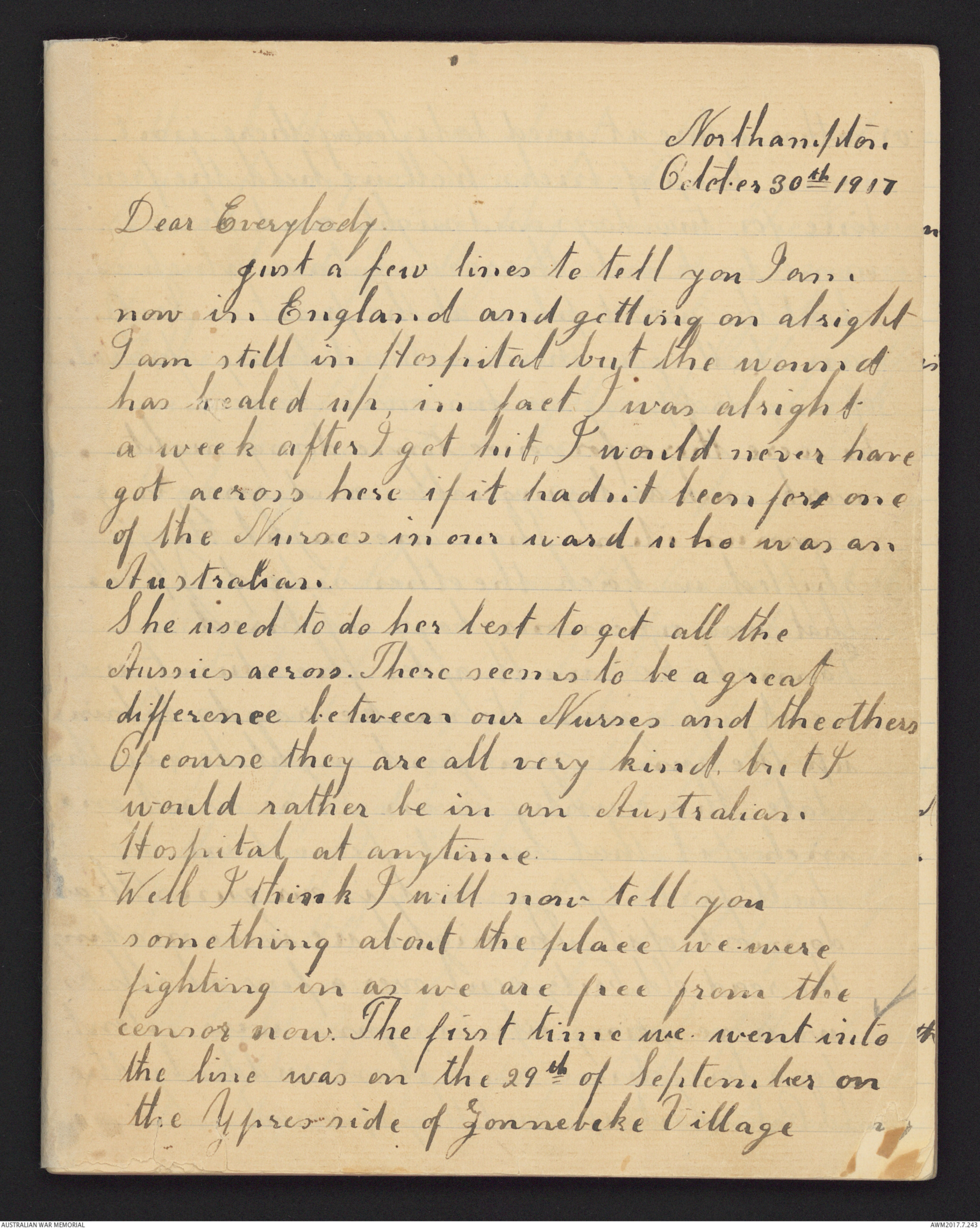
Northampton.
October 30th 1917
Dear Everybody.
Just a few lines to tell you I am
now in England and getting on alright
I am still in Hospital but the wound
has healed up in fact I was alright
a week after I got hit, I would never have
got across here if it hadn't been fore one
of the Nurses in our ward who was an
Australian.
She used to do her best to get all the
Aussies across. There seems to be a great
difference between our Nurses and the others
Of course they are all very kind but I
would rather be in an Australian
Hospital at anytime.
Well I think I will now tell you
something about the place we were
fighting in as we are free from the
censor now. The first time we went into
the line was on the 29th of September on
the Ypres side of Zonnebeke Village
2
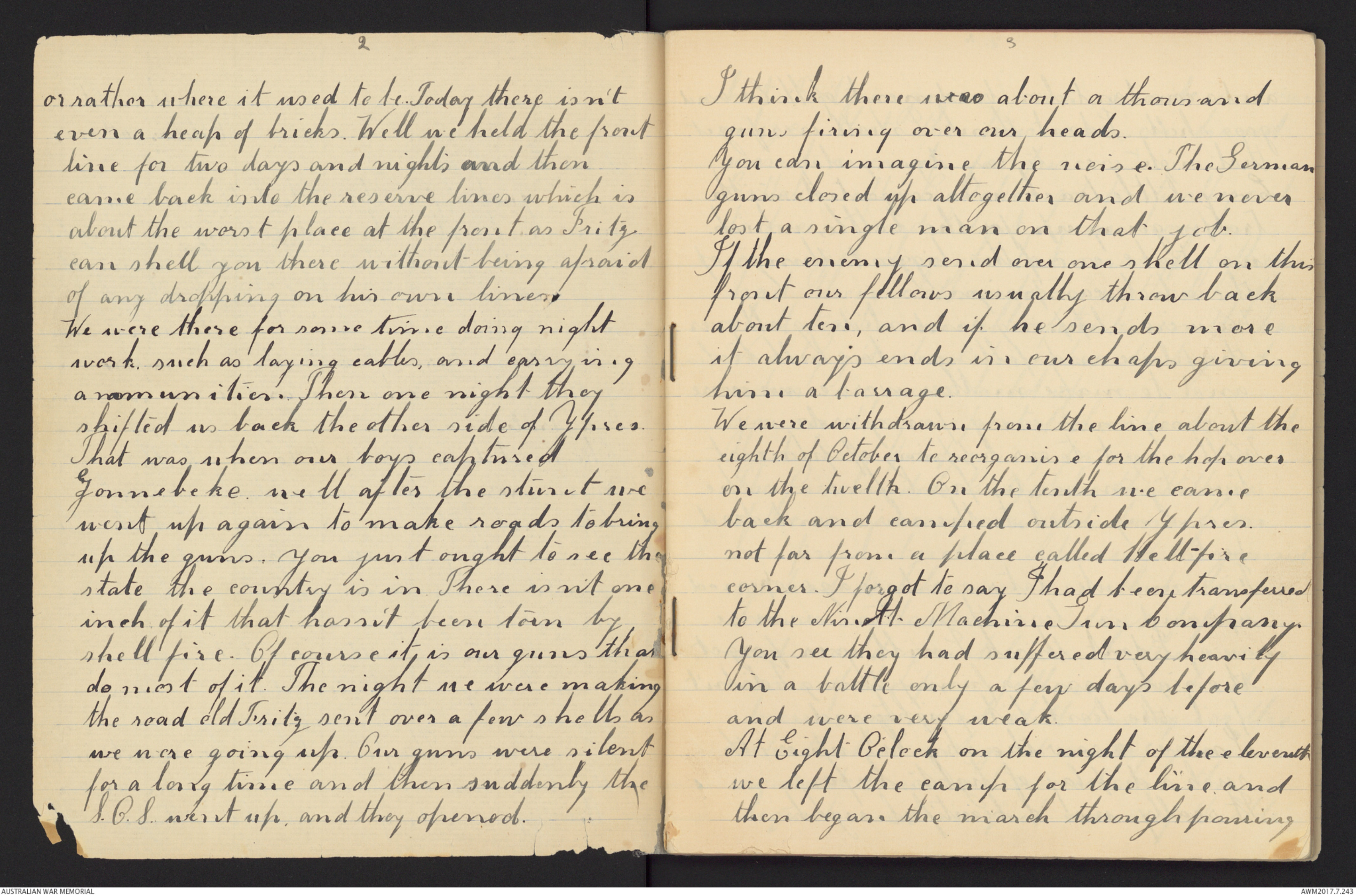
or rather where it used to be. Today there isn't
even a heap of bricks. Well we held the front
line for two days and nights and then
came back into the reserve lines which is
about the worst place at the front as Fritz
can shell you there without being afraid
of any dropping on his own lines.
We were there for some time doing night
work such as laying cables, and carrying
ammunition. Then one night they
shifted us back the other side of Ypres.
That was when our boys captured
Zonnebeke well after the stunt we
went up again to make roads to bring
up the guns. You just ought to see the
state the country is in There isn't one
inch of it that hasn't been torn by
shell fire. Of course it is our guns that
do most of it. The night we were making
the road old Fritz sent over a few shells as
we were going up. Our guns were silent
for a long time and then suddenly the
S.O.S. went up and they opened.
3
I think there was about a thousand
guns firing over our heads.
You can imagine the noise. The German
guns closed up altogether and we never
lost a single man on that job.
If the enemy send over one shell on their
front our fellows usually throw back
about ten, and if he sends more
it always ends in our chaps giving
him a barrage.
We were withdrawn from the line about the
eighth of October to reorganise for the hop over
on the twelth. On the tenth we came
back and camped outside Ypres
not far from a place called Hell-fire
corner. I forgot to say I had been transferred
to the Ninth Machine Gun Company.
You see they had suffered very heavily
in a battle only a few days before
and were very weak.
At Eight O'clock on the night of the eleventh
we left the camp for the line and
then began the march through pouring
4
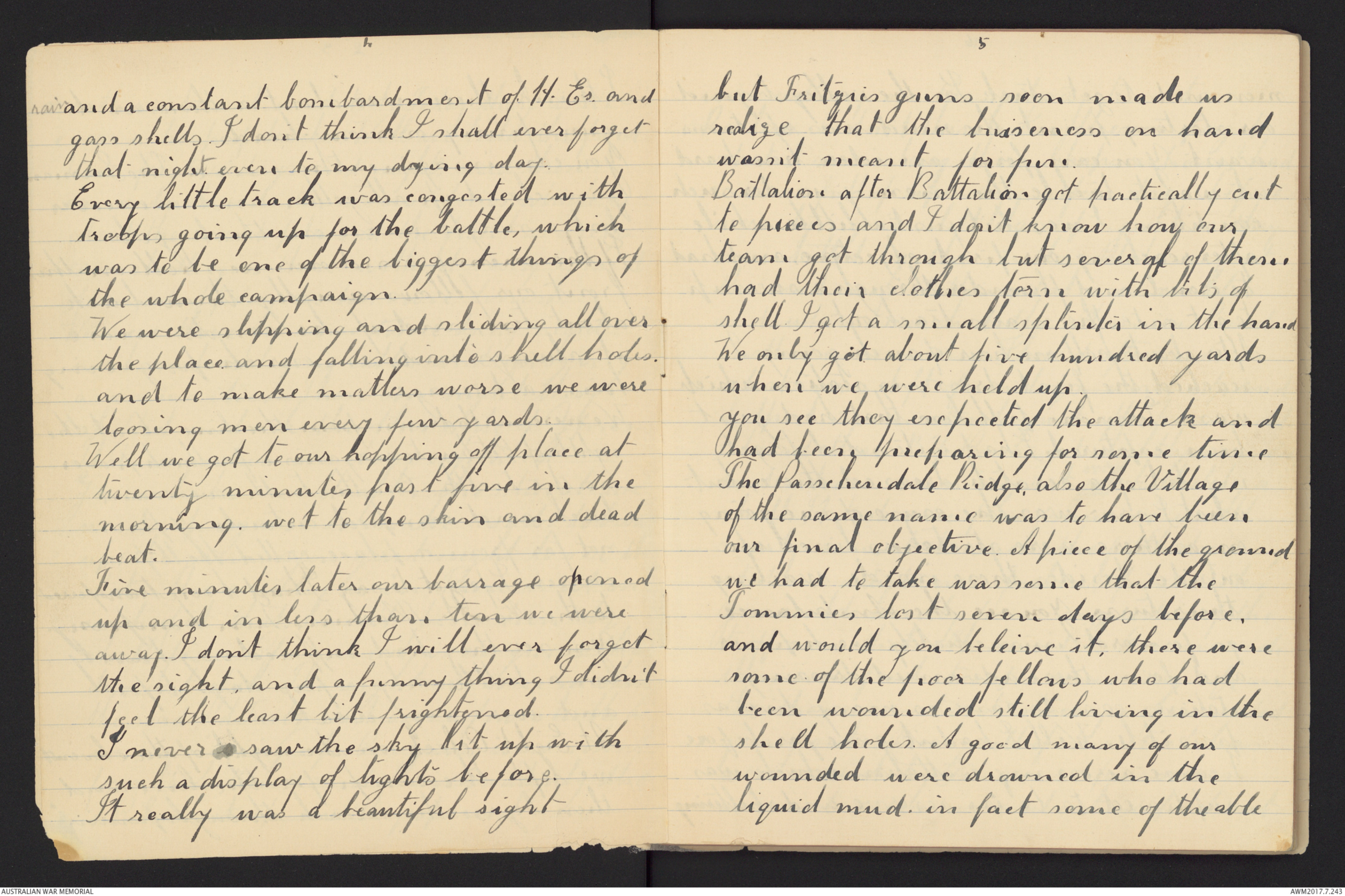
and a constant bombardment of H.E's and
gass shells. I don't think I shall ever forget
that night ever to my dying day.
Every little track was congested with
troops going up for the battle, which
was to be one of the biggest things of
the whole campaign.
We were slipping and sliding all over
the place and falling into shell holes
and to make matters worse we were
loosing men every few yards.
Well we got to our hopping off place at
twenty minutes past five in the
morning wet to the skin and dead
beat.
Five minutes later our barrage opened
up and in less than ten we were
away. I don't think I will ever forget
the sight, and a funny thing I didn't
feel the least bit frightened.
I never saw the sky lit up with
such a display of lights before.
It really was a beautiful sight
5
but Fritzies guns soon made us
realize that the business on hand
wasn't meant for fun.
Battalion after Battalion got practically cut
to pieces and I don't know how our
team got through but several of them
had their clothes torn with bits of
shell. I got a small splinter in the hand.
We only got about five hundred yards
where we were held up.
You see they expected the attack and
had been preparing for some time
The Passchendaele Ridge, also the Village
of the same name was to have been
our final objective. A piece of the ground
we had to take was some that the
Tommies lost seven days before,
and would you believe it, there were
some of the poor fellows who had
been wounded still living in the
shell holes. A good many of our
wounded were drowned in the
liquid mud, in fact some of the able
6
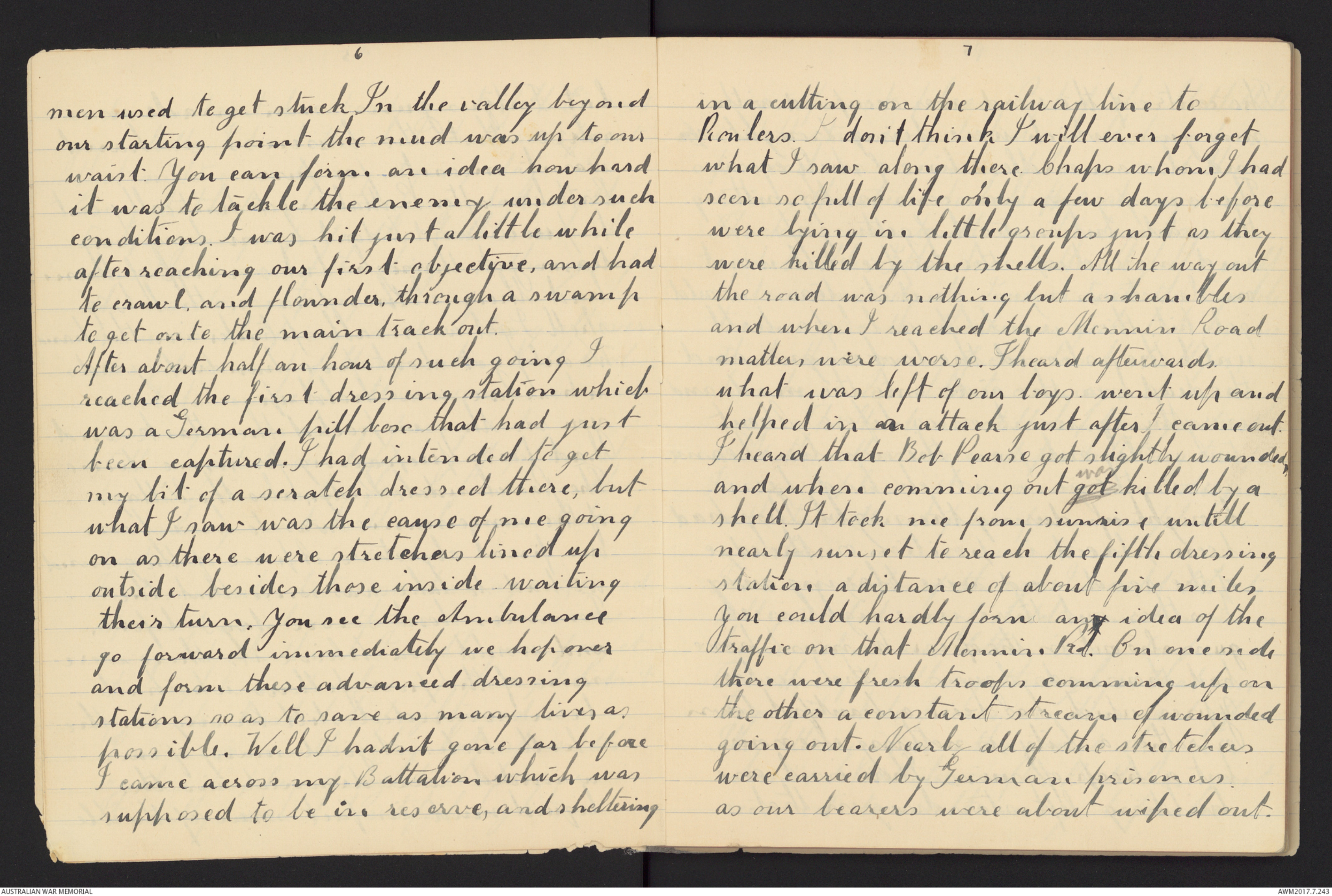
men used to get stuck. In the valley beyond
our starting point the mud was up to our
waist. You can form an idea how hard
it was to tackle the enemy under such
conditions. I was hit just a little while
after reaching our first objective, and had
to crawl and flounder, through a swamp
to get onto the main track out.
After about half an hour of such going I
reached the first dressing station which
was a German pill box that had just
been captured. I had intended to get
my bit of a scratch dressed there, but
what I saw was the cause of me going
on as there were stretchers lined up
outside besides those inside waiting
their turn, you see the Ambulance
go forward immediately we hop over
and form these advanced dressing
stations so as to save as many lives as
possible. Well I hadn't gone far before
I came across my Battalion which was
supposed to be in reserve, and sheltering
7
in a cutting on the railway line to
Roulers. I don't think I will ever forget
what I saw along there Chaps whom I had
seen so full of life only a few days before
were lying in little groups just as they
were killed by the shells. All the way out
the road was nothing but a shambles
and when I reached the Mennin Road
matters were worse. I heard afterwards
what was left of our boys went up and
helped in an attack just after I came out.
I heard that Bob Pearse got slightly wounded,
and when coming out got was killed by a
shell. It took me from sunrise untill
nearly sunset to reach the fifth dressing
station a distance of about five miles
you could hardly form any idea of the
traffic on that Mennin Rd. On one side
there were fresh troops coming up on
the other a constant stream of wounded
going out. Nearly all of the stretchers
were carried by German prisoners.
as our bearers were about wiped out.
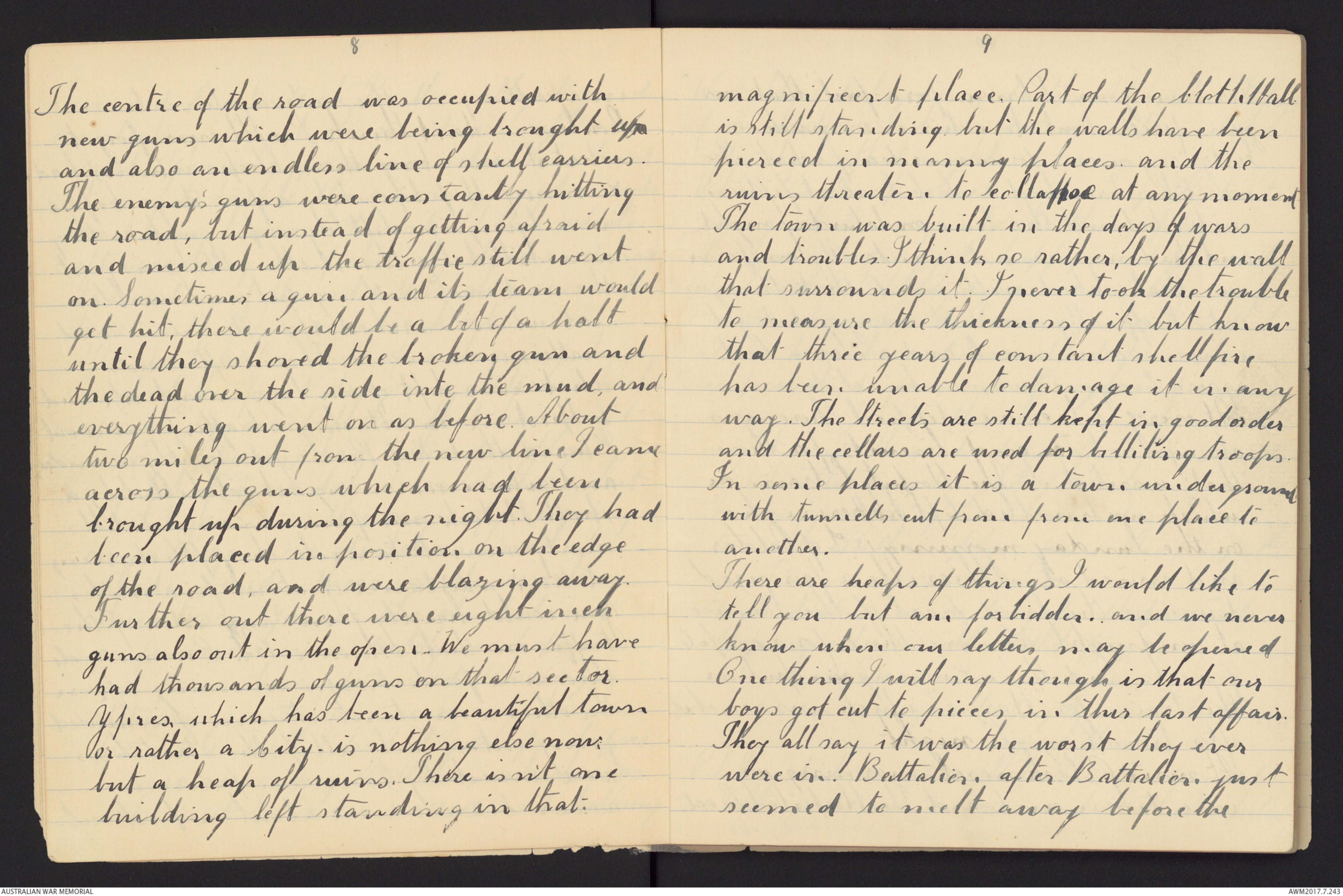
8
The centre of the road was occupied with
new guns which were being brought up
and also an endless line of shell carriers.
The enemy's guns were constantly hitting
the road, but instead of getting afraid
and mixed up the traffic still went
on. Sometimes a gun and its team would
get hit, there would be a bit of a halt
until they shoved the broken gun and
the dead over the side into the mud, and
everything went on as before. About
two miles out from the new line I came
across the guns which had been
brought up during the night. They had
been placed in position on the edge
of the road, and were blazing away.
Further out there were eight inch
guns also out in the open. We must have
had thousands of guns on that sector.
Ypres which has been a beautiful town
or rather a City is nothing else now,
but a heap of ruins. There ins't one
building left standing in that
9
magnificent place. Part of the [[?]] Hall
is still standing but the walls have been
pierced in manny places and the
ruins threaten to collapse at any moment.
The town was built in the days of wars
and troubles. I think so rather, by the wall
that surrounds it. I never took the trouble
to measure the thickness of it but know
that three years of constant shell fire
has been unable to damage it in any
way. The streets are still kept in good order
and the cellars are used for billiting troops.
In some places it is a town underground
with tunnells cut from one place to
another.
There are heaps of things I would like to
tell you but am forbidden and we never
know when our letters may be opened
One thing I will say though is that our
boys got cut to pieces, in this last affair.
They all say it was the worst they ever
were in. Battalion after Battalion just
seemed to melt away before the
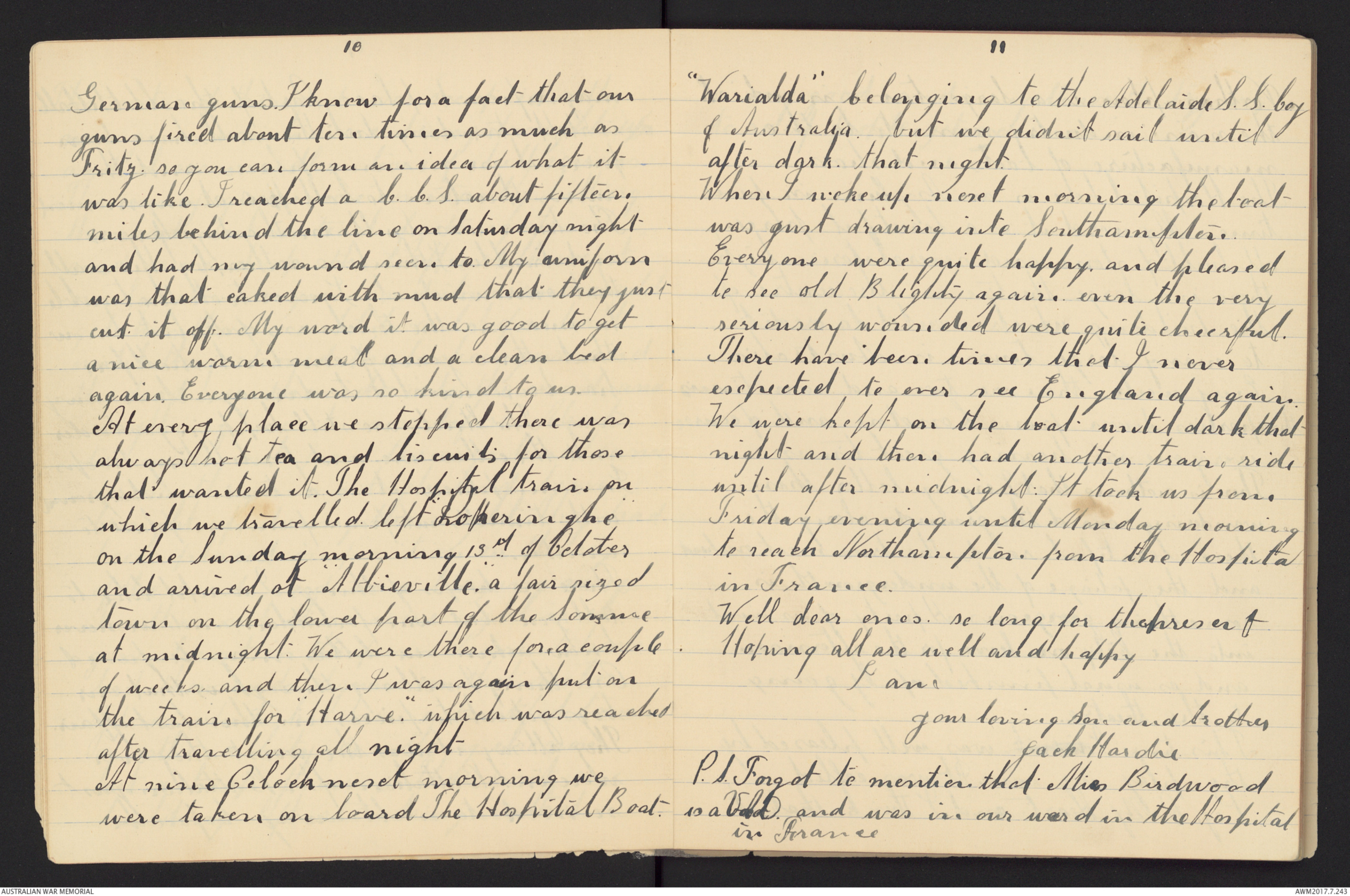
10
German guns. I know for a fact that our
guns fired about ten times as much as
Fritz, so you can form an idea of what it
was like. I reached a C.C.S. about fifteen
miles behind the line on Saturday night
and had my wound seen to. My uniform
was that caked with mud that they just
cut it off. My word it was good to get
a nice warm meal and a clean bed
again. Everyone was so kind to us.
At every place we stopped there was
always hot tea and biscuits for those
that wanted it. The Hospital train on
which we travelled left Poperinge
on the Sunday morning 13th of October
and arrived at Abbeville a fair sized
town on the lower part of the Somme
at midnight. We were there for a couple
of weeks and there I was again put on
the train for "Harve" which was reached
after travelling all night.
At nine o'clock next morning we
were taken on board The Hospital Boat.
11
"Warialda" belonging to the Adelaide S.S. Coy
of Australia, but we didn't sail until
after dark that night.
When I woke up next morning the boat
was just drawing into Southampton.
Everyone were quite happy and pleased
to see old Blighty again even the very
seriously wounded were quite cheerful.
There have been times that I never
expected to ever see England again.
We were kept on the boat until dark that
night and then had another train ride
until after midnight. It took us from
Friday evening until Monday morning
to reach Northampton from the Hospital
in France.
Well dear ones so long for the present
Hoping all are well and happy
I am
your loving Son and brother
Jack Hardie
P.S. Forgot to mention that Mrs Birdwood
is a [[?]] and was in our ward in the Hospital
in France.
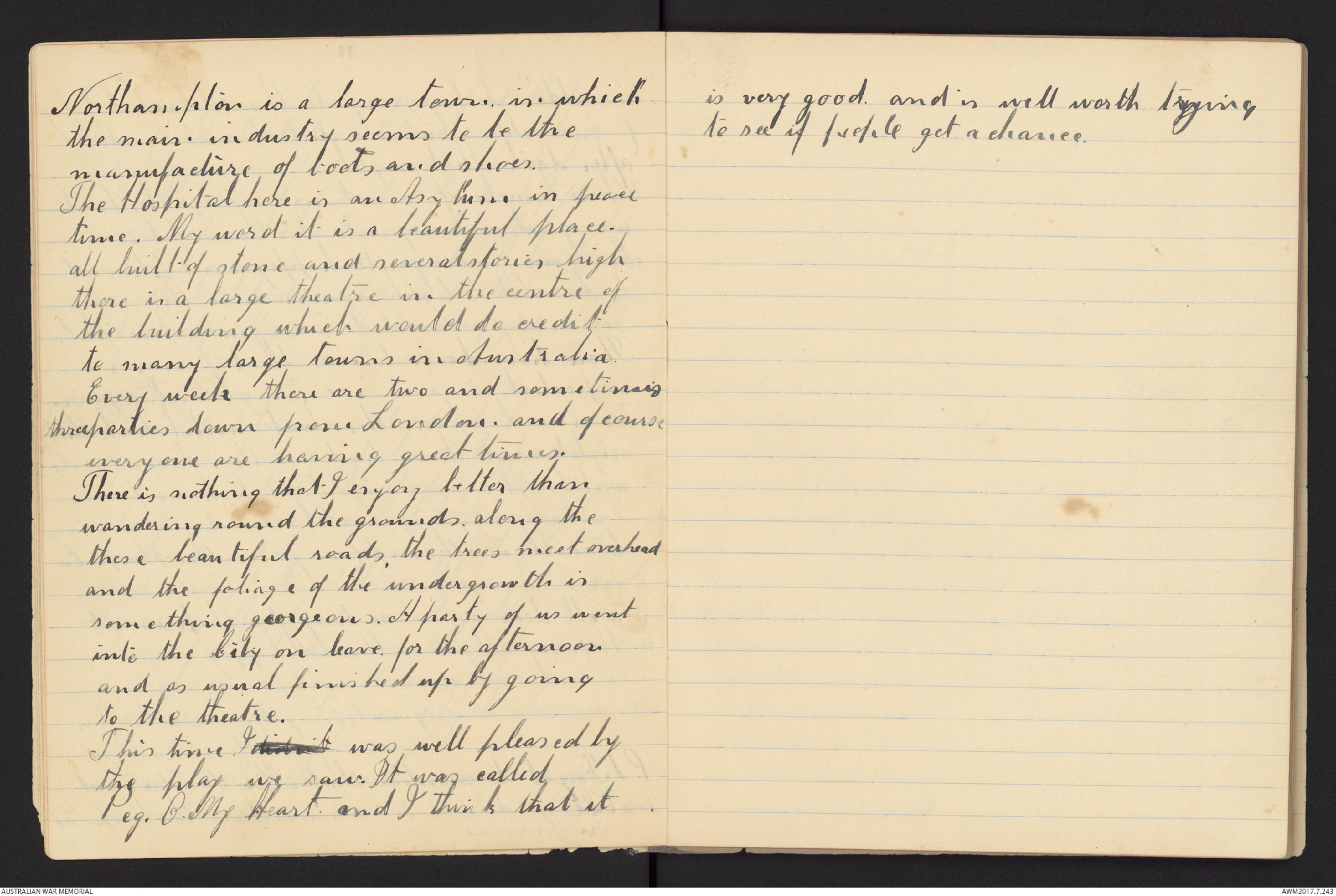
Northampton is a large town in which
the main industry seems to be the
manufacture of boots and shoes.
The Hospital here is an Asylum in peace
time. My word it is a beautiful place.
all built of stone and several stories high
there is a large theatre in the centre of
the building which would do credit
to many large towns in Australia.
Every week there are two and sometimes
three parties down from London and of course
everyone are having great times.
There is nothing that I enjoy better than
wandering round the grounds along the
these beautiful roads, the trees meet overhead
and the foliage of the undergrowth is
something gorgeous. A party of us went
into the City on leave for the afternoon
and as usual finished up by going
to the theatre.
This time I didn't was well pleased by
the play we saw. It was called
Peg.O.My Heart. and I think that it
is very good and is well worth trying
to see if people get a chance.
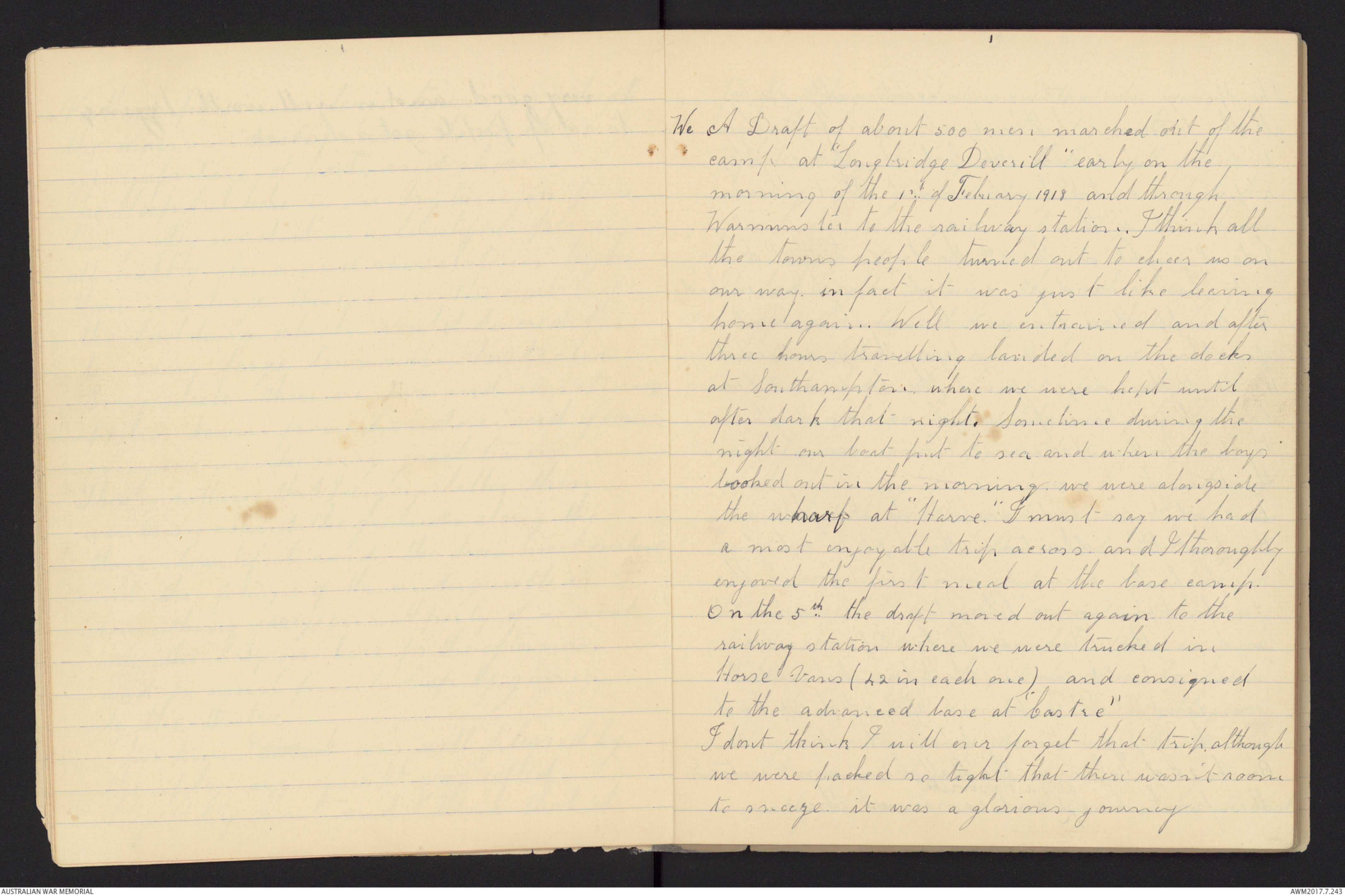
We A Draft of about 500 men marched out of the
camp at "Longbridge Doverill "early on the
morning of the 1st of February 1918 and through
Warmunster to the railway station. I think all
the towns people turned out to cheer us on
our way in fact it was just like leaving
home again. Well we entrained and after
three hours travelling landed on the docks
at Southampton where we were kept until
after dusk that night. Sometime during the
night our boat put to sea and when the boys
looked out in the morning we were alongside
the wharf at "Havre". I must say we had
a most enjoyable trip across and I thoroughly
enjoyed the first meal at the base camp.
On the 5th the draft moved out again to the
railway station where we were trucked in.
Horse Vans (42 in each one) and consigned
to the advanced base at "Castre".
I don't think I will ever forget that trip although
we were packed so tight that there wasn't room
to snooze. it was a glorious journey.
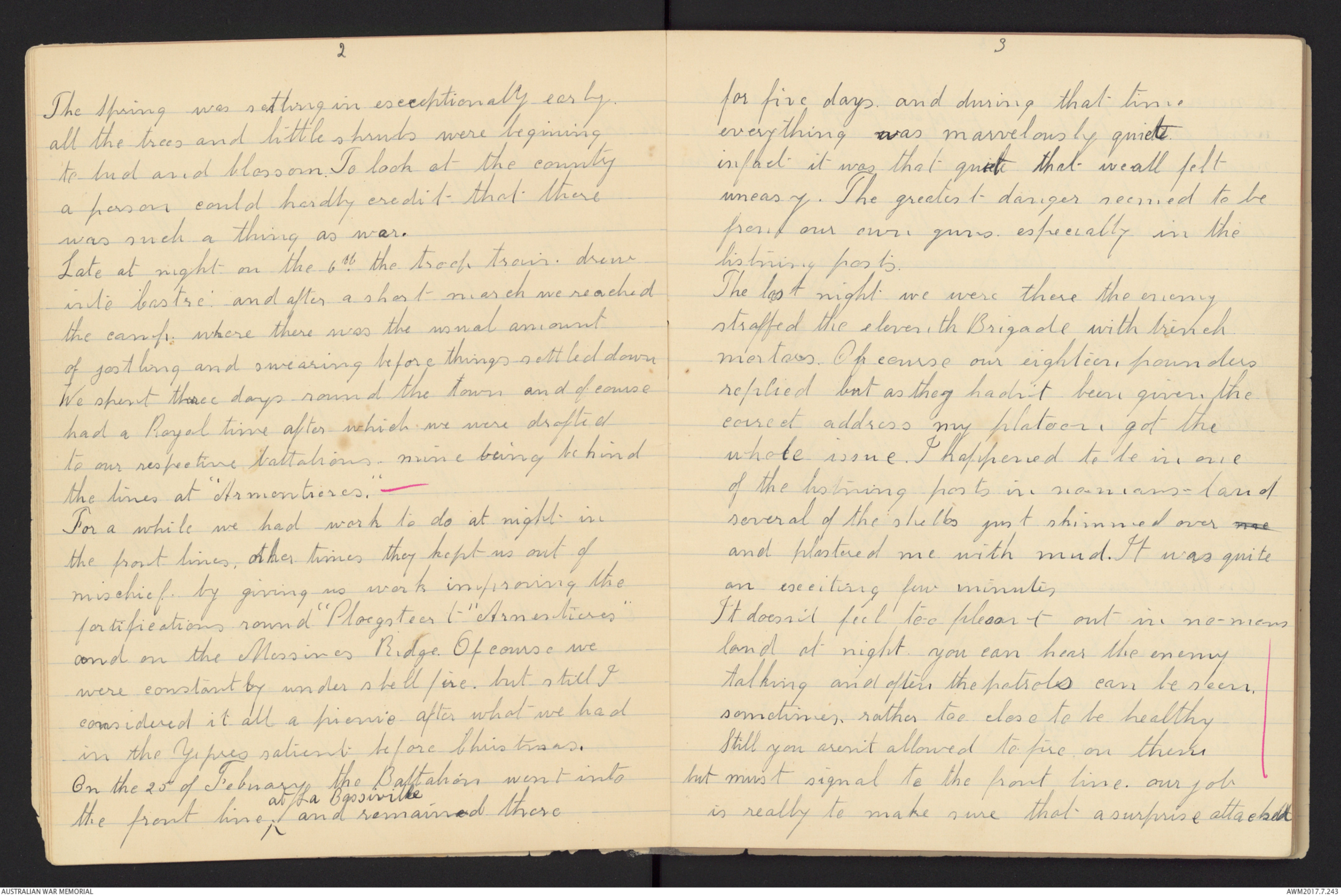
2
The Spring was setting in exceptionally early
all the trees and little shrubs were beginning
to bud and blossom. To look at the country
a person could hardly credit that there
was such a thing as war.
Late at night on the 6th the troop train drew
into 'Castre' and after a short march we reached
the camp where there was the usual amount
of jostling and swearing before things settled down.
We spent three days round the town and of course
had a Royal time after which we were drafted
to our respective battalions. mine being behind
the lines at "Armientieres".
For a while we had work to do at night in
the front lines, other times they kept us out of
mischief by giving us work improving the
fortifications round "Ploegsteert” Armientieres"
and on the Messines Ridge. Of course we
were constantly under shell fire, but still I
considered it all a picnic after what we had
in the Ypres salient before Christmas.
On the 25th of February the Battalion went into
the front line ^at La Bassiville and remained there
3
for five days and during that time
everything was marvelously quiet,
in fact it was that quiet that we all felt
uneasy. The greatest danger seemed to be
from our own guns especially in the
listening posts.
The last night we were there the enemy
straffed the eleventh Brigade with trench
mortars. Of course our eighteen pounders
replied but as they hadn't been given the
correct address my platoon got the
whole issue. I happened to be in one
of the listening posts in no-mans-land
several of the shells just skimmed over me
and plastered me with mud. It was quite
an exciting few minutes.
It doesn't feel too pleasant out in no-mans
land at night you can hear the enemy
talking and often the patrols can be seen.
sometimes rather too close to be healthy
Still you aren't allowed to fire on them
but must signal to the front line. our job
is really to make sure that a surprise attack
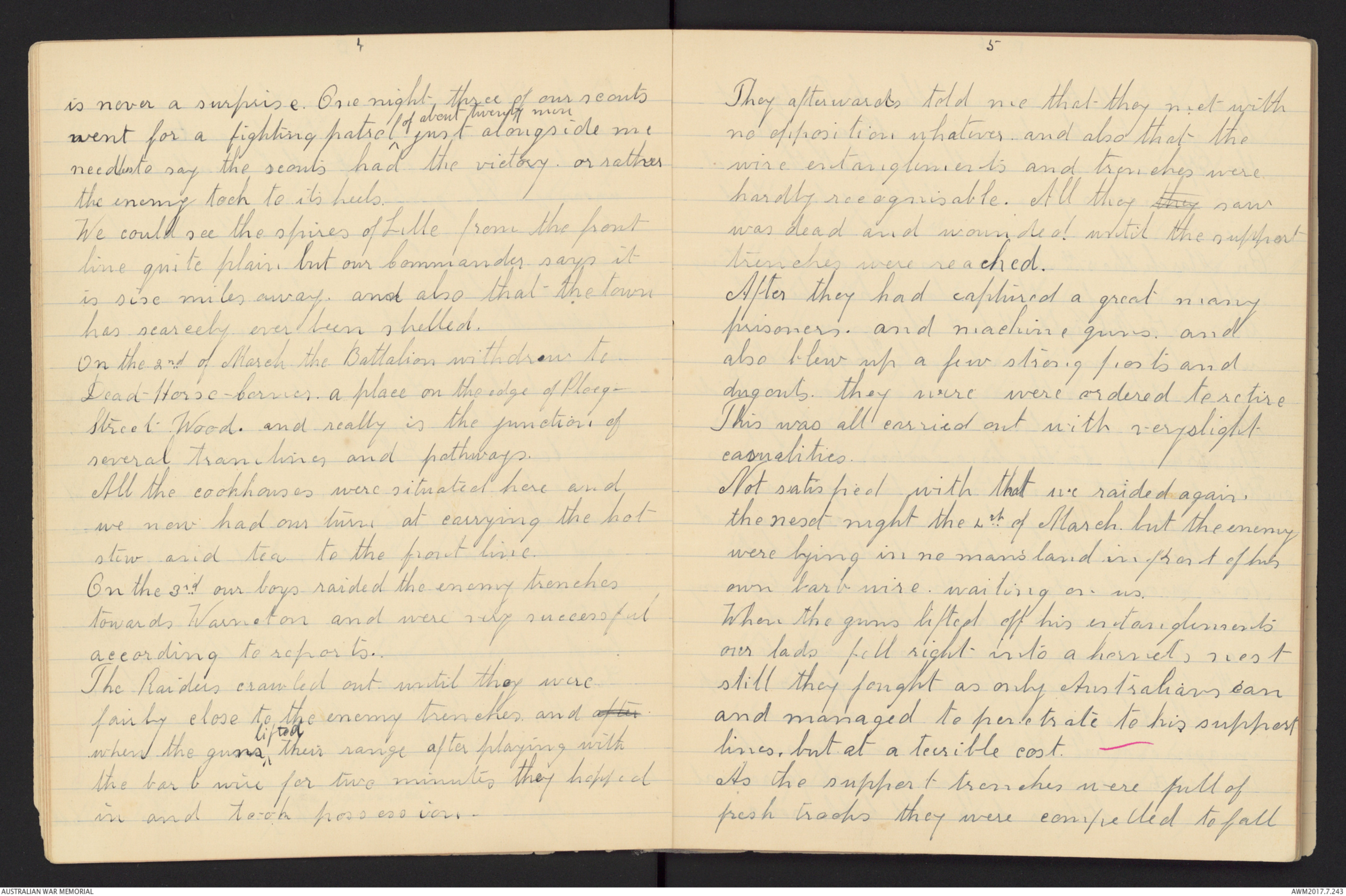
4
is never a surprise. One night three of our scouts
went for a fighting patrol ^of about twenty men just alongside me
needless to say the scouts had the victory or rather
the enemy took to its heels.
We could see the spires of Lille from the front
line quite plain, but our Commander says it
is six miles away. and also that the town
has scarcely ever been shelled.
On the 2nd of March the Battalion withdrew to
Dead-Horse-Corner. a place on the edge of Ploeg-
Street Wood. and really is the junction of
several tran lines and pathways.
All the cook houses were situated here and
we now had our turn at carrying the hot
stew and tea to the front line.
On the 3rd our boys raided the enemy trenches
towards Warneton and were very successful
according to reports.
The Raiders crawled out until they were
fairly close to the enemy trenches and after
when the guns ^lifted their range after playing with
the barb wire for two minutes they hopped
in and took possession.
5
They afterwards told me that they met with
no opposition whatever and also that they
wire entanglements and trenches were
hardly recognisable. All they they saw
was dead and wounded until the support
trenches were reached.
After they had captured a great many
prisoners and machine guns and
also blew up a few strong posts and
dugouts they were were ordered to retire.
This was all carried out with very slight
casualties.
Not satisfied with that we raided again
the next night the 1st of March but the enemy
were lying in no man's land in front of his
own barb wire waiting on us.
When the guns lifted off his entanglements
our lads fell right into a hornet nest
still they fought as only Australians can
and managed to penetrate to his support
lines, but at a terrible cost.
As the sapper & trenches were full of
fresh troops they were compelled to fall
 Sandy Mudie
This transcription item is now locked to you for editing. To release the lock either Save your changes or Cancel.
This lock will be automatically released after 60 minutes of inactivity.