
Photostat copy of letters from Percy Wellesley Chapman to his mother, 5 April 1915 to 1 February 1917 - Part 2
(6)
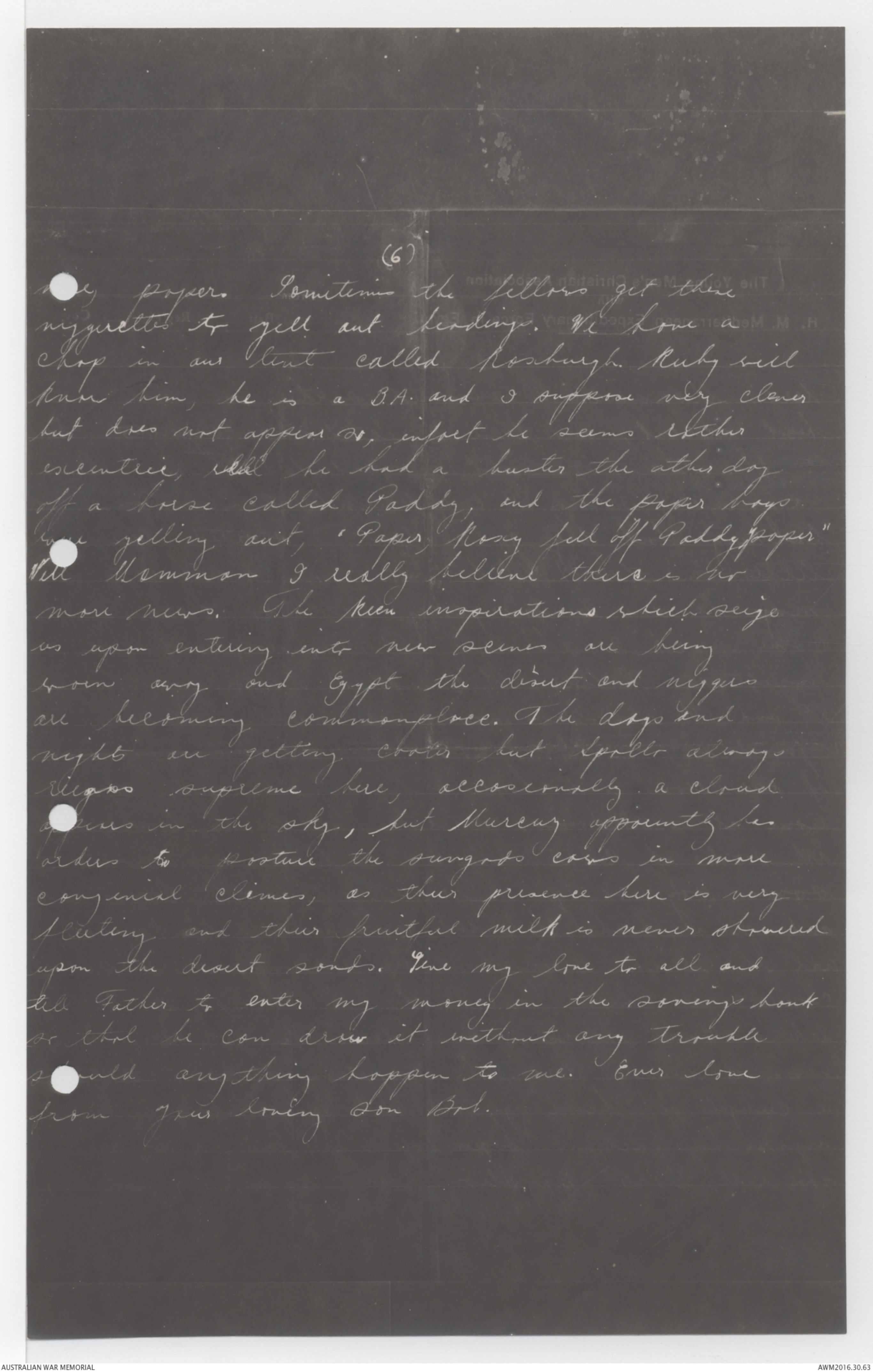
[[?]] paper. Sometimes the fellows get these
niggerettes to yell out headings. We have a
chap in our tent called Roxburgh. Ruby will
know him, he is a B.A. and I suppose very clever
but does not appear so, in fact he seems rather
excentric, well he had a buster the other day
off a horse called Paddy, and the paper boys
were yelling out "Paper, Roxy fell off Paddy paper"
Well Mamman, I really believe there is no
more news. The keen inspirations which seize
us upon entering into new scenes are being
worn away and Egypt the desert and niggers
all becoming commonplace. The days and
nights are getting cooler but Spreer always
riegns supreme here, occasionally a cloud
appears in the sky, but Murcury apparently has
orders to posture the sungods cares in more
congenial climes, as their presence here is very
fleeting and their fruitful milk is never showered
upon the desert sands. Give my love to all and
tell Father to enter my money in the savings bank
so that he can draw it without any trouble
should anything happen to me. Ever love
from your loving son Bob.
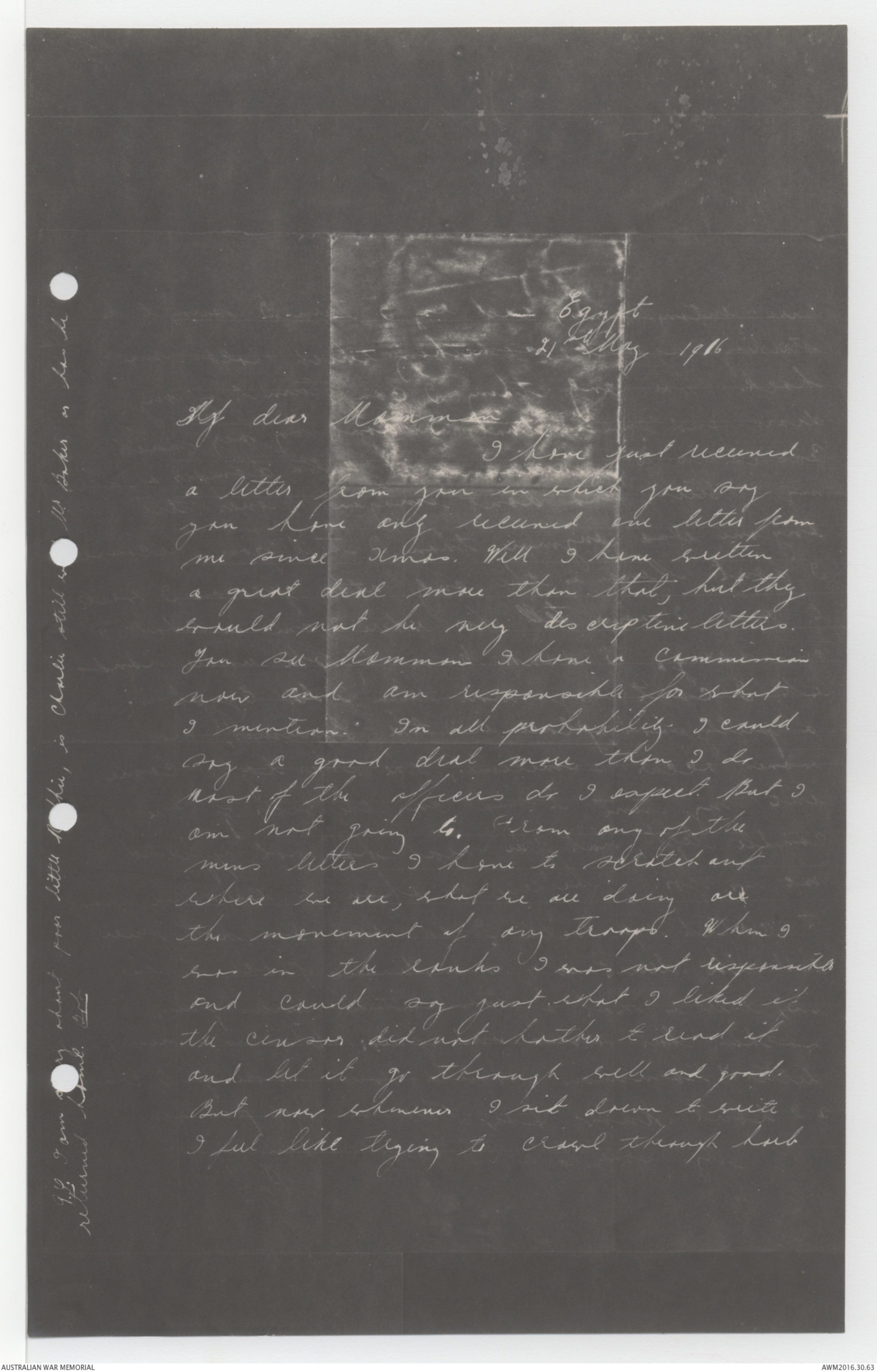
Egypt
21st May 1916
My dear Mamman,
I have just received
a letter from you in which you say
you have only received one letter from
me since Xmas. Well I have written
a great deal more than that, but they
would not be very descriptive letters.
You see Mamman I have a Commission
now and am responsible for what
I mention. In all probability I could
say a good deal more than I do
most of the officers do I expect. But I
am not going to. From any of the
mens letters I have to scratch out
where we are, what were all doing or
the movement of any troops. When I
was in the ranks I was not responsible
and could say just what I liked if
the censor did not bother to read it
and let it go through well and good.
But now whenever I sit down to write
I feel like trying to crawl through barb
[*P.S. I am sorry about poor little Robbie, is
Charlie still with Mr Baker or has he
returned home. Bob*]
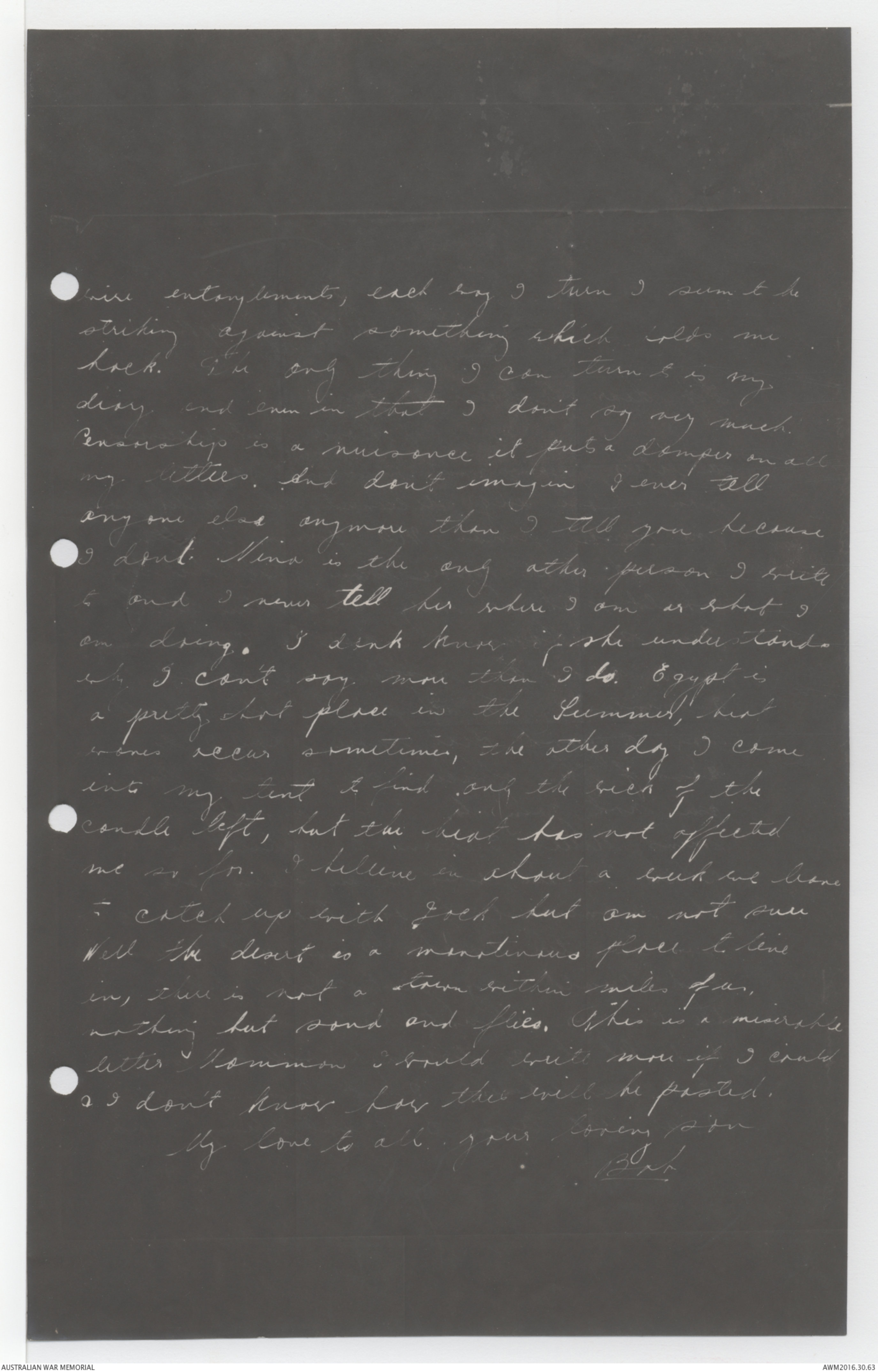
wire entanglements, each way I turn I seem to be
striking against something which holds me
back. The only thing I can turn to is my
diary and even in that I don't say very much.
Censorship is a nuisance, it puts a damper on all
my letters. And don't imagine I ever tell
anyone else anymore than I tell you because
I dont. Nina is the only other person I write
to and I never tell her where I am or what I
am doing. I don't know if she understands
why I can't say more than I do. Egypt is
a pretty hot place in the Summer, heat
waves occur sometimes, the other day I came
into my tent to find only the wick of the
candle left, but the heat has not affected
me so far. I believe in about a week we leave
to catch up with Jock but am not sure
Well the desert is a monotonous place to live
in, there is not a town within miles of us,
nothing but sand and flies. This is a miserable
letter Mamman I would write more if I could
& I don't know how this will be posted.
My love to all, your loving son
Bob
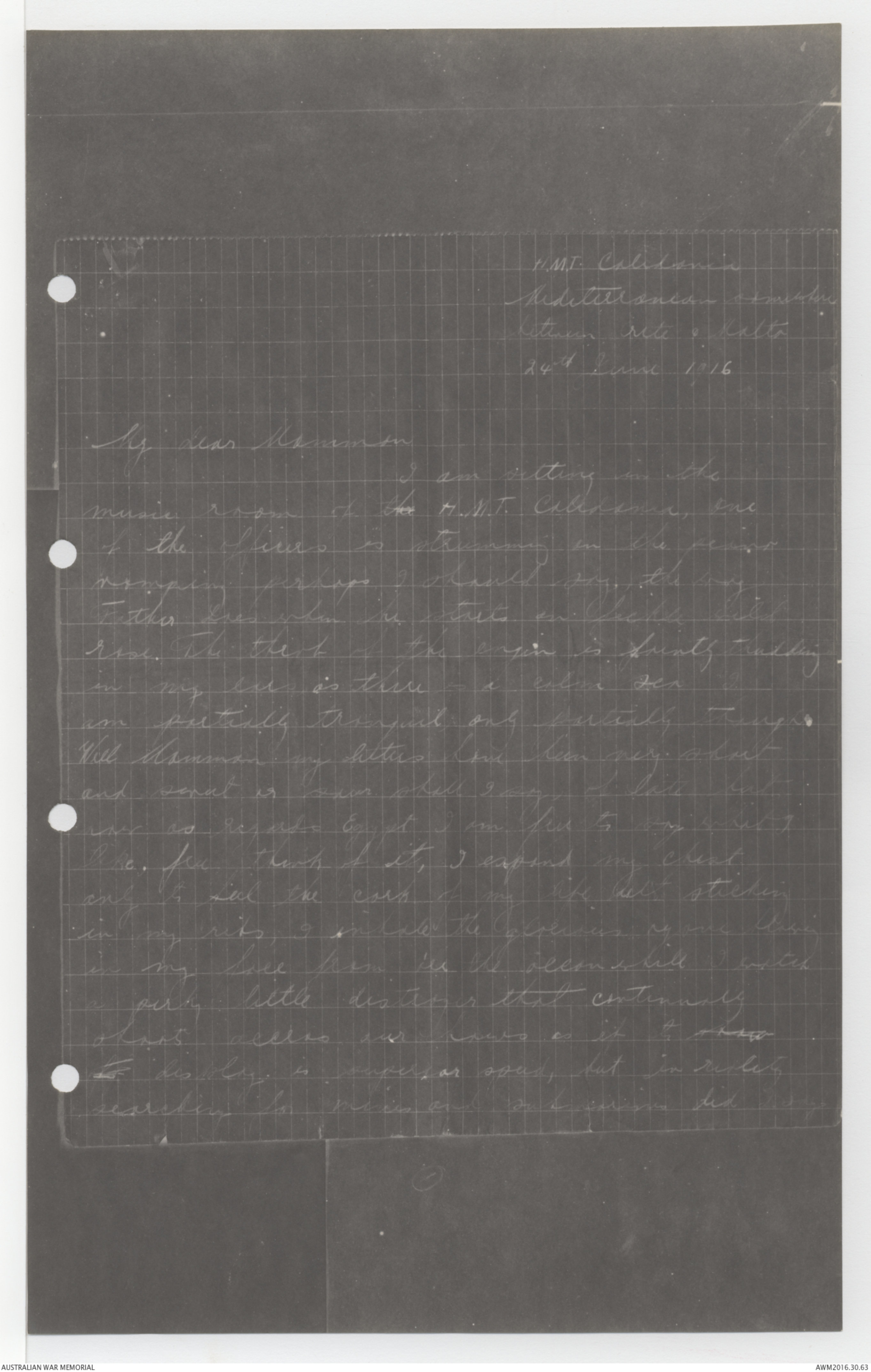
H.M.T. Caledonia
Mediterranean somewhere
between Crete & Malta
24th June, 1916
My dear Mamman,
I am sitting in the music room of the H.M.T. Caledonia, one
of the officers is strumming on the piano
romping perhaps I should say the way
Father does when he struts on fickle wild
rose. The throb of the engine is faintly thudding
in my ears as there is a calm sea. I
am partially tranquil only partially though.
Well Mamman my letters have been very short
and sweet or [[sour?]] shall I say of late but
now as regards Egypt I am free to say what I
like. [[few?]] think of it, I expand my chest
only to feel the cork of my life belt sticking
in my ribs, I inhale the glorious [[smell?]] flowing
in my face from all the ocean while I watch
a perky little destroyer that continually
shoots across our bows as if to show
fo display is superior speed, but in reality
searching for mines and [[submarines?]] did I say
2
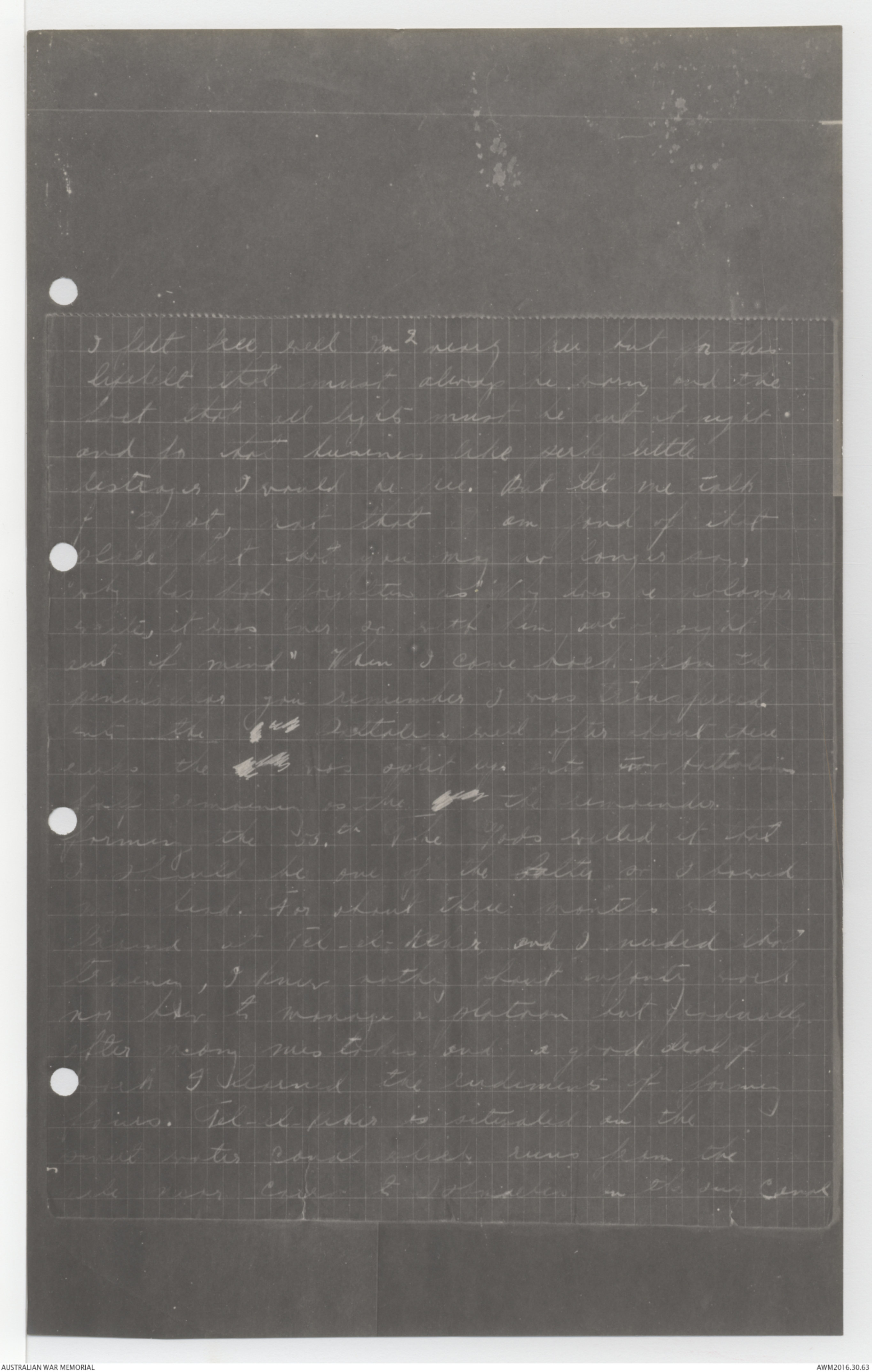
I felt free, well I'm nearly free but for this
lifebelt that must always be worn and the
fact that all lights must be out at night
and to that business like perky little
destroyer I would be free. But let me talk
of Egypt, not that I am fond of that
place but that you may no longer say,
"why has Bob forgotten us." Why does he no longer
write, it was ever so with him out of sight
out of mind" When I came back from the
peninsular you remember I was transferred
into the xth Battalion well after about three
weeks the xth was split up into two battalions
half remaining as the xth the remainder
forming the 55th. The Gods willed it that
I should be one of the latter so I bowed
my head. For about three months we
trained at Tel-el-Kebir and I needed that
training, I know nothing but infantry work
nor how to manage a platoon but gradually
after many mistakes and a good deal of
[[?]] I learned the rudiments of forming
[[fours?]]. Tel-el-Kebir is situated on the
sweet water canal which runs from the
Nile near Cairo to Ishmailia in the Suez Canal
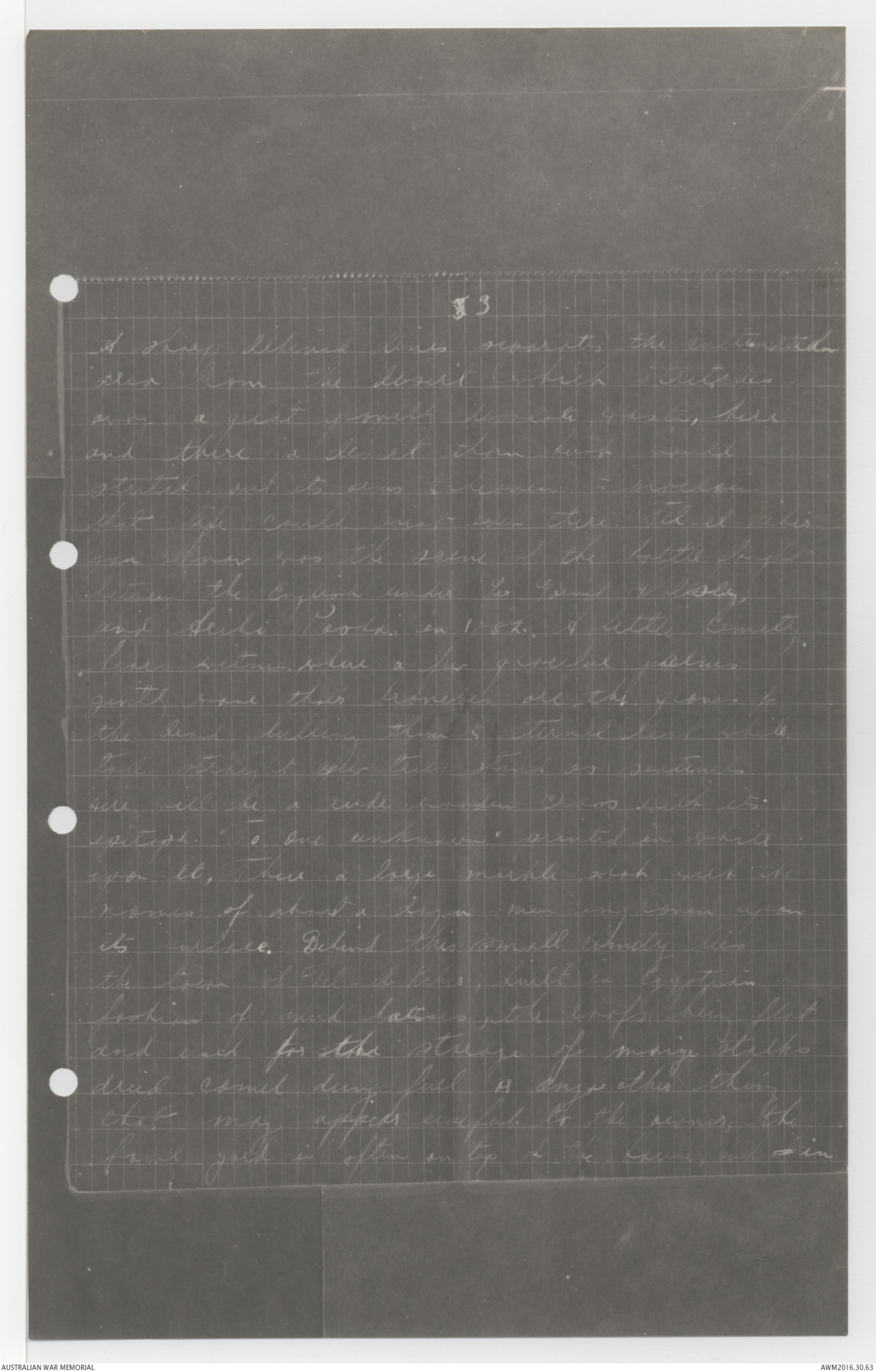
x 3.
A sharp defined line separates the cultivated
area from the desert which stretches
away. a great gravelly desolate waste, here
and there a desert thorn bush would
stretch out its arms & heaven to [[?]]
that life could exist even there. Tel-el-Kebir
you know was the scene of the battle fought
between the English under Sir Garnet Wolsley,
and Aribi Pasha in 1882. A little cemetry
bares witness where a few graceful palms
gently wave their branches all the groans of
the dead lulling them to eternal rest while
tall straight yew trees stand as sentinels.
Here will be a crude wooden cross with its
epitaph "To one unknown" printed in white
upon it, There a large marble slab with the
names of about a dozen men engraven upon
its surface. Behind this small cemetry lies
the town of Tel-el-Kiber, built in Egyptian
fashion of mud houses, the roofs being flat
and used for the storage of maize stalks
dried camel dung fuel or any other thing
that may appear useful for the ovens, the
front yard is often on top of the house, and xx in
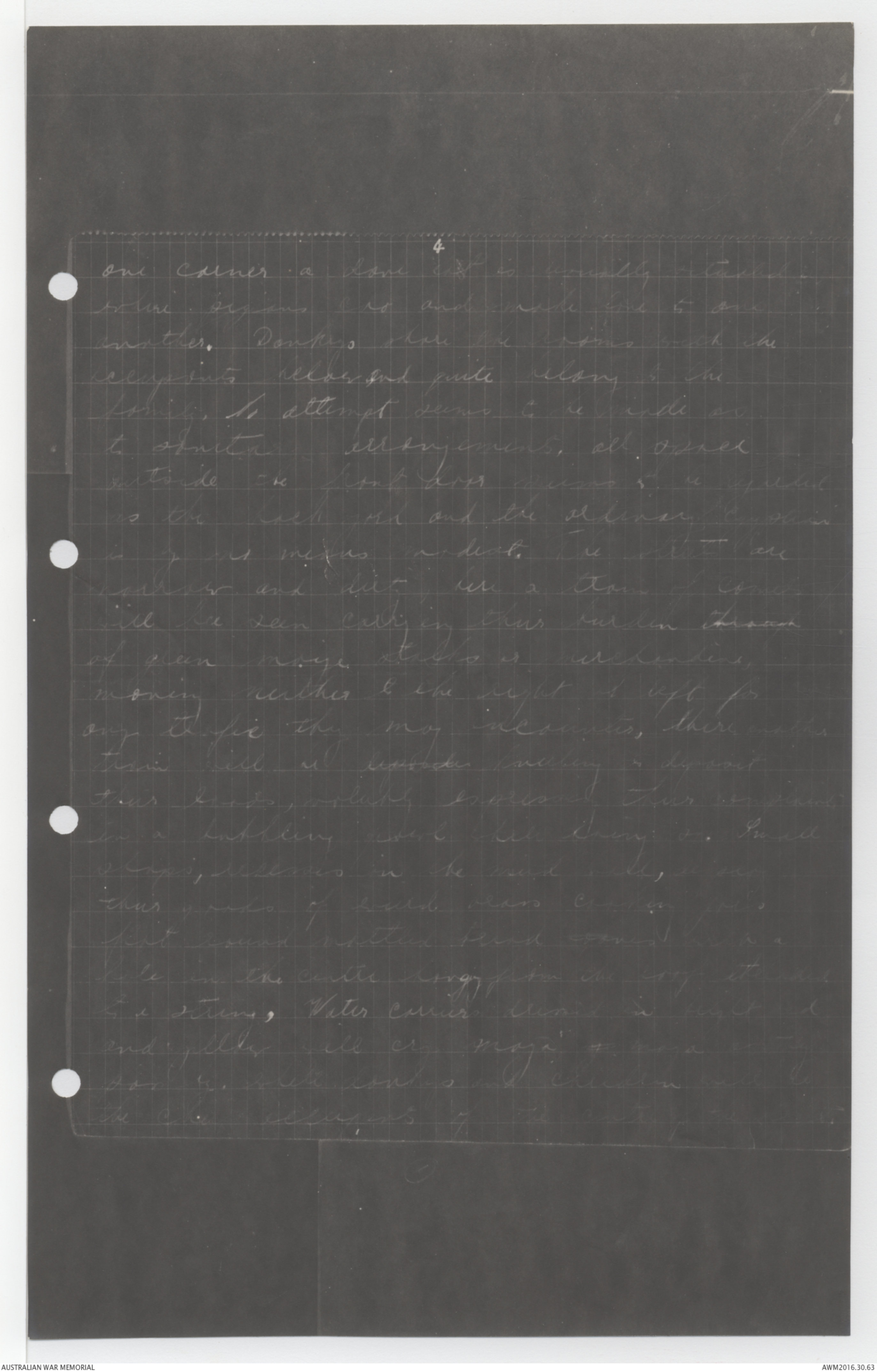
4
one corner a dove cote is usually situated
where pigeons coo and make love to one
another. Donkeys share the rooms with the
occupants below and quite belong to the
family. No attempt seems to be made as
to sanitary arrangements, all space
outside the front door seems to be regarded
as the back yard and the ordinary Egyptian
is by no means modest. The streets are
narrow and dirty, here a train of camels
will be seen carrying their burden through
of green maize stalks or merchandise,
moving neither to the right or left for
any traffic they may encounter, there another
train will be xxxxxxx loading or deposit
their loads, volubly expressing their experiences
in a babbling [[?l ]] while doing so. Small
shops, recesses in the mud wall, display
their goods of [[solid?]] brass cooking pots
flat round [[matted bread cc ovens]] with a
hole in the centre hanging from the [[string?]] threaded
to a string, Water carriers [[d?ed]] in [[flight?]] and
and yelling will cry Maya x Maya as they
pass by, while donkeys and children will be
the [[chief?]] occupants of the centre of the [[carts?]]
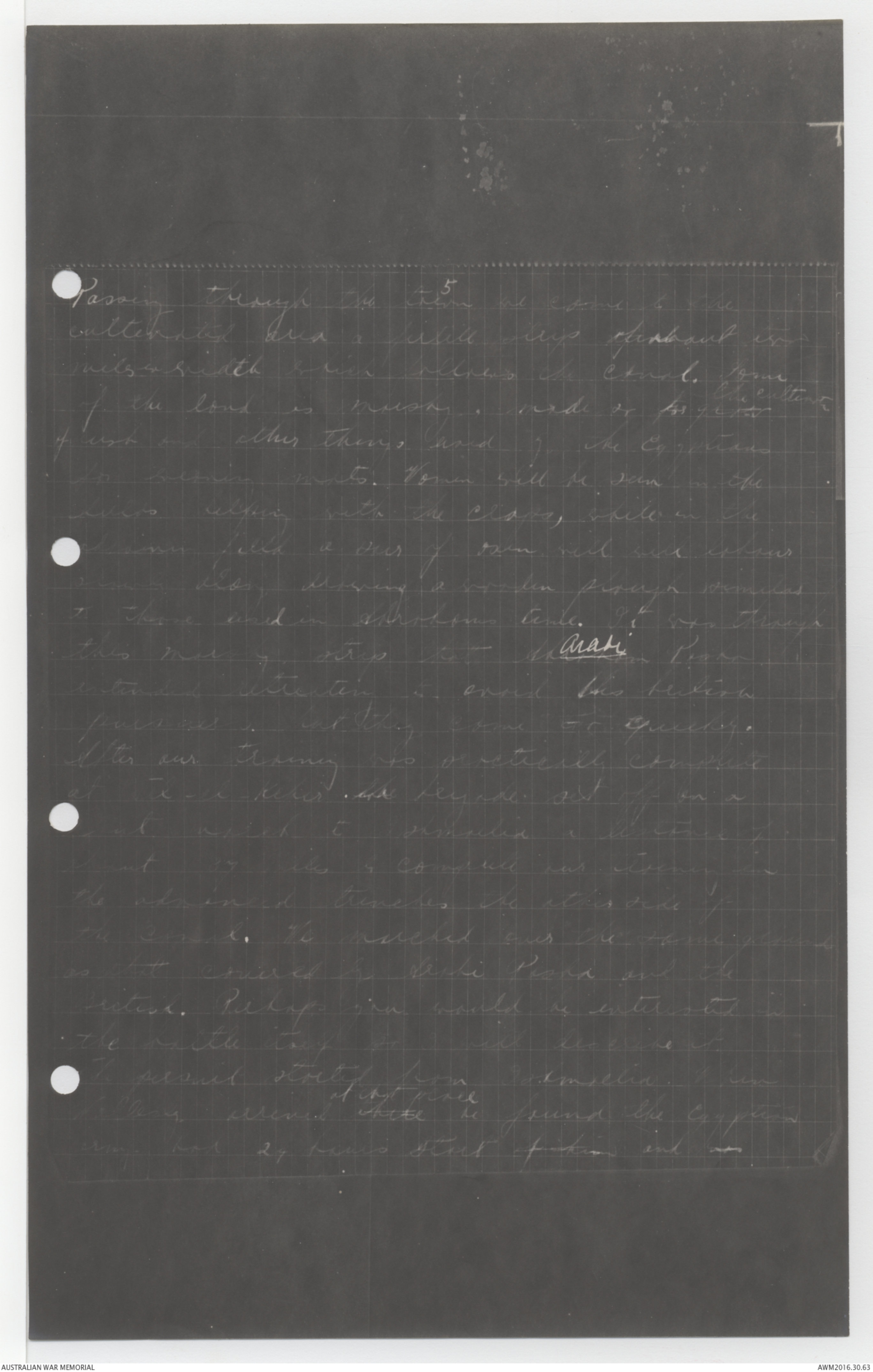
5
Passing through the town we come to the
cultivated area a fertile strip of about two
miles in width which follows the canal. Some
of the land is marshy, made so for first the cultivation
of rush and other things used by the Egyptians
for weaving mats. Women will be seen in the
fields helping with the crops, while in the
adjoining field a pair of oxen will [[will?]] labours
slowly along drawing a wooden plough similar
to those used in Abrahams time. It was through
this marshy strip that xxxxx Arabi Pasha
intended returning to avoid his British
pursuers but they come so quickly.
After our training was practically complete
at Tel-el-Kebir, the brigade set off on a
[[-t?]] march to Ishmailia a distance of
about 37 miles to complete our training in
the advanced trenches the other side of
the Canal. We marched over the same ground
as that covered by Arabi Pasha and the
British. Perhaps you would be interested in
the battle itself so I will describe it
The pursuit started from Ishmailia. When
Wolseley arrived there at that place he found the Eqyptian
army had 29 hours start of him and was
6
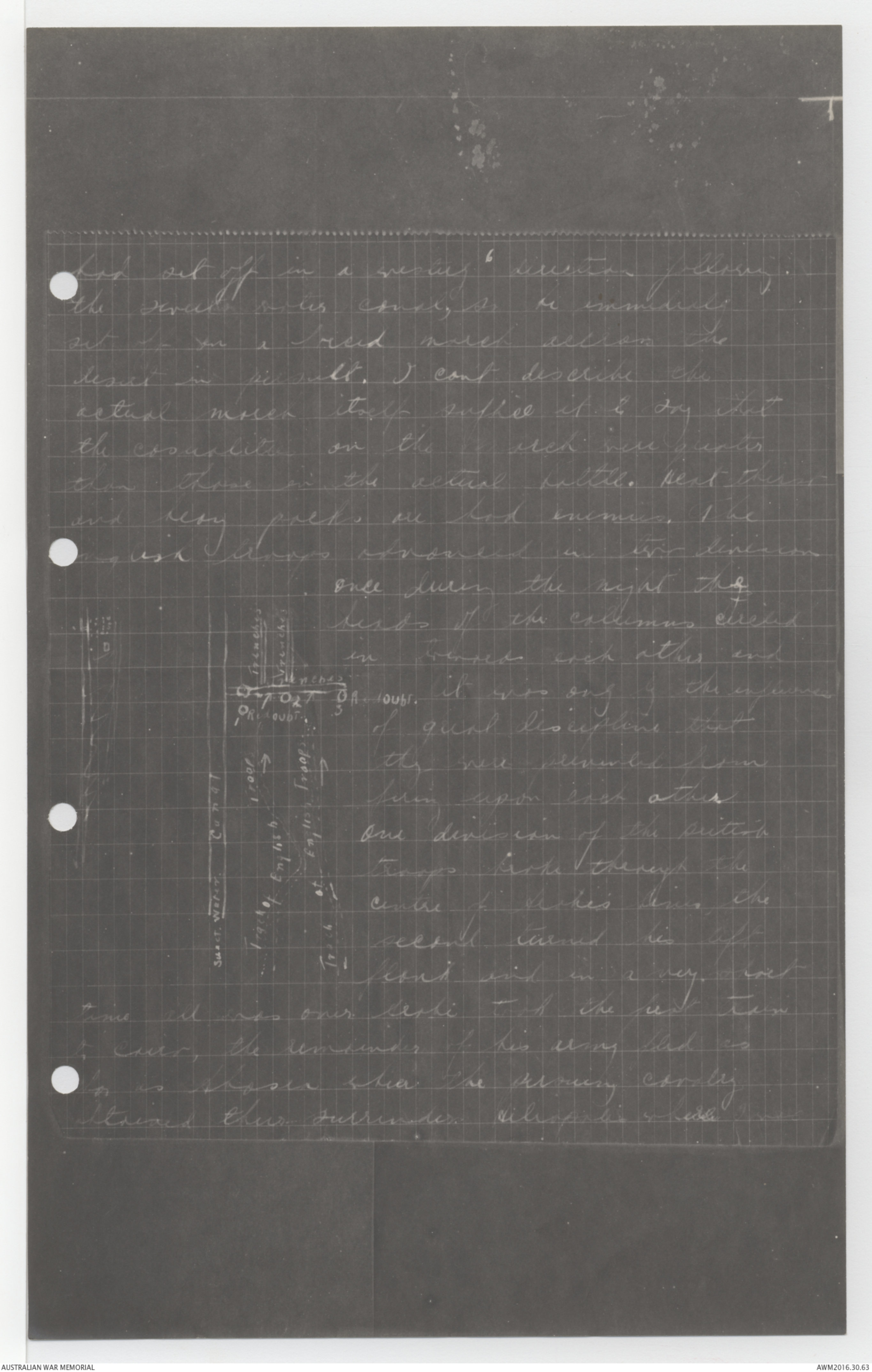
had set off in a westerly direction following
the sweet water canal, so he immediately
set off on a [[tired?]] march across the
desert in pursuit. I can't describe the
actual march itself suffice it to say that
the casualties on the march were greater
than those in the actual battle. Heat thirst
and heavy packs are bad enemies. The
English troops advanced in two divisions
Hand drawn map - see original document
once during the night the
heads of the columns circled
in towards each other and
it was only by the influence
of great discipline that
they were prevented from
firing upon each other.
One division of the British
troops broke through the
centre of Arabi's lines, the
second turned his left
flank and in a very short
time all was over. Arabi took the first train
to Cairo, the remainder of his army fled as
far as [[Khosin??]] where the pursuing cavalry
obtained their surrender. Heliopolis where I was
7
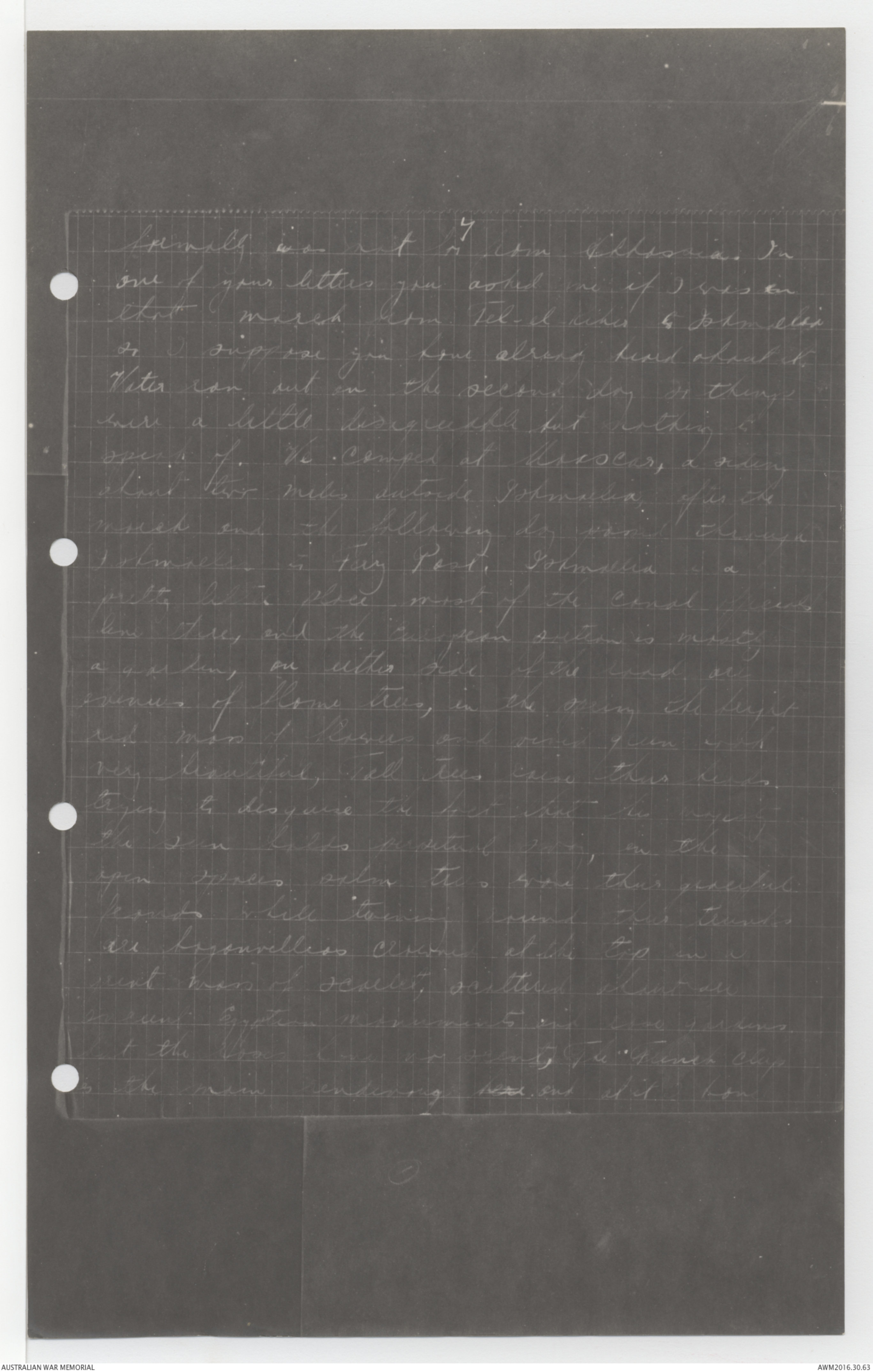
formally was not far from Abbassia. In
one of your letters you asked me if I was in
that march from Tel-el-Kiber to Ishmailia
so I suppose you have already heard about it.
Water ran out on the second day so things
were a little disagreeable but nothing to
speak of. We camped at [[Moascar?]], a siding
about two miles outside Ishmailia, after the
march and the following day passed through
Ishmailia to Ferry Post, Ishmailia is a
pretty little place most of the Canal officials
live there, and the European section is mostly
a garden, on either side of the road, are
avenues of flame trees, in the spring the bright
red mass of flowers and vivid green look
very beautiful, Tall trees raise their heads
trying to disguise the fact that his majesty
the sun holds perpetual sway, in the
open spaces palm trees wave their graceful
fronds while twining round their trunks
are boganvilleas crowned at the top in a
great mass of scarlet, scattered about all
[[around?]] Egyptian monuments and rose gardens
but the roses have no scent, the French clay
is the main rendering here and at it how
 Sam scott
This transcription item is now locked to you for editing. To release the lock either Save your changes or Cancel.
This lock will be automatically released after 60 minutes of inactivity.