
Typescript copy of diary entries of Percy Wellesley Chapman, 26 July 1916 to 9 March 1917 - Part 1
BOB'S DIARY.
Part 2.
26 July
1916.
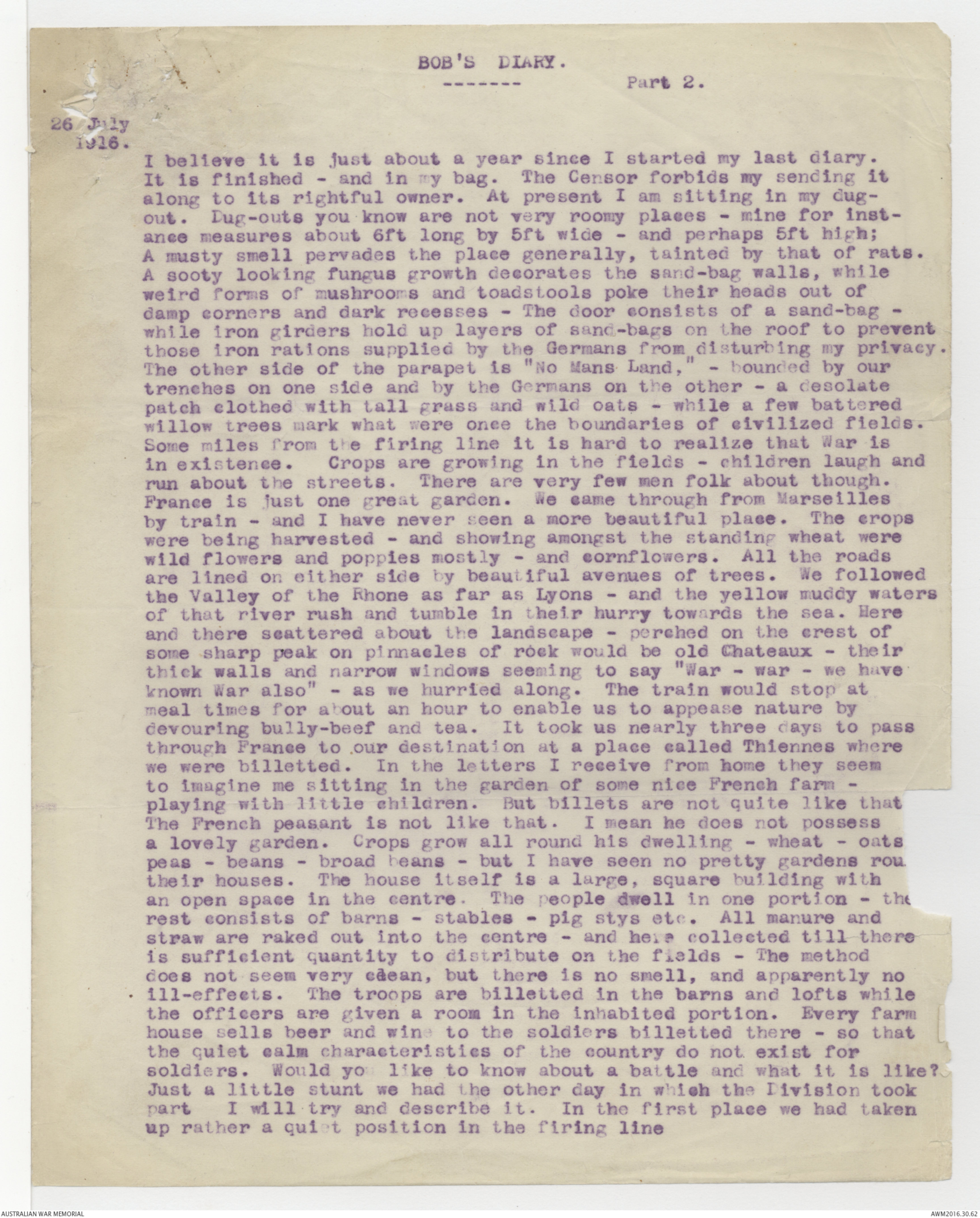
I believe it is just about a year since I started my last diary.
It is finished - and in my bag. The Censor forbids my sending it
along to its rightful owner. At present I am sitting in my dug-out.
Dug-outs you know are not very roomy places - mine for instance
measures about 6ft long by 5ft wide - and perhaps 5ft high;
A musty smell pervades the place generally, tainted by that of rats.
A sooty looking fungus growth decorates the sand-bag walls, while
weird forms of mushrooms and toadstools poke their heads out of
damp corners and dark recesses- The door consists of a sand-bag -
while iron girders hold layers of sand-bags on the roof to prevent
those iron rations supplied by the Germans from disturbing my privacy.
The other side of the parapet is "No Mans Land," - bounded by our
trenches on one side and by the Germans on the other - a desolate
patch clothed with tall grass and wild oats - while a few battered
willow trees mark what were once the boundaries of civilized fields.
Some miles from the firing line it is hard to realize that War is
in existence. Crops are growing in the fields - children laugh and
run about the streets. There are very few men folk about though.
France is just one great garden. We came through from Marseilles
by train - and I have never seen a more beautiful place. The crops
were being harvested - and showing amongst the standing wheat were
wild flowers and poppies mostly - and cornflowers. All the roads
are lined on either side by beautiful avenues of trees. We followed
the Valley of the Rhone as far as Lyons - and the yellow muddy waters
of that river rush and tumble in their hurry towards the sea. Here
and there scattered about the landscape - perched on the crest of
some sharp peak on pinnacles of rock would be old Chateaux - their
thick walls and narrow windows seeming to say "War - war - we have
known War also" - as we hurried along. The train would stop at
meal time for about an hour to enable us to appease nature by
devouring bully-beef and tea. It took us nearly three days to pass
through France to our destination at a place called Thiennes where
we were billetted. In the letters I receive from home they seem
to imagine me sitting in the garden of some nice French farm -
playing with little children. But billets are not quite like that
The French peasant is not like that. I mean he does not possess
a lovely garden. Crops grow all round his dwelling - wheat - oats
peas - beans - broad beans - but I have seen no pretty gardens [[rou?]]
their houses. The house itself is a large, square building with
an open space in the centre. The people dwell in one portion - the
rest consists of barns - stables - pig stys etc. All manure and
straw are raked out into the centre - and here collected till there
is sufficient quantity to distribute on the fields - The method
does not seem very clean, but there is no smell, and apparently no
ill-effects. The troops are billetted in the barns and lofts while
the officers are given a room in the inhabited portion. Every farm
house sells beer and wine to the soldiers billetted there - so that
the quiet calm characteristics of the country do not exist for
soldiers. Would you like to know about a battle and what it is like?
Just a little stunt we had the other day in which the Division took
part I will try and describe it. In the first place we had taken
up rather a quiet position in the firing line
2.
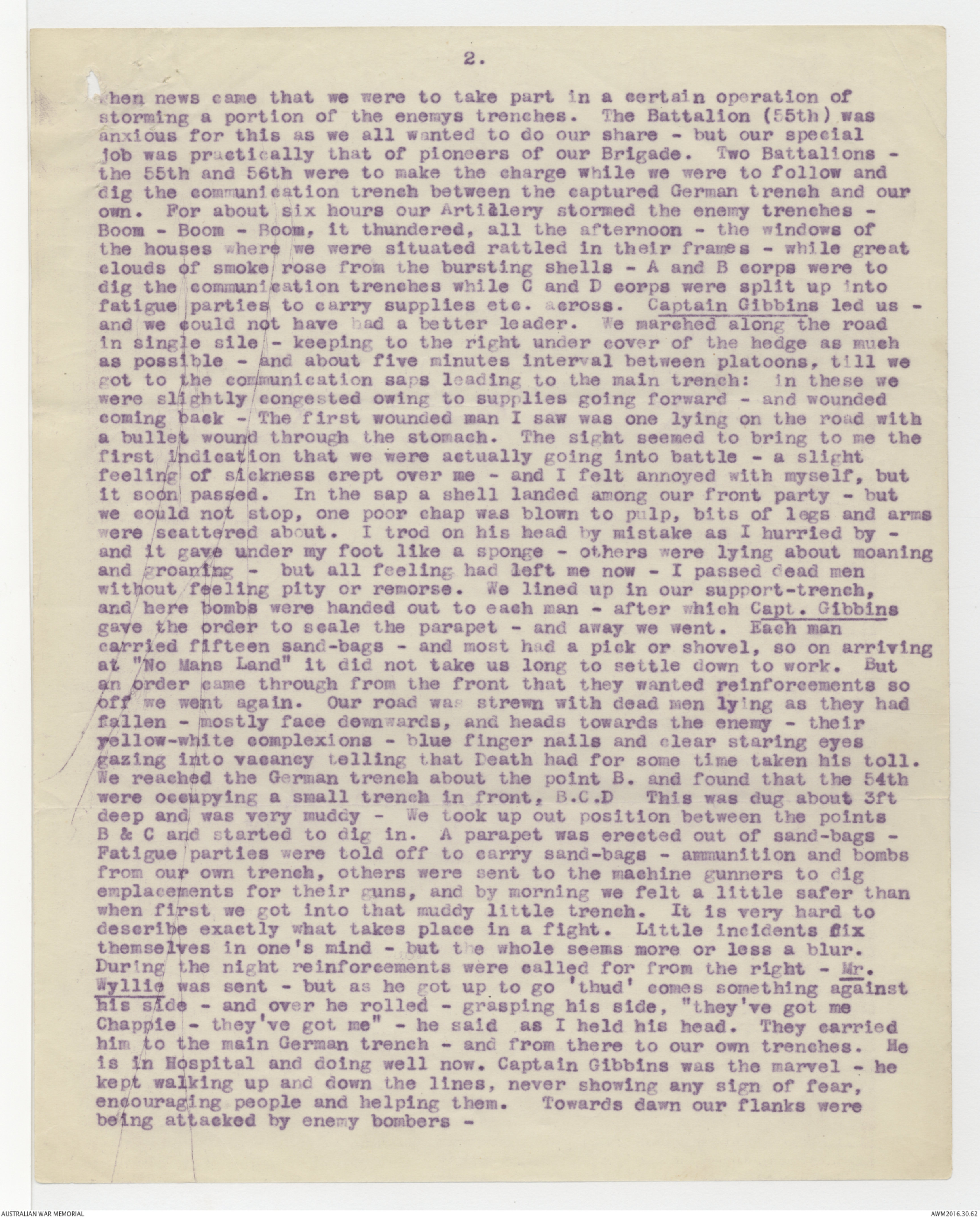
when news came that we were to take part in a certain operation of
storming a portion of the enemys trenches. The Battalion (55th) was
anxious for this as we all wanted to do our share - but our special
job was practically that of pioneers of our Brigade. Two Battalions -
the 55th and 56th were to make the charge while we were to follow and
dig the communication trench between the captured German trench and our
own. For about six hours our Artillery stormed the enemy trenches -
Boom - Boom - Boom, it thundered, all the afternoon - the windows of
the houses where we were situated rattled in their frames - while great
clouds of smoke rose from the bursting shells - A and B corps were to
dig the communication trenches while C and D corps were split up into
fatigue parties to carry supplies etc. across. Captain Gibbins led us -
and we could not have had a better leader. We marched along the road
in single sile - keeping to the right under cover of the hedge as much
as possible - and about five minutes interval between platoons, till we
got to the communication saps leading to the main trench: in these we
were slightly congested owing to supplies going forward - and wounded
coming back - The first wounded man I saw was one lying on the road with
a bullet wound through the stomach. The sight seemed to bring to me the
first indication that we were actually going into battle - a slight
feeling of sickness crept over me - and I felt annoyed with myself, but
it soon passed. In the sap a shell landed among our front party - but
we could not stop, one poor chap was blown to pulp, bits of legs and arms
were scattered about. I trod on his head by mistake as I hurried by -
and it gave under my foot like a sponge - others were lying about moaning
and groaning - but all feeling had left me now - I passed dead men
without feeling pity or remorse. We lined up in our support-trench,
and here bombs were handed out to each man- after which Capt. Gibbins
gave order to scale the parapet - and away we went. Each man
carried fifteen sand-bags - and most had a pick or shovel, so on arriving
at "No Mans Land" it did not take us long to settle down to work. But
an order came through from the front that they wanted reinforcements so
off we went again. Our road was strewn with dead men lying as they had
fallen - mostly face downwards, and heads towards the enemy - their
yellow-white complexions - blue finger nails and clear staring eyes
gazing into vacancy telling that Death had for some time taken his toll.
We reached the German trench about the point B. and found that the 54th
were occupying a small trench in front, B.C.D This was dug about 3ft
deep and was very muddy - We took up out position between the points
B & C and started to dig in. A parapet was created out of sand-bags -
Fatigue parties were told off to carry sand-bags - ammunition and bombs
from our own trench, others were sent to the machine gunners to dig
emplacements for their guns, and by morning we felt a little safer than
when first we got into that muddy little trench. It is very hard to
describe exactly what takes place in a fight. Little incidents fix
themselves in one's mind - but the whole seems more or less a blur.
During the night reinforcements were called for from the right - Mr.
Wyllie was sent - but as he got up to go 'thud' comes something against
his side - and over he rolled - grasping his side, "they've got me
Chappie - they've got me"- he said as I held his head. They carried
him to the main German trench - and from there to our own trenches. He
is in Hospital and doing well now. Captain Gibbins was the marvel - he
kept walking up and down the lines, never showing any sign of fear,
encouraging people and helping them. Towards dawn our flanks were
being attacked by enemy bombers -
3.
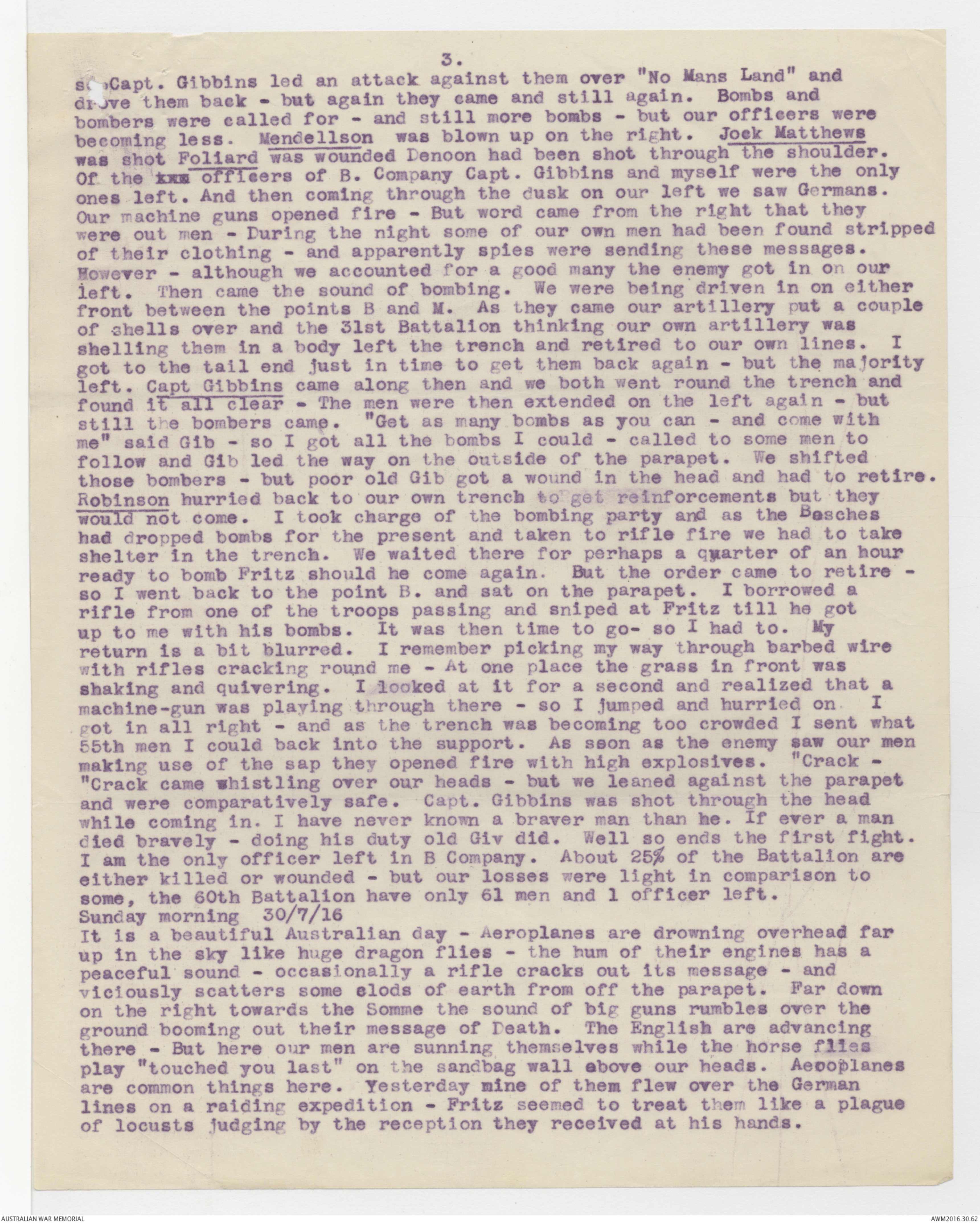
so Capt. Gibbins led an attack against them over "No Mans Land" and
drove them back - but again they came and still again. Bombs and
bombers were called for - and still more bombs - but our officers were
becoming less. Mendellson was blown up on the right. Jock Matthews
was shot Foliard was wounded Denoon had been shot through the shoulder.
Of the XXX officers of B. Company Capt. Gibbins and myself were the only
ones left. And then coming through the dusk on our left we saw Germans.
Our machine guns opened fire - But word came from the right that they
were out men - During the night some of our own men had been found stripped of
their clothing - and apparently spies were sending these messages.
However - although we accounted for a good many the enemy got in on our
left. Then came the sound of bombing. We were being driven in on either
front between the points B and M. As they came our artillery put a couple
of shells over and the 31st Battalion thinking our own artillery was
shelling them in a body left the trench and retired to our own lines.
got to the tail end just in time to get them back again - but the majority
left. Capt Gibbins came along then and we both went round the trench and
found it all clear - The men were then extended on the left again - but
still the bombers came. "Get as many bombs as you can - and come with
me" said Gib - so I got all the bombs I could - called to some men to
follow and Gib led the way on the outside of the parapet. We shifted
those bombers - but poor old Gib got a wound in the head and had to retire.
Robinson hurried back to our own trench to get reinforcements but they
would not come. I took charge of the bombing party and as the Bosches
had dropped bombs for the present and taken to rifle fire we had to take
shelter in the trench. We waited there for perhaps a quarter of an hour
ready to bomb Fritz should he come again. But the order came to retire -
so I went back to the point B. and sat on the parapet. I borrowed a
rifle from one of the troops passing and sniped at Fritz till he got
up to me with his bombs. It was then time to go - so I had to. My
return is a bit blurred. I remember picking my way through barbed wire
with rifles cracking round me - At one place the grass in front was
shaking and quivering. I looked at it for a second and realized that a
machine-gun was playing through there - so I jumped and hurried on. I
got in all right - and as the trench was becoming too crowded I sent what
55th men I could back into the support. As soon as the enemy saw our men
making use of the sap they opened fire with high explosives. "Crack -
"Crack came whistling over our heads - but we leaned against the parapet
and were comparatively safe. Capt. Gibbins was shot through the head
while coming in. I have never known a braver man than he. If ever a man
died bravely - doing his duty old Giv did. Well so ends the first fight.
I am the only officer left in B Company. About 25% of the Battalion are
either killed or wounded - but our losses were light in comparison to
some, the 60th Battalion have only 61 men and 1 officer left.
Sunday morning 30/7/16
It is a beautiful Australian day - Aeroplanes are drowning overhead far
up in the sky like huge dragon flies - the hum of their engines has a
peaceful sound - occasionally a rifle cracks out its message - and
viciously scatters some clods of earth from off the parapet. Far down
on the right towards the Somme the sound of big guns rumbles over the
ground booming out their message of Death. The English are advancing
there - But here our men are sunning themselves while the horse flies
play "touched you last" on the sandbag wall above our heads. Aeroplanes
are common things here. Yesterday mine of them flew over the German
lines on a raiding expedition - Fritz seemed to treat them like a plague
of locusts judging by the reception they received at his hands.
4.
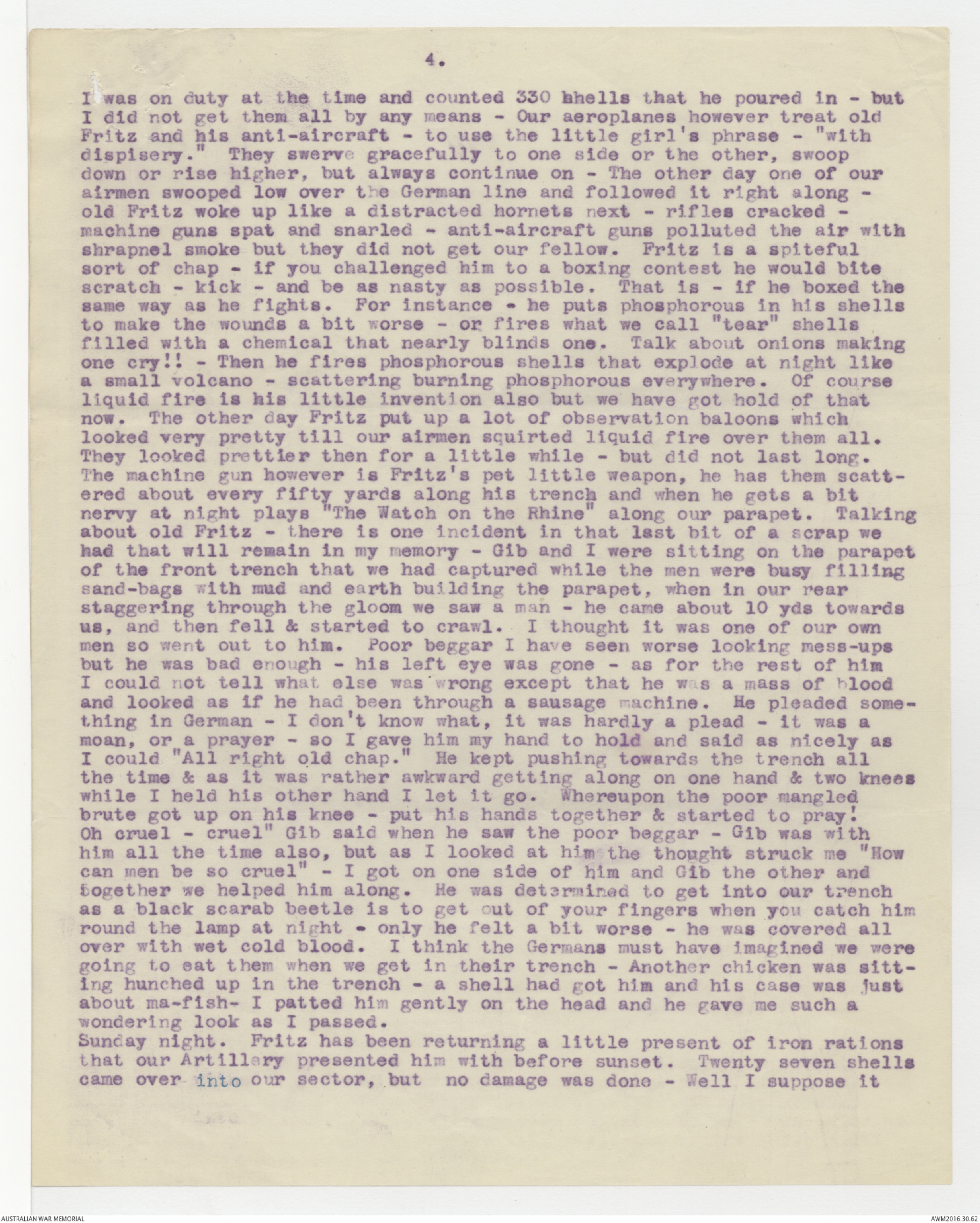
I was on duty at the time and counted 330 shells that he poured in - but
I did not get them all by any means - Our aeroplanes however treat old
Fritz and his anti-aircraft - to use the little girl's phrase - "with
dispisery". They swerve gracefully to one side or the other, swoop
down or rise higher, but always continue on - The other day one of our
airmen swooped low over the German line and followed it right along -
old Fritz woke up like a distracted hornets next - rifles cracked -
machine guns spat and snarled - anti-aircraft guns polluted the air with
shrapnel smoke but they did not get our fellow. Fritz is a spiteful
sort of chap - if you challenged him to a boxing contest he would bite
scratch - kick - and be as nasty as possible. That is - if he boxed the
same way as he fights. For instance - he puts phosphorous in his shells
to make the wounds a bit worse - or fires what we call "tear" shells
filled with a chemical that nearly blinds one. Talk about onions making
one cry!! - Then he fires phosphorous shells that explode at night like
a small volcano - scattering burning phosphorous everywhere. Of course
liquid fire is his little invention also but we have got hold of that
now. The other day Fritz put up a lot of observation baloons which
looked very pretty till our airmen squirted liquid fire over them all.
They looked prettier then for a little while - but did not last long.
The machine gun however is Fritz's pet little weapon, he has them scattered
about every fifty yards along his trench and when he gets a bit
nervy at night plays "The Watch on the Rhine" along our parapet. Talking
about old Fritz - there is one incident in that last bit of a scrap we
had that will remain in my memory - Gib and I were sitting on the parapet
of the front trench that we had captured while the men were busy filling
sand-bags with mud and earth building the parapet, when in our rear
staggering through the gloom we saw a man - he came about 10 yds towards
us, and then fell & started to crawl. I thought it was one of our own
men so went out to him. Poor beggar I have seen worse looking mess-ups
but he was bad enough - his left eye was gone - as for the rest of him
I could not tell what else was wrong except that he was a mass of blood
and looked as if he had been through a sausage machine. He pleaded something
in German - I don't know what, it was hardly a plead - it was a
moan, or a prayer - so I gave him my hand to hold and said as nicely as
I could "All right old chap". He kept pushing towards the trench all
the time & as it was rather awkward getting along on one hand & two knees
while I held his other hand I let it go. Whereupon the poor mangled
brute got up on his knee - put his hands together & started to pray!
Oh cruel - cruel" Gib said when he saw the poor beggar - Gib was with
him all the time also, but as I looked at him the thought struck me "How
can men be so cruel" - I got on one side of him and Gib the other and
together we helped him along. He was determined to get into our trench
as a black scarab beetle is to get out of your fingers when you catch him
round the lamp at night - only he felt a bit worse - he was covered all
over with wet cold blood. I think the Germans must have imagined we were
going to eat them when we get in their trench - Another chicken was sitting
hunched up in the trench - a shell had got him and his case was just
about ma-fish- I patted him gently on the head and he gave me such a
wondering look as I passed.
Sunday night. Fritz has been returning a little present of iron rations
that our Artillery presented him with before sunset. Twenty seven shells
came over into our sector, but no damage was done - Well I suppose it
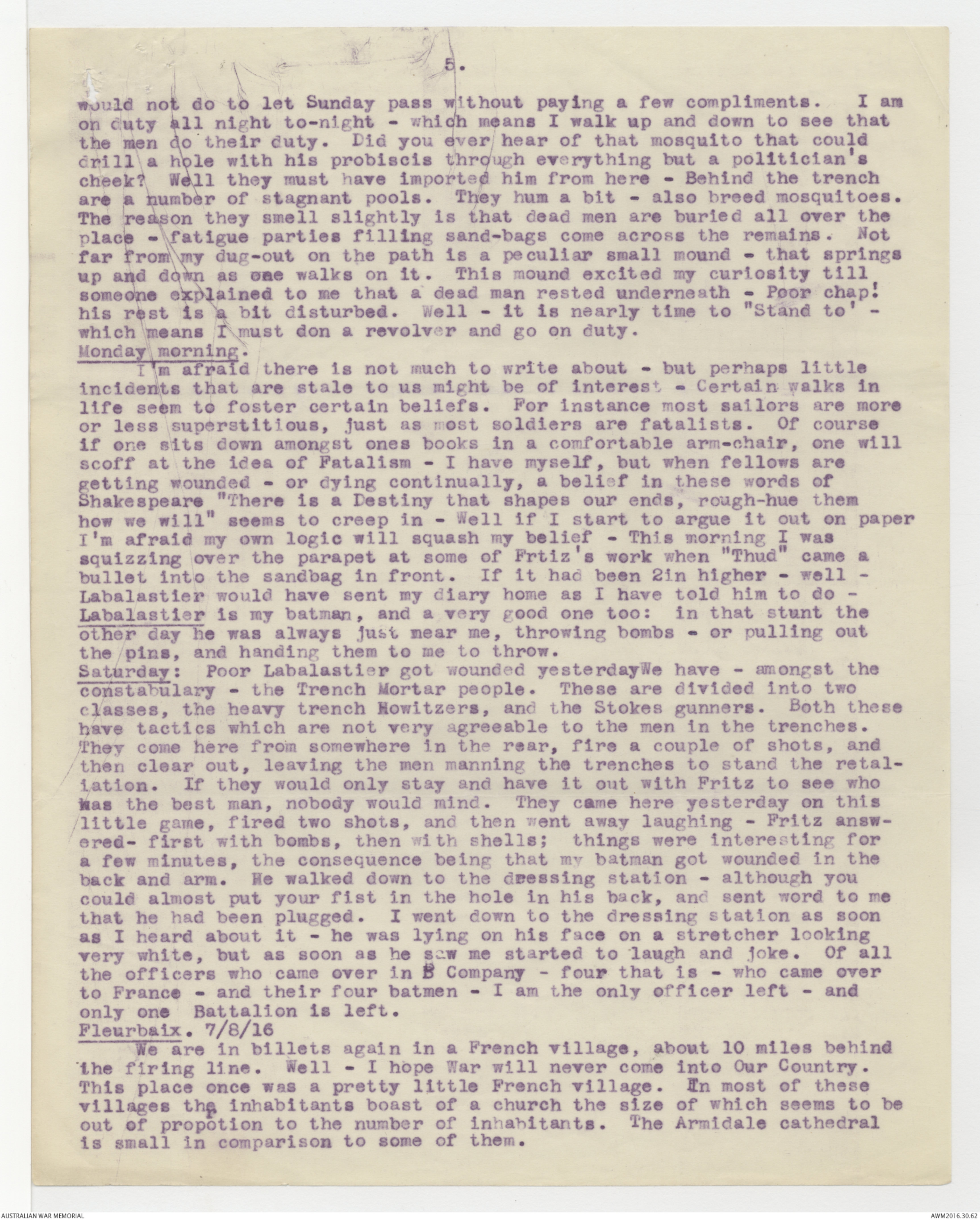
5.
would not do to let Sunday pass without paying a few compliments. I am
on duty all night to-night - which means I walk up and down to see that
the men do their duty. Did you ever hear of that mosquito that could
drill a hole with his proboscis through everything but a politician's
cheek? Well they must have imported him from here - Behind the trench
are a number of stagnant pools. They hum a bit - also breed mosquitoes.
The reason they smell slightly is that dead men are buried all over the
place - fatigue parties filling sand-bags come across the remains. Not
far from my dug-out on the path is a peculiar small mound - that springs
up and down as one walks on it. This mound excited my curiosity till
someone explained to me that a dead man rested underneath - Poor chap!
his rest is a bit disturbed. Well - it is nearly time to "Stand to' -
which means I must don a revolver and go on duty.
Monday morning.
I'm afraid there is not much to write about - but perhaps little
incidents that are stale to us might be of interest - Certain walks in
life seem to foster certain beliefs. For instance most sailors are more
or less superstitious, just as most soldiers are fatalists. Of course
if one sits down amongst ones books in a comfortable arm-chair, one will
scoff at the idea of Fatalism - I have myself, but when fellows are
getting wounded - or dying continually, a belief in these words of
Shakespeare "There is a Destiny that shapes our ends, rough-hue them
how we will" seems to creep in - Well if I start to argue it out on paper
I'm afraid my own logic will squash my belief - This morning I was
squizzing over the parapet at some of Fritz's work then "Thud" came a
bullet into the sandbag in front. If it had been 2in higher - well -
Labalastier would have sent my diary home as I have told him to do -
Labalastier is my batman, and a very good one too: in that stunt the
other day he was always just near me, throwing bombs - or pulling out
the pins, and handing them to me to throw.
Saturday: Poor Labalastier got wounded yesterdayWe have - amongst the
constabulary - the Trench Mortar people. These are divided into two
classes, the heavy trench Howitzers, and the Stokes gunners. Both these
have tactics which are not very agreeable to the men in the trenches.
They come here from somewhere in the rear, fire a couple of shots, and
then clear out, leaving the men manning the trenches to stand the retaliation.
If they would only stay and have it out with Fritz to see who
was the best man, nobody would mind. They came here yesterday on this
little game, fired two shots, and then went away laughing - Fritz answered -
first with bombs, then with shells; things were interesting for
a few minutes, the consequence being that my batman got wounded in the
back and arm. He walked down to the dressing station - although you
could almost put your fist in the hole in his back, and sent word to me
that he had been plugged. I went down to the dressing station as soon
as I heard about it - he was lying on his face on a stretcher looking
very white, but as soon as he saw me started to laugh and joke. Of all
the officers who came over in B Company - four that is - who came over
to France - and their batmen - I am the only officer left - and
only one Battalion is left.
Fleurbaix. 7/8/16
We are in billets again in a French village, about 10 miles behind
the firing line. Well - I hope War will never come into our Country.
This place once was a pretty little French village. In most of these
villages the inhabitants boast of a church the size of which seems to be
out of proportion to the number of inhabitants. The Armidale cathedral
is small in comparison to some of them.
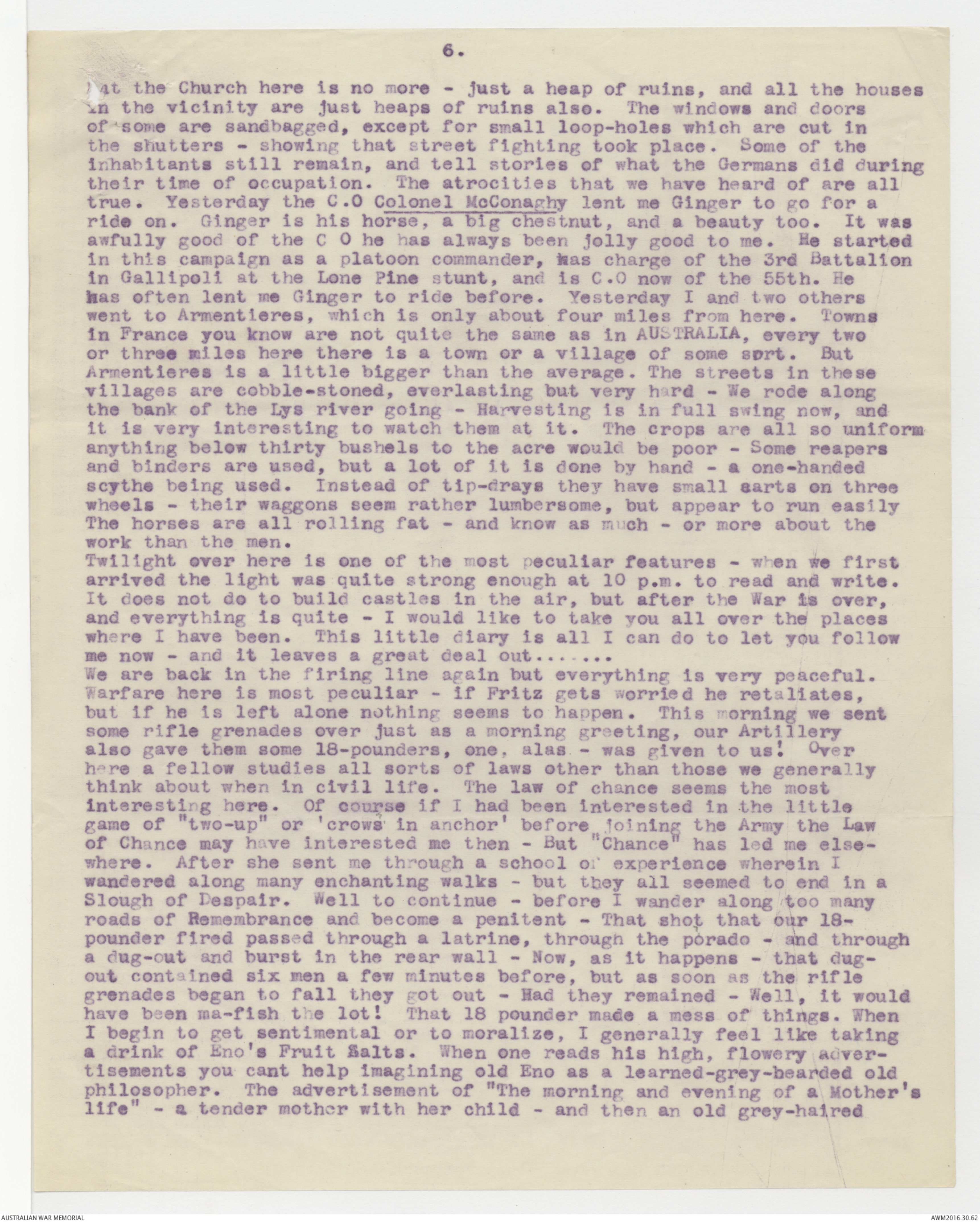
6.
but the church here is no more - just a heap of ruins, and all the houses
in the vicinity are just heaps of ruins also. The windows and doors
of some are sandbagged, except for small loop-holes which are cut in
the shutters - showing that street fighting took place. Some of the
inhabitants still remain, and tell stories of what the Germans did during
their time of occupation. The atrocities that we have heard of are all
true. Yesterday the C. O Colonel McConaghy lent me Ginger to go for a
ride on. Ginger is his horse, a big chestnut, and a beauty too. It was
awfully good of the C O he has always been jolly good to me. He started
in this campaign as a platoon commander, was charge of the 3rd Battalion
in Gallipoli at the Lone Pine stunt, and is C.O now of the 55th. He
has often lent me Ginger to ride before. Yesterday I and two others
went to Armentieres, which is only about four miles from here. Towns
in France you know are not quite the same as in AUSTRALIA, every two
or three miles here there is a town or a village of some sort. But
Armentieres is a little bigger than the average. The streets in these
villages are cobble-stoned, everlasting but very hard - We rode along
the bank of the Lys river going - Harvesting is in full swing now, and
it is very interesting to watch them at it. The crops are all so uniform
anything below thirty bushels to the acre would be poor - Some reapers
and binders are used, but a lot of it is done by hand - a one-handed
scythe being used. Instead of tip-drays they have small carts on three
wheels - their waggons seem rather lumbersome, but appear to run easily
The horses are all rolling fat - and know as much - or more about the
work than the men.
Twilight over here is one of the most peculiar features - when we first
arrived the light was quite strong enough at 10 p.m. to read and write.
It does not do to build castles in the air, but after the War is over,
and everything is quite - I would like to take you all over the places
where I have been. This little diary is all I can do to let you follow
me now - and it leaves a great deal out . . . . . . .
We are back in the firing line again but everything is very peaceful.
Warfare here is most peculiar - if Fritz gets worried he retaliates,
but if he is left alone nothing seems to happen. This morning we sent
some rifle grenades over just as a morning greeting, our Artillery
also gave them some 18-pounders, one, alas - was given to us! Over
here a fellow studies all sorts of laws other than those we generally
think about when in civil life. The law of chance seems the most
interesting here. Of course if I had been interested in the little
game of "two-up" or 'crows in anchor' before joining the Army the Law
of Chance may have interested me then - But "Chance" has led me elsewhere.
After she sent me through a school of experience wherein I
wandered along many enchanting walks - but they all seemed to end in a
Slough of Despair. Well to continue - before I wander along too many
roads of Remembrance and become a penitent - That shot that our 18-pounder
fired passed through a latrine, through the porade- and through
a dug-out and burst in the rear wall - Now, as it happens - that dugout
contained six men a few minutes before, but as soon as the rifle
grenades began to fall they got out - Had they remained - Well, it would
have been ma-fish the lot! That 18 pounder made a mess of things. When
I begin to get sentimental or to moralize, I generally feel like taking
a drink of Eno's Fruit Salts. When one reads his high, flowery advertisements
you cant help imagining old Eno as a learned-grey-bearded old
philosopher. The advertisement of "The morning and evening of a Mother's
life"- a tender mother with her child - and then an old grey-haired
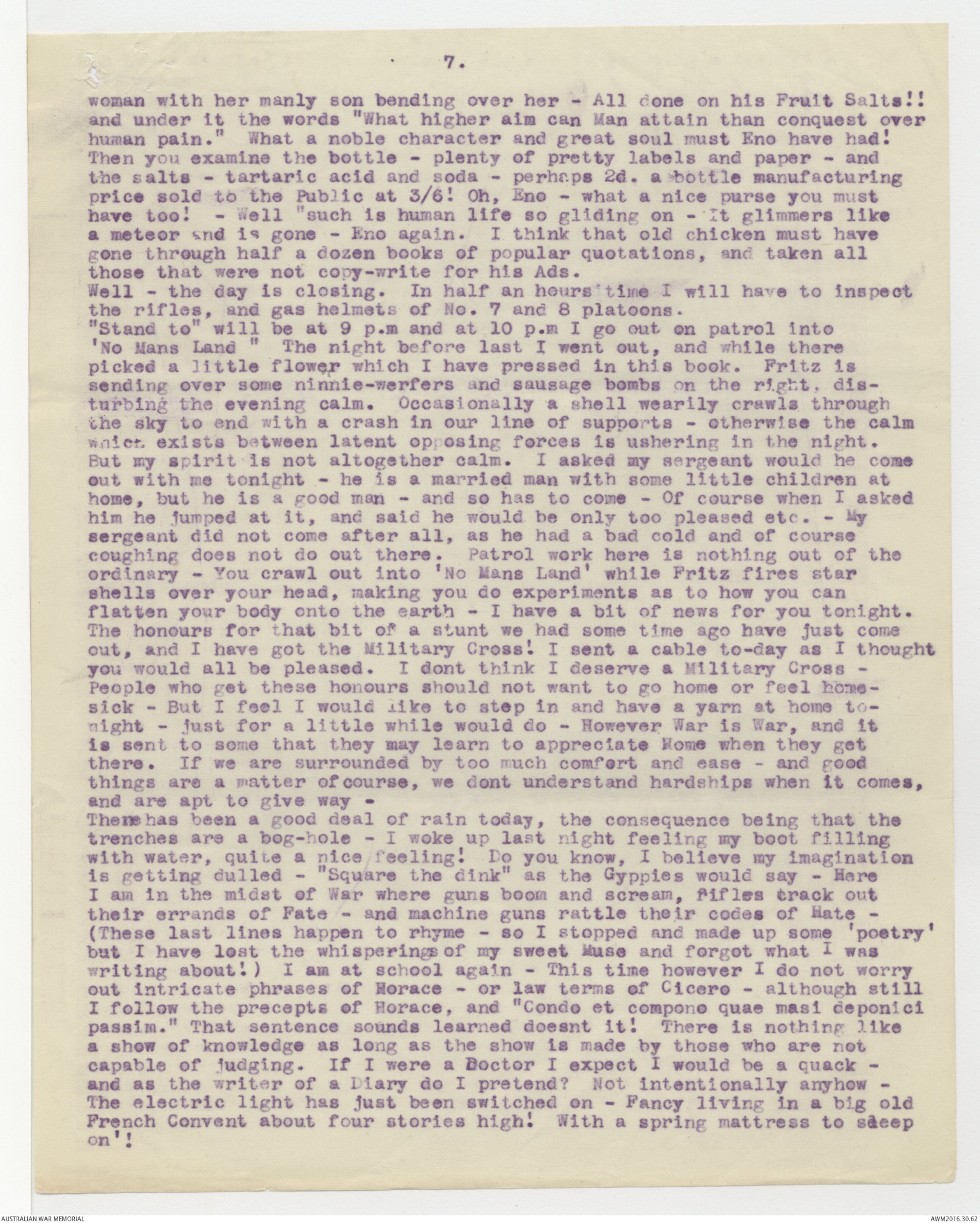
7.
woman with her manly son bending over her- All done on his Fruit Salts!!
and under it the words "What higher aim can Man attain than conquest over
human pain." What a noble character and great soul must Eno have had!
Then you examine the bottle - plenty of pretty labels and paper - and
the salts - tartaric acid and soda - perhaps 2d. a bottle manufacturing
price sold to the Public at 3/6! Oh, Eno - what a nice purse you must
have too! - Well "such is human life so gliding on - It glimmers like
a meteor and is gone - Eno again. I think that old chicken must have
gone through half a dozen books of popular quotations, and taken all
those that were not copy-write for his Ads.
Well - the day is closing. In half an hours' time I will have to inspect
the rifles, and gas helmets of No. 7 and 8 platoons.
"Stand to" will be at 9 p.m and 10 p.m I go out on patrol into
'No Mans Land" The night before last I went out, and while there
picked a little flower which I have pressed in this book. Fritz is
sending over some ninnie-werfers and sausage bombs on the right, disturbing
the evening calm. Occasionally a shell wearily crawls through
the sky to end with a crash in our line of supports - otherwise the calm
which exists between latent opposing forces is ushering in the night.
But my spirit is not altogether calm. I asked my sergeant would he come
out with me tonight - he is a married man with some little children at
home, but he is a good man - and so has to come - Of course when I asked
him he jumped at it, and said he would be only too pleased etc. - My
sergeant did not come after all, as he had a bad cold and of course
coughing does not do out there. Patrol work here is nothing out of the
ordinary - You crawl out into 'No Mans Land' while Fritz fires star
shells over your head, making you do experiments as to how you can
flatten your body onto the earth - I have a bit of news for you tonight.
The honours for that bit of a stunt we had some time ago have just come
out, and I have got the Military Cross! I sent a cable to-day as I thought
you would all be pleased. I dont think I deserve a Military Cross -
People who get these honours should not want to go home or feel homesick -
But I feel I would like to step in and have a yarn at home tonight -
just for a little while would do - However War is War, and it
is sent to some that they may learn to appreciate Home when they get
there. If we are surrounded by too much comfort and ease - and good
things are a matter of course, we dont understand hardships when it comes,
and are apt to give way -
There has been a good deal of rain today, the consequence being that the
trenches are a bog-hole - I woke up last night feeling my boot filling
with water, quite a nice feeling! Do you know, I believe my imagination
is getting dulled - "Square the dink" as the Gyppies would say - Here
I am in the midst of War where guns boom and scream, rifles crack out
their errands of Fate - and machine guns rattle their codes of Hate -
(These last lines happen to rhyme - so I stopped and made up some 'poetry'
but I have lost the whisperings of my sweet Muse and forgot what I was
writing about!) I am at school again - This time however I do not worry
out intricate phrases of Horace - or law terms of Cicero - although still
I follow the precepts of Horace, and "Conde et compose quad masi deponici
passim." That sentence sounds learned doesn't it! There is nothing like
a show of knowledge as long as the show is made by those who are not
capable of judging. If I were a Doctor I expect I would be a quack -
and as the writer of a Diary do I pretend? Not intentionally anyhow -
The electric light has just been switched on - Fancy living in a big old
French Convent about four stories high! With a spring mattress to sleep
on'!
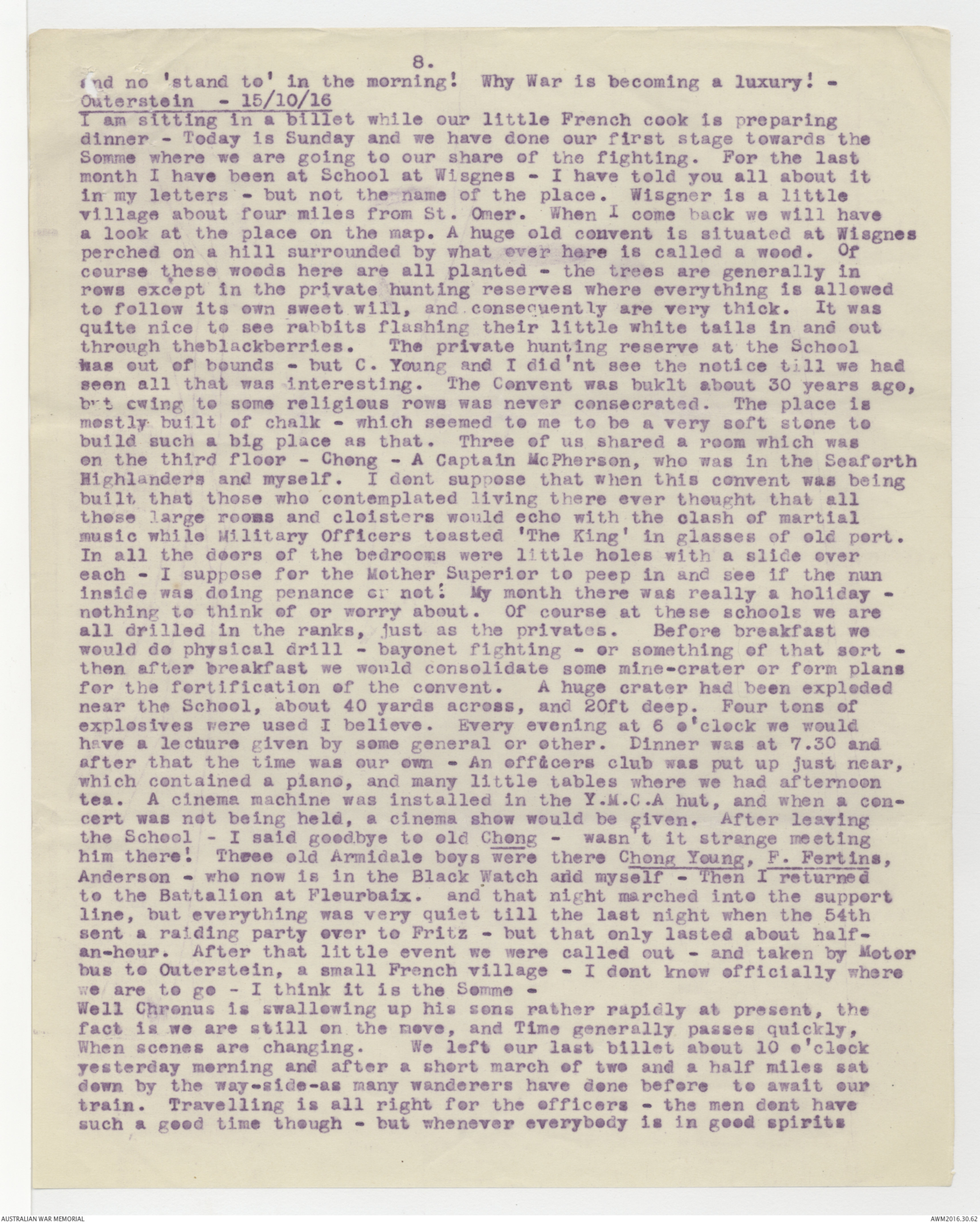
8.
and no 'stand to' in the morning! Why War is becoming a luxury! -
Outerstein - 15/1016
I am sitting in a billet while our little French cook is preparing
dinner - Today is Sunday and we have done our first stage towards the
Somme where we are going to our share of the fighting. For the last
month I have been at School at Wisgnes - I have told you all about it
in my letters - but not the name of the place. Wisgner is a little
village about four miles from St. Omer. When I come back we will have
a look at the place on the map. A huge old convent is situated at Wisgnes
perched on a hill surrounded by what ever here is called a wood. Of
course these woods here are all planted - the tress are generally in
rows except in the private hunting reserves where everything is allowed
to follow its own sweet will, and consequently are very thick. It was
quite nice to see rabbits flashing their little while tails in and out
through theblackberries. The private hunting reserve at the School
was out of bounds - but C. Young and I didn't see the notice till we had
seen all that was interesting. The Convent was buklt about 30 years ago,
but owing to some religious rows was never consecrated. The place is
mostly built of chalk - which seemed to me to be a very soft stone to
build such a big place as that. Three of us shared a room which was
on the third floor - Chong - A Captain McPherson, who was in the Seaforth
Highlanders and myself. I dont suppose that when this convent was being
built that those who contemplated living there ever thought that all
these large rooms and cloisters would echo with the clash of martial
music while Military Officers toasted 'The King' in glass of old port.
In all the doors of the bedrooms were little holes with a slide over
each - I suppose for the Mother Superior to peep in and see if the nun
inside was doing penance or not! My month there was really a holiday -
nothing to think of or worry about. Of course at these schools we are
all drilled in the ranks, just as the privates. Before breakfast we
would do physical drill - bayonet fighting - or something of that sort -
then after breakfast we would consolidate some mine-crater or form plans
for the fortification of the convent. A huge crater had been exploded
near the School, about 40 yards across, and 20ft deep. Four tons of
explosives were used I believe. Every evening at 6 o'clock we would
have a lecture given by some general or other. Dinner was at 7.30 and
after that the time was our own - An officers club was put up just near,
which contained a plane, and many little tables where we had afternoon
tea. A cinema machine was installed in the Y.M.C.A hut, and when a concert
was not being held, a cinema show would be given. After leaving
the School - I said goodbye to old Chong - wasn't it strange meeting
him there! These old Armidale boys were there Chong Young, F. Fertins,
Anderson - who now is in the Black Watch and myself - Then I returned
to the Battalion at Fleurbaix. and that night marched into the support
line, but everything was very quiet till the last night when the 54th
sent a raiding party over to Fritz - but that only lasted about half-an-hour.
After that little event we were called out - and taken by Motor
bus to Outerstein, a small French village - I dont know officially where
we are to go - I think it is the Somme -
Well Chronus is swallowing up his sons rather rapidly at present, the
fact is we are still on the move, and Time generally passes quickly.
When scenes are changing. We left our last billet about 10 o'clock
yesterday morning and after a short march of two and a half miles sat
down by the way-side-as many wanderers have done before to await our
train. Travelling is all right for the officers - the men dont have
such a good time though - but whenever everybody is in good spirits
9.
comforts don't count much. They travelled in horse-trucks with straw
on the bottom to lie on - 35 to a truck! - Sounds rather crowded doesn't
it! but the French go 40 to a truck! - B. Company had to get to the
station first, and help load up the transport, but this did not take
long and when everything was ready our train steamed up from the station
about half past 2. It takes a big train to convey a battalion of troops,
but these French engines are up to the task; they are so big and powerful.
After about nine hours journey we arrived at our present billeting
quarters - about five miles from Abbeville. When I come back we can
follow all my wanderings together. After about three hours work, the
transport was at last unloaded after a great deal of grunting - and
slipping about in the mud, and we turned into bed about 5 this morning.
This is the best billet I've been in so far - My bed is one of those
old fashioned wooden ones, and requires a step-ladder almost to get into
- then you sink down and get lost amongst the mattress. The Company
is billeted at a bread-factory, and over the road is a large cotton
mill. I have already asked the Manager for permission to go through,
and am looking forward to doing so after parade which takes place in a
quarter of an hour -
Half-past twelve next day -
I have not been through the cotton mill yet Fortune - this time in the
shape of our C.O - bade me on parade till 5 o'clock.
We went for a route march through a small wood which at present looks
very pretty - I only wish it was not War-time - and we were here together.
Last night before going to bed my host and Madame asked me to share in
a bottle of cider - the farther south we get the nicer and more hospitable
the people seem to become - The two with whomx I am billeted
have no children and so bestow their care upon any worthy - and perhaps
unworthy creature that comes along - whether it be a small spoilt dog
or a lonely soldier on his way to the Somme. I cant talk French very
well, but we managed to get along fairly - I told her about Australia
and the Peninsula - and Egypt and showed her some home photographs.
This morning has been Polling Day recording the votes on the Referendum -
During most of the morning it has been raining - but just for a minute
the sun shone through my window. I'm afraid it will be pretty muddy
in the trenches, all sorts of stories reach us as to the conditions
there - However we will soon see for ourselves.
)- And now we have seen. There does not seem to be much between those
last two sentences does there? but there is . . . . . . . . .--
I am sitting in a small dug-out which Captain Stutsbury and I share -
The dug-out is not high enough to stand up in - not long enough to lie
down in, it resembles somewhat I should think those special forms of
torture introduced into the West Indies by the Spaniards. However - this
is the Somme so too much cannot be expected. And Sunday also - which
may account for the bright sun shining - But you would like to know
how we got there? If the guns would only keep quiet I might be able
to concentrate my thoughts a little - but there is just one continuous
rumble - the shells that pass directly over our heads we can hear hiss
and scream on their way, but for the rest it is just one continuous
B.o.o.o.ooooo - etc. The M at the end of the B.O.O.M never comes; We
marched from our last billeting place Pont-Remy for about 8 miles -
training at about 5.30 in the morning Then in came by motor-transport
for about 30 miles, and the remaining 10 on Shanks ponies, again arriving
at our destination after dark. The night was spent anywhere we could
rest our heads, and as there was a very heavy frost - well some of us
10.
had to try to keep warm by adopting natures method of shivering - Now
if I tell you about mud and cold you must not imagine me to be sick or
miserable, because I am one of that sort of people who enjoy misery! -
that is of course when it comes while I am trying to do my job - and
I am in no way responsible for it - Well to continue - The next day
we marched through Montanbau once a French village, but now no more.
There is hardly anything to indicate that a town ever existed. The road
that passes by is made of the bricks that once composed the houses and
village church. From here the road passes on towards Bapaume - I cannot
descrive the scenery here.
Near Pont-Remy the country is very pretty, undulating hills with woods
perched on top and villages nestling in the valleys. It is all much
more picturesque than higher north. Here the country was just as beautiful
before the War - but now is just a great desolate waste.
The little villages are all blown clean away, the woods, there were
plenty here - are gone! and broken stumps are all that remains. It
is not possible to walk ten yards in a straight line without falling
into a shell-hole. The whole country is one great upheaval. During the
day when going to the front trenches - we have to march through saps
filled with liquid mud - in some places two feel deep. The trenches
themselves remind me somewhat of those at the peninsula, the only places
for sleeping in are small shell shelters, into the side of which is
hardly enough room to sit in properly. let alone lie down.
B Company had to occupy a line of trenches in the reserve known as
Cobham trenches - These it seemed were a little better than those in
front, but there was very little difference between them. However it
did not take long for the men to make themselves as comfortable as
possible. Australians are very resourceful - much more so than the
Tommies, who are regular stoics, but cannot shift for themselves as
well as we can. I shall never forget the roar of the guns as Stutsbury
and I huddled up in our little dug-out, trying to keep warm. Just one
great B-O-O-M like the roar of the sea, broken only by the hiss and
scream of shells, which passed over our heads. I only heard one
machine gun at work - the mud and slush has put everything but big guns
out of action. Flers - which was taken by the New Zealanders some time
ago was situated on our right rear - the road to it is lined by dead
horses. The Tommies who we relieved had been in the trenches for about
11 days. The Brigades down here are sent into the trenches, and given
a certain work to do.. If they are successful they are relieved - if
not they stay till they are successful. These poor chaps had to advance
A tank went over first and cleared the enemy trench, but as no infantry
seemed to be coming, the tank Commander opened the back door, called
"Come on Infantry" Two officers answered the call - and walked over
to the trench, but the men were too exhausted by lack of food and water,
and sleep to follow - After spending a couple of days in the trenches
we were relieved and are now bivouacked near Montaubau - awaiting finer
weather to take a couple of German trenches in front. One of the
officers here is called Morgan, a jolly nice old chap full of life &
roar - he keeps us all alive. I made up a rhyme about him - here it is. -
"For roar and noise - why Morgan
Will beat the bally lot!
Worse than a barrel organ
Is the voice that he has got.
He sings his Hielan' Scotch songs
That is he makes a row
And thinks that it is music
 Transcriber 206
This transcription item is now locked to you for editing. To release the lock either Save your changes or Cancel.
This lock will be automatically released after 60 minutes of inactivity.