
Typescript copy of diary entries of Percy Wellesley Chapman, 1 July 1915 to 30 June 1916 - Part 6
4/5
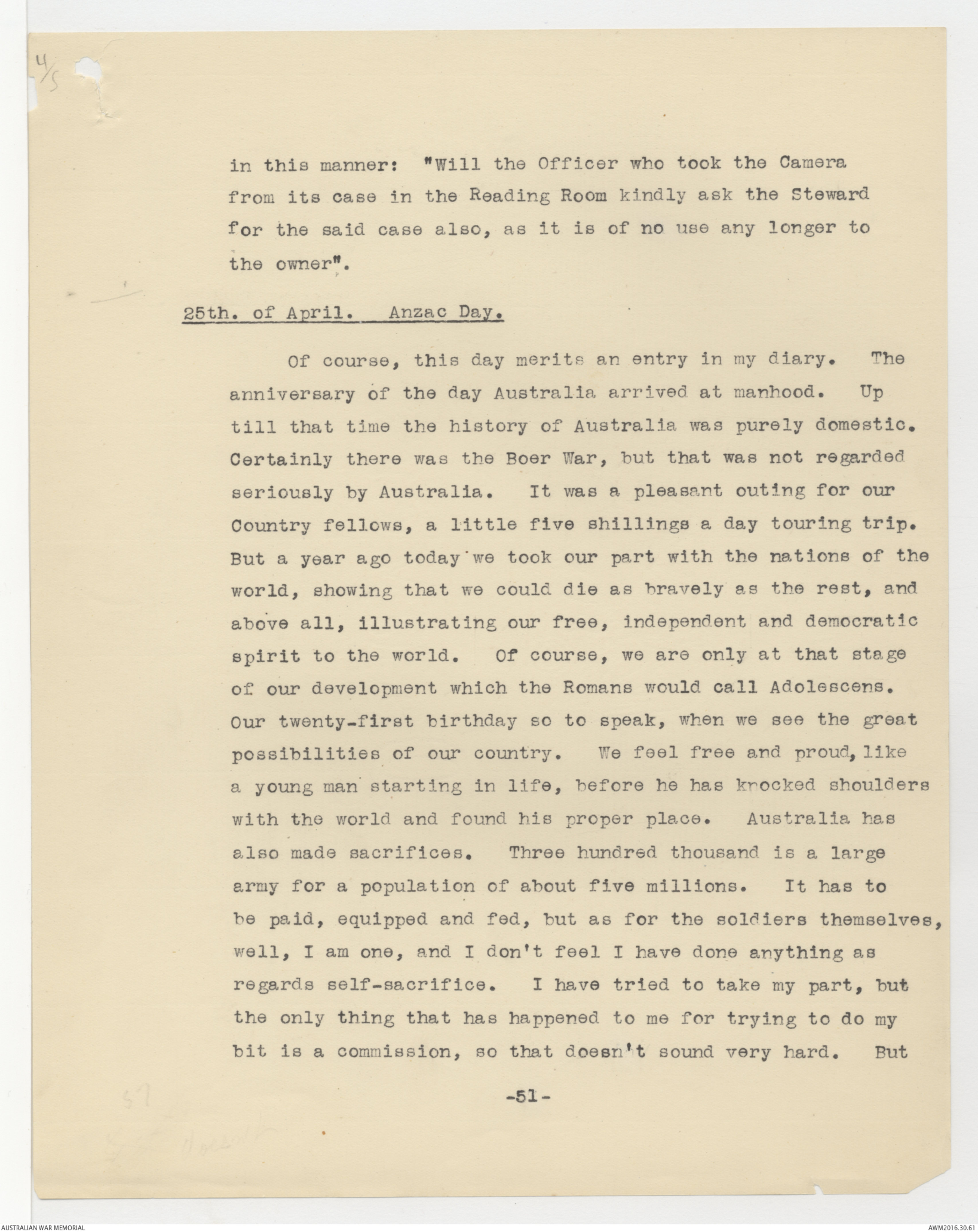
in this manner: "Will the Officer who took the Camera
from its case in the Reading Room kindly ask the Steward
for the said case also, as it is of no use any longer to
the owner".
25th. of April. Anzac Day.
Of course, this day merits an entry in my diary. The
anniversary of the day Australia arrived at manhood. Up
till that time the history of Australia was purely domestic.
Certainly there was the Boer War, but that was not regarded
seriously by Australia. It was a pleasant outing for our
Country fellows, a little five shillings a day touring trip.
But a year ago today we took our part with the nations of the
world, showing that we could die as bravely as the rest, and
above all, illustrating our free, independent and democratic
spirit to the world. Of course, we are only at that stage
of our development which the Romans would call Adolescens.
Our twenty-first birthday so to speak, when we see the great
possibilities of our country. We feel free and proud, like
a young man starting in life, before he has knocked shoulders
with the world and found his proper place. Australia has
also made sacrifices. Three hundred thousand is a large
army for a population of about five millions. It has to
be paid, equipped and fed, but as for the soldiers themselves,
well, I am one, and I don’t feel I have done anything as
regards self-sacrifice. I have tried to take my part, but
the only thing that has happened to me for trying to do my
bit is a commission, so that doesn't sound very hard. But
-51 -
5/5
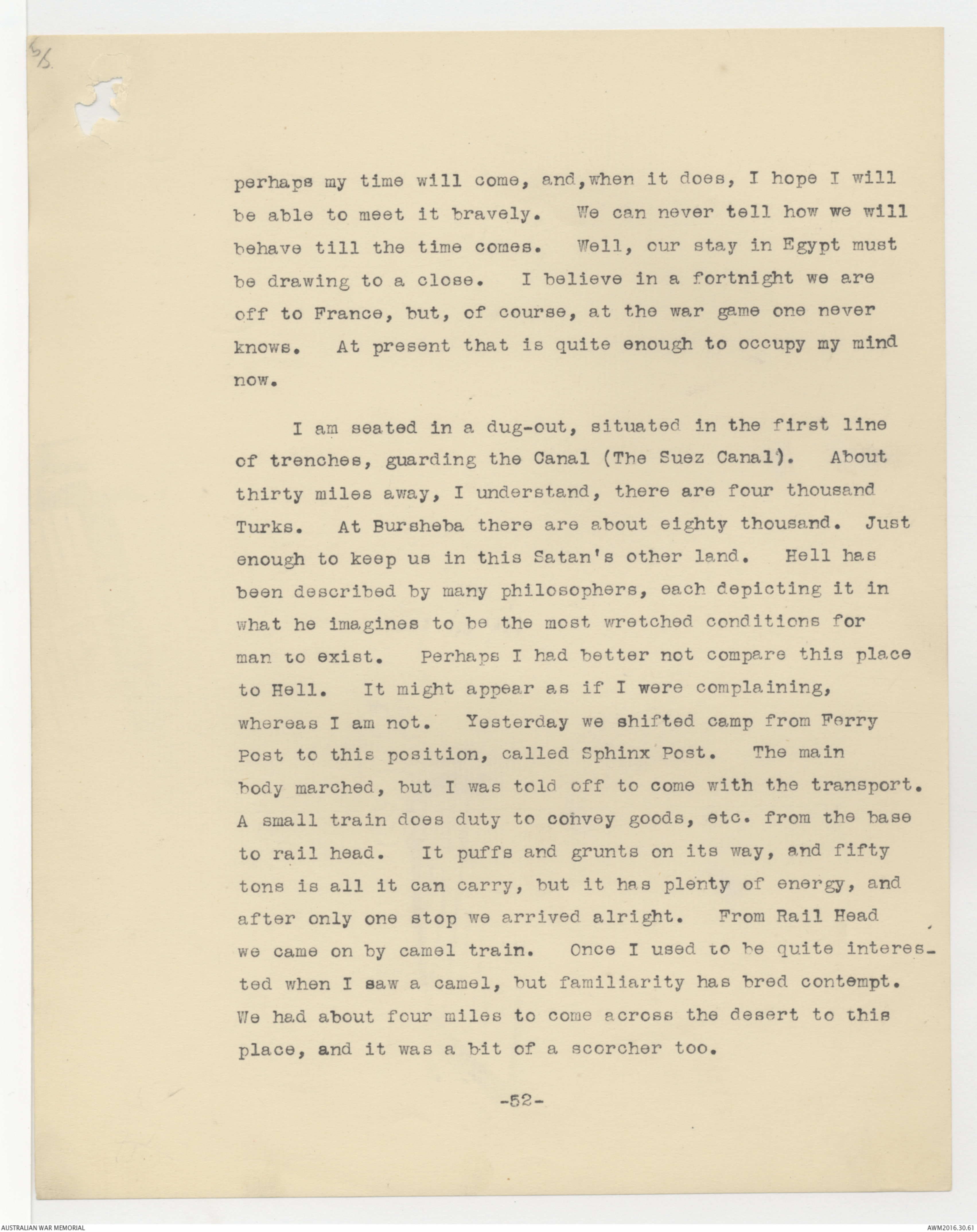
perhaps my time will come, and,when it does, I hope I will
be able to meet it bravely. We can never tell how we will
behave till the time comes. Well, our stay in Egypt must
be drawing to a close. I believe in a fortnight we are
off to France, but, of course, at the war game one never
knows. At present that is quite enough to occupy my mind
now.
I am seated in a dug-out, situated in the first line
of trenches, guarding the Canal (The Suez Canal). About
thirty miles away, I understand, there are four thousand
Turks. At Bursheba there are about eighty thousand. Just
enough to keep us in this Satan's other land. Hell has
been described by many philosophers, each depicting it in
what he imagines to be the most wretched conditions for
man to exist. Perhaps I had better not compare this place
to Hell. It might appear as if I were complaining,
whereas I am not. Yesterday we shifted camp from Ferry
Post to this position, called Sphinx Post. The main
body marched, but I was told off to come with the transport.
A small train does duty to convoy goods, etc. from the base
to rail head. It puffs and grunts on its way, and fifty
tons is all it can carry, but it has plenty of energy, and
after only one stop we arrived alright. From Rail Head
we came on by camel train. Once I used to be quite interested
when I saw a camel, but familiarity has bred contempt.
We had about four miles to come across the desert to this
place, and it was a bit of a scorcher too.
-52-
6/5
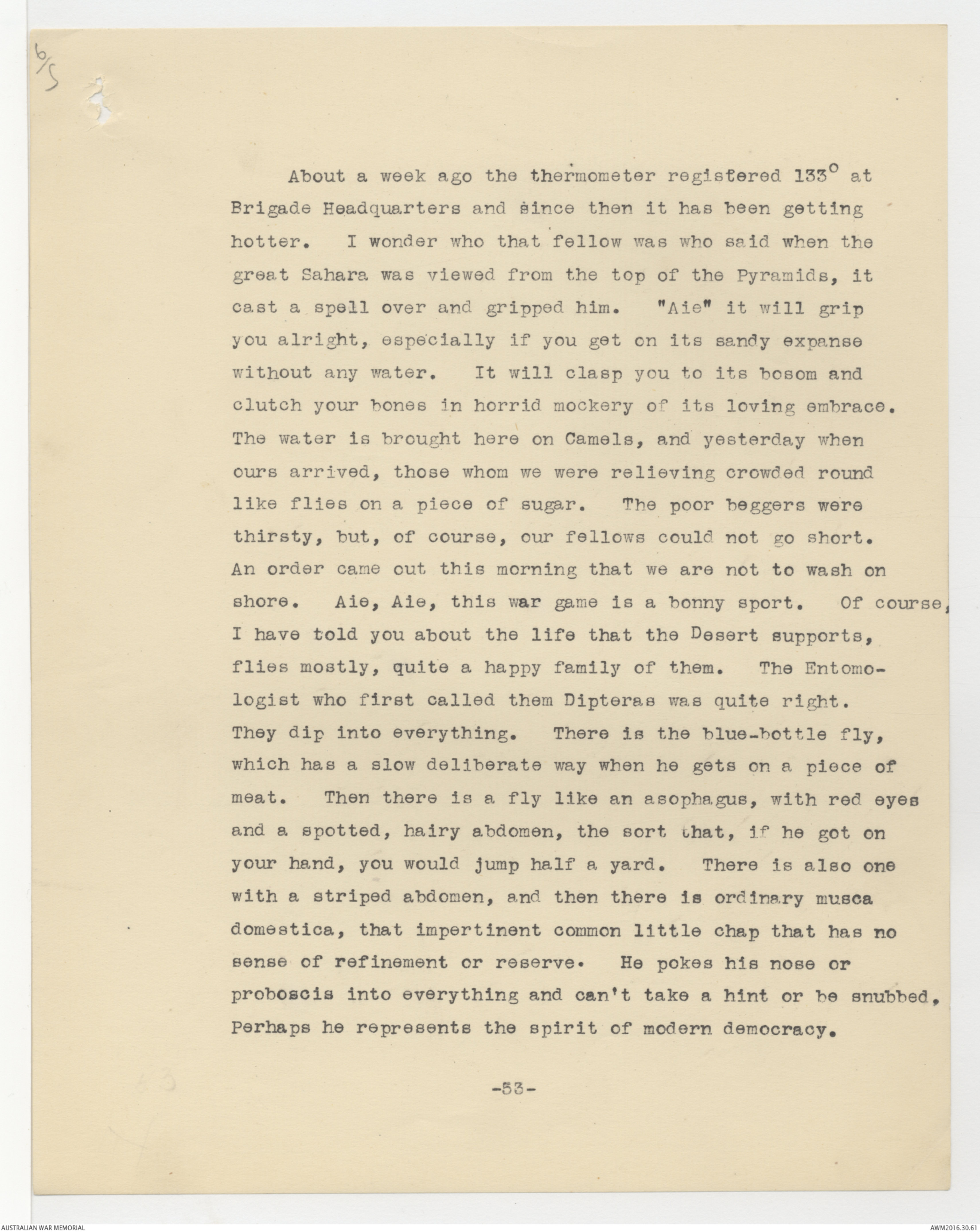
About a week ago the thermometer registered 133° at
Brigade Headquarters and since then it has been getting
hotter. I wonder who that fellow was who said when the
great Sahara was viewed from the top of the Pyramids, it
cast a spell over and gripped him. "Aie" it will grip
you alright, especially if you get on its sandy expanse
without any water. It will clasp you to its bosom and
clutch your bones in horrid mockery of its loving embrace.
The water is brought here on Camels, and yesterday when
ours arrived, those whom we were relieving crowded round
like flies on a piece of sugar. The poor beggers were
thirsty, but, of course, our fellows could not go short.
An order came out this morning that we are not to wash on
shore. Aie, Aie, this war game is a bonny sport. Of course,
I have told you about the life that the Desert supports,
flies mostly, quite a happy family of them. The Entomologist
who first called them Dipteras was quite right.
They dip into everything. There is the blue-bottle fly,
which has a slow deliberate way when he gets on a piece of
meat. Then there is a fly like an asophagus, with red eyes
and a spotted, hairy abdomen, the sort that, if he got on
your hand, you would jump half a yard. There is also one
with a striped abdomen, and then there is ordinary musca
domestica, that impertinent common little chap that has no
sense of refinement or reserve. He pokes his nose or
proboscis into everything and can't take a hint or be snubbed,
Perhaps he represents the spirit of modern democracy.
-53-
7/5
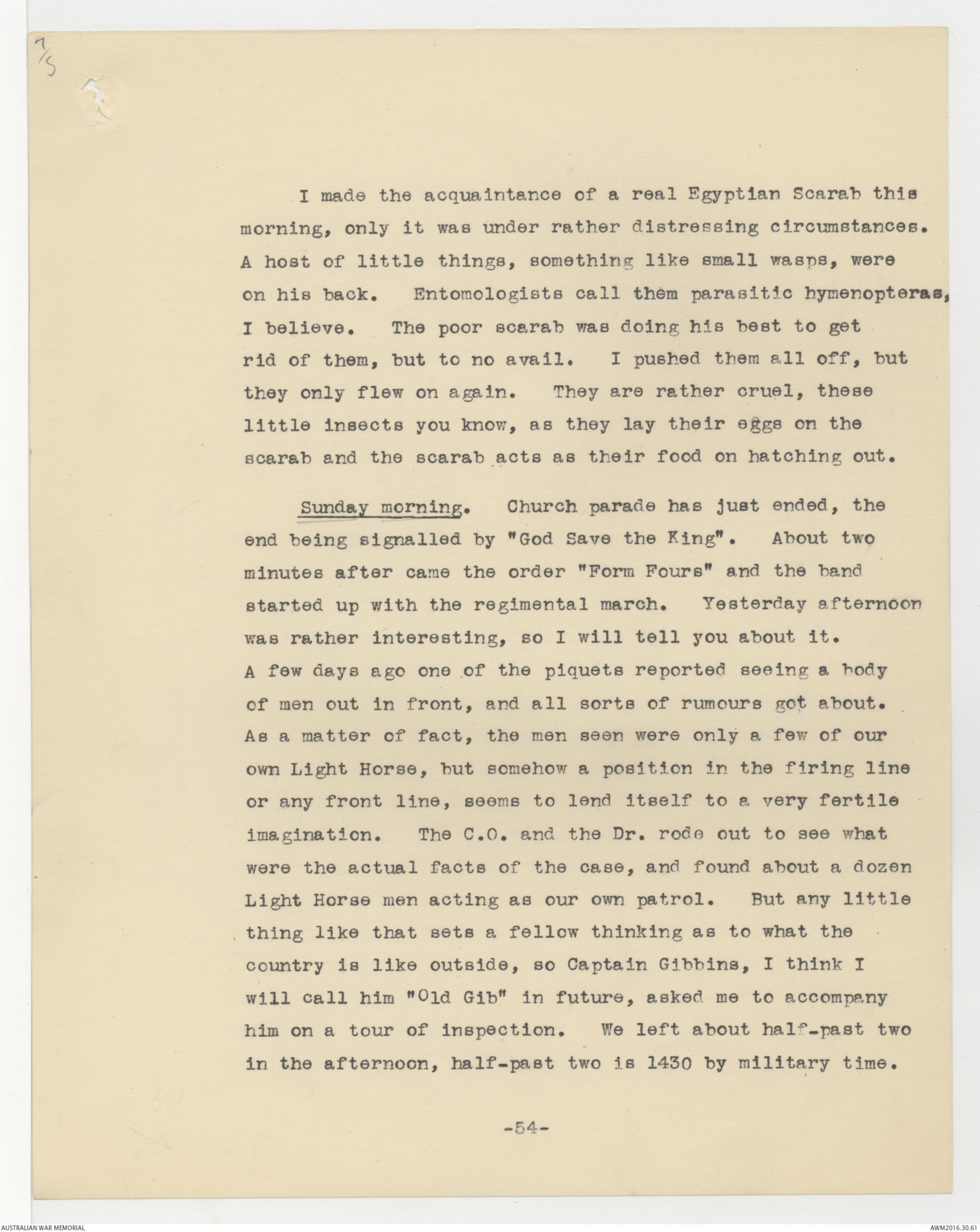
I made the acquaintance of a real Egyptian Scarab this
morning, only it was under rather distressing circumstances.
A host of little things, something like small wasps, were
on his back. Entomologists call them parasitic hymenopteras,
I believe. The poor scarab was doing his best to get
rid of them, but to no avail. I pushed them all off, but
they only flew on again. They are rather cruel, these
little insects you know, as they lay their eggs on the
scarab and the scarab acts as their food on hatching out.
Sunday morning. Church parade has just ended, the
end being signalled by "God Save the King". About two
minutes after came the order "Form Fours" and the band
started up with the regimental march. Yesterday afternoon
was rather interesting, so I will tell you about it.
A few days ago one of the piquets reported seeing a body
of men out in front, and all sorts of rumours got about.
As a matter of fact, the men seen were only a few of our
own Light Horse, but somehow a position in the firing line
or any front line, seems to lend itself to a very fertile
imagination. The C.O. and the Dr. rode out to see what
were the actual facts of the case, and found about a dozen
Light Horse men acting as our own patrol. But any little
thing like that sets a fellow thinking as to what the
country is like outside, so Captain Gibbins, I think I
will call him "Old Gib" in future, asked me to accompany
him on a tour of inspection. We left about half-past two
in the afternoon, half-past two is 1430 by military time.
-54-
8/5
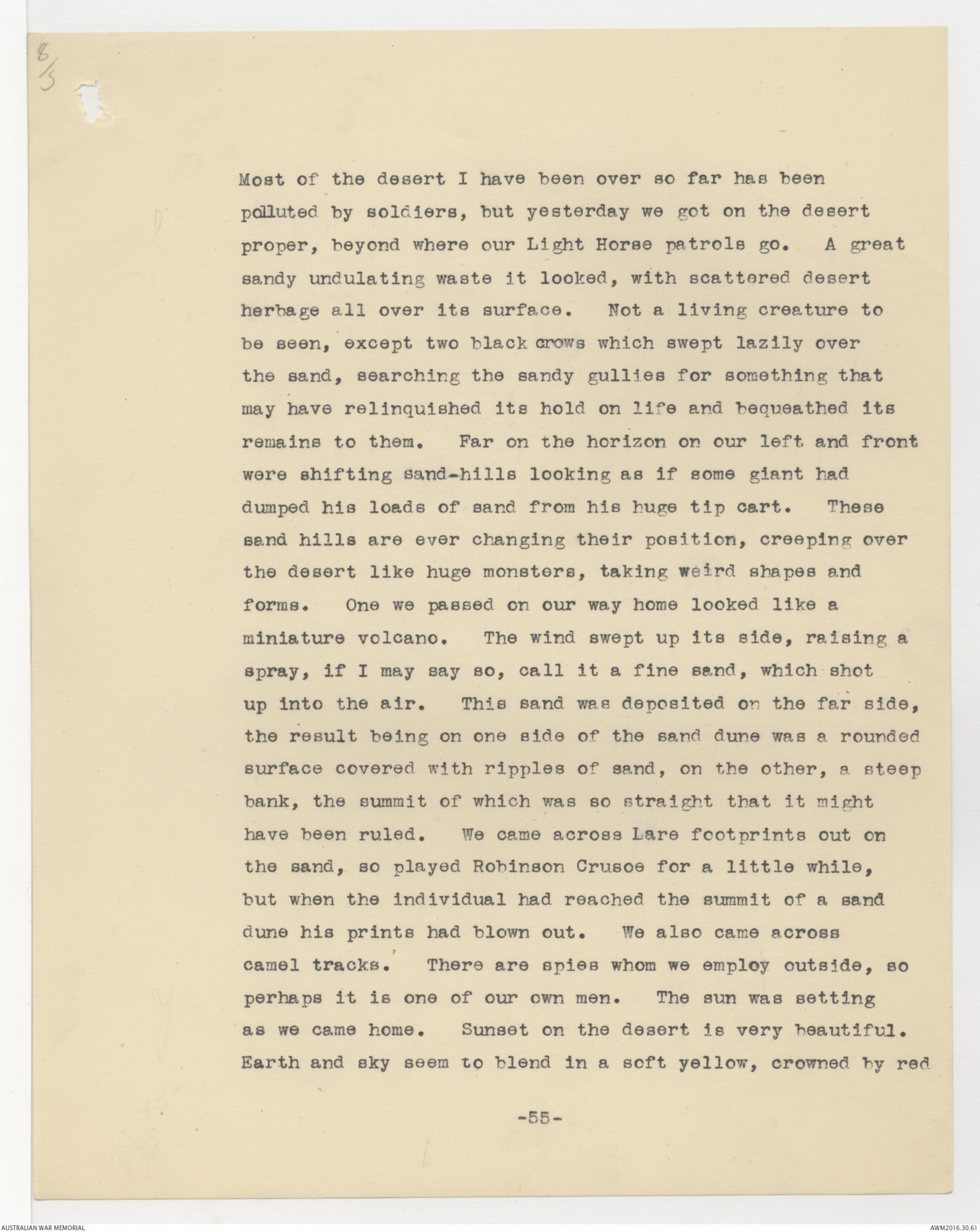
Most of the desert I have been over so far has been
polluted by soldiers, but yesterday we got on the desert
proper, beyond where our Light Horse patrols go. A great
sandy undulating waste it looked, with scattered desert
herbage all over its surface. Not a living creature to
be seen, except two black crows which swept lazily over
the sand, searching the sandy gullies for something that
may have relinquished its hold on life and bequeathed its
remains to them. Far on the horizon on our left and front
were shifting sand-hills looking as if some giant had
dumped his loads of sand from his huge tip cart. These
sand hills are ever changing their position, creeping over
the desert like huge monsters, taking weird shapes and
forms. One we passed on our way home looked like a
miniature volcano. The wind swept up its side, raising a
spray, if I may say so, call it a fine sand, which shot
up into the air. This sand was deposited on the far side,
the result being on one side of the sand dune was a rounded
surface covered with ripples of sand, on the other, a steep
bank, the summit of which was so straight that it might
have been ruled. We came across Lare footprints out on
the sand, so played Robinson Crusoe for a little while,
but when the individual had reached the summit of a sand
dune his prints had blown out. We also came across
camel tracks. There are spies whom we employ outside, so
perhaps it is one of our own men. The sun was setting
as we came home. Sunset on the desert is very beautiful.
Earth and sky seem to blend in a soft yellow, crowned by red
-55-
9/5
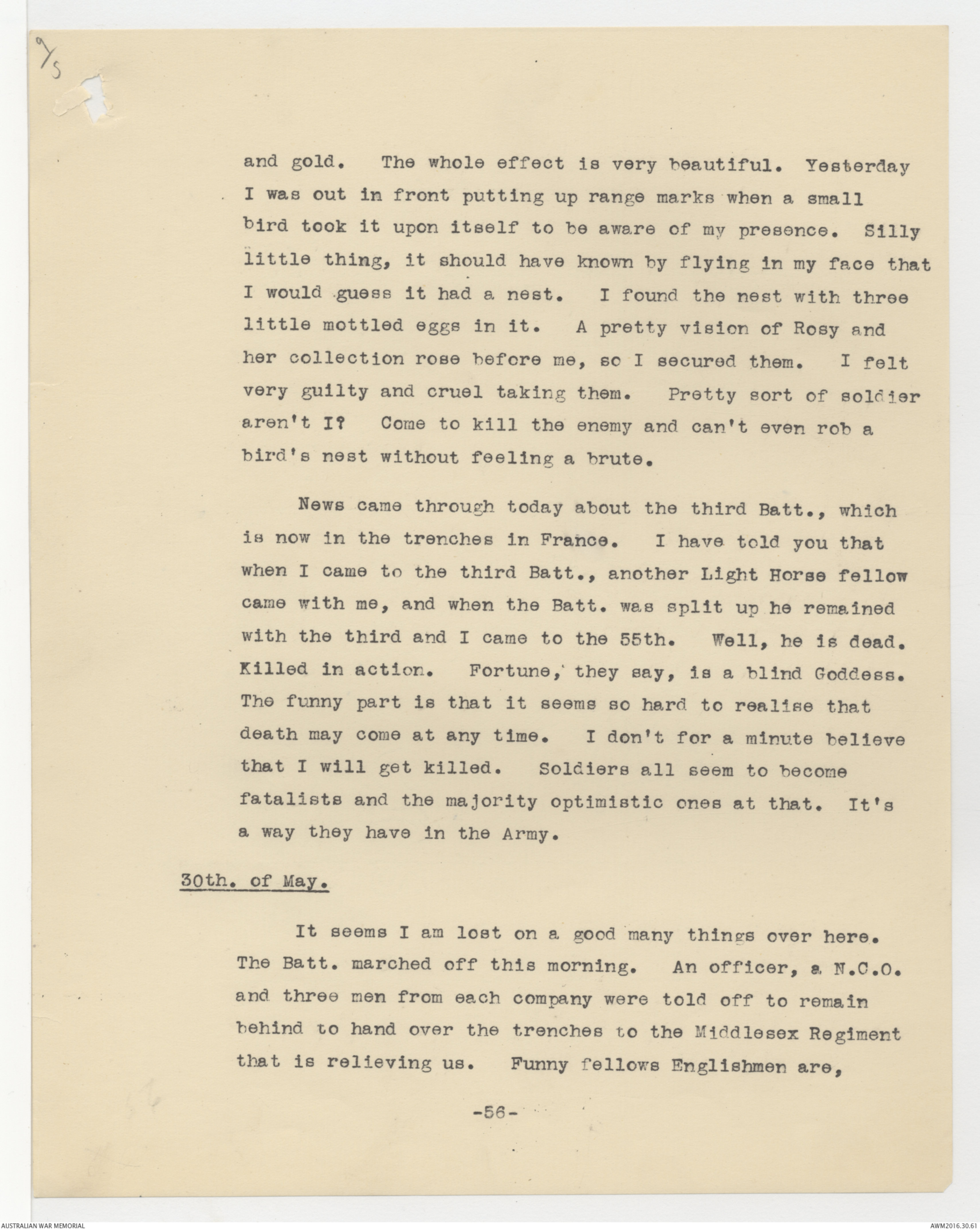
and gold. The whole effect is very beautiful. Yesterday
I was out in front putting up range marks when a small
bird took it upon itself to be aware of my presence. Silly
little thing, it should have known by flying in my face that
I would guess it had a nest. I found the nest with three
little mottled eggs in it. A pretty vision of Rosy and
her collection rose before me, so I secured them. I felt
very guilty and cruel taking them. Pretty sort of soldier
aren't I? Come to kill the enemy and can't even rob a
bird's nest without feeling a brute.
News came through today about the third Batt., which
is now in the trenches in France. I have told you that
when I came to the third Batt., another Light Horse fellow
came with me, and when the Batt. was split up he remained
with the third and I came to the 55th. Well, he is dead.
Killed in action. Fortune, they say, is a blind Goddess.
The funny part is that it seems so hard to realise that
death may come at any time. I don't for a minute believe
that I will get killed. Soldiers all seem to become
fatalists and the majority optimistic ones at that. It's
a way they have in the Army.
30th. of May.
It seems I am lost on a good many things over here.
The Batt. marched off this morning. An officer, a N.C.O.
and three men from each company were told off to remain
behind to hand over the trenches to the Middlesex Regiment
that is relieving us. Funny fellows Englishmen are,
-56-
10/5
[*p.48*]
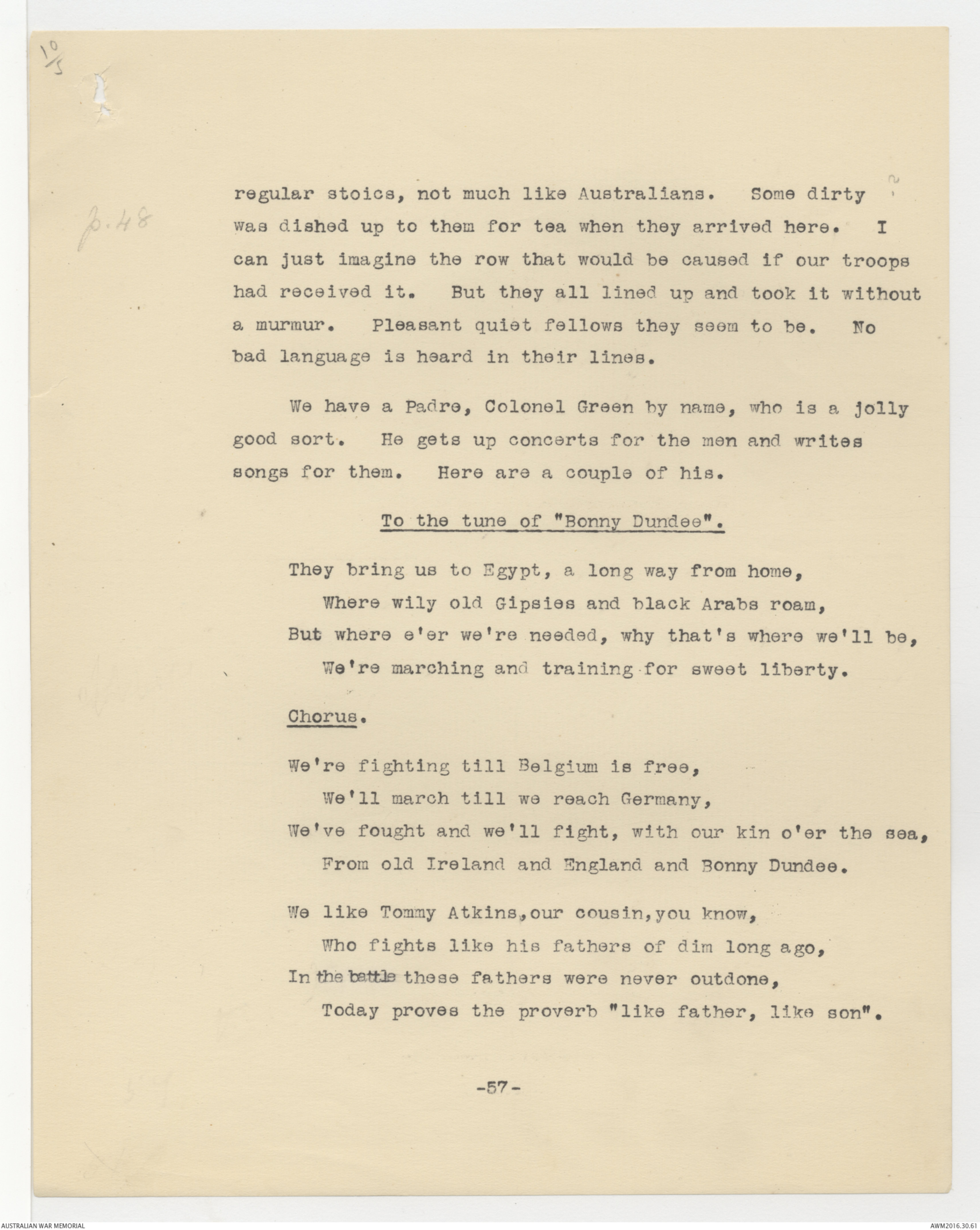
regular stoics, not much like Australians. Some dirty ?
was dished up to them for tea when they arrived here. I
can just imagine the row that would be caused if our troops
had received it. But they all lined up and took it without
a murmur. Pleasant quiet fellows they seem to be. No
bad language is heard in their lines.
We have a Padre, Colonel Green by name, who is a jolly
good sort. He gets up concerts for the men and writes
songs for them. Here are a couple of his.
To the tune of "Bonny Dundee".
They bring us to Egypt, a long way from home,
Where wily old Gipsies and black Arabs roam,
But where e'er we're needed, why that's where we'll be,
We're marching and training for sweet liberty.
Chorus.
We're fighting till Belgium is free,
We'll march till we reach Germany,
We've fought and we'll fight, with our kin o'er the sea,
From old Ireland and England and Bonny Dundee.
We like Tommy Atkins, our cousin, you know,
Who fights like his fathers of dim long ago,
In the battle these fathers were never outdone,
Today proves the proverb "like father, like son".
-57-
11/5
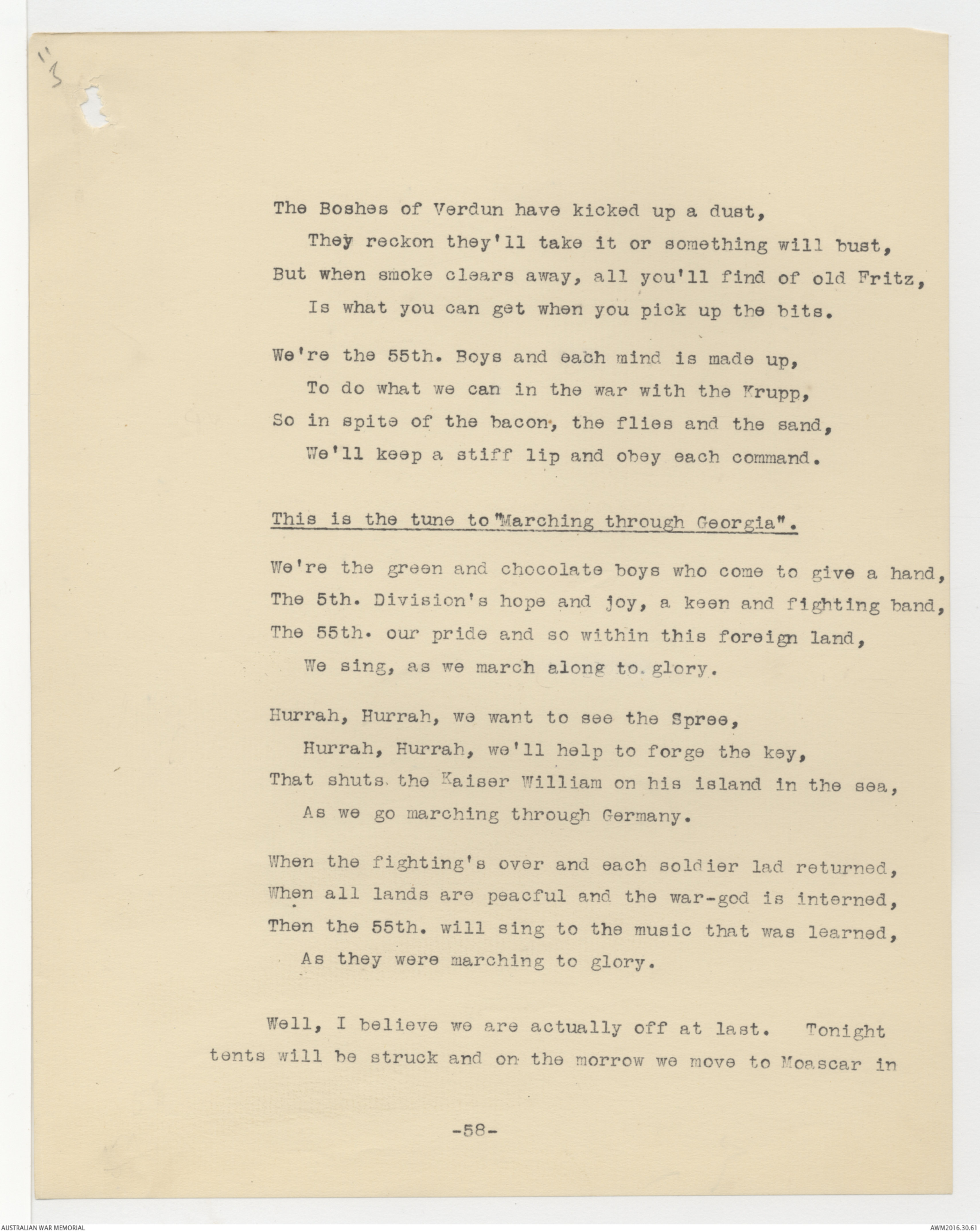
The Boshes of Verdun have kicked up a dust,
They reckon they'll take it or something will bust,
But when smoke clears away, all you'll find of old Fritz,
Is what you can get when you pick up the bits.
We're the 55th. Boys and each mind is made up,
To do what we can in the war with the Krupp,
So in spite of the bacon, the flies and the sand,
We'll keep a stiff lip and obey each command.
This is the tune to "Marching through Georgia".
We're the green and chocolate boys who come to give a hand,
The 5th. Division's hope and joy, a keen and fighting band,
The 55th. our pride and so within this foreign land,
We sing, as we march along to glory.
Hurrah, Hurrah, we want to see the Spree,
Hurrah, Hurrah, we'll help to forge the key,
That shuts the Kaiser William on his island in the sea,
As we go marching through Germany.
When the fighting's over and each soldier lad returned,
When all lands are peacful and the war-god is interned,
Then the 55th. will sing to the music that was learned,
As they were marching to glory.
Well, I believe we are actually off at last. Tonight
tents will be struck and on the morrow we move to Moascar in
-58-
12/5
order to entrain for Alexandria, but our comings and goings
are cancelled so often that it is useless to anticipate.
Yesterday I was in Ishmalia. The first leave I have had
for nearly six months, and when in there I bought some
things for you. Silks, they were. I had always kept
off those silks till yesterday and I don't know why I
bought them now.
22nd. June 1916.
I am writing on board the H.M.S. Caledonia, a boat of
about nine thousand five hundred tons. Near me a gramophone
is doing its duty. This one is not a gift but belongs
to the ship. A piano and an organ also decorate the
writing room, so you see I am comfortable. Life-belts are
again playing their part. We have to wear the beastly
things everywhere we go. At dinner they must be at
ones feet, at night under one's head, at all other times
round one's waist. We are on our way to France. This
morning we passed some Islands. They looked rugged and
bare from on board. I heard it said that one was Crete.
A small destroyer ploughed her way beside us this morning,
but now has departed. Somewhere within half-an-hour's
journey are three trawlers, ready to steam up at the first
signal of distress in order to save those having a swim in
the sea. On the last boat I was on, boats were allotted
to each platoon, but here the orders are that, should we
get struck by a Torpedo, troops are to be lined up on
board and ordered to jump overboard. The boats and rafts
can then be lowered without being smashed.
-59-
13/5
I have a pet on board in the shape of a chameleon, whose
colour changes every time he gets on a different coloured
surface, and which eats flies by shooting out his tongue
about six inches. He has various nick-names. Some call
him Clarence, others Percy. The ladies of New York, some
years ago, used to have these things as pets and carry them
about chained to their shoulders. They are a kind of lizard.
Cammy, as I call him, has a good deal of attention showered
upon his shoulders.
Marseilles, 30th. June.
We have at last arrived at Marseilles after an uneventful
voyage from Malta. A cruiser accompanied us all the
way till well up in the Gulf of Lyons. Marseilles is a
pleasant change after Egypt, that perpetual land of sameness.
Here one could almost persuade himself that he was viewing
some scenic railway at the White City. At the left entrance
into the harbour are rugged white peaks of rock with railway
tracks through them and large factories belching out smoke
and blackness, but there are trees here and green grass.
Trees, think of it. The outer harbour is just a large
circular bay, bounded by high hills, mostly composed of
limestone. At the foot of these are houses surrounded
by green trees, their red-tiled roofs just showing. Isolated
peaks of rock jut out of the water on the right side.
Entering on one of these is an old castle, while on another
are fortifications. Behind Marseilles proper rise steep,
while rugged hills. Overlooking the harbour, situated on
-60-
14/5
a high hill, is a church, with a high, white statue of
"Notre Dame de la Mer", looking seawards. It all looks
very picturesque. The inner harbour is artificial, a
breakwater being the boundary between rough and still
water. The Caledonia was hauled into the wharf by these
busy little tugs, which fumed and puffed, looking very
important, while the band played the Marseillaise. At
present, disembarkation officers, staff officers, are
everywhere, talking, arranging, straffing, etc.
My trip across has not been altogether pleasant, as
the first night I slept forehead on deck, and the next morning
woke up to find I was deaf. It is a most awful thing to
be deaf, and especially at this time, when, if I had been
affected permanently, well, it would have been a trip home
to Australia, and I don't want that. Egypt, I expect, was
the chief cause. By the time I left there, I felt I would
rather sit down and sleep than work. I can't stand heat.
I knew I would get alright again, so did not mention the
fact to anyone, but it is a most lonely feeling. I could
hear when people spoke a little loudly, so it passed off
alright, and this morning something went snap in my ear, and
behold, I was perfectly right again.
I will have to start a fresh diary about my experiences
at the French frontier, as this one is just about filled.
I have not kept a full record right through, but it may give
[*p.52 ?*]
you an idea of where I have been and done. A good many
things I have left out, but it would cause a little repetition
of they were inserted, and the general idea is embodied here.
-61-
15/5
France.
I had better get this diary finished and posted, otherwise
there is a possibility that it will not go at all.
During the last few days we have been winding our way
through France in a train. The scenery was most beautiful.
I have never seen anything like it. However, I will leave
the description till some other time, as I am not in a
literary frame of mind at present.
-62-
 Daniela R
This transcription item is now locked to you for editing. To release the lock either Save your changes or Cancel.
This lock will be automatically released after 60 minutes of inactivity.