
Typescript copy of diary entries of Percy Wellesley Chapman, 1 July 1915 to 30 June 1916 - Part 5
were made of cases of biscuits and bully beef, these
were all smashed in, the biscuits scattered about and sawdust
thrown over all. All our dug-outs and most of the
hospital tents were left standing; we of the rearguard
could help ourselves to anything we wanted; tinned Machonacies,
stews, tinned milk, jam, gum boots, anything in
fact that was left, but they were not of much use as we
could not carry them away. The day before we left Colonel
Meredith informed us that we were honoured by being
allowed to remain amongst the last on the Peninsular. But
our regiment was split up into two parties, the batsmen
and some others left on the Saturday night; of the remainder
seventy-five were chosen to leave the trenches at
three o’clock on Monday morning, the remainder left early
on Sunday night. I was lucky enough to be amongst the
last to go. Eight only of our squadron remained behind.
Captain Weir, Sergeant Major Frost, Sergeant Broom, Corporal
Kingsford, Corporal Kelly, Corporal Michael, Jack
Holland, Henderson, Fraser and myself. Our Kits were
carried down by those who went before. Ted carried mine
and I believe expressed his feelings rather strongly on
the way as to my fondness for souvenirs. I had a Turkish
shell in my haversack which I had picked up and have brought
along with me. I was sorry for those who had to carry
our things for us, but there was a possibility of the
Turks sending the last party off rather hurriedly, so
necessity ordered that our tent mates should carry our
swags into the boat for us: Well there is not much to
say about the last few hours in the trenches, seventy-
five of us were holding what was formerly held by fifteen
hundred. But the Turks did not know. Scattered firing
--41-
went on just as usual. I amused myself by taking a charge
out of a cricket ball bomb in order to keep it as a
souvenir. At twenty-twe minutes past three we filed out
of the trenches, and as we did a red glare lit up Walker’s
ridge on our right where they had blown up the Turks.
Abdul answered with a rattle of machine gun-fire, but our
trenches were then empty. Not a hitch occurred in the
embarkation, as we left our positions the rattle of machine
guns hinted that we might be cut off, our march grew into
a hurried trot but it was quite orderly. We marched straight
on to the punt which awaited to take us on to the transport
steamer, the last transport that left Anzac with troops.
A few blue jackets remained on shore to blow up the piers
etc., so here we are now about to return to Egypt and to
the horses I believe. Lemnos Island is not a very
interesting
place in the middle of winter, undulating barren
hills is all it boasts of. In the spring I believe the
place looks very pretty, covered with green crops and vine
yards. During our stay there our regiment was rather
short of tucker, so one man from each troop was sent to
buy stores. It fell to my lot to go so I had a chance
of seeing a Greek village. The houses are all built of
stone, there are no verandahs, the water supply seems to
come from village wells, the streets are narrow and muddy.
Greek girls are all more or less heavily built, but they
are plump and rather pretty. The men are the dandies,
blue breeches and stockings, shoes, and a peculiar blue
vest.
Christmas Day.
I must make an entry to-day but circumstances
don’ t
--42
allow of saying very much. Our table is occupied by a
number of fellows playing Banker, gambling is the only
occupation on board, on deck all day groups form
round
the crown and anchor boards, and at night cards; are the
ruling passion below. Christmas passed very quietly
except that this afternoon a burial service took place
on board, one of the troops died, I don't know the cause
of death. We were issued plum pudding and wine for dinner,
so the day has not passed unnoticed. We are on the move
again and if my writing is not very legible it is owing
to the fact that we are travelling in a third class
Egyptian carriage, and I hope you won't do so. They
resemble horse boxes, the only difference being that
they have six poky little windows on each side, a door
at each end and seating accommodation for
forty-eight
people, the seats are made of wood and hard, good Lord,
they are hard, comfort or rest seem. to be the chief
aims of avoidance by the builders. There are
forty-four
of us in this carriage, so you see according to what it
is supposed to carry the full complement is not here, but
then we each have our packs, wet equipment, rifles, etc.,
so the place is full, there are men and kits mixed up
together on the floor in a tangled mass. I trod on a
fellow's leg not long ago while making my way out to buy
some oranges, there were three fellows and their kits
mixed up together in the passage way. I'm afraid writing
under these conditions is hopeless.
January 17th
It behoves me to start on another: page after
that wobbly writing on the last sheet; it makes me laugh
-43-
every time I look at it, the resemblance to this third
class carriage is so great. Well I am in the infantry
now as a subaltern or 2nd Lieutenant and the conditions
are slightly different to those enjoyed in the ranks.
First we have an officer’s mess and don't have to wash our
own dixies in sand, and of course, well I won't describe
it, everything is better. We are camped on the old
battle-field of Telel Kebir. I am an ignorant sort of a
fellow: here is an historic battle-field and I don’t
know anything about it. I don't admit my ignorance to
every one. When the name is mentioned I casually remark,
Oh yes, do you remember the exact details of that battle;?
but somehow the subject gets dropped. The old gun-mounds
will be painted out with gusto, but they are plain to
every one, and then the speaker hears a remark passed by
someone else or has to see a friend. Isn't it strange
how we hate to say I don't know.
To our critic to an Australian Soldier in Egypt:
"Ain’t you got no blanky song, have you got no better use,
Than to fling back home your inky products of your pen's abuse?
since we landed over here,
Do you think we've all gone dippy, since we landed over here,
Is a soldier less a soldier 'cos he socks a pint of beer?
Do you take your whisk and soda in a cool and shady spot
Waited on by little Hebes who the boys don't know as ot?
Have you got no loving Mother waiting for you over 'ome
Do you own no smiling sister over there across the foam?
Do you think they likes you better for your tales of drink & shame
Do you think they'll praise your actions in defaming our fair name?
One swallow makes no summer, there shickers not a force,
Where a few makes it a welter. you condemns the lot of course.
stars:
Do you think ver Gawd Almighty cos you wears a Captain’s star?s
Thinks us blokes is dirt beneath you, men of low degree and bars.
Say yer cannot be Australian, let us say in our defence
You can read it on your coinage - Honi soit qui mal y pense.
-44
Cease your wouseristic whining tell the truth and play the game.
And we only ask fair drinking, how we keep Australia's name.
Tight the devil on a new salvarmy stunt
To reform the Arab's moralswhile We're waiting for the Front.
Let me ask yer Mr. Critic try and face things with a smile -
Don’t be findin’ all the crook'uns studying them blokes all the while
Then just write home nice and proper 'bout the boys that's all true
blue,
And they'll love yer better, this is my advice to you.
blue,
Gunner F.C. Westbrook at Mena wrote this.
Sunday, 5th. March, 1916.
It is just a year to-day since I enlisted, so of
course the occasion merits an entry in my diary. This
afternoon I spent writing to you and to home. This is
rather a peculiar diary, I have not made an entry for some
time but there is practically nothing to write about.
Tel-el-Kebir is about half-way between Cairo and Ismalia,
a small Arab town situated on the sweet water canal; the
town itself is not very interesting, just an ordinary
Egyptian town built of mud bricks, donkeys carrying their
burdens through the streets, their forlorn
woe-begone
faces, long ears and skinny, dirty appearance quite
harmonises with their surroundings. Egyptians in dirty,
flowing garments sell papers, oranges or chocolates. One
wonders how the oranges can be eaten when the appearance
of the sellers is so dirty. Of course, the better class
of Egyptian is not like this, he is pompous and fat for the
most part, while those working as clerks in the railway
department and other places ape European clothes, the
only article of Egyptian make being the red fez cap.
-45-
Well, it is just about time I made an entry in my
diary. I have been lying down on the sand in a tent, not
of course in a tent as I was going to say, as the last two
or three days have been spent under an Egyptian sun, and
under rather trying conditions. We have just completed
a march from Tel-el-Kebir to a place called Ferry Post
about four miles past Ismalia, and that march was done
with a full kit up over the desert. But by this time
the inconveniences have had time to fade, and although the
march seemed hard at the time it was only a
Thirty-five mile
strut over the desert, which took us a little over two
days to do. The first day we did about fifteen miles over
good sand but the next was over the soft shifting sand,
and as our water ran out about mid-day, well the afternoon
could have been a little more pleasant. On the way we
passed some salt lakes with a few scattered palm trees
round their edge. An Arab camp also added to the interest.
Those people live just as they did five thousand years ago,
driving their herds of sheep and goats over the desert,
camping where any vegetation shows and then moving on again.
Their tents are made out of black goat hair just propped
up anyhow with a few tent poles. For a week we camped
at Ferry Post near Ishmalia on the Suez Canal and had
plenty of swimming and fishing. The Canal is just like
a river, a strong current runs northwards at the rate of
about two miles an hour. We did a little outpost work, and
when on duty on the banks of the Canal saw at night the
large steamers with their huge searchlights moving slowly along.
-46-
The light at night looks very weird as the shadows kept continually
moving forward. Now we have moved on again into the
desert where our training is to be completed, and within a
few weeks I believe we are off to France. I don't know if I
can make an entry for each time we shift camp.
To-day is
Sunday only not an Australian Sunday. This is Egypt, that
land of Cleopatras and ancient history, a land of extremes
and sameness. Extremes in the character of its women folk
who are either very good or very bad. Extremes in the temperature
which is hot during the day and cold at night, but
the sunshine and the desert ever remain the same. At present
I am in charge of a guard looking after an aerodrome in the
desert. The desert in summer is a fine place, flies, fleas,
camels and Arabs, in fact I am getting poetical about it, the
gentle muse has kissed my forehead, I am hers, her I must
obey, here goes -
"I wish I were a camel, a camel I would be,
To hump my burden on the sand, stretching away on either hand,
As far as one can see.
"If I were but a little fly, in Egypt I would be
And drown my sorrows in a cup, of some subalterns tea.
"If I were but a soldier, on piquet I would be,
And nitch my little walking stick, each time I caught a flea.
"And when my stick was nitched quite o’er,
And I had scratched till I was sore,
Another stick . I'd nitch some more, each time I caught a flea.
"If, I were but an Arab, on Egypt desert sand,
I’d slit my blessed jugular co seek a better land.
"If I were but a beetle, I'd crawl upon the sands,
Just to show that life exists, here as in other lands.
"But as I must be satisfied, to be just what I am,
I make up little ditties as senseless as I can.
-47-
The inspirations that one receives do not lead to
very noble results on the desert, do they?
We have changed camp again, and are now on the east side
of the Canal. Messing about is, I suppose, the best way to
explain our doings. Last night we were on outpost work
some distance from the main camp. I was in charge of a
piquet, and when all arrangements for the night had been
made and reliefs were told off, what must happen but a
dust storm. Of course, it would not do to be in Egypt
without experiencing all the vicissitudes of the climate.
After the wind had done its best to fill our ears, eyes,
nose and mouth with sand, a shower of rain tried to occur.
It succeeded just enough to lay the dust, but it was not
an enjoyable night, and now, which happens to be following
afternoon, the ground has dried and the wind is trying to
blow the tent down. Outside, of course, the sun cannot
be seen, the light resembles somewhat the yellow twilight
on a winter’'s evening. Sand is everywhere. Outside it
beats against the tent like sleet, inside - well, it is
inside everything. I grind my teeth and crunch sand. I
have swallowed a good deal also, and, foolishly, had a glass
of water, which appears to have made mud inside me. Anyway,
I feel Father peculiar. Do you know, when I have no news
to write about I generally seem to run into doggerel verse.
The other day we were seated in a hut off duty and Captain
Gibbins, otherwise "Old Gib", pointed to various objects and
said we'd each have to make a piece of poetry about a
special one. He gave me a hat as my subject, and also the
-48-
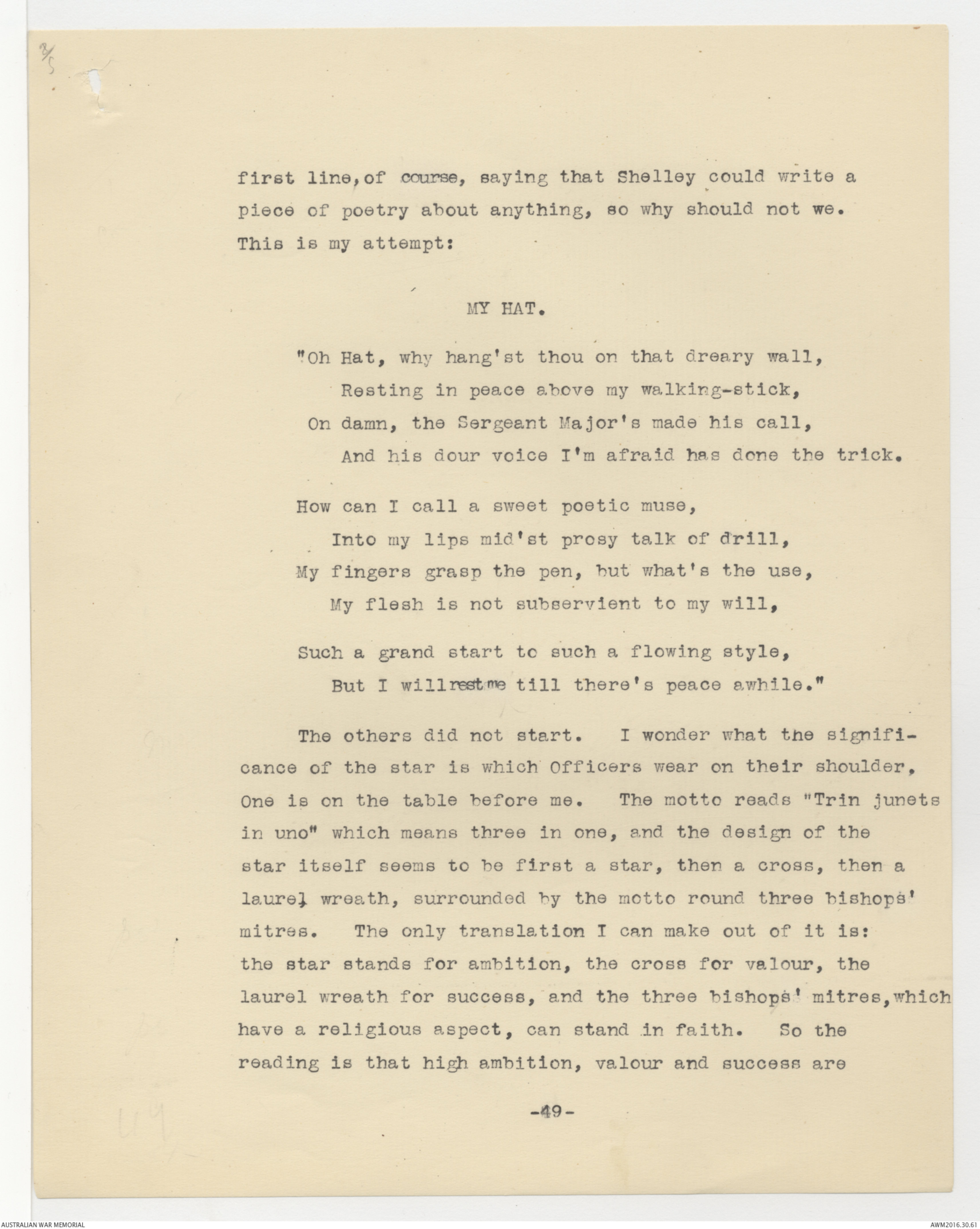
First line, of course, saying that Shelley could write a
piece of poetry about anything, so why should not we.
This is my attempt:
MY HAT.
Ooh Hat, why hang'st thou on that dreary wall,
Resting in peace above my walking-stick,
On damn, the Sergeant Major's made his call,
And his dour voice I'm afraid has done the trick.
How can c Call a sweet poetic muse,
Into my lips mid’ st prosy talk of drill,
My fingers grasp the pen, but what’s the use
My flesh is not subservient to my will,
Such a grand start to such a flowing style,
But I will rest me till there’s peace awhile.
The others did not start. I wonder what the
significance
of the star is which Officers wear on their shoulder,
One is on the table before me. The motto reads "Trin junets
in uno" which means three in one, and the design of the
star itself seems to be first a star, then a cross, then a
laurel wreath, surrounded by the motto round three bishops
mitres. The only translation I can make out of it is:
the star stands for ambition, the cross for valour, the
laurel wreath for success, and the three bishops! mitres, which
have a religious aspect, can stand in faith. So the
reading is that high ambition, valour and success are
-49-
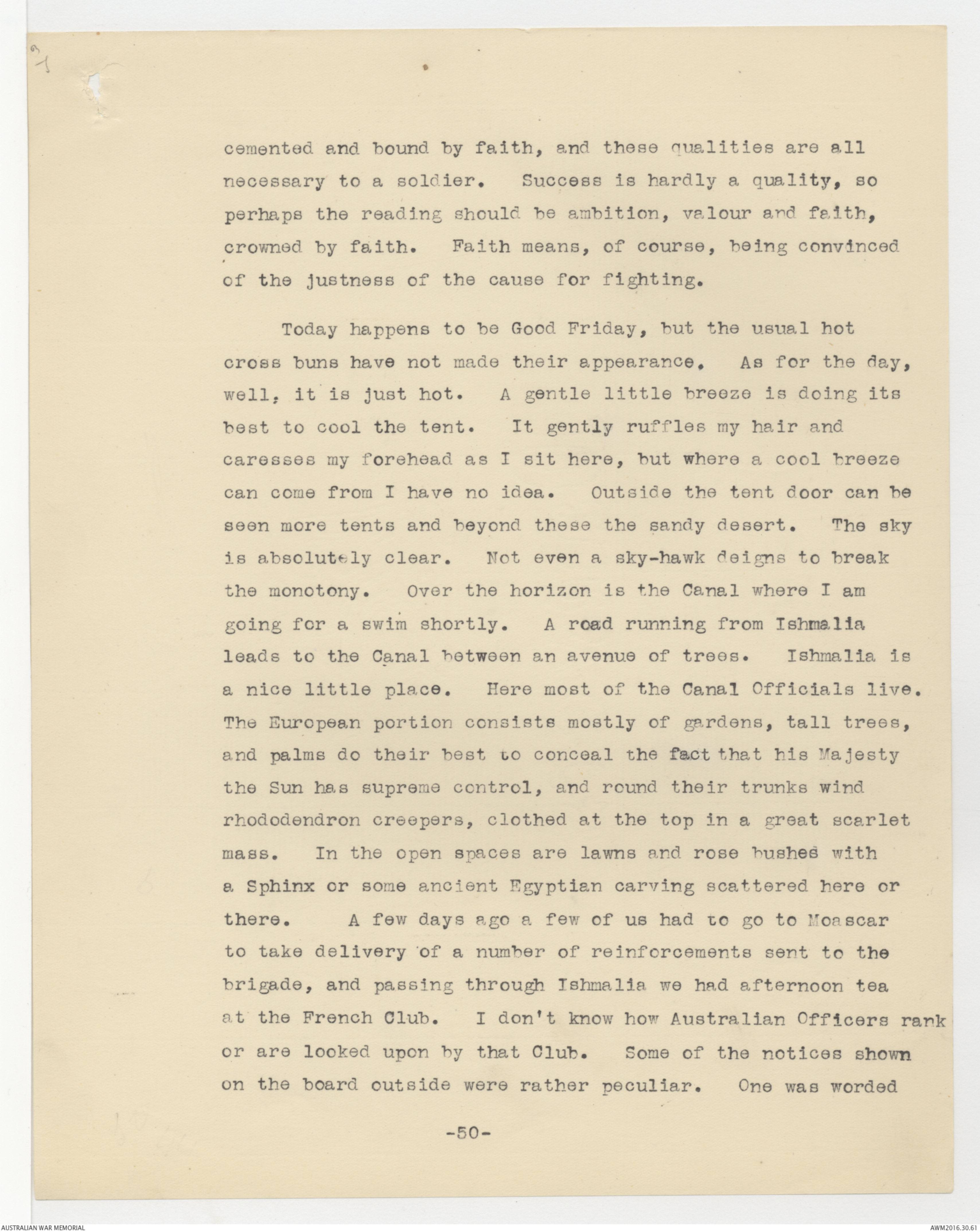
cemented and bound by faith, and these qualities are all
necessary to a soldier. Success is hardly a quality, so
perhaps the reading should be ambition, valour and faith,
crowned by faith. Faith means, of course, being convinced
of the justness of the cause for fighting.
Today happens to be Good Friday, but the usual hot
cross buns have not made their appearance. As for the day,
well, it is just hot. A gentle little breeze is doing its
best to cool the tent. It gently ruffles my hair and
Caresses my forehead as I sit here, but where a cool breeze
can come from I have no idea. Outside the tent door can be
seen more tents and beyond these the sandy desert. The sky
is absolutely clear. Not even a sky-hawk deigns to break
the monotony. Over the horizon is the Canal where I am
going for a swim shortly. A road running from Ishmalia
leads to the Canal between an avenue of trees. Ishmalia is
a nice little place. Here most of the Canal Officials live.
The European portion consists mostly of gardens, tall trees,
and palms do their best to conceal the fact that his Majesty
the Sun has supreme control, and round their trunks wind
rhododendron creepers, clothed at the top in a great scarlet
mass. In the open spaces are lawns and rose bushes with
a Sphinx or some ancient Egyptian carving scattered here or
there. A few days ago a few of us had to go to Moascar
to take delivery of a number of reinforcements sent to the
brigade, and passing through Ishmalia we had afternoon tea
at the French Club. I don't know how Australian Officers rank
or are looked upon by that Club. Some of the notices shown
on the board outside were rather peculiar. One was worded
-50-
 Leanne mckenna
This transcription item is now locked to you for editing. To release the lock either Save your changes or Cancel.
This lock will be automatically released after 60 minutes of inactivity.