
Typescript copy of diary entries of Percy Wellesley Chapman, 1 July 1915 to 30 June 1916 - Part 4
November 28th.
To-day is my birthday and is Sunday, so I will consider
the circumstance merits an entry in my diary. In fact
it is rather a novel way of spending a birthday. Of
yore should I be at home, I would have been ushered into
the breakfast table in state to inspect the huge bundle
of presents on my plate. But to-day I began the Sabbath
at 12 o'clock midnight, rifle in hand, creeping out into
the snow and cold on patrol work. Outside the
dug-out
while I write, sitting in my blankets, the snow flakes
are chasing each other towards the earth, where they
flitter about looking for the most suitable place to
settle. To-day is Thursday and nearly all traces
of the snow have gone. In the sheltered crevices of the
hills it still lingers, just isolated patches here and
there as if it were unwilling to make way for sunny
days. Gallipoli can be cold sometimes, for instance
a couple of mornings ago after we had finished breakfast,
the tea left in the cups and billy froze into a solid
mass, but now peace and sunshine have taken possession;-
except for the crack of rifles in the distance everything
is still. A hospital boat lying at anchor about three
miles out to sea is awaiting its load of sick and wounded--
sometimes when it is cold and miserable a wounded man
is envied because he can go out to a comfortable bed.
Bang! a shrapnel has just burst at Casualty Point right
on the water's edge, too low to do any damage I fancy.
These shells come from a gun known as "Beachy Bill"
concealed somewhere in what is known as the olive grove,
but so far our guns have not been able to silence it, the
number of victims fallen to Beachy Bill total over a
-31-
thousand or more. Three men have been told off as
permanent bomb-throwers - Jack Holland, Betts and myself.
With the instructions issued about throwing, it mentions
that only the bravest and best men must be chosen for
this branch. I don't know whether to feel flattered
or not. I suppose they have chosen the first three
that struck their notice. I am a permanent patrol
member also, not that that signifies anything,but in the
patrol work a man has scope for a little freedom of
thought and action and that is what I like. In the
trenches you have a much easier and warmer time, a good
deal more sleep also, but non-coms are always there and
officers to be "halted" and allowed to pass; a fellow
is only a machine more or less in the trench, once he
creeps out over the parapet towards the Turks he has to
think. I have to-night off and am glad of it too.
During the first part of the cold snap one of the boots
that I was wearing had had some slits made in the toe as
that member of my foot had a habit of pushing itself
forward and becoming sore, consequently when the snow and
slush came it filtered through. I had those boots and
socks on for about fort-eight hours, the result is that
since then my foot has a habit of throbbing. It will be
perfectly well by to-morrow and does not need any sympathy
however. I have become an out-and-out pincher, and
have become quite proud of the accomplishment. Once I
heard a story about two soldiers who went through the
Crimean War comfortably and it was done just by looking
after themselves. Well, I'm going to follow their example
The day after the snow we were sent down to the beach to
get some trousers for the regiment; the whole beach down
-32-
there is packed with cases of all sorts of things such
as boots, leggings, clothes, eatables, etc., but although
the commissariat do their duty and have the staff stuff
here ready, the military authorities never issue it
until too late, and if a fellow helps himself he is apt
to get two years hard. However I wanted a pair of
boots, and as luck would have it "Beachy Bill" started
to shell the clothes, so that every one was ordered to
leave. The place is full of military police, but as a
shell lobbed near a box of leggings and these chaps
ducked for safety, I followed their example and ducked
also, but to the box where I secured a good pair. I also
got an overcoat, a pair of boots, a waterproof cape, and
never felt so happy as when I got home and changed into
dry boots and socks. I heard that during the snow there
were about eleven cases of frost-bite, a good many
occurred amongst the Gurkhas. Yesterday afternoon a
rumour spread that at half-past three a cannonading demonstration
would be given against Snipers Nest. Snipers
Nest I may say is a Turkish post, a pointed ridge which
juts out towards our position about four hundred yards
from our trenches. I made my way up to our Snipers
post that I could have a good view. I expect you have
never heard six-inch shells bursting in earnest. They
were lyddite and great clouds of green smoke rose as they
thundered on to this narrow neck of land. The first
shell hit a little wide among some green brush, and dis
turbed a flock of grouse, one fluttered with a broken
wing into the Turkish trench. The second shell also
fell short, but the third crashed right on to the posi¬
tion through a bank of earth and burst in a tunnel. The
whole hill seemed to shake as these high explosives
-33-
burst, and the sound seemed to crash against our ears.
We could hear pieces of broken shell humming over our
heads. As soon as this gun had found the range two of
them opened fire, and four shells in succession crashed
home. I don't know what became of the Turks. I didn't
see any legs or arms flying skywards, but perhaps they
had withdrawn to a safe position after the first shell.
Jack Holland was sent on guard to Embros a couple of
weeks ago, and returned the day before yesterday with a
nice supply of provisions such as six tins of milk, two
bottles of bovril, some tins of salmon and a bag of
oranges and potatoes, and last but not least about ten
shillings' worth of chocolates. I suppose you think it
strange that we spend so much on chocolates, but you
really have no idea of the craving for something of that
sort that takes possession of a fellow here. Of course
ten shillings does not buy very much, a penny stick
costs as much as sixpence here; huge profits are made
by some of the sailors on the hospital ships, they buy
things such as chocolates, dried figs, tinned fish, etc.,
at Malta or Alexandria where prices are normal and
retail, then sell them here at three or four times their
original price. Squadron cooking has started now, and
this means that we don't get the dainty dishes, or the
amount of food that we had when doing our own. And
lately also, owing to the rough weather and no stores
being able to be landed we have been on half rations.
But it didn't affect us much - I have rigged up a little
stove in the wall of the dug-out, and on this we cook
porridge in the morning made from ground biscuits, and
in the good times we laid in a supply of bully beef and
-34-
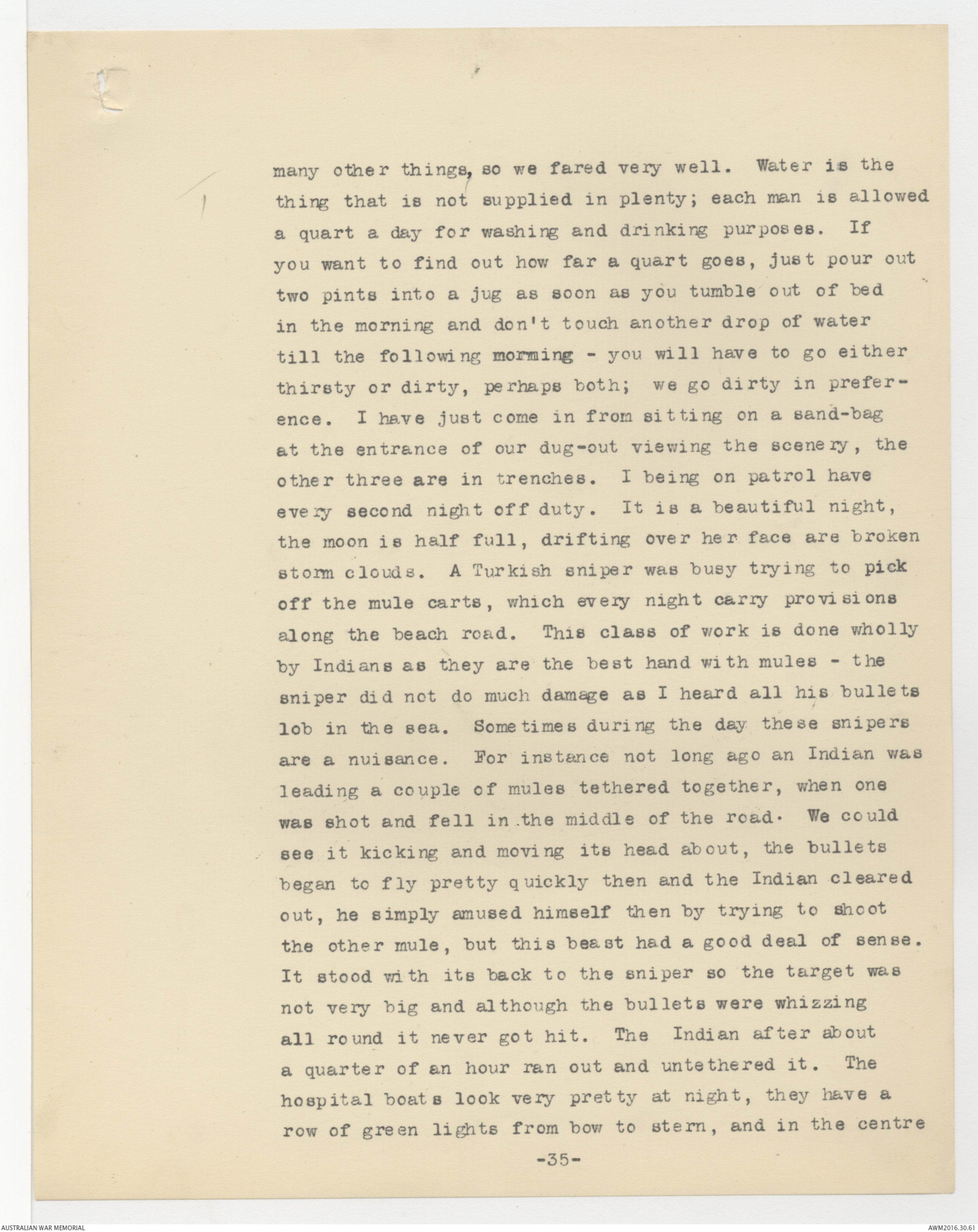
many other things, so we fared very well. Water is the
thing that is not supplied in plenty; each man is allowed
a quart a day for washing and drinking purposes. If
you want to find out how far a quart goes, just pour out
two pints into a jug as soon as you tumble out of bed
in the morning and don't touch another drop of water
till the following morming - you will have to go either
thirsty or dirty, perhaps both; we go dirty in
preference.
I have just come in from sitting on a sand-bag
at the entrance of our dug-out viewing the scenery, the
other three are in trenches. I being on patrol have
every second night off duty. It is a beautiful night,
the moon is half full, drifting over her face are broken
storm clouds. A Turkish sniper was busy trying to pick
off the mule carts, which every night carry provisions
along the beach road. This class of work is done wholly
by Indians as they are the best hand with mules - the
sniper did not do much damage as I heard all his bullets
lob in the sea. Sometimes during the day these snipers
are a nuisance. For instance not long ago an Indian was
leading a couple of mules tethered together, when one
was shot and fell in the middle of the road. We could
see it kicking and moving its head about, the bullets
began to fly pretty quickly then and the Indian cleared
out, he simply amused himself then by trying to shoot
the other mule, but this beast had a good deal of sense.
It stood with its back to the sniper so the target was
not very big and although the bullets were whizzing
all round it never got hit. The Indian after about
a quarter of an hour ran out and untethered it. The
hospital boats look very pretty at night, they have a
row of green lights from bow to stern, and in the centre
-35-
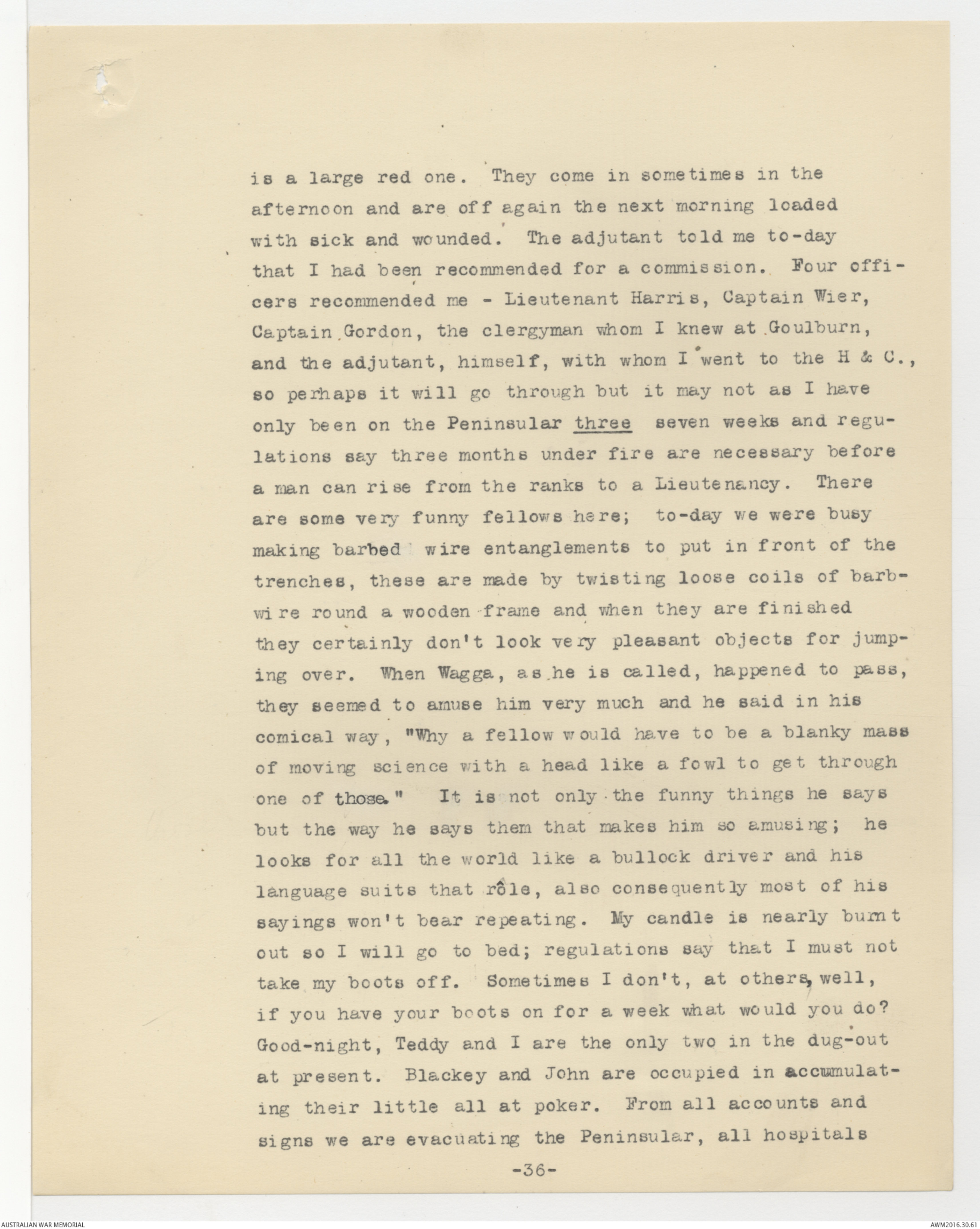
is a large red one. They come in sometimes in the
afternoon and are off again the next morning loaded
with sick and wounded. The adjutant told me to-day
that I had been recommended for a commission. Four officers
recommended me - Lieutenant Harris, Captain Wier,
Captain Gordon, the clergyman whom I knew at Goulburn,
and the adjutant, himself, with whom I went to the H & C.,
so perhaps it will go through but it may not as I have
only been on the Peninsular three seven weeks and regulations
say three months under fire are necessary before
a man can rise from the ranks to a Lieutenancy. There
are some very funny fellows here; to-day we were busy
making barbed wire entanglements to put in front of the
trenches, these are made by twisting loose coils of barbwire
round a wooden frame and when they are finished
they certainly don't look very pleasant objects for jumping
over. When Wagga, as he is called, happened to pass,
they seemed to amuse him very much and he said in his
comical way, "Why a fellow would have to be a blanky mass
of moving science with a head like a fowl to get through
one of those" It is not only the funny things he says
but the way he says them that makes him so amusing; he
looks for all the world like a bullock driver and his
language suits that role, also consequently most of his
sayings won't bear repeating. My candle is nearly burnt
out so I will go to bed; regulations say that I must not
take my boots off. Sometimes I don't, at others, well,
if you have your boots on for a week what would you do?
Good-night, Teddy and I are the only two in the dug-out
at present. Blackey and John are occupied in accumulating
their little all at poker. From all accounts and
signs we are evacuating the Peninsular, all hospitals
-36-
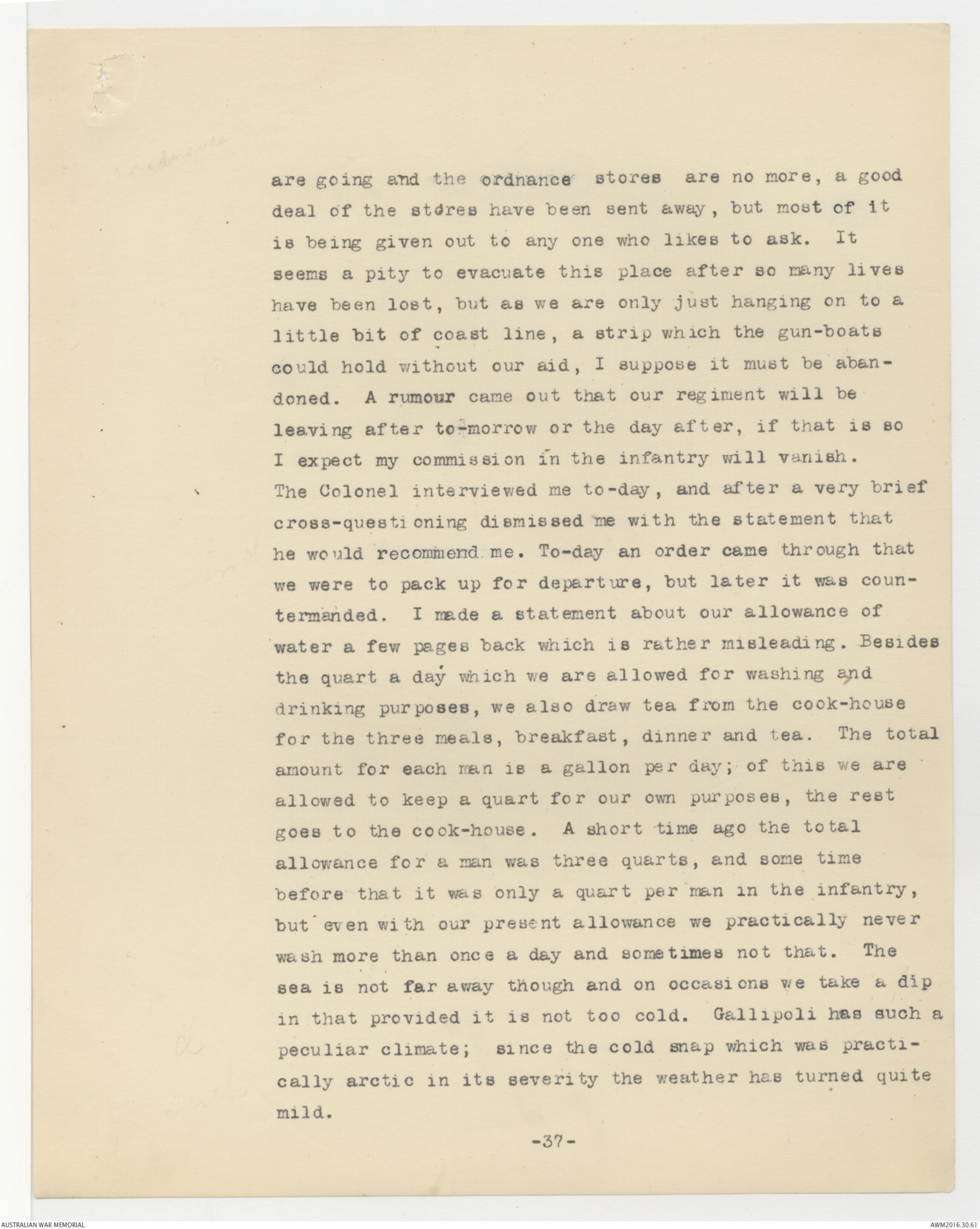
are going and the ordnance stores, are no more, a good
deal of the stores have been sent away, but most of it
is being given out to any one who likes to ask. It
seems a pity to evacuate this place after so many lives
have been lost, but as we are only just hanging on to a
little bit of coast line, a strip which the gun-boats
could hold without our aid, I suppose it must be abandoned.
A rumour came out that our regiment will be
leaving after tomorrow or the day after, if that is so
I expect my commission in the infantry will vanish.
The Colonel interviewed me to-day, and after a very brief
cross-questioning dismissed me with the statement that
he would recommend me. To-day an order came through that
we were to pack up for departure, but later it was countermanded.
I made a statement about our allowance of
water a few pages back which is rather misleading. Besides
the quart a day which we are allowed for washing and
drinking purposes, we also draw tea from the
cook - house
for the three meals, breakfast, dinner and tea. The total
amount for each man is a gallon per day; of this we are
allowed to keep a quart for our own purposes, the rest
goes to the cook-house. A short time ago the total
allowance for a man was three quarts, and some time
before that it was only a quart per man in the infantry,
but even with our present allowance we practically never
wash more than once a day and sometimes not that. The
sea is not far away though and on occasions we take a dip
in that provided it is not too cold. Gallipoli has such a
peculiar climate; since the cold snap which was practically
arctic in its severity the weather has turned quite
mild.
-37-
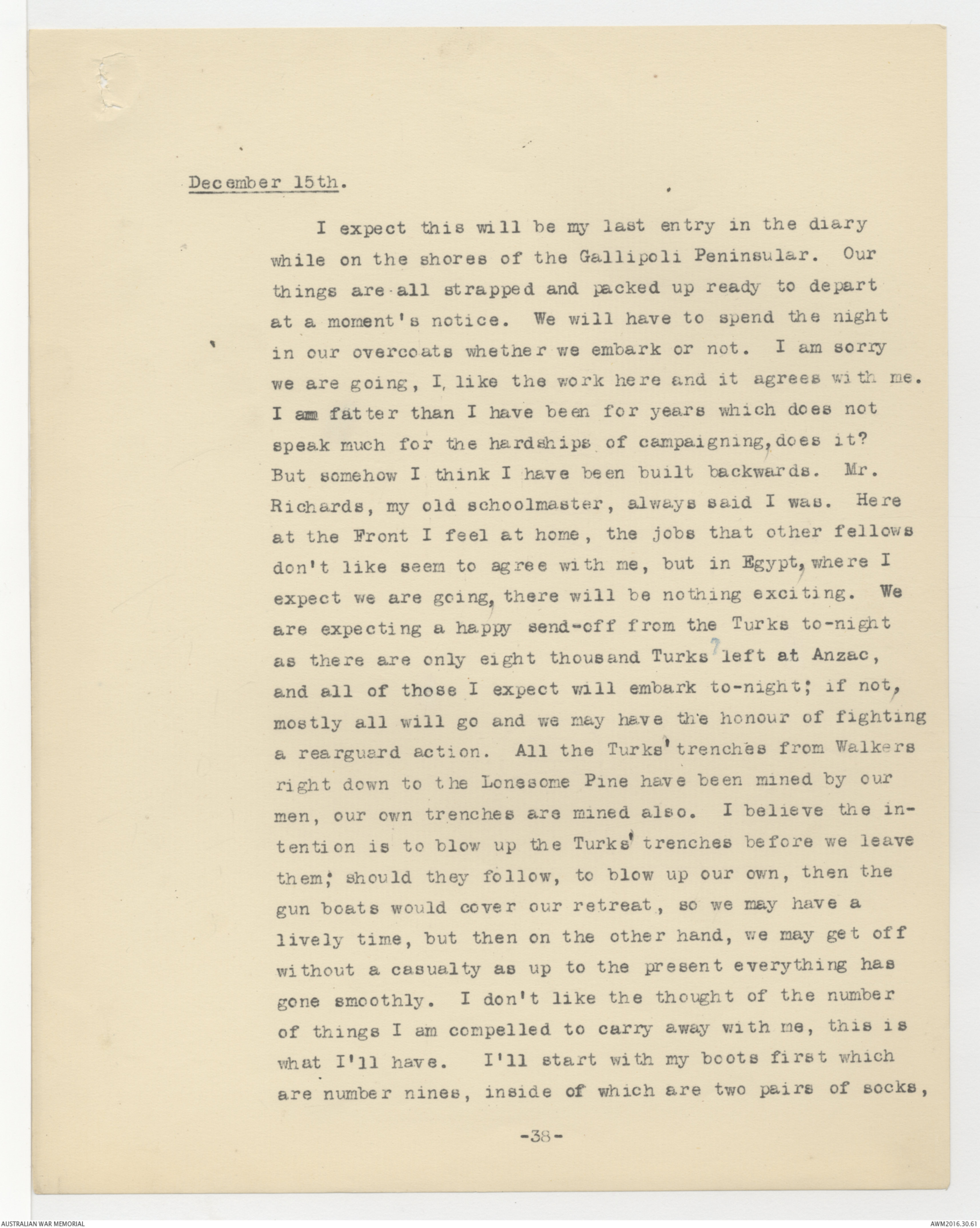
December 15th.
I expect this will be my last entry in the diary
while on the shores of the Gallipoli Peninsular. Our
things are all strapped and packed up ready to depart
at a moment's notice. We will have to spend the night
in our overcoats whether we embark or not. I am sorry
we are going, I like the work here and it agrees with me.
I am fatter than I have been for years which does not
speak much for the hardships of campaigning, does it?
But somehow I think I have been built backwards. Mr.
Richards, my old schoolmaster, always said I was. Here
at the Front I feel at home, the jobs that other fellows
don't like seem to agree with me, but in Egypt, where I
expect we are going, there will be nothing exciting. We
are expecting a happy send-off from the Turks
to-night
as there are only eight thousand Turks left at Anzac,
and all of those I expect will embark to-night; if not,
mostly all will go and we may have the honour of fighting
a rearguard action. All the Turks trenches from Walkers
right down to the Lonesome Pine have been mined by our
men, our own trenches are mined also. I believe the intention
is to blow up the Turks trenches before we leave
them; should they follow, to blow up our own, then the
gun boats would cover our retreat, so we may have a
lively time, but then on the other hand, we may get off
without a casualty as up to the present everything has
gone smoothly. I don't like the thought of the number
of things I am compelled to carry away with me, this is
what I'll have. I'll start with my boots first which
are number nines, inside of which are two pairs of socks,
-38-
then come underpants and trousers, cholera belt, trousers'
belt on which hangs a n automatic pistol and fifty rounds
of ammunition, a camera and field ambulance bandages,
singlet flannel shirt, cardigan jacket, tunic woolly
sheepskin vest, comforter, balaclava cap. overcoat
and
cap: then comes wet equipment and 150 rounds rifle,
two haversacks, one containing two tins bully beef, tin
of herring, biscuits, tin of jam one of milk and some
of cocoa and some soup tablets, the other containing razors
turn-out, tooth brush, towel, etc., water bottle; then
comes pack, which contains three pairs of socks, trousers
and tunic, putties - I am wearing leggings -towel,
singlet, underpants, spare cardigan jacket, photo films,
tobacco, on that comes two blankets, a rug and a waterproof sheet,
and a waterproof cape which I collared on the
beach, Amen. Something to fight a rearguard action on,
isn't it? But I have the pack and blankets tied on
separately so that they can be heaved into the nearest
ditch should the necessity arrive. I forgot to mention
that I have also a bayonet, and entrenching tool, quart
pot and dixy.
December 21st. Lemnos.
Well, we are off the Peninsular at last, but I must
leave the description and accounts of events till I am
in a more restful frame of mind. Just at present there
are eleven of us in a tent, the first tent since we left
Egypt just eight weeks ago. I intended making rather a
big entry but gentle sleep is hovering round, already she
has laid her soft hand upon some of the inmates of the
tent and their quite steady breathing reminds me that
perhaps I had better lay me down.
-39-
December 23rd.
Still Lemnos, but our stay here will be ended very
soon, Last night we embarked upon the HARORAPA, a
New Zealand boat of about twelve thousand tons. There
are over two thousand of us on board, a nice little
haul should we come across a submarine, but I must tell
you of the departure from Gallipoli. Sometime before
we left our squadron was changed from Number 1
subsection
trenches to No 11 subsection which means that instead
of manning the trenches in the gully we shifted to those
on top of the hill. I did not sample those but when on
duty I was on the outpost, a small trench about two
hundred yards in front of the main trenches. That night
of the evacuation the first light-horse had the honour
of leaving the trenches last. For days beforehand
troops had been leaving the Peninsular; one day we would
hear that there were eight thousand all told left to man
the trenches, next day the number would sink still lower
although we never heard the official numbers. The first
thing that really assured us we were going was the burning
of stores, etc. that could not be carted away;
thousands of pounds' worth of eatables and clothing had
to be destroyed, as the facilities for loading were so
poor. There are no harbours, and the rough sea breaks
straight upon the jetties taking all before it,
consequently time could not be given to much surplus material.
A great fire burned for two days before we left illuminating
the whole sky with its lurid light. I never
realised how wasteful war can be till I saw those great
heaps of food burning, with streams of melted bacon fat
running from them. Some of the stores-houses on the beach
-40-
 Leanne mckenna
This transcription item is now locked to you for editing. To release the lock either Save your changes or Cancel.
This lock will be automatically released after 60 minutes of inactivity.