
Typescript copy of diary entries of Percy Wellesley Chapman, 1 July 1915 to 30 June 1916 - Part 3
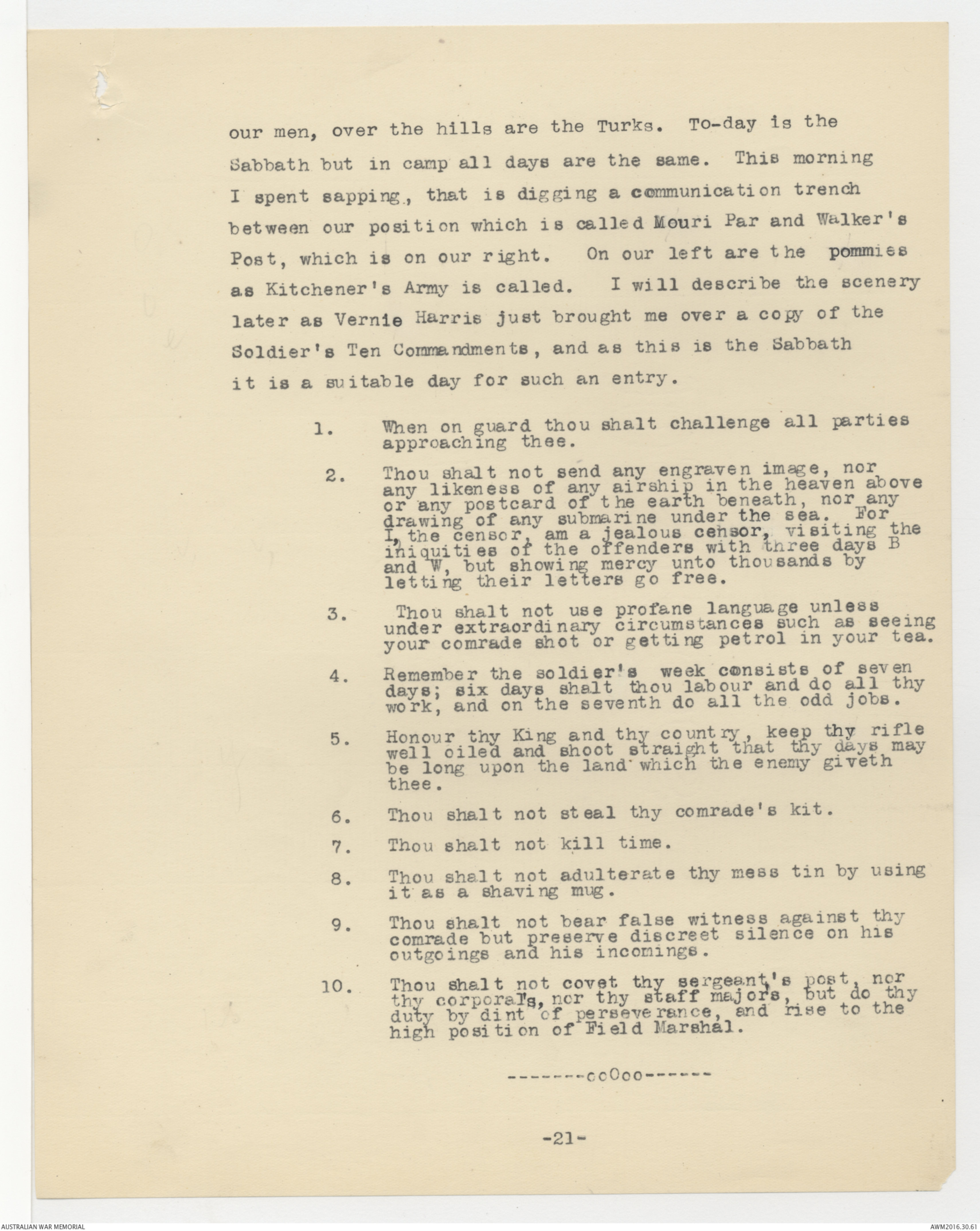
our men, over the hills are the Turks. To-day is the
Sabbath but in camp all days are the same. This morning
I spent sapping, that is digging a communication trench
between our position which is called Mouri Par and Walker's
Post, which is on our right. On our left are the pommies
as Kitchener's Army is called. I will describe the scenery
later as Vernie Harris just brought me over a copy of the
Soldier's Ten Commandments, and as this is the Sabbath
it is a suitable day for such an entry.
1. When on guard thou shalt challenge all parties
approaching thee.
2. Thou shalt not send any engraven image, nor
any likeness of any airship in the heaven above
or any postcard of the earth beneath, nor any
drawing of any submarine under the sea. For
I, the censor, am a jealous censor, visiting the
iniquities of the offenders with three days B
and W, but showing mercy unto thousands by
letting their letters go free.
3. Thou shalt not use profane language unless
under extraordinary circumstances such as seeing
your comrade shot or getting petrol in your tea.
4. Remember the soldier's week consists of seven
days; six days shalt thou labour and do all thy
work, and on the seventh do all the odd jobs.
5. Honour thy King and thy country, keep thy rifle
well oiled and shoot straight that thy days may
be long upon the land which the enemy giveth
thee.
6. Thou shalt not steal thy comrade's kit.
7. Thou shalt not kill time.
8. Thou shalt not adulterate thy mess tin by using
it as a shaving mug.
9. Thou shalt not bear false witness against thy
comrade but preserve discreet silence on his
outgoings and his incomings.
10. Thou shalt not covet thy sergeant's post, nor
thy corporal's, nor thy staff major's, but do thy
duty by dint of perseverance, and rise to the
high position of Field Marshal.
-21-
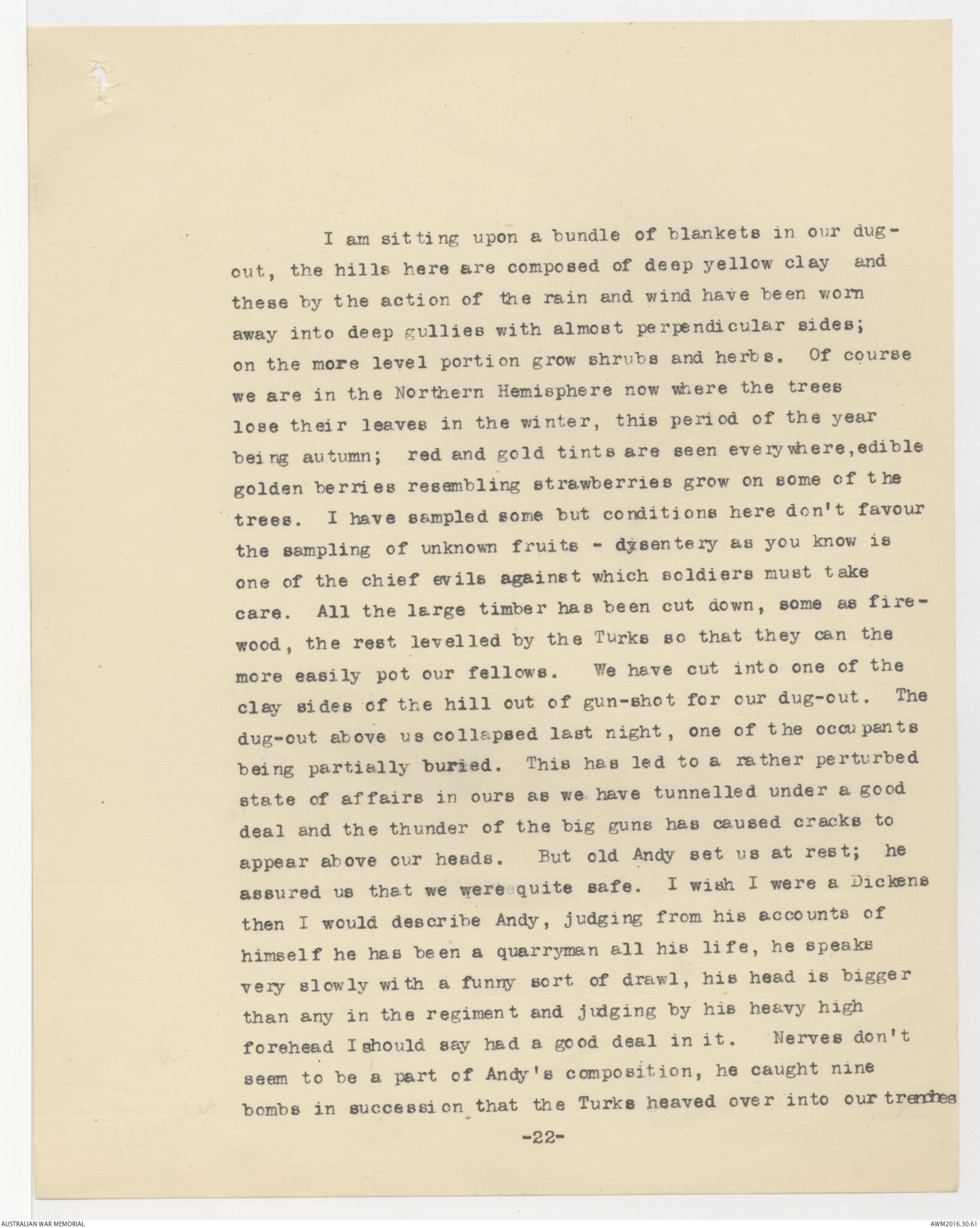
I am sitting upon a bundle of blankets in our dugout,
the hills here are composed of deep yellow clay, and
these by the action of the rain and wind have been worn
away into deep gullies with almost perpendicular sides;
on the more level portion grow shrubs and herbs. Of course
we are in the Northern Hemisphere now where the trees
lose their leaves in the winter, this period of the year
being autumn; red and gold tints are seen everywhere, edible
golden berries resembling strawberries grow on some of the
trees. I have sampled some but conditions here don't favour
the sampling of unknown fruits - dysentery as you know is
one of the chief evils against which soldiers must take
care. All the large timber has been cut down, some as firewood,
the rest levelled by the Turks so that they can the
more easily pot our fellows. We have cut into one of the
clay sides of the hill out of gun-shot for our dug-out. The
dug-out above us collapsed last night, one of the occupants
being partially buried. This has led to a rather perturbed
state of affairs in ours as we have tunnelled under a good
deal and the thunder of the big guns has caused cracks to
appear above our heads. But old Andy set us at rest; he
assured us that we were quite safe. I wish I were a Dickens
then I would describe Andy, judging from his accounts of
himself he has been a quarryman all his life, he speaks
very slowly with a funny sort of drawl, his head is bigger
than any in the regiment and judging by his heavy high
forehead I should say had a good deal in it. Nerves don't
seem to be a part of Andy's composition, he caught nine
bombs in succession that the Turks heaved over into our trenches
-22-
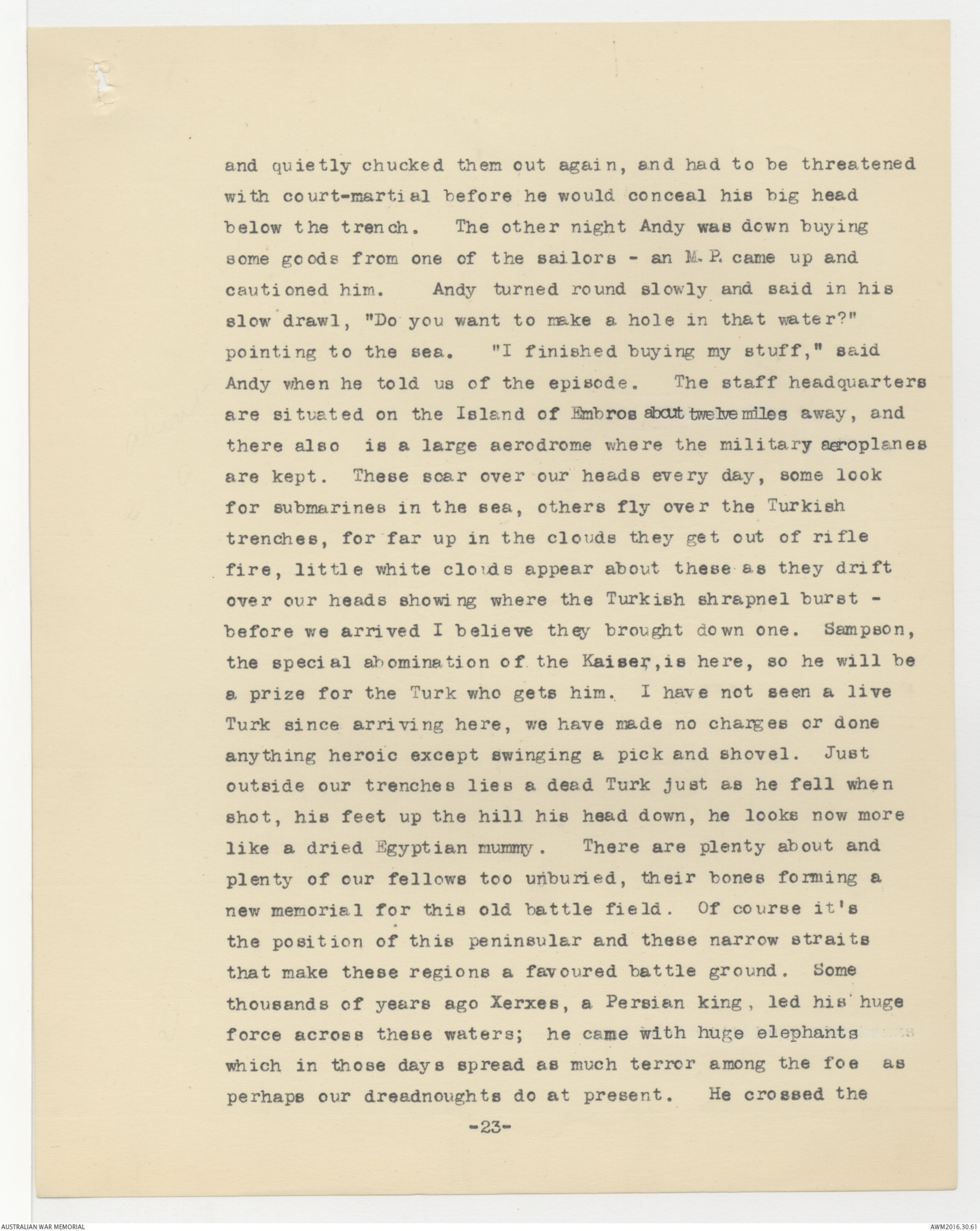
and quietly chucked them out again, and had to be threatened
with court-martial before he would conceal his big head
below the trench. The other night Andy was down buying
some goods from one of the sailors - an M.P. came up and
cautioned him. Andy turned round slowly and said in his
slow drawl, "Do you want to make a hole in that water?"
pointing to the sea. "I finished buying my stuff," said
Andy when he told us of the episode. The staff headquarters
are situated on the Island of Embros about twelve miles away, and
there also is a large aerodrome where the military aeroplanes
are kept. These soar over our heads every day, some look
for submarines in the sea, others fly over the Turkish
trenches, for far up in the clouds they get out of rifle
fire, little white clouds appear about these as they drift
over our heads showing where the Turkish shrapnel burst -
before we arrived I believe they brought down one. Sampson,
the special abomination of the Kaiser, is here, so he will be
a prize for the Turk who gets him. I have not seen a live
Turk since arriving here, we have made no charges or done
anything heroic except swinging a pick and shovel. Just
outside our trenches lies a dead Turk just as he fell when
shot, his feet up the hill his head down, he looks now more
like a dried Egyptian mummy. There are plenty about and
plenty of our fellows too unburied, their bones forming a
new memorial for this old battle field. Of course it's
the position of this peninsular and these narrow straits
that make these regions a favoured battle ground. Some
thousands of years ago Xerxes, a Persian king, led his huge
force across these waters; he came with huge elephants
which in those days spread as much terror among the foe as
perhaps our dreadnoughts do at present. He crossed the
-23-
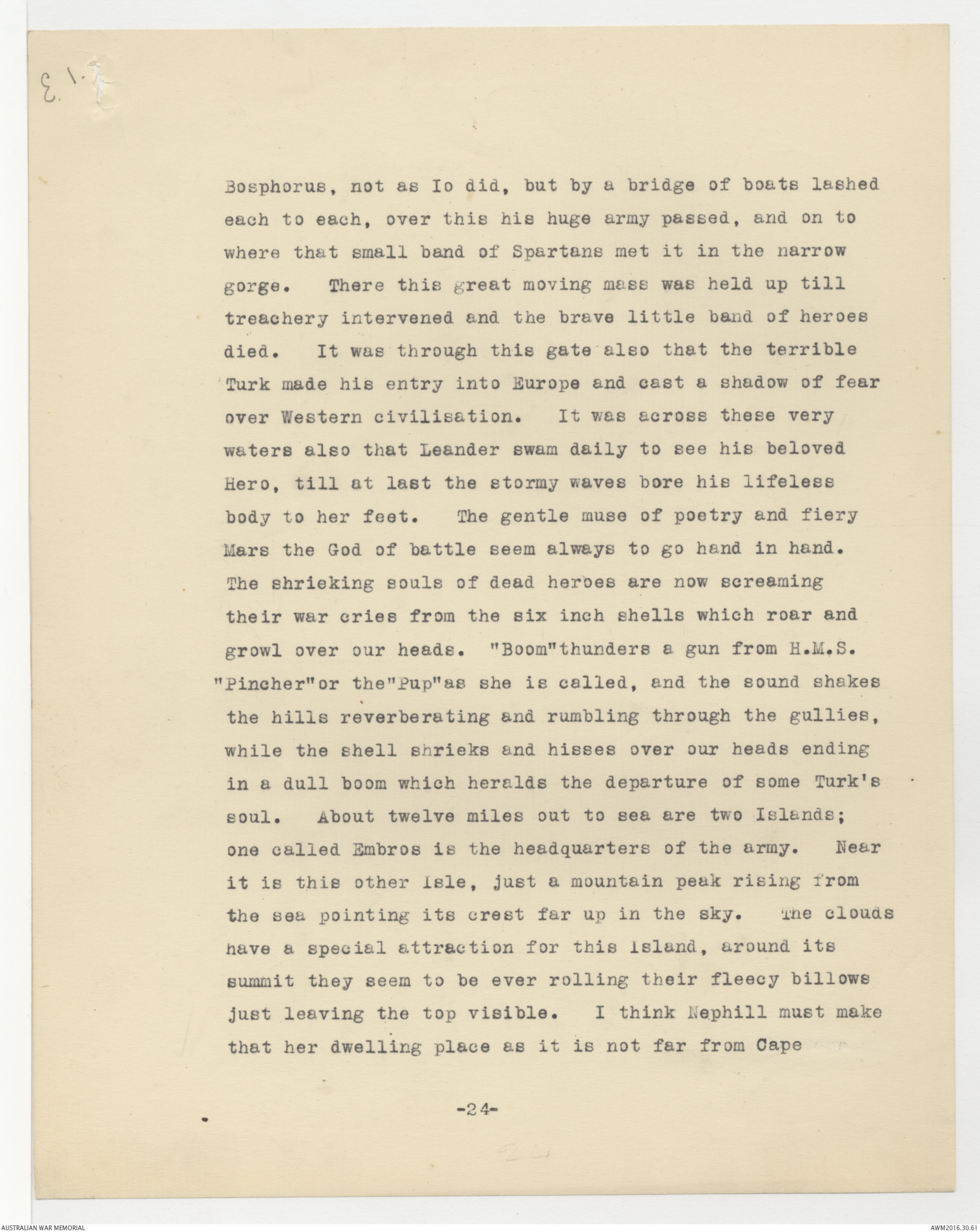
Bosphorus, not as Io did, but by a bridge of boats lashed
each to each, over this his huge army passed, and on to
where that small band of Spartans met it in the narrow
gorge. There this great moving mass was held up till
treachery intervened and the brave little band of heroes
died. It was through this gate also that the terrible
Turk made his entry into Europe and cast a shadow of fear
over Western civilisation. It was across these very
waters also that Leander swam daily to see his beloved
Hero, till at last the stormy waves bore his lifeless
body to her feet. The gentle muse of poetry and fiery
Mars the God of battle seem always to go hand in hand.
The shrieking souls of dead herbes are now screaming
their war cries from the six inch shells which roar and
growl over our heads. "Boom" thunders a gun from H.M.S.
"Pincher" or the "Pup" as she is called, and the sound shakes
the hills reverberating and rumbling through the gullies,
while the shell shrieks and hisses over our heads ending
in a dull boom which heralds the departure of some Turk's
soul. About twelve miles out to sea are two Islands;
one called Embros is the headquarters of the army. Near
it is this other Isle, just a mountain peak rising from
the sea pointing its crest far up in the sky. The clouds
have a special attraction for this Island, around its
summit they seem to be ever rolling their fleecy billows
just leaving the top visible. I think Nephill must make
that her dwelling place as it is not far from Cape
-24-
Helles where her daughter fell into the sea. This is
how Cape Helles and the Hellespont got their names.
I'm afraid this will have to wait as Jack Holland has
just come in with the rations for the day. We live very
well here, bacon is issued every day, rice, jam, treacle,
tinned milk occasionally, sugar, flour or bread, bully
beef and biscuits, and about every third day fresh meat;
currants are issued also. The biscuits are our special
amusement, they're beastly things. Blackey has just
managed to break one in half. Porridge is sometimes
made of them, an empty shell-case comes in very handy for
grinding purposes, it is no use boiling these stone slabs
of nourishment as they will resist the effects of boiling
water for hours. The Turks gave us a little demonstration
last night, Blackey and I were trenching at the time in
the front trenches and were lucky enough to get a good
view of the proceedings. About half-past-eight the rifles
started to crack; there seemed to be a continuous rattle
from Walkers post right up to the lonesome pine. All the
positions here are named. On our left are the Pommies,
our post is called Mouri Par, following on comes Walkers,
a few hundred yards from us just across the gully, then
comes Popes, Quinns, Courteneys, Steels, and lastly the
lonesome pine. But as I have not actually been in a
charge or even helped man the trenches yet, I will leave
my description and impressions till later. Jock and
Blackey are very interested at present over a flea, which
-25-
has up to the present evaded all their attempts at catching.
At last they have him, a regular beauty about five
times the size of an ordinary pulex irritans, this chap
must be a pulex irritantissimus. Now Jock has discovered
another and Blackey drawls out, "Leave 'em alone, now you
have disturbed the whole blanky family." Fleas are
rather plentiful in this camp. Being awake in bed at
night one can feel them indulging in races up and down
one's legs and back. These are the men in our section,
Ted, Eric Blackwell, Jock Holland, and myself. I was
section leader till we arrived here, but as Jock had been
to New Guinea and had seen more service than I, it behoved
me to ask him to accept that responsibility. Blacky is
our chief character; he is rather bushified and very good-natured,
has a pipe in his mouth all day and smokes any
black vile stuff that goes by the name of tobacco. He
expresses ideas which are not favorable to womenfolk.
I will never forget the first time I met him, his legs are
thin and slightly bandy, and inclined to wobble a little
at the knees, not from weakness but just because they are
his and therefore different from the average. When I try
to imagine him in the future I see an old good-natured
face with a bushy black beard and a pair of bandy legs;
these are his main features. The position I seem to see
him in is strolling down George Street with about twenty
open-mouthed youngsters following in his wake, gazing at
the shop-windows. We have to shift quarters this afternoon,
-26-
our present lot of dug-outs are not satisfactory
from a sanitary point of view. Personally, I am very
glad for the shift, as we will be situated upon a terrace
cut out from the side of a hill overlooking the sea, I
always feel cramped and miserable shut away from an
open view; the rest of the section were very pleased
with this posse as it is called, till the roof threatened
a disastrous downpour upon our heads. The last two
nights we have been playing soldiers in reality, doing
patrol work in a deep gully looking for Turks, we creep
gingerly along picking along our steps over stones and
bushes, sitting down every few yards to listen. I will
describe last night's patrol work to give you an idea
what we do. To begin with an order has come out that no
shot is to be fired on the peninsular by our men for
forty-eight hours. The order came out yesterday morning
so all day long our guns were quiet, no shots rang out
from our snipers in answer to the Turks, no machine guns
rattled their death watch tick. Now and then the Turks
would fire but no return being offered their shooting
died down. Yesterday evening just about dusk our trench
partly fell in with the two patrols on the right, before
leaving Captain Wier told us all to be very careful and
vigilant as an attack by the Turks was expected, a
rumour having spread amongst them that we were evacuating.
As it happened our patrol party had the first shift, that
is from about half-past five till midnight. We crept over
the parapet just about dusk into the bed of a stony little
creek which runs up into the gully and then branches out
into two arms. The formation of the gully resembles a
crater somewhat, high clay walls surround it ri sing in
places to about two hundred feet, the only opening being
-27-
where this small watercourse breaks through to the sea;
cutting this water course at right angles are some of
our trenches; cutting this large hollow in half is a
steep ridge tapering down from the Turkish trenches
to the junction of the watercourse. Our usual programme
is to follow the bed of one creek up generally
the right then cut across and examine the left, but as
this was a special night we did otherwise. As soon as
we had got a little distance from our trenches I asked
Sergeant Riley what his plan of procedure was, but before
he could reply I asked might I make a suggestion. He is
a very nice fellow, as game and careful as he can be.
Of course he said yes I could, so this is what I proposed.
Our usual course is either up the bed of the
creek I said, or else through the more or less open bush;
on the left bank now the last few nights have been very
moonlight and in all probability the Turks have noted
this course, and should they intend making an attack the
first thing they will do will be to capture us to stop
the alarm being given. I propose that we cut through
this scrub on the right and take up a high position overlooking
a track which in all probability they would take
should they come down. The idea I have written down was
really the Sergeant's as he had really suggested the
posse on the right, but I will just write down here what
actually took place. My suggestion of cutting through
the scrub was followed, so we crept along the bank till
we came to what appeared to be a track. I gave my rifle
to the Sergeant while I crept up this, accompanied of
course by my little automatic pistol, to see if it
offered a chance of progress, it seemed to have been a
-28-
track once but appeared to have been abandoned to foxes.
I thought we could get along this so came back and
reported. Up we crept all of us all told, the Sergeant
and I in front, the other two about fifteen yards behind,
there was only room of course for one abreast; sometimes
we'd push through on our hands and knees, at others
just force through the thick wild holly and privet.
We had not got far before it began to get very dark, the
moon did not come up till nine o'clock and as it was
cloudy the darkness seemed to settle over everything and
take possession. Turning a sharp bend in this track
a rather pungent odour made its presence known, something
like an old dead sheep decayed just enough to let the
ribs appear. But no sheep had died here - lying along
the track all facing the same way were six dead Turks.
Their bones showing white in the fast fading light, their
uniforms tattered bits of rag about them. Here the track
seemed to end, and as it was too dark to proceed further
we had to crouch down amidst this ghastly company. Here
we had to sit for about two hours till the faint rays
of the coming moon helped us on our way. It is wonderful
how many noises are in the undergrowth at night, various
little night creatures were scratching among the dead
leaves; one took a visit to the dead Turks and took
sudden fright at my boot, at another time we heard something
coming up from the creek; swish, swish we heard
in the undergrowth just like a man's thighs brushing
against the leaves. My safety catch went forward and I
slipped the cut-off out of my rifle ready to bail up
Mister Turk should it happen to be he, but it must only
have been a fox jumping through the leaves. As soon as
-29-
the light began to show we pushed forward and arrived
at last at the Turkish outpost. We skirted this and wound
our way down the gully again. We did not go far down
however, we had satisfied ourselves that no Turks were
mobilising for an attack, so turned sharp to the right
crossing the ridge rather high up. By this time the
moon was well up in the sky, fleecy white clouds were
drifting across but peace was not over all, towards the
north flashes would appear in the sky looking from where
we were seated like sheet lighting. Then would follow
a great peal of thunder - boom! boom! it would sound
rumbling over the sea and up the gullies. Our battleships
were bombarding the Narrows. We investigated the
left hand gully, creeping up little watercourses that led
up towards our trenches looking for Turks that might
have crept down in the darkness and concealed themselves
for the purpose of throwing bombs. But Abdul kept very
serenely to his trenches last night and we returned to
ours just on the tick of twelve. Captain Wier seemed
rather pleased to see us. Lieutenant Harris told me
later that the Captain was very anxious lest we should be
cut off last night. I got a good souvenir the other day,
in fact it was on Mother's birthday. I was doing fatigue
work fixing up a wall near the cook house (squadron cooking
is starting in a few days) when something plucked
at my sleeve and buried itself with a splutter in the
clay in front of me. The something seemed to be a bullet
which passed through the right sleeve of my shirt. I
dug the bullet out, I was looking for a good one to bring
back and now I have it.
-30-
 Transcriber 206
This transcription item is now locked to you for editing. To release the lock either Save your changes or Cancel.
This lock will be automatically released after 60 minutes of inactivity.